












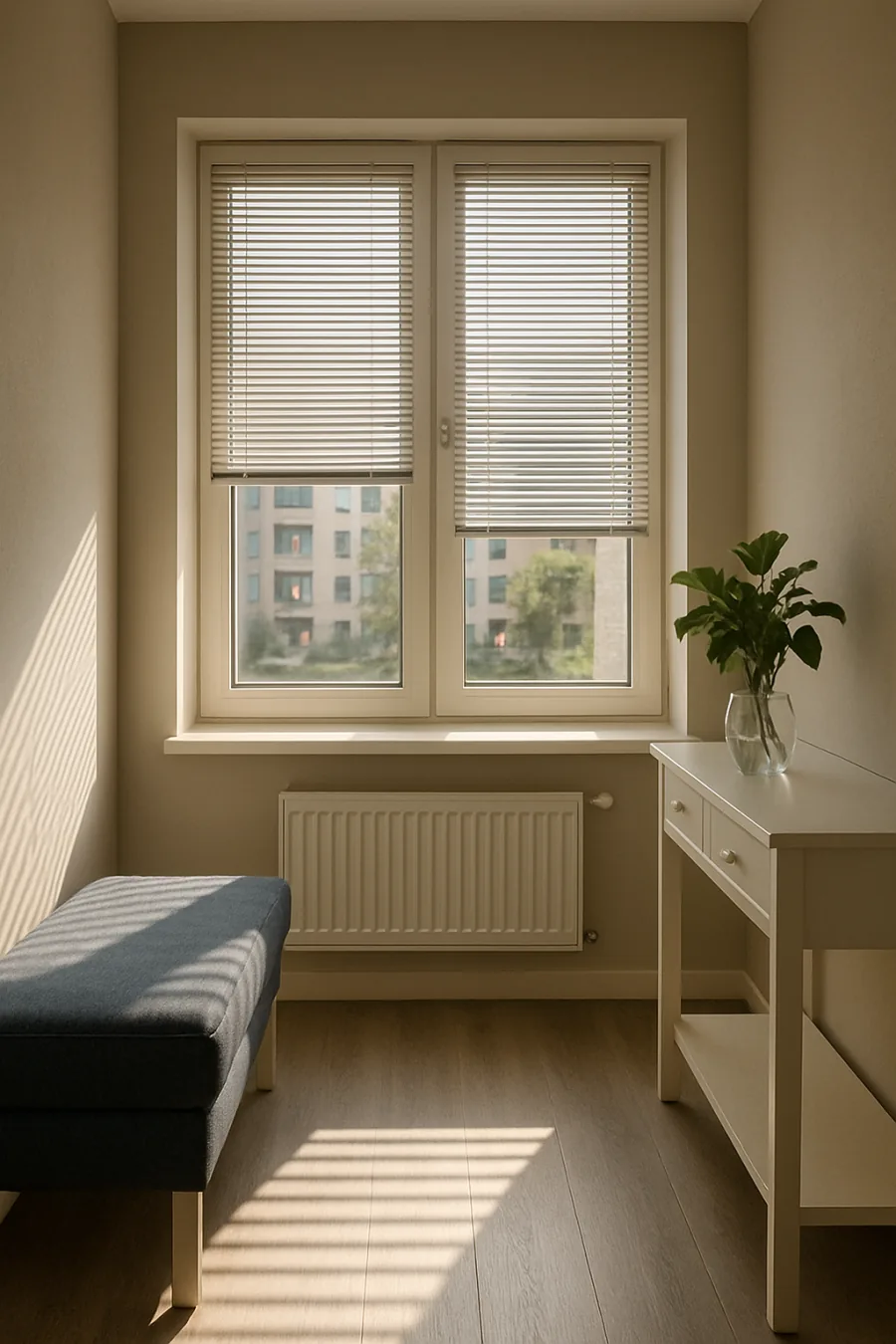











We make aluminium blinds in Almaty in our own workshop to your measurements: a 16 mm slat for narrow windows and vents, a 25 mm slat as the standard for a regular window. Price from 4,200 ₸/m², manufacturing in 3–5 days. The metal is not afraid of moisture or heat, can be washed all over and lasts longer than plastic.
How aluminium blinds differ from PVC, steel and wood
Aluminium blinds are metal slats that are not afraid of moisture or steam and hold their colour for a long time. PVC (plastic blinds) fades and yellows in the sun, so plastic is not suitable for a kitchen or near radiators. There is a difference between metals too: steel is heavier and stiffer, aluminium is lighter — hence the different mounting. Wooden blinds suit living rooms, but next to a sink and a hob wood loses to metal.
A quick look at each material
Aluminium is a metal. The slat is light, so it can be fitted to a plastic window without drilling the frame, and in the dusty, dry climate of Almaty metal easily handles regular washing. PVC is plastic. It is cheaper and also washable, but its strengths end where the heat begins: on the sunny side plastic goes cloudy and loses its looks.
Wooden blinds are an option for the bedroom and living room. A warm look, but moisture and steam are a no-go for them. Steel blinds are another metal: stronger and heavier than aluminium, but they also need more serious mounting. A light aluminium blind is fine with brackets in the glazing bead or mounting tape; steel cannot be hung that way.
Comparison table by properties
| Property | Aluminium | PVC | Wood | Steel |
|---|---|---|---|---|
| Moisture and steam | not afraid of | not afraid of | a no-go | not afraid of |
| Heating in the sun | heats up, light and mirrored colours reflect heat | heats up, deforms | heats up, dries out | heats up more |
| Fading | holds its colour for years | fades and yellows | darkens | holds colour |
| Noise in a draught | rattles, fixed with a bottom hold-down | rattles less | almost silent | rattles |
| Repairability | slats are replaced one by one | slats are replaced one by one | difficult | slats are replaced one by one |
| Care | comes off and is washed whole | washable | dry dusting only | washable |
In the kitchen next to the stove and in the bathroom, aluminium wins out of the four materials: it handles steam and splashes easily, and the blind comes off and is rinsed under the tap whole. Plastic withstands both moisture and grease, but the sun lets it down — on windows that get direct heat, PVC yellows. If you are choosing between them, PVC or aluminium blinds, for a sunny kitchen the answer is metal.
Aluminium is not afraid of moisture or steam and holds its colour for a long time, while PVC fades and yellows in the sun and is not suitable for a kitchen or radiators.
Slat width: 16 mm, 25 mm and why we don’t fit 50 mm
For plastic windows we fit slats in two widths: 16 mm and 25 mm. A 16 mm slat, 0.18 mm thick, suits narrow windows and vents; a 25 mm slat, 0.21 mm thick, is fitted by default for a standard window. The difference between them is not in light blocking — that is minor — but in how rigid the blind is and how much space the stack takes up at the top.
When 16 mm, and when 25 mm
A 16 mm slat is chosen where the sash is often tilted open for ventilation and where a compact stack at the top matters: narrow windows, vents, small sashes in the kitchen and bathroom. The stacked slats take up less height, and the blind does not get in the way of the handle and hardware.
An ordinary window in a room is a 25 mm slat. Why? It is more rigid, sags less when the sash is open and holds the angle you set: you tilt the slats to the angle you want and they stay there instead of drooping by evening. In terms of light blocking the difference between 16 and 25 mm is small, so choose between them by window size and by how you use the sash, not by how much they darken the room.
Wide openings and glazing
The wider the blind, the greater the load on the slat along its whole length. On panoramic glazing and wide openings sagging shows up most: a thin slat over a long span bends, the tilt mechanism stops holding the angle, and the blind starts swaying in a draught. That is why for wide windows we take the most rigid slat we have — 25 mm — and split the opening into several blinds rather than stretching one.
About the 50 mm slat, let’s be straight: it is not in our price list. We do not make it, we do not quote a price or lead time for it, and we do not advise looking for it: it is not needed for a standard window in a flat, and for a wide opening we work out the number of blinds from 25 mm.
A 16 mm slat is thinner and suits narrow windows and vents; a 25 mm slat is more rigid, sags less and is therefore fitted by default for a standard window.
Slat finishes: matt, gloss, perforated, mirrored, wood-effect
The colour and texture of an aluminium slat are set by powder enamel. It comes matt, gloss, with a satin emboss and metallic, and we match the shade by RAL — that is, by the standard catalogue, not “by eye” from a photo on the internet. For us this is also a practical point: metal heats up in the sun, so the finish affects how much heat goes back behind the glass. Let’s go through the options we fit most often.
- Matt enamel. The basic choice. It gives no glare and looks calm both in the kitchen and in the bedroom. On colour — white, beige and grey slats we price at the same rate, dark ones are a little more expensive.
- Gloss enamel. The same metal, a different surface: smooth, reflecting light. In studies and kitchens gloss can throw a glare onto the table, so there we more often recommend matt.
- Satin emboss. A surface with a fine pattern, warm in appearance. If you don’t want a cold metallic sheen, take this one.
- Metallic. A finish with a sheen. We fit it rarely, at the client’s request — it’s a matter of taste, but in an interior with metal details it looks right.
Perforation and mirror
Perforated slats are chosen for offices and kitchens. Why? With the blinds closed they let through diffused light and air — the room does not turn into a dark box, and the sun does not beat straight in. A mirrored slat works differently: it reflects more solar heat back through the glass than any other slat, so it is chosen for windows with a high sun load. Both options cost more than the basic matt slat and take longer to manufacture. We do not add perforation or a mirror finish “for looks” — only if the task is genuinely solved.
Wood-effect and light tones
Wood-effect aluminium blinds do exist, and they are made not from wood but from metal with an enamel that imitates wood grain. This option is chosen when you want a warm look in a living room but with all the properties of metal kept — moisture resistance and easy washing. White slats solve the opposite task: they visually dissolve against a light window reveal and recede into the background, and a light finish also heats up less. We usually ask the client one thing: if the room is lived in and you want a warm texture — we look at wood-effect; if it’s a bathroom or kitchen and you need practicality — we take white or light matt. We match the exact shade by RAL at the measurement, bring samples with us and hold them against the window.
The finish is set by powder enamel — matt, gloss, with a satin emboss or metallic; we match the colour by RAL.
Horizontal or vertical: where each type of aluminium fits
Horizontal aluminium blinds are the main type for windows; vertical ones are chosen for premises with fire-safety and sanitary requirements. The difference is not in the material but in the geometry of the blind and in the task the room has to meet.
Horizontal — the base for windows
For an ordinary window in a flat or study we fit horizontal aluminium blinds. The slats lie across the glass, the blind takes up little space at the top and does not stop the sash tilting open. Horizontal aluminium blinds are easy to care for: take them down, wash them, hang them back.
They are fitted in kitchens, bathrooms, on balconies, on office windows. They also suit aluminium windows and glazing — precisely because they are mounted without drilling the frame, on brackets into the glazing bead or on mounting tape. The window manufacturer’s warranty is kept.
And if the window is narrow, with a sash that tilts open often? Then a 16 mm slat — a compact stack at the top, nothing gets in the way.
Vertical blinds and aluminium windows
Vertical aluminium blinds are used where sun protection is subject to fire-safety and sanitary requirements. The slats hang along the window, the blind gathers to the side, and the material itself does not support combustion and is easy to wash — this is what determines where it is used: industrial premises, medical and food facilities, corridors and lobbies of administrative buildings.
But there is a nuance. Vertical aluminium blinds are a heavy thing, and you cannot hang them on a sash — they are fixed to the ceiling or to the wall above the opening. For aluminium windows, glazing and office facades we more often fit horizontal ones anyway: the blind is light, it holds without drilling the frame, and we don’t touch the facade.
We do not quote a price for vertical aluminium blinds: this item is not in our price list, so there is nothing to calculate. If you see a figure somewhere, ask what exactly it is for.
In commercial premises with panoramic glazing the choice starts from a calculation: both the rigidity of the slat and how the blind will behave over a wide opening matter here.
Horizontal aluminium blinds are the main type for windows; vertical ones are chosen for premises with fire-safety and sanitary requirements; both are mounted without drilling the frame, and only horizontal ones are fitted on a sash.
Heat, noise and fading: what actually happens to aluminium in the sun and in a draught
Metal heats up in the sun — that is normal. But light and mirrored slats reflect solar heat back through the glass, so the windowsill and the air by the window stay cooler than with a dark fabric. There is a second factor too: dust in Almaty settles on slats quickly, and they have to be wiped often, so Jalusso advises looking not only at the appearance but also at how the finish is maintained.
Heat and fading
A dark slat absorbs heat and gives it off into the room, a light one reflects it back through the glass. In this sense a mirrored slat is the most effective. As for fading, things are calmer than they seem: aluminium blinds hold their colour for a long time, and noticeable fading over years of use is usually not an issue. We do not promise that the paint will never change — on the south side, where the sun is up almost all day, the colour does drift a little more noticeably over time. But compared with PVC, which yellows in the sun, the difference is fundamental.
For the Almaty climate two qualities of the finish matter: resistance to temperature swings in winter and resistance to dust in summer. Powder enamel takes regular wiping with a damp cloth without a problem, and holds its colour for years.
Noise and glare in the office
The clatter of slats in a draught is the only real complaint we hear about this material. The solution is simple: bottom fixing. It stops the clatter and keeps the blind in place when a window is open or an extractor fan pulls air through the kitchen. We install it at the customer's request, and it noticeably changes how the blinds feel.
In an office, the main problem is not noise but glare on monitors. Aluminium blinds have an advantage here: the slat turns and cuts off direct light without completely blocking the view from the window. Perforated slats are chosen precisely for this — with the blinds closed, light passes through softly and does not create sharp stripes on the screen. And what wears out first? The mechanism: the cord or the chain. The blind and slats noticeably outlast the mechanics, and replacing a single slat is inexpensive.
Metal does heat up, but not the way you might think: it is the surface that heats up, not the air in the room, if the slat is light-coloured and turned to reflect the heat.
Drill-free mounting: how to install blinds on a sash and on aluminium windows
We do not drill into the frame. The blind of aluminium blinds is light, so it is held by three types of drill-free mounting — glazing-bead brackets, spring clips and mounting tape — and the window manufacturer's warranty remains valid. For aluminium windows and glazed façades this is the most common option: both a plastic window and an aluminium profile allow brackets to be fitted into the glazing bead or mounting tape to be used. We do not install a wooden blind with this type of mounting — it is heavier.
Three drill-free methods
- Glazing-bead brackets. The bar is inserted into the groove of the glazing bead along the edge of the sash, without a single hole in the frame. Glazing-bead brackets preserve the window manufacturer's warranty — that is their main advantage.
- Spring clips. The blind is secured with clamps and removed in one motion: handy when the blinds need to be taken down for washing.
- Mounting tape. Adhered to a prepared surface; used when the glazing bead is narrow or its shape does not allow the bar to be inserted.
Sash, ventilation, attic and sheer curtains
So that the sash can open for ventilation, the blind is positioned along the height of the sash and with a gap to the neighbouring frame. On narrow sashes that are often tilted open, we install a 16 mm slat — it has a compact top stack, and when the sash is tilted it does not catch on the frame.
Aluminium blinds are mounted on aluminium windows, glazed façades and office fronts in the same way as on a plastic window: both profiles accept brackets or tape. The only difference is the geometry of the groove, so the measurer checks it on site.
Sloped and roof windows are a non-standard shape, and we manufacture such products longer than the usual time.
Sheer curtains and curtains on the same window as blinds can be combined: the rail is mounted on the wall or ceiling, while the blinds stay on the sash and do not interfere with the curtain fabric. This way both sun protections work independently.
Glazing-bead brackets preserve the window manufacturer's warranty, while mounting tape and spring clips give the same result where the groove is not suitable.
Controls: wand, cord or chain
A wand is convenient on tall windows, a cord and chain — on standard ones. We select the control to match the window height and how often you actually touch the slats. Ask for custom aluminium blinds for a specific sash — then the control will not need to be redone.
The difference is simple. A wand is a rigid rotating handle that holds the slat angle without sagging: on a window taller than standard you do not have to reach up for it. A cord folds into a compact knot and takes up almost no space by the glass. A chain does not stretch over time and does not tangle the way a cord does.
People usually choose like this. In the kitchen and on the balcony, a chain is more often chosen — it easily withstands humid air and frequent handling. On a work window by a desk, a wand is installed: turn the handle to the right angle — and the light is softer, no glare falls on the monitor. In a child's room we recommend a cord: it is easier to take the blind down entirely, and a short cord is less interesting to a child than a long hanging chain.
Moreover, the control is part of the mechanism, not a separate part. What wears out first? The cord: it frays at the bend, and then we simply replace it on a visit. The chain and wand last noticeably longer, so the 3-year warranty on the mechanism covers them too.
Installation costs 4,500 ₸ per item; for orders from 150,000 ₸ we install free of charge. Measurement is free: the measurer arrives with samples, shows how the wand moves and how the chain folds, and calculates the cost on site — it is easier to see on the window what is more convenient in everyday use.
The control is chosen to match the window height and how often it is used: a wand is convenient on tall windows, a cord and chain — on standard ones.
Care in dusty Almaty: how to wash and how to replace a single slat
Caring for aluminium blinds in Almaty comes down to two things: regular washing of the slats and replacing a single slat if it gets bent. The dusty climate of Almaty requires frequent cleaning, so Jalusso slats are designed to be easy to wash.
Care checklist
- Close the slats into the blind and remove it from the brackets — drill-free mounting allows the blind to be removed without tools.
- Wash the whole blind under the tap with warm water.
- Go over the slats with a soft sponge or cloth without abrasives.
- Let the water drain and hang the blind back in place.
- Close and open the slats with the standard wand or cord — this way the mechanism lasts longer.
In summer in Almaty there is more dust than in spring — windows on the ground floor and facing the street collect it faster. A kitchen blind has to be washed more often: steam and grease settle on the slats, and one wash a month keeps them in order. In living rooms, washing once a season is enough, and in case of heavy dust — more often. You can also wash aluminium blinds without taking them down — wipe the slats with a damp cloth in place, but the whole blind under the tap comes out noticeably cleaner. Once a year it is worth calling a technician: they will tighten the mechanism and replace the cord or chain if they have stretched.
Replacing a single slat
A bent slat is no reason to replace the whole blind. With aluminium blinds the slats are removable, and we replace only the damaged one. A thin slat is indeed easy to bend on impact, and it cannot be straightened back evenly — the metal loses its shape. So we bring the required slat and install it on site. In terms of money this is cheaper than replacing the item, and in terms of time — faster than waiting for a new order. We also come after the warranty period: to tighten, adjust, replace the cord or chain.
The blind of aluminium blinds can be removed and washed entirely under the tap, and a bent slat is replaced one at a time — we bring it and install it on site.
Balcony, kitchen, bathroom and panoramic glazing: a breakdown by room
Aluminium blinds for a balcony in Almaty are a good fit, and this is one of the most common places for installation. A balcony tests the product on three points at once: the temperature difference between day and night, draughts from a slightly open sash, and dust that drifts in from the street in dry heat. Metal passes this test calmly, but the mounting and the mechanism do not, if they are assembled poorly. That is why for a balcony Jalusso always fits the blind to the size of the sash, not “by eye”.
Next — by room, because the requirements differ.
Kitchen and bathroom. Aluminium blinds are not afraid of moisture and steam, so next to the stove and in the bathroom they are more practical than plastic: the blind is removed and washed whole under the tap, along with grease film and splashes from the sink. In the kitchen, people more often choose a perforated slat — with the blinds closed, diffused light and air pass through it, and the area above the worktop does not get dark.
Balcony. Here the slat is 25 mm: it is stiffer, flutters less when the sash is open and holds its tilt angle when the blind is in the wind. The temperature difference on a balcony tests the quality of the mounting and the mechanism — and this is a reason not to save on hardware, otherwise after a season the blind will start to warp.
Panoramic glazing. For a wide blind, a rigid slat matters, otherwise it sags. We quote such projects separately: sections, the number of mounting points and the tilt of the slats depending on which way the windows face — south and west in Almaty get noticeably hotter.
Suburbs. Measurement and delivery within the city are free. We also travel to Kaskelen, Talgar, Issyk and Kapshagay; the cost of the visit depends on the distance and is quoted before the visit, not after the fact.
PVC windows on a balcony and in rooms have sashes of different widths, and this affects the choice of slat: narrow and frequently tilted sashes take 16 mm, a standard window takes 25 mm.
A typical example: a kitchen window with a vent. On the sash itself we fit 16 mm — the slat packs compactly on top and does not interfere with tilting; the fixed part takes 25 mm. We mount both blinds without drilling the frame, using brackets into the glazing bead, and the window manufacturer’s warranty stays valid. Steam from the stove does not harm such a blind.
On a balcony, aluminium handles the temperature difference and draughts; in the kitchen and bathroom it is not afraid of moisture and steam; and on panoramic glazing, a rigid slat is what solves the problem.
How much aluminium blinds for PVC windows cost and what the price is made up of
Aluminium blinds for PVC windows cost from 4,200 ₸ per square metre. This figure includes a product made from a 16 mm slat — the one used for narrow sashes and vents. From there the price rises for three reasons: slat width, coating and mounting method.
| Slat | Where we install | Price from, ₸/m² | Manufacturing |
|---|---|---|---|
| 16 mm | narrow windows, vents | 4,200 | 3–5 days |
| 25 mm | standard for a window | 4,500 | 3–5 days |
| perforated | light passes through more softly | 5,400 | 5–7 days |
| mirrored | maximum reflection | 5,900 | 5–7 days |
What makes up the price
First — the slat itself: metal is more expensive than plastic, so within the same group of horizontal blinds, aluminium costs more than PVC, and that is normal. Second — colour. White, beige and grey are calculated with a coefficient of 1.0. A dark shade — 1.04. Third — mounting. On the frame it has a coefficient of 1.0, on the wall — 1.02, without drilling — 1.1. And lastly — installation. It costs 4,500 ₸ per product. For orders from 150,000 ₸ we do not charge for it at all.
Custom aluminium blinds are calculated like this: the window area is multiplied by the price of the chosen slat, coefficients for colour and mounting are applied to the result, then installation is added if the order did not reach the threshold. Measurement and consultation are always free: the measurer arrives with samples and calculates the cost on the spot, in front of you.
An example calculation and the suburbs
Let’s take an average kitchen window of two square metres, a 25 mm slat, white colour, mounting without drilling. Two metres at 4,500 ₸ is 9,000 ₸, the coefficient of 1.1 for mounting gives about 9,900 ₸, plus installation of 4,500 ₸ per product. The total is roughly 14,400 ₸ for a finished window with installation.
We travel to Kaskelen, Talgar, Issyk and Kapshagay. We quote the cost of the visit in advance: it is calculated by mileage, and you know it before the measurer sets off to you. That is noticeably calmer than finding out the price once they are already there.
The price of aluminium blinds for PVC windows is made up of area, slat width, colour, mounting and installation — and each of these components is visible in the quote before you order.
How we work: measurement, workshop, installation, warranty
We manufacture aluminium blinds in Almaty in our own workshop and install them to measure. We do not keep ready-made products in stock — every blind is made for a specific window, so the price is made up of the slat, colour, mounting and installation for your particular opening, not an average figure per square metre.
Here is what the order journey looks like, from the first message to the signed acceptance report.
- Measurement. You message us on WhatsApp, and a measurer comes to you — with samples of slats and coatings. The measurement includes a visit with samples and a cost calculation on the spot: you immediately see what a 16 or 25 mm slat looks like and understand the final amount. Measurement and consultation are free, and delivery within the city is free too.
- Workshop. Then the order goes into production. We make 16 and 25 mm slats in 3–5 days, perforated and mirrored ones in 5–7 days. If the window is a non-standard shape, it takes longer — our measurer Kirill handles such orders.
- Installation. We install without drilling the frame: brackets into the glazing bead, spring clips or mounting tape. Installation costs 4,500 ₸ per product. For orders from 150,000 ₸ installation is free — on projects with several windows this amount adds up on its own.
- Warranty. We give 3 years on the mechanism and 1 year on installation from the date the acceptance report is signed. On aluminium blinds we fix a warranty fault free of charge — 5 working days are allowed for this. Once the warranty period has expired, we still come out to you — to straighten the slats, adjust the mechanism, replace the cord or chain.
What the warranty does not cover — mechanical damage, re-installation on your own, water and natural fading. If a slat is bent, it does not need to be replaced together with the whole blind: a bent slat is replaced one by one, and we bring it to you on site.
Our measurers also travel to the suburban area — Kaskelen, Talgar, Issyk and Kapshagay. The cost of the visit depends on the distance, and we tell you it before the visit, so you can decide with your eyes open. And within the city, neither measurement nor delivery limits you in any way.
Measurement and consultation are free, the measurer arrives with samples and calculates the cost on the spot, and the warranty is 3 years on the mechanism and 1 year on installation from the date the acceptance report is signed.
A real-life example: a kitchen window with a vent
Next to the stove, aluminium is more practical: it is not afraid of steam and can be washed whole, while plastic behaves worse under kitchen grease and hot air. This is a typical situation that we discuss at measurements more often than any other.
A kitchen window usually consists of two parts. A fixed sash above the worktop — the one directly above the stove. And a narrow tilt sash with a vent on the side, which is opened for ventilation. Slat widths here are chosen per part: the large sash takes 25 mm, the narrow tilt sash takes 16 mm. On a wide blind, a 16 mm slat flutters more, while on a small sash a twenty-five-millimetre slat looks bulky, and a compact stack on top matters more.
How do we reason further? People pull the sash with the vent every day, so we choose mounting without drilling, into the glazing bead: we do not touch the frame, and the window manufacturer’s warranty stays valid. The blind above the stove is removed in a couple of seconds — that is the main argument in favour of metal. Steam, grease film and splashes are washed off under the tap together with the blind, whereas plastic slats turn yellow after hot steam and lose their look.
A separate note about the stove. An open flame next to the slats is not the best idea, so we keep the bottom edge of the blind above the cooking zone. Nothing beyond that is required.
For the kitchen and bathroom, aluminium blinds suit better than other materials: metal handles moisture and steam, and the blind can be taken down and washed whole.
FAQ
We've gathered the questions we get most often on WhatsApp before the measurement. Short and to the point.
Do you have aluminium blinds in wood-look and white?
Yes, we make both. The colour and texture come from powder enamel: matte, glossy, with a satin-like embossing or metallic, and we match the shade by RAL. The wood-look finish is chosen when you want a warm appearance but need the durability of metal. White slats are the most common choice for the kitchen and bright rooms: they heat up less in the sun. We bring samples to the measurement so you can see the colour at your own window, not from a picture.
Are aluminium blinds suitable for a balcony?
They are, and the balcony is one of the most common places we install them. Aluminium handles the temperature difference between day and night and draughts. The blind can be taken down and washed whole, which matters on a balcony: there is more dust there than in a room.
How do you fit blinds on a plastic window without drilling?
We don't drill the frame. The blind is light, so it holds on brackets in the glazing bead or on mounting tape, and there are also spring clips. The window manufacturer's warranty stays valid. We don't fit wooden blinds with this kind of mounting — only aluminium.
Can one bent slat be replaced?
Yes, and we replace them one at a time. A thin slat dents, and straightening it evenly is no longer possible, but there's no need: we bring a new one and fit it on site. The cost of replacement is calculated separately from the product, and we can't give it in advance — it depends on how many slats are needed.
Do you travel outside the city?
We do: Kaskelen, Talgar, Issyk, Kapshagay. The cost of the visit depends on the distance and is quoted before we come out. Within the city, measurement and delivery are free.
How long does an order take?
Slats 16 and 25 mm — 3–5 days, perforated and mirrored — 5–7 days. A non-standard window shape, such as a mansard or arched one, takes longer. We count the time from the measurement. Warranty — 3 years on the mechanism and 1 year on installation, and after the warranty we still come out: to tighten, adjust, replace a cord or chain.
You can only buy aluminium blinds by measurement: we don't keep ready-made products in stock, every blind is made for a specific window.
Conclusion
Aluminium blinds in Almaty are a practical choice for a kitchen, bathroom and balcony. The metal is not afraid of moisture or steam, can be washed all over and holds its colour for a long time. For living rooms the compromise is a matt slat in a warm tone, but there people more often choose fabric or wood anyway.
Five takeaways worth keeping.
A 25 mm slat is the base for a standard window. It's stiffer, flutters less and holds the tilt angle. Leave the 16 mm slat for narrow sashes, vent panes and windows with a compact stack at the top.
Colour and texture are set by the powder enamel: matt, gloss, satin-embossed or metallic. Light and mirrored slats reflect solar heat back through the glass — you can feel it in summer.
No need to drill the frame. Brackets in the glazing bead, spring clips, mounting tape — the blind is light, and the window manufacturer's warranty stays valid. We don't fit wooden blinds with this kind of mounting.
Tapping in a draught is solved with a bottom fixing. It's not a defect but a matter of what's included, and it's sorted out at the measurement.
A dented slat is replaced one at a time. We bring it and fit it on site — no need to replace the whole blind.
There's one practical recommendation: start with a measurement. The measurer comes with samples, shows you the 16 and 25 mm slats in person, and works out the cost on the spot. Measurement and consultation are free, and after that you'll be choosing not from a description but from what you've seen with your own hands.
We make aluminium blinds in Almaty in our own workshop and install them by measurement: price from 4,200 ₸/m², manufacturing 3–5 days for 16 and 25 mm slats, installation 4,500 ₸ per item.

