




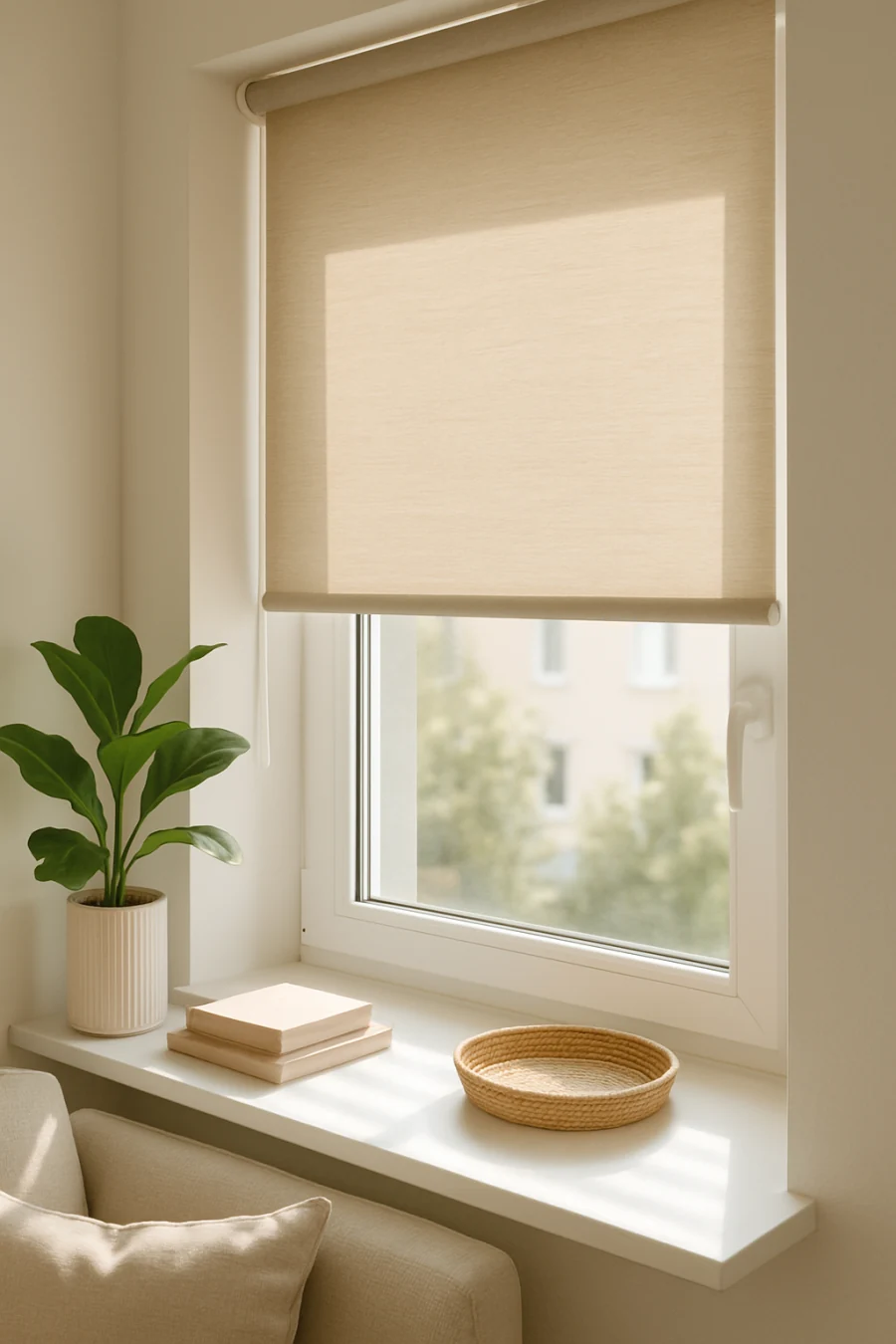


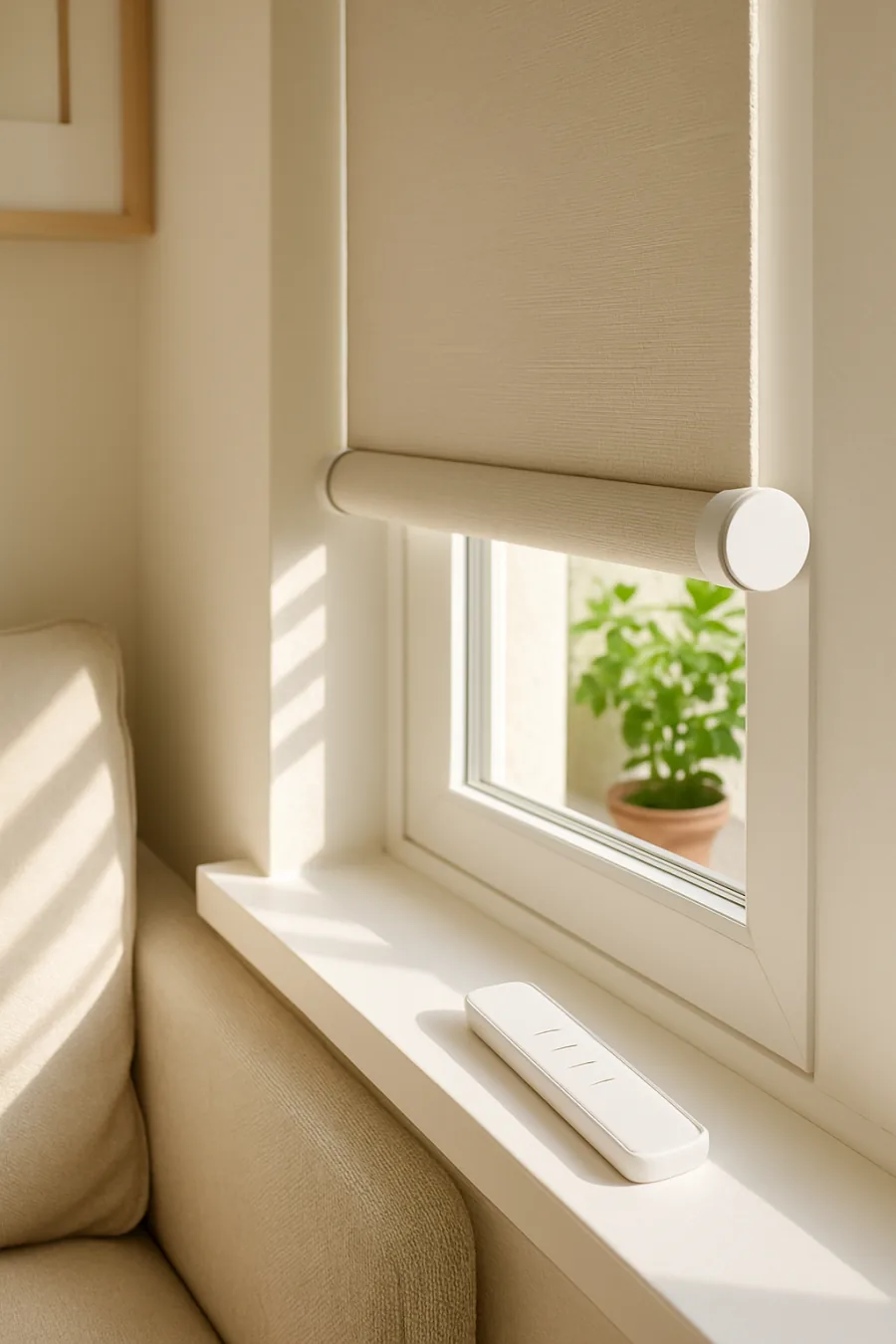




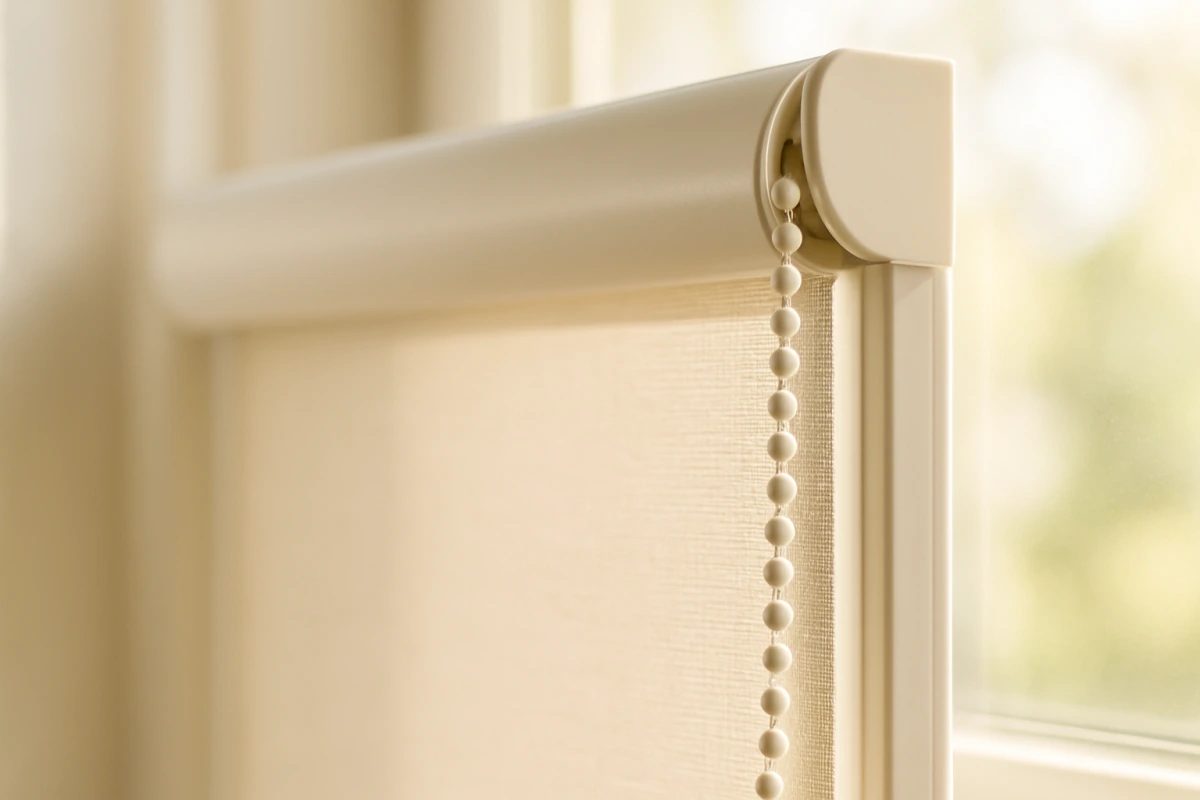
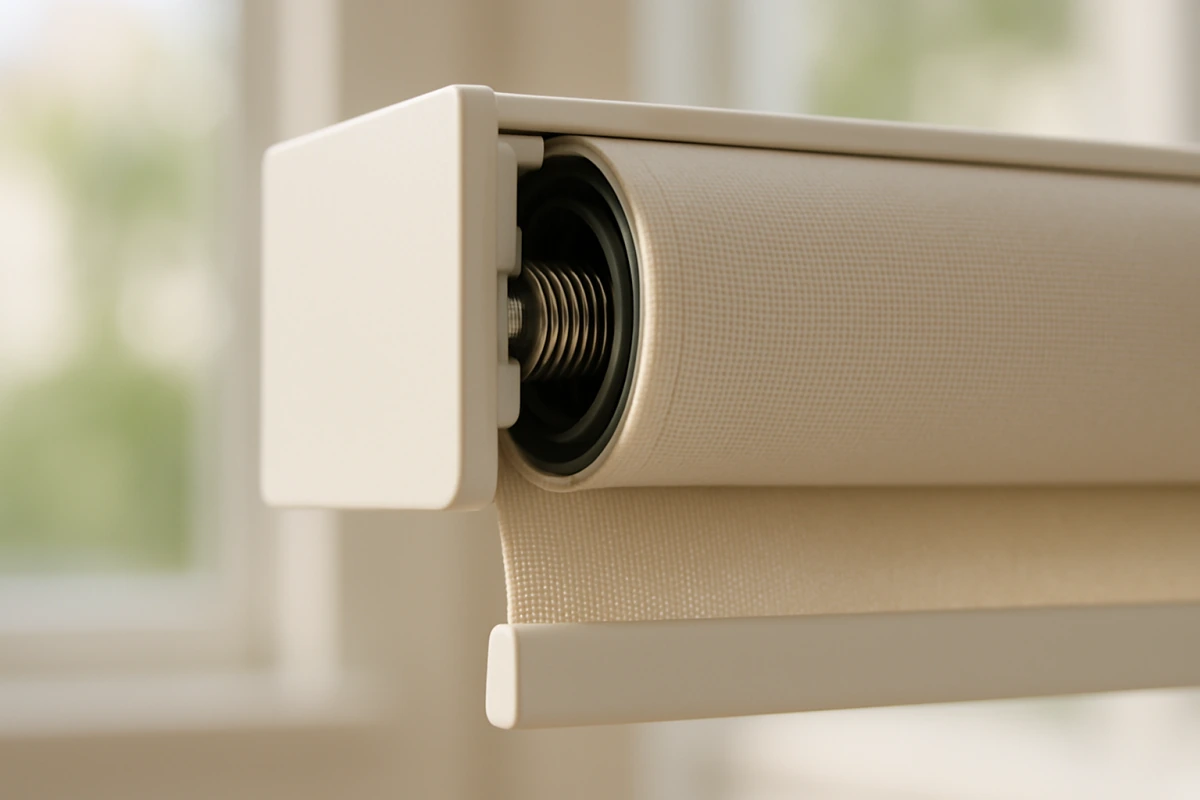










Cassette roller blinds in Almaty are roller blinds where the tube and fabric are covered by a housing box and the edges of the blind run in guide rails. No strip of light gets through at the edges, and the fabric does not flap. We make them to measure in our own workshop, manufacturing time — 4–6 days.
How a cassette system is built and how it differs from a regular roller blind
Cassette roller blinds in Almaty differ from a regular roller blind in that the tube with the rolled-up fabric is covered by a housing box, and the edges of the blind run in guide rails. In an open system the tube and fabric hang in view, and a strip of light remains at the sides of the blind. A cassette roller blind consists of a cassette (housing box), side guide rails and the blind. The cassette covers the tube and the rolled-up fabric — only the edge of the blind is visible from outside.
We are a manufacturer with our own workshop in Almaty, and during measurements we often hear the same question: does the housing box really change anything? It does, and here is how.
- No strip of light gets through at the edges: the edge of the blind slides inside the guide rail instead of hanging in the air.
- The fabric does not flap: with the sash open, a draught does not blow the fabric outwards.
- The cassette does not take up the windowsill: the housing box hangs on the sash or sits in the profile groove.
- The sash opens freely: the housing box does not cover the hinges or the handle.
As for mounting, the cassette system is fitted on the sash or in the profile groove. It has no wall-mounted version — it is not an open roller blind that you can hang on the wall above the window. That is why measurement is needed: the housing box has to sit so that it does not get in the way of the sash.
What you see from the side
From the end, the cassette looks like a thin strip. Only the edge of the fabric is visible; the roll itself is hidden. Dust does not settle on the wound fabric, so on a window facing a dusty side, the cassette keeps the fabric cleaner than an open system. The look also does not clash with the frame — the white housing blends with the white profile.
How it differs from open roller blinds and from MINI
With open roller blinds, the tube and fabric are in plain sight, and a strip of light remains along the edges. Cassette roller blinds remove that strip thanks to the guide rails. And MINI is also a housing, but without guides along the edge, so it does not give a tight fit at the sides: the tube is covered, but light still leaks through along the edge. The difference is visible not in a picture, but on the actual window.
With cassette roller blinds, the tube and wound fabric are covered by the housing, and the edges of the fabric run in guide rails, so light does not leak through in a strip along the edges and the fabric does not billow.
Where the cassette is mounted: sash, frame, glazing bead
Cassette roller blinds are mounted on the sash or fixed into the groove of the profile. There is no wall-mounted version of the cassette system: it is not a roller blind on brackets above the opening, the housing is always connected to the sash. So the question “will the cassette fit” is decided not by the window area, but by the geometry of the specific sash of a tilt-and-turn window.
Cassette blinds for windows are matched not by the size of the opening, but by the thickness of the glazing bead and the free movement of the sash. The measurer checks how much space remains between the housing and the window reveal when the sash turns for ventilation, and whether the housing hits the reveal. The sash handle is a separate point to check: if the housing runs nearby, the hand must reach the handle freely without touching the cassette. Cassette roller blinds in Almaty for plastic windows remain the most common option: the glazing bead on such a profile is even, and the mounting point is found quickly.
The guide rails hold the edge of the fabric along the full height. When the sash is open, a draught does not blow the fabric outward, the fabric does not billow or flap. This is noticeable if the window is long and faces a windy side — there an open roller blind behaves worse.
What the measurer checks
- The depth of the glazing bead — it determines which guide rail will fit on the frame.
- The gap between the housing and the reveal when the sash turns.
- The distance from the edge of the cassette to the sash handle.
- The evenness of the frame: a skew is visible by the gap between the fabric and the glazing bead.
- The mounting method — onto the frame or into the standard groove of the profile.
Cassette blinds have no wall-mounted version, so the check is done on the sash, not on the wall under the windowsill. And measurement is always free: the measurer arrives with samples and calculates the cost on site.
If the sash does not open
A cassette system can also be mounted on a fixed window. The mounting goes into the groove of the profile, there is nothing to open there, so the gap for the sash to turn does not need to be checked. Otherwise the order is the same: glazing bead, evenness of the frame, mounting method.
The cassette system is mounted on the sash or goes into the groove of the profile; it has no wall-mounted version, so during measurement the glazing bead, the reveal and the gap for the handle are checked.
Flat and U-shaped guide rails: which system to choose for your window
Flat guide rails are a narrow strip that is glued onto the glazing bead of the window right next to the fabric. U-shaped guide rails are an aluminium profile in the shape of the letter U; it wraps the edge of the fabric on three sides. They are easy to tell apart: the flat one lies on the frame, the U-shaped one fits over the edge of the fabric.
Flat guide rails are sold under the name UNI-1, U-shaped ones under the name UNI-2. The names are different, but the point is the same: both systems hold the edge of the fabric so that light does not leak through in a strip. Cassette roller blinds in Almaty uni are chosen not by a picture, but by your glazing bead — its shape determines what will fit on the window at all.
The choice between the systems is decided during measurement, not by appearance.
| Feature | Flat guide rails (UNI-1) | U-shaped guide rails (UNI-2) |
|---|---|---|
| Mounting | Glued onto the glazing bead of the window | Mounted along the edge of the opening, wraps the edge of the fabric |
| Requirements for the glazing bead | Suitable for an even frame and a shallow glazing bead | Requires a deeper glazing bead |
| How the edge of the fabric behaves | Runs along the strip right next to the glass | Slides inside the groove without coming out of it |
| Where it is used | Even frames where a neat look is needed | Windows where rigid fixing of the edge matters |
The table shows the main thing: flat guide rails are glued onto the glazing bead of the window and work on an even frame, while U-shaped guide rails require a deeper glazing bead and wrap the edge of the fabric on three sides. If the glazing bead is shallow, there is simply nothing for the U-shaped profile to catch onto — the measurer will see this right away.
Why UNI-1 reduces the light opening
The strip lies on the glazing bead and slightly overlaps the glass along the edge — this is the price for a tight fit. The light opening becomes a little smaller, but there is no strip of light along the edge. Cassette roller blinds uni 1 are therefore chosen where a neat edge matters, not maximum glass.
Matching the colour to the frame
For a laminated “wood-look” frame, the cassette and guide rails are matched using the samples the measurer brings along. The colour of the housing and profile is matched to the frame so that the structure does not stand out.
Cassette roller blinds with guide rails are mounted on both aluminium and wooden windows. On an aluminium frame the profile is usually thin, and the mounting is matched to it separately; on a wooden window the condition of the glazing bead is checked. Cassette roller blinds with guide rails on a wooden frame are mounted less often — there an even glazing bead for the strip is more often needed. Roller blinds with guide rails are in any case calculated by measurement, not by a standard size.
How UNI-2 differs
Cassette roller blinds uni 2 differ from UNI-1 not by the housing box, but by the profile along the edge. The U-shaped profile holds the fabric more rigidly: the fabric slides inside the groove and does not come out of it in a draught. You pay for this with the depth of the glazing bead — on a shallow profile this option cannot be assembled.
A flat strip is glued onto the glazing bead right against the fabric and suits a flat frame, while the U-shaped profile wraps the edge of the fabric on three sides and requires a deeper glazing bead.
Where a cassette does not fit
Cassette roller blinds do not fit every window, and it is better to find this out before ordering, not after installation. The maximum cassette size limits the width of a single blind, the housing box may hit the window reveal, and a mosquito net sometimes prevents the bracket from being mounted. Our measurer checks all of this on site.
Here are the limitations we encounter most often.
- Maximum cassette size. One sash takes one fabric of a certain width, and above this limit the system does not work on the sash.
- The window reveal is too close to the frame. If the gap is small, the housing box hits the reveal when the sash turns and prevents the window from opening fully.
- Mosquito net. The net frame takes up space at the edge of the profile, and sometimes there is simply nowhere to mount the guide rail.
- Sash travel under the handle. If the handle turns right up against the edge, the cassette may catch it when opening.
- Deep glazing bead for an unsuitable profile. Not every glazing bead accepts a U-shaped guide rail.
Cassette roller blinds and similar cassette roller shutters are installed on both tilt-and-turn windows and fixed windows. But in some cases an open roller blind is the better choice, and Jalusso says so directly rather than selling a cassette for the sake of a cassette.
Wide opening
A wide window requires dividing into several fabrics. A single blind cannot cover such an opening — the cassette size limit does not allow it, and a wide fabric sags and ripples in the guide rails. So we divide the opening into sections, each with its own roller tube, and then each works separately: one raised, the other lowered.
Cassette roller blinds on a wide window look like several even strips, not like one billowing fabric. For a kitchen or living room this is also more convenient — the light is adjusted in parts.
Fabric and glass
With a system with flat guide rails, the fabric runs right against the glass. In summer heat the fabric may stick to the glass, and in winter with condensation it may freeze to it along the edge.
Condensation on glass in Almaty in winter is normal: it is freezing outside, warm and humid inside, and moisture settles on the coldest spot. During the measurement we look at where the moisture goes and select a system so that the fabric does not sit right against the wet glass. With the U-shaped profile the edge runs inside the groove, and the fabric does not stick to the glass — for a problematic window this is noticeably calmer.
In my view, talking about “zero light at the edges” without mentioning condensation and sticking is only half the conversation. A tight fit has its price, and it is more honest to name it during the measurement.
A cassette system on a sash has a size limit, so a wide window is divided into several fabrics, and a housing box hitting the reveal and a mosquito net are checked during the measurement.
Fabrics in a cassette: blackout and day-night
Two groups of fabrics go into a cassette: blackout and day-night, also called zebra. Cassette blackout roller blinds are a dense fabric that does not let light through. Day-night fabric consists of alternating dense and transparent stripes: by shifting them, you dose the light. The cassette (housing box) is the same — only the material and the way of controlling light change.
Blackout fabric gives the densest darkening in a cassette. Why? The fabric does not let light through, and the guide rails hold it at the edges, so there is no strip at the sides — and the room darkens evenly. That is why cassette blackout roller blinds with guide rails are most often chosen for the bedroom and the meeting room, where even darkness without gaps is needed before showing slides. Cassette blackout blinds are also installed in a child’s room — if the child has trouble falling asleep with light.
Day-night fabric works differently — it doesn’t make the room completely dark. The stripes are aligned and separated to control how much light passes through the window opening, but even in the closed position some light still gets through. Cassette day-night roller blinds are handy in the kitchen and study: during the day you shut out the sun without losing daylight. Cassette day-night roller blinds on a window with a vent behave the same way — the fabric runs smoothly in the guide rails and doesn’t flap.
What to choose — that is the question. For a bedroom where complete darkness is needed — blackout. For a place where it is only important to dim the light and keep the view of the street — day-night. What exactly suits your windows, the measurer will say on site: he brings samples and shows how both fabrics look in a cassette.
Cassette blackout roller blinds with guide rails give the densest darkening, while day-night adjusts light with stripes and does not make the room completely dark.
Operation: chain, spring, electric motor
In a cassette system the control type is chosen before the calculation, because the final price depends on it: a chain adds a coefficient of 1.06 to the base, an electric motor — 1.85, electric with a remote control — 2.1. Mechanical control comes without a surcharge. Let us break down how these options differ in practice.
Chain control — the fabric is raised and lowered by a chain at the side of the cassette. The movement is smooth. You can leave the blind at any height — this is convenient if you often go to the windowsill: water flowers, air the room, put something on the windowsill. The chain is attached to the frame, does not dangle. The coefficient of the cassette system does not change — 1.28 to the price of the product, and the control is counted as a separate surcharge of 1.06.
The spring mechanism works differently: the fabric is raised by a light push of the hand and fixed in the desired position. No chain, no cord — nothing hangs down. Cassette roller blinds with a spring mechanism are chosen for small windows where frequent access to the windowsill is not needed. But the spring mechanism is not installed in every cassette — it is designed for a certain fabric weight and will not cope with dense fabric over a large opening. Our measurer checks this.
Electric motor with a remote control — a motor in the roller tube raises and lowers the fabric with the remote. You can control it from the sofa without going to the window. An option for high windows and blinds in hard-to-reach places. But the electric motor does not fit in every cassette: the housing box is narrow, and the motor takes up space. We do not promise cassette roller blinds with a motor for panoramic glazing — our measurer decides this on site, looking at the sash and the size of the opening.
| Control option | Coefficient to the base price |
|---|---|
| Mechanical | ×1 |
| Chain | ×1.06 |
| Electric motor | ×1.85 |
| Electric with remote control | ×2.1 |
What to choose for a child’s room
In a child’s room a chain is not the best option: a child may pull it or get tangled. A spring without a chain or cord is more practical here, if the window is small. For a high window in a child’s room the measurer may suggest electric with a remote control — parents control it themselves, and the child cannot reach the motor.
A chain leaves the blind at any height, a spring raises the fabric with a push without a hanging cord, and an electric motor is not installed in every cassette — our measurer decides this.
Installation: with and without drilling
Cassette roller blinds on plastic windows are installed without drilling the frame: the bracket is either glued or fits into the standard profile groove. No marks remain on the frame — no holes, no glue stains. For a rented apartment this is often the deciding factor. On your own window the option also works.
What actually fits is decided not by the catalogue but by the profile. The measurer checks the depth of the glazing bead, how even the frame is and the gap to the window reveal — both the installation method and which guide rails will fit depend on this. A flat strip needs one thing, a U-shaped profile another. It is easy to get this wrong, so the measurement, not a preference, determines the mounting method.
And what about adhesive-mounted guide rails on a sunny side? Fair question. Almaty summers are hot, a south-facing window heats up a lot, and over time the adhesive layer behaves worse than in the shade. Jalusso takes this into account: on sunny windows it more often suggests mounting into the profile groove or the glazing bead, where the joint is held by mechanics, not just glue. If glue still remains the only option for your profile, the measurer will say so right on the spot, before you order.
And the housing box itself is almost invisible on the frame: a white cassette blends with a white profile, and a coloured one is matched to samples. The design does not cover the handle and does not stop the sash from turning — provided the gaps have been checked at the measurement. Installation warranty — 1 year from the date the acceptance report is signed.
Installation without drilling leaves no marks on the frame, and the choice between adhesive mounting and the profile groove is determined at the measurement by your glazing bead and the side of the building.
Care, fabric replacement and winter condensation
Cassette roller blinds need almost no care: dust does not settle on the rolled-up fabric because the housing box covers it. The blind comes off the tube, and it can be washed or replaced with another one without changing the cassette or touching the mounting on the frame. This is a noticeable difference from an open roller blind, where the fabric hangs in plain sight and collects dust along its whole height.
How to care for the fabric so it keeps its look:
- Dust is removed from the blind with a soft brush or a vacuum cleaner on low power.
- Stains are removed with a damp sponge without aggressive products.
- The fabric is carefully taken off the roller tube, washed by hand if the label allows it, and put back in place; a washing machine is out of the question for it.
- The housing box and guide rails are wiped with a damp cloth — they are not afraid of water.
Replacing the fabric in the cassette is a separate procedure. The mechanism stays, the housing box stays, the guide rails stay, and the blind is changed for a new one. If a few years later you are tired of the colour or the fabric has faded, there is no need to replace the whole system.
In winter, condensation settles on the glass. And Almaty winters are cold, with frosts and a big temperature difference between day and night, while inside the flat it is warm and humid — that difference is what produces moisture on the glass. With a system with flat guide rails, the blind runs right up against the glass, so moisture can remain on the edge of the fabric. This is not a dead end: the measurer checks this risk in advance and selects a variant with a gap from the glass. There is no need to take the fabric down for the winter. The fabric in the cassette can be removed and replaced without changing the housing box, and winter condensation on the glass is checked at the measurement so that moisture does not remain on the blind.
A cassette roller blind in the kitchen also behaves predictably: the housing box does not take up the windowsill, the tube is covered, and grease and dust do not settle on it. It is enough to wipe the housing box with a damp cloth once a month. If you do decide to replace the blind, we do it ourselves — an installer can take off the fabric and fit a new one.
How much a cassette roller blind costs in Almaty
Cassette roller blinds in Almaty are calculated from 5,400 ₸/m² — this is the price of the base with an open roller tube, that is, an ordinary roller blind without a housing box. A cassette system is more expensive: in the calculator it comes with a coefficient of 1.28 to the product price. The blind, fabric and control are included in the same base, and then multipliers are applied to it.
What the price is made up of. First — the area of the opening: the wider and taller the window, the more fabric goes into the blind. Second — the fabric group, blackout or day-night. Third — the control. And fourth — the mounting method, with or without drilling the frame.
Chain control adds a coefficient of 1.06 to the base. An electric motor — 1.85, electric with a remote control — 2.1. Installation without drilling is counted as a separate coefficient of 1.1, and together with the cassette 1.28 it is not multiplied in one estimate: the calculator shows only one variant.
| Component | How it is calculated |
|---|---|
| Base, open roller tube | from 5,400 ₸/m² |
| Cassette system | coefficient 1.28 to the product price |
| Chain control | coefficient 1.06 |
| Electric motor | coefficient 1.85 |
| Electric with remote control | coefficient 2.1 |
| Installation | 4,500 ₸ per item, free from 150,000 ₸ |
Cassette roller blinds cost the buyer in Almaty about a quarter more than open roller blinds — because of the housing box and guide rails. But they are exactly what closes off the reason people choose the system: light does not leak along the edge of the fabric, and the fabric does not billow. You can only buy cassette blinds from us made to measure, after a measurement — there are no ready-made units in stock, because we are the manufacturer.
Example calculation
Let us take a kitchen window with a sash that opens for ventilation. We calculate by the area of the opening: the base from 5,400 ₸/m² is multiplied by the cassette system coefficient 1.28, then by the control coefficient — with a chain this is 1.06. Installation is added to the result. The measurer calculates the exact amount at your place, taking into account the fabric group and the actual dimensions.
About 1.28 and installation
The coefficient 1.28 is a multiplier of the “installation” group in the calculator, but it is applied to the product price, not to the cost of installation. Installation costs 4,500 ₸ per product and becomes free for orders from 150,000 ₸. We do not include the price of a spring mechanism as a separate line in the calculation: it is not in the control group of the calculator, and the question is settled at the measurement.
The warranty covers the mechanism and installation — 3 years and 1 year respectively — but not fabric fading and not mechanical damage.
How measurement and manufacturing work
We make cassette roller blinds in Almaty only by measurement: there are no ready-made products in stock for any item. We are a manufacturer with our own workshop, so every blind is cut for a specific opening rather than chosen from what is on the shelf. Manufacturing time for roller blinds — 4–6 days from the moment of measurement.
Here is how it looks step by step:
- You write on WhatsApp. A photo of the window and a rough idea are enough — a cassette system for the bedroom, blackout or day-night. Aida, our fabric consultant, answers on materials, and Kirill, our lead measurer, takes the order for a visit.
- The measurer arrives with samples. He looks at the glazing bead, the window reveal, the gap under the handle and how the sash turns, while you feel the fabric with your hands instead of choosing from a picture on your phone.
- We calculate the cost on the spot. Measurement is always free, and delivery within the city is free too.
- Then the workshop. Talgat, our craftsman, cuts the blind and assembles the cassette and guide rails.
- Installation. Our foreman Zhenya fits the system to the window. Installation costs 4,500 ₸ per item, and if your order is from 150,000 ₸, we install it free.
What happens after the measurement
After the measurement you are left with a calculated cost and an understanding of which guide rail system will fit your sash. You do not have to decide right away — the figure does not change just because you think it over for a day.
The measurement is what determines the mounting method and the guide rail system: flat or U-shaped, with or without drilling. You cannot guess this from a photo, which is why we do not take orders “by size from the internet”.
The warranty covers the mechanism and installation, but not fabric fading. The mechanism — 3 years, installation — 1 year from the date the acceptance report is signed. Natural fading of fabrics under the Almaty sun is not considered a warranty case, and we say this before the order, not after.
Trips to the suburbs
Within the city, measurement and delivery are free. To the suburbs — Kaskelen, Talgar, Issyk, Kapshagay — we do travel, but the cost of the visit depends on the distance and is quoted before the visit, so there are no surprises.
FAQ
What glazing bead depth is needed for flat guide rails? A flat strip sits on the glazing bead and is held by it, so the glazing bead must be even and not bevelled. We don't give the depth in numbers: it differs from profile to profile, and the measurer checks it on site. If the glazing bead is too narrow or rounded, the flat side guide rails won't sit tightly — in that case we suggest a U-shaped profile.
Can the fabric be changed without replacing the cassette? Yes. The cassette stays on the window; only the fabric on the tube is changed. The reason is more often not wear but a wish to switch to a different density: day-night was enough during the day, but the bedroom needed blackout.
What happens to guide rails on adhesive tape on the sunny side? The adhesive on a south-facing window ages faster than on a north-facing one: heat and dust do their work. And the profile itself doesn't deteriorate — the fixing weakens. That's why on the sunny side we more often recommend fixing into the profile groove.
Will a cassette fit an aluminium or wooden window? On aluminium — yes, if the profile has a groove or an even frame for the strip. On wooden ones we install less often: the frame breathes, and the fixing is selected individually.
If one sash opens and the neighbouring one is fixed — how do you align the blinds? Cassette roller blinds with guide rails are installed on each part separately, and the bottom is aligned along one line so the housings look like a single row. For such a window we make cassette blinds both for the sash and for the fixed part.
Warranty — 3 years on the mechanism and 1 year on installation from the date the acceptance report is signed; it does not cover fabric fading.
Bottom line
A cassette system differs from an open roller blind in that the tube is covered by a housing box, and the edges of the fabric run in guide rails. Because of this, light doesn't leak in a strip along the sides, the fabric doesn't billow in a draught, and an open sash doesn't catch the roll. With an ordinary roller blind the tube and the wound fabric stay visible — hence the strip of light along the edge and dust on the material.
The choice between flat and U-shaped guide rails is decided by the glazing bead and how even the frame is, not by appearance. A flat strip sits on the glazing bead right against the fabric; a U-shaped profile wraps the edge on three sides and requires a deeper groove. One option may look better in a photo, but the other will fit your window. That's exactly the measurer's job.
A cassette on a sash has a size limit. That's why we divide a wide window into several fabrics — each works separately, and one can be raised without touching the others.
The money picture is this. The base price is from 5,400 ₸/m² with an open roller tube, that is, the price of an ordinary roller blind without a housing box. A cassette system is calculated with a coefficient of 1.28 to the product price, not to the installation cost. Installation — 4,500 ₸ per product, free for orders from 150,000 ₸. Manufacturing time for roller blinds — 4–6 days, warranty — 3 years on the mechanism and 1 year on installation.
The recommendation is simple: book a free measurement. The measurer will bring fabric and profile samples, check the glazing bead, the window reveal and the clearances for the handle, select the system and calculate the cost on site — for your window, not for an average figure from the internet.

