














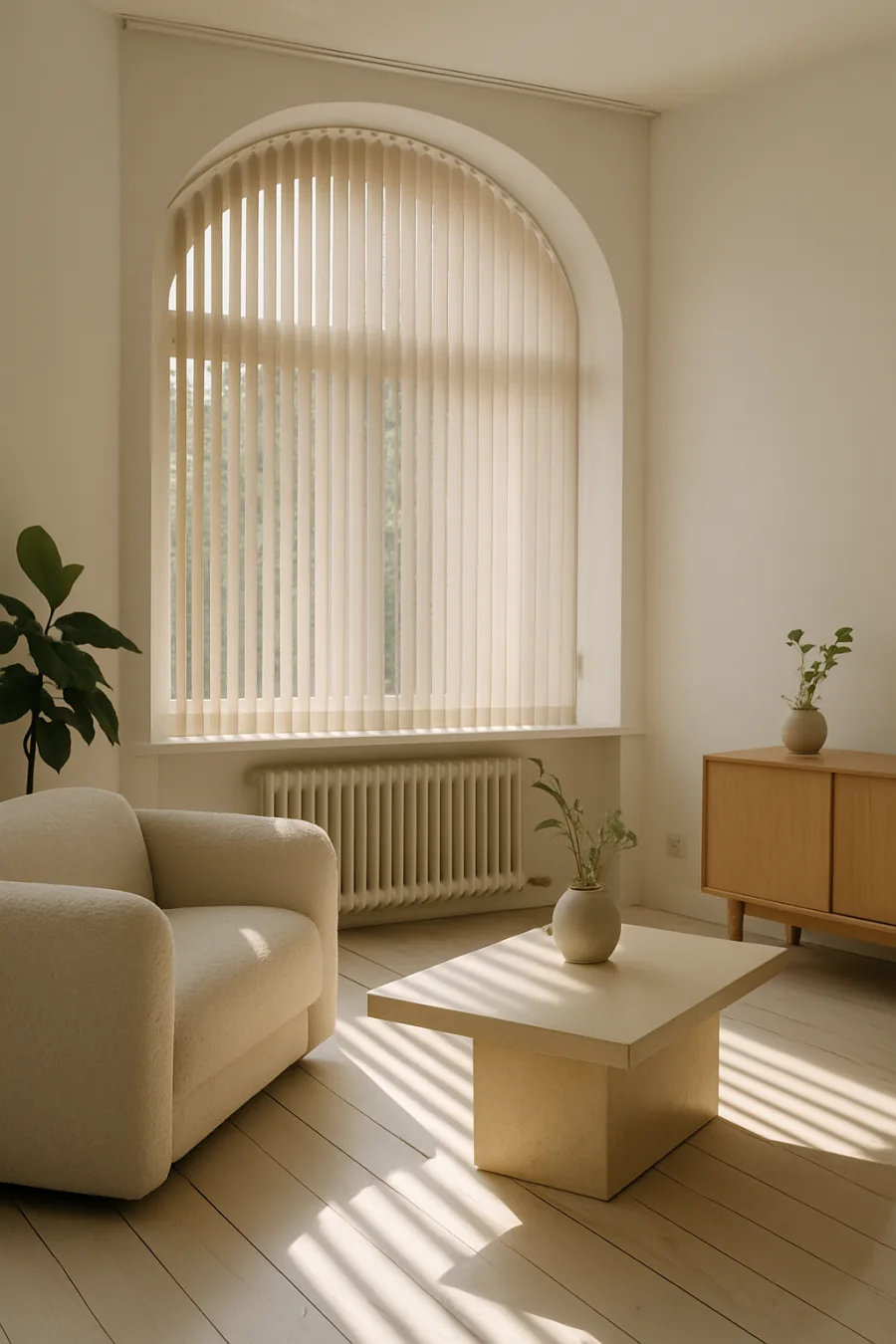











We make arched vertical blinds in Almaty to measurement: the slats don’t bend, they are cut in our workshop to a template of the curve, and the rail is bent to the radius if needed. Fabric slats 89 mm start from 4,600 ₸/m². Measurement and a visit within the city are free; we give the lead time for an arch after measurement.
Two different products under one name: blinds for an arched window and an “arched” blind
Under the name “arched vertical blinds” two different things are sold. The first is a blind for a window with a semicircular top. The second is an ordinary rectangular window where the bottom edge of the slats is cut in an arc. These are different products, and they are priced differently.
Blinds for an arched window
An arched window is an opening with a semicircular top: the arc of the arch above and a straight section down to the windowsill. With such a window both the arc and the lower part need to be covered, and that is the main difficulty. A rectangular blind will not sit on top — open corners and strips of light will remain along the edges of the arc.
An arched window requires the blind to be cut to an arc template. The measurer takes the contour of the opening, and in the workshop the slats are cut along it so that they follow the radius. The semicircular transom — the upper section above the rectangular sashes — lives separately from the window; it is more often covered with its own blind so that the sashes open independently.
“Arched” blinds on an ordinary window
Here the window is the most ordinary, rectangular one. The decorative arched edge is formed by slats of different lengths on a straight rail: the outer ones shorter, the middle ones longer, and the bottom edge runs in an arc. Nothing is bent or cut along a radius — the shape is set by the length of each slat.
A shaped edge is not only in the form of an arch: there is also a reverse arc, a slanted line, a wave. This is a decorative shape, and we do not promise it as a service — show your opening to the measurer, and he will say what can realistically be done for your rail. Such a blind looks good in a living room or bedroom where you want to move away from strict rectangular geometry. But do not expect it to solve the problem of a real arch: that requires cutting along the contour.
Under “arched vertical blinds” two different things are sold: a blind for a window with a semicircular top and a blind with a decorative bottom edge in an arc on an ordinary rectangular window.
Can vertical blinds be hung on an arched window and how the arc is covered
Yes, they can. We make arched vertical blinds in Almaty like this: the slats are not bent along the radius of the arch — they are cut in the workshop to a template taken from the opening. If needed, we bend the rail under the arc, and the blind lies exactly along the contour.
What gets bent and what gets cut
The rail — we bend, the slat — we cut along the contour. A fabric slat 89 mm cannot be stretched along a radius: when bent, the fabric creases and folds, and light immediately shows through on the arc. That is why the measurer takes the contour of the opening, the workshop cuts to a template along it, and each slat gets its own length.
A bent rail solves a different problem — it follows the line of the arc so that the blind runs along the window instead of cutting the corner. In practice we do not always bend: if the arc is gentle and asymmetric just enough that the rail lies straight, we do without bending.
What cutting along the radius gives you:
- no open corners remain on the arc;
- there are no gaps between the slats for light to shine through;
- the bottom edge follows the shape of the opening instead of cutting it with a straight line;
- the upper part of the blind sits flush against the frame.
When the opening is divided into sections
If the arc is steep or noticeably asymmetric, the arch and the rectangular part below it are covered separately — this is a sectional system. The upper section is made fixed to a template, the lower one is functional: the slats turn, and light is adjusted from the arch to the windowsill. We more often recommend this option for windows where an opening sash sits under the arch: the functional part is moved aside and does not stop the window from opening.
In my opinion, sections are an overrated option for a smooth symmetrical arch: there a single blind looks calmer and has no extra joints. But on a steep arc you cannot do without dividing.
Slats are not bent along a radius — they are cut to a template taken on site, and if needed the rail is bent under the arc.
What is better for an arched window: vertical, pleated or horizontal
For a steep and asymmetric arc, pleated or horizontal blinds cut to shape are more often chosen. Vertical arched vertical blinds are appropriate where you need even geometry from the arch to the windowsill and light adjustment by turning the slat. There is no clear winner — the choice depends on the radius of the arc and on what needs to open.
| System | How it lies on the arc | When we choose it |
|---|---|---|
| Pleated blinds | The blind is cut along the contour, the folds run along the radius | Steep or asymmetric arc, complex geometry of the opening |
| Horizontal blinds | The slats are cut to a template, the stack follows the shape | Semicircular transom, wide openings with straight sashes below |
| Vertical blinds | A 89 mm slat is cut to a template, the rail is bent under the arc | You need even geometry from the arch to the windowsill, light adjustment by turning the slat |
Pleated blinds suit a steep arc and complex geometry because the fabric gathers into a fold and follows the contour without tension. The only thing to remember: gathering pleated blinds into a neat stack on a narrow reveal is harder than vertical slats — there is less room for the fasteners.
Semicircular transom above the sashes
If there are rectangular sashes under the arch that need to open, the top is covered separately. We cover the semicircular transom with a fixed blind to a template, and on the straight part we install a separate system — so the sash moves freely and does not pull the blinds on the arc with it. Often the top is done in pleated or horizontal blinds, and vertical ones go on the rectangular bottom: this is cheaper than running a single blind across the whole opening.
Blinds and curtains on one opening
You can combine vertical blinds and curtains on one opening, but each needs its own zone. We hang the curtains on a rail at the reveal, and place the slats closer to the frame — then the curtain covers the window in the evening, and during the day the vertical blinds on arched windows work on their own. When the curtain and the slats hang in the same plane, they catch on each other when drawn apart, and the blind quickly loses its look. If the curtain is only for looks and the light is adjusted by the slats, we hang the curtain outside the travel of the slats.
Pleated and horizontal blinds are chosen for non-standard shapes more often, while vertical ones win on openings where you need even vertical geometry and a turning slat.
Measuring an arched window and the arc template
You can’t describe an arc with a ruler: width and height give you a rectangle, but we need the contour. That’s why we don’t calculate vertical blinds for arched windows from two numbers, but from a template that our measurer takes on site. Lead measurer Kirill has been working with non-standard windows for nine years — arched, triangular, attic — and on every arch the first thing he checks is whether the radius is even.
The measurement goes step by step, and each step covers its own mistake.
- Photos of the opening from several angles. Photos are sent via WhatsApp before the visit — from them we prepare the quote in advance and understand which side to approach the window from.
- Width and height at several points. We measure the straight part in three places: at the windowsill, in the middle and at the start of the arc. A wall has unevenness, and one number won’t show it.
- The contour of the arc. The measurer takes a template: transfers the curve of the opening onto a stiff material and marks where the top is and where the bottom is.
- The opening side of the sash. It determines how the blind goes around the handle and where it moves when opened.
- Mounting points. The measurer checks where the glazing bead runs, whether there is a window reveal and where the bracket can be fixed.
The arc template is needed because measuring at several points reveals unevenness in the radius and the opening, and an opening that looks even almost always turns out to be slightly asymmetrical. Our workshop cuts the slats to this contour — then the blind follows the arc without open corners or light gaps. The formula “width × height plus a photo” works for a rectangular window; on an arch it gives a blind that will hang crooked.
It also happens like this: the customer sends good photos and dimensions, we calculate a preliminary price from them, and at the measurement it turns out that the arc is slanted on one edge. No problem — we take the contour on site, and the cutting is done to it.
Width and height don’t describe the arc, so the measurer takes the contour of the opening and the workshop cuts the slats to it.
What the measurer takes
The contour of the arc, the width and height at several points, the opening side of the sash. Plus he notes where the glazing bead is on the frame and where the window reveal is — the mounting depends on this. Kirill usually asks to open the sash and close it in front of us: that way you can see whether the handle catches the future blind.
Why photos before the visit
Photos from several angles help prepare the quote in advance. From the photos you can see the height of the opening, the frame material and whether there is a windowsill to rest on during installation. The measurer arrives with samples of suitable fabrics, not with a full suitcase.
What the blind on an arch consists of
The main blind for an arched window is fabric slats 89 mm. This is the base material of vertical systems: a slat 89 mm wide gives an even spacing along the whole arc and doesn’t pucker at the transition from the straight part to the radius. We choose the density by the window orientation. For the south side we take fabric with a coating so the blind withstands the heat and doesn’t fade as quickly, for the north side the base one is enough. The coating is not marketing: on an arched window the slat is longer than usual, and an overheated section behaves worse.
What the blind itself consists of:
- Fabric slats 89 mm — the base for living rooms. The fabric diffuses light softly, and cutting to the template allows the arc to be repeated without creases.
- A weight along the lower arc — a weight sewn into the bottom edge. The blind doesn’t fly apart from a draught, and the bottom stays movable.
- The rail — we bend it to the radius in the workshop if the arc requires it. The slats themselves are not bent: they are cut to the contour.
- Control — a chain on the side or an electric motor if you can’t reach the top of the arch.
Shaped-edge forms are a separate story. A regular arch, an inverted one, a slanted one and a wave are made not on an arc, but on a straight rail: the decorative edge is formed by slats of different lengths, and the bottom edge of the blind follows an arc on an ordinary rectangular window. We don’t promise this option — we explain what it is and send you to the measurer. Vertical blinds with an arch in this sense are about the shape of the bottom, not about a window with a semicircular top.
The same cutting is done for a roof window and in a bay window: where a straight rail doesn’t fit the geometry of the opening and cutting to the contour is needed.
The main blind for an arched window is fabric slats 89 mm, and we choose the density by the window orientation.
Shaped-edge forms
A regular arch, an inverted one, a slanted one, a wave — all four are made on a straight rail. Slats of different lengths line up into the required contour, and the bottom edge follows the given line. Nothing is bent or cut to a radius — it’s pure decorative geometry.
Where else a blind with slats of different lengths is used
An roof window and a bay window are typical cases where a straight rail doesn’t fit. In an attic the slope cuts off the top, in a bay window the opening breaks at an angle. A blind with slats of different lengths covers such openings without gaps and without complex mounting.
How a blind with slats of different lengths behaves
A blind with slats of different lengths slides open just like a regular one — along the rail, but it behaves differently. The reason is geometry: a short slat ends higher, a long one goes to the bottom, and in the stacked position they end up next to each other. The lower connecting chain, which on standard vertical blinds keeps the slats in one plane, is not fitted when the height difference is large: there is simply nothing to attach it to on a short slat. In the workshop we look at the specific difference and decide whether it makes sense to fit it at all.
The rotation of the slats works as usual. A slat turns around its axis on the rail, and the blind adjusts the light from full blackout to an open view regardless of its length. But sliding the slats requires attention: when you pull the blind to the side, the short slats go into the stack together with the long ones, and the stack turns out uneven at the bottom.
A draught is the second feature of a non-standard shape. A long slat on a high arch swings more than a short one: it has more free length and fewer fixing points. On an arched window by a balcony door, where the air flow is constant, we sew a weight into the bottom edge — it follows the curve and holds the slat. Without it the blind sways.
Limitations worth knowing before ordering:
- the lower connecting chain is not always fitted — only when the height difference is small;
- long slats on a high arch swing from a draught, and the weight solves it only partially;
- in the stacked position the bottom of the blind looks uneven, this is not a defect but a consequence of the cutting.
How to open the sash under the arched part
The sash under the arched part is opened without removing the blinds: the blind is moved to the side along the rail. If the arch is steep or the opening is wide, we make a sectional system — the arch and the rectangular part are covered by separate blinds, and the sash moves freely between them. Another option is mounting the blind directly on the sash: then it moves together with the door, and the fixed part stays on the window reveal.
Can the shape be redone
After installation, there is little you can really change: tighten the rail, rehang the blind, replace a single slat. If you have changed the interior and want a different edge shape, that is a new cut to a new template — the slats are cut in the workshop to follow the contour, and the old ones will not fit a different curve. There is nothing to be done about that, geometry is geometry.
The main thing that determines how arched vertical blinds behave is the height difference between the shortest and the longest slat: the greater it is, the more noticeable the difference in how they spread, stack and sway.
Mounting and installation without damaging the window
You do not have to drill into the frame of an arched window. A no-drill mounting goes into the glazing bead or clips onto the sash — the profile stays intact, and the window warranty remains valid. This is the first thing we ask at the measurement: can we drill or not?
The measurer selects the mounting option based on the opening, not on a catalogue. Here is what we actually install on arched windows:
- Into the glazing bead — the bracket goes between the glass and the profile, with no holes in the frame.
- Onto the sash — it clips onto the profile, and the blind moves together with the sash.
- Into the ceiling or the window reveal — ceiling mounting is used on long and tall openings, where the blind is heavy and must hold a straight line.
- Onto the wall — when the window sits in a niche and there is space above the frame.
Ceiling mounting on an arched opening is not a fallback option but the main one if the blind is long. The load goes into the floor slab, the rail does not pull the frame down, and vertical blinds on arched windows stay level without sagging along the straight part. Besides, no-drill mounting costs more than ordinary wall installation — in the calculator it has a coefficient of 1.1 against one.
At the measurement we always check where the sash opens. The door or sash must not meet the blind — the measurer sets the mounting back with a margin and shows how the blind will sit in the open position.
An opening without a window
We also install the blind on an interior archway. There is no window there, so it does not control light — it is a partition that covers the opening completely and spreads to the sides. We install these in hallways and corridors where another door is visible from the room.
No-drill mounting on the frame keeps the window warranty valid, and on long and tall openings ceiling mounting becomes the main option.
How much arched vertical blinds cost and what the price is made up of
Fabric vertical blinds start from 4,600 ₸ per m² according to the price list. This is the base option — a 89 mm slat. After that the price grows with cutting to a template and with the mechanism you will use to control the blind.
A non-standard shape adds workshop labour to the base. An arched window requires cutting the blind to a template of the curve: the measurer takes the contour of the opening, and the slats are cut to the required length along it. We do not have a single surcharge for this operation — it is tied to the specific curve, so the measurer calculates the exact amount on site. Three things affect the cost: the area of the blind, the slat material and the controls.
| Parameter | Coefficient to the base price |
|---|---|
| Mechanical control | ×1 |
| Chain control | ×1.06 |
| Electric motor | ×1.85 |
| Electric motor with remote control | ×2.1 |
| Wall mounting | ×1 |
| Installation on the frame | ×1.05 |
| No drilling | ×1.1 |
| Cassette system | ×1.28 |
An electric motor solves the problem of controlling the blind at an inaccessible height: on a tall arch you cannot reach the chain, and a button or remote control removes that problem. Its coefficient is noticeable — 1.85, or 2.1 with a remote control — and on a small window it is rarely justified. Where the arch reaches the ceiling, it is the opposite.
Another detail it is better to know in advance. If you need vertical blinds in an arch shape, that is, with the bottom edge curved on a straight rail, this is a separate decorative form — we explained the difference at the beginning of the article. Its calculation also goes through a measurement.
What's included in the price
Measurement and consultation are always free. On the visit the specialist brings samples and gives you the price right there. Within the city, measurement and delivery are free. Installation costs 4,500 ₸ per item, but if the order total reaches 150,000 ₸, we install free of charge.
No-drill mounting is not a gift but an option with a coefficient of 1.1: it keeps the window warranty valid, and we honestly include it in the calculation.
Lead time
Standard vertical blinds according to the price list take 3–5 days. Arched cutting is a separate operation in the workshop, so we give the timeframe at the measurement after taking the dimensions. We schedule installation right after the blinds are ready — usually as soon as the blind comes out of the workshop.
Fabric vertical blinds start from 4,600 ₸/m², chain control adds a coefficient of 1.06, an electric motor — 1.85, and we give the timeframe for arched cutting after the measurement.
Caring for the blind on a tall arch
Fabric slats on a tall arch are cleaned without taking the blind off the rail. Dust settles on the fabric from top to bottom, and you can reach the upper part of the curve with a long brush on a telescopic handle — no stepladder needed. Caring for the blind comes down to four actions, and none of them requires dismantling.
- Vacuum on low power: a soft-bristle attachment, with vertical movements along the whole length of the slat. A strong airflow pulls the fabric towards itself and pulls it out of the mounting.
- Wipe with a soft sponge, slightly damp, without soaking. Fabric slats are not washed or soaked: water leaves marks that can no longer be removed.
- Use the mildest product, without chlorine and without solvents. Washing right on the window is more convenient than taking the blind down and hanging it back up.
- Move the slats aside and go over the rail with a brush once a season — that is where most dust collects, especially on an opening that is opened often.
A draught on a tall arch is a separate concern, not just about cleaning. The blind at a balcony door sways from the constant airflow, and the longer the slat, the more noticeable the swing. The internal tension of the slats makes them sway less than a blind on the straight part, and in a strong wind the long strips at the upper curve lash against each other.
From experience: on an arched window in a living room we usually recommend turned slats first, rather than slats gathered into a stack — the fabric moves less from the air, and nothing keeps flying towards the frame.
Fabric slats keep their shape without being taken down and are not meant for washing, so all the care for the blind on a tall arch comes down to a vacuum, a soft sponge and a brush with a long handle.
We work in Almaty and the suburbs
We make arched vertical blinds in Almaty ourselves: we have our own workshop, and cutting to a template is done here, not reordered on the side. This is a fundamental point. A non-standard shape does not tolerate intermediaries — when someone else's factory stands between the measurement and the machine, the curve template loses accuracy, and light gaps appear on the arch again.
An arched window requires cutting the blind to a template of the curve. Our measurer takes the curve template right on site — within the city, measurement and delivery are free. The measurer comes with samples of fabric slats so that you can hold the material against your window instead of choosing a colour on a phone screen. Kirill, our lead measurer, has been handling non-standard windows — arched, triangular, attic — for 9 years, so he will read an uneven radius or an asymmetrical curve on site.
What we do in Almaty:
- Jalusso manufactures arched vertical blinds to your template in its own workshop.
- We mount without drilling the frame where possible — the window warranty stays intact.
- We give a 3-year warranty on the mechanism and a 1-year warranty on installation from the date the acceptance report is signed.
- After the warranty period we come out: to tighten, adjust, replace the cord or chain.
Climate and fabric choice
Almaty has a sharply continental climate: cold winters with frost and big day-to-night temperature swings, and hot, dusty summers. For fabric slats this means two different approaches. For south-facing windows we use fabric with a protective treatment — it fades less and repels dust more easily. For north-facing windows a basic fabric is enough: there is noticeably less sun there, and there is no point paying extra for protection.
Suburbs
Our measurer will also come to a private house outside the city. Kaskelen, Talgar, Issyk, Kapshagay — we cover all these directions, and the call-out fee depends on the distance and is quoted before the visit, not after. The timeline for the vertical blinds themselves is 3–5 days according to the price list; arched cutting to a template is a separate operation in the workshop, so we give the exact timeline at the measurement, once the size has been taken.
FAQ
Before the measurement we are most often asked five questions. Here are short answers to each — without a measurer’s visit they give you the general picture, but the exact sizes and price are still calculated on site.
Questions
Can a blind be fitted to an asymmetrical arch? Yes, but the cutting is more complex here: the left and right sides of the curve differ in length and curvature, so the measurer takes a separate template of the curve for each half of the opening. If this is not done, open corners and light gaps will remain on one side. In this situation we cut vertical blinds for arched windows in sections so that the blind sits evenly.
What about an uneven radius? An uneven radius is common on older windows. The measurer takes the contour of the opening at several points along the curve, and the workshop builds the cutting from these points. We do not straighten the radius itself — it stays as it is — but the blind follows exactly that curve, with no gaps at the edges. Sometimes it is easier to step back slightly from the edge of the curve than to chase every millimetre of its contour.
Will a blind work on an arch above a door? Yes, this is a workable solution. The mounting goes into the window reveal or the ceiling, the blind does not enter the sash’s swing area, and the door opens freely. The same solution works for an arch in a hallway where there is no window.
Will the window warranty be preserved? Drilling-free mounting preserves the window warranty: the brackets fit into the glazing bead or clip onto the sash, and no holes are left in the profile.
Do you need an electric motor for a tall arch? You need one where the chain cannot be reached — for example, on an arch in a stairwell. On an ordinary arched window in a living room, manual control is enough.
In short: an arched window requires cutting to a curve template, not selecting a ready-made blind by width and height.
Conclusion
The name “arched vertical blinds” covers two different products: a blind for a window with a semicircular top, and a decorative arched bottom edge on a straight rail of an ordinary window. We make the first, not the second, and at the measurement this difference is cleared up right away, in a couple of minutes of conversation with samples in hand.
Slats do not bend along a radius. They are cut in the workshop to a template that the measurer takes from the opening. The rail is a different matter: we can bend it to the curve. Hence the main rule of an arched window — the curve is covered by cutting, not by deforming the blind, and it is the cutting that removes open corners and light gaps.
For a steep and asymmetrical curve, pleated blinds or horizontal blinds cut to shape are more often chosen. Vertical blinds are suitable where you need clean geometry from the arch to the windowsill and light adjustment by turning the slat. We price both options at the measurement and show you the difference, rather than pushing the client towards one system.
The price is made up of the area, the slat material, the control type and the mounting method. Fabric vertical blinds start from 4,600 ₸ per m², a chain adds a coefficient of 1.06, an electric motor — 1.85, drilling-free mounting — 1.1. The timeline for standard vertical blinds is 3–5 days according to the price list, while arched cutting is a separate operation in the workshop, and we give its timeline after the measurement, not before.
What to do next? Photograph the opening from several angles, including the curve and the side the sash opens on, and call a measurer with samples. They will take a template of the curve, check the radius and unevenness, and calculate the price on site — measurement and call-out within the city are free. Our workshop makes arched vertical blinds in Almaty: from template to installation the product follows a single route, with no middlemen.

