

















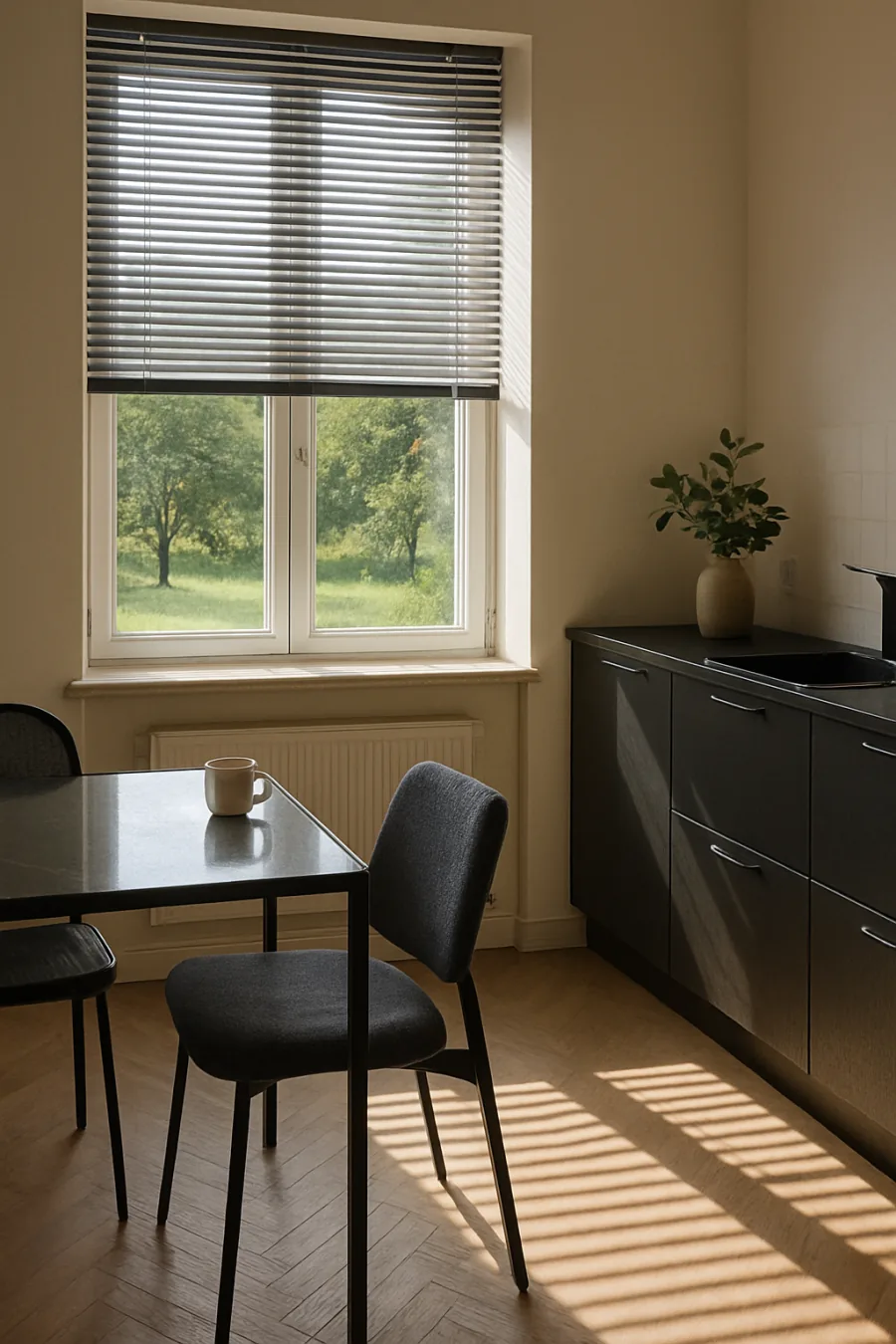


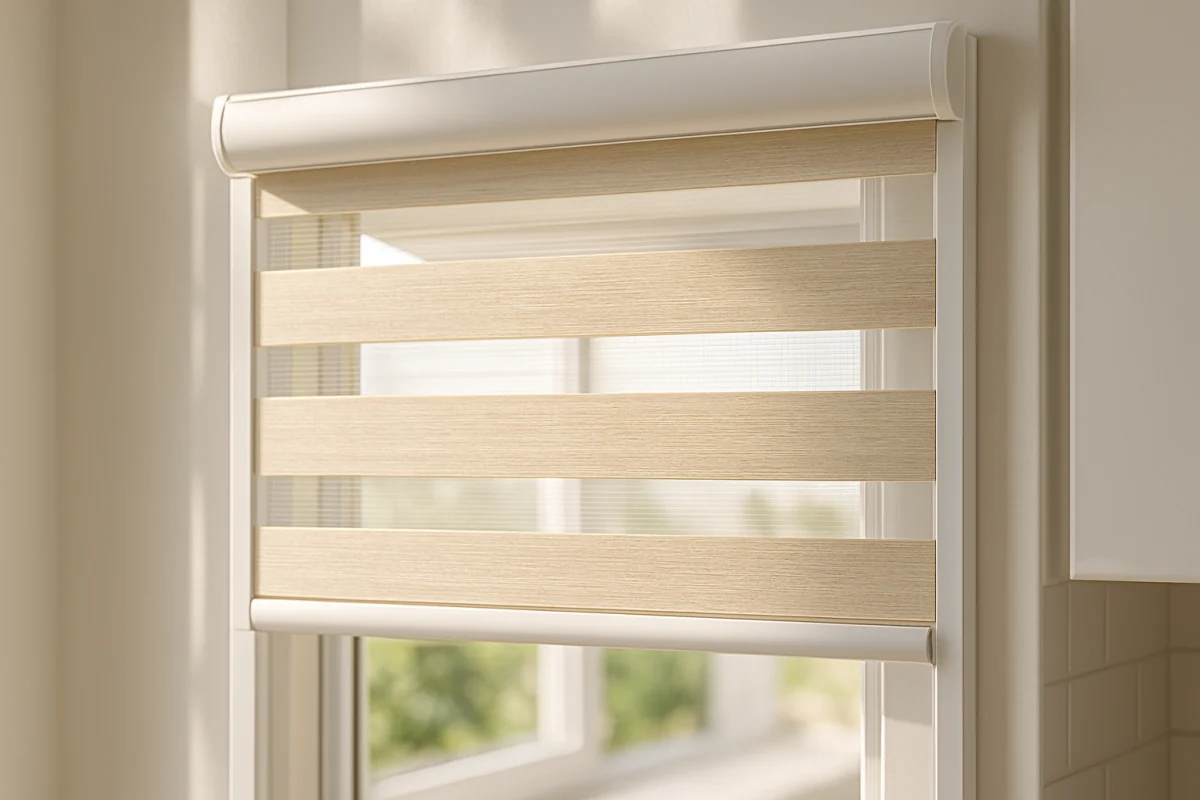

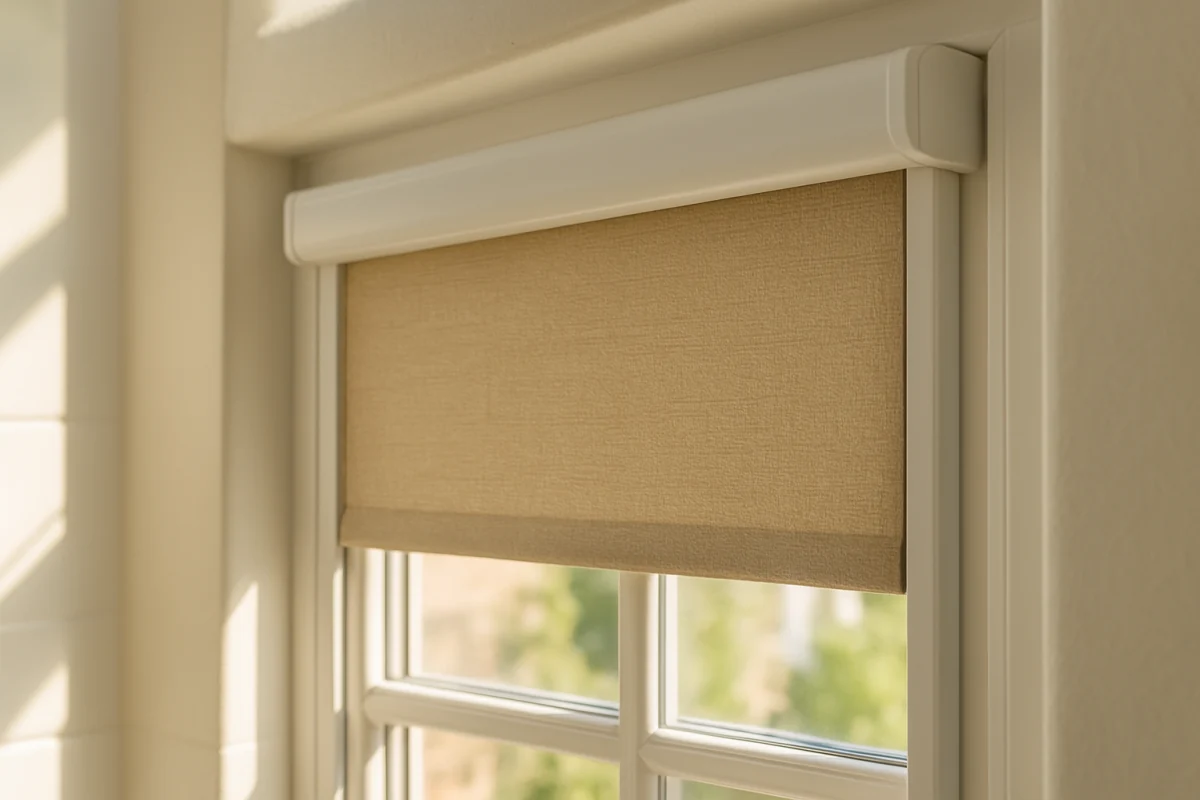










Kitchen blinds in Almaty are chosen based on what stands by the window. By the stove and sink, aluminium, PVC plastic and fibreglass fabric work well: steam and grease don’t harm them, and the slat can be washed right on the window. For a balcony block and an opening sash, we fit the blind on the sash. Everything by measurement, from 3,600 ₸/m².
What stands by your window and why it decides the choice
Kitchen blinds in Almaty are chosen not by the colour of the wallpaper, but by what stands by the window. A stove and hob give off grease and heat. A sink by the window creates steam and splashes. A worktop-windowsill takes up space for mounting. A balcony door requires a blind on the sash, otherwise it won’t open.
Jalusso has been making blinds for seven years and sees the same picture: a person comes with a photo of the window from the tile shop and asks for “something practical”. But practicality is different for every window. Below — how the area by the window changes the material and mounting.
| What stands by the window | What changes | What we install | Price from |
|---|---|---|---|
| Stove and hob | grease and heat on the blind | horizontal aluminium, slat 25 mm | 4,200 ₸/m² |
| Sink by the window | steam and splashes | PVC plastic, slat 25 mm | 3,600 ₸/m² |
| Worktop-windowsill | little space under the rail | mounting on the frame or into the glazing bead | surcharge for mounting |
| Balcony door | the door must open | blind on the sash, vertical blinds | from 4,600 ₸/m² |
Four points at the window
The stove and hob are to the left or right of the window. Grease settles on everything hanging nearby — both the sheer and the slats. Aluminium and PVC plastic handle this load: the slat is wiped with a damp cloth right on the window.
A sink by the window adds steam and splashes. Fabric without treatment in this area picks up odours and a grey film.
The worktop-windowsill is a story of its own. When the work surface runs into the windowsill, little space is left above it, and a rail will not fit there. The measurer checks where the mounting will go: on the frame or into the glazing bead.
A balcony door next to the window changes everything: a blind above the opening will simply block it.
How the window opens
The opening sash determines the layout. If the kitchen is aired every day, we mount the blind on the sash — it moves with it, and nothing needs to be opened. If the window is fixed or there is one sash above the work area, we hang the blinds above the opening.
A kitchen window differs from any other not in size, but in what stands next to it.
Which blinds suit a kitchen and which do not
In a kitchen, the materials that win are those that do not absorb steam and grease: horizontal aluminium blinds, PVC plastic blinds and fibreglass slats. Untreated fabric by the sink quickly picks up odours, while wood and bamboo behave worse under constant steam. Let us go through them one by one.
What fits
Horizontal aluminium blinds with a 25 mm slat are the basic solution for a kitchen window. Aluminium slats are not afraid of moisture or heat, are washed right on the window and can be replaced one by one if a dent is left somewhere.
PVC plastic blinds are a budget option for the sink and stove area. Moisture does not affect the material, grease is removed with a damp cloth, and the slat does not crease but springs back when touched. PVC plastic is wiped with a damp cloth and a mild detergent — the blind itself is not taken down.
Fibreglass slats do not absorb grease or steam and withstand washing with detergent: the fabric does not fade by the stove and does not stretch from moisture. Kitchen fibreglass blinds are suitable for a window near the sink and the hob.
We install treated fabric blinds only away from the stove: the treatment holds grease on the surface, and the blind is cleaned without soaking. Untreated fabric is not suitable for the work area — it absorbs grease and odours, and is hard to wash.
What is conditionally suitable
Wooden blinds with a 50 mm linden slat can go in a kitchen, but under constant steam wood behaves worse than aluminium or PVC. We install them away from the stove and sink, by the dining area.
Bamboo blinds behave the same way: the straw reacts to moisture. Neatly covering a window by the table with them — yes, but by the hob I would not advise it.
What we do not advise by the stove
We do not offer pure fabric blinds for the stove and sink: steam and grease soak into the fibre, and the blind cannot be washed — the treatment is lost. Paper blinds are in the price list, but in a kitchen by the stove they are the most questionable material, so we do not consider them a kitchen solution.
Jalusso’s whole catalogue of kitchen blinds is built around what stands by the window, and the choice is always made based on measurements.
In a kitchen it is aluminium, PVC and fibreglass that work: these three materials are not harmed by steam and grease, and they are washed in place.
Balcony door and opening sash: how to cover them so they still open
A balcony door is rarely the same as any other, and the fixing scheme depends on how it opens. A tilt-and-turn door needs a blind on the sash: it moves with the door both when turning and when tilting. With a sliding door the sash moves sideways along a rail — a blind on it catches the neighbouring section, so here vertical blinds are more often chosen, as their slats pull to the side. A fixed door with a push handle sets a different task: the handle sticks out inwards and catches the blind as it is raised, and the measurer works around its position with the fixing.
Balcony door and window unit
A balcony door and a window in a shared frame count as two units, and that is not a whim. The door sash and the window sash open independently, so they get separate blinds — one for the door, one for the window. For kitchen blinds with a balcony we use one material and colour, so the unit reads as a single line rather than a set of different windows. How many blinds will have to be made is clear at the measurement: if the door and window stand right next to each other, we leave a gap between them for the neighbouring sash handle.
A window that opens
An opening sash leaves a choice of two schemes, and how often you air the room decides it. Fixing to the sash is convenient where the window is opened every day: the blind opens together with the window, and nothing needs to be raised or taken off. Fixing above the opening leaves the sash free, but the blind hangs separately from it, and airing goes past it. We fit day-night blinds on an opening sash only the first way — the two-layer fabric adjusts the light smoothly and does not get in the way of opening the window. If the frame cannot be drilled, a bracket into the glazing bead holds just as well, and the window stays intact.
Sink by the window and the tap
A sink by the window adds a tap and its spout to the scheme — and this is where fixing above the opening falls short. When raised, the bottom edge of the blind catches the mixer if it is tall and stands close to the glass. At the measurement we look at which side the tap is on, how far it comes out of the worktop, and from that we calculate the installation height or choose fixing to the sash. The second option is more reliable: the blind opens together with the window, and the tap stays untouched.
Materials for a kitchen: how they differ by the stove, sink and windowsill
Kitchen window blinds are chosen not by one feature but by three zones at once: what stands on the left by the stove, what is on the right by the sink, and what occupies the windowsill. The same material behaves differently in these zones, and a year later the difference is more obvious than on the day of installation.
Stove and hob
A stove and hob give off grease and heat all year round, so here we keep aluminium or PVC plastic with a 25 mm slat. After a year a thin film of oil settles on aluminium, which comes off with a damp cloth. On PVC the film settles the same way, but the matte surface holds it tighter, and you have to rub a little longer. We do not recommend gloss in this zone: cloth marks show on it straight away.
A 16 mm slat by the stove is convenient because it gets dirty in small patches — wipe one strip and you are done. A narrow slat is more easily bent by a careless movement, but it can be replaced one at a time.
The slats are turned to adjust the light: during the day they are turned so the sun does not hit the work area, in the evening they are closed. By the stove the tilt mechanism collects dust mixed with grease faster than on other windows, and a slat that turns stiffly is the first sign that it is time to clean it.
Sink by the window
A sink by the window means steam and splashes every day. Aluminium and PVC plastic take this load calmly, while fibreglass slats hold up thanks to their tight weave: they do not absorb water, and grease washes off with detergent. After a year fibreglass looks almost like new, if you do not soak it and do not scrub it with the rough side of the sponge.
Coated fabric by the sink does last, but the coating weakens over time from frequent washing, and the blind starts to absorb odours. This is not a breakdown and not a warranty case.
Worktop-windowsill
A worktop-windowsill limits the space for the rail: when the worktop continues into the windowsill at one level, only a narrow strip remains above the frame, and a wide cassette will not fit there.
What do we do at the measurement? We go for fixing to the frame or into the glazing bead, and on a narrow window we fit a mini system with a 16 mm slat. The opening sash determines the choice of fixing: if the handle and the reveal are close, a blind above the opening will not let the window open.
Finish to match the kitchen units
A 25 mm slat in a wood-effect finish is a warm tone for a kitchen with wooden fronts, and the embossing hides small fingerprints better than smooth metal. We match the colour on site using samples: matte and gloss finishes, tinting.
How much do kitchen blinds cost: a table by material
The price of kitchen blinds comes down to four things: the window area, the design, the material and the control method. In the price list, plastic options start from 3,600 ₸/m², horizontal aluminium with a 25 mm slat from 4,200 ₸/m². Below is the full range with prices, lead times and a note on which part of the window each option suits.
Table by material
| Material and finish | Price from | Manufacturing time | Where by the window to install |
|---|---|---|---|
| PVC plastic, slat 25 mm | from 3,600 ₸/m² | 3–5 days | Sink and hob, the most budget-friendly option |
| Horizontal aluminium, slat 25 mm | from 4,200 ₸/m² | 3–5 days | The work area by the hob and sink |
| Vertical, fabric, slat 89 mm | from 4,600 ₸/m² | 3–5 days | Balcony door, slats draw to the side |
| Metal, steel, slat 25 mm | from 5,200 ₸/m² | 5–7 days | A walk-through kitchen where the fabric is often brushed against |
| String curtains, polyester | from 5,800 ₸/m² | 5–7 days | Window away from the stove |
| Multi-texture, two fabrics in one blind | from 7,200 ₸/m² | 7–10 days | A sunny kitchen, smooth light adjustment |
| Day-night blinds, two-layer fabric | from 7,300 ₸/m² | 5–7 days | South-facing and ground floor |
| With electric motor, 220 V or battery | from 7,800 ₸/m² | 7–10 days | A high window you can't reach by hand |
| Printed blinds, photo printing | from 8,900 ₸/m² | 7–12 days | Window above the dining table |
| Bamboo, straw | from 9,400 ₸/m² | 7–10 days | A kitchen with no steam by the window, warm tone |
| Pleated blinds, pleated fabric | from 9,800 ₸/m² | 7–10 days | A small window away from the sink |
| Wooden, linden, slat 50 mm | from 12,400 ₸/m² | 7–12 days | A kitchen without constant steam by the window |
What adds to the price
The control method multiplies the base rate: manual ×1, chain ×1.06. Electric motor — ×1.85, electric motor with remote control — ×2.1, the most expensive option. Let’s do the maths: horizontal aluminium blinds for a window of two square metres at the base rate come to roughly 8,400 ₸, with an electric motor — around 15,500 ₸. That’s a noticeable difference, and on an ordinary kitchen window it’s rarely justified: you can reach the handle by hand.
Mounting is a separate coefficient. On the wall ×1, on the frame ×1.05, no drilling ×1.1, cassette system ×1.28.
Installation of blinds costs 4,500 ₸ per item. On orders from 150,000 ₸ installation is free, but one kitchen, even with a balcony door and window unit, usually doesn’t reach that amount: people hit the threshold when they order blinds for the whole flat at once. The balcony door and the window count as two items, so installing the unit is 9,000 ₸.
Installation and warranty
The mechanism of kitchen blinds is under warranty for 3 years, and the installers’ work for one year from the day the acceptance form is signed. Grease, water and natural fading of the fabric are not covered, and we say so before the order. We fix warranty cases free of charge within 5 working days, and after the warranty we still come out: to tighten, adjust, replace a cord or chain.
The “from” figure in the table is the lower bound in the price list; the exact amount for your window will be calculated by our measurer on site: measuring the window opening is free at any time.
Curtains or blinds for the kitchen
Near the stove and sink, net curtains and heavy fabric lose out. Fabric without a treatment absorbs grease and odours that rise from the hob along with the steam, and it has to be washed often — and hung back up every time. Blinds don't know that fate: the slat is wiped with a damp cloth right on the window, no need to take the blind down.
But it's not all so clear-cut. Blinds and curtains in the kitchen are not a replacement for one another but two tools for different zones. Look at where the window is relative to the work area.
If the sink is by the window or the stove and hob stand right against the reveal, the question of curtains or blinds answers itself: steam and grease reach the blind every time you cook. Here aluminium, PVC and fibreglass fabric are what work.
It's a different matter for a window by the dining table. There, a net curtain remains appropriate: it doesn't come into contact with the stove, collects less grease, and soft fabric softens the light and keeps things cosy. Many people go for a combination: blinds on the working part of the window and a net curtain on the table zone, if the opening is divided. A curtain over blinds in one opening is also possible — a heavier fabric over a light one — but that's a matter of taste, not practicality.
One more thing — the indoor climate. In an Almaty kitchen, the blind works both against the hot summer sun and against winter temperature swings: a closed slat keeps the heat by the window while you air the room. A sheer curtain doesn’t do that job — it lets both light and cold through.
So the answer is simple: put blinds by the stove and the sink, and a sheer curtain stays appropriate away from the work area. Our measurer will pick the material for the work area from samples on site.
A narrow window, a panel building and a rented flat
On a narrow window in a panel building, the fight isn’t for centimetres of glass but for centimetres around the sash. A mini system on the sash mounts straight to the frame, so it doesn’t eat up space above the opening. In a Khrushchev-era flat, where the windowsill is often taken up by a worktop-sill, that solves half the problem.
A narrow window and a small kitchen
What gets in the way first? The radiator under the window. It pushes the lowest mounting point down, and there’s simply nowhere to put a long floor-length blind. A mini system with a 16 mm slat runs along the height of the sash and doesn’t touch the radiator. A 25 mm slat works too, but takes up a little more depth. Ventilation doesn’t suffer: the sash tilts open together with the blind, no need to raise the slats.
Another detail is the gas pipe. In some panel-kitchen flats it runs along the window, and it can’t be covered with a housing box. Measuring the window opening is needed precisely so the blind and the pipe are kept apart, rather than discovering the problem during installation.
No drilling into the frame
No-drill frame mounting wins twice in a narrow opening: the frame stays intact and no space is spent on a heavy-duty rail. A bracket into the glazing bead holds onto the bead, and spring clips work on a thin profile. We don’t recommend adhesive tape by the hob — steam weakens the glue and the blind starts to come away. In rented kitchens this is the most common mistake: tape seems the safest option for the landlord’s window.
Rented flat
In a rented flat the question is usually not about money but about what you can do to a window that isn’t yours. With no drilling, the whole structure comes off: the brackets come out of the glazing bead, and when you move out the window is as it was handed over. One caveat: the glazing bead must be intact. If it’s cracked, the mounting won’t hold, and that comes up at the measurement, not afterwards.
Suburbs
We travel to Kaskelen, Talgar, Issyk and Kapshagay. We calculate the cost of such a visit by distance and tell you in advance. Within the city, measurement and delivery are free.
Sun in an Almaty kitchen
A kitchen on the south side gets sun almost all day, and the blind here does two jobs at once — light and heat. Summer in Almaty is hot and sunny, winter is cold with a noticeable temperature swing between day and night, so the window is under load all year: warming by day, giving off cold at night. The denser the blind, the less light and heat reach the work area. We don’t promise degrees and we don’t calculate savings on the air conditioner — there are no such items in our price list.
A south- or west-facing kitchen
The south side increases heating of the work area, so we install a denser blind by the window. Modern kitchen blinds with dense slats will do, and beautiful kitchen blinds from the day-night and multi-texture collections stand out noticeably: their stripes alternate, and the light is adjusted smoothly, without a jump from “open” to “closed”.
- South and west: day-night or multi-texture, the light is dimmed gradually.
- North and east: aluminium with 25 mm slats is enough, a dense blind isn’t needed there.
- A window under an overhang or in the shade of a building: light is hardly an issue, choose by the area by the window.
Plastic in the sun
PVC plastic blinds in a south-facing kitchen fade over time — it’s a natural process and isn’t covered by the warranty: the warranty terms state directly that natural fading of the fabric is not a warranty case. The mechanism, however, stays under warranty for 3 years. If the window is in the sun all day, it’s more honest to look straight away at aluminium or a blind with a dense light-resistant finish.
Ground floor and evening
In the evening the kitchen is visible from the street — especially on the ground floor and where a neighbouring building stands opposite. Dense day-night and multi-texture stripes close the room off from prying eyes when the blind is lowered all the way. In the daytime, with the stripes raised, your kitchen is visible from the street too — that’s normal operation of the blind, not a defect.
Colour and finish
Grease and dust are least noticeable on mid and warm tones — beige, grey-brown, wood-effect finishes. Aluminium with 25 mm slats in a wood embossing goes well with a kitchen with wooden fronts, and matte finishes look calmer by the stove than gloss: every drop shows on gloss. We select the tint and texture from samples at the measurement.
A blind on a kitchen window in Almaty is chosen by the side of the light and the floor height: day-night and multi-texture adjust the light smoothly, while a dense finish closes the room off from prying eyes in the evening.
Care: how to remove grease from slats and what to do with fabric
The difference in care comes down to the material, not the type of design. The main rule is in the answer about washing blinds on this page: slats are washed right on the window, and treated fabric is not soaked. Below are the details that come up a few months in, by the hob.
Slats
PVC plastic wipes clean with a damp cloth fastest: grease doesn’t sink into a smooth surface. Embossed aluminium is a little fussier — dust packs into the grooves, and it’s worth lifting it out with a soft brush, not a fingernail. Fibreglass slats handle washing with detergent without any trouble and don’t stretch from moisture; this is the case where you can wring the cloth out more firmly. We don’t wash the blind under running water or take it off the brackets: steam and grease come off without soaking.
Don’t bend the slat or rub across its edge — once creased, it won’t straighten out. If a dent is left, slats are replaced one by one, with no need to take the blind apart.
Treated fabric
A fresh grease spot on fabric is blotted, not rubbed: a smeared spot goes deeper into the fibre and the sponge won’t lift it. We don’t use a steamer or a stiff brush on fabric — hot steam and bristles weaken the treatment just like machine washing, after which grease from the hob soaks in for good.
Printed blinds
Kitchen blinds with a print are the same story as an ordinary blind in that material: the photo print is washed with a soft sponge, and it shouldn’t be scrubbed with an abrasive. Trendy kitchen blinds with a photo print look bright right up to the first stiff brush — the print wears at the edges, not in the centre, because the edge of the blind gets wiped with a cloth more often.
Care schedule
- Every week — a damp cloth over the slats by the hob: fresh grease settles there, and it’s easier to remove before it sets.
- Once a month — a mild product over the whole blind, including the area by the sink where steam builds up.
- Once a season — a sponge over the treated fabric and a check of the blind’s edge for wear.
- Once a year — dust off the mechanism. The most common cause of sticking is dust, not worn parts.
- When it’s easier to take the blind down — if you washed the whole window or were cleaning up after renovation; there’s no point taking it down just for grease by the hob.
How an order works in Almaty: from WhatsApp to installation
Ordering kitchen blinds in Almaty by measurement is easier if you prepare for the conversation in advance: a photo of the window sent to WhatsApp settles half the questions. We’re a manufacturer with our own workshop, we don’t keep ready-made items in stock, so every detail is calculated for a specific window rather than picked from what’s available.
What to send on WhatsApp before the measurement
Three shots: the whole window with the reveals, a close-up of how the sash opens, and what stands next to it — the hob, the sink, the edge of the worktop. Add a few words to the photos about what you don’t like in the old solution: it got in the way of opening the door, the blind caught on the tap, the fabric held the smell. That way the measurer brings the right samples, not the whole case.
What to measure yourself
The width and height of the opening by the glass and by the frame — with a tape measure, no allowances. That’s enough for a preliminary calculation from the price list: we’ll still measure the window opening on site, but you’ll see the ballpark straight away. If the sash is tilt-and-turn, note which side the handle is on — that determines where the mounting goes.
What to decide before the measurer arrives
The control: manual, chain or electric motor with remote control — the coefficients differ severalfold, and it’s better not to decide this standing over the samples. And the colour. Bring a sample of the front or a photo of the kitchen units: for wooden fronts we match a 25 mm embossed slat, for painted ones a flat tone. The mistake here is always the same: people pick a blind a shade darker than the worktop, and the kitchen turns gloomy. A blind a shade lighter than the units usually looks better.
Kitchen-living room and the suburbs
In a studio, a single blind running the full height reads as one continuous line, with no breaks at the windows — worth mentioning before the measurement, because the mounting method depends on it. We travel to Kaskelen, Talgar, Issyk and Kapshagay; we quote the call-out fee before we come.
FAQ
Below are the questions that come up after the material is chosen: about the insect screen, about the sash you open every day, and about whether you can do it in stages.
Can I hang blinds over the sink if the sash opens?
Yes, but the mounting is chosen based on the sash. If the blind sits over the opening and the sash opens inward, the bottom edge of the slats will be in the frame’s way — so the blind is moved onto the sash and travels with it. When the sink is by the window and there’s also a tap above it, we leave a gap in height: the measurer checks where the sash handle moves and where the mixer tap sits, and only then sets the mounting point.
Will blinds work alongside an insect screen?
They will if the screen sits in its own frame rather than on hook-and-loop tape over the sash. Mounting into the glazing bead leaves the screen frame its space, and the blind doesn’t collide with it. Another option is to fit the blind onto the sash itself: it moves with the sash and doesn’t touch the screen. We don’t recommend hook-and-loop tape over the screen frame, though: near the stove it doesn’t hold well.
Are blinds suitable for a kitchen-living room with a floor-to-ceiling window?
They are, but the design is calculated based on the window height. For floor-to-ceiling glazing we use a single blind running the full height — that way the kitchen and living room read as one continuous line. If the window is tall, the mechanism and the weight of the blind are checked at the measurement: that determines whether a chain is enough or an electric motor is needed.
Can I start with one window and add the rest later?
Yes, that’s the usual order. First we fit the blind on the kitchen window, and when it’s time for the rest, the measurer matches the material and shade against samples to the blind already hanging. It’s best to keep the name of the material and colour from the first order — that makes matching easier.
What should I do if the mechanism jams?
Don’t yank the cord or chain by force: in a kitchen the mechanism most often jams from greasy dust rather than a breakdown, and a sharp pull turns a cleaning job into a repair. Message us on WhatsApp — if it’s a warranty case, it’s fixed free of charge; the warranty terms are covered above, in the price section. Reinstalling the blind yourself voids the warranty, so it’s better not to move it to another window on your own.
What to remember
Buying blinds for the kitchen without mistakes is easier if you keep four tips in mind.
Tip one: don’t choose a blind from a catalogue photo until you’ve looked at your own window. The material is dictated not by the interior but by its proximity to the stove and sink.
Tip two: check how the sash opens and where the balcony door swings. If the handle and the window reveal are tight, a blind over the opening will get in the way of ventilation — then you need a sash-mounted design.
Tip three: on a narrow window in a panel building, don’t agree to a wide “room to grow” system. A mini system and a bracket into the glazing bead leave the frame intact and take up less space.
Tip four: at the measurement, talk through the controls and mounting — chain, electric motor, fitting to the frame or drilling-free. These are the two lines that change the final price the most, and it’s better to hear them before the blind goes to the workshop.

