















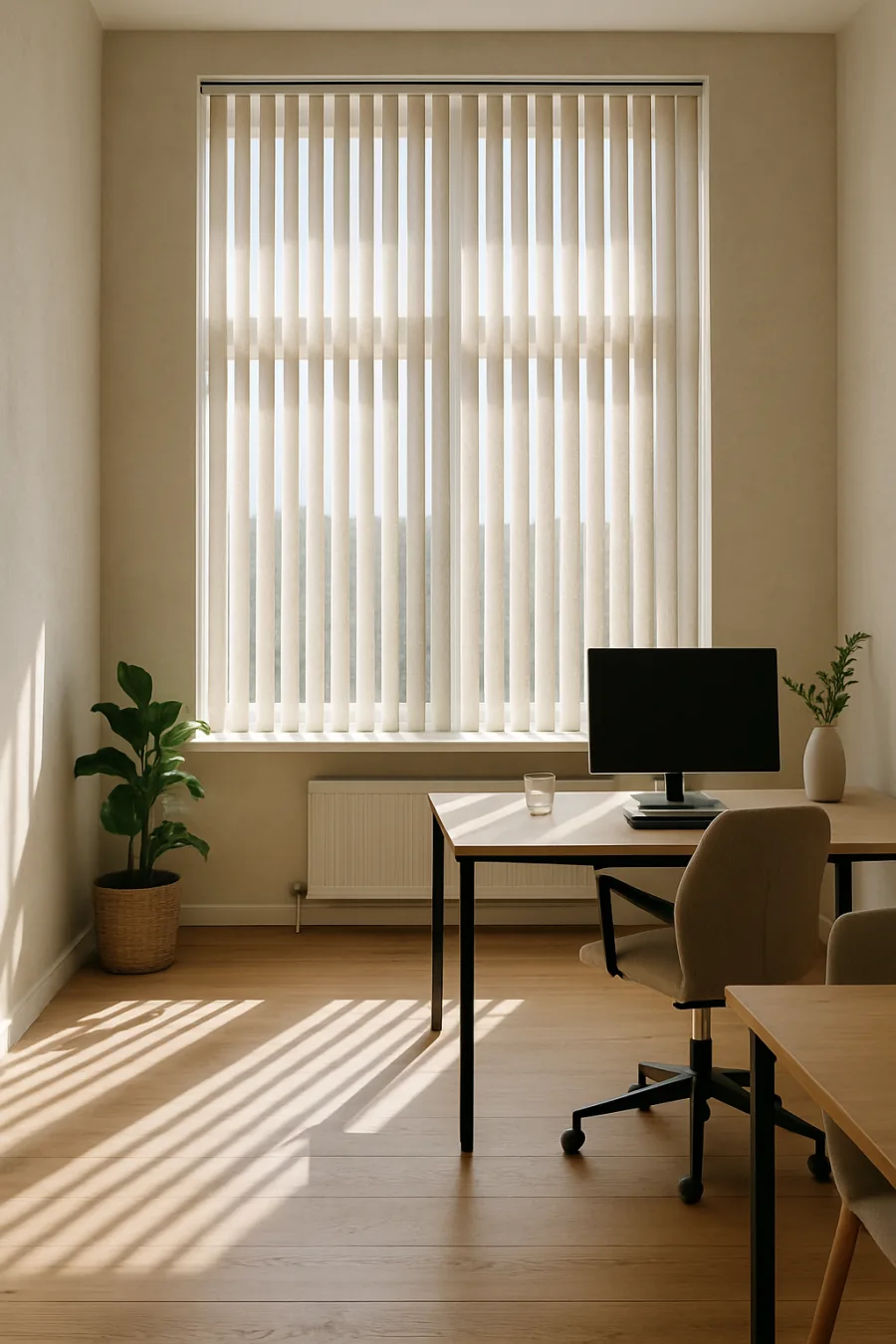











Vertical blinds with electric motor are fabric slats 89 mm on a sliding rail, where the motor performs two operations: it moves the carriers along the window and turns the slats around their axis. We manufacture them in Almaty to measure: from 7,800 ₸/m², manufacturing in 7–10 days, measurement and delivery within the city are free.
How the motor moves vertical slats: two operations instead of one
Motorised vertical blinds in Almaty perform two operations: the electric motor slides the carriers with the slats along the window and turns the slats around their axis. It is not one movement, as it seems from the button on the remote, but two separate mechanisms inside the sliding rail. One drives the carriers along the track, the other turns each slat in place. Understanding this difference removes half the questions before the measurement even starts — it becomes clear why the system needs two motors or one with two modes, and why the commands “open” and “turn” never coincide.
What slides and what turns
The carrier runner holds the slat and travels along the rail. The slat hangs on the carrier and rotates separately around its own axis. Two movements — two different commands. Sliding the slats gathers the fabric into a stack at the edge of the window: the opening is fully clear, you can step out onto the balcony or wash the glass. Turning the slats around their axis does not move anything anywhere — the fabric stays in place and only changes its angle to the light. On the remote it feels simple: one button moves, the other tilts. And on a wide opening these commands are almost always needed separately — in the morning to soften the light, during the day to clear the way out.
What the set consists of
The set includes a sliding rail with a motor, carrier runners, 89 mm slats, an electric motor and a remote control. The rail carries the whole load, the carriers guide the slats, and we select the fabric for the 89 mm slats from samples at the measurement — the density determines how the fabric hangs and how much it weighs. The electric motor has two power options: a cord from a socket or concealed wiring, or a battery on the rail itself, with no cord to the mains. At the measurement we look at the opening and tell you which option can realistically be installed.
The motor of a vertical rail performs two independent operations — it slides the carriers with the slats along the window and turns the slats around their axis.
Turning the slats without sliding: the main mode of the day
Yes, you can turn the slats without sliding them — and in motorised vertical blinds this is the most frequent command of the day. The motor rotates each slat around its axis while the carriers stay in place: the opening is still covered by the fabric, but the light passes through it differently. We call this turning without sliding and put it first on the remote and in the scenarios.
What the difference between the two operations is. Sliding the carriers along the window clears the opening entirely — this is needed when you step out onto the terrace or wash the glass. Turning the slats around their axis clears nothing, it only changes the angle of the fabric strips to the light. The practical point is simple: in the morning the fabric stands at a sharp angle, during the day the slats turn further, by evening they close completely — and all of this without a single movement of the stack.
Here are four states that are actually used:
- Open: the slats are turned edge-on to the glass, the room gets maximum light.
- Softened: the slats are at an angle, the light is diffused, the room cannot be seen from the street.
- Closed: the slats align with the plane of the window, giving maximum darkening for the chosen fabric.
- Fully slid: the carriers gather into a stack, the opening is clear.
Turning versus sliding
There is no need to slide the fabric every day. In our experience, on a wide window with panoramic glazing, sliding is ordered for a specific task — access to a balcony or terrace, access to the glass for washing — and not as a daily ritual. Turning the slats is quieter and faster: the motor rotates the axis, the carrier runner does not travel anywhere, nothing rattles and nothing bumps into the balcony door. And on a floor-to-ceiling window, when sliding, the stack of slats goes off to the side, and that is already a question of the assembly layout, not the mode.
Dense fabric and the weight of the blind
The density of the slat fabric affects two things at once: darkening and the weight of the blind. Screen and sheer are light, jacquard is denser, blackout is the heaviest of all. Heavy blackout fabric does not overload the motor by itself, but it requires matching the motor to the weight of the blind and the width of the opening: on a wide window there are more slats, and the motor carries a greater load. That is exactly why we do not sell a motor separately from the measurement — an engineer looks at the width, height and fabric and names the model to suit them. Overloading the motor comes not from dense fabric, but from a motor chosen by eye.
In everyday use, what is most often needed is precisely turning the slats without sliding: it softens the light without opening the opening.
Where the slat stack goes and how to choose the assembly layout
The layout for gathering the stack is chosen at the measurement for the specific opening, not after installation. Motorised vertical blinds in Almaty slide the carriers to one side, so the whole stack of slats ends up at the edge of the window — and the Jalusso measurer determines that edge together with you in advance, while the rail has not yet arrived from the workshop.
Three layouts
On a sliding rail the stack goes either to one side or from the centre in both directions — these are the three assembly options. A one-way layout leaves the opposite edge of the opening free. A centre-opening layout splits the blind in half, and then each sash is covered by its own group of slats.
What does this give on a wide wall? With panoramic glazing, a centre-opening layout means each half weighs less and the motor drives it more evenly. A one-way layout, on the other hand, frees up a single continuous opening — handy when you step out through it onto a terrace or wash the glass.
We choose the fabrics, the assembly side and the mounting with samples in hand: a measurement with fabric samples is needed precisely to estimate how the blind will hang on the specific window. The assembly side is not changed after installation — it is a decision of the rail, not a setting on the remote.
What stands in the way of the stack
The main reference point is the balcony door. If the stack goes towards it, the slats will run into the door leaf or the handle, and the motor simply will not reach the end. On such openings we take the stack to the opposite side, away from the sash.
The balcony door is not the only obstacle. A radiator under the window means the slats have to be kept at the right offset from the wall, and a corner with furniture or a column prevents the stack from opening fully. At the measurement we go along the whole wall and find the free side where the blind will hang without obstruction.
The layout for gathering the stack is chosen around the balcony door, the radiator and the furniture, and it is decided at the measurement, not after installation.
Tall windows and double-height spaces: ceiling or wall
On a tall window or a double-height space, a motorised rail is fixed to the ceiling or to the wall above the opening. What to choose is decided not by the installer's habit but by geometry: whether there is a flat surface above the window and how much space is left to the floor. A tall window and a double-height space require ceiling or wall mounting of the rail, and during the measurement we look at both options at once.
The difference is where the rail carries the weight from. Ceiling mounting puts the rail on a horizontal surface above the glazing — the slats then hang strictly vertically, and the motor does not pull the structure sideways. Wall mounting attaches the rail to the wall above the opening: this is done when there is a wall section of sufficient width above the window, and the ceiling is far away or occupied by a beam. A third option is the side wall: it saves you on narrow wall sections between windows, but then the fasteners and the rail are visible from the end.
Mounting table
| Where we mount it | When it suits | What to consider |
|---|---|---|
| Ceiling | There is a horizontal surface above the glazing, a floor-to-ceiling window or a double-height space | The distance from the wall to the rail and the height from which the slats descend |
| Wall above the opening | There is a wall section above the window, the ceiling is high or occupied by a beam | The width of the wall section and whether the rail will block ventilation |
| Side wall | A narrow wall section between windows or a window right next to a corner | The direction the stack folds and whether the fasteners are visible from the end |
On a tall window, 89 mm slats descend as a long fabric, and such a rail calls for a motor with a weight margin — we select it during the measurement, looking at the width and height of the opening.
Panoramic glazing is almost never hung on a single rail. A wide wall of great length is divided into sections with separate rails: each is driven by its own motor, and they can be started together from one remote control. One remote — several commands, and this is more convenient than stretching one long structure across the whole wall.
Floor-to-ceiling window and the gap
On a floor-to-ceiling window, the bottom edge of the slat comes close to the floor. We leave a gap so that the slat with its weight does not rub against the flooring when it turns and shifts — otherwise the fabric quickly starts to ripple. We calculate the gap during the measurement based on the height of the opening.
On a tall window, a motorised rail is fixed to the ceiling or to the wall above the opening, and the choice depends on whether there is a flat surface above the window and how much space is left to the floor.
Draught, open sash and the bottom chain
If the window is open and there is a draught, and the motor is running at that moment, the slats catch the airflow and swing aside — you will not get an even stack. The reason is simple: the open sash and the window handle end up in the path of the slats. So before starting the motor, clear the opening: close the sash, set the handle to the horizontal position, and only then press the button. On a short opening this takes a second; on a wide wall with several sections it is a habit that develops in a couple of days.
Wind alone does not tear the slat. The fabric hangs freely on the rail, held at the bottom by the chain, and a gust from an open sash simply pushes the fabric aside. The other thing is that the runner carriage is moving along the track at that moment and pushing the slat forward — and that is where the movement meets resistance. The motor honestly tries to complete the operation, while the slat catches on the handle or the door frame.
What the weight does
The bottom weight chain keeps the slats vertical during movement. Without it, the carriage would move but the bottom of the fabric would stay in place — the slat would simply be pulled up at the top and end up crooked. The chain runs along the bottom of all the slats and keeps them in one line so that the carriage leads an even fabric. It does not hinder the motor: the chain has its own load, the motor its own.
If a slat turns sideways
A twisted slat is not a motor failure but a consequence of starting the movement with the window open. The procedure is as follows:
- Stop the motor with the same button you started it with.
- Clear the opening — close the sash, move the handle out of the path.
- Straighten the slat by hand: turn it around its axis into an even position and check that the bottom of the chain is in place.
- Start the motor again and see whether the stack moves evenly.
If after this the slat tilts again in the same place, the cause is not the draught — most likely the carriage is not seated tightly. This is already a warranty case, and we come out for it under the contract.
An open sash and the window handle are the only obstacle you can easily remove yourself: just close the window before pressing the button on the remote.
What the kit consists of and which fabrics we fit on a motor
On a motorised rail we fit 89 mm fabric slats — and not every fabric will do here, only those that hold their shape when suspended. The kit consists of a rail with a motor, runner carriages, slats and a control unit with a remote. Power — a cable or a battery on the rail itself.
We make 89 mm slats from fabrics of different densities:
- Screen — a mesh structure, diffuses light and keeps a view of the street.
- Jacquard — denser than screen, the pattern is woven into the fabric, the room is darkened more.
- Blackout — does not let light through, the heaviest of our fabrics.
- Sheer — light and semi-transparent, for soft diffusion.
- Multi-texture — dense and transparent slats alternating, gives a different degree of privacy across the width of the window.
The density of the slat fabric affects two things at once: the darkening and the weight of the fabric. A heavy blackout fabric requires selecting a motor for the weight of the fabric — on a wide window we calculate a motor with a margin separately. That is why we come with samples: feeling the fabric on a screen is pointless, while during the measurement you can see how the fabric behaves on the carriage. For a meeting room with a window across the whole wall, we usually fit screen or jacquard — blackout is rarely needed there, while the weight of the stack on a long rail grows noticeably. In my opinion, it is not worth chasing maximum density on every opening: the motor is more expensive, and the difference in darkening does not always justify the difference in price.
We show all the fabrics mentioned during the measurement with samples, and there we also say for each opening which density will work on a motor.
How to remove the slats
The slat is removed from the carrier, and the rail with the motor is left untouched. It is enough to detach the fabric from the runner — the motor itself, the wiring and the settings stay in place. The slats can be washed, but do not dry them in the machine: the fabric shrinks and stops hanging evenly.
Almaty dust gets into the structure of the fabric, so once a season it is worth taking the fabric down and going over it with a vacuum cleaner on a soft brush. Washing — as needed, without aggressive products. A sagging slat is then simply rehung on the carrier by the Jalusso installers — the mechanism allows this without taking the rail apart.
Slats 89 mm wide made of fabrics of different density — screen, jacquard, blackout, sheer and multi-texture — are the very filling that determines both the darkening and the weight of the fabric on the motor.
Control: remote, switch, smartphone, schedule
The remote control is included with vertical blinds with an electric motor — we do not charge for it separately, nor for the initial setup of scenarios. Radio control with a remote lets you control the slats from one point: you stand at the kitchen table and close a window at the other end of the living room. If that point is inconvenient, we move the button to the wall.
The control methods come down to four, and at the measurement we select them for your daily routine:
- Remote control — the basic option, one per unit, one shared for several rails.
- Wall switch — placed where your hand reaches on its own: by the entrance to the meeting room, by the door to the terrace.
- Smartphone control — for when the remote is forever disappearing under the sofa cushions and the phone is always at hand.
- Schedule — opening and closing by time without your involvement.
The set of commands does not depend on the power source. A mains-powered motor 220 V and a battery-powered motor accept the same commands; the only difference is where the energy comes from.
Remote, switch, smartphone
A wall switch is especially helpful on a tall window and on a double-height wall: you cannot reach the rail, but the button is right there, at hand. For a long glazed wall, one wall switch for everything is more convenient than a shelf of remotes. What is more, the switch can be installed during installation rather than redone later.
Schedule and scenarios
Scheduled control saves you from opening by hand in the mornings: the slats part at a set time while you are still drinking your coffee. Integration into a smart home lets you build scenarios — for example, in a meeting room the slats close on their own before a presentation. This is a typical situation that we work through on a panoramic window in a meeting room: one press starts the whole wall.
About noise, I will be honest: the motor runs quietly, but in the complete silence of a bedroom the sound of the motor is audible. The volume depends on the weight of the fabric and the motor model, so at the measurement we look at the specific opening. For a bedroom we usually take slats on a lightweight fabric.
For children and pets, vertical blinds with a motor are safer than manual ones: there is no hanging chain to pull. The slats move on a command from the remote, not from an accidental tug.
Vertical slats can be controlled with a remote, a wall switch, a smartphone and on a schedule, and scenarios are built in a smart home.
A panoramic wall and several rails on one remote
Panoramic glazing is rarely covered with a single rail: we divide a wide wall into sections, and each section has its own rail with a motor. There can be one remote for all of them. The carriers travel within their own section, the stack gathers at its own edge, and the command reaches all the motors at once — the wall closes evenly, without skewing to one side.
Sections and one remote
Sections are made along the glazing mullions and along the wall piers. Each rail gets its own motor, but we set up the radio control so that one remote runs the whole wall. It can also be separate: in the living room, open only the part where the sofa is, and leave the rest closed from the sun. This logic will also come in handy in a meeting room and in an open-plan office.
Power: mains or battery
A mains-powered motor 220 V runs from a socket or concealed wiring — it is more convenient to lay the wiring during renovation, so the cable goes into the wall. A battery-powered motor runs on a battery without a wire to a socket. We install a battery where there is no socket or you do not want to chase the walls: on a finished renovation the difference in installation is noticeable, and we explain it at the measurement when we see the wall.
Bay window and corner
About a bay window and a corner window, I will say it straight: we do not offer them as a ready-made solution. A corner breaks the line of the rail, and how the slats will lie at the turn depends on the geometry of the opening. We look on site, work through the design together with the measurer and honestly say what will work and what will not.
Meeting room case
A classic situation is a panoramic window in a meeting room. Here the slats close automatically before a presentation: one remote, one scenario for all sections. In a shop window the logic is different — in the morning one press opens the fabrics along the whole line of glazing, because reaching for each section by hand is slow and inconvenient. The motor is selected for the weight and width of the fabric, and on a wide wall this is no longer one item but several.
A mains-powered motor runs from a socket or concealed wiring, a battery-powered one runs on a battery without a wire to a socket, and panoramic glazing is divided into sections with separate rails that are started together from one remote.
How much it costs and how long to wait
The price list item “Blinds with an electric motor” — from 7,800 ₸/m², manufacturing 7–10 days. We make vertical blinds with an electric motor in Almaty in our own workshop, so the lead time is counted from the measurement and does not depend on supplies of ready-made products: we do not keep ready-made ones in stock, every fabric is assembled for a specific opening.
Several things affect the price. The type of motor: mains-powered at 220 V or battery-powered. The presence of a remote and integration into a smart home. The density and texture of the slat fabric — blackout is more expensive than screen. And the size of the opening: the wider the fabric, the more fabric is used and the more powerful the motor needs to be.
| What affects the price | How exactly |
|---|---|
| Motor type | mains-powered 220 V or battery-powered |
| Control | remote, switch, smartphone, scenarios |
| Slat fabric | screen, jacquard, blackout, sheer |
| Size of the opening | section width and window height |
| Mounting method | ceiling, wall, no drilling |
During the measurement we select the motor to match the weight and width of the fabric — this is the first step in the quote. Installation of a rail with a motor is priced by the area of the product and the mounting method. It costs 4,500 ₸ per product, and for orders from 150,000 ₸ we install for free.
What's included in the price
Jalusso doesn’t charge separately for measurement and consultation — they are always free, and its measurer arrives with fabric samples so you can choose the density on the spot, not from a picture. Delivery within the city is free too.
The mechanism is covered for three years and installation for one year, counted from the day the acceptance report is signed. If the motor or rail fails under warranty, we fix it free of charge within 5 working days. After the warranty we still come out: to tighten, adjust, replace a failed motor or unit. The warranty does not cover mechanical damage, cases where the product was reinstalled on your own, exposure to water, and fabric fading over time.
Suburbs
We travel to Kaskelen, Talgar, Issyk and Kapshagay. We tell you the cost of the visit in advance — the price depends on how far it is, and there are no surprises afterwards.
The fabric is assembled in our workshop in Almaty, so the manufacturing time for motorised vertical blinds is 7–10 days.
What happens without power and how to care for a motorised rail
When the power goes out, the slats stay in the position they were in when it happened. Nothing slides apart, sags or falls — the motor simply stops receiving commands. A battery-powered motor in this situation keeps working from the battery as long as it has charge.
What to do next depends on the motor model. Some motors have a manual release: the slats are moved by hand and the opening is cleared. Others don’t have this option. We show you the manual opening method during the measurement so you know what to expect in your own apartment, rather than finding out at the moment of a power cut. We won’t promise that any motor releases the slats by hand — that’s not the case.
Power cuts are a rare scenario. What worries owners far more often is something else: whether to touch blinds that are already up. Motorising an old rail is possible, but it depends on its design on site. Sometimes it’s enough to replace the mechanism with a motorised one. Sometimes the rail itself isn’t designed for the load of a motor, and then it’s cheaper and more reliable to install a new product. We don’t give the 3-year mechanism warranty on someone else’s structure — only on our own product.
Manual opening
The procedure is this: make sure the power is really out and not just a tripped breaker, then find the manual release on the motor. Its location and method depend on the model — on some it’s a lever under the rail housing, on others a rod on the side. During the measurement we show you this part on a sample so your hand remembers the movement.
Caring for the fabric and rail
Almaty dust and hot summers are the main enemies of slats. In summer the fabric fades in the sun, in winter dust settles on it, blown around the room by radiators. A 89 mm slat is removed from the runner one by one, and the rail with the motor is left alone: take off the fabric, vacuum it with a soft brush attachment or wipe it with a dry cloth, hang it back. Wet cleaning is done rarely — water makes the fabric lose its shape, and the 3-year mechanism warranty doesn’t cover natural fading. A motorised rail needs no care itself: once a year it’s worth calling a technician to tighten the fasteners and check the movement of the runners.
How motorised vertical blinds differ from manual and from horizontal ones
The difference between manual vertical blinds and vertical blinds with an electric motor is who does the work. With manual ones you pull the cord or chain yourself: first you move the runners along the sliding rail, then you turn the slats with a separate cord. With motorised ones both operations are done by the motor on command from the remote. The mechanics are the same, but the effort is zero. That’s exactly why on a wide opening, where the fabric is long and heavy, a motor stops being a luxury.
It’s worth separating two similar things: a sliding rail for slats and an electric curtain rail for drapes. The names are close, the designs are different. A sliding rail carries the runners on which 89 mm slats hang, and the motor here not only moves them along the window but also turns each one around its axis — while an electric curtain rail doesn’t control slats at all, it simply draws two heavy curtains apart. Need to turn the light — that’s vertical blinds. Need to draw the drapes — that’s an electric curtain rail.
Motorised horizontal blinds are built differently. Their motor tilts the slats and raises the whole fabric up to the rail. With vertical ones the fabric doesn’t rise: moving the slats gathers it into a stack at the edge of the window. That’s where the different openings come from — horizontal ones are good on an ordinary window, vertical ones work at heights and widths you can’t reach by hand.
Comparison table
| What we compare | Manual vertical | Motorised vertical | Motorised horizontal | Electric curtain rail for drapes |
|---|---|---|---|---|
| What the motor does | No motor, you pull by hand | Turns the slats around their axis and moves the runners along the window | Tilts the slats and raises the fabric up | Draws two curtains apart |
| Where the fabric gathers | Stack at the edge of the window, by hand | Stack at the edge of the window, on command | Rises up to the rail | Stays hanging, only the gap changes |
| For which opening | A low window that’s easy to reach | A tall window, double-height space, panoramic glazing, shopfront | An ordinary window of standard height | A wide opening for drapes |
Meeting room and shopfront
In an office meeting room and a shop window, motorised vertical blinds are more practical than manual ones for a simple reason: the slats are operated every day, often several times. By hand that’s slow, and on a tall window also awkward — you have to reach. A remote or a button on the wall solves the problem. In a meeting room the scenario is convenient to link to a presentation so the slats close on their own. Against roller blinds in a meeting room, the choice more often falls on vertical ones when the opening is wide: it’s easier to divide one glazed wall into sections with separate rails and operate them together than to hang many narrow roller fabrics.
The motor of a vertical rail performs two operations — moving the carriers along the window and turning the slats around their axis, whereas on horizontal blinds it tilts the slats and raises the fabric.
When motorised vertical blinds are not the right fit
Short answer: vertical blinds with an electric motor suit most straight openings, but for a bay window or a corner window we do not offer them — there the solution is chosen during the measurement. The reason is simple. A sliding rail guides the carriers along one straight line, and the slats hang in one plane. At a corner this line breaks, and when sliding, a slat runs into the neighbouring window section.
A bay window and a corner window are not the only limitation. A tall window and a double-height space also need attention, but for a different reason: there the issue is not geometry but mounting. A tall window and a double-height space require ceiling or wall mounting of the rail, and not every opening has a surface to which a rail with a motor can be securely fixed. If a beam or a narrow reveal runs above the window, the mounting is chosen individually.
What else is worth checking before ordering:
- an opening with several turns and niches where the rail has nowhere to sit in a straight line;
- an area where the stack of slats runs into a balcony door or furniture and there is nowhere to move it;
- a very heavy, dense fabric at a large width — the motor is matched to the weight and width of the fabric during the measurement, and not every weight is suitable for a standard rail.
What can only be decided on site
The design of the rail, the side the stack gathers on, the mounting and the choice of motor for the weight of the fabric — these are four things that cannot be decided from a photo or over the phone. The measurer comes with fabric samples, looks at the opening and calculates the cost on site. Consultation and measurement are free at any time, and delivery within Almaty is also free.
More often I have to talk people out of not the motor but the layout they have already pictured in their head. In person everything is simpler: we look, we work out the side the stack gathers on — and the solution is found.
For a bay window and a corner window we do not offer vertical blinds with a motor — the solution is chosen during the measurement.
FAQ
Short answer: what matters is not the opening itself but the combination of the opening, the weight of the fabric and the space for the rail. We motorise straight windows — from standard to floor-to-ceiling and double-height windows; for a bay window and a corner window we do not offer vertical blinds with a motor, there the solution is found on site. During the measurement the measurer comes with fabric samples, looks at the width, the height, what is above the opening and to the side, and chooses the motor based on that. The mounting, the side the stack gathers on and the type of motor are decided in one conversation at the window, not from a photo.
Yes, you can turn the slats without sliding them, and for a living room this is the main command. The fabric stays closed, only the angle of the slats around their axis changes — the room is no longer on view, but light still comes in. Sliding is needed less often: to step out onto the terrace, wash the glass or let in a lot of air.
It is best not to run the motor with the sash open. The sash and the window handle end up in the path of the slats, and the airflow pushes them aside. The order is simple: close the window, wait for the slats to settle, then give the command.
How many rails you get on panoramic glazing depends on the width of the wall and how it is convenient to divide it. We split the wall into sections, each with its own rail with a motor, and they can be started together from one remote control. In a shop window this noticeably saves the morning, when otherwise every fabric would have to be opened by hand.
It is possible to motorise vertical blinds that are already installed, but not always: it all depends on the design of the rail on site. We check whether a ready-made motor will fit or whether the rail needs to be replaced, and we do not give a warranty on someone else's design — we are responsible only for what we installed ourselves.
The warranty on the mechanism is 3 years, on installation — 1 year. We fix warranty cases free of charge within 5 working days, and after the warranty we still come: to tighten, adjust, replace a motor that has failed. Installation costs 4,500 ₸ per item; for orders from 150,000 ₸ we do not charge for it.
Conclusion
The motor of a sliding rail does two things: it moves the carriers with the slats along the window and turns the slats around their axis. This is what vertical blinds with an electric motor in Almaty are — not a “smart” add-on to an ordinary design, but two separate movements, each with its own command from the remote control. Understanding this pair of operations removes half the questions before the measurement.
Turning the slats without sliding them is the main mode of the day. It covers the light without freeing the opening, and it is the one you will press most often. Full sliding is needed less often: to step out onto the balcony, wash the glass or let in more air. If the room has a balcony door, count how many times a day you open it — this determines how often the stack will travel along the wall.
The layout of the stack is chosen during the measurement, around the door, radiator and furniture. After installation the side cannot be changed: the carriers are already set apart, the rail is fixed. This decision is made once, together with the measurer, when he sees the opening and what is in the path of the slats.
On a tall window and in a double-height space, the rail with a motor is mounted to the ceiling or to the wall above the opening. We divide a wide glazed wall into sections with separate rails — they can be started together from one remote control. And on a panoramic wall this is not a luxury but a way to avoid running along the window with a button.
Price position — from 7,800 ₸/m², manufacturing 7–10 days. Measurement and delivery within the city are free, installation 4,500 ₸ per item, and for orders from 150,000 ₸ installation is free. Warranty on the mechanism 3 years, on installation 1 year.
There is one practical recommendation: book a free measurement with fabric samples. The measurer will match the motor to the weight and width of the fabric, determine the layout of the stack and the mounting for your opening — and give you the exact cost on site.

