








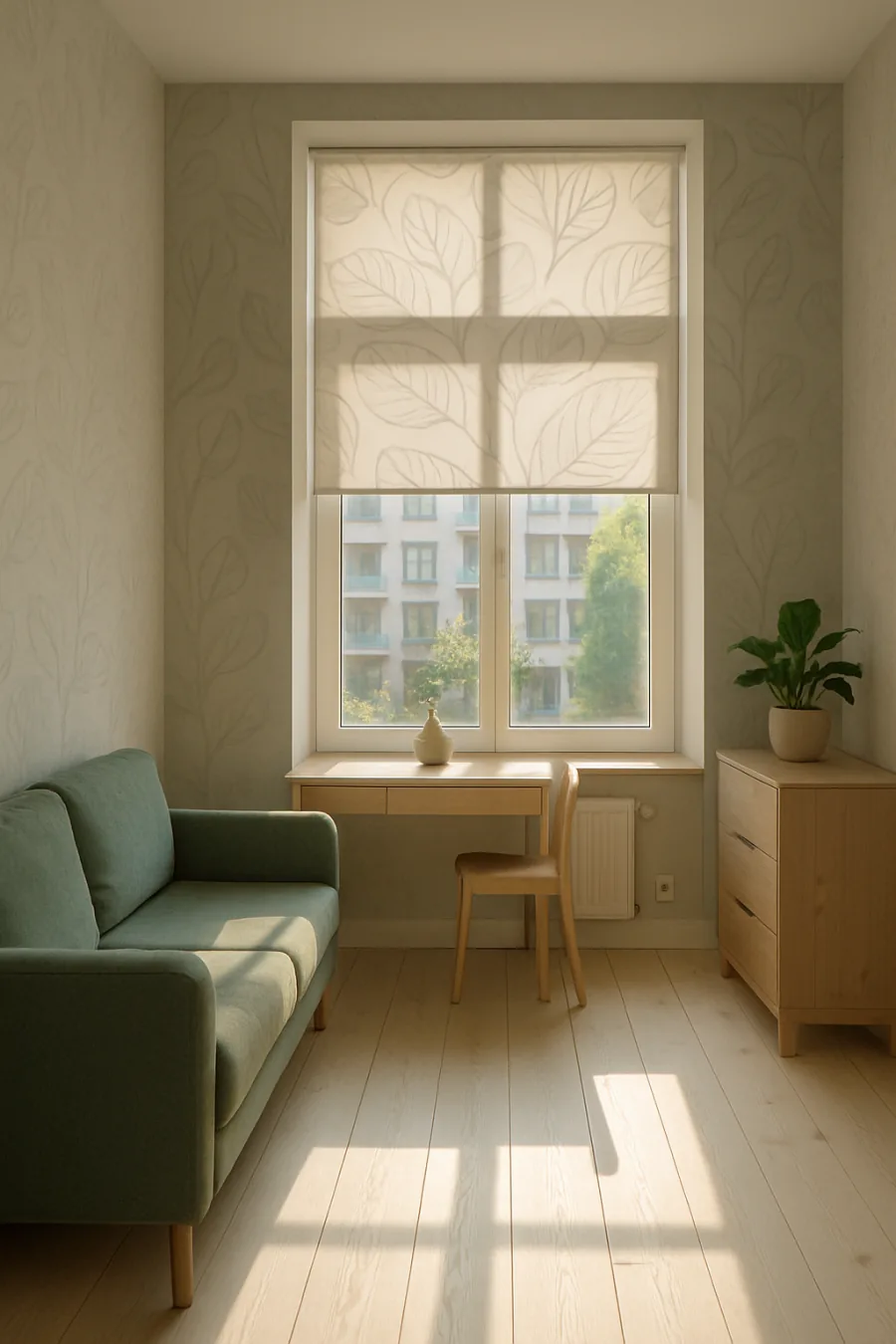











We choose blinds for a child's room in Almaty by the control type, not by colour: side handle, tensioned chain, spring mechanism on the sash or electric motor. During the day, dense fabric fitted close to the glazing bead darkens the room, but internal systems don't give full darkness. We quote based on measurement and manufacture in our own workshop.
What safe control means for a child's room
Safety in a child's room is determined not by the colour of the fabric but by where the control is placed and whether a loose cord hangs at the bottom. We come to this conclusion at every measurement: parents choose the shade, but the mechanism is what needs deciding. Blinds for a child's room require controls without freely hanging cords — otherwise any string a child can reach will sooner or later end up in their hands. Children's blinds start with the question: what exactly is hanging at the window.
The idea of safe control is simple: all moving parts are either kept out of reach or tensioned so they can't be pulled or wrapped around anything. Hanging cords are the main source of risk in a child's room, and that's exactly what Jalusso avoids when selecting a system.
Four types of control and what's left hanging at the bottom
- Side handle: the control is on a bar at the side of the fabric, nothing hangs at the bottom. With horizontal aluminium blinds that have this handle, a child can't pull a cord — there simply isn't one.
- Tensioned chain: the chain is secured with a tensioner so it doesn't dangle or form a loop. A tensioner is a bracket that attaches the chain to the frame or window reveal and keeps it taut. In a child's room, a chain is only acceptable when tensioned.
- Spring mechanism: the fabric goes up with a press on the bottom rail, no cord. This mechanism is mounted on the sash — there's nothing to pull down.
- Electric motor: runs on 220 V or a battery, controlled by a remote or a wall switch. The cord and chain disappear from a child's reach entirely.
What changes with age
A toddler pulls at everything hanging at arm's level: at this stage, the most important thing is that nothing dangles down low. A preschooler already tries to open the window on their own — here a child lock on the handle helps too, and the blind should not stop the sash from moving. A schoolchild adjusts the light at their desk themselves: tilting a slat or sliding the strips is easier for them than for an adult, and this is no longer about risk, but about independence. As the child grows up, the system is usually not replaced — only the habit of using it changes.
In a child's room, safety is set not by the material, but by where the controls are and whether a freely hanging cord is left down low.
How to darken the room for a daytime nap and where light still gets through
A daytime nap is best covered by a dense fabric fitted right up against the glazing bead with an overlap along the edge. Even then, the room will not be completely dark. Internal blinds for a child's room do not provide full darkening during the day: light still comes through along the edges of the fabric, at the glazing bead and along the sides of the window. Blackout reduces light leaks, but does not remove them completely.
Day-night blinds adjust the light level by sliding the strips: during the day the strips are spread apart and the room is bright, by bedtime they are brought together and the light is gone. This is convenient if the child sleeps at different times. But even here a thin strip of light remains along the edge — it is noticeable once your eyes have adjusted to the semi-darkness.
Where exactly the light comes through:
- along the bottom edge of the fabric, if it does not reach the windowsill
- at the glazing bead, when the fabric is not fitted right up against it
- along the sides, if the fabric is narrower than the opening
- through the gaps between the sash and the frame — no fabric can fix that
Combining blinds with heavy curtains into one setup makes little sense. A curtain covers the same edges as the fabric, while more dirt and dust build up in the room. If a daytime nap just is not happening, it is more honest to say this: we cannot make a child's room completely dark during the day, that requires external systems, not internal ones.
We usually suggest a compromise: a dense fabric fitted right up against the glazing bead plus an overlap along the edge — that is enough for a child to fall asleep. In my view, chasing absolute darkness in a child's room is not worth it at all: in the morning it is easier for a child to wake up when there is light in the room.
Why there will be no complete darkness
An internal system sits inside the room, while light comes from the street past the fabric: through the gaps at the edge, at the glazing bead and between the sash and the frame. Dense fabric blocks the main flow, but not all the gaps. External systems cover the window from the street and are therefore darker, but that is a different design and different installation. We will not promise full darkening with internal blinds — in a child's room this matters, because parents end up disappointed.
The material does not solve the darkness question by itself. A dense fabric fitted right up against the glazing bead with an overlap along the edge reduces light leaks more than any blackout promise, and it is the density and the fit that determine how dark the room will be.
Horizontal aluminium, day-night or pleated: what matters in a child's room
The choice between systems is decided not by colour, but by what the child will do with the fabric. Horizontal aluminium blinds for a child's room are chosen where the slats get touched by hand: they do not crease from contact and can be wiped with a damp cloth in place.
| System | The task in a child's room | Control | Which window it suits |
|---|---|---|---|
| Horizontal aluminium | slats get touched, bent, splashed | side handle, taut chain | standard sash |
| Day-night | smoothly change the light during the day and in the evening | chain or electric motor | standard sash |
| Pleated blinds | cover a window of complex shape | handle, holds position at any point | arched, sloped, roof windows |
Horizontal aluminium blinds use a side handle instead of a hanging cord, and this is their main argument for younger children. Here slats are replaced one at a time: bend one — you do not need to redo the whole product.
Day-night blinds are built differently — it is a two-layer fabric, and it adjusts the light level by sliding the strips. In the morning you let in more light, by naptime you close them tight. Parents who want to change the light all day long most often choose this system.
Pleated blinds are cut to fit arched and sloped windows, mount directly on the sash without drilling and hold their position at any point of the lift. For a non-standard opening in a child's room, this is the only one of the three that follows the contour.
And what about roller blinds? We rarely install them in a child's room: the fabric lowers as a single flat sheet, the slats cannot be touched, but light also gets through along the edge just like with other internal systems. If the window is even and you just need to cover the glass — it is a workable option. On an arched window a roller system will not fit at all.
An electric motor in a child's room is not overkill if there is a toddler in the room. The motor removes the cord and chain from the child's reach completely: control moves to a remote or a wall switch. It runs on 220 V or on a battery that charges itself. Jalusso recommends the battery version for a child's room: no need to run a socket, and the wires stay hidden in the room.
In our workshop, for a child's room the most frequently ordered are horizontal aluminium with a side handle and day-night on the sash. In terms of price, these are from 4,200 ₸/m² and from 7,300 ₸/m², pleated — from 9,800 ₸/m², electric motor — from 7,800 ₸/m². The measurer shows samples, and parents themselves pull the handle, tug the fabric, and see how the system moves.
To sum up: horizontal aluminium is chosen where the child touches the slats by hand, day-night — where it is important to change the light smoothly, pleated — where the window is of non-standard shape.
Blinds or curtains in a child's room: what covers the window better
A window in a child's room can be covered in different ways, and the difference shows not on the first day, but after a month: blinds take up the windowsill and do not lie on the floor, while a heavy curtain hangs all the way down to the floor and collects dust along its whole length. For a child's room this is the main difference.
Take an ordinary day. The child comes up to the window, touches the fabric, then puts a toy car on the windowsill, then drops it behind the radiator. Horizontal aluminium blinds hold up in this situation: their slats withstand contact and can be wiped with a damp cloth right on the window, without taking them down and without washing. A curtain in the same situation is taken down entirely, washed, ironed and hung back — and that is no longer a five-minute job.
Let's compare the second point — what hangs down low. With a curtain it is the free edge of the fabric, and it ends up exactly where the child plays on the floor. With blinds on the sash, nothing hangs down low: the fabric ends inside the profile. Dust and allergies work against long fabric here — it accumulates dust over its whole area, not on a single flat surface that you wipe with a sponge.
As for caring for blinds, it is predictable. Wipe the slats — and that's it. Fabric requires careful handling without machine washing: fabric with a coating is cleaned with a vacuum cleaner or a sponge, it must not be soaked, and water is not covered by the warranty at all.
A calm answer to “aluminium is not recommended for a child's room”
Aluminium slats don't tear and don't mind moisture; they only bend under strong pressure. A child can easily bend one slat — but a single slat is replaced without replacing the whole structure, and the blinds stay on the window.
In the end, people choose blinds for a child's room not because they are “better” in general, but because looking after them in a child's room takes just a few minutes.
How much it costs to cover a window in a child's room and what the price depends on
The price of a covered window in a child's room is calculated from the area and the material, not from the colour. Horizontal aluminium — from 4,200 ₸ per m², day-night — from 7,300 ₸ per m², pleated — from 9,800 ₸ per m², blinds with an electric motor — from 7,800 ₸ per m². Installation of blinds in a child's room is 4,500 ₸ per item, and if the order comes to 150,000 ₸ or more, we hang them free of charge.
| System | Price | Manufacturing time |
|---|---|---|
| Horizontal aluminium, slat 25 mm | from 4,200 ₸/m² | 3–5 days |
| Plastic, PVC, slat 25 mm | from 3,600 ₸/m² | 3–5 days |
| Day-night, two-layer fabric | from 7,300 ₸/m² | 5–7 days |
| Pleated blinds, pleated fabric | from 9,800 ₸/m² | 7–10 days |
| With electric motor | from 7,800 ₸/m² | 7–10 days |
| With a pattern, photo printing on the blind | from 8,900 ₸/m² | 7–12 days |
Manufacturing time depends on the item: aluminium and plastic leave the workshop in 3–5 days, day-night — in 5–7, pleated and electric motor — in 7–10, printing on fabric — in 7–12.
How the control and the mounting change the price
A measurement for a child's room ends not with a conversation but with a cost calculation on the spot, so you see the total before you order. Then coefficients are applied to the price per m². Mechanical control is charged per unit, chain — ×1.06, electric motor — ×1.85, electric with remote control — ×2.1. Mounting is also calculated as a multiplier: on the wall — ×1, on the frame — ×1.05, without drilling — ×1.1, cassette system — ×1.28. Installation without drilling costs more than wall installation precisely because of this coefficient — but the frame stays intact.
Example calculation per price list
A window of 1.4 m² in a child's room, horizontal aluminium, mounted in the glazing bead without drilling. We take the base 4,200 ₸ per m², multiply by the area and by the coefficient 1.1 — that gives a range we calculate from. We add installation at 4,500 ₸ per item: below the threshold of 150,000 ₸ it is chargeable. The measurer gives the exact amount on the spot, because the width of the opening, the shape of the window and the chosen control are added to the area.
What about the warranty
The mechanism is covered by a 3-year warranty, installation — by a 1-year warranty; the count starts from the day the acceptance certificate is signed. We allow 5 working days to fix a warranty fault in children's blinds, and the client pays nothing for it. The warranty does not cover mechanical damage, re-installation on your own, water and natural fading of the fabric. Once the warranty period has ended, you can still call us: we will tighten the mountings, adjust the movement, and fit a new cord or chain.
The amount for a covered window in a child's room is given by the measurer on the spot, not by a calculator on the website.
Materials for a child's room: what we use and what we don't recommend
For a child's room we recommend aluminium and PVC where the child touches the slats with their hands, and impregnated fabric where soft, diffused light matters more. We don't recommend wood and bamboo in a child's room: they are sensitive to moisture and require a dry cloth only, and in a room where a child may spill water or reach out with wet hands, that is an unnecessary risk rather than a solution.
Here is what we use and how to care for each material:
- Aluminium slats 25 mm. They don't crease when touched and don't mind moisture. Care: a damp cloth with a mild product, right on the window. A single slat is replaced if a child bends it.
- Plastic slats 25 mm. Cheaper than aluminium, but plastic doesn't mind water either. Care: the same damp cloth. Scratches from toys are more noticeable than on metal.
- Impregnated fabric. It doesn't collect dust the way a heavy curtain does. Care: a vacuum cleaner with a soft brush attachment or a sponge, without soaking. It must not be washed in a machine — the impregnation washes out, and the warranty does not cover water.
- Pleated paper. A budget option, installed within a matter of days. Care: a dry cloth or a soft brush; it doesn't tolerate water.
Children's blinds made of aluminium and PVC are washed with a damp cloth, impregnated fabric is cleaned with a sponge or a vacuum cleaner, and wood and bamboo are best not used in a child's room at all.
Choosing by age and furniture by the window
The child's age determines the requirements for the control and the material: for a toddler it matters that nothing hangs down low, for a preschooler — that the window doesn't open under the fabric, for a schoolchild and a teenager — that there is something to adjust the light at the desk with. Furniture by the window affects the choice of system and the installation height: a bed and a desk get on differently with the same fabric. And we discuss the colour of the fabric with the parents last of all. Because no one will want to change it in two years, and the requirements will have had time to change by then.
At what age does a child reach the control? As soon as they get on their feet and start walking — that is, at about one year. Before that, any system will do; after that, it won't. A toddler pulls at everything that hangs and swings: a chain and a cord are the first thing that interests them in the room. What should be changed when they grow up? Nothing will have to be changed if you take a system right away where the control is brought out to a side handle or to a spring mechanism. A preschooler tries to open the window: what matters here is not the system itself, but that the fabric doesn't get in the way of the sash handle and doesn't block the child lock. A teenager adjusts the light at the desk themselves, and they need the slats to tilt or the strips to move, not a fixed position once and for all.
A bed by the window
If the headboard is right up against the windowsill, day-night and pleated blinds will work: their fabric moves along the guide rails and doesn't hang over the pillow. Horizontal aluminium with a side handle is also installed, but a low bed is best moved away from the windowsill by at least a hand's width, so that the child doesn't reach for the slats from a lying position. We calculate the installation height from the top of the headboard, not from the floor.
A desk and a computer
For a schoolchild and a teenager, what matters most is the light on the screen and on the notebook. During the day, tilting the slats gives diffused light without glare: it isn't dark at the desk, and the sun doesn't hit the screen itself. In the evening, dense fabric covers the window from streetlights and cars in the yard. A desk by the window is a common reason to choose day-night: the strips change the light level smoothly, without moving anything on the windowsill.
Jalusso manufactures blinds for a child's room in Almaty to measure, so it fits the width and height of the system to the furniture, not the other way round: what won't get boring in a couple of years is a neutral fabric and a control that works without effort.
Mounting without drilling: the frame stays intact, for a rented flat and a new build
You don't have to drill the frame. The brackets go into the glazing bead — the strip that holds the glass unit in the sash, and it can be removed and put back without tools. Mounting without drilling keeps the frame free of holes: the window hardware is untouched, and our warranty covers only our product and installation and does not replace the window manufacturer's warranty.
How it looks step by step
- The measurer looks at the glazing bead and checks whether it can be removed on your sash — on some profiles the strip sits tight.
- The brackets go into the groove of the glazing bead, and the glazing bead goes back in place.
- The fabric is hung, and we check the movement and the fixing.
- The sash opens and closes as before — the mechanism doesn't get in its way.
For a rented flat this is a standard option: when you move, the system comes off together with the glazing bead and goes with you, leaving no marks on the frame. In a new build the logic is the same — the windows are under warranty, and we don't touch them with a single hole.
Ventilating the sash still works: the blinds hang on the sash itself and move with it. Pleated blinds are mounted on the sash without drilling, and the concertina fabric doesn't get in the way of turning the handle. What's more, on narrow sashes this is the only way to cover the window without running into the window reveal.
What if there’s a child lock on the handle? We remove the handle, install the blinds, and put the lock back. We choose the order of the brackets and the height so that the lock doesn’t stop the blind from moving.
Mounting into the glazing bead leaves the frame without holes, so it’s chosen both in a rented apartment and in a new build where the windows are still under warranty.
Measurement and installation: how it goes and what to look at on site
Measurement and consultation are always free with us, and at this stage parents decide more than when looking at a catalogue on their phone. The measurer arrives with samples: you can touch the aluminium slat, the day-night fabric and the pleated blind, pull the control and understand what will actually end up in your child’s room. And that’s more honest than any picture.
After that, everything goes step by step.
- You message us on WhatsApp — give the approximate window size and your city. We reply with a time that suits you.
- The measurer arrives with samples, looks at the window, the sashes, the windowsill and where the bed or desk is.
- On site, they calculate the cost — turning the price range from the price list into a specific sum for your window, taking into account the control and the mounting.
- We agree on the system, the control and the mounting; you get the manufacturing time for the chosen item.
- The workshop makes the product, then the installer arrives and mounts it on the window.
What to look at on site: how the control behaves when you pull it by hand; whether a cord is left hanging at the bottom; whether the blind catches the windowsill or furniture. Non-standard windows — arched, slanted, attic — the measurer measures separately and cuts the pleated blind to the shape, because such a window can’t be calculated from a photo.
We travel to the suburbs: Kaskelen, Talgar, Issyk, Kapshagay. We tell you the call-out cost before we set off, so the sum doesn’t grow on the way. Within the city, measurement and delivery are free.
The measurement ends with an exact cost calculation on site, not a price list on the website.
Care, repairability and warranty
If a child bends a slat, you don’t need to replace the whole structure. With horizontal aluminium blinds, the slat is replaced one at a time, not the whole blind. That’s what repairability means in everyday terms: the damaged element is taken out of the ladder and replaced, and the rest stays in place.
What actually holds up in a child’s room? Aluminium slats don’t crease when touched and are wiped with a damp cloth right on the window. A pulled fabric blind with impregnation is cleaned with a sponge or a vacuum cleaner, without soaking — water and machine washing harm it. We don’t use bamboo or wood in a child’s room: they’re sensitive to moisture and need a dry cloth only.
A short list for caring for blinds in a child’s room:
- Aluminium and PVC — a damp cloth with a mild product every couple of weeks, dust doesn’t build up between the slats.
- Fabric blind with impregnation — a sponge or a vacuum cleaner on low power, without soaking.
- Spring mechanism and side handle — wipe the housing, no lubrication needed.
- A bent slat — replaced separately, it’s not a warranty case, but it’s also no reason to replace the whole product.
On warranty, we’re straight with you: 3 years on the mechanism and 1 year on the installation from the date the acceptance report is signed. Fixing a warranty case in a child’s room takes up to 5 working days, and you don’t pay for it. After the warranty we still come — to tighten the mounting, adjust the tensioner, replace the cord or chain. What we don’t cover: mechanical damage, re-installation on your own, water and natural fading of the fabric. A blind soaked from a watering can or washed in a machine is no longer a warranty case.
The warranty on the product and installation is ours; we don’t extend it to the plastic window itself.
A pattern on the blind and a colour that won’t get boring
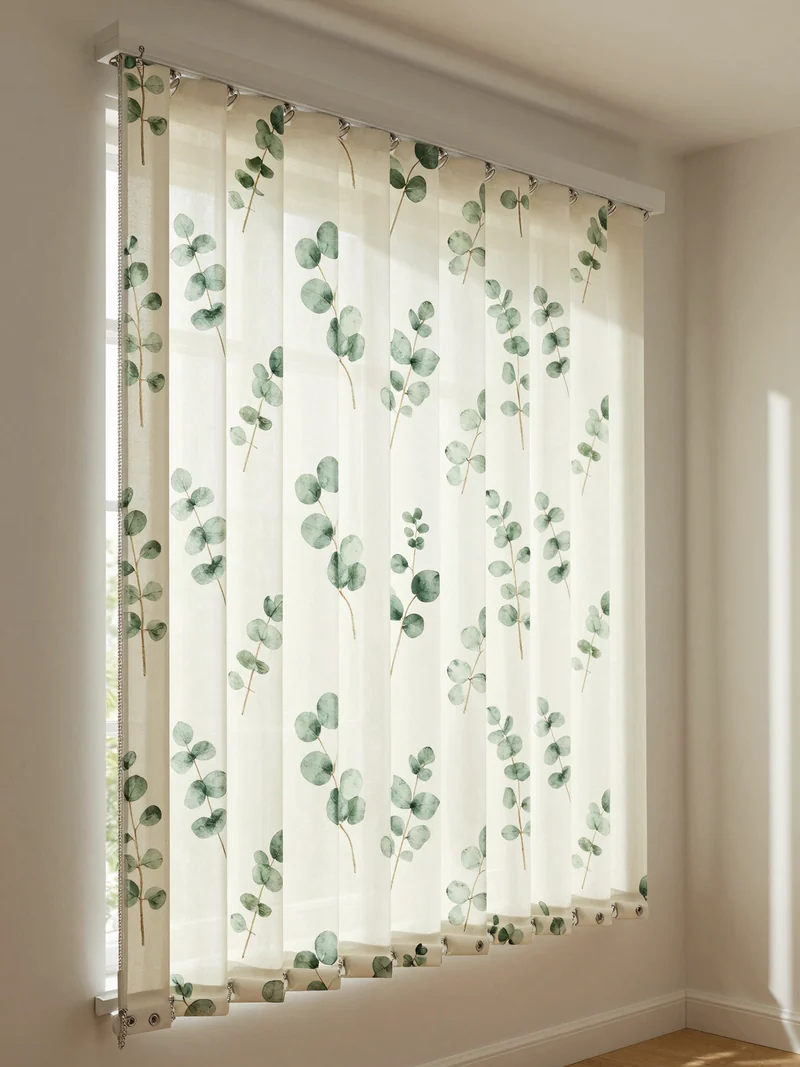
We make children’s blinds with a pattern by photo printing on the blind: we take the design from the catalogue or print your own artwork — a drawing from the wall, a picture from a book, anything, as long as the file is of good resolution. Photo printing is applied to a blind with impregnation, so such a blind is wiped with a sponge without soaking, not washed in a machine.
How do you send the picture? You send the file on WhatsApp, the measurer brings samples of printing on fabric — and you see how the design sits on the blind, even before ordering.
What works as a design: large clouds and soft gradients; animals without fine speckling; geometry and stripes to match the furniture; a world map or constellations for a schoolchild. A small, busy pattern reads poorly in a child’s room — the eye gets tired on it, and after a year such a pattern starts to irritate.
About fading, I’ll be straight: photo printing on the sunny side lightens over time — it’s a natural process, and the warranty doesn’t cover it. A simple rule works here: the calmer the colour of the blind, the longer it looks the way you intended. Grey, beige, dusty blue, olive — these colours look calm in a child’s room and don’t clash with the wallpaper. A bright, saturated shade lasts a couple of years while the child is small, and then you want to change it.
The practical conclusion: use a pattern as an accent on one window, not on all of them at once, and choose a calm background for it.
If you’re unsure about the design
Go for a calm base, and set the character of the room with cushions, posters and furniture — they’re easier to replace than a blind.
Almaty specifics: climate, panorama, suburbs
Ordering blinds for a child’s room in Almaty from the manufacturer is easier than it seems: we make them in our own workshop and bring samples to the measurement so you can look at the material with your own hands. We don’t have ready-made products in stock — every system is assembled for a specific window after measurement. That’s why a window with a vent, an arched sash or a panorama in a new build is ordinary work for us, not a reason to turn down the order.
Almaty summers are hot and dusty, winters are cold, with frosts and a noticeable temperature difference between day and night. That’s where the choice of system comes from. From the south and east, the sun overheats the child’s room — there, day-night is appropriate, as shifting the stripes smoothly removes the brightness. From the north there’s little light, and a dense blind will make the room gloomy: here aluminium or pleated blinds are better, as they diffuse the light without eating it. In summer, dust settles on everything, and that’s another argument for slats, which are wiped with a damp cloth right on the window.
Panorama in a new build
Panoramic glazing is covered with a separate blind for each sash — and with its own control on each. You can’t cover such a wall with one whole blind: the sashes open independently, and the blind would pinch them. We divide the window into sections by the mullions, calculate the area of each and choose the mechanism for the height. In terms of timing, a panorama falls into the standard price list items: aluminium and day-night — 3–7 days, pleated and multi-textured — 7–10 days.
Kitchen, vent, non-standard
We cover arched, slanted and roof windows of non-standard shape with pleated blinds: the blind is cut to the geometry of the sash and fixed at any point. A kitchen window with a vent is rare in a child’s room, but the principle is the same — the system is mounted on the sash and doesn’t stop it opening for ventilation.
We’re a manufacturer with our own workshop in Almaty, and the manufacturing time depends on the price list item, not the season: measurement and delivery within the city are free, and we travel to the suburbs — Kaskelen, Talgar, Issyk, Kapshagay — with the call-out cost told before we set off.
FAQ
We’ve gathered what parents ask after choosing the system, when it comes down to specifics.
Do you need an electric motor in a child's room, or is it overkill? An electric motor runs on 220 V or a battery, and both options remove the cord and chain from a child's reach — control moves to a remote or a wall switch. The battery version needs no wiring, no socket has to be run; we install the mains version if the cable was laid during renovation. For a child's room this is not a luxury but a way to close the question of control safety for good.
What if a child bends a slat? On aluminium horizontal blinds a single slat can be replaced without replacing the whole structure — that is the repairability we recommend them for in a room where everything gets touched by hand. If the chain is damaged or the fabric was pulled so hard that the adjustment is off, we come and tighten the mechanism. Mechanical damage is not covered by the warranty, but we do the work anyway.
Can fabric with a coating be washed in a machine? No. A coating does not take machine washing well because of dust and dirt, and water damage is not a warranty case either. We clean coated fabric with a sponge or a vacuum cleaner on low power, without soaking. If you want to take it down and wash it, that is fabric without a coating, and then there is no talk of dust protection.
How do you install blinds on a window with a child lock on the handle? Drill-free mounting changes nothing in the hardware: the brackets slide into the glazing bead, the lock on the handle stays in place and works as it did. The sash opens for ventilation, and the blind moves with it on its own mounting. During the measurement we look at how the handle and glazing bead are made and choose a system so that they do not get in each other's way.
And if you want to really darken the room? Blackout reduces light leaks along the edge, but interior systems do not give complete darkness during the day — that requires exterior systems. In a child's room we say this honestly before the order, not after.
An electric motor removes the cord and chain from a child's reach completely — that is its main advantage in a child's room, not the convenience of control.
Conclusion
When choosing blinds for a child's room in Almaty, people go by the control, and that is the main takeaway from this whole guide. The colour of the fabric, the pattern, the texture — all of that is decided second and can be changed without redoing the structure. But a hanging cord or a dangling chain can only be fixed by replacing the system: a side handle, a tensioned chain, a spring mechanism on the sash or an electric motor — four ways to remove a downward-pulling element from a child's reach.
Interior systems do not give complete darkness during the day. Dense fabric tight against the glazing bead with an overlap along the edge reduces light leaks at the frame and on the sides, but does not remove them entirely: for full blackout you need exterior systems, not the ones installed inside the room.
The material is chosen based on how the child behaves at the window. Aluminium slats withstand touching and can be wiped with a damp cloth right on the window; coated fabric looks softer but is cleaned with a sponge or a vacuum cleaner. If the child bends and pulls, go for aluminium. Mounting into the glazing bead leaves the frame without a single hole — the same solution you need in a rented flat and in a new building under warranty.
The price is quoted by the measurer on site; before the measurement any figure remains a range. If you have decided to buy blinds for a child's room, the advice is simple: call a measurer with samples and try the controls by hand — how the handle moves, how the chain is tensioned, how the blind lowers when you press the rail. That makes the choice obvious.

