







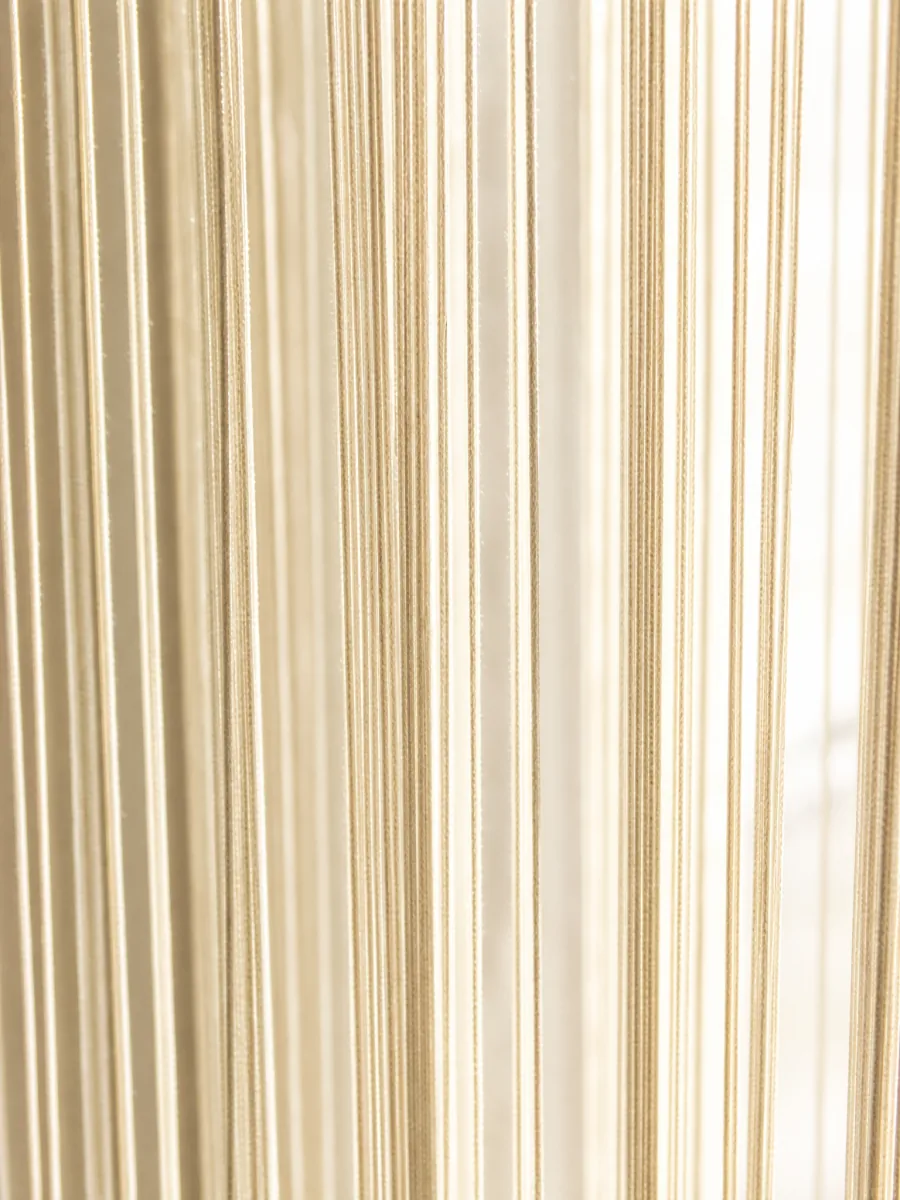














Paper blinds are a pleated fabric made of corrugated paper on mounting tape that attaches directly to the sash without drilling. We make them in Almaty to measure, from 3,200 ₸ per m², manufacturing time 2–3 days. This is a seasonal solution: paper wears out along the fold line, so for the kitchen, bathroom and windows you want for years, it is more honest to choose plastic.
What paper blinds are and how they differ from roller blinds and roller shutters
Paper blinds are a pleated fabric made of corrugated paper that attaches directly to the window sash. No roller, no cord and no slats: an accordion of folds gathered into a fabric opens and closes by hand. We make such paper blinds in Almaty to the size of the sash, from 3,200 ₸ per m², manufacturing time 2–3 days. And straight to the point: this is a light-blocking solution for a limited time. A paper window blind hides the room from prying eyes and from part of the sun, but it does not last for years.
The difference from roller blinds and roller shutters is in the mechanics, not in the finish material. Roller blinds wind onto a roller and lower as a single fabric. Roller shutters work in a similar way: a dense material on a roller, guide rails, fixed at the required height. A pleated fabric works differently — it holds its shape thanks to the folds themselves, so it does not need a roller. That is exactly why we offer paper only as an accordion.
Why paper roller blinds and roller shutters are a different story
We do not make paper roller blinds or paper roller shutters for windows as a separate product type. A roller mechanism is designed for fabric or a dense material that can withstand winding onto a roller and repeated lifting. Thin corrugated paper quickly loses its fold on a roller and tears. If you need paper roller shutters, it is more honest to choose fabric roller blinds — they cost more, but they last noticeably longer.
Pleated blinds made to sash size versus a ready-made product from a marketplace
Marketplaces sell ready-made standard sizes — one size of product, the same for all windows. Such a fabric rarely fits the opening at the edges: gaps remain, and you either trim it yourself or put up with the light coming through. We cut the paper blind to the measurements of a specific sash, so the fabric fits precisely, including non-standard window heights.
Paper blinds are a pleated fabric made of corrugated paper for the sash, a temporary light-blocking solution for a limited time, not a replacement for fabric roller systems.
How long paper blinds last and what the lifespan depends on
Paper blinds last from a few months to a couple of years, and the exact lifespan is set not by the calendar but by how often you raise the fabric. Every folding and unfolding runs along the same fold line, and that is where the paper wears out first. A fabric that is lowered and then left alone lasts noticeably longer than one that is raised twice a day.
The lifespan of the fabric is determined by three things: how often it is raised, the density of the paper, and how aggressive the window is in terms of sun and moisture. The denser the paper, the longer it holds at the folds — this is directly related to the weight per square metre. Thin paper of 70 g/m² creases and wears through faster, dense paper of 120 g/m² resists longer, but even it does not turn into a multi-year product.
Folds, sun, moisture — three reasons why paper does not last for years
- The fold line. The accordion always folds along the same edges, and over time the paper tears at them. This is the main reason paper blinds are replaced rather than repaired.
- Sun. On a south or west window the paper fades: the colour goes unevenly, and the fabric loses its look before it tears at the fold.- Moisture. Winter condensation on the glass unit and steam soften the paper, it ripples and loses its shape.
Paper density affects all three points at once, so for a south window Jalusso usually suggests a denser fabric — it both blocks more light and holds at the folds longer.
Paper wears out and tears along the fold line — that is a property of the material, not a defect, and we say so before you order.
How paper blinds are attached: tape, preparing the sash, removing without a trace
Paper blinds for windows are attached with mounting tape — the same sticky tape people call Velcro at home. There is no need to drill the frame at all: the paper blind is light, and installing the product takes a few minutes and needs no tools. That is exactly why paper blinds on sticky tape are often chosen for rented housing and for an apartment where renovation is still underway and no one will allow you to drill the profile.
Here is how we work.
- The measurer takes the dimensions of the sash and shows paper samples on site.
- The blind is cut in the workshop exactly to these dimensions — we make paper blinds for windows to measure, rather than picking them from ready-made standard sizes.
- The sash is wiped, degreased and left to dry.
- The mounting tape is stuck to the blind, the blind is pressed against the profile and smoothed along its whole length.
- The movement of the pleats is checked: the blind is raised and lowered several times.
It all holds on the contact area between the tape and the profile. The smoother the surface, the stronger the grip — on a plastic profile with rounded edges this is noticeable right away.
Preparing the sash
The sash is wiped with a soft cloth, degreased if necessary, and the surface must be left to dry. Dust, an oily film and traces of old tape are the three reasons why sticky tape later peels off at the edge. The tape holds on a smooth profile; on a rough or freshly painted area the grip is weaker.
If you need paper blinds on sticky tape for a while and are already thinking about how to remove them, we will say it straight: a mark remains only as long as there is glue on the profile. Remove the glue right away and the profile is clean.
How to raise the blind and fix it at a height
The pleated blind gathers in folds from the bottom up, fold on fold, and in the raised position it is secured so the window stays open. It is lowered back the same way, by the bottom edge, without jerking.
Every time you raise it, the paper runs along the same fold line. That is the main wear on the material — not dust and not sun, but how often you touch the blind. That is why we talk about paper blinds for windows as a solution for a season.
The blind is stuck to the mounting tape right on the sash in a few minutes, without tools or drilling, and comes off without marks on the profile if the glue is removed right away.
Paper or plastic: when it is more honest to pay more
It is worth paying more exactly when the window has to work for years. Paper pleated blinds are chosen for a temporary task: to get through a renovation, to cover a room until the main order is ready, to hand over an apartment. As soon as it is a permanent window — kitchen, bedroom, study — it is more honest to look at plastic or fabric pleated blinds right away.
On the price list the starting difference is small, and that is confusing. Paper 70 g/m² starts from 3,200 ₸ per m², PVC plastic blinds with a 25 mm slat — from 3,600 ₸, vertical fabric blinds with a 89 mm slat — from 4,600 ₸. But behind these figures is a different service life for the blind, and that is what determines which is more cost-effective in the long run.
| Parameter | Paper pleated | PVC plastic, slat 25 mm | Vertical fabric, slat 89 mm |
|---|---|---|---|
| Price from | 3,200 ₸/m² | 3,600 ₸/m² | 4,600 ₸/m² |
| Manufacturing time | 2–3 days | 3–5 days | 3–5 days |
| Where it fits | Renovation, moving, renting out an apartment, a temporary office | Windows that have to work for years: kitchen, bedroom, study | Tall windows and offices where light needs to be adjusted vertically |
| Where it is not worth it | Kitchen, bathroom, non-standard windows | Where the solution is needed for a season and you do not want to spend much | Small windows — the slat takes up a lot of space |
As for the question “paper or roller” — a roller mechanism is fabric or a dense material on a roller tube. We make such products, but we do not put paper in them: our paper blind is only made as a pleated fold. So the choice is not between paper and a roller blind, but between paper and other materials.
Installation adds 4,500 ₸ per product to the bill; for orders from 150,000 ₸ we do it free of charge. From experience, we will put it this way: if someone is hesitating between paper and plastic for a permanent window, the right answer is almost always plastic. Paper wins only where the solution is temporary.
Plastic blinds last noticeably longer than paper and cost more — paper blinds win only where the solution is temporary.
Which tasks paper suits best
Paper blinds for windows are chosen where the opening needs to be covered now, not for years: during renovation and moving, until the main order is ready, when renting out an apartment, and in a temporary office. Here are the scenarios in which paper fully does its job.
- Renovation and moving. We hang paper blinds before the finishing work or right after it — decide based on the dust. While the walls are being plastered and sanded, the blind will collect dust and paint splashes, and it is no great loss if it has to be replaced. After the finishing work it is hung so the room does not sit with a bare window while the main blinds are being made.
- Renting out an apartment. Paper covers the windows for the tenants’ move-in while you have not yet decided on the interior. After that the tenant lives with it or orders their own.
- Temporary office. The space is occupied for six months — paper is cheaper than any permanent solution, and after the move it is not taken down and carried along.
- Hallway and north-facing study. Here paper lasts the longest: the sun hardly reaches it, the blind fades less and wears more slowly at the folds.
- Balcony and loggia for a season. A workable option if the sash is protected from rain and winter condensation. On an open balcony, where moisture reaches the blind, paper will not last even a season.
When renting out an apartment, the question usually sounds like this: paper or permanent blinds right away? If the tenants are moving in for a long time and you know their preferences, it is more honest to install plastic right away. If the tenants and the interior are not yet decided, paper settles the question for the first months and costs pennies against the backdrop of a renovation.
A separate note on care: paper can’t be washed, and a soiled blind is easier to replace than to scrub. Dust is removed with a dry soft brush, and that’s where the list of procedures ends.
A typical situation in a new-build
A customer orders their main blinds, and the windows in the flat stay bare while the permanent products are being made. During that time we cover the sashes with paper so that neighbours can’t look in and the sun doesn’t beat into empty rooms. When the permanent blinds arrive, the paper ones come off — the adhesive is removed right away, and the profile stays clean.
Paper covers windows during renovation, until the main order is ready, when a flat is being handed over for rent, and in a temporary office — wherever a solution is needed today, not in a week.
Density and foil coating: what 70, 90 and 120 g/m² give you
Paper density in grams per square metre is the main parameter of paper pleated blinds. The denser the paper, the better it darkens the room and the longer it lasts at the folds. It’s a direct consequence: the thicker the fibre, the later the fold tears.
We make paper blinds in three densities. Paper at 70 g/m² is thin and slightly translucent; it’s chosen when you just need to cover a window during renovation. Paper at 90 g/m² is the standard density, the case when someone doesn’t want to go into the details and asks for the usual option. Paper at 120 g/m² is dense, darker against the light, for rooms where the sun hits directly. We make the fold at 15 and 25 mm.
A separate option is foil-coated paper. The foil coating reflects heat instead of letting it inside. It makes sense above all on a south-facing window. We won’t promise complete darkness — there are gaps along the edges of the blind, and the paper itself is slightly translucent.
Light transmission and darkening are not the same thing. Darkening depends on the density and on how tightly the blind fits the frame. Dense paper blocks light noticeably better than a sheer curtain, but for sleeping in a dark room we don’t recommend paper. Our pleated paper blinds are a temporary solution, and in terms of darkening they honestly occupy their niche between a sheer curtain and dense fabric.
The price of paper pleated blinds depends on the density and colour. The shape of the window isn’t factored in, because we don’t make paper blinds for arched, triangular or sloped windows.
Colours and fold
Besides white, we have beige and grey. White and beige are calculated at the base coefficient of 1.0, grey at a coefficient of 1.03, so it comes out a little more expensive. The price difference is small, and you should choose the colour by the interior, not by the surcharge.
The fold of 15 and 25 mm is a question of how the blind behaves on the window. Both widths suit a standard sash, and they’re chosen by appearance.
The surcharge for density and foil coating only pays off when the window really faces the sun.
In practice, the most common question is: is a paper pleated curtain the same as paper pleated blinds? Yes, it’s one and the same product under different names. And “pleated curtain blinds” means the same product too.
Which rooms to hang paper blinds in, and where not to
Paper blinds are appropriate in a living room, a hallway and on a north-facing window, but we don’t recommend them for the kitchen or the bathroom. The reason is simple: moisture and condensation destroy the paper blind irreversibly. Soaked paper ripples, and it can’t be returned to shape.
In winter, condensation collects on the glass unit. In a room it stays along the bottom edge of the glass, while in the kitchen steam from cooking adds to it. For paper this is critical: the blind sits right against the sash, and all the moisture goes to it. Plastic handles these conditions calmly, paper doesn’t.
Where it works:
- Living room, bedroom, kids’ room — dry air, and the paper lives its usual life.
- Hallway — almost no steam gets in here, and the window is often covered only on the bottom third.
- North-facing study — the sun rarely looks in, the blind fades more slowly, and the paper lasts the longest.
- Balcony and loggia for a season — if it’s not a room with a laundry dryer.
Where it doesn’t:
- Kitchen — steam and splashes. Here plastic pays off; it costs from 3,600 ₸ per m² and lasts noticeably longer.
- Bathroom — constant humidity.
- A window above the bathtub or washing machine — the same steam, only closer.
Care
Paper pleated blinds can’t be washed: water soaks the paper and it deforms irreversibly. Dust is removed with a dry soft brush — without pressure, along the direction of the folds. If the blind gets stained with paint or grease, it’s easier to replace it than to scrub it.
We don’t recommend wiping with a damp cloth or sponge: water makes paper lose its fold.
Steam, winter condensation and splashes are critical for paper — paper blinds hold up where it’s dry, while in the kitchen and bathroom plastic replaces them.
Care, moisture and sun: how paper behaves in the Almaty climate
The Almaty climate shortens the service life of a paper blind more than the lifting regime does. A sharply continental pattern — hot sunny summers with dust and cold winters when condensation settles on the glass unit — hits paper from two sides at once. In summer the sun causes the paper to fade: the blind loses colour, and on a south-facing window this happens noticeably faster than on a north-facing one. In winter moisture and condensation destroy the paper blind: a paper curtain on a window gets soaked along the bottom edge and ripples, while at the folds the material loses strength.
The dust of an Almaty summer adds a third load. It settles on the folds, and it can only be removed with a dry soft brush — paper can’t be washed, it soaks and deforms irreversibly. A soiled blind is easier to replace. A balcony and loggia amplify this picture: the temperature difference between day and night is sharper there than in a room, and winter condensation stays longer, so paper on an uninsulated balcony wears out faster. We install it there for a season, and we say so upfront, not after installation.
What speeds up the wear of a paper blind in Almaty:
- sun on a south- and south-west-facing window — fading and loss of colour;
- winter condensation on the glass unit — soaking and deformation;
- summer dust in the folds — soiling that can’t be washed off;
- sharp temperature swings on a balcony and loggia.
On a north-facing window paper lasts the longest: there’s less sun and less fading, though winter condensation remains.
Insect screen and protruding handle
A mosquito net and a protruding handle don't get in the way of paper blinds. The fabric is light and is attached with mounting tape directly to the sash, not to the frame, so the net goes back in place as usual. With a protruding handle, we cover only the lower part of the window — the fabric runs below the handle and doesn't stop you from opening the sash. The same solution works in a hallway, where the top of the window needs to stay clear.
Almaty's sharply continental climate speeds up wear on the paper along the folds, so on a balcony, loggia or south-facing window we honestly consider paper a seasonal option.
How much do paper blinds cost by sash size
The price of paper blinds is calculated per square metre of fabric, not per finished product of a fixed size. That's where the range comes from: the same fold on a narrow sash and on a wide window will cost differently, because we cut the fabric to the measurement. Within the price per metre, the paper density, foil coating and fabric colour all play a part.
| Paper density | Price from, per m² | Manufacturing time | How it differs |
|---|---|---|---|
| 70 g/m² | from 3,200 ₸ | 2 days | Thin, lets light through |
| 90 g/m² | from 3,600 ₸ | 2–3 days | Standard density |
| 120 g/m² | from 4,100 ₸ | 2–3 days | Dense, darker |
| With foil coating | from 4,800 ₸ | 3–4 days | Reflects heat |
The fabric colour also affects the price, and this isn't a marketing markup. White and beige come with a coefficient of 1.0, grey — 1.03. The difference is small, but on a wide window it shows up in the bill. It's more honest to say this upfront rather than at the moment of approval.
If you compare it with plastic over the years, the arithmetic is simple: paper 70 g/m² — from 3,200 ₸ per m², PVC plastic with a 25 mm slat — from 3,600 ₸ per m². The price gap per metre is minimal. Buying paper blinds makes sense when a window is being covered for a season, not for years: then you're not paying for a lifespan you won't get through.
Installation
Installation of the product costs 4,500 ₸ per item. On orders from 150,000 ₸ we do it free of charge. The fabric itself is stuck with mounting tape directly onto the sash in a few minutes, with no tools and no drilling, so installation is a small part of the bill, not a separate construction job.
Exactly how much it will cost for your windows depends on the area of the sashes and the density you choose. Our measurer will come to you with samples of paper blinds — and will calculate the price right there.
You can only buy pleated paper blinds to fit the sash: the price is made up of the paper density and the fabric colour, while installation of the product adds 4,500 ₸ to the bill and becomes free on orders from 150,000 ₸.
How to order paper blinds in Almaty
We make paper blinds in Almaty ourselves — the company has its own workshop, and every piece of fabric is cut to the measurement of a specific sash. There are no ready-made products in stock: every window size is different, and paper doesn't stretch or get trimmed on site. An order goes through five steps.
- You message us on WhatsApp and describe the window.
- The measurer comes with samples of paper of different densities and calculates the cost on the spot.
- You choose the density and colour, and we put the fabric into production.
- In 2–3 days the product is ready, it's delivered and stuck onto the sash.
- The fabric comes off without marks on the profile if the adhesive is removed straight away.
Measurement and consultation are always free; within the city, both measurement and delivery are free. We also travel to the suburbs — Kaskelen, Talgar, Issyk, Kapshagay — the cost of the visit depends on the distance and is quoted before the visit, before the car sets off. A nice detail: the measurer doesn't just measure, he immediately shows how the paper looks against the light, and that removes half the doubts.
How fabric cut to size differs from a ready-made one from a marketplace
Marketplaces sell ready-made standard sizes, and fabric of one size doesn't fit a sash of another size — you're left with gaps at the edges or extra material with nowhere to go. A product cut to the sash size differs from a ready-made one in exactly this: Jalusso cuts the fabric for your opening, rather than adjusting the opening to whatever is sitting in the warehouse.
We manufacture paper blinds in Almaty with our own workshop, made to measurement, with no ready-made products in stock — that's why the paper fabric fits the sash precisely, not approximately.
FAQ
We've gathered what people most often ask about paper blinds before ordering — about the warranty, non-standard windows, the difference from fabric pleated blinds, and the balcony. We answer briefly and without promises the product can't keep.
Question: what about the warranty on paper blinds? Answer: the fabric on tape has no mechanism, so the warranty on the mechanism doesn't apply to it. Wear on the paper along the folds is a property of the material, not a defect, and we say this before the order. The company's warranty terms are 3 years on the mechanism, 1 year on installation from the date the acceptance certificate is signed, and a warranty case is resolved free of charge within 5 working days. The warranty doesn't cover mechanical damage, re-installation done yourself, water, or natural fading.
Question: do you make them for arched, triangular and sloped windows? Answer: we don't make paper blinds for arched, triangular and sloped windows — those need fabric pleated blinds. For rectangular sashes the fabric is simply cut to size. Non-standard windows require fabric pleated blinds, and for such openings we select the fabric separately.
Question: how do paper blinds differ from fabric pleated blinds? Answer: in material and lifespan. Fabric pleated blinds hold their shape longer and tolerate moisture; paper is a pleated fabric made of corrugated paper with a fold of 15 or 25 mm. Both types of pleated blind fold up like an accordion and are raised the same way, but the paper one is made for a temporary job.
Question: can paper blinds be hung on a balcony or loggia for a season? Answer: on a glazed balcony for a season — yes, if the window is closed and the fabric doesn't take on moisture and condensation. On an open loggia we don't advise it: steam and splashes are critical for paper.
Paper blinds aren't suitable for a kitchen, a bathroom or non-standard windows — in those places plastic or fabric pleated blinds are more honest, and we offer them right away, not after the fabric has become unusable. Paper lasts longest in a north-facing study and in a hallway, where there's no steam or direct sun.
Conclusion
Paper blinds are a pleated fabric made of corrugated paper, and people take them for a season, not for years. We repeat this conclusion to every client before the measurement, because after that the person makes the decision themselves: some need to cover windows for the duration of a renovation, others for years.
What's worth keeping in mind before ordering.
The fabric is made to the sash size, not selected from ready-made standard sizes. The price is calculated per square metre: paper 70 g/m² — from 3,200 ₸, 90 g/m² — from 3,600 ₸, 120 g/m² — from 4,100 ₸, with foil coating — from 4,800 ₸. Manufacturing time is 2–3 days, with foil coating 3–4 days; this is the fastest time in our catalogue.
It's attached with mounting tape directly onto the sash. No drilling needed, no tools needed, the whole thing takes a few minutes. The fabric comes off without marks on the profile if the adhesive is removed straight away, not six months later.
Paper wears along the fold line. This is a property of the material, not a defect, and we don't consider such wear a warranty case. There's nothing to be done about it: the more often you raise the fabric, the faster the folds wear out.
Where paper loses out. In the kitchen and bathroom, steam and splashes destroy the fabric, and plastic will pay off there. For arched, triangular and sloped windows we don't make paper blinds — you need pleated fabric.
There is one practical recommendation. Message us on WhatsApp, describe your window, and we will send a measurer with paper samples. The measurement is free, they will calculate the cost on site and show you how the blind will sit on your sash.

