























Blinds in Almaty are made to measure for a specific window, not sold ready-made from stock. The price is calculated per square metre: from 3,200 ₸ for paper pleated to 12,400 ₸ for wooden. Measurement and consultation are free, the measurer comes with samples and calculates the cost on the spot. We make blinds for a standard window in 2 days.
Types of blinds and how they differ
All blinds fall into two big groups: slat systems, where separate slats block the light, and fabric systems, where a single piece of material covers the window. The width of the slat determines both the type of system and the price per square metre. For horizontal aluminium blinds it is 25 mm, for vertical fabric blinds — 89 mm. The difference is not in design but in physics: a narrow slat gives more points for adjusting the light, a wide one covers the window faster. By material the choice comes down to four options. Aluminium blinds are not afraid of moisture. PVC plastic ones cost less and can also be washed. Fabric ones give soft light and colour: coloured blinds are most often fabric, and coloured or plain blinds are chosen from samples that our measurer brings. Wooden and bamboo blinds are about interior design, not about saving money.
Slat systems — horizontal and vertical
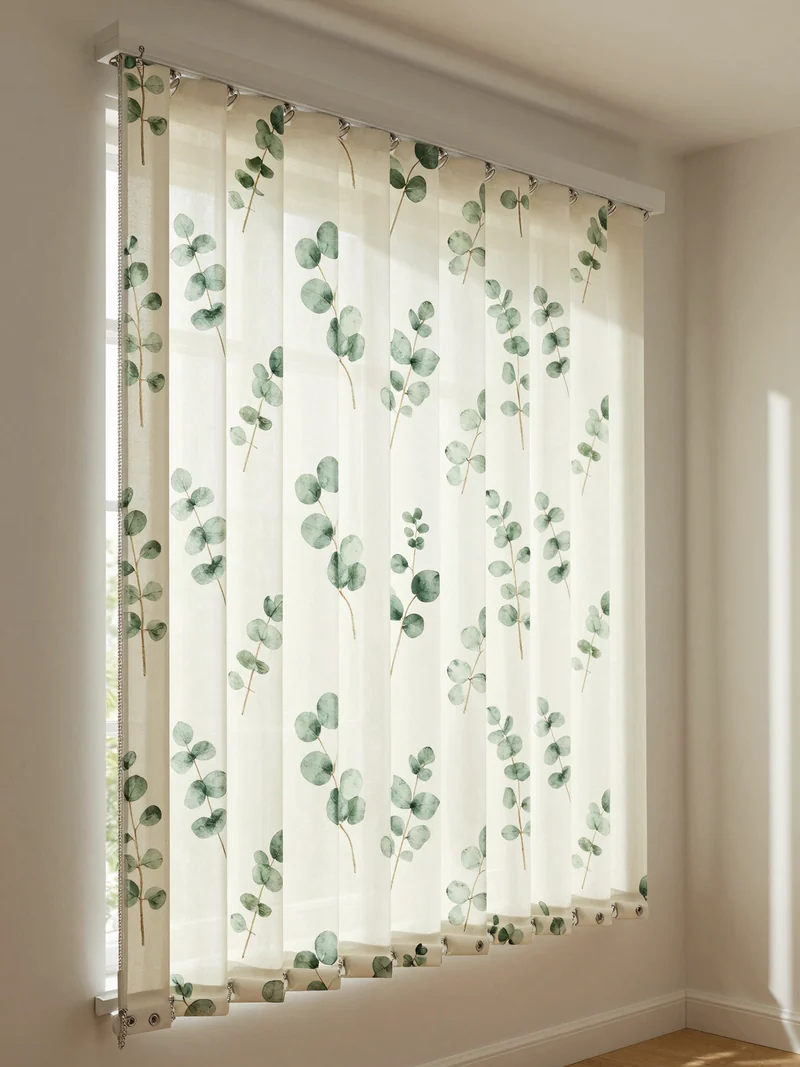
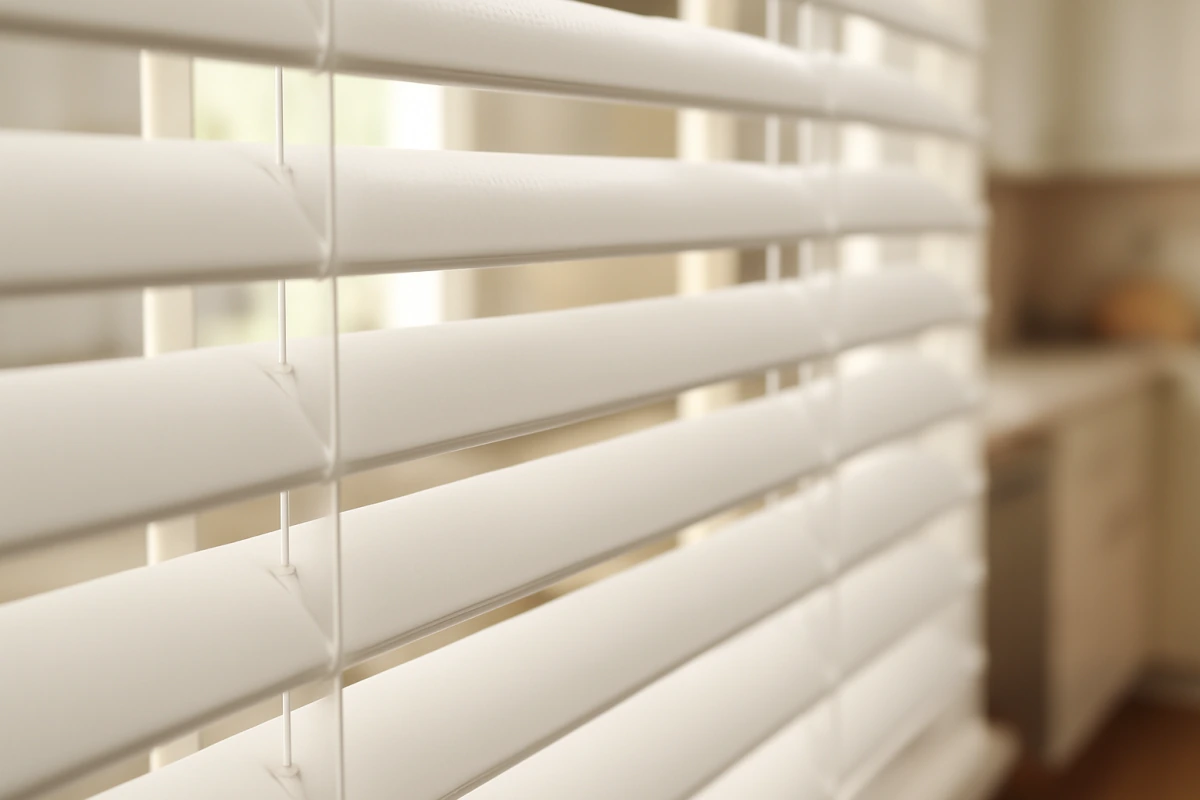
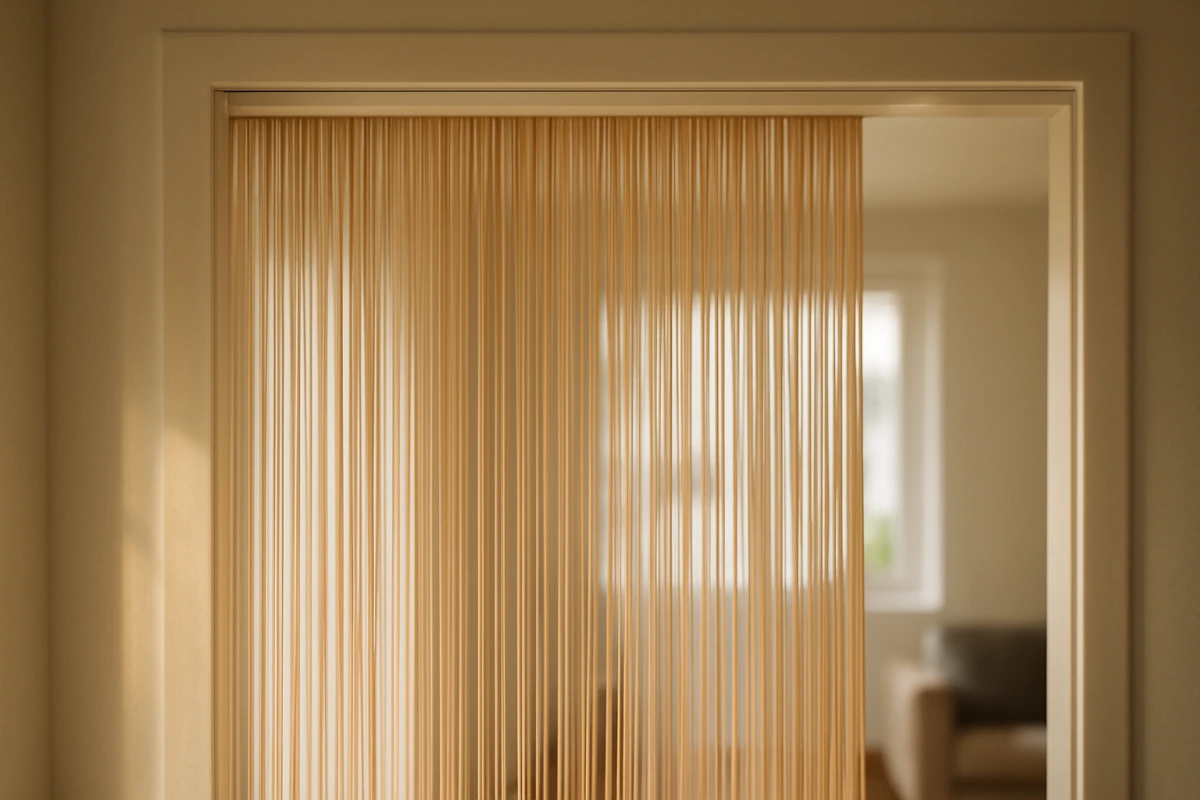
Horizontal blinds are assembled from a 25 mm slat threaded onto cords or tapes. Such a system covers the window from the bottom up and controls light more precisely: you can raise the blind by a third and leave the top part open. Vertical blinds work differently. A 89 mm slat hangs from the top, turns around its axis and slides apart to the sides like a curtain. On a tall window the long slat catches on the neighbouring ones when it turns — few people warn you about this at the selection stage. But on panoramic office glazing, vertical blinds cover an opening several metres wide without a single joint.
Fabric systems — roller, day-night, pleated
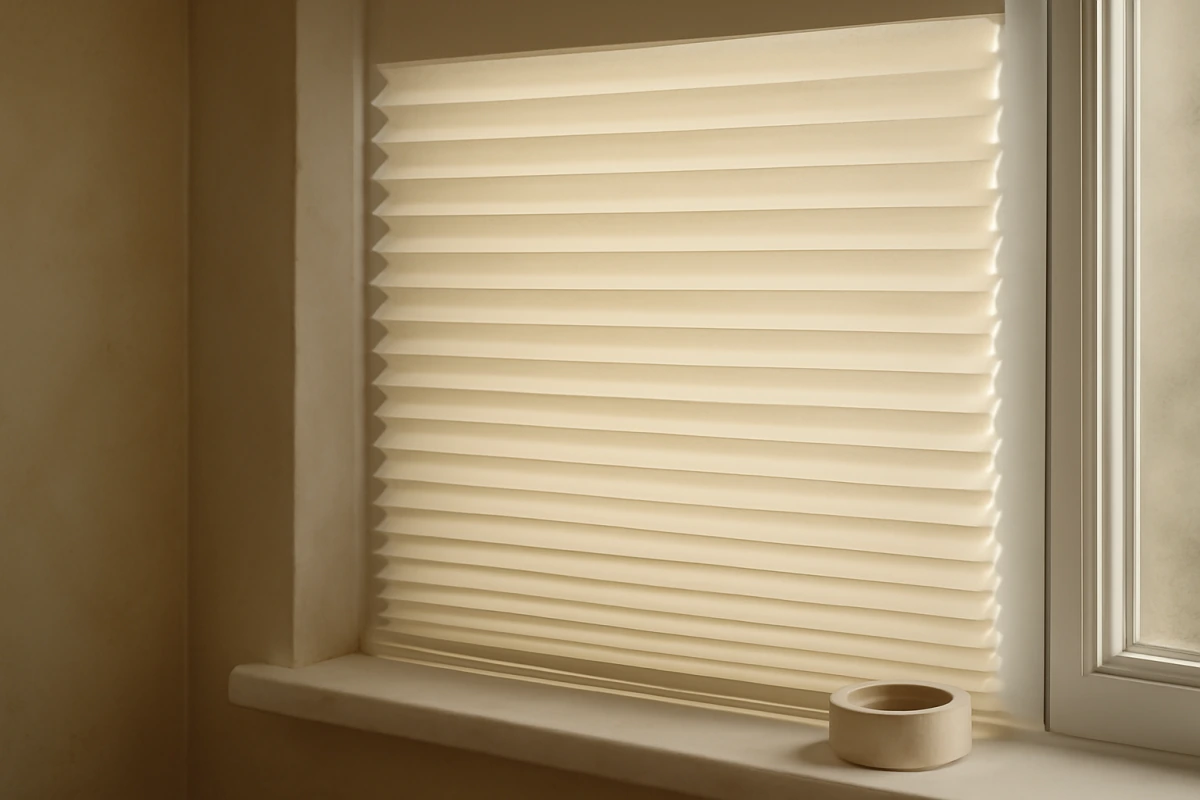
Roller blinds cover the window with a single fabric panel on a tube. The light is adjusted only by raising them, but no dust collects on slats. Day-night blinds are more complex: two layers of fabric with alternating stripes slide against each other and give any light density — from transparent to almost full blackout. Pleated blinds are a folded fabric panel that runs up and down along guide rails and does not sag. Pleated blinds are fitted on sloping and arched windows, where there is simply nowhere to hang the tube of a roller blind.
Comparison table of types
| Type | Slat width or type of fabric | Where to install | Light protection | Care | Price from per m² | Manufacturing time |
|---|---|---|---|---|---|---|
| Horizontal aluminium | slat 25 mm | kitchen, office, bedroom | high | wipe | from 4,200 ₸ | 3–5 days |
| Vertical fabric | slat 89 mm | panoramic windows, office | medium | vacuum | from 4,600 ₸ | 3–5 days |
| Plastic PVC | slat 25 mm | kitchen, bathroom | medium | wash | from 3,600 ₸ | 3–5 days |
| Paper pleated | folded fabric | bedroom, kids’ room | medium | dry wipe | from 3,200 ₸ | 2–3 days |
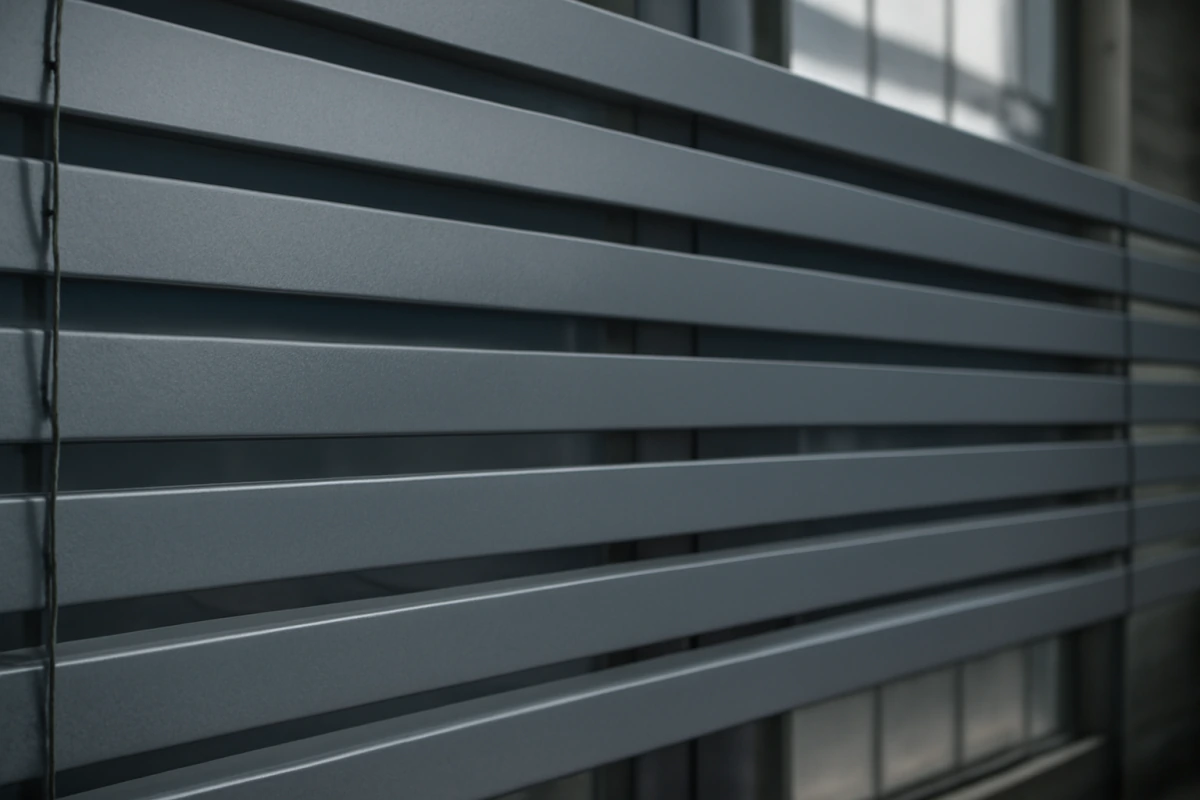
| Metal steel | slat 25 mm | office, shop | high | wipe | from 5,200 ₸ | 5–7 days |
| Roller blinds | single fabric panel | bedroom, kitchen | medium | wipe | from 5,400 ₸ | 4–6 days |
| Day-night blinds | two-layer fabric | living room, bedroom | adjustable | vacuum | from 7,300 ₸ | 5–7 days |
| Wooden, linden | slat 50 mm | living room, study | high | dry cloth | from 12,400 ₸ | 7–12 days |
In practice the choice comes down to one question. A kitchen window with a vent pane — people take aluminium or PVC, because they can be washed and do not get in the way of opening the sash. Panoramic office glazing — vertical fabric blinds for the full height of the opening. Bedroom — day-night or a roller blind with dense fabric. New blinds for windows after renovation are chosen the same way: the best blinds for windows are not the most expensive ones, but those that suit the room and the way the sash opens.
Slat width and type of fabric determine the type of blinds and the price per square metre, while the material decides where the system can be installed at all.
How much do window blinds cost in Almaty
The price of blinds is calculated per square metre, not per item. Hence the range: a metre of paper pleated blinds starts from 3,200 ₸, a metre of linden wood blinds with a 50 mm slat — from 12,400 ₸. The measurer gives the exact amount for your window on site, because the area is calculated by sashes.
How much a square metre of blinds costs depends on the type, the control, the fabric, the mounting and the shape of the window. Manufacturing time depends on the type and material: paper pleated blinds are made in 2–3 days, horizontal aluminium and vertical fabric — in 3–5 days, metal steel — in 5–7 days, wooden and bamboo — in 7–12 days. I’ll talk about the control and fabric that add to the base price in the next section.
Price table by type
| Type | Material and slat | Price from, ₸/m² | Lead time |
|---|---|---|---|
| Horizontal aluminium | slat 25 mm | 4,200 | 3–5 days |
| Vertical fabric | slat 89 mm | 4,600 | 3–5 days |
| Plastic PVC | slat 25 mm | 3,600 | 3–5 days |
| Paper pleated | fabric | 3,200 | 2–3 days |
| Metal steel | slat 25 mm | 5,200 | 5–7 days |
| Roller blinds | open roller tube | 5,400 | 4–6 days |
| Day-night | two-layer fabric | 7,300 | 5–7 days |
| Multi-textured | combined | 7,200 | 7–10 days |
| With electric motor | mechanism | 7,800 | 7–10 days |
| With a pattern, photo print | fabric | 8,900 | 7–12 days |
| Bamboo | slat | 9,400 | 7–10 days |
| Pleated blinds | folds | 9,800 | 7–10 days |
| Wooden | linden, slat 50 mm | 12,400 | 7–12 days |
Those looking for inexpensive blinds usually look at the first rows of the table: paper pleated, PVC plastic and horizontal aluminium. These are the cheapest window blinds among our options, and in my opinion, for a rented flat or a country house they are fully justified. We replace them later without regrets. Fabric and multi-texture blinds cost more, but they hold light differently, and on the south side the difference is felt in the very first season.
Why the price for plastic windows is calculated the same way
The cost of window blinds is not tied to the standard size of a window from the manufacturer’s catalogue. We don’t count the whole window, but each sash and opening separately: the height of the glass unit, the width, whether there is a vent, the depth of the glazing bead. That’s why the price of blinds for plastic windows in Almaty can differ for two seemingly identical windows in the same flat — if one is narrower than the other.
Two sashes of the same plastic window look identical, but the glass and glazing bead almost always differ. That’s why the total for several windows in one flat is rarely divided equally by the number of windows. A standard-looking plastic window doesn’t mean a standard glazing area.
Low prices for blinds in Almaty don’t mean that an option from the first row of the table will suit your window: paper pleated blinds are not installed in wet areas or on a sash that is opened often. Our price per square metre starts from 3,200 ₸ for paper pleated and goes up to 12,400 ₸ for linden wood with a 50 mm slat; measurement and the exact cost for your windows are calculated free of charge.
What makes up the price
The price of blinds is made up of the base cost of the type and four coefficients: control, fabric, mounting and window shape. The base price is taken from the price list per square metre, and the coefficients multiply it. That’s why two windows of the same size can differ in price by almost double — the only difference is the configuration.
Mechanical control is the basic option with a coefficient of 1.0: the slats are turned by hand, and you open the sash by moving the fabric aside with your hand. A chain adds 6 percent to the price and gives smooth adjustment of the slat rotation from the side. An electric motor increases the price coefficient to 1.85, and with a remote control — to 2.1. In my opinion, an electric motor is overrated for an ordinary flat: it is justified on tall windows and panoramic glazing where you can’t reach by hand.
Fabric affects the price through density. Standard fabric comes with a coefficient of 1.0, sun protection — 1.15, blackout — 1.35. The denser the fabric, the less light and heat enters the room, so for the south side the difference in price pays off quickly.
Coefficient table
| Parameter | Value | Coefficient |
|---|---|---|
| Control | mechanical | 1.0 |
| Control | chain | 1.06 |
| Control | electric motor | 1.85 |
| Control | electric motor with remote control | 2.1 |
| Fabric | standard | 1.0 |
| Fabric | sun protection | 1.15 |
| Fabric | blackout | 1.35 |
| Mounting | wall-mounted | 1.0 |
| Mounting | frame-mounted | 1.05 |
| Mounting | no drilling | 1.1 |
| Mounting | cassette system | 1.28 |
| Window shape | rectangular and square | 1.0 |
| Window shape | sloped | 1.3 |
| Window shape | arched | 1.45 |
| Window shape | triangular | 1.5 |
A cassette system increases the price coefficient to 1.28: the roller tube with the fabric is covered by a housing box, and only a neat strip is visible from outside. Drilling-free mounting adds 10 percent — for the brackets and spring clips that hold the product in the glazing bead. A sloped window gives 1.3, an arched one — 1.45, a triangular one — 1.5. The cheapest option is a straight rectangular window with mechanical control, without a cassette — everything else only adds to the base.
Example calculation for one window
Let’s take a rectangular window with an area of 2 square metres, horizontal aluminium blinds. Base — from 4,200 ₸ per metre, so 8,400 ₸. Mechanical control — multiplier 1.0. Standard fabric — also 1.0. Frame mounting — 1.05. Rectangular shape — 1.0. Total: 8,400 × 1.05 = 8,820 ₸ without installation.
If the same window gets a chain and a cassette system, the multipliers are multiplied: 8,400 × 1.06 × 1.28 × 1.05. Let’s calculate: 8,400 × 1.06 = 8,904, then × 1.28 = 11,397, then × 1.05 = 11,967 ₸. The difference for one window is more than three thousand tenge, and that’s just the configuration.
The final price is the base price of the type multiplied by the coefficients for control, fabric, mounting and window shape.
Mounting: on the sash, on the frame or on the wall
Mounting is chosen before measurement, because the size of the fabric and the installation method depend on it. There are three points: the sash, the frame and the wall above the opening. For a plastic window, blinds are most often mounted on the sash or on the frame — then the fabric stays right by the glass unit. The wall is needed where the window opens inwards and the fabric would get in the way.
What changes in practice, by mounting method:
- Mounting on the sash. The fabric moves together with the sash, so the size is taken by the glass and glazing bead, not by the whole frame. If there are several sashes, each gets its own product — that’s how you get blinds for each window sash.
- Mounting on the frame. The fabric is mounted on the fixed part, it is wider and covers the opening entirely. This solution is chosen when you don’t want the blinds on the glass of plastic windows to move every time you open it.
- Mounting on the wall. The fabric covers the window from top to bottom, but so that it doesn’t rest against the window reveal, you need extra width and height beyond the window opening.
Can you do without drilling the frame? Yes, and we always do it this way: mounting into the glazing bead with brackets, spring clips or adhesive tape. We don’t drill the frame — the window manufacturer’s warranty is preserved.
What changes with sash mounting
Measurement is taken by the glass and the glazing bead — the narrow strip along the edge of the glass unit. The vent is counted separately. Blinds for a window with a vent are made either short, up to the opening line, or as a second product for the vent itself. Otherwise the fabric will hit the sash when ventilating. We always clarify at the measurement how you open the window: by turning the handle, tilting from the top or opening wide.
When a cassette system is needed
A cassette system is a closed roller in a housing box, with the fabric or slats coming out of it rather than hanging in view. The fabric doesn’t rub against the sash, and guide rails run it along the bottom and sides. It is suitable for windows with a wide windowsill and in rooms where a neat line by the glass matters. The mounting coefficient for a cassette system is higher than for ordinary frame mounting — you don’t choose it to save money.
Ready-made blinds or made to measure
Blinds for windows are made to measure, not to a standard size, so a ready-made product almost never fits someone else's opening. Ready-made window blinds are assembled for a specific width and height, and that width stays with them forever.
Buying ready-made window blinds is tempting: no waiting, no need to call anyone. But on a PVC window the size is set not by the whole frame, but by each sash separately. Window measurement is taken along the glass and glazing bead, and two sashes of the same window are almost always different widths. A product assembled for one sash won't fit the neighbouring one with glazing-bead mounting. And our made-to-measure lead time is short — a standard window is done in 2 days, so the time saved by a ready-made option is illusory.
What to do with narrow and small windows if the standard size doesn't fit? Order custom. A non-standard window needs its own calculation: a short slat is used for a narrow sash, the minimum product width is calculated for a small window, and only the workshop cuts the slat to the actual dimensions.
What this looks like in practice:
- ready-made blinds from a marketplace don't fit non-standard PVC windows — their standard size is averaged;
- whether you call it made-to-measure or custom blinds, the path in Almaty is the same: measurement, calculation, workshop, installation;
- ordering blinds for narrow windows is calculated the same way as for wide ones, the only difference is the slat cutting;
- ordering blinds online is convenient, but the measurer still confirms the dimensions, otherwise the product will have to be redone;
- To order blinds in Almaty, one WhatsApp request with a photo of the window and approximate sizes is enough.
We regularly see the same picture: a person first buys a ready-made set, and then calls a measurer. A ready-made product only fits the opening it was assembled for; for non-standard PVC windows the standard size doesn't fit.
Window measurement for blinds
Window measurement comes before the price calculation, and it's done by the measurer, not by the client with a tape measure along the frame. The reason is simple: the size of the blind depends on where you mount it. When mounting on a sash or frame, the figures are taken along the glass and glazing bead of each sash separately. When mounting on the wall, a margin is added to the width and height of the window opening, otherwise the blind won't cover the opening at the edges.
Here’s how it works.
- We determine whether we mount on each sash or on the whole opening at once. This decides how many separate products will be in the order.
- We take the width and height along the glass and glazing bead — where the blind will move, not where the frame is.
- We consider the vent pane: it's either covered by a separate product or left open. If the vent pane opens inwards, the blind is not placed over it as one solid piece.
- We mark the mounting points on the sash, frame or wall. On the wall — with a margin beyond the opening.
- We check that the blind doesn't catch the sash handle or the windowsill.
The difference between mountings is visible on a wide window. One large window with sash mounting turns into several products, one per sash. The same window with wall mounting is one blind. The material, size and price come out different.
A mistake at measurement is expensive — the product is made to specific millimetres, and it can't be redone.
What the measurer does on site
Comes with samples of slats and fabrics. Takes dimensions for each sash. Calculates the price on site and gives the lead time. City visits are free.
Jalusso doesn't charge for measurement and consultation — it's always free, whether you end up ordering or not.
How an order goes from request to installation
Ordering blinds in Almaty takes four steps: a request on WhatsApp, a free measurement with samples, manufacturing in our workshop and installation. We don’t keep ready-made items in stock — every window is calculated separately. A standard window is covered in 2 days.
- Request. You write in WhatsApp, send a photo of the window and approximate dimensions. Fabric consultant Aida clarifies what matters: which way the window faces, the floor, whether you need sun protection or darkening.2. Window measurement. The measurer comes with samples of slats and fabric, takes dimensions along the sashes and glazing bead and calculates the price on site. Window measurement comes before the price calculation and is always free — city visits and delivery are free too.
- Manufacturing. The workshop cuts the slat and fabric to size and assembles the mechanism. Metal steel blinds are made in 5–7 days, wooden ones in 7–12. The reason is simple: metal and wood need more operations to prepare the material.
- Installation. Installation costs 4,500 ₸ per product. For orders from 150,000 ₸ it's free, and this is exactly the case when you cover blinds on several windows in an apartment or office at once. Warranty — 3 years on the mechanism, 1 year on installation from the date the acceptance report is signed.
I'll say a separate word about lead times by type, because the question “how many days” comes up more often than any other. Paper pleated blinds are made in 2–3 days, aluminium, fabric vertical and PVC — in 3–5. A non-standard window shape lengthens the lead time: the slat layout is calculated first, and that's no longer a conveyor.
We also travel to the suburbs — Kaskelen, Talgar, Issyk, Kapshagay. The cost of the visit depends on the distance, and we give it before the visit, not after.
A standard window is done in 2 days, installation costs 4,500 ₸ per product, and for orders from 150,000 ₸ it's free.
Case: panoramic glazing in an office
We fitted out an office with several rooms with panoramic glazing. The client wanted to cover the windows and not drill the aluminium profile — it has its own warranty from the developer. We calculated vertical fabric blinds with drill-free mounting, and for control we suggested a chain: a coefficient of 1.06 versus 1.85 for an electric motor, and there would have been too many remote controls for that number of windows. On some windows with difficult access we did install electric motors. The installation was issued as one estimate, and it fell within the free installation by order amount.
Materials: aluminium, plastic, fabric, wood
The slat material decides where blinds can be installed at all: in a wet area, in a bedroom or on panoramic glazing. Aluminium blinds hold their shape, don't fear steam and cost from 4,200 ₸ per m². PVC plastic is cheaper — from 3,600 ₸ — and just as easy to wash, but the slat is softer and can bend on a long window. In the kitchen, bathroom and any room where the window is often opened for ventilation, these two materials are the ones chosen.
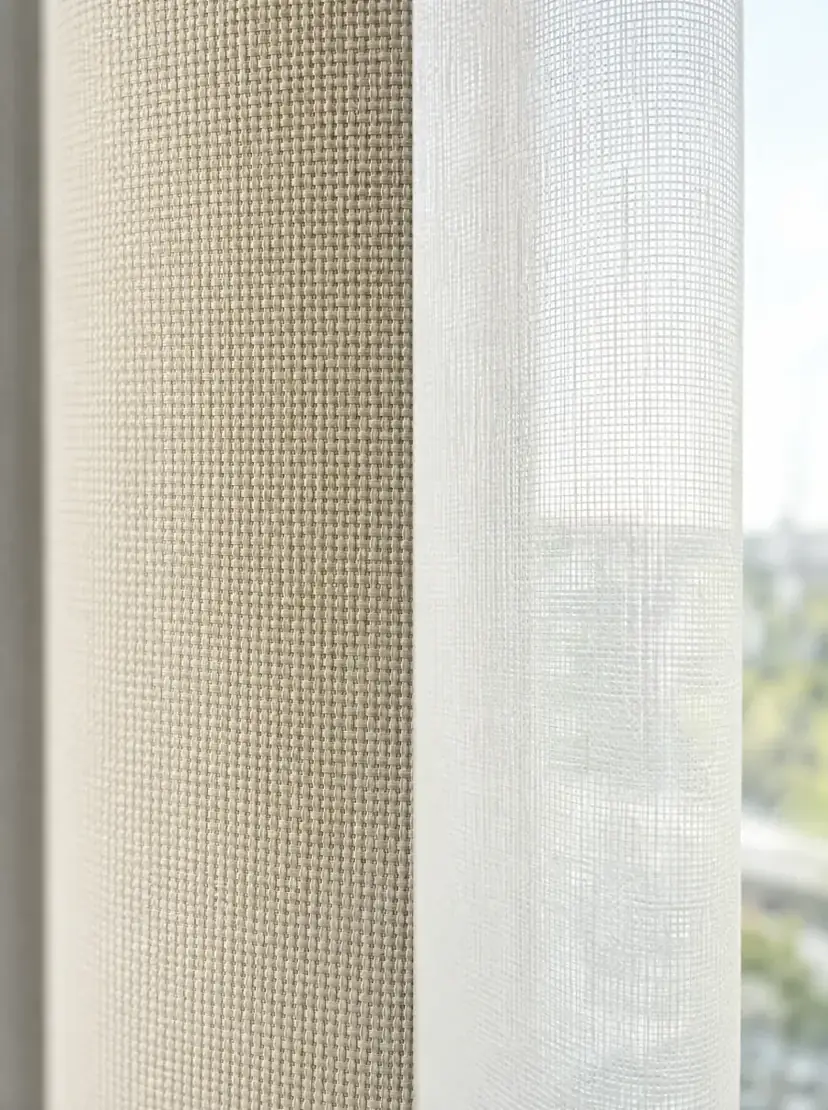
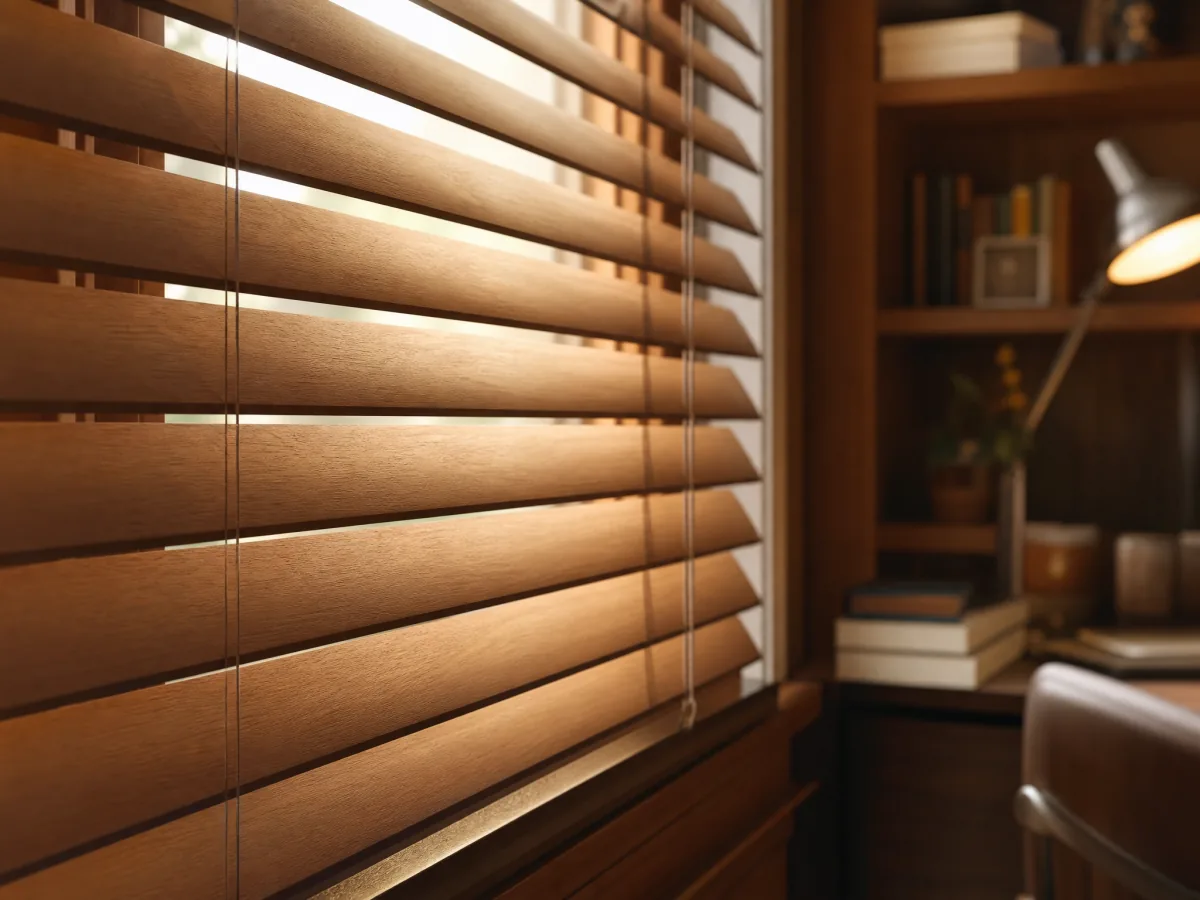
Fabric blinds are vertical systems with a 89 mm slat and roller blinds. Fabric doesn't glare in the sun and doesn't cause reflections on a monitor, so for a room and for a whole apartment it's chosen more often than metal. Wooden blinds made of linden with a 50 mm slat are the most expensive option, from 12,400 ₸, but the texture is visible both on the window and on the wall if the blind is taken beyond the opening. Bamboo ones cost from 9,400 ₸ and behave similarly: a natural material, medium light protection, a dry room is a must.
Day-night differs from an ordinary roller blind in that it has two layers of fabric on one tube. Day-night blinds regulate the density of light with two layers of fabric: the stripes shift and let in more or less light without raising the blind. An ordinary roller blind has one layer and works like a switch — open or closed.
The density of the fabric affects sun protection and fading. Standard gives basic light protection, sun protection holds the rays more tightly, blackout provides bedroom darkening. But putting blackout on every window in a row, in my view, is an overrated approach: in a child's room it's as dark during the day as in the evening.
If you need curtains on the windows together with blinds, that is decided on site. Blinds and curtains on windows often mean roller fabrics — they are hung on the sash, and no rail is needed. Decorative blinds on windows are also mounted on the wall when the opening is wide and the frame is non-standard. And, by the way, for a home we do not advise buying blinds and curtains as one set: two systems on one window get in each other's way when opening.
For example, in an apartment with windows on two sides we installed aluminium in the kitchen, day-night in the bedroom, and standard fabric in the kids' room: it came out even and without extra darkening.
Fabric density affects sun protection and fading: standard, sun-protection and blackout give different levels of light blocking.
Non-standard windows: large, tall, narrow, small
A non-standard window is not fitted to a standard product — it gets its own measurement and its own configuration. Large and tall openings are covered with vertical blinds: a single row of slats runs from ceiling to windowsill and does not sag the way a long horizontal rail does. For wide blinds on panoramic glazing we assemble them in sections per sash, so each part opens separately. In my view, trying to cover a panorama with one long horizontal fabric is an overrated approach: a 25 mm slat at a great height starts to sway from draughts.
Narrow and small windows are handled in much the same way. For blinds on narrow windows, horizontal ones are chosen, with a short slat matching the glass width. Blinds on a small window in a bathroom or storage room are also horizontal, often mini blinds with the same 25 mm slat: they take up little space and do not get in the way of opening the sash. Blinds on each window sash are measured and hung as a separate product — that way the vent and the turning part move independently. Continuous blinds on windows with several sashes are made only with wall mounting, when the fabric covers the whole opening.
What a non-standard size changes in practice: long blinds on long windows require a reinforced roller tube or an extra support so the slat does not stretch under its own weight. For blinds on tall windows in new buildings with windows up to the ceiling, we calculate by sections rather than one height. Window measurement here is done by a measurer with samples — a tape measure along the frame will not show how the fabric will behave at a great height. A non-standard window requires a separate calculation and the measurer's experience, not picking the nearest standard size.
Vertical blinds cover large and tall windows with a single row of slats, while for narrow windows horizontal ones with a short slat are chosen.
Arched, triangular and roof windows
A sloped, arched or triangular shape means a separate calculation and a separate measurer. An arched window cannot be covered with a straight fabric: the slats are cut along the arc, and each rail gets its own length. A roof window on a sloped plane is calculated with an angle correction: horizontal blinds on a sloped frame sag and catch the sash, so pleated or a roller system with guide rails is more often chosen. A triangular window in an attic is handled by lead measurer Kirill: nine years on non-standard shapes, including arched, triangular and roof windows. The window shape goes into the calculation as a coefficient — sloped 1.3, arched 1.45, triangular 1.5 of the base price for the type.
Blinds by room: kitchen, bedroom, kids' room, office
Room blinds are chosen for how the room is used, not for the overall style of the apartment: each room has its own conditions for moisture, light and safety. For the kitchen, horizontal blinds made of aluminium or PVC are chosen — grease and steam from the stove wipe off the slat with a cloth. Fabric quickly deteriorates in these conditions, so blinds for a room where you cook are chosen from a washable material.
For the bedroom, roller blinds or day-night blinds with blackout fabric are installed. Blackout provides bedroom darkening, and in summer in Almaty that is not a luxury: the sun rises early. Fabric density affects sun protection and fading, so for east- and south-facing bedrooms a sun-protection fabric is chosen, not standard.
For the kids' room — dense fabric without long hanging cords and chains. In a kids' room I would not install vertical blinds with a bottom chain: a child pulls on it instinctively. Horizontal blinds with shortened controls or roller blinds with a spring mechanism are safer.
For a study and office, vertical blinds with a 89 mm slat are suitable: they cover wide PVC windows and let you adjust light by sections. In a meeting room, vertical blinds block the view from the street without killing daylight completely. But for a single narrow window in a study, horizontal blinds are better — a vertical slat looks bulky there.
Blinds on windows do not rule out curtains. In the bedroom, blinds and curtains on windows are often hung over a sheer: blinds on the sash or frame, and the rail is left for heavy drapery. That way blinds on windows for a home work together with curtains without redoing the window reveals — the curtains and rail simply live above the blinds.
For the kitchen, aluminium or PVC is chosen — they can be washed; for the bedroom, blackout for darkening; for the kids' room, dense fabric without long hanging cords.
Almaty sun, south-facing windows and fading
On the south side, sun protection is chosen by fabric density, not by colour. In Almaty summer is hot and sunny, and a south-facing window takes direct rays all day. That is why for the south Jalusso offers one of two options: dense sun-protection fabric or aluminium blinds.
South-facing windows need dense sun-protection fabric, because a sparse fabric lets light through and heats up itself. Fabric density affects sun protection and fading at the same time: the denser the weave, the less ultraviolet passes through the fabric and the longer it holds its colour. The same rule works for roller blinds and day-night blinds, where light is adjusted by two layers of fabric.
What matters more in the room — soft light or full resistance to ultraviolet? Sun-protection fabric keeps the room light but removes heating and harsh light. Blackout is installed where darkness is needed during the day: in a bedroom after a night shift, in a home cinema. Aluminium blinds do not fade: the metal and the slat coating hold their colour, while fabric loses colour over time — more slowly with sun-protection, faster with standard.
In my view, for the south you should not choose the sparsest fabric in the range: redoing the fabric costs more than taking a dense one right away. A typical situation is a south-facing window in an apartment where, behind dense sun protection, it is not the fabric that fades but the windowsill and the sofa upholstery by the window. Made-to-order blinds on windows with a dense slat or fabric cover this scenario too. This configuration is made by the manufacturer: we do the measurement, select the fabric and assemble the product in our own workshop, rather than reselling someone else's.
Aluminium does not fade, fabric loses colour over time — on south-facing windows in Almaty, dense sun-protection fabric or metal is chosen, not a sparse fabric.
Warm blinds, service life and care
There is no such thing as warm blinds as a separate class. Heat is kept by the glass unit, not by the product on the window: winter in Almaty is cold, with frosts and a temperature difference between day and night, but it is the glass unit that cools the room, not a thin layer of fabric in front of it. An extra layer at the glass adds a minimal amount to the temperature. If cold comes from the window in winter, this needs to be solved by adjusting the glass unit's hardware, not by choosing blinds.
There is still some sense in the phrase “warm blinds for windows.” That is how people usually describe something that covers a window tightly and completely, with no gaps at the edges. Fabric systems solve this task — roller blinds, day-night blinds, pleated blinds and vertical fabric blinds. They look neat and let in little light. They do not add warmth, but they do give the feeling of a closed window.
The service life of blinds is determined by the material and by how often you touch the mechanism. The control mechanism wears out first: the turning unit, the cord or the chain. The slat, even an inexpensive one, usually outlasts its hardware. Caring for blinds noticeably extends their service life — dust in the turning unit is the main reason why the slats stop holding their angle.
Care and washing by material:
- Aluminium horizontal and PVC plastic — a damp cloth, and a mild product for heavy soiling. No abrasives: they leave matte scuffs on PVC.
- Fabric roller and day-night blinds — clean dry with a soft brush or a vacuum with an attachment. Remove stains locally, do not soak the fabric. The density of the fabric affects protection from the sun and fading, not resistance to water.
- Wooden and bamboo — dry wiping only. Water raises the grain and the slat loses its look.
- Vertical fabric blinds — remove the slats from the runners, hand-wash them as separate strips, and dry them laid out flat.
Modern window blinds are assembled so that disassembly takes a minute: the slats come off the runners without tools. And that is why in the workshop we do not advise saving on the mechanism — a cheap unit annoys you every day, while inexpensive slats last for years. Where it is worth paying more and where it is not, the measurer decides on site.
What the warranty covers and what it does not
Warranty — 3 years on the mechanism and 1 year on installation from the date the acceptance report is signed. We fix warranty cases free of charge within 5 working days. For the mechanism this is most often replacing the cord, chain or turning unit; for installation it is tightening the brackets and adjustment.
The warranty does not cover mechanical damage, reinstallation on your own, water ingress or natural fading of the fabric. Fading is not a defect but a property of the material under direct sun: that is why on the south side we recommend sun-protection fabric or aluminium from the start. After the warranty period expires we still come out: to tighten, adjust, replace the cord or chain.
Warranty 3 years on the mechanism and 1 year on installation, and the first thing to wear out in a product is the control mechanism — the cord or chain.
Blinds or curtains, combining with a rail
In an apartment, blinds are more practical if there is little space at the window: they take up less space at the window than curtains, and they do not need a rail. Horizontal blinds are mounted directly on the sash or on the frame, roller blinds cover the window with a single fabric on a tube above the glass unit, and vertical blinds move aside along a guide rail. Curtains for windows do not rule out blinds. They combine easily: blinds are mounted on the sash or frame, curtains are hung on a rail over them — the result is two-layer protection, thick fabric at night and slats during the day.
What to choose? In my opinion, for the kitchen and small rooms blinds alone are enough, while in the bedroom the combination is more practical. There is a nuance with installation: if both the blinds and the rail are mounted on the same frame, the measurer calculates the projection of the fabric and the projection of the rail together, otherwise the curtains will catch on the slats. The second point is the depth of the window reveal. On a narrow reveal, a rail over the blinds will not fit, and then the curtain is hung on a ceiling rail or dropped in favour of a roller blind.
It’s easier to order blinds and curtains together: one measurement, one installation. The measurer takes sizes for both the slats and the rail, and the installers fit everything in a single visit.
Wholesale for offices and shops
We take wholesale orders for offices, shops and other sites where there are many identical windows. A wholesale order is used where one type of blinds, one control and one deadline for the whole volume are needed — that way the workshop plans its workload, and the site is handed over on schedule rather than in parts. We are a manufacturer with our own workshop in Almaty: we make blinds for a shop, office or business centre on the same principle as for a single apartment — by measuring each window.
Measuring the window comes before calculating the cost, and on a site this is especially noticeable. Panoramic glazing, shop windows, tall windows in meeting rooms — we calculate a separate configuration for each, then combine everything into one invoice.
Then comes the visit around Almaty and to the suburbs. Within the city, measurement and delivery are free — in the Turksib district just as in the centre. We travel to Kaskelen, Talgar, Issyk and Kapshagay, and we quote the visit cost before the visit — so there are no surprises in the invoice. Installation follows the general price list: 4,500 ₸ per item, and for orders from 150,000 ₸ installation is free.
A wholesale order for an office or shop in Almaty is calculated the same way as a retail one: price per square metre plus coefficients, only there are many items in the invoice.
FAQ
Brief answers to what people ask most often before ordering.
Questions about price and timelines
How much does a square metre of blinds cost? From 3,200 ₸ for paper pleated to 12,400 ₸ for linden wood with a 50 mm slat. The total for your window is the base price of the type multiplied by the coefficients for control, fabric, mounting and window shape.
How many days does it take to make custom blinds? We complete a standard window in 2 days. Non-standard shapes take longer. Paper pleated — 2–3 days, metal steel and day-night — 5–7 days, multi-texture, with electric motor and photo printing — up to 7–12 days.
When is installation free? Installation costs 4,500 ₸ per item, and for orders from 150,000 ₸ we do it free of charge. For an order across several windows, do the maths yourself: the saving is noticeable.
Is it really possible to buy blinds inexpensively? Yes. The cheapest are paper pleated from 3,200 ₸ and PVC plastic from 3,600 ₸ per m². And here is an important point: inexpensive does not mean ready from stock. We still make window blinds to your measurements.
Questions about mounting and windows
Can blinds be hung on a plastic window without drilling? Yes. Into the glazing bead with brackets, with spring clips or with double-sided tape. We do not drill the frame — the window manufacturer's warranty stays valid. Drilling-free mounting keeps the frame intact, and that is its main point.
What about a vent window? Blinds for a window with a vent window are calculated separately: the fabric of the upper part moves as its own section. Measurement is by the glass and glazing bead of each sash, and the vent window is a separate item.
Will they fit a non-standard window? Yes. Window blinds are made to measure, not by standard size, so we calculate arched, triangular and roof windows as a separate configuration.
If I buy window blinds using my own measurements, will they fit? You can send the dimensions via WhatsApp for a preliminary quote, but the product is cut to specific millimetres, so the measurer confirms them before manufacturing. Measurement is free, so you pay nothing extra.
Where to buy blinds in Almaty? From the manufacturer. Measurement and consultation are always free, the measurer arrives with samples and calculates the cost on site — so you see the price per m² before ordering, not after.
Conclusion
Blinds in Almaty are made to measure for a specific window, not sold ready from stock. That is why the conversation about price starts not with a price list but with the question of what kind of window you have.
The price per square metre depends on five things: the type of blinds, the control, the fabric, the mounting and the shape of the window. Paper pleated starts from 3,200 ₸ per m², linden wood with a 50 mm slat goes up to 12,400 ₸. An electric motor raises the coefficient to 1.85, a chain to 1.06, blackout to 1.35, an arched window to 1.45. And this is not a surcharge for complexity just to make a nice figure: behind each coefficient is a different configuration and a different amount of work in the workshop.
Drill-free mounting keeps the window manufacturer's warranty valid. We fit the blind into the glazing bead on brackets, spring clips or adhesive tape — the frame stays untouched.
Measurement and consultation are always free. Our measurer arrives with samples, takes sizes by sash and calculates the price on the spot. A standard window is done in 2 days, and for orders from 150,000 ₸ we don't charge for installation.
The easiest way: send a photo of your window and its dimensions to WhatsApp. Or book a measurer — they'll bring samples and give you an exact price for your window.

