














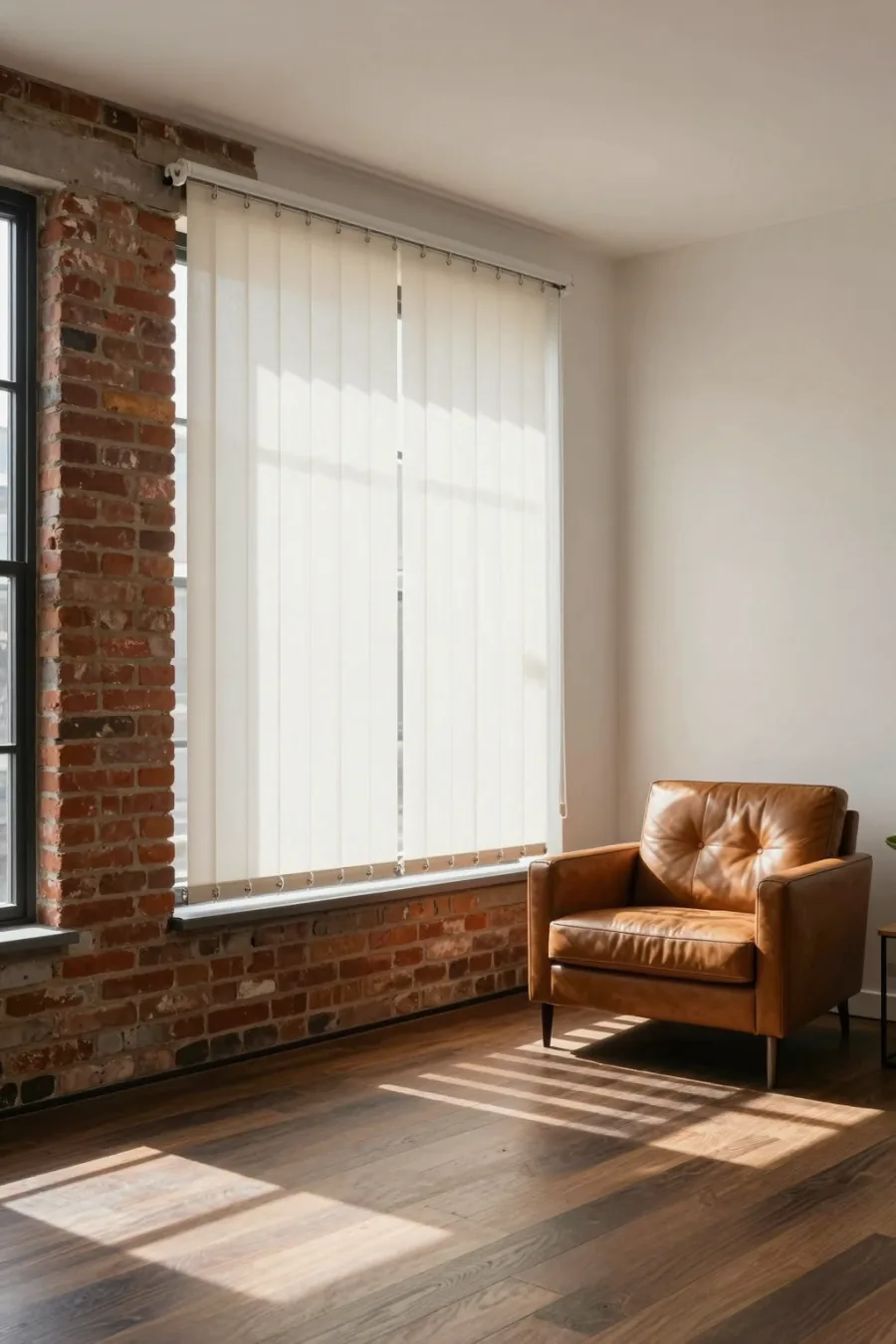











Transparent blinds in Almaty are not a separate type of construction, but a type of fabric: sheer mesh, jacquard or two-layer zebra. During the day they let in light and hide the room from prying eyes; in the evening, with the light on, silhouettes are visible from the street. Dense evening privacy is provided by the dense stripe of the zebra or a second fabric.
Transparent blinds are a fabric, not a separate type of blinds
Transparent blinds are not a separate construction, but a type of fabric. Transparent fabric is put on vertical slats, on the day-night system and on roller mechanisms — the construction itself stays ordinary. Hence the confusion: a person expects a separate section in the catalogue, but gets a choice of fabric for the same vertical or roller system they saw at a neighbour’s place. Sheer zebra is a two-layer fabric with alternating transparent and dense stripes; shifting the layers changes the light smoothly. Polyester and jacquard are transparent fabric of various densities: from light mesh to dense patterned jacquard. The material is chosen in advance from samples, and the measurer brings the samples — you need to look at the fabric against the light in your own lighting, not on a screen.
How transparent fabric differs from sheer
Sheer does not regulate anything: it hangs and lets light through. Transparent fabric is controlled — it goes up, shifts its layers, and is fixed at the required height. And the difference is not cosmetic: sheer has to be tucked behind the rail and taken down entirely when it gets dusty, while the fabric lives on its own mechanism. In the evening, with the light on, silhouettes are visible both through sheer and through transparent fabric, but with a dense stripe the fabric gives better evening privacy. If you want more privacy, the density of the fabric matters more than the mere fact of having fabric on the window.
Transparent and semi-transparent — where the line is
The line is drawn by density, not by name. Light mesh barely holds back the gaze from outside during the day, jacquard is denser, and in a multi-texture fabric transparent and dense fabric alternate within one piece. Semi-transparent fabric is the middle of the range: it already hides the interior, but still lets in a lot of light. During the measurement, samples are held against the glass and looked at from both sides: from inside the room and from the street.
Transparent fabric is a type of fabric that is put on vertical slats, on day-night and on roller systems, not a construction in its own right.
Can you be seen from the street in the evening when the light is on in the room
In the evening, with the lights on, people outside see silhouettes, not what is happening in the room. This applies to both sheer curtains and transparent fabric — the only difference is how dense the pattern is that blocks the light. Evening privacy depends entirely on the density of the fabric, not on how new or beautiful the fabric hanging on the window is.
When it gets dark, the picture flips. During the day it is brighter outside than inside, and the eye from the street catches the reflection on the glass; at night the light from the room becomes brighter than the street, and the glass starts to work like a screen. Transparent blinds in Almaty do not change this: any material is lit up from inside with such a difference in light. A dense pattern breaks the flow of light and blurs the outline of a person or furniture; a semi-transparent fabric does not do this.
With a light mesh, the silhouette is more visible in the evening. With dense jacquard and multi-texture with a dense stripe, it is less visible. Transparent fabric does not give complete darkness, and we will not promise complete evening privacy.
Why the room is not visible during the day
During the day it is brighter outside than inside, so a passerby sees the reflection of the sky and neighbouring buildings, not the interior. Transparent fabric lets diffused light through and does not make the room visible from the street during the day. Neither a wardrobe, nor a table, nor a person behind the glass can be made out — only a soft glow is visible.
And this works on any floor. On the first floor a neighbour stands closer, on the ninth — farther, but the principle is the same: while it is brighter outside, the room is closed off. If you look from the street right up close, details are slightly more distinguishable than from the opposite side of the courtyard.
What to do if you need darkness at night
A choice of two options.
- Two-layer zebra. The dense stripe overlaps the transparent one, and the fabric closes the room from prying eyes in the evening. Shifting the layers adjusts the degree of closure — from semi-transparent to almost dense. It is installed in living rooms and studios.
- A second dense fabric paired with a transparent one. During the day the transparent fabric works, in the evening the dense one replaces it. In the bedroom this is usually the option chosen: in the morning you need light, at night — darkness, and one fabric does not solve both tasks.
There is also a third nuance that comes up during measurement. The colour of the fabric looks different during the day when backlit and in the evening under a lamp: a light fabric seems cooler and slightly darker in the evening, because it is lit not by the sky but by a room lamp. That is why we always bring samples to the measurement — the fabric needs to be seen under the lighting that will be in the room.
The dense stripe of a zebra and a second dense fabric are two ways to get evening privacy; a light mesh on its own does not provide it.
How to choose fabric density for your floor and side of the building
Fabric density is chosen by floor and side of the building, not by interior colour. It determines whether the room will be visible from the street during the day and how much heat stays at the glass in summer. Below is a guide, and you choose the exact fabric from samples at the measurement: the measurer brings them along.
| Floor and side of the building | Recommended density | What is visible from the street during the day | What is visible in the evening with the lights on |
|---|---|---|---|
| First floor, windows facing the street and pavement | Dense fabric or screen with coating | Diffused light | Silhouettes, with dense fabric — almost nothing |
| Lower floors, windows facing the courtyard or opposite a neighbouring building | Sheer zebra or medium-density jacquard | Diffused light | Silhouettes, the dense stripe of a zebra blurs them |
| Middle floors, windows facing north | Light mesh | Diffused light | Silhouettes |
| Upper floors, windows facing north | Light mesh, sheer zebra | Diffused light | Silhouettes |
| South side, any floor | Screen with coating or dense fabric | Diffused light | Silhouettes, with dense fabric — almost nothing |
On the first floor passersby are level with the windowsill, so a light mesh does not work here: it softens the gaze but does not remove it entirely. For the ninth floor the situation is the opposite — from the ground the room is viewed at an angle, and a light sheer mesh is enough. Fabric density is chosen by this logic, not by the principle of “the denser the better”.
Almaty climate and fabric choice
Almaty has a sharply continental climate — winters are frosty, with a noticeable difference between day and night temperatures, and summers are hot and dusty. The south side heats up more than the others in summer — there Jalusso more often installs screen with coating. A sun-protection mesh with coating reflects some of the heat back outside the glass, and the room heats up more slowly; it also reduces glare on a monitor screen. In winter, dense fabric works as an extra layer at the glass and softens the cold that pulls from the window.
And the dusty season in Almaty is long, and a light mesh gets clogged faster than dense jacquard. Dust is least noticeable on multi-texture fabric — it alternates transparent and dense fabric, and the edges are not so visible.
Do not neglect the side of the building: the same fabric behaves differently on a north and south window. For the south, transparent blinds for windows are chosen denser, for the north a light mesh is enough.
The main guide when choosing is the floor and side of the building; fabric density is chosen by them, and on the first floor or on the south you cannot do without dense fabric or screen with coating.
Zebra, vertical or screen: what to install on a specific window
The choice of system is decided by three factors at once: whether evening privacy is needed, how the sash opens and what is on the windowsill. Sheer zebra and multi-texture blinds close the room in the evening with a dense stripe. Vertical blinds are pulled to the side and do not interfere with a balcony door or a tilt-and-turn sash. Screen with coating is installed where it is important to reduce glare on a screen and lower the heat at the glass. The system is not chosen by wallpaper colour — first the window and how it opens, then the fabric.
| Where we install | System | Why so | Lead time per price list |
|---|---|---|---|
| Balcony door and window unit, door plus window | Vertical, fabric, slat 89 mm | The blind slides to the side, the door opens freely | 3–5 days |
| Bedroom, east-facing window | Day-night, two-layer fabric | In the morning a dense stripe cuts the bright edge at the glass | 5–7 days |
| Study, south-facing window | Screen with a coating | The glare on the monitor goes away, the room doesn't get dark | the price is calculated at the measurement |
| Floor-to-ceiling panoramic glazing | Multi-texture, two fabrics in one blind | A single blind reads as one piece, with no breaks at the sashes | 7–10 days |
| Kitchen, window by the table | Day-night or multi-texture | Dust collects along the edge, the blind is cleaned with a vacuum | 5–7 or 7–10 days |
A sheer fabric lets in diffused light and doesn't make the room visible from the street during the day. What can be seen in the evening no longer depends on the system, but on whether the fabric has a dense stripe.
Bedroom and panoramic window
For a bedroom, sheer blinds are installed together with a dense fabric. A sheer one alone doesn't solve the problem: in the morning light hits the edge, and in the evening silhouettes are visible with the lamp on. The second blind closes off the room when needed, while during the day a light mesh remains.
On panoramic glazing, width and height are measured by whole spans, not by sashes. A single blind across the entire frame reads more calmly than several blinds with different edges.
Kitchen
The kitchen window by the stove is the only place where fabric suffers from grease and steam. The blind is placed away from the hob, otherwise grease settles on the fabric in a thin layer, and it can't be removed with a sponge. Screen with a protective coating loses its properties from frequent cleaning.
If the kitchen window is by the table rather than the stove, day-night or multi-texture blinds are chosen: you run a vacuum over them once a season, and that's enough. We've installed them this way in apartments more than once — kitchen on the ground floor, window facing the courtyard, neighbours opposite: day-night with a dense stripe, and in the evening the room is closed off.
Sheer blinds, transparent roller shutters and soft PVC windows are three different products
Sheer blinds for a veranda are not the same as sheer blinds for a room window. The only thing they share is the word “sheer”. Behind it are three different products with different purposes, materials and installation locations.
Transparent roller shutters for a veranda are external protection for the opening. This is a sheet of transparent plastic that lowers from the outside and protects a gazebo, terrace or summer kitchen from wind and dust. They are installed around the perimeter, not on a window sash. Soft PVC windows belong in the same category: flexible sheets in a profile frame that are used to close off open terraces for the cold season. Both work on the outside.
Sheer blinds for windows are a product for the room. Here the sheerness comes from the fabric: a light sheer mesh, jacquard, screen with a protective coating or a two-layer zebra. Such a blind is mounted on the frame, in the glazing bead or on the wall inside the opening and controls light from the inside. It doesn't protect from wind and doesn't retain heat — it has a different job.
The confusion comes from the word “sheer”. A person is looking for protection for a veranda and lands on a page about fabric. Or the other way around: they want to replace the sheer in the living room, and they're shown plastic roller shutters. These are different workshops, different installation and different measurements.
The practical distinction is simple. If the opening needs to be closed from the outside and protected from the weather — that's roller shutters or soft PVC windows. If the blind lives inside the room and works with light — that's sheer blinds.
Transparent roller shutters for a veranda and soft PVC windows are external protection for terraces, while sheer blinds are a fabric blind for a window inside the room.
Mounting: on the sash, in the glazing bead, without drilling the frame
Sheer blinds for windows can be installed without drilling the frame. There are two common options for this: brackets in the glazing bead and spring clamps on the sash. With both, the frame stays intact, and no holes appear in the profile.
The difference between them is simple. A clamp sits on the sash and holds the blind directly on it. A bracket in the glazing bead hooks onto the glazing bead of the glass unit — the thin strip around the perimeter of the glass. Which of the two will work depends on the profile and on whether the sash opens. Moreover, on one window these options are sometimes combined: a clamp on the opening sash, a glazing bead bracket on the fixed part.
At the measurement this takes a couple of minutes. The measurer arrives with samples, looks at the profile, checks how the sash moves and names the suitable mounting. The cost is calculated on the spot, because the price coefficient depends on the type of mounting.
What each option gives you:
- Drill-free mounting keeps the frame intact — the window doesn't lose its factory properties, and when you move, the blind can be removed without a trace.
- Mounting on the sash lets you open the window without removing the blinds: the blind moves together with the sash.
- A bracket in the glazing bead works for fixed windows and balcony units where the sash doesn't open.
- On panoramic glazing, mountings of one type are installed along the entire line so that the blinds run at the same height.
On a fixed window the question of opening doesn't arise: there the mounting works only as a holder for the blind. But next to a sash, a clamp wins because it doesn't get in the way of the window opening.
Tilt-and-turn sash
A sheer blind can be installed on a tilt-and-turn sash, and you can open the window without removing it. The clamps sit so that the blind moves together with the sash. At the measurement we check whether the system bumps into the handle and the window reveal.
If it does, a different type of bracket is chosen or the blind is shifted. This happens more often on narrow sashes where the handle is close to the edge.
A uniform look
So that the blinds look the same on the sash and on the fixed window, mountings of one type and colour are chosen. This is decided at the measurement using samples: you can see how the bracket will sit on the profile and how the blind will hang.
A small detail: different profiles have different glazing bead geometry. What fits one window may sit crooked on the next one — so the mounting is checked for each opening, not assigned to the whole site in one line.
Drill-free mounting keeps the frame intact, while mounting on the sash lets you open the window without removing the blinds.
Care of the transparent fabric and its coating
Caring for transparent fabric comes down to one rule: machine washing rinses out the coating. The coating sits on the fibre, not inside the fabric, so during spinning and with detergent it goes out with the water. What remains is an ordinary mesh — it still lets light through, but no longer reflects part of the heat back behind the glass. Hence the order of steps: a vacuum cleaner on low power with a soft attachment, then a sponge without soaking. The fabric is not rubbed, not wrung out and not doused with stain remover.
The numbered order we follow on site:
- Run the vacuum cleaner over the fabric on low power — dust comes off along the edge and between the slats.
- Go over it with a sponge, slightly damp, without soaking and without detergent.
- Let the fabric dry stretched out, without putting it back into the cassette while wet.
- Once a season, check the edge of the vertical slats — that is where the most dust settles.
If the fabric is removable, take it off the brackets and carry it to the water carefully, without folding it along a crease. Machine washing is not suitable for coated screen — that is exactly how it loses the very thing this fabric is chosen for on the sunny side. The dust-repellent coating is renewed at the factory; we do not offer it as a separate service around the city.
Which stays cleaner — slats or roller fabric
When it comes to collecting dust, vertical blinds and roller blinds behave differently. On vertical slats dust settles along the edge, on roller fabric — across the whole surface. Slats are more convenient in this sense: you go over the edge with an attachment and barely touch the flat part. Roller fabric has to be gone over entirely, but it has no strips or cords for dust to get stuck between. Both are enough to vacuum on low power — that is all it takes for the fabric to keep its look.
Fading
Fabric fading is a natural process and is not covered by the warranty. Fabric changes colour in the sun over time: white shifts to a warm shade, coloured fabric lightens along the edge and along the fold line. In our warranty, fabric fading is on the list of exclusions together with mechanical damage and self-reinstallation. The process cannot be stopped completely, but it can be slowed down. White fabric stays white longer if you choose coated screen on the sunny side: part of the heat goes back behind the glass, and the fabric gets less heat. For the other sides the choice is simpler — sheer mesh or jacquard is enough there.
The screen coating is rinsed out by machine washing; caring for coated fabric rules out machine washing — only a vacuum cleaner and a sponge without soaking.
How much do transparent blinds cost in Almaty
Transparent blinds in Almaty are priced by fabric area: vertical fabric ones — from 4,600 ₸ per m², day-night — from 7,300 ₸, multi-texture — from 7,200 ₸. For installation we charge 4,500 ₸ per item; if the order total reaches 150,000 ₸, we install at no extra cost. The final figure depends not only on the square metres — density, opening width and the type of control change the amount noticeably.
What affects the price
Four things move the cost: fabric density, opening width, control and mounting. Density is the choice between a light mesh and jacquard, and the price difference between positions in the price list reaches several thousand tenge per square metre. Opening width affects how much fabric is used and how many slats or strips go into the cutting.
Control is calculated as a coefficient to the base price. Manual — ×1. Chain with stoppers — ×1.06, and that is the one most often chosen for the kitchen and the kids’ room: the fabric stops at the right height and the bottom does not flap in a draught. Electric motor — ×1.85, and with a remote control — ×2.1. The difference between manual and a motor with a remote is a little more than double, and on a wide panoramic fabric that is the biggest line in the estimate.
Mounting adds too. The coefficient depends on the mounting: to the wall — ×1, to the frame — ×1.05, drill-free installation — ×1.1, cassette version — ×1.28. The cassette is more expensive than the others because the fabric goes into a closed housing, and only a neat profile is visible in the interior.
Example calculation
A typical case: a window in the living room, vertical fabric blinds at 4,600 ₸ per m², chain control. The fabric takes a coefficient of 1.06, wall mounting leaves the multiplier unchanged. Installation — 4,500 ₸ per item if the order does not reach 150,000 ₸. The measurer gives the exact amount on site using the samples — both the square metres and all the coefficients are calculated in front of you.
For the motorised version of the same window, the electric motor raises the price by a coefficient of 1.85, with a remote — 2.1. A cassette system in the same calculation adds 1.28. If the fabric is installed without drilling the frame, the multiplier will be 1.1.
Timelines and warranty
Vertical fabric blinds and day-night are made in 3–5 and 5–7 days respectively, multi-texture — in 7–10 days. The time is counted from the measurement, because Jalusso has no ready-made items in stock: every fabric is cut for a specific opening.
We give three years of warranty on the mechanism and one year on the installation work, counted from the date the acceptance report is signed. If a case is recognised as a warranty one, we repair it free of charge — that takes no more than five working days. Once the warranty has expired, our technician still comes: tightens the fabric, adjusts the movement, fits a new cord or chain. Fabric fading, mechanical damage, self-reinstallation and traces of water are not covered by the warranty — just like machine-wash care, which rinses out the coating.
The price of transparent blinds is made up of the fabric area, the coefficients for control and mounting, and installation; the base positions are 4,600 ₸ per m² for vertical, 7,300 ₸ for day-night and 7,200 ₸ for multi-texture.
How we work: measurement, workshop, installation
We make transparent window blinds only by measurement: we have no ready-made items in stock, every system is assembled in the workshop for a specific opening. The order is as follows.
- You write on WhatsApp and give your address. The measurer arrives with samples, holds the fabric against your glass and calculates the cost on the spot.
- You choose the density and the control. Aida, our fabric consultant, helps you tell apart options that look similar — on a sample they look different than on a window.
- The workshop makes the fabric to size. Non-standard windows — arched, triangular, attic — go to our lead measurer Kirill, who has nine years of practice with them.
- Installation. We charge 4,500 ₸ per item; for orders from 150,000 ₸ installation is free. Our foreman Zhenya installs both ordinary systems and electric motors.
The warranty covers the mechanism for three years and the installation for one year from the date the acceptance report is signed. Fixing a warranty case takes up to five working days, and we do not charge for it. Even after the warranty period has ended, our technician comes — tightens the mountings, adjusts the mechanism, replaces the cord or chain.
Trips to the suburbs
Jalusso travels to Kaskelen, Talgar, Issyk, Kapshagay — the call-out cost depends on the distance and is quoted before the visit. Within the city, measurement and delivery are free.
Measurement with samples is free within the city, while a visit to the suburbs is charged separately.
FAQ
Will the frame and window reveals be visible through the fabric? Through a light sheer mesh the frame and reveals show through — the gap along the edge is visible, especially against a light background. Dense jacquard and multi-texture blinds hide them: the fabric covers the glass closely, and the reveal does not show through. On panoramic glazing this is more noticeable than on a narrow sash, because the edge line is long. In my view, if the frame is new and you want to keep it in the picture, a light mesh actually wins here.
How much light does transparent fabric let through? We don't give an exact light transmission figure — it depends on the fabric density and varies from batch to batch. Transparent fabric lets through diffused light: the room stays bright, but the sun comes in softly, without harsh spots on the floor. Density is chosen from samples at the measurement: the measurer brings fabric swatches and shows them on your window in your lighting. A light mesh lets in more light, jacquard and multi-texture let in less, but also hide better in the evening.
Can transparent blinds be installed in the kitchen next to the stove? Yes, but the fabric is placed away from the stove: grease and steam settle on the fabric, and cleaning becomes a separate job. If the window is by the table, choose zebra or multi-texture — they are easier to vacuum.
What does the warranty on fabric cover? Three years on the mechanism and one year on installation from the date the acceptance certificate is signed; we fix warranty cases free of charge within five working days. The warranty does not cover the following cases: the fabric faded on its own, water got on it, the fabric was damaged mechanically, or the blinds were reinstalled by the customer. And after the warranty we still come — to tighten, adjust, replace the cord or chain. Fabric changes colour in the sun over time, and this is a normal process, not a defect.
How does the Almaty climate affect the choice of transparent fabric? Sharply continental climate: summers are hot and dusty, winters are cold, with frosts and temperature swings between day and night. On the south side, screen with a coating reflects some of the heat back outside the glass, and the room heats up more slowly. In winter, dense fabric works as an extra layer by the glass, while a light mesh barely holds back the cold from the window. So for the south, choose dense fabric; for north-facing windows, a light one is enough.
The light transmission of transparent fabric depends on the fabric density and is chosen from samples at the measurement, and the frame and window reveals are only hidden by dense jacquard and multi-texture.
Conclusion
Transparent blinds are a type of fabric, not a separate construction: sheer mesh, jacquard and sheer zebra are mounted on vertical slats, on day-night and on roller systems.
During the day, transparent fabric lets through diffused light and does not make the room visible from the street. In the evening, with the lights on, silhouettes are visible from the street, and this is a limitation of any transparent fabric, not a defect of a particular fabric. The only reason people ask us for transparent blinds in Almaty is to remove the sheer and curtain and keep the light. But if the window faces a neighbouring house, a light mesh alone is not enough.
Dense evening privacy is provided by a dense zebra stripe or a second fabric paired with a transparent one. Density is chosen based on the floor and which way the window faces: the first floor and the south require denser fabric or coated screen fabric, upper floors with north-facing windows get by with a light mesh. And the climate here works against thin fabric — summers in Almaty are hot and dusty, winters are cold, with strong temperature swings between day and night.
The price depends on the fabric density, the width of the opening and the control. Vertical fabric ones — from 4,600 ₸ per m², day-night — from 7,300 ₸, multi-texture — from 7,200 ₸. Installation — 4,500 ₸ per item, free for orders from 150,000 ₸.
The practical step is one: call a measurer with samples, look at the fabric in your lighting — both during the day and in the evening under a lamp — and choose the density for your specific window.

