


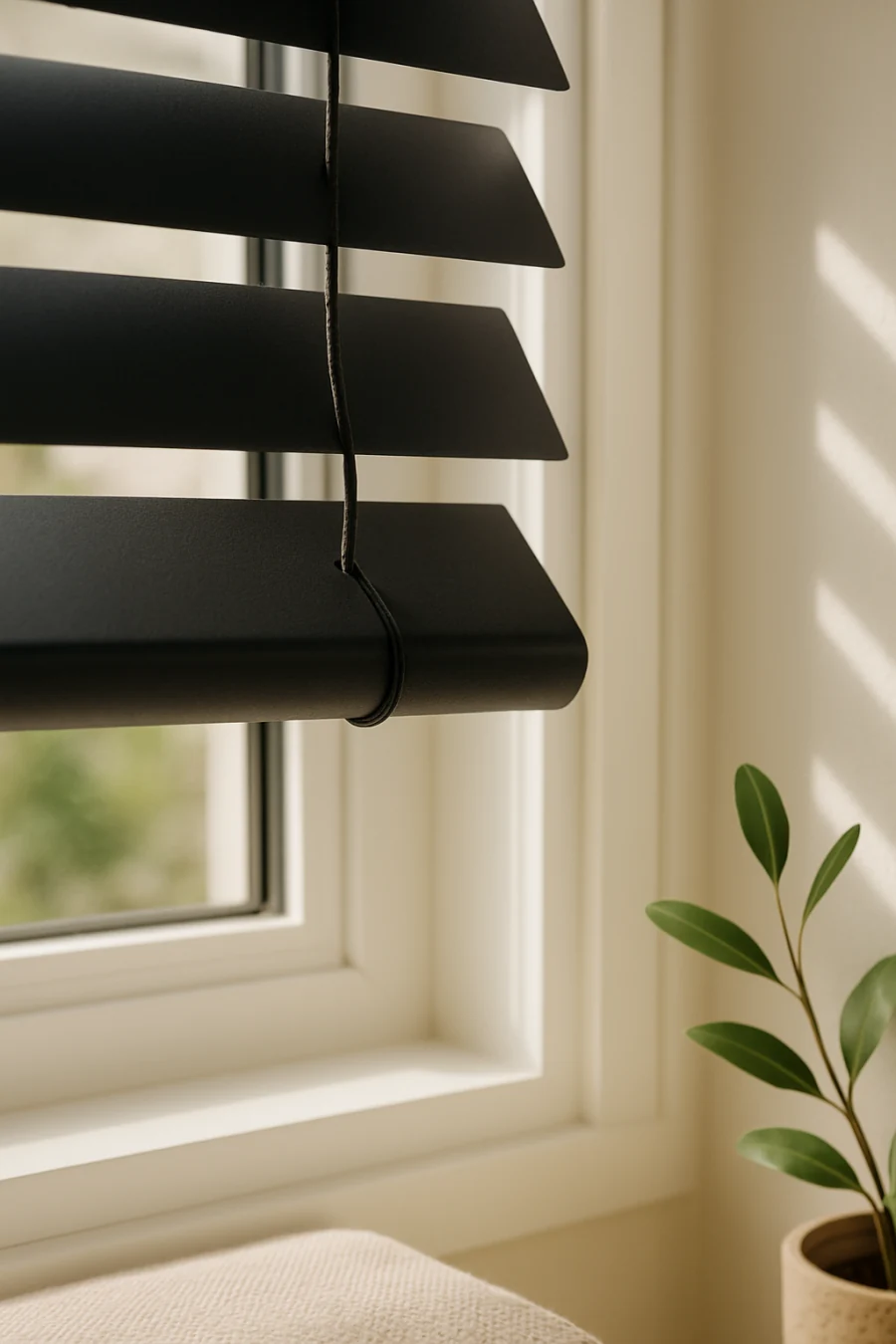















Blue blinds are a light cool tone close to white: they give soft diffused light, work as a colour accent on the window and hardly eat up any light in the room. We make them to measure in Almaty: the measurer brings samples, you choose the tone in your own lighting, then the workshop and installation follow.
How blue blinds differ from navy, turquoise and grey-blue
Blue blinds are a light cool tone close to white, not a saturated colour. Navy is noticeably darker and denser: on a window it works as a dark spot, while blue stays an almost neutral background. Hence the main practical difference: blue doesn't darken the room but gives a colour accent on the window.
Customers come with the same worry: how not to buy a “hospital” tone and how not to confuse blue with navy. The confusion arises because in shops and on screenshots the shade is shown without light. On a slat it behaves differently.
The working rule for the tone boundary
Distinguish two independent qualities: lightness and saturation. Lightness is how much white is in the tone, saturation is the intensity of the pigment. Blue differs from navy in both at once — it is lighter and less saturated.
The boundary lies where the tone stops reading as light. As soon as there is so much pigment that the slat looks dark against the window, it is already navy. A simple reference point: turquoise has green mixed into the tone and drifts into sea shades; grey-blue has a grey undertone and reads muted and calm. Blue borders on both, but itself stays pure and cool.
We suggest not arguing about names but looking at the sample itself. In my view, that's the only way not to get it wrong — everyone's vocabulary is different, but the eye sees more accurately.
Why blue and navy are separate pages for us
Blue and navy blinds are separate pages on our site because they are different tones, not one colour under two names. If you are looking for a saturated dark tone, it is described in another section; here we only talk about light cool blue.
The boundary between blue and navy, as well as the proximity to turquoise and grey-blue, is determined by the lightness and saturation of the slat, and it is these two qualities that decide how the tone will sit in the room.
How blue reads on a south-facing and a north-facing window in Almaty
On a south-facing window, blue blinds glow and give a feeling of coolness in the room; on a north-facing one, the same shade turns grey. This is not an optical illusion or a property of a particular slat — it is the effect of which way the window faces.
A south-facing window gets sun almost all day. Almaty summers are hot, sunny and dusty, and fabric against such light washes out: blue on a south-facing window loses depth of tone, but the room next to it feels cooler. A north-facing window gets almost no direct light, and blue turns grey. The more saturated the tone, the more noticeable this shift — saturated blue on a north-facing window looks a bit dirty. A muted grey-blue reads calmly and evenly there all day.
- South-facing window: light and medium blue glow, the room looks cooler.
- West-facing window: the tone is more even, and towards evening the fabric is lit by the low sun.
- North-facing window: blue turns grey; a saturated tone looks a bit dirty, a muted one looks calm.
Winter in Almaty is cold, with frosts and a temperature swing between day and night. In this climate, a window hardly lights the fabric in winter, and the difference between south and north reads even more sharply than in summer: on the south side blue stays alive, on the north side it turns grey.
What is visible from the street during the day and in the evening
During the day, blue blinds give diffused light — details in the room are not visible from the street, you just see a light or dark patch of the window. It looks dark on a bright facade and light in the shade.
In the evening the picture is different. Blue blinds made of dense closed fabric — for example, day-night blinds fitted close to the glazing bead — hide silhouettes. Open slats and thin fabric show figures in the room when the light is on. For a bedroom and a ground floor, this is worth considering in advance.
On a south-facing window, blue blinds glow and give a feeling of coolness; on a north-facing one they turn grey — and it is which way the window faces, not the shade itself, that decides how the tone you choose will look.
Matte, gloss or metallic: how the slat surface changes the look of blue
The most practical choice for a living room is matte blue — it hides fingerprints and small scratches, and dust is almost invisible on it. Metallic, on the contrary, catches the light and shows dust more. For the kitchen and a child’s room we usually recommend a matte slat; we leave metallic for interiors where the surface is not touched by hand.
A tone behaves differently on different surfaces, and this is not about the pigment itself but about how light reflects. A matte finish diffuses the rays and keeps an even blue in any weather. Gloss reflects the window and walls, and blue in it shifts: in the morning it is cooler, during the day it looks lighter. Metallic adds a touch of shine, and the same shade reads deeper and darker on it than on matte.
In summer, dust in Almaty blows in from the street constantly, and here the difference between surfaces is immediately visible. On matte blue aluminium fabric with a 25 mm slat, the film of dust appears softly, and it is wiped off with a damp cloth once every couple of weeks. On metallic, dust settles into the shine and makes the slat dull — you have to wipe it more often. Scratches show more on blue than on white, so in the kitchen, where the fabric is moved by hand, a matte surface is more practical.
| Surface | Glare | Fingerprints | Dust visibility | How blue looks |
|---|---|---|---|---|
| Matte | almost none | hides | low | even, slightly muted light tone |
| Gloss | reflects the window and walls | noticeable | medium | shifts in lightness during the day |
| Metallic | catches the light | noticeable | high | deeper and darker than matte |
Sometimes customers bring a photo from the internet and ask for “exactly this blue”. We look at the picture together with the customer — and almost always it is metallic under direct studio light, not the tone you see in a room. On a sample in your hand, the difference between matte and metallic on blue aluminium disappears, because the sample is held against the light. On a window, the slat stands in transmitted light, and the surface starts to play differently.
The rule is simple: the more often you will touch the fabric with your hands, the more reason to choose a matte surface. Fingerprints and small scratches are almost invisible on a matte slat, while metallic highlights both.
What to look at when choosing
Hold the sample against the window, not the wall, and compare all three surfaces in the same light. Choose matte for the kitchen, a child’s room and a hallway, where slats get knocked; gloss and metallic — for the living room, an office and shop windows, where the fabric is not touched. Before ordering, ask how the surface will behave in your room — our measurer brings samples and shows them on site.
Which room blue blinds suit
Blue blinds suit any room in an apartment if you choose the material for the purpose of the room, not just the tone. For a child’s room and a bedroom we more often install muted blue; for the kitchen and balcony — blue aluminium or blue PVC with a 25 mm slat; for the living room — blue fabric; for an office — slats that remove glare from the monitor.
In the kitchen, blue does not create coldness if you use warm light and do not overload the walls. But it is not the colour that feels cold — it is an empty room with a single cold tone on the window. A couple of wooden details, a warm lamp — and blue reads as an accent, not as an operating theatre. About appetite, let us be direct: blue on a windowsill does not make food look grey; light through the slat falls on the table as diffused light, not as a coloured patch. On the contrary — a cool tone next to white dishes looks cleaner than yellow or terracotta. Steam and grease are more of a threat to a kitchen than a shade: aluminium and PVC are washed right on the window, grease does not soak into the finish, and the fabric does not need to be taken down.
Kitchen, bathroom, balcony
The kitchen, bathroom and balcony require a material that does not care about steam, moisture and temperature swings. Blue aluminium and blue PVC are exactly that: a 25 mm slat is washed with a damp cloth and is not afraid of splashes from the sink or steam from the stove. We do not install fabric next to the stove — thin fabric absorbs grease and collects dust, and it is hard to bring it back to its original look.
Bedroom and kids’ room
A bedroom requires dense fabric that closes the window right up to the glazing bead: blue day-night fabric or a screen blocks the morning light, and the room stays closed until you get up. Blue in a child’s room is not necessarily a “children’s” colour: a muted grey-blue on a slat does not clash with the wallpaper and does not look out of place a few years later. A saturated tone in a child’s room works as an accent if the walls are light and the furniture is neutral.
Living room and office
A living room needs a fabric that diffuses light — day-night blinds or a screen in a blue tone: in the evening silhouettes can't be made out from the street, and during the day the room stays bright. A study needs blue horizontal slats: they remove glare from the monitor, and you can work during the day without a lamp. Matching the shade between rooms is easier if you order both windows with one measurement: the Jalusso measurer will bring samples, and you'll see the same tone in your own light in two rooms — that way it matches without surprises.
Blue next to warm wood, oak-look laminate and beige walls
Blue blinds get along with warm wood and beige walls if you choose a muted grey-blue rather than a saturated tone. Warm floors and warm furniture on their own clash with a pure cool colour — a muted blue resolves that clash.
Grey-blue reads as a colour accent, but it doesn't shout. Next to oak-look laminate and furniture it works calmly: the grey undertone echoes the wood grain, the cool blue echoes the beige walls. A saturated blue looks out of place in such a room. And it's not about taste, but about how cool and warm colours share the same space.
A white plastic frame is a different story. On it, blue blinds read as a colour accent: the white background doesn't mute the tone, it draws it out. If the walls are white, a saturated blue is appropriate — it gives the window colour and the room character.
What blue blinds go with:
- White plastic frame — contrast, a colour accent on the window
- White and light beige walls — blue doesn't clash with the background, it works as a focal point
- Warm wood, parquet, oak-look laminate — only a muted grey-blue
- Oak-look furniture and beige walls — grey-blue of the same lightness as the walls
- Scandinavian style — light blue on a white frame, wood as an accent
- Nautical style — blue next to white and light wood
- Coloured curtains on a rail — the blinds stay the accent, the curtains take on the background
Coloured curtains and drapes on a rail can be combined with blue blinds, but then one of them sets the tone. With saturated drapes, it's better to choose muted blinds; with bright curtains as the background, the blue on the window stays the main detail. In Scandinavian and nautical styles, this pairing works on a light base with wood.
Holding a sample against the wallpaper, floor and furniture in person is more reliable than comparing on a screen. Until you see the blue next to oak-look laminate and a beige wall in your own light, the decision remains a guess.
A muted grey-blue on a warm background and a saturated blue on a white frame are two different solutions to the same task: the first blends into the interior and works with colour, the second creates contrast and works as an accent.
Blue on a sample and blue on a window against the light
On a window, the slat and fabric stand against the light, and the same blue tone reads lighter than on a sample in your hand. This isn't a manufacturer's mistake or a faulty batch. You hold the sample in the room's reflected light, while the fabric works with light passing through it: some rays pass through, and blue light comes into the room — cool and diffused.
That's exactly why blue blinds should be chosen not from a picture on your phone, but from samples in your own lighting. The measurer brings them along, you hold the slat against the wallpaper, the furniture front, the floor and look — during the day and towards evening. The same tone on a south-facing windowsill and by a north wall are two different colours. And the difference is more noticeable than with white or grey.
There's a second reason why the sample and the window differ. A coated fabric tints the light passing through it a cool shade: the room seems brighter and “cleaner” than with closed heavy curtains. Aluminium and PVC don't have this effect — there you see exactly the colour that's on the sample.
Does blue fade in the Almaty sun? Blue pigment on light tones lasts longer than saturated dark colours — that's a general rule for both slats and fabric. But we won't promise that the fabric won't fade at all: on a south-west window under the Almaty summer, the fabric gradually lightens, like any dyed fabric. Natural fading isn't covered by the warranty — the mechanism has 3 years, installation has 1 year from the date the acceptance certificate is signed, and fabric fading isn't covered by the terms.
What does this change in practice? If you like the tone on the sample, look at it on the window before ordering — measurement is free, and you lose nothing. Aluminium and plastic slats hold their colour more evenly than fabric, and for a south-facing side that's an argument in their favour.
Blue on a window is always lighter than blue in your hand, and the warranty covers the mechanism and installation, but not natural fading of the fabric.
How to choose a shade: step-by-step procedure
The shade of blue is chosen not from a picture, but from samples in your own lighting: the measurer comes with them and calculates the cost on the spot. Measurement and consultation are always free, and within the city delivery and the visit are free too.
The process is as follows:
- Look at the tone in your own light — during the day and in the evening with a lamp on. The same sample reads differently in the morning and at dusk.
- Hold the sample against the wallpaper, furniture and floor. Blue against warm wood and a beige wall behaves differently than against white.
- Choose the slat surface — matte, gloss or metallic. Matte hides fingerprints, metallic catches the light.
- Decide on the control and mounting. Blue blinds are mounted into the glazing bead or on brackets without drilling the frame — convenient both in rented housing and on new windows.
- Get a quote on the spot. The measurer gives the amount based on your dimensions, not an average price list.
Then the workshop, manufacturing and installation. Timelines: horizontal and vertical items — 3–5 days, day-night — 5–7 days. We give 3 years warranty on the mechanism and one year on installation from the date the acceptance certificate is signed.
We also travel to the suburbs — Kaskelen, Talgar, Issyk, Kapshagay — and we quote the visit cost before the visit, so the amount doesn't come as a surprise. Within the city, measurement and delivery are free.
The blue tone should be chosen from a sample in your hand in your own light, not from a photo on a screen.
Price of blue blinds in Almaty: what the amount is made up of
Blue blinds in Almaty are calculated by the same price list items as any others: the tone is a choice of slat or fabric within the construction, not a separate line on the invoice. Here are the guidelines before you call.
| Position | Price | Manufacturing time |
|---|---|---|
| Horizontal aluminium | from 4,200 ₸/m² | 3–5 days |
| Vertical fabric | from 4,600 ₸/m² | 3–5 days |
| Day-night | from 7,300 ₸/m² | 5–7 days |
| Plastic PVC | from 3,600 ₸/m² | 3–5 days |
| With electric motor | from 7,800 ₸/m² | 7–10 days |
Control shifts the amount more noticeably than colour. Mechanical comes with a coefficient of 1, chain — 1.06, electric motor — 1.85, electric motor with remote — 2.1. Mounting is calculated by the same logic: on the wall — 1, on the frame — 1.05, without drilling — 1.1, cassette system — 1.28. Installation without drilling the frame adds a tenth to the base price, and this is the case where the extra cost pays off in peace of mind: the brackets go into the glazing bead or are mounted on spring clips, the frame stays intact, and the window warranty isn't lost.
We charge 4,500 ₸ per item for installation, and from 150,000 ₸ we do it free. To be honest: a single kitchen usually doesn't reach that threshold, but a whole apartment or an office with several openings does.
Blue blinds with an electric motor are calculated as a separate item — from 7,800 ₸/m² and 7–10 days, because the motor changes both the construction and the assembly time.
The shape of the opening is a factor that outweighs the rest on non-standard windows. An arched, triangular or mansard window requires a separate calculation: the area isn't calculated as a rectangle. Such orders are handled by our lead measurer Kirill, who has nine years of experience with non-standard openings.
Colour has almost no effect on the price — the total depends on the type of construction, window size, controls and the shape of the opening, and the exact amount is quoted by the measurer on site.
Care for blue slats and fabric
Blue blinds need no special products. Blue aluminium and blue PVC are washed with a damp cloth and a mild detergent right on the window, without taking the blind down; grease and steam do not soak into the slat, so a kitchen or bathroom is cleaned just like a living room. But you should not scrub the slat with an abrasive: scratches show up more on blue than on white, and they are harder to buff out.
Fabric is a different matter. A blue blind is cleaned with a vacuum cleaner on low power — it cannot be machine washed, the fabric loses its treatment and its shape. The treatment protects blue fabric from dust and fading better than an ordinary one, but it does not change the main point: natural fading of fabric is not covered by the warranty. Pigment fades more slowly on light shades than on deep dark ones, and even so we will not promise that blue fabric will not fade.
What is worth doing regularly:
- wipe the slats with a damp cloth, without abrasives or stiff sponges;
- clean the fabric with a vacuum cleaner on low power, without taking the blind down;
- do not soak or machine wash a fabric blind;
- do not wipe blue slats with a dry cloth — dust gets rubbed into the shade.
In my view, blind care is the part clients remember after installation, so we talk about it during the measurement.
The fabric treatment protects blue fabric from dust, and after the warranty we still come out to service the mechanism: tighten, adjust, replace a cord or chain.
Blue for an office or coffee shop: how to avoid a “hospital” interior
The “hospital” look comes not from blue itself but from its saturation together with a cheap glossy surface. A muted blue on vertical slats reads as part of the brand palette, not as paint from a treatment room. That is what the choice for an office or coffee shop should be built on.
Blue vertical slats, 89 mm — a practical solution for an office or coffee shop with glazing. The slats turn around their axis, so on panoramic glazing blue holds its geometry across wide openings: the blind runs in even verticals from floor to ceiling, without sagging or waviness. Light falls evenly all working day, not in patches.
Blue slats remove glare on the monitor without darkening the room. During the day staff work without lamps, and coffee shop guests see a bright space, not semi-darkness. And the blind can be turned to the right angle — for sun from a particular side, not just “open-closed”.
Blue zones a space almost without partitions. In a coffee shop, vertical slats separate the window area from the main room: during the day they are open and the room looks whole, in the evening they close and shield guests from passers-by. In my view, this is more honest than glass partitions — cheaper to install and needs no approvals.
What ruins an interior? A saturated shade on gloss. People choose it to “make it bright” and get exactly that effect. In an office with glazing we recommend a muted blue and a matte surface, a light-coloured housing and one shade for all the openings on the floor.
Blue vertical slats 89 mm on panoramic glazing give even light and geometry across wide openings, while a muted shade instead of a saturated one steers the interior away from the “hospital” look.
Case studies
Blue blinds in Almaty are most often ordered for seven scenarios: a child’s room, kitchen, living room, study, rented flat, office with glazing and bedroom. The shade and design in each case are matched to the window and the task, not to a catalogue.
Here is how it works. In a child’s room, blue is taken as a 25 mm slat with a side handle — there is no hanging chain in the room, so the child cannot pull on it. A muted shade matching the walls reads as an accent, not as a “children’s” colour they will grow out of. In the kitchen we install blue aluminium: the slat is washed right on the window, grease does not soak into the coating, and the blind does not need to be taken down. In the living room, blue PVC covers the window without a single hole in the frame — the brackets are fitted into the glazing bead.
- Study: blue horizontal slats remove glare from the monitor without darkening the room — during the day we work without lamps.
- Rented flat: blue blinds are fixed with spring clips, the frame stays intact, and they come off without marks when you move.
- Office with glazing: blue vertical slats 89 mm hold their geometry across wide openings, light is even all working day.
- Bedroom: blue day-night fabric sits tight against the glazing bead, morning light does not wake you.
For each of these orders we choose a single blue shade — from samples under your own lighting, so that the window, floor and furniture look like one palette.
A typical order for blue blinds is decided not by colour but by the pair “material plus fixing method”: aluminium and PVC for the kitchen and balcony, fabric for the bedroom, slats for the study, vertical blinds for office glazing.
FAQ
How do you tell blue from dark blue when the sample is in your hand? Look at the lightness: blue is light, close to white, while dark blue is noticeably darker and more saturated. If in daylight you want to call the slat simply “coloured”, it is already dark blue.
Are blue blinds suitable for a kitchen? Yes, in blue aluminium or blue PVC. They are washed right on the window, grease does not soak into the slat, and steam and temperature changes do not affect them. We do not recommend fabric next to the stove.
What should you choose for a bedroom? A dense blind — blue day-night fabric or a screen fitted tight against the glazing bead: then morning light does not wake you. Blue aluminium and PVC are not suitable for a bedroom — through open slats the room is flooded with light in the morning.
Does colour affect the price? Colour has almost no effect on the price of blinds: you pay for the construction, window size, controls and the shape of the opening. Horizontal aluminium — from 4,200 ₸/m², vertical fabric — from 4,600 ₸/m², day-night — from 7,300 ₸/m², with an electric motor — from 7,800 ₸/m². The exact amount is quoted by the measurer on site.
Can they be installed without drilling the frame? Yes, the brackets are fitted into the glazing bead — the plastic window stays intact and its warranty is not lost. In rented housing this is the usual option.
Does blue fade in the sun? Blue pigment on light shades lasts longer than on deep dark ones, but natural fading of fabric is not covered by the warranty. That is why the shade is chosen from samples under your own lighting, not from a picture.
How do you care for them so the colour does not dull? Slats — with a damp cloth and a mild detergent, without abrasives: scratches show up more on blue than on white. Fabric is cleaned with a vacuum cleaner on low power, machine washing is not allowed — the blind loses its treatment and shape.
Conclusion
Blue blinds in Almaty are a light cool shade, close to white, not a saturated colour. Dark blue is darker and denser in tone, turquoise leans green, and grey-blue is a muted version of the same blue with a grey undertone. The line between them runs along the lightness and saturation of the slat, and the difference is obvious as soon as all three samples lie side by side.
On a south-facing window, blue glows in the sun and gives the room a feeling of coolness. A north-facing window behaves differently. The same shade turns grey, and there a muted grey-blue reads more calmly. The practice is simple: first the side of the light, then the shade.
The surface of the slat changes the look of a shade no less than the shade itself. A matte surface hides fingerprints and small scratches, and dust on it is almost invisible. Metallic catches the light and shows dust more. For a living room we more often recommend a matte slat — in my view, metallic is overrated where the window faces a dusty street.
Colour has almost no effect on the price. The total depends on the type of construction, window size, control and the shape of the opening. Horizontal aluminium — from 4,200 ₸/m², vertical fabric — from 4,600 ₸/m², day-night — from 7,300 ₸/m², with electric motor — from 7,800 ₸/m². Installation — 4,500 ₸ per item, free for orders from 150,000 ₸.
Natural fading of fabric is not covered by the warranty — this is stated directly in its terms. We will not promise that blue fabric will not fade in the Almaty sun. Aluminium and PVC hold pigment longer, but even there the shade is chosen consciously.
One recommendation: call a measurer with samples and look at blue in your own light — during the day and in the evening, holding a slat against the wallpaper, furniture and floor. Measurement and consultation are always free, and the measurer calculates the cost on site.

