
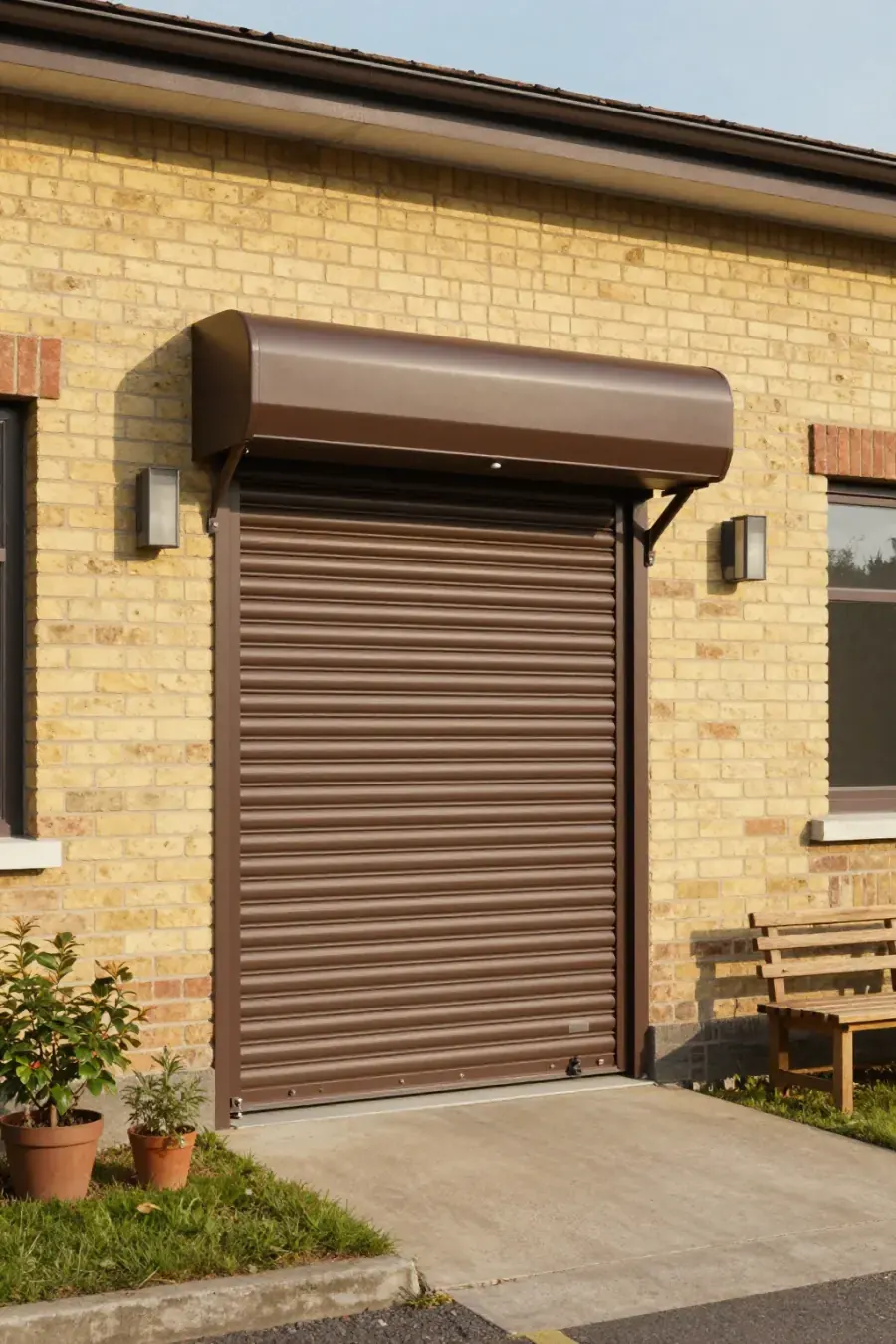


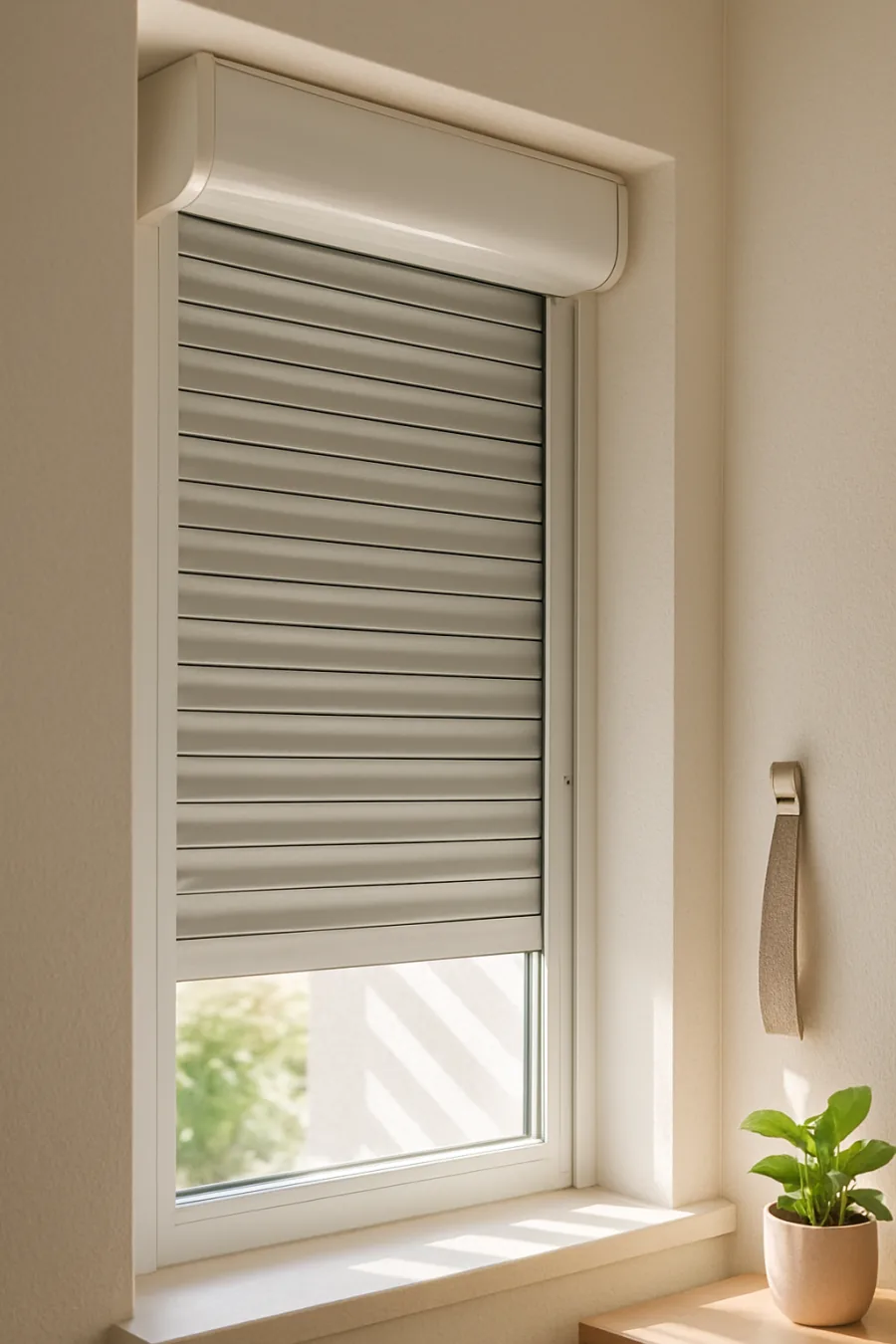


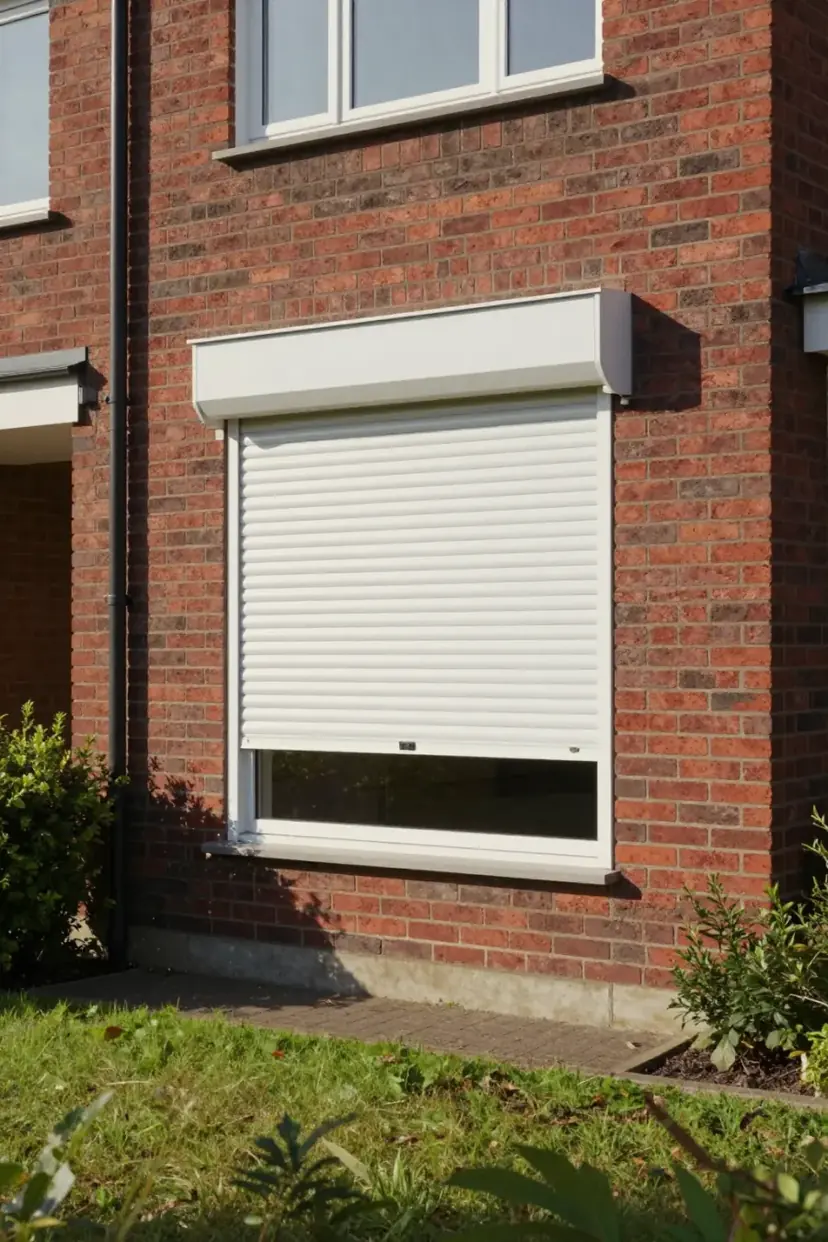


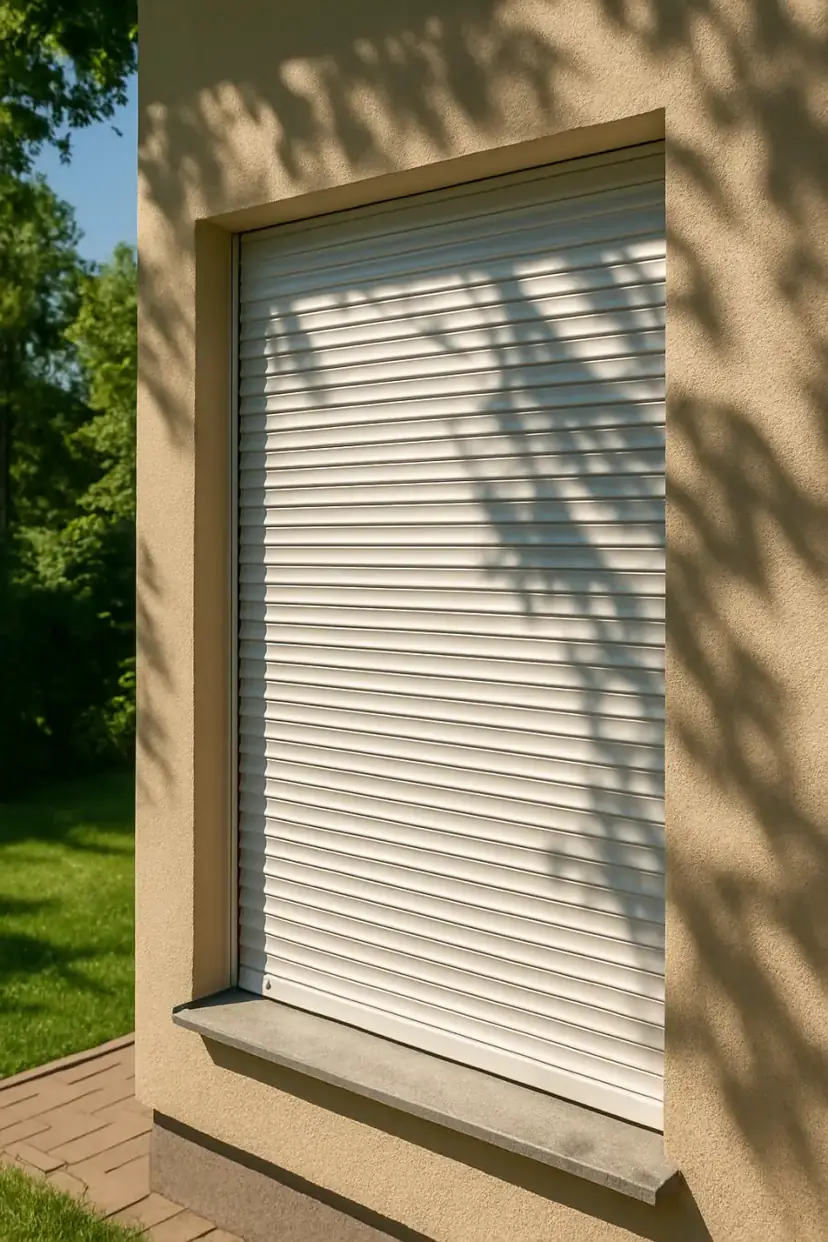











We make roller shutters on doors in Almaty to measure: the curtain of aluminium slats rolls up into a housing box above the opening and takes up no space in the vestibule. Price from 17,500 ₸/m² for mechanical, from 24,900 ₸/m² for protective extruded, from 35,000 ₸/m² with electric motor. Manufacturing in 10–18 days.
How a door roller shutter differs from a window one
A door roller shutter differs from a window one in its housing box and profile. The curtain goes up into a housing box above the opening, not sideways like a hinged sash, so a roller shutter door takes up no space in the vestibule or the room. We make roller shutters on doors in Almaty to measure: without it, you cannot tell what the opening height is and what curtain weight the mechanism will support.
Construction: housing box, guide rails, slats
The system consists of four parts. The housing box above the opening hides the blind when it is raised. The guide rails hold the slats at the sides and set the vertical travel. The blind itself is assembled from slats — aluminium profiles with a locking joint. For interior doors and openings onto a terrace, a roll-formed foam-filled profile is more often chosen: it is lighter, runs more quietly and puts less strain on the mechanism. Vertical travel is not a design detail but a condition of operation. The blind rises upwards and stays in the housing box while the opening is open.
What changes at a door opening
A door opening is taller and narrower than a window opening, and this changes the calculation. On a window the curtain is short and light; on a door there are more slats — the weight grows, and with it the demands on the controls. Here the guide rails are fixed at the sides of the opening over its full height, not around the frame perimeter. The measurer on site decides whether to use a mechanical or an extruded profile, and which control suits: a tape, a cord, a cardan winch, a spring-inertia mechanism or an electric motor. The height of the opening and the weight of the curtain are the two parameters that determine the choice of mechanism. A door roller shutter differs from a window one in its housing box and profile: the curtain goes up into the box above the opening, not sideways like a hinged sash.
Roller shutters on an entrance door: instead of a second door or in addition to it
Roller shutters on an entrance door are most often installed instead of a second hinged door. The second sash was needed to close the opening while the main door was open: it kept the heat in and stopped people from looking into the flat. A roller shutter door does the same, but the curtain goes up rather than sideways. The housing box above the opening saves space in the vestibule — a hinged sash is cramped there, while a vertical blind needs only a couple of centimetres at the sides of the opening.
How it looks in practice. The main entrance door stays in place, and a housing box with a blind of aluminium slats is mounted above it. In the evening you lower the blind — it covers the opening completely, right down to the threshold. During the day you raise it. No second hinges, no juggling two locks.
When roller shutters on an entrance door are installed in addition to it rather than instead of it. This happens when a good door is already in place, the owner does not plan to replace it, but a barrier is needed on the outside. A lowered curtain takes some of the load off the door itself: scratching or prying it open from outside becomes harder because access is blocked. For this option, extruded aluminium is used — a heavy profile with a deadbolt lock that secures the curtain in the guide rails. A roll-formed foam-filled profile cannot handle this task: it is lighter and designed for interior openings.
What a roller shutter door at the entrance gives you:
- an opening without a second hinged sash — space is freed up in the vestibule;
- the blind closes the entrance in seconds, without swinging a sash;
- extruded aluminium with a deadbolt lock blocks access from outside;
- the control is chosen to suit the opening — from a tape to an electric motor.
A roller shutter door replaces the second hinged sash: it takes up no space in the vestibule because the curtain goes up rather than sideways.
Entrance, interior, exterior: how they differ in profile and controls
Entrance, interior and exterior door roller shutters differ in profile, and the profile in turn dictates the type of control and the method of installation. The profile is not a matter of taste. It is the weight of the curtain, and the weight determines which mechanism you will use to raise the slats every day — by hand, by cord or by remote control.
For an entrance door, extruded aluminium is used; for an interior door, a roll-formed foam-filled profile; for rooms and bathrooms, a perforated profile. Three materials — three different tasks. And within one task the profile can change depending on where the opening is: inside a flat or outside.
Entrance door
Extruded aluminium is used for entrance doors and ground floors where protection against break-ins is needed. The slats in such a profile are thick-walled, the blind is heavy, and a deadbolt lock is built into it. We rarely install a roll-formed foam-filled profile for an entrance — it is lighter, quieter and better suited to other tasks.
Here is a typical question from the owner of a private house without security: extruded or roll-formed? If the door faces the street and is open to prying eyes, extruded wins. If it is a vestibule inside a courtyard under supervision, roll-formed is enough, and it is cheaper. It is at this fork that the measurer asks the most questions.
Interior door
Roller shutters can be installed on an interior door, and it is not exotic. A roll-formed foam-filled profile is used for interior doors and terrace openings. Foam-filled slats move more quietly than extruded ones, and the curtain is lighter, so it can realistically be raised by hand.
An interior roller shutter door is needed where the opening is wider than a standard sash or where a hinged door gets in the way. A walk-in closet, a bedroom, zoning off a kitchen — roller shutter doors are installed in a room instead of a regular door, not over it. The advantage is that the curtain goes up into the housing box above the opening, and no sector of the room is left blocked by a hinged sash.
A perforated profile lets light and air through — it is used for rooms and bathrooms where it matters not to turn the space into a sealed box. Inside a flat, perforation works well: there is air exchange, and the blind still blocks prying eyes.
Exterior door and terrace opening
Exterior door roller shutters work in different conditions than interior ones. An opening onto a terrace or a yard catches the sun, dust and the full annual temperature range of Almaty. A roll-formed foam-filled profile copes better here than extruded in terms of weight, but the gaps and guide rails need attention: dust gets into the groove and the curtain starts to run more stiffly. We honestly warn about this at the measurement.
For a terrace opening Jalusso more often installs a perforated or roll-formed profile, and extruded if the yard exit is effectively a second entrance to the house. And one more thing: exterior door roller shutters work from the street side, so the control is outside, not inside — worth remembering if you are used to opening the door from the room.
Interior and exterior door roller shutters differ not so much in profile as in operating conditions and the side the control is on. The profile is chosen for the task of the opening, not for its location: extruded aluminium protects an entrance door, a roll-formed foam-filled profile serves interior doors and terrace openings, and a perforated one lets light and air through in rooms and bathrooms.
What actually protects a door opening from break-ins
Protection comes from a combination of heavy extruded aluminium, a deadbolt lock and guide rails fixed into the wall — not from a lock on its own. A lock without a strong blind holds only until the first blow to a slat. And the other way round: a solid blind without side fixing is simply bent and pulled out of the groove.
Extruded aluminium is a profile with internal stiffening ribs, without foam filling. Such a profile does not bend under a point load, and it is precisely bending that break-in attempts rely on. We do not install a roll-formed foam-filled profile for an entrance door: it is lighter and quieter, and its place is interior openings and terraces.
A deadbolt lock strengthens the protection of an entrance door against break-ins thanks to the bolts that extend from the blind into the guide rails rather than into a thin sash. What does this give in practice? The blind stays connected to the housing box over the full height of the opening.
The guide rails hold the curtain in the opening and at the same time carry the load from the deadbolts. That is why break-in resistance depends on what the guide rails are fixed to and how:
- fixing into a solid wall — the basic option for an entrance;
- fixing into an opening with insufficient load-bearing capacity requires reinforcement before installation;
- a cassette system hides the housing box, but the fixing of the guide rails stays the same.
What does this mean in terms of money? Extruded — the category from 24,900 ₸/m², manufacturing in 12–16 days. If the opening leads into a ground-floor apartment or into the vestibule of a private house, we count protective extruded profile by default, not roll-formed profile. On higher floors the question is already debatable — there it is more often draughts and noise that decide, not break-ins.
I will separately mention a common misconception: that it is enough to put a heavy lock on an old door. Break-in resistance is a system of the curtain, the fixing and the attachment point. The weak link determines the result, and most often the weak link is not the lock but what the guide rails are fixed to.
What makes up the price of a roller-shutter door
The price of a roller-shutter door is made up of three things: the area of the opening, the profile and the type of control. The area is multiplied by the rate per square metre, the profile sets that rate, and the control and installation add a coefficient. Jalusso counts the whole opening — with the housing box and guide rails — so a narrow door almost never comes out cheaper than a wide window of the same area.
The profile is the main multiplier. A roll-formed foam-filled profile — mechanics included, from 17,500 ₸/m²; manufacturing takes 10–14 days. Protective roller shutters made of extruded aluminium — for shop windows, garages and ground floors — from 24,900 ₸/m², lead time 12–16 days. A perforated profile, through which the shop window is visible and air passes, — from 27,800 ₸/m². An electric motor with a drive, remote control, emergency lift, schedule and sun sensor — from 35,000 ₸/m², and this is the longest option in terms of lead time, 14–18 days.
Then the price includes coefficients — for control and for installation. We take mechanical control as one, chain — ×1.06, electric motor — ×1.85, electric motor with remote control — ×2.1. For installation: on the wall — ×1.0, on the frame — ×1.05, without drilling — ×1.1, cassette system — ×1.28.
| What we take into account | Coefficient |
|---|---|
| Manual control | ×1.0 |
| Chain | ×1.06 |
| Electric motor | ×1.85 |
| Electric motor with remote control | ×2.1 |
| Wall mounting | ×1.0 |
| Installation on the frame | ×1.05 |
| Installation without drilling | ×1.1 |
| Cassette system | ×1.28 |
Let us separately calculate an example according to the price list, without addresses and invented figures: a standard door opening with a roll-formed foam-filled profile and a chain. The rate from 17,500 ₸/m² is multiplied by the area of the opening, then by 1.06 for the chain and by 1.0 for installation on the wall. If such an order comes to from 150,000 ₸, we no longer charge for installation — it is free. In all other cases installation costs 4,500 ₸ per item. From experience I will say this: customers most often overpay not for the profile but for control they do not need — we rarely install an electric motor on an interior door in an apartment, and usually that is the right decision.
A curtain with an electric motor costs noticeably more than mechanics, and not only because of the coefficient: the set includes the drive, remote control, emergency lift, schedule and sun sensor. The manufacturing lead time also depends on the profile and the type of control — from 10–14 days on a roll-formed profile to 14–18 days with an electric motor.
Hence the practical conclusion: you cannot buy roller shutters for a door according to a ready-made price tag without knowing the dimensions of the opening — any sum named in advance will be either too high or incomplete.
Bottom line: the price of a roller-shutter door is calculated from the area of the opening at the profile rate, adjusted for control and installation — mechanics from 17,500 ₸/m², protective extruded from 24,900 ₸/m², electric motor from 35,000 ₸/m², and we do installation for 4,500 ₸ per item or free of charge for orders from 150,000 ₸.
Comparison of profiles and control: table
The load capacity of the control limits the choice of mechanism by the weight of the curtain: the heavier the profile and the higher the opening, the more powerful the mechanism needed. That is exactly why a door roller shutter in a private house and a roller-shutter door in an apartment almost always differ in the type of control already at the measurement.
Mechanical control and a chain handle a moderate curtain weight and are suitable for openings of standard height. A crank winch is installed where the opening is low and reaching for the curtain is inconvenient. A spring-inertia mechanism is suitable for heavy curtains: it takes part of the effort on itself, and lifting the curtain by hand becomes easier. An electric motor is not limited by the strength of a hand — it raises and lowers the curtain on command from the remote control.
| Type of control | Coefficient to the price | What we use it for |
|---|---|---|
| Mechanical (strap, cord) | ×1.0 | Interior openings, low entrance doors |
| Chain | ×1.06 | Frequent passage, easy to reach |
| Crank winch | by type of mechanism | Low opening, inconvenient access to the curtain |
| Spring-inertia mechanism | by type of mechanism | Heavy curtain, high opening |
| Electric motor | ×1.85 | Entrances, office, opening out of arm's reach |
| Electric motor with remote control | ×2.1 | Control from outside, schedule and sun sensor |
Now about noise — a question we are asked at every measurement of interior doors. Mechanical control is quieter than an electric motor when the curtain moves: the electric motor and gearbox produce a steady hum that can be heard from the next room in an apartment. The chain adds a light rustle of the slats. For a bedroom or study where the door is used in the evening, this is a difference people notice.
The profile and the control are chosen together, not separately. A roll-formed foam-filled profile is lighter, and mechanics are enough for it. Extruded aluminium is heavier, and for it a spring-inertia mechanism or an electric motor is more often chosen. In the catalogue we keep four profile options with different manufacturing lead times — from 10 to 18 days — and the type of control directly affects the lead time your order will fall into.
My experience suggests: automation is more often chosen not for convenience but for access to the opening from outside. If a roller-shutter door is at an entrance and is opened from inside, manual operation does the job without paying extra.
Door roller shutters and door roller blinds with the same curtain can cost differently precisely because of the control, which is why the type of mechanism is named at the measurement, not after.
The type of control is selected by the weight of the curtain and the height of the opening: mechanical ×1.0, chain ×1.06, electric motor ×1.85, electric motor with remote control ×2.1.
Installation of a door roller shutter: how measurement and installation go
We do not advise installing a roller-shutter door yourself, and it is not about the complexity of the fasteners. A mistake in the geometry of the opening or in the choice of mechanism shows up a month later: the curtain starts to jam in the guide rails, the chain breaks, and redoing it costs more than the installer's work. The measurement of the opening determines the type of mechanism and control, and the whole structure is built from that — this is where it is decided whether roller shutters can be installed on a door in your case at all.
The work goes step by step:
- Request and consultation — 15 minutes. We clarify the type of opening and what door is behind it.
- Measurement — on the day of your request. The measurer arrives with profile samples and calculates the cost on the spot.
- Manufacturing — 10–18 days depending on the profile and the control type.
- Installation — 4,500 ₸ per unit. Free for orders from 150,000 ₸.
What the measurer does on site
He settles three things. First — roll-formed or extruded: for an interior doorway a roll-formed foam-filled profile is enough, while an entrance door on the ground floor needs extruded aluminium. Second — the control type: strap, cord, crank shaft, spring-inertia mechanism or electric motor. Third — the mounting method: wall mounting, frame mounting or a cassette system. A cassette system hides the housing more neatly, but wall mounting is cheaper — the difference in the calculator’s coefficients is noticeable.
One question that almost always comes up: does the opening or the load-bearing wall need reinforcing? In most cases no — the guide rails are fixed into the existing wall or frame, and no extra preparation is needed. Reinforcement is discussed on site if the wall is crumbly or the opening is skewed. In winter in Almaty, with frosts and the temperature swing between day and night, the fasteners are pulled and compressed in turn — that is why the measurer looks at the wall material more carefully than at the colour of the profile.
Within the city, measurement and delivery are free. We also travel outside the city — to Kaskelen, Talgar, Issyk and Kapshagay; the price of such a visit is calculated by mileage and quoted in advance. Measurement and consultation are free within Almaty, and this rule has no exceptions by type of opening.
Timelines and warranty
Manufacturing takes 10–18 days: perforation and extrusion take longer than a roll-formed profile, and an electric motor takes longer than a mechanical control. The mechanism carries a three-year warranty, and the installation one year, counted from the day the acceptance report is signed. If a case is recognised as a warranty case, we do the work free of charge — it takes up to 5 working days. When the warranty period has already expired, we still come out to you — to tighten the mechanism, adjust it, fit a new cord or chain. The warranty does not cover mechanical damage, cases where the roller shutter was re-installed by the owner, exposure to water, or natural fading of the fabric.
Measurement and consultation are free within the city, installation costs 4,500 ₸ per unit and is free for orders from 150,000 ₸, and manufacturing takes 10–18 days.
Winter operation and curtain care in Almaty
Winter operation of a door roller shutter in Almaty means taking frosts and the temperature swing between day and night into account. Because of this, the curtain and the mechanism need periodic tightening and adjustment — not because the system is bad, but because metal and plastic behave differently in cold and in a thaw. Caring for the curtain comes down to simple steps, and nothing needs painting.
Our profiles are painted at the factory. There is no need to paint the curtain of a door roller shutter in winter — paint goes on unevenly in frost, and on a freezing surface it will not adhere at all. But there is plenty of dust in Almaty in winter: dry snow, sand from the roads, de-icing agents. The guide rails and slats collect this film, and the curtain starts to run more stiffly.
What we do when we come out for service:
- clean the guide rails of sand and ice;
- tighten the mechanism and adjust the travel of the curtain;
- check the condition of the cord or chain;
- lubricate the moving parts.
The curtain is removable: it is taken off the guide rails, washed and put back. Water must not get into the mechanism — that is one of the reasons we take the curtain off rather than hose it down. By the way, our most common winter complaint is not a breakdown, but that the crank shaft or electric motor turns more heavily than usual. Usually tightening and cleaning are enough.
What if people constantly pass through the opening? A roller door in a busy place loosens more slowly than you would think: the mechanism itself is enclosed in the housing, and the guide rails hold the curtain along its whole height, not at a single point like the hinges of a hinged sash. But regularity matters more than intensity — it is better to tighten and adjust once a year than once every five years, when the curtain starts catching on the guide rails. Roller doors in a bathroom and on a terrace are serviced by the same logic, only terrace ones collect dust and moisture more often.
The warranty on the mechanism is valid for 3 years from the date the acceptance report is signed. A warranty case is resolved free of charge within 5 working days, and after the warranty we still come out — to tighten, adjust, replace the cord or chain. A curtain that you removed and washed yourself does not void the warranty, but mechanical damage and traces of water in the mechanism do.
A cold winter with a temperature swing between day and night is a normal operating mode for a roller door, as long as the mechanism is serviced rather than left unattended for years.
A case from practice: choosing a system for a specific opening
A roller door works both on the entrance of an apartment building and on a balcony exit — the limitation is not the type of ownership but the opening. We close an entrance vestibule the same way as the vestibule of a private house: the profile and control type are chosen by the width of the opening, the weight of the curtain and how often people pass through. A balcony exit is an opening onto a terrace or loggia, and it counts as external: here the curtain works under sun and dust, so the profile is taken denser than for a blank wall inside an apartment.
The typical sites Jalusso works with across Almaty look like this:
- entrance door to a ground-floor apartment — extruded aluminium and a deadbolt lock;
- vestibule of a private house — roll-formed foam-filled profile for the entrance;
- interior door to a bedroom — roll-formed foam-filled profile, it is quieter in motion;
- door to a terrace — roll-formed profile, denser than usual, external conditions;
- walk-in closet — perforated profile: you can see what is inside, and air passes through;
- bathroom — perforated profile for the same reason;
- workshop — extruded aluminium, protection is needed there;
- office or study — electric motor, because people pass through the opening constantly.
Extruded aluminium is used for entrance doors and ground floors: it is heavier than roll-formed foam-filled and withstands impact. A perforated profile lets light and air through — that is why it is chosen for a room, a walk-in closet and a bathroom. A roll-formed foam-filled profile closes interior openings and terrace exits where protection against break-ins is not needed.
And the difference between the cases is not the status of the site but three parameters: the height of the opening, the weight of the curtain and how many times a day the door is opened. If an interior door to a room means a few movements a day, an office or study with an electric motor opens dozens of times, and we do not put a mechanical control there.
Typical sites for door roller shutters are the entrance door to a ground-floor apartment, the vestibule of a private house, an interior door to a bedroom, a door to a terrace, a walk-in closet, a bathroom, a workshop and an office.
FAQ
How does a roller door open during a power outage?
Via the emergency lift — it comes with the electric motor. The curtain can be opened by hand, without power. In our configuration the electric motor comes straight away with the drive, remote control, emergency lift, schedule and sun sensor, so there is nothing extra to buy.
What happens to a roller door in a fire?
The curtain does not seal the opening shut: a mechanical control opens by hand, and the electric motor has an emergency lift. A roller door does not block evacuation the way solid metal gates with a lock do. This matters for vestibules, workshops and offices where people pass through the opening constantly.
Can roller shutters be fitted on a garage door instead of sectional gates?
Yes, if the opening suits them in geometry and weight — that is what our measurer determines on site. We make roller shutters for garage doors from extruded aluminium: it holds a deadbolt lock and is designed for a curtain that works outside all the time. For heavy and wide curtains, the mechanism is selected by load capacity, sometimes with a spring-inertia mechanism.
How much noise does the blind make when it moves?
Manual operation is quieter than an electric motor, and a roll-formed foam-filled profile is quieter than an extruded one. For roller shutters on an interior door in a flat, this is the deciding factor: the next room does not hear you closing the opening in the evening.
What warranty do door roller shutters come with?
The warranty on the mechanism is 3 years from the date the acceptance report is signed, and on installation — 1 year from the same date. We allow 5 working days to fix a warranty case on roller shutters, and you will not have to pay for it. Once the warranty period has expired, a visit is still possible: our technician will tighten the curtain, adjust its travel, and fit a new cord or chain. The warranty does not cover mechanical damage, reinstallation on your own, water, or natural fading.
How much does it cost to switch a manual door roller shutter to an electric motor later?
The measurer will give you the exact amount — it depends on the weight of the blind. In our price list, an electric motor comes with a coefficient of ×1.85, and an electric motor with a remote control — ×2.1 to the base price, and when switching, part of the mechanical unit is replaced. It is cheaper to include automation right away: redoing it will cost more than a single operation.
Can one slat be replaced without changing the whole blind?
Yes, slats are replaced individually. For this, the profile needs to be from the same batch and match in the geometry of the lock. The roller door stays on its guide rails, and the curtain is not taken apart completely.
What about an opening with a threshold?
Roller shutters on external and internal doors work both with and without a threshold: the threshold itself does not hinder the travel of the curtain. Whether to remove it or leave it is decided by the measurer for the specific opening. We do not remove thresholds separately.
How long does it take to open and close manually and with an electric motor?
Manually, with a chain or strap, it is a few seconds of hand movement, and you set the pace. An electric motor closes the opening faster, and a schedule lets you set opening and closing by the clock without your involvement.
Can it be combined with an intercom or a smart lock?
Yes, an electric motor with a remote control connects to third-party control systems. This is done in offices and studies: roller shutters on doors work on a schedule, while access to the opening stays with the intercom or smart lock.
Our roller shutters for doors are made by a single manufacturer — from measurement to installation, and the warranty on the mechanism is valid for 3 years from the date the acceptance report is signed.
What to remember
A door roller shutter closes the opening with a curtain that rolls up into the housing box above it, so a second hinged sash is not needed. The profile is chosen by the task: extruded aluminium with a deadbolt lock for a front door and ground floors, roll-formed foam-filled for interior doors and an opening onto a terrace, perforated for rooms and bathrooms where light and air are needed. The control is selected by the weight of the curtain and the height of the opening: manual, chain, electric motor, electric motor with a remote control. The price also comes from these two things — from 17,500 ₸/m² for manual operation and a roll-formed profile, from 24,900 ₸/m² for protective extruded aluminium, from 35,000 ₸/m² with an electric motor.
Burglar protection comes not from a single lock but from a combination of a heavy profile, a deadbolt lock, and guide rails fixed into the wall. In winter in Almaty, the blind works in freezing temperatures and a day-to-night temperature difference — the mechanism is periodically tightened and adjusted, and the warranty on the mechanism is valid for 3 years from the date the acceptance report is signed.
What to do next? We install roller shutters on doors in Almaty only after a measurement — it settles what cannot be settled from a photo or over the phone: the measurer on site determines whether manual operation or extruded aluminium is suitable, which control to install, and how to fix the guide rails. Measurement and consultation are always free, and within the city the visit and delivery are free too, and the measurer arrives with samples and calculates the cost on site.
A door roller shutter is a system assembled for a specific opening, and the choice of profile, control, and fixing is made by measurement, not by catalogue.

