




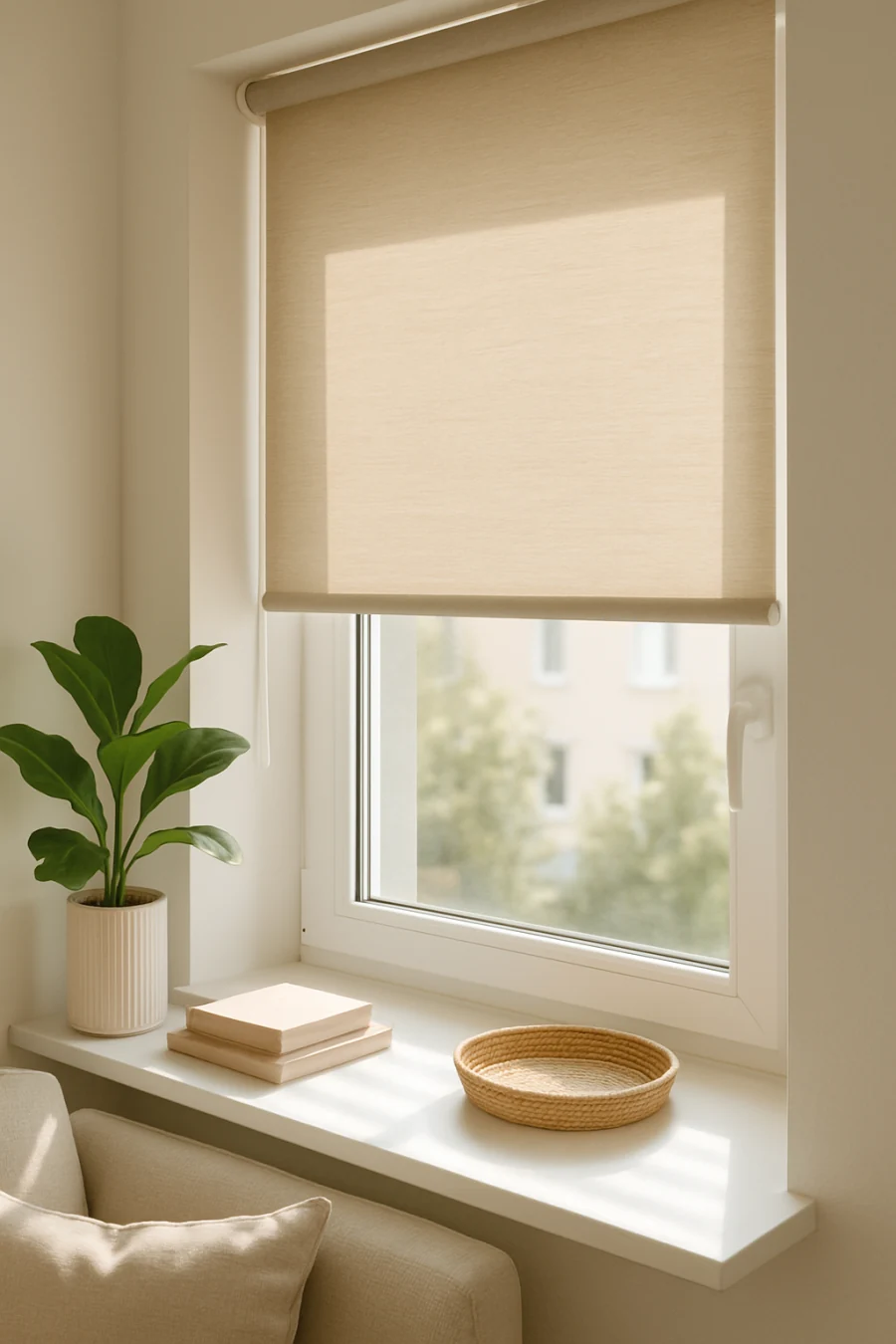















We make roller blinds for a balcony door in Almaty to measure in our own workshop: the fabric runs from the tube above the glass to the bottom of the door, and when mounted on the moving sash it moves with it. Price — from 5,400 ₸/m², manufacturing time 4–6 days, measurement and delivery within the city are free.
Why a blind on a balcony door behaves differently than on a window
A roller blind for a balcony door is a fabric that winds onto a tube above the door glass, covers the glass down to the bottom, and when mounted on the moving sash moves with it when it's opened. On a window these tasks don't come up: there the fabric hangs on a fixed frame and nothing gets in its way.
A balcony door is different because it moves. The door sash turns on hinges into the room, and anything fixed to the frame rather than to the sash itself will be in its path when it opens. That's why a roller blind for a balcony door is mounted on the moving sash — then the fabric moves with the door. A blind on the sash moves with the door when it opens, and the opening is completely clear.
A balcony unit is a door and a window next to each other, in one frame or in two adjacent ones. How many blinds you need for it depends on how the door opens. A balcony door in an apartment almost always opens inward, so one shared rail above the whole unit doesn't work here: the fabric would block the sash's movement. This needs to be sorted out before the measurement, not after.
There's a second reason it behaves differently. The fabric runs to the bottom of the door, not to the windowsill. An open roller tube without a cassette keeps the fabric by the glass, so the blind takes up minimal space by the sash. A nice side effect — the door opens and the blind stays pressed against the glass, not flapping around the room.
And the difference is felt right away: on a window we just cover the glass, on a door we cover the glass and leave the door free to move. In my view, this detail is what defines the whole design. A roller blind for a balcony door only works when the mounting is chosen for the side the sash opens.
How to hang the blind so it doesn't get in the way of the door opening
We mount the fabric on the moving door sash: then the blind moves with it and nothing catches when it opens. Mounting on the frame or on the wall above the opening is also possible, but such a blind doesn't move with the door. And this is where the main thing starts, the reason a balcony door can't be treated as just a wide window.
The measurement determines which side the sash opens and where the handle is. This decides which side the fabric runs on and where the mounting goes. The door handle sticks out past the glass — if the fabric runs right up against it, the sash won't turn. So we leave a gap for the handle: the fabric runs with an offset, nothing gets in the handle's way, it turns freely, and the sash opens and closes as usual.
Another point is tilt ventilation. When the door is tilted, the blind stays by the glass and doesn't get in the way: the fabric moves with the sash instead of hanging across the opening. For doors that are ventilated often, this is the option that works.
What we mount with depends on your door's profile. There are mounts with Velcro, suction cups or a spring — no need to drill the frame or the door, and no marks are left when you move out. We usually recommend this option for rented housing. Before choosing, the measurer checks the profile and says which mount will hold on it.
Want to understand how the fabric will sit on your door specifically? Look at which way the sash opens and where the handle is — that's where the calculation starts.
Mounting on the sash and mounting on the wall are two different things
On the sash, the blind moves with the door, so it doesn't get in the way of opening. On the wall above the opening, the blind doesn't move with the door. If the door opens inward, the fabric on the wall will get in its way — we say so honestly and don't offer this option in that case.
To drill or not to drill
Fasteners with hook-and-loop tape, suction cups or a spring let you avoid drilling into the frame or the door leaf. The measurer checks the profile and picks a fastener that will hold on it. If the profile won't hold such a fastener, we say so right away, before you order.
The bottom line: we hang roller blinds on a balcony door on the moving sash — then the blind travels with the door, the gap under the handle lets it turn freely, and the fabric down to the bottom doesn't catch on anything when the door opens.
How to check the window reveal and the handle before ordering
The blind's housing box sticks out above the frame and rests against the window reveal — this is the main reason a cassette system can't always be fitted on a balcony door. You can actually check the spot yourself, before calling a measurer. Just look at three things: the sash's opening angle, the distance from the hinges to the reveal, and how far the handle sticks out above the door leaf.
Go through the list.
- Open the sash all the way and see what happens with the reveal. There should be room for the housing box between the top of the frame and the reveal — if the box rests against it, the sash won't open to its full angle.
- Measure with a tape how many centimetres there are from the hinge to the reveal. The smaller this gap, the more the box is squeezed.
- Turn the handle and see how far it sticks out. If the handle protrudes above the glass, the fabric will have to be fitted with an offset for it.
A drywall reveal gets damaged by the box hitting it. Over time a drywall reveal dents where it's touched, and a dent or a crack in the plaster appears. PVC reveal panels are stronger, but they too work loose over time if the box hits them every time the door opens. That's why we look at the spot in advance — redoing a reveal costs more than choosing the right system.
What to do if there's no room
An open roller tube without a housing box takes up minimal space at the glass — it doesn't stick out above the frame the way a cassette does. This is the first thing we suggest when the reveal is tight. The second option is mounting on the sash instead of the wall above the opening: then the blind travels with the door and doesn't rest against the reveal at all. The final solution is chosen at the measurement, based on your profile and handle. An important point: an open system leaves a narrow strip of light at the edges of the fabric — we don't hide this and don't promise a tight fit with no gaps.
The housing box of a cassette system sticks out above the frame and can rest against the reveal, so before ordering you check the sash's opening angle, the distance from the hinges to the reveal, and how far the handle sticks out.
How to hold the bottom of the fabric so the blind doesn't swing
The bottom of the fabric on a balcony door is held by a tension cord: a thin transparent cord runs along the edge of the fabric and keeps it from swinging, so the blind doesn't flap when the sash opens. We fit this cord specifically on doors where the fabric covers the glass down to the bottom — on a window there's no need for it, there the fabric hangs quietly. But on a door, every time it's pulled towards you, the air and the movement of the sash push the fabric.
There are several ways to hold the bottom, and they're not equivalent.
| Fixing method | How it works | Where it suits a door |
|---|---|---|
| Tension cord | Runs along the edge of the fabric, keeps it from swinging | A door with fabric down to the bottom that's opened often |
| Weight bar | The weight bar secures the bottom edge of the fabric and gives it weight | A quiet door that's rarely opened |
| Magnets to fix the bottom | Magnets hold the fabric against the glass | A door where it's important to press the fabric tight |
| Guide rails | Guide rails prevent the fabric from swinging along its whole height | A door with higher demands placed on it |
The weight bar is the simplest option: it's sewn into the bottom edge and just gives the fabric weight. But against flapping when the sash is opened sharply, weight alone isn't enough. Magnets to fix the bottom work at specific points: they hold the fabric against the glass in a couple of places, and the fabric doesn't move around. Guide rails prevent the fabric from swinging along its whole height, but that's a different construction, and it's less common on a balcony door — usually where there are special demands on noise and swaying.
A separate case is tilt ventilation. When the sash is tilted open, the blind stays at the glass and doesn't get in the way: the fabric travels with the sash and is pressed against it, so it doesn't hit the glass. We tested this in a child's room on a site with a balcony unit: the child opens the door by themselves, the cord holds the fabric, and the blind doesn't catch. If the door is left on ventilation for long periods — and in Almaty in summer that's a common thing — the cord justifies itself best.
A thin transparent cord runs along the edge of the fabric and keeps it from swinging — this is the standard version for a blind on a balcony door.
One blind for the whole balcony unit or separate ones
A balcony unit in an apartment includes three parts: the balcony door, the fixed section under it, and the window next to it. You can cover such a unit with one piece of fabric, but not always. A wall-mounted system covers the whole opening if the width allows it — then roller blinds on the window and balcony door look like a single plane with no joints. But this option has a condition that decides everything.
One blind for the whole unit gets in the way of a door that opens inwards. And a balcony door in an apartment almost always opens inwards — towards you, into the room. The fabric fixed above the opening hangs across the sash's path, and the door crumples it or rests against it. That's why we fit a wall-mounted system for the whole unit as an exception, not as a rule.
The workable option is different: a separate blind on the door sash plus a separate one on the window. The fabric on the door is fixed to the moving sash and travels with it, and the window is covered by its own fabric. That way the balcony door opens freely and the glass stays covered.
- The door opens inwards, the window is next to it — two blinds: one on the sash, the second on the window.
- The door opens outwards, onto the balcony — you can try one piece of fabric for the whole unit, if the width of the opening allows it.
- There's a fixed section between the door and the window — it's either included in the common fabric or left open, depending on the measurement.
- The opening is narrow, the window and door are right next to each other — often only the option with two separate pieces of fabric works.
How to level the bottom of the fabrics
When there are two fabrics, their bottom edges should read as one line, otherwise the block looks mismatched. The fabrics come out in different lengths: on the door the glass goes all the way down, on the window it ends above the windowsill. Jalusso cuts them so that the bottom edge of both sits at the same level.
On a project with a balcony block we made two blinds of different lengths — one for the door and one for the window — and the bottom of both ran along a single line. The measurer takes the door height and the window height separately, and in the workshop the fabrics are cut to these numbers for a common bottom line.
This calculation is done at the measurement: it determines how many fabrics are needed, where the open roller tube will sit and where the common bottom line will run.
Mini system, open roller tube or cassette: what to choose for a door
For a balcony door an open roller tube is more often suitable: the fabric winds onto the tube without a housing box, so at the glass the blind takes up minimal space and does not rest against the reveal. A cassette system covers the tube with a housing box — it looks neater, but the box protrudes above the frame and can catch on the reveal. A mini system, also called a mini roller blind, is the same roller blind on a small tube, where the fabric runs from the tube down to the bottom of the glass, without side guide rails.
How does a cassette system behave on a door? Its housing box protrudes above the frame, and it is the first thing to meet the reveal when the sash opens. The housing box of a cassette system rests against the reveal if the distance from the frame to the reveal is small. And a drywall reveal gets damaged by the box hitting it — dents and scuff marks are left on it. PVC reveal panels are stronger, but over time they too collect marks from constant contact. At the same time, a cassette system protects the fabric from dust and looks more put together, so it is installed where there is enough space at the glass.
The open roller tube does not have this problem: there is no housing box, and the fabric lies closest to the glass. In the calculator, a cassette system adds a coefficient of 1.28 to the price — it is objectively more expensive than an open roller tube.
| System type | Protrusion at the glass | Where it is appropriate on a balcony door |
|---|---|---|
| Open roller tube | Minimal, no housing box | A door with a narrow reveal, where every centimetre counts |
| Mini system (mini roller blind) | Small tube without a housing box | A regular door, the sash opens freely |
| Cassette system | The housing box protrudes above the frame | A door with a wide reveal, where the housing box does not touch the sash |
The difference between the systems is visible on a door, not on a window: there the sash does not move, and the protrusion of the housing box hardly matters. Here it decides whether the door opens all the way or not.
A mini system is often confused with a cassette system, and that is understandable — both look compact. But a mini roller blind is an open roller tube in a small version, without a housing box, while a cassette always comes with a closed tube. On a narrow door, an open roller tube and a mini roller blind give almost the same result in terms of space at the glass, while a cassette loses out on protrusion.
For a roller blind on a balcony door, the choice of system is determined not only by appearance, but by the distance from the frame to the reveal and the side the sash opens on — this is visible at the measurement.
What we recommend in practice
When there is barely any space at the glass, we install an open roller tube: it does not create a protrusion that could hit the reveal. If the customer wants a hidden tube and there is space above the frame, we suggest a cassette with the caveat that the housing box needs to be checked against the reveal. On panoramic glazing, where the box above the door does not get in the way, a cassette system looks neater — that is usually where I recommend it.
Control on a door: chain, mechanical, electric motor
For roller blinds on a balcony door, a chain mechanism is more often chosen. The control hangs at the side of the fabric, at hand level. You do not have to pull upwards through the glass, and you do not have to bend down to the floor. The chain does not meet the door handle: it runs along the edge of the blind, while the handle is on the sash off to the side. If the handle is high and its turning radius is wide, at the measurement we check whether there is enough space between them and, if necessary, shift the fabric. The chain mechanism controls the raising and lowering of the blind and fixes the fabric at the desired height — on a door this is more convenient than pulling on the bottom bar.
Mechanical control is the same principle, only without a chain. It is appropriate where the blind is almost always closed and is rarely opened.
An electric motor requires power on the moving sash. The door opens, so the cable must somehow reach the motor on every turn — this is resolved at the measurement, and we will not promise a simple connection in advance. For tall doors that are hard to reach, we consider the option. But if the sash moves every day, think about whether you need a button where a movement of the hand is enough. In my view, an electric motor on a balcony door is an overrated thing: it is justified on panoramic glazing and in commercial properties where the fabric is large, not on a door sash in an apartment.
When there are children in the house, the chain is raised to a height the child cannot reach. That way there is no loop left at chest level. At the measurement we look at where the blind ends and where the chain goes.
The chain control hangs at the side of the fabric at hand level, so for a balcony door a chain or mechanical control is more often chosen, not an electric motor.
Fabric for a balcony door
We select the fabric for a balcony door based on the room and on what happens behind the glass. For a door, polyester is chosen — it holds its shape, does not stretch when the fabric moves with the sash, and easily withstands the temperature difference between the room and the balcony. Dense polyester is opaque and hides the door from prying eyes: from the street or the courtyard you can no longer see anything through the glass. A semi-transparent fabric keeps the light and the view — the room does not look curtained during the day.
A fabric treatment makes it easier to care for against dust and condensation. This is exactly what matters on a door: more dust settles at the glass than on a window, and in winter moisture collects on the fabric when you open the sash to air the room. Treated fabric can be wiped with a sponge, and stains come off. The mechanism and the tube stay dry.
A kitchen is about the fabric being easy to wash. Grease and steam settle on the fabric faster, so here a washable polyester with a treatment is chosen: wipe with a soft cloth — and that is it. You can also vacuum it with a furniture attachment, but in a kitchen it is usually easier to go over it with a damp sponge.
The room sets the fabric
A bedroom — dense fabric or blackout. Dense polyester dims the light from the balcony, while blackout is chosen when complete darkness is needed at the door. Semi-sheer and transparent fabric are not suitable for a bedroom if the door opens onto the street.
The south side is a separate story. In summer the sun in Almaty is hot, and a fabric that dims both light and heat works better than a thin one: the fabric keeps the room from heating up through the glass, while the light stays soft.
Brackets to match the frame colour
If the frame is laminated “wood-effect”, we select brackets to match the colour — brown for a light frame or for dark lamination. That is how we did it on a project with a balcony block. The door and window then look like one system, not two separate purchases.
The fabric manager shows samples at the measurement, and you hold them against your frame in your own light — that way it is easier to see whether the fabric matches the tone.
Dense polyester is opaque and hides the door from prying eyes, while treated fabric is more convenient at a door where dust and condensation settle more often — this is the main guideline when choosing for a balcony door.
Complex configurations: mullion, fixed panel, French casement, mosquito net
If the door is divided by a mullion — a horizontal profile bar — each section needs its own blind. You cannot cover such a door with a single fabric: the mullion prevents the fabric from passing from top to bottom, and it will rest against the bar. The measurer calculates both sections separately and brings the bottom of the fabrics onto a single line so that the door looks whole.
If the lower part of the door is solid, it is covered by a sandwich panel rather than glass. In this case we make the blind up to the top of the sandwich panel — along the glass, not lower. There is no point in covering the panel completely: it does not let light through, and the extra length of the blind only catches when the door is opened. The measurer marks the boundary of the solid lower panel on site, and we cut to that line.
A French door is a two-sash balcony exit where one sash is active and opens, while the other is pressed against it. We install the blind on the active sash, and cover the second one with a separate blind fixed in place or leave it open. The measurer checks which sash is the leading one, and the fittings are calculated from that.
An insect screen on a balcony door and a blind do not get in each other’s way. The screen stays outside, the blind inside — they run on different sides of the frame. But on an aluminium frame, mounting to the sash requires checking the profile during measurement: aluminium has its own geometry, and not every fitting will hold on it.
About outdoor installation from the balcony side, I will say it straight: this is a limitation, not an equivalent option. You can only operate the blind with the door open — you cannot reach the chain from inside the room. We do this kind of installation, but we do not recommend it as the main option.
A door mullion requires a separate blind for each section, while the insect screen stays outside and the blind inside, and they do not get in each other’s way.
How much does a roller blind for a balcony door cost
Roller blinds for a balcony door in Almaty start from 5,400 ₸/m², and this is the price for an open roller tube. The total is made up of the opening area, the fabric group and the type of control. Mechanical control is the cheapest, while an electric motor and a motorised one with a remote control are more expensive. Installation is calculated separately: 4,500 ₸ per item, and for orders from 150,000 ₸ it is free.
What actually moves the price? First of all, the area of the blind. The taller the door and the wider the sash, the more square metres go into the cut — the fabric is included in the price per metre rather than bought separately. Next comes the fabric group: dense polyester, dim-out and blackout cost differently, and on the south side people more often choose a fabric that softens light and heat. The list is closed by the control. A chain mechanism adds very little to the base, while an electric motor changes the figure noticeably.
Our warranty on the mechanism is 3 years, on installation — 1 year, and the manufacturing time for roller blinds is 4–6 days. These two figures do not depend on whether the blind is for a door or a window.
How the price is calculated
The base is from 5,400 ₸/m² for an open roller tube. After that, the calculator coefficients apply, and there are only two sets of them. By control: mechanical — ×1, chain — ×1.06, electric motor — ×1.85, motorised with remote control — ×2.1. By installation: wall-mounted — ×1, frame-mounted — ×1.05, no drilling — ×1.1, cassette system — ×1.28.
Calculate it like this: multiply the opening area by the base price, apply the control coefficient to the result, then add installation with its coefficient. That is all.
An honest caveat: we do not quote a price for the tension cord, the clearance for the handle or the spring — these items are not in the price list. There is no spring in the calculator either; it has the four control options I listed above. If you need any of these for your door, the measurer will quote the price on site, for your door.
Why installation is noticeable in the total on a narrow door
The area of a balcony door is often less than one square metre. Installation, however, is calculated not by metres but per item — a fixed 4,500 ₸. That is why the share of installation in the bill for a door is higher than in the bill for a wide window, even though the blind itself for the window may cost more.
No-drill mounting and the cassette system add their own coefficients to installation, and therefore increase precisely this “noticeable” part. The measurer will show both figures separately — for the blind and for installation — so that you can see what the total is made up of.
The price of a roller blind for a balcony door is always a calculation for a specific opening, not a ready-made figure from a catalogue, since we are a manufacturer and make the item to measure in our own workshop.
Measurement, manufacturing, installation and warranty
We make roller blinds for a balcony door to measure in Almaty: we do not keep ready-made items in stock, every blind is cut in our own workshop for a specific opening. The procedure is as follows: you write on WhatsApp, the measurer comes with samples of fabrics and fittings, calculates the cost on site, after that the item goes to the workshop and then to installation. Measurement and consultation are always free — this is not a one-off promotion but our usual way of working.
From measurement to the finished roller blinds for a balcony door takes 4–6 days. Then installation: 4,500 ₸ per item, and for orders from 150,000 ₸ we do it free of charge.
What the free visit includes
Within the city, measurement and delivery are free. To the suburbs — Kaskelen, Talgar, Issyk, Kapshagay — we do travel, the cost of the visit depends on the distance, and we quote it before the visit, not after. The measurer brings samples, holds them against your frame and shows how the blind will sit on the sash.
Warranty
The mechanism has a 3-year warranty, and installation work — 1 year, counted from the date the acceptance certificate is signed. For a warranty request on roller blinds we allow 5 working days — and you do not have to pay for it. When the warranty period has already expired, we will still come: to adjust the mechanism, tighten it, or fit a new chain or cord. The warranty does not cover mechanical damage, re-installation by hand, exposure to water, or natural fading of the fabric.
FAQ
A roller blind for a balcony door is mounted on the moving sash, so it does not get in the way of opening. Do you have any doubts worth clearing up before the measurement? We have collected the questions people ask most often.
Can you do without drilling the frame or the door leaf? Yes, no-drill mounting is suitable for rented housing: after you move out, no marks are left on the profile. The measurer checks the profile and says which fitting will hold on it.
Does a chain mechanism on a door catch on the handle? The chain hangs at the side of the blind at hand level, and the blind runs with a clearance from the handle, so the sash opens freely.
Which fabric should I choose for a kitchen, where dust and condensation settle? A fabric with a coating: stains come off with a sponge, and the blind is not afraid of the damp air by the door.
What should I do if I want a single blind for the whole balcony unit? A balcony unit with a door opening inwards cannot be covered with a single blind — it gets in the way of the sash. In that case we install the blind separately on the door, and another one on the window next to it.
How long is the wait and what about the warranty? Manufacturing takes 4–6 days, the warranty on the mechanism is 3 years. Measurement is free at any time.
Mounting on the moving sash is what sets roller blinds for a balcony door in Almaty apart from a blind on an ordinary window.
Conclusion
We install roller blinds for a balcony door in Almaty on the moving sash: the blind moves together with the door, so opening and ventilation remain free. This is the main point, and everything else follows from it.
Second — the space by the glass is calculated before the order, not after. The housing box of a cassette system protrudes above the frame and may run into the window reveal, especially if the reveal is made of plasterboard. An open roller tube does not have such a protrusion, and on many balcony doors in panel buildings we go with exactly that.
Third — the bottom of the blind is held by a tension cord. A thin transparent cord runs along the edge and keeps the blind from swinging, so it does not flap when the sash is opened. At the same time, an open system without guide rails does not turn into a solid partition — a strip of light remains at the edges, and we say this openly during the measurement, not after installation.
Fourth — the numbers. Roller blinds start from 5,400 ₸/m² for an open roller tube, manufacturing takes 4–6 days, installation is 4,500 ₸ per item, and for orders from 150,000 ₸ we don't charge for it.
There's one practical recommendation: message us on WhatsApp and book a free measurement. Our measurer arrives with samples, checks which way the sash opens, how far the handle sticks out and the distance to the window reveal, and calculates the price on the spot — based on your door, not on an average opening.

