


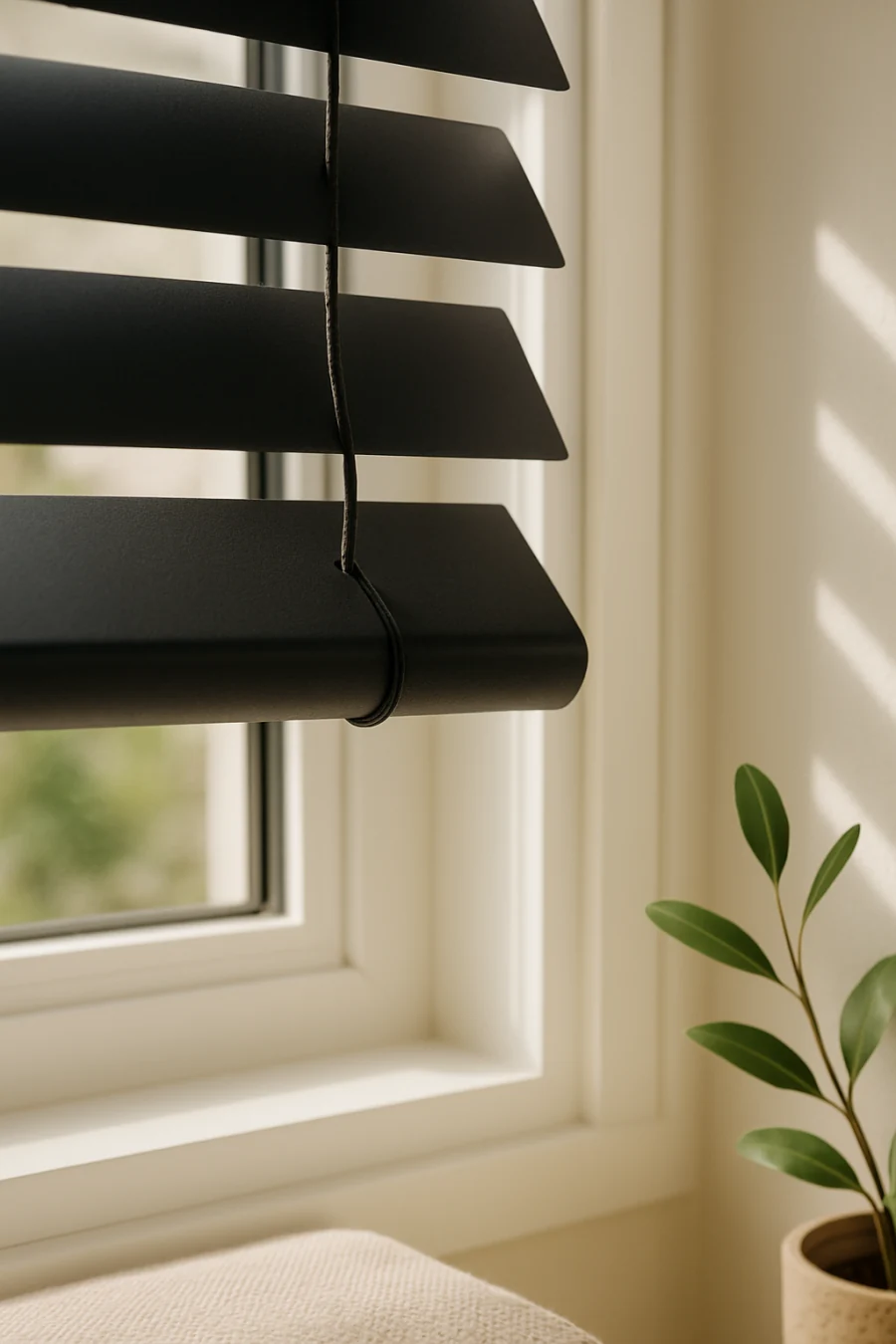















We make blue blinds to measure in Almaty: our measurer brings samples, and you look at the shade at your own window in your own light. A rich blue makes a statement, while a muted grey-blue is calmer for a bedroom or study. Metal and plastic hold their colour, while fabric on south- and west-facing windows lightens over time. Prices — from 3,600 ₸/m².
How blue changes the light in a room
Blue blinds in Almaty don’t turn a room dark — they change the shade of the light that passes through them. A closed blue blind works like a light filter: white daylight passing through a slat or fabric takes on a blue tint, and the room gets a cool-toned glow instead of a neutral one. The denser the material, the stronger this effect. On light aluminium it’s barely noticeable, while dense fabric sets the tone for the whole room.
What’s important to understand before ordering: blue doesn’t take away light, it recolours it. A rich blue draws attention to the window and makes it the strongest line in the room — that’s a question of composition, not of brightness. A muted grey-blue behaves more calmly: it also tints the light, but doesn’t clash with your décor or pull the eye towards itself. Blue on a south-facing window doesn’t cool the air — the feeling of coolness comes from the cold shade of light itself, and the room temperature doesn’t change with the colour of the slat.
Thin fabric versus a dense slat
Blue vertical fabric, including day-night, diffuses light across the full height of the window — it isn’t cut into stripes, and the room stays evenly lit. Day-night blinds adjust the light smoothly: by shifting the layers of the fabric, you add or remove light without a sharp edge. Blue aluminium with a 25 mm slat behaves differently. When the slats are tilted, light comes through in thin stripes, and a grid of light and shadow appears on the wall behind the window. During the day it’s almost invisible. In the evening with side light, it reads more clearly.
South, west and north
On south- and west-facing windows blue lightens: the sun bleaches the shade, and the room gets more light than the sample suggests indoors. On north-facing windows, on the other hand, a rich blue makes the room dimmer, because there’s little cool light to begin with. A muted grey-blue on the north side looks more even and feels less heavy.
The difference between indoor and outdoor lighting is resolved by a measurement: our measurer comes with samples, and the shade is checked at your window, not from a picture on a screen.
Does blue fade in the Almaty sun
Blue aluminium and blue PVC hold their colour — the slat is coated on the surface, and the finish doesn’t fade in the sun; blue fabric lightens over time, especially on south- and west-facing windows. So blue blinds behave differently, and it depends not on the shade but on the material.
Blue aluminium holds its colour thanks to the slat’s coating. Washing, heat, dry air — the coating doesn’t care. Blue PVC behaves the same way: the colour layer sits on the surface of the plastic, so a damp cloth won’t remove the colour. Both materials work on the sunny side without losing their shade.
Blue fabric is a different matter. Fabric fades under ultraviolet light, and on a south- or west-facing window the shade shifts to a lighter tone over seasons, not weeks. A fabric treatment slows fading but doesn’t stop it: fabric with a sun-protective treatment holds its colour noticeably longer than ordinary fabric. For comparison: a 89 mm vertical slat in matte blue fabric on a north-facing window lightens slowly. The same slat on a south-facing opening — faster.
- Blue aluminium, 25 mm slat: the coating holds its colour, the slat is washable under the tap, and moisture and heat don’t affect the shade. Manufacturing time 3–5 days.
- Blue PVC, 25 mm slat: the same principle for colour, an option for the kitchen, bathroom and balcony. Time 3–5 days.
- Blue vertical fabric, slat 89 mm: the colour fades on the sunny side, the treatment slows the process down. Lead time 3–5 days.
And here's what matters: natural fading of the fabric is not covered by the warranty. Three years on the mechanism and one year on installation cover breakdowns, not what the sun does to the shade over a season.
What to do if the window faces south
Choose a shade deeper than it looks on the sample: on the south and west sides the fabric lightens anyway, and the extra depth of tone then works in your favour. If blue really matters to you for the long term, look at blue aluminium or PVC: their coating holds its colour in the Almaty sun. And choose a dense fabric with treatment when you need soft diffused light rather than a colour that lasts forever.
Rich or muted: how to choose a shade
Rich blue draws attention to the window, while muted grey-blue looks calmer all day and feels less heavy in a small room. The choice here isn't about how pretty the picture is, but about how much colour you're ready to live with every day.
Rich blue is a dense, pure tone: it reads as a colour accent and immediately becomes the main line of the room. This tone is chosen more often for a child's room and the kitchen. Muted grey-blue moves into a calm, dusty palette: it doesn't clash with the décor and doesn't look heavy. This is the one we recommend for the bedroom and the study, where people sit for hours.
And how do you avoid an “institutional” or “office” look? The feeling of something official comes not from blue itself, but from combining it with cold white light and bare walls. Add wood, a warm lamp, textiles by the window — and the same tone reads completely differently. What's more, on the sunny side any blue lightens, so a tone deeper than it looks on the sample works well there.
A separate note on the study, where people work at a monitor. Blue slats remove glare on the screen, and the room doesn't get dark — you can work without a lamp. Grey-blue is preferable to a bright one here: it doesn't pull your eyes away from work. In my view, for a home study it's the calmest option in the whole blue range.
Table: which tone works where
| Room | Recommended tone | Why |
|---|---|---|
| Bedroom | Muted grey-blue | Looks calm all day, doesn't feel heavy and doesn't get in the way of rest |
| Study | Muted grey-blue | Removes glare on the monitor, doesn't distract from work |
| Kids' room | Rich blue | Reads as a colour accent, doesn't look heavy |
| Kitchen | Rich blue | Matches the splashback or cabinet fronts, brings the work area to life |
| Office | Rich blue | Holds the geometry on wide openings, light is even |
Помните: оттенок нельзя выбрать по картинке на экране. Замерщик Jalusso привозит образцы оттенков на замер, вы прикладываете их к своим стенам при своём освещении и смотрите, как тон ведёт себя утром и вечером. Только так видно, какой синий останется акцентом, а какой станет тёмным пятном.
How much blue blinds cost in Almaty
Blue blinds in Almaty cost the same as products of the same type in any other colour — we don't charge extra for colour. We price by the m²: blue aluminium — from 4,200 ₸/m², blue PVC — from 3,600 ₸/m², vertical fabric — from 4,600 ₸/m², day-night — from 7,300 ₸/m². There are no ready-made items in stock, everything is made to measurement.
| Type | Material | Price | Lead time |
|---|---|---|---|
| Horizontal | Aluminium, slat 25 mm | from 4,200 ₸/m² | 3–5 days |
| Plastic | PVC, slat 25 mm | from 3,600 ₸/m² | 3–5 days |
| Vertical | Fabric, slat 89 mm | from 4,600 ₸/m² | 3–5 days |
| Day-night | Two-layer fabric | from 7,300 ₸/m² | 5–7 days |
| With electric motor | 220 V motor or battery | from 7,800 ₸/m² | 7–10 days |
| Metal | Steel, slat 25 mm | from 5,200 ₸/m² | 5–7 days |
The price depends on the type of construction, the fabric material and the controls. An electric motor raises the cost noticeably — it's the most expensive option in the quote. We install blue blinds for 4,500 ₸ per item; if the order reaches 150,000 ₸ — installation is free. Measurement and consultation are always free: the measurer arrives with samples, works out the cost on the spot, and travel and delivery within the city are also free. We travel to the suburbs — Kaskelen, Talgar, Issyk, Kapshagay — and we tell you the cost of the visit before it happens.
What the total is made up of
We apply coefficients to the base price. For controls: manual — base, chain adds a little, electric motor — 1.85, electric with remote — 2.1. For installation: on the wall — base, on the frame — 1.05, without drilling — 1.1, cassette system — 1.28.
Drill-free mounting is chosen most often for new windows and rented housing: the frame stays intact and the window warranty isn't lost. The cassette system costs more than the others, but it covers the fabric with a housing box.
At the measurement we bring out the samples and calculate in front of you: width, height, number of sashes and the chosen controls immediately give a specific sum instead of a range.
The price on the list doesn't depend on colour: blue and white products of the same type cost the same, and the total is determined by the type of construction, material, controls and mounting.
Which room blue blinds suit
Blue blinds suit almost any room — the only question is how rich a tone to choose. For a child's room and the kitchen people more often choose a livelier shade as a colour accent, for the bedroom and study — a muted one that looks calm all day.
The difference between rooms isn't in the window geometry itself, but in how much time you spend in the room and in what light. Muted grey-blue suits the bedroom and study — it doesn't pull attention to itself and doesn't strain the eyes by evening. Rich blue, on the contrary, draws attention to the window, and that's good where the window should be the main line.
- Child's room. Blue blinds won't look gloomy in a child's room if it's a lively blue rather than a flat dark tone, and if the ceiling and walls stay light. Choose side-handle controls — there are no hanging cords in the room.
- Bedroom. Muted grey-blue suits the bedroom better than a rich one: it doesn't wake you with its look in the morning and looks calm. Day-night fabric with treatment regulates light gently, without harsh stripes.
- Study. Here glare on the monitor is what matters: blue slats remove it, and the room stays workable without a lamp on. Choose a muted tone so the window doesn't compete with the screen.
- Kitchen. Blue aluminium or blue PVC can be wiped down right on the window — steam and grease don't bother them. Choose the tone to match the splashback or cabinet fronts so the room doesn't end up with two different blues.
As for “won't I get tired of it”: the most common case is when too rich a tone is chosen for all the windows at once, and it turns into a background rather than an accent. Blue goes with white, grey, wood and yellow, so the window is easy to support with the décor rather than clash with it. And one more thing: the shade on a screen and the shade on a window are different things, so it's worth holding the samples against your own walls.
For a child's room and the kitchen people more often choose a livelier tone as an accent, for the bedroom and study — a muted one that looks calm all day.
Blue in the kitchen: material decides
Blue blinds in the kitchen are a practical solution if you install them in aluminium or PVC. Both materials don't mind steam and grease, can be wiped down right on the window, and the fabric doesn't need to be taken down. We don't recommend fabric by the stove: over time the treatment absorbs grease and smell, and it can no longer be washed out.
The kitchen is the only room where the window works in the most aggressive mode: steam from pots, splashes from the sink, greasy film from the stove. Blue aluminium holds its colour thanks to the coating on the surface of the slat, and a damp cloth with a mild product won't harm it. Blue PVC behaves similarly — plastic doesn't mind steam, and the slat flexes and doesn't crease from an accidental touch. What to choose? If the stove is nearby, go for aluminium: it's stiffer and can be washed under the tap. PVC is noticeably cheaper and works well for the balcony part of the kitchen or a rented flat.
The most common mistake in the kitchen is two different blues in one room. A blue kitchen front and blue slats from different batches and materials read as two foreign colours, even if both are called by the same word. That's why blue in the kitchen is chosen to match the splashback or cabinet fronts using samples, in your own light: by the window the light is cooler, by the worktop warmer, and the same shade looks different in the two spots. The measurer brings samples and holds them against the splashback — that's how you see whether the tone matches or clashes.
A practical checklist for the kitchen
- Material — aluminium by the stove, PVC on the balcony side or in rented housing.
- Tone — choose it against a sample by the backsplash and the cabinet fronts, not from a picture on a screen.
- Individual slats can be replaced one by one if damaged, without replacing the whole structure.
- Caring for the slats — a damp cloth with a mild detergent, no need to take the blind down.
- The mechanism should be cleaned of dust once a year — this is the most common cause of jamming.
In the kitchen, aluminium or PVC is more practical: they don’t mind steam and grease and can be washed right on the window, and the blue tone is matched to the backsplash or the cabinet fronts so that the room doesn’t end up with two different blues.
One blue window or all of them: how the accent reads
One blue window among white blinds reads as an accent — your eye stops on it on its own when you walk into the room. If all the windows are covered in blue, the tone stops being an accent and becomes a background: it sets the mood of the room, and the rest of the finish is built around it. You can’t mix — one blue window next to three neutral ones works, but blue and, say, turquoise in the same room argue with each other.
Blue goes with white, grey, wood and yellow. With white and wood it gives a calm, composed room. With yellow it makes a contrasting pair, and here it’s important not to overdo it: there should be only a little bright yellow nearby, otherwise the window gets lost. With grey, blue reads evenly, without flashes, and this is the safest option if you’re unsure about the shade.
Panoramic glazing deserves a separate conversation. A wide slat — 89 mm — holds its geometry on a large opening better than a narrow one, and on tall sashes the chain becomes inconvenient. Where you can’t reach the top edge, we install an electric motor: the slats are turned with a remote control or from a smartphone, powered by mains or a battery.
How does it look from the street? Blue blinds on a house facade are noticeable — especially if the other windows are white. During the day, with the slats turned, from the street you see an even colour, not what’s happening in the room. In the evening, when the lights are turned on inside, the closed blind doesn’t let anything out — but the density of the fabric decides here, and at the measurement we show how the chosen material behaves against the light.
And one note from practice: in an apartment with two windows facing different sides, one blue tone often looks like two different ones — darker on the north window, lighter on the south. This is not a defect or a mistake in the selection. That’s how light behaves with any colour.
One blue window among white ones reads as an accent, and if all the windows are covered in blue, the tone becomes the background of the room and sets its mood.
What’s more practical in blue: aluminium, plastic or fabric
Practicality in blue comes down to one thing: where the window is and how often you’re willing to look after it. Blue aluminium and blue PVC can be washed with a damp cloth right on the window and don’t mind moisture, while blue vertical fabric gives a soft, diffused light. Dust behaves differently too: it’s more noticeable on a smooth slat, and almost invisible on matte fabric.
Blue PVC doesn’t mind steam and grease — that’s why it’s more often chosen for the kitchen, the bathroom and the balcony. The slat is springy, an accidental touch won’t damage it, and it costs less than aluminium: from 3,600 ₸/m², manufacturing time 3–5 days. Blue aluminium holds its colour thanks to the coating, can be washed under the tap and easily withstands the heat by the glass — from 4,200 ₸/m², the same 3–5 days.
Fabric is a story of its own. A vertical slat of 89 mm diffuses the light along the whole height of the window instead of cutting it into stripes. Day-night adjusts the light level smoothly: you shift the layers and the room changes from bright to muted, with no sharp line. Blackout covers the window tightly, but light still comes through at the edges of the blind unless it’s a cassette system. Fabric — from 4,600 ₸/m² for vertical and from 7,300 ₸/m² for day-night, 5–7 days.
| Material | Moisture and grease | Care | Dust | Price and lead time |
|---|---|---|---|---|
| Blue aluminium, slat 25 mm | not afraid of | can be washed under the tap, slats are replaced one by one | visible on a smooth surface | from 4,200 ₸/m², 3–5 days |
| Blue PVC, slat 25 mm | not afraid of | a damp cloth, no need to take the blind down | visible on a smooth surface | from 3,600 ₸/m², 3–5 days |
| Blue vertical fabric, slat 89 mm | doesn’t like getting wet | a vacuum cleaner or a sponge without soaking | almost invisible | from 4,600 ₸/m², 3–5 days |
| Day-night, two-layer fabric | doesn’t like getting wet | a vacuum cleaner, a stain — spot-clean with a sponge | almost invisible | from 7,300 ₸/m², 5–7 days |
| Blackout | doesn’t like getting wet | a vacuum cleaner, machine washing is not allowed | almost invisible | calculated at the measurement |
There’s a nuance you can’t see in a picture: matte fabric forgives infrequent cleaning, while a smooth blue slat shows dust within a few days. On the other hand, a slat just needs a wipe and it’s like new, while fabric can’t be cleaned that quickly. At the measurement we hold both a slat and a fabric sample against your window so you can see for yourself how each one looks in your light.
The most practical for everyday use are aluminium and PVC: they can be washed and don’t mind moisture, while fabric wins where you need soft light and smooth adjustment.
Blue in the evening under warm lamps
Blue looks different depending on the light that falls on it. During the day, against the sun, blue becomes lighter and seems easier than it really is. In the evening, under warm lamps, the same shade turns cold, and the slat reads deeper and darker than you remembered it in the morning. That’s exactly why we don’t recommend choosing blue from a picture on a screen.
A sample shows the shade in its own light — by your window, with your wallpaper and your lamps. This effect has a simple explanation: a closed blue blind tints the light in the room that passes through it, and in the evening the yellow tone of the lamps is added to that. The two colours add up, and blue on the window looks different from blue on a wall in a shop.
The measurer brings shade samples to the measurement. The samples are held against the walls and the windowsill, looked at in daylight and with the lights on, and only after that is the tone chosen. In Almaty the daylight hours are short in winter, and the difference between a sample outside and a slat on the window is especially noticeable.
Blue on a sample and blue on a window are two different colours, because the light outside the window and the light in the room don’t match. We always warn about this at the measurement: the shade you liked in a photo may look colder and darker in your light. Seeing a live sample in your own lighting removes that surprise.
How to match blue to your interior
Blue blinds aren’t chosen from a catalogue picture but from samples on site: the measurer brings them along and holds them against your walls in your lighting. Here’s the order.
- Look at what tone is already in the room. Blue goes with white, grey, wood and yellow — these are calm pairs where the window reads as an accent, not an argument. With warm beige or terracotta, blue behaves more sharply.
- Hold the sample against the wall instead of keeping it in your hand. A sample shows the shade in its own light — by the window, on the wall by the wardrobe and in the corner it will be different, and you should decide by the wall you sit next to most often.
- Check it in the morning and in the evening. During the day, against the sun, blue looks lighter; in the evening, under warm lamps, it takes on a cool shade. The same sample looks like two different tones under these conditions.
- Decide what you actually want from the window. If you need a colourful accent, go for the saturated option. If the window should support the decor and not pull attention, choose a muted grey-blue.
- Measure the opening and calculate the cost. Measurement and consultation within the city are free; the measurer calculates on site and gives you the price before you order.
There are ready-made directions that are convenient to start from. Nautical style — blue plus white and light wood — makes the window a natural part of the room. For a bedroom with wooden furniture, a muted tone is chosen more often. And for a child’s room, on the contrary, a livelier shade works, and it doesn’t clash with a white ceiling.
And the order of the steps matters: first the sample against the wall, then the decision. The shade is chosen from samples on site, not from a screen, and that’s the only way to see blue as it will be in your room.
Care for blue slats and fabric
Blue blinds don’t require special products: aluminium and PVC are wiped with a damp cloth and a mild detergent right on the window, no need to take the blind down. Fabric can’t be cleaned that way — it needs a vacuum cleaner or a sponge without soaking. The difference is simple, but it’s exactly where products most often get ruined.
Caring for aluminium and PVC slats comes down to wiping. Mild dish soap, warm water, a cloth without abrasives — the colour doesn’t come off, because the coating covers the entire surface of the slat, not a thin layer on top. Kitchen grease and dust come off in one pass. Individual slats, if one gets bent, are replaced one by one — the whole structure doesn’t need to be taken apart.
Fabric behaves differently. Blue fabric is cleaned with a vacuum cleaner on minimum power or wiped with a sponge without soaking: it can’t be washed in a machine, the treatment washes out with the water, and the blind loses its shape. The fabric treatment is exactly what slows down fading — without it, blue turns grey noticeably faster. And yet blue fabric does fade on the south and west sides, and that’s a natural process, not a defect: the warranty doesn’t cover it.
The blind mechanism needs to be cleaned of dust once a year — this is the most common cause of jamming and a stiff chain. Blowing out and wiping the turning mechanism takes a couple of minutes.
- Aluminium and PVC: a damp cloth with a mild detergent right on the window, without taking it down.
- Fabric: a vacuum cleaner or a sponge without soaking, machine washing is out of the question.
- Mechanism: clean off dust once a year, otherwise the chain runs stiff.
- Individual slats: replaced one by one, without replacing the whole structure.
- Warranty: doesn’t cover natural fading of fabric or mechanical damage.
Kirill, our lead measurer, usually shows you during the measurement how a slat comes off and where the spot on the mechanism is that needs blowing out — so you don’t have to figure it out a year later.
The simplest care is the kind that doesn’t take time: aluminium and PVC are wiped in place, fabric gets by without water, and the mechanism is blown free of dust once a year.
Measurement, installation and warranty
Blue blinds in Almaty can be installed without drilling the frame: we have brackets that fit into the glazing bead and spring clips, so the frame stays intact and the window warranty isn’t lost. This is what people usually do when the flat is rented or the windows were just installed and are still under warranty. The weight of the blind matters: we don’t mount heavy dense fabric on clips, we assess it during the measurement.
We install electric motors on horizontal, vertical and day-night blinds — the motor is matched to the weight and width of the blind. Control can be by remote, smartphone or schedule; power is either mains 220 V or a battery, if you don’t want to run a socket. When the power goes out, most systems can be opened manually. The coefficient to the base price for the motor plus remote is 2.1.
The measurer’s visit and consultation cost nothing: he brings samples with him and calculates the price right at your place. Within the city, the visit and delivery are also free. To the suburbs — Kaskelen, Talgar, Issyk, Kapshagay — we do travel; the cost of the visit depends on the distance and is quoted before the visit, not after.
- Installation costs 4,500 ₸ per item, and from 150,000 ₸ in an order it’s free.
- From the moment the acceptance report is signed, we keep the mechanism of blue blinds under warranty for 3 years, and the installation for 1 year.
- We repair blue blinds under warranty free of charge — we allow 5 working days for the job.
- When the warranty period has already expired, Jalusso will still come: tighten, adjust, replace the cord or chain.
- Not covered by the warranty: mechanical damage, reinstallation on your own, exposure to water and fading of fabric over time.
Manufacturing time depends on the type: horizontal and vertical — 3–5 days, day-night — 5–7, electric motor — 7–10, wooden — 7–12. And the count starts from the measurement, not from the first message on WhatsApp.
Measurement and consultation within the city are free; to the suburbs we travel with a cost based on distance; installation costs 4,500 ₸ per item, and with an order from 150,000 ₸ it’s free.
A real example
A typical situation we deal with most often during a measurement: a kitchen in a new building, the blue units are already in, and the window is still covered by neutral blinds. The owners want to support the colour but are afraid the window will pull attention to itself or that the shade won’t match the fronts.
The measurer brings shade samples with him and lays them out right on the windowsill — at your window, in your light and under your lamp. A sample shows the shade honestly: in a catalogue screenshot, blue always looks more even than in real life. Then we hold the slats against the walls and the backsplash, not against a phone screen. That’s how you see whether the tone clashes with the decor or works together with it.
As for the material, in the kitchen the choice is almost always the same. Blue aluminium and blue PVC are wiped with a damp cloth right on the window, they don’t mind steam or grease, and the slat doesn’t get dented from an accidental touch. Blue aluminium holds its colour thanks to the coating on the surface of the slat — it doesn’t come off when washed and doesn’t fade in the sun.
We usually don’t recommend fabric in a kitchen next to the stove. Over time the treatment absorbs grease and odours, and restoring the look of the blind is harder than wiping a slat.
Another point that can only be settled on site. If the units and the backsplash are two different blues, you need a third, neutral colour between them: white, grey or wood. Then the window reads as a continuation of the decor, not as a clash of two shades. During the measurement, samples are held against the walls and the backsplash — that way the shade is seen in its own light and doesn’t clash with the decor.
FAQ
Blue blackout in a child’s bedroom covers the window tightly, but doesn’t give complete darkness: light still comes through at the edges of the blind unless it’s a cassette system with guide rails. Blackout removes most of the light, and in the morning the room stays dim. But if the child wakes up from the first strip of dawn along the window contour, fabric alone isn’t enough — you need a cassette system. With day-night, morning light comes through noticeably more.
Is dust visible on blue?
On a smooth slat, dust is more noticeable than on matte fabric — that’s true. Blue blinds behave in this respect just like any others, and what saves you isn’t the colour but the care: aluminium and PVC are wiped with a damp cloth along with the windowsill, a minute a week is enough. Blue PVC doesn’t mind steam or grease, so a kitchen or bathroom with it doesn’t create problems. Fabric blinds are cleaned with a vacuum cleaner or a dry sponge, and on a matte surface dust is barely visible. Dust shows up most on dark gloss, and we don’t install gloss slats.
Is there a warranty on these blinds?
The warranty starts from the date the acceptance certificate is signed: one year on installation and 3 years on the mechanism. If the product has mechanical damage, was reinstalled on your own, was damaged by water, or the fabric has faded naturally, the warranty does not cover this.
Conclusion
Blue on a window is not a risk of making a room dark, but a controlled choice of shade and material. A rich tone draws attention to the window and works as an accent, while a muted grey-blue looks calmer all day and feels less heavy in a bedroom or study. What to choose is decided not by a picture on a screen, but by your window, your side of the light and your interior finish.
The second point is about material. Blue aluminium and blue PVC hold their colour thanks to the coating and are not afraid of moisture or heat: the slat can be wiped right on the window, grease and steam do not harm it. Blue fabric gives soft diffused light, but on the south and west sides it lightens over time, and natural fading is not covered by the warranty. For a kitchen, balcony and office, a slat is more practical; for a bedroom and a panoramic window, fabric is better.
The third point is about price. Blue blinds in Almaty cost the same as products of the same type in any other colour: we do not charge extra for colour. The total is determined by the type of construction, material, control — manual, chain or electric motor — and mounting. Measurement and consultation are free within the city, installation costs 4,500 ₸ per product, and for orders from 150,000 ₸ it is free.
There is one practical recommendation: do not choose a shade from memory or from a screenshot. Invite a measurer with samples, hold them against your walls during the day and in the evening under warm lamps — and take the tone that stays even in both scenarios. Then the window will become a colourful accent, not a dark spot you regret after a season.

