
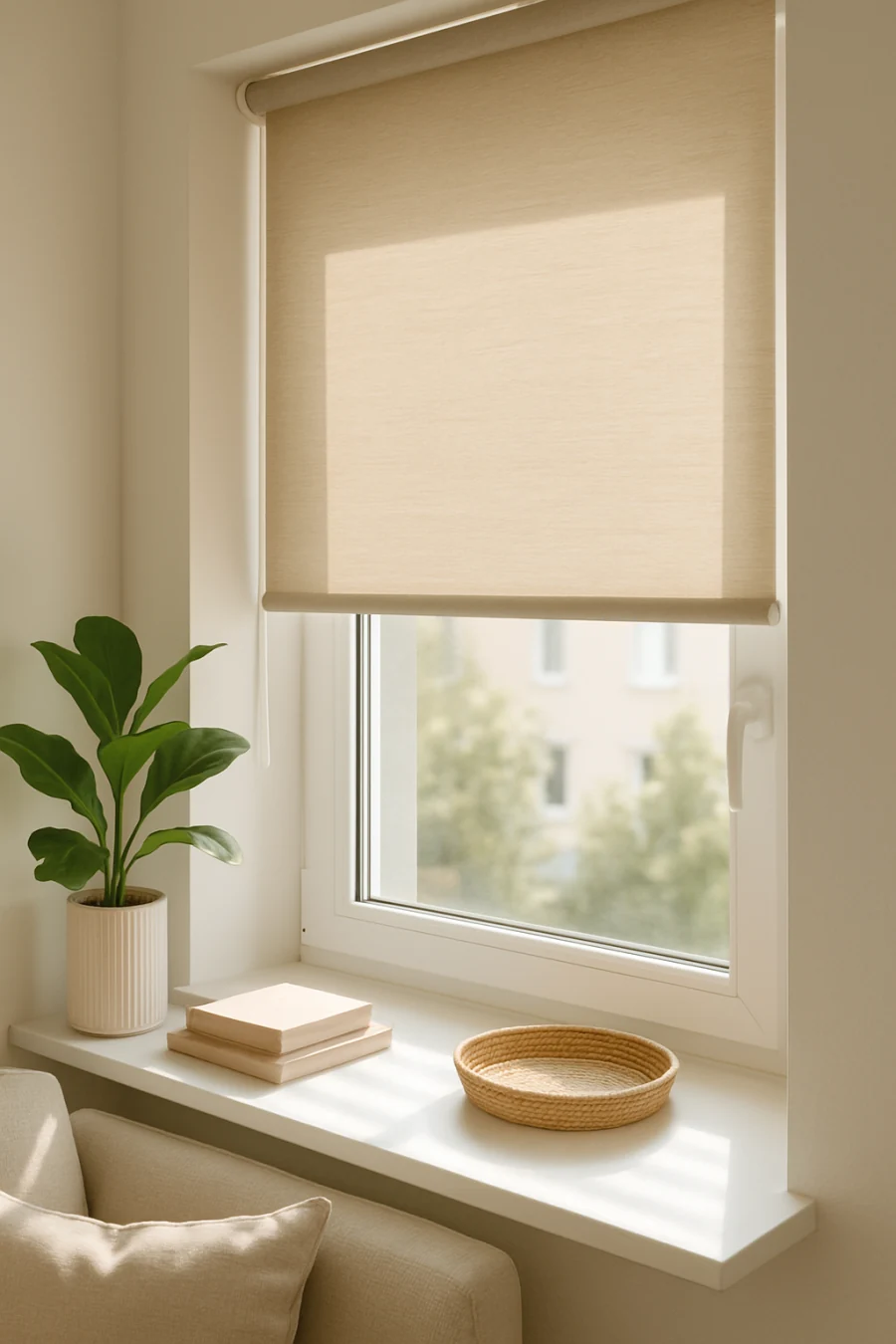



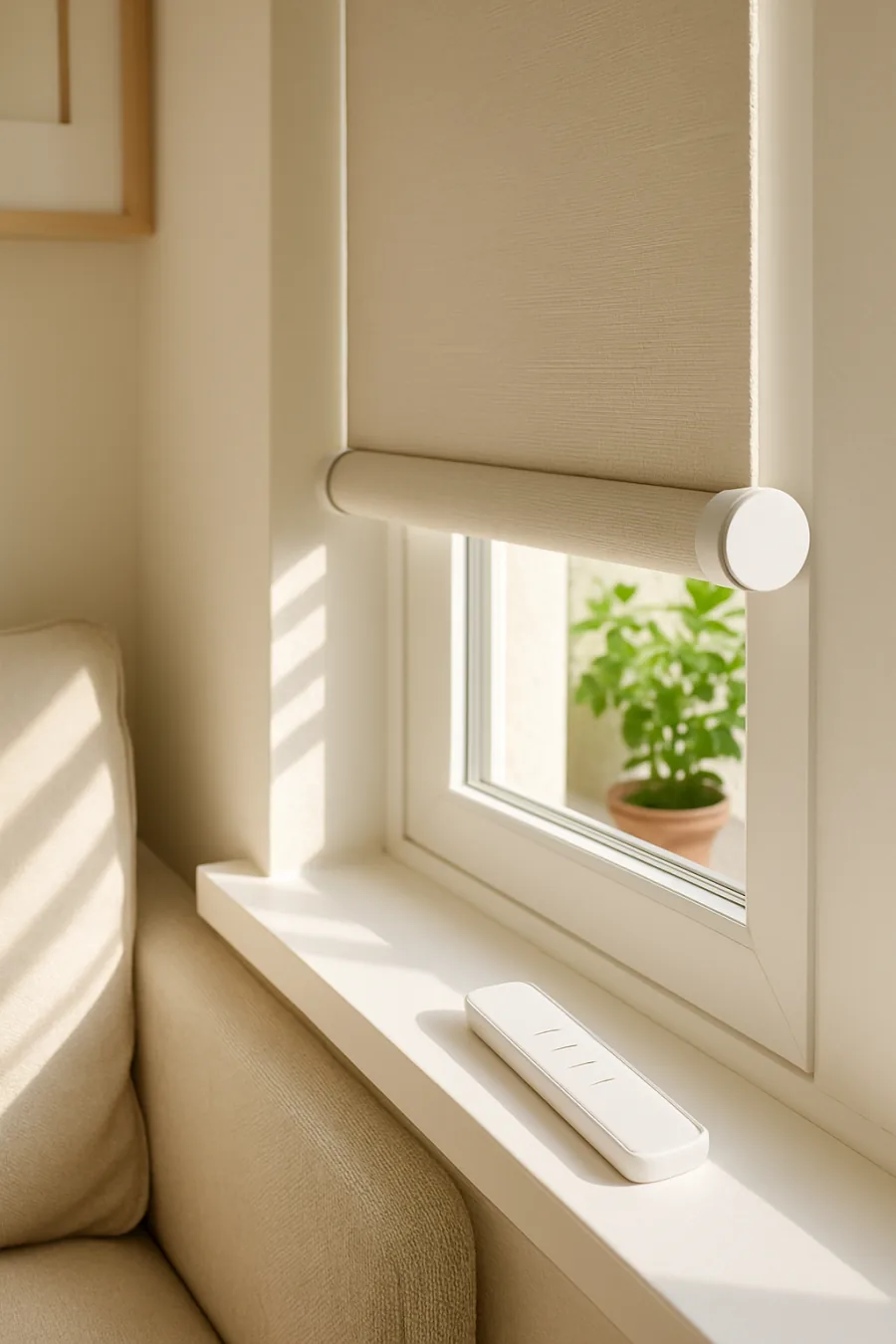


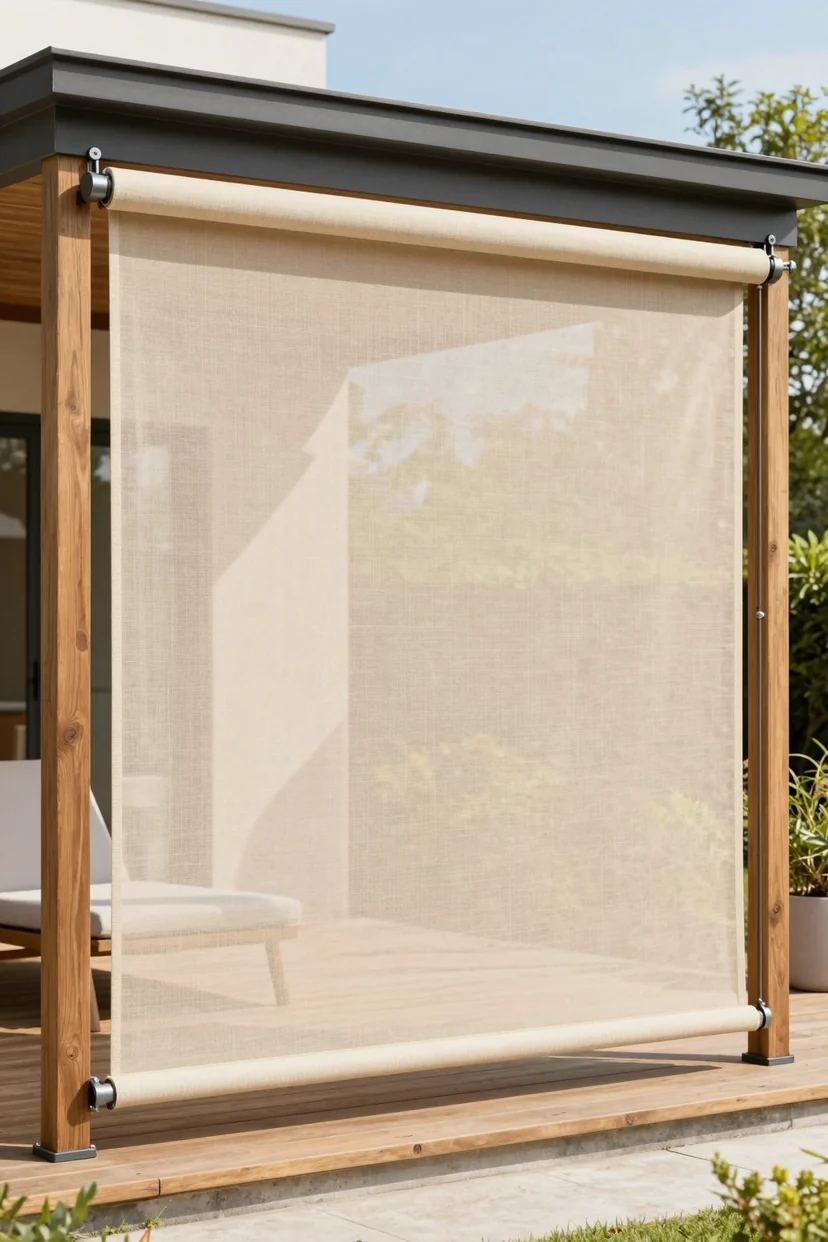


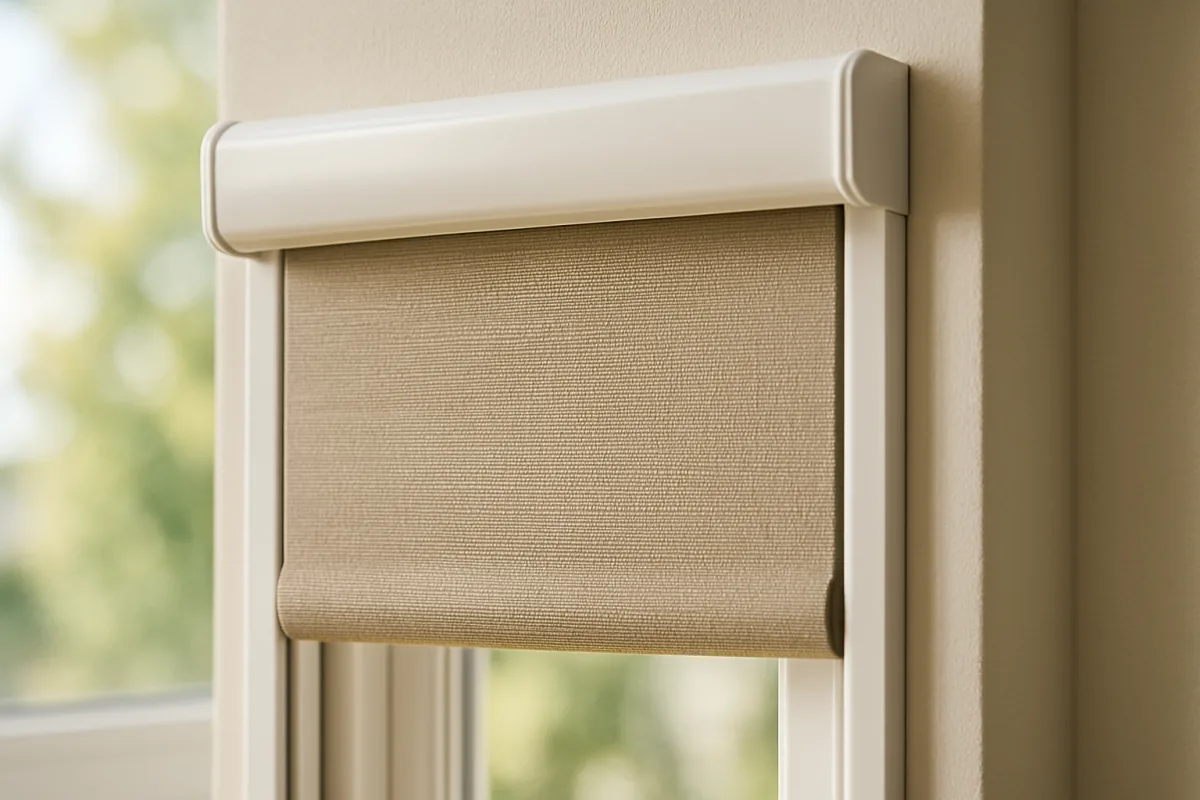

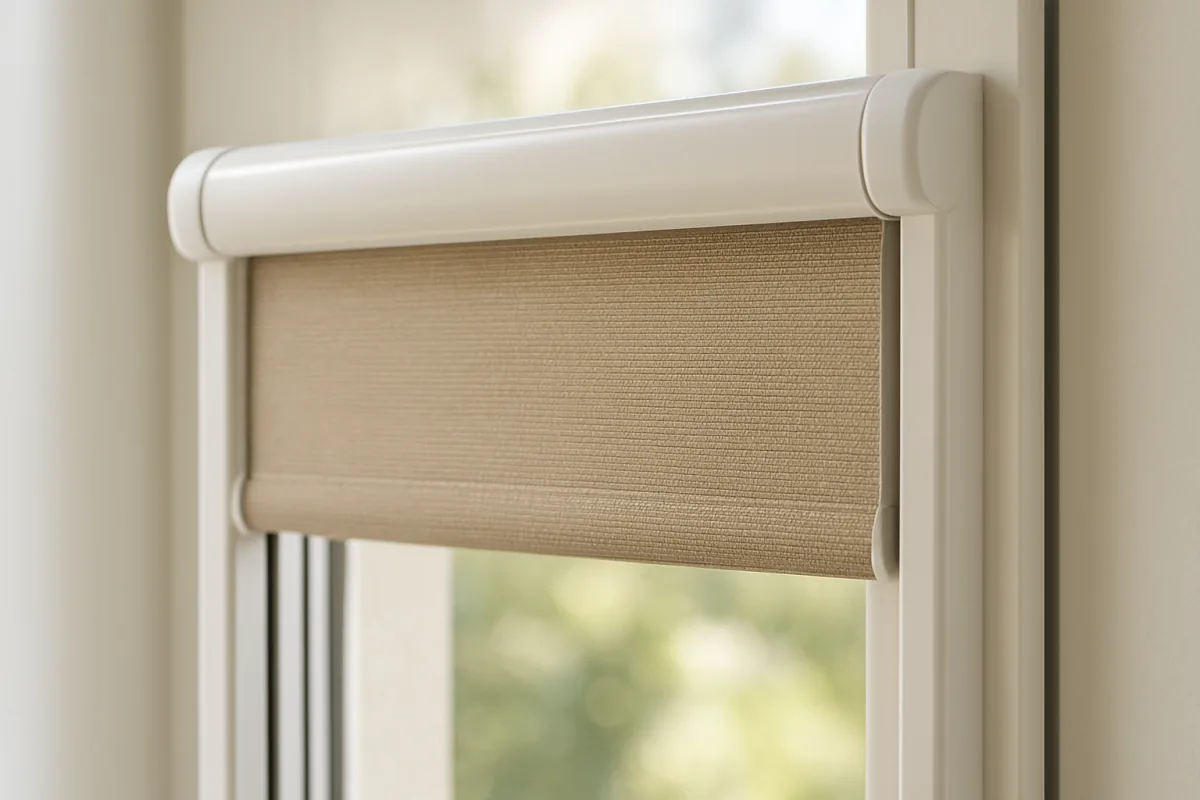









Sun-blocking roller blinds in Almaty are fitted on the sunny side: the fabric diffuses or reflects direct rays, so the heat and glare are gone while the room stays bright. The fabric is chosen for the window’s orientation, the system for the window. Measurement is free, and we work to your dimensions.
A sun-blocking blind and a blackout blind are two different things
Sun-blocking roller blinds in Almaty remove direct rays and glare but keep the room bright. A blackout blind does the opposite — it makes the room dark. These are two different fabrics, and they should not be confused.
A sun-blocking roller blind works simply. The fabric diffuses the direct sunbeam as it approaches the room: light passes through, but the sun spot on the desk and the hot stream do not. Blackout darkens the room completely, down to the silhouettes of furniture in the half-light. The choice here is not about fabric quality but about what you need during the day: to read by the window or to sleep after a night shift.
Difference from blackout
Sun-blocking means “keep the light, remove the rays and heat”. Blackout means “make it dark”. During the day a sun-blocking blind does not turn the room into a cave: you turn on the light only right at the desk, and you see the difference on the monitor screen, where the glare is gone. Blackout does not set that task — it simply blocks out the day.
How it differs from light-diffusing and reflective fabric
Light-diffusing fabric lets the beam pass through and breaks it into a soft flow. Reflective fabric works differently: the outer side bounces the rays back towards the glass, so cooled light comes inside. We recommend reflective fabric for south and west, where the sun beats down for hours. Dim-out fabric stands apart: it dims daylight and hides the interior from prying eyes, but it does not give full darkness. Dim-out is sun-protective, blackout is not.
A sun-protective blind keeps the room bright while removing direct rays and glare, whereas blackout darkens the room completely — these are different tasks.
How to choose fabric for the window’s orientation in Almaty
Fabric density is chosen by the window’s orientation: south and west require dense fabric and guide rails along the edges, while east is fine with medium density. The window’s orientation determines how many direct rays will hit the fabric and how long it will stay under them.
Almaty's climate is sharply continental: hot and dusty summers, cold winters with frosts and a big difference between day and night. Because of this, a window works in two modes — in summer it needs protection from overheating, in winter from the cold at the glass.
| Orientation | What to look at when choosing |
|---|---|
| South | Dense fabric, guide rails along the edges |
| West | Dense fabric, guide rails, light colour |
| East | Medium density, open roller tube |
South and west
A south window holds direct rays almost all day. On a west window the most active phase is after noon: the sun is low, the rays go deep into the room and heat what stands far from the window. That is why roller blinds on the sunny side in Almaty are more often taken denser than on windows facing other directions.
A south or west window requires dense fabric and guide rails: the fabric takes the rays on itself, and the side rails keep light from going around the blind. Light transmission here is chosen so that the room does not go dark — light passes through, but without direct spots on the floor and furniture.
East
An east window gets sun in the morning, while it has not risen high. The rays go low and do not manage to warm the air the way they do in the west. Morning light is softer, and dense fabric is not essential here: medium density is enough to remove glare from the screen and not get in the way of breakfast.
Floor-to-ceiling windows in new buildings
Floor-to-ceiling windows in an Almaty new building collect more heat than an ordinary window: the glass area is several times larger. And the low sun — west or winter south — hits such a wall almost horizontally, so not only the windowsill heats up, but also the floor by the window.
What to do with a plastic window
A plastic window by itself does not save you from the sun: the profile holds heat better than wood, but the glass lets rays through just the same. The fabric and the mounting are chosen by the Jalusso measurer — he looks at how the sun moves across your windows during the day and suggests fabric to match.
On south and west the sun is most active, there you need dense fabric and guide rails along the edges, while an east window is fine with medium density.
Pearlescent coating: how it works and which side to hang it
The pearlescent coating is the outer side of the fabric with a sputter that reflects direct rays while the sun beats against the glass. That is why the fabric is hung with the coating towards the glass, not into the room. Then soft light comes into the room, not a hot flow. Reflective fabric works exactly like this: the rays go back outside without managing to warm the air by the window.
Why the coating faces the glass
If you hang the fabric with the coating into the room, the effect is lost. The sputter faces inside and reflects not the sun, but the light from the walls and furniture — there is no use in that, and the heating at the glass does not get any less. The pearlescent coating is turned towards the glass: that way it takes the direct rays on itself and does not let them deep into the room. Glare on the screen disappears at the same time — the monitor is readable even at noon, when the sun stands opposite the window.
How it looks from the street
From outside such a blind looks light and matte, not like a black plug. For a facade this is a noticeable difference: the windows do not look speckled with dark spots. In my opinion, for a new building with an even row of windows this matters more than it seems: the building looks neater when the neighbours have not hung their fabrics shut tight. And one more plus for those who live on the first floors — light fabric does not turn the room into a shop window, but also does not create the feeling of a boarded-up window.
An example from practice: in a home library with two sashes we turned the fabric with the pearlescent layer towards the glass, and the light in the room stayed diffused — no sharp sun spots appeared on the shelves.
The outer side of the fabric with the pearlescent sputter reflects direct rays while the sun beats against the glass, so the coating is turned towards the glass.
What really protects from the sun and heat: density, system, guide rails
Three things protect from the sun and heat together: fabric density, the type of system and guide rails along the edges of the fabric. On their own, each works weakly. Dense fabric on an open roller tube without guide rails will let light through the side gaps, while thin fabric in a cassette will not hold back the heat. Sun-protective blinds for plastic windows are chosen precisely as a set — for the window’s orientation, the depth of the reveal and how the sash opens.
Heating at the glass works simply. A direct ray passes through the glass, falls on the windowsill, on the floor by the window, on the furniture — and from these surfaces the heat spreads through the room. Window film takes part of the rays on itself before they enter the room, which is why it is often put on windows that face south or west all day. An internal blind cannot do that: it intercepts the light already inside the room. And that is not a drawback — just a different tool.
What gives a greater effect:
- Dense fabric — holds back more light than medium or thin.
- Cassette system with guide rails — keeps the edges of the fabric at the glass, the gaps at the sides are noticeably smaller.
- Light colour on the south side — light fabric heats up less than dark, so the fabric gives less heat back into the room.
- Fabric lowered to the windowsill — light does not go around the blind from below.
Light and glare
Glare on the screen is the reflection of a direct ray from the glossy surface of a monitor or TV. Diffusing fabric removes the ray itself, and the screen is readable even at noon. At the same time light transmission stays sufficient: the room does not turn into a dark cave, the light simply becomes soft and even. For a study and a teenager's room, where the desk stands by the window, this is the main task — not to darken, but to remove the spot of sun from the screen.
What the blind does about the heat
The heat has already passed through the glass; the blind only stops it from going further into the room. A lowered blind divides the windowsill into two zones: in the sun the surface gets hot, in the shade it stays cool. A plant on the shaded half doesn't overheat, and neither do appliances. That's why in the kitchen and in a room with a west-facing window it makes sense to lower the fabric all the way to the windowsill, not just to the middle of the window.
Light or dark colour for the south
For a south-facing side it's better to choose a light fabric: it heats up less than a dark one and gives off less heat into the room. A dark fabric in the sun becomes hot itself, and that heat has nowhere to go while the blind is down. UV radiation is absorbed roughly equally by both light and dark fabric — colour isn't the main factor here. For a bedroom in a new building we usually recommend a light sandy shade: from the street the facade isn't dotted with dark windows, and the room stays bright.
An interior blind doesn't replace film or external protection — it works with the light that has already entered the room.
Open roller tube and cassette: which holds the sun better
A cassette system holds the sun better. Its fabric and roller are covered by a housing box, and guide rails run along the sides, holding the edges of the fabric against the glass. An open roller tube leaves side gaps, and light passes through them at the edges. The difference is most noticeable at midday, when the sun is high and hits the glass directly.
| What we compare | Open roller tube | Cassette system |
|---|---|---|
| Fabric and roller | Open, roller visible | Covered by housing box |
| Fabric edges | Loose, gap at the sides | Guide rails against the glass |
| Light at the edges | Noticeable strip | Noticeably less |
| Mounting | To the wall, to the frame | To the sash or frame |
| Cost | Base price | Coefficient ×1.28 |
The measurer looks at the window and says what will give more: a cassette on a narrow sash or an open roller tube with dense fabric.
Open roller tube
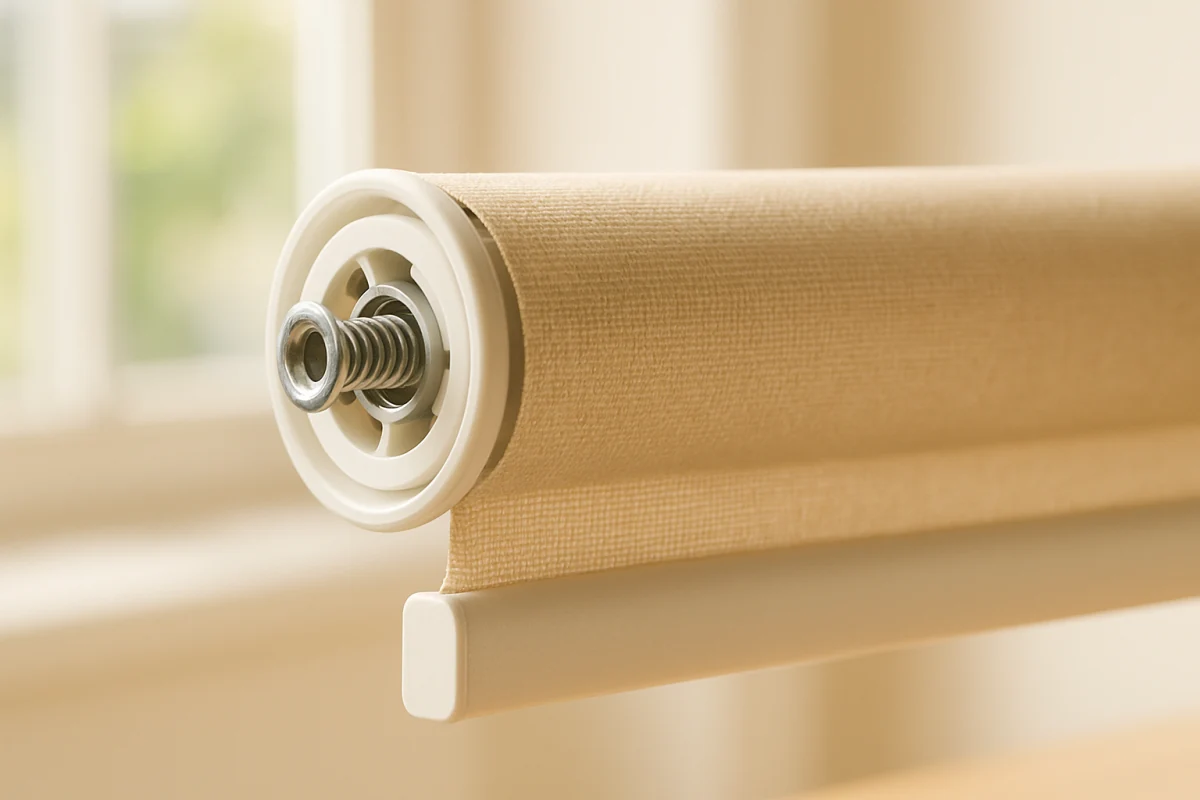
An open roller tube is the basic and most affordable system. The fabric winds onto a roller tube that stays open, and the mechanism is mounted above the opening. Side gaps are unavoidable here: the fabric hangs freely, and there's a gap at the edges through which light passes. For some people that's enough: if the window faces east, the side strip doesn't bother them. But for south and west I usually recommend looking at a cassette.
Cassette with guide rails
A cassette system reduces the gaps at the edges — it doesn't eliminate them completely, just reduces them. The housing box covers the roller tube and the wound fabric, and the guide rails press the edges of the fabric against the frame. Less dust settles on such fabric. The price is higher: a cassette comes with a coefficient of ×1.28 to the base cost. About the gaps, I'll be honest — light still passes through the edges of a cassette, it's just a narrow strip instead of a wide one.
How it differs from horizontal blinds
Horizontal blinds let light through between the slats: even fully closed slats leave gaps, and striped light falls on the table and floor. Roller blind fabric is solid, so it blocks the flow in one piece. If you compare sun protection, horizontal blinds lose to roller blinds, and sun-protection roller blinds with guide rails hold the rays most tightly.
Sun passes through the gaps of any interior system — the only question is how wide that strip is.
Fabric for your room: pearl, dim-out, polyester
How much light the fabric lets through depends on its density and coating — there's no universal figure here, but the logic of selection is simple: the denser the fabric and the more it reflects the rays, the less light and heat reaches the room. Through most sun-protection fabrics the street is visible as silhouettes, not details — if you need the interior not to be readable from the street, choose dim-out.
The table helps you navigate the three main options that we most often bring to a measurement.
| Fabric | What it does with light | Where to install |
|---|---|---|
| Polyester, open roller tube | Lets through a lot of daylight, scatters rays weakly | East, windows facing a courtyard where there's no direct sun for hours |
| Pearlescent coating | Reflects direct rays with the side facing the glass | South and west, if you need light without glare |
| Dim-out fabric | Dense fabric dims daylight, silhouettes from the street aren't readable | Bedroom, living room on the sunny side |
Pearl
A pearl coating is applied to windows where the sun hits directly: the outer layer with the coating reflects the rays while they fall on the glass. The room doesn't get dark — the light comes in soft, without a hot stream and without glare on a monitor screen.
Dim-out
Dim-out fabric dims daylight and hides the interior from prying eyes: from the street you see only a smooth fabric, no furniture, no silhouettes of the household. But dim-out doesn't give complete darkness — if in a bedroom you need the morning sun not to wake you at all, that's a job for blackout, and we have a separate page for it.
Polyester
Polyester is the base fabric in our price list, that very option from 5,400 ₸/m² with an open roller tube. For east-facing windows and rooms where the sun doesn't stay long, it's enough: the fabric holds its shape when lowered and is inexpensive per square metre.
Care and combining with sheer
Sun-protection roller blinds can be vacuumed with a soft attachment on low power, and washed with a damp sponge without aggressive products, but machine washing isn't advisable: the fabric loses its coating and shape. Sun-protection fabric gets along fine with sheer and curtains, only it's mounted closer to the glass, and the sheer is left on top — that way the fabric lowers and rises without catching the curtain.
Sun-protection fabric reduces fading of furniture and parquet because it takes the direct rays on itself, but the warranty doesn't cover natural fading of the fabric itself — it's designed for constant sun, not for eternal colour.
Control and mounting: chain, spring, electric motor
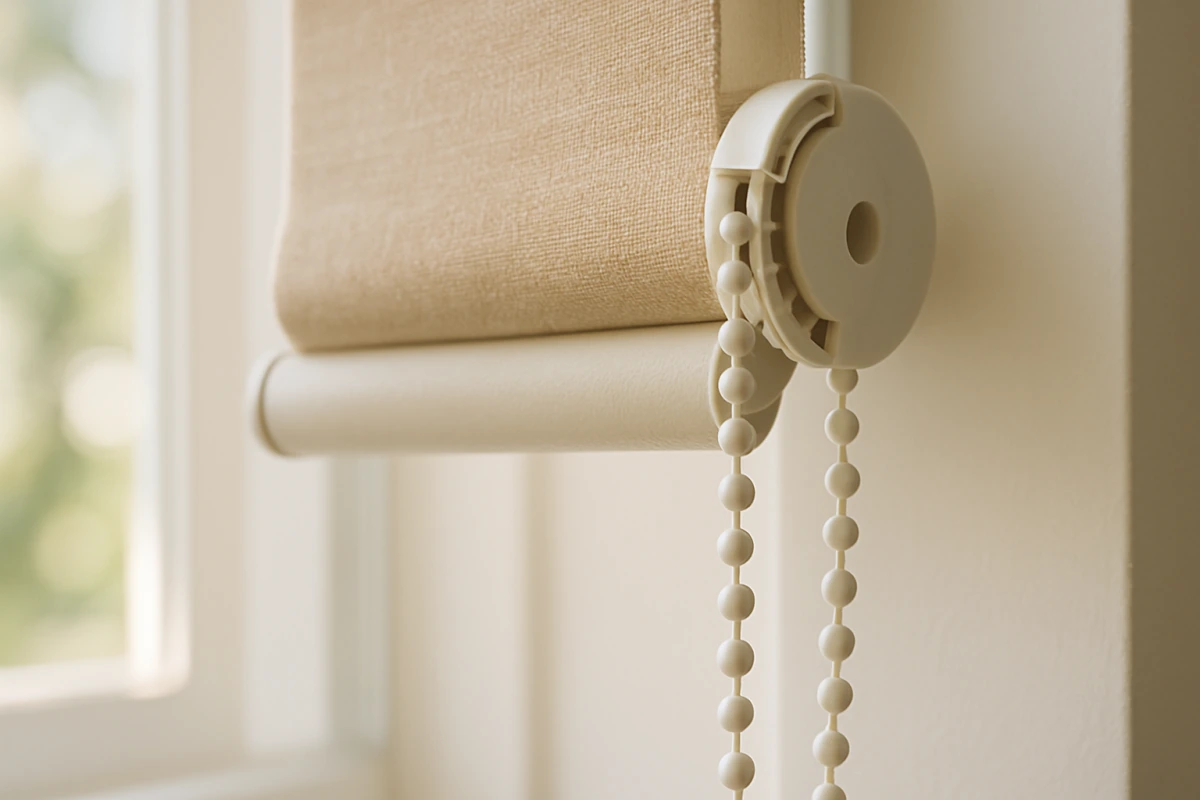
A chain mechanism holds the fabric at any height, a spring mechanism raises it without a chain or cord, and an electric motor makes frequent light adjustment throughout the day easier. The choice depends on how often you touch the blind and how easy it is to reach the window.
Chain, spring, electric motor
The chain mechanism is the most common option for sun-blocking window blinds. The fabric stops where you release it and does not roll up on its own. This is convenient in a kitchen or a room where the light is adjusted several times a day: open it slightly in the morning, lower it further at noon, raise it in the evening. The chain is operated from both sides, so the blind works on both a narrow sash and a wide opening.
The spring mechanism works without a chain: pull the bottom rail — the fabric rises, release it at the desired height — it locks in place. Nothing hangs down, which helps on windows with limited access, for example when the windowsill is occupied or the sash is close to the wall. But there is no smooth adjustment by a couple of centimetres here — the mechanism holds its position in steps.
An electric motor is installed where the blind covers a floor-to-ceiling window or where there are several windows and you cannot be bothered to go to each one. One remote control, one press — and the fabric moves. In the calculator, an electric motor comes with a coefficient of ×1.85, and an electric motor with remote control — ×2.1, so this is a deliberate extra cost for comfort, not a basic option.
No-drill mounting
Drill-free mounting — with hook-and-loop fasteners, suction cups or a spring — leaves no marks on the profile, so it is chosen for rented housing. The measurer looks at the profile of the plastic window and selects an option that will not interfere with the sash. For wide floor-to-ceiling windows we do not promise such mountings: the weight of the fabric is different there, and installation on the frame or a cassette is more reliable.
Sash ventilation is a separate story. If the blind hangs on an opening sash and rests against the window reveal, the measurer either shifts the mounting or suggests a cassette system with guide rails, which does not interfere with opening the window. During installation, a cassette comes with a coefficient of ×1.28.
The bottom line is simple: a chain — for frequent manual adjustment, a spring — where a hanging cord is not needed, an electric motor — for panoramic windows and lazy evenings.
Floor-to-ceiling, corner and non-standard windows
A non-standard window is solved not by fabric, but by how the fabric is divided across the sashes. On a floor-to-ceiling window you can hang one wide blind for the whole opening or several narrow ones — one per sash. A corner window requires shading both sides of the corner. A hotel room or office on the sunny side is usually covered with identical blinds on each window.
Floor-to-ceiling window
One wide blind for the whole floor-to-ceiling window covers the opening entirely and looks calmer, but it requires a wide roller tube — which is heavier and more expensive when calculated by area. Blinds per sash come out cheaper: each one is smaller, the mechanism is simpler. There is also a practical difference. If the sashes open for ventilation, a narrow blind on each one does not interfere with them, while one wide blind covers the whole opening and has to be raised completely. In new buildings with panoramic glazing we more often install separate fabrics per sash precisely for this reason.
Corner window
A corner window is two planes of glass, and the sun comes in from two sides. One blind on one sash does not cover the other side: the room heats up through the unshaded wing for half the day. That is why two blinds are needed here, one for each side of the corner. We install them independently, and the person adjusts the light as the sun moves. The measurer looks at where each plane faces and calculates the sizes separately.
For example, in a guest room with a corner window we shaded both sides of the corner: during the day the sun moved along one wall first, then after lunch along the other, and without the second blind half the room stayed in the sun. The measurement took one visit, manufacturing — 6 days.
Hotel and office
A hotel and an office have many windows, and all of them are on one side of the building. Uniformity matters here: the same fabrics, the same controls, the same mounting on every window. In a room on the south side, a sun-blocking blind keeps the heat outside throughout the day — the air conditioner is turned on noticeably less often than without blinds. We worked with hotel rooms on the south side: one window, manufacturing 6 days.
Sun-blocking roller blinds for such properties are calculated as a package, not per window: this makes it easier to maintain the same look and the same fabric shade across the whole floor.
On a corner window the sun comes in from two sides, so both sides of the corner need shading, not just one sash.
Price of sun-blocking roller blinds: what the sum is made up of
The base price of sun-blocking roller blinds is from 5,400 ₸/m² for polyester fabric on an open roller tube. Installation is calculated separately: 4,500 ₸ per item, and for orders from 150,000 ₸ we install free of charge. Manufacturing time for the base price item is 4–6 days.
You can estimate by square metres in your head, but the exact sum will still be quoted by the measurer: they see the opening, the window profile and understand which fabric and which mounting will fit here. What the figure is made up of and why two similar windows give a different total — further on.
What makes up the price
The fabric is calculated by the area of the opening. To dense fabric on the south side we add a reflective coating, and this is already a different version than the polyester base. Mounting changes the total more than it seems: a cassette with guide rails keeps the edges at the glass, but adds a coefficient of 1.28 to the price. Control is a separate line: an electric motor applies a multiplier of 1.85 to the cost, an electric motor with remote control — 2.1.
Look at how this works on a kitchen window with a vent pane of about 1.3 m². The base is roughly 7,000 ₸ for the fabric, plus installation 4,500 ₸. Replaced mechanical control with a chain — multiplier 1.06. Added a cassette — 1.28. The measurer does this arithmetic on site, with samples in hand.
Control and installation coefficients
Coefficients by control type: mechanical — ×1, chain — ×1.06, with electric motor — ×1.85, electric control with remote — ×2.1.
Coefficients by installation: wall — ×1, frame — ×1.05, drill-free mounting — ×1.1, cassette version — ×1.28.
An electric motor is justified on panoramic glazing — the chain hangs high there, and reaching for it every time is inconvenient. But on a standard window in a bedroom, where you adjust the light in the morning and evening, I would put the price difference into dense fabric for the west side — more benefit.
Timelines and warranty
Four to six days is the manufacturing time for the base price item. We give 3 years on the roller blind mechanism itself, 1 year on installation work, counted from the day the acceptance act is signed. Warranty cases are fixed free of charge within 5 working days; after the warranty we still come: to tighten, adjust, replace the cord or chain. The warranty does not cover cases of mechanical damage, re-installation by your own efforts, exposure to water and natural fading of the fabric.
Measurement and consultation are always free, and within the city both measurement and delivery are free.
Roller blinds — from 5,400 ₸/m² for the base “polyester, open roller tube”, installation 4,500 ₸ per item, for orders from 150,000 ₸ installation is free, manufacturing time 4–6 days.
What a sun-blocking blind will not do
Sun-blocking blinds on plastic windows solve the problem of light and glare, but do not replace window film or external sun-blocking systems. An internal blind stands behind the glass, so the heat that has passed through the glass is only stopped from going further into the room. The fabric takes the direct rays, and the windowsill stops heating up entirely, but the air by the glass has time to warm up before the blind stops it.
Here is what is honestly worth keeping in mind before the measurement.
- Window film works before the blind does: it reflects part of the rays before they even enter the room. If you have floor-to-ceiling glazing and sun from morning to evening, film and a blind complement each other rather than replace each other.
- External sun protection systems take the load before it reaches the glass, so in hot weather they are more effective than internal ones. But these are separate facade structures, and we do not make them.
- Guide rails reduce the gaps at the edges, but they do not remove them completely. Even with a cassette system, a strip of light remains around the perimeter — it is just noticeably narrower than with an open roller tube.
- Blackout darkens the room completely, while a sun protection blind keeps it light. If you need complete darkness, that is a different task and a different page.
A practical example from a measurement: on a south-facing bedroom window, the customer wanted to get rid of morning glare but keep the room light. We installed a dense fabric with a pearlescent coating and guide rails — the glare was gone, and the room is filled with diffused light. This blind is not designed for complete darkness, and that is worth agreeing on in advance.
An internal blind does not replace film or external protection: the heat has already passed through the glass, and the blind only keeps it from spreading further into the room.
What happens from request to installation
A request starts on WhatsApp: you write to us, we ask a few questions about your windows and agree on a time. Measurement and consultation are always free with us. This is not a one-time seasonal promotion — this is how the entire roller blinds category works, and sun protection roller blinds are no exception.
Then a measurer arrives with fabric and mechanism samples. He looks at the plastic window: the profile, the sashes, how they open, where the mounting will go. The measurer selects the fabric and mounting for the window and calculates the cost on the spot, in front of you, rather than sending a figure a day later. If you want to touch the fabric and compare two options against the light, this is exactly the moment.
- You write on WhatsApp and agree on a visit time.
- The measurer arrives with samples and calculates the cost on the spot.
- The workshop makes the blinds to your dimensions: 4–6 days.
- Installation in the city — delivery is free, installation is 4,500 ₸ per item.
Request and measurement
The conversation about mounting is half the measurement. If the window is in a rented apartment and you cannot drill into the frame, the measurer will suggest drill-free mounting: it leaves no marks and suits rented housing. For wide floor-to-ceiling windows, we do not promise this type of mounting — a different fitting is needed there, and the measurer will say so directly on the spot.
Workshop and installation
Manufacturing takes 4–6 days — this timeframe applies to roller blinds with an open roller tube in polyester. We charge 4,500 ₸ for the installation of each item; if the order total reaches 150,000 ₸, we install free of charge. The warranty period for the mechanism is 3 years, for installation — 1 year, counted from the date the acceptance certificate is signed. Measurement and delivery within the city are free; for the suburbs — Kaskelen, Talgar, Issyk, Kapshagay — we do travel there, and we quote the travel cost before the visit.
Measurement and consultation are always free, the measurer arrives with samples and calculates the cost on the spot, and within the city measurement and delivery are free.
Conclusion
Sun protection roller blinds in Almaty keep the room light while removing direct rays and glare, whereas darkening a room is a separate task handled by blackout. These two things should not be confused: if you need light during the day and no sun spots on your desk — this is the right place. If you need complete darkness — that is a different fabric and a different selection logic.
Fabric is selected based on the window’s orientation. South and west require dense fabric and guide rails at the edges; an east-facing window is fine with medium density. In an Almaty new-build with floor-to-ceiling windows, there is a lot of glass, and the low afternoon sun heats more than you would expect from the window area — there, fabric density and guide rails matter more than colour.
The pearlescent coating faces the glass: the coated outer side of the fabric reflects direct rays outward while the sun hits the glass. If you get the side wrong, the coating will work into the room instead of outside. A small thing, but it is exactly what distinguishes working sun protection from a merely pretty blind.
A cassette system with guide rails blocks the sun more tightly than an open roller tube. But gaps at the edges remain even with it, just noticeably smaller — we will not promise complete light-tightness.
The price of sun protection roller blinds is from 5,400 ₸/m² for the base “polyester, open roller tube”; the final cost depends on the opening area, the control type and the mounting. A chain adds less to the base than an electric motor with a remote control; a cassette is more expensive than an open roller tube.
There is one practical step: call a measurer with samples. He will see how the sun moves across your windows, show you the fabric in hand and give you the final cost on the spot.

