




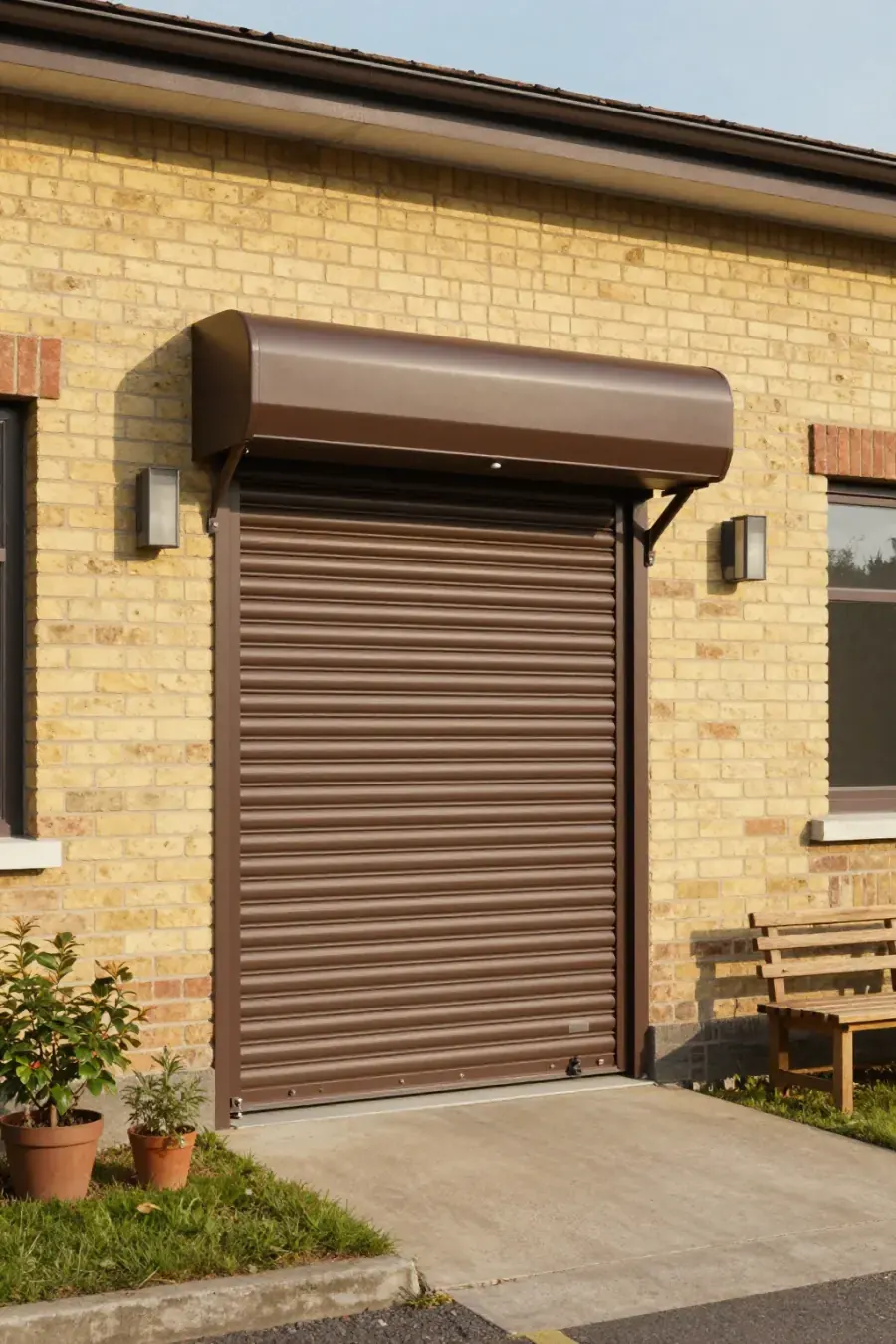

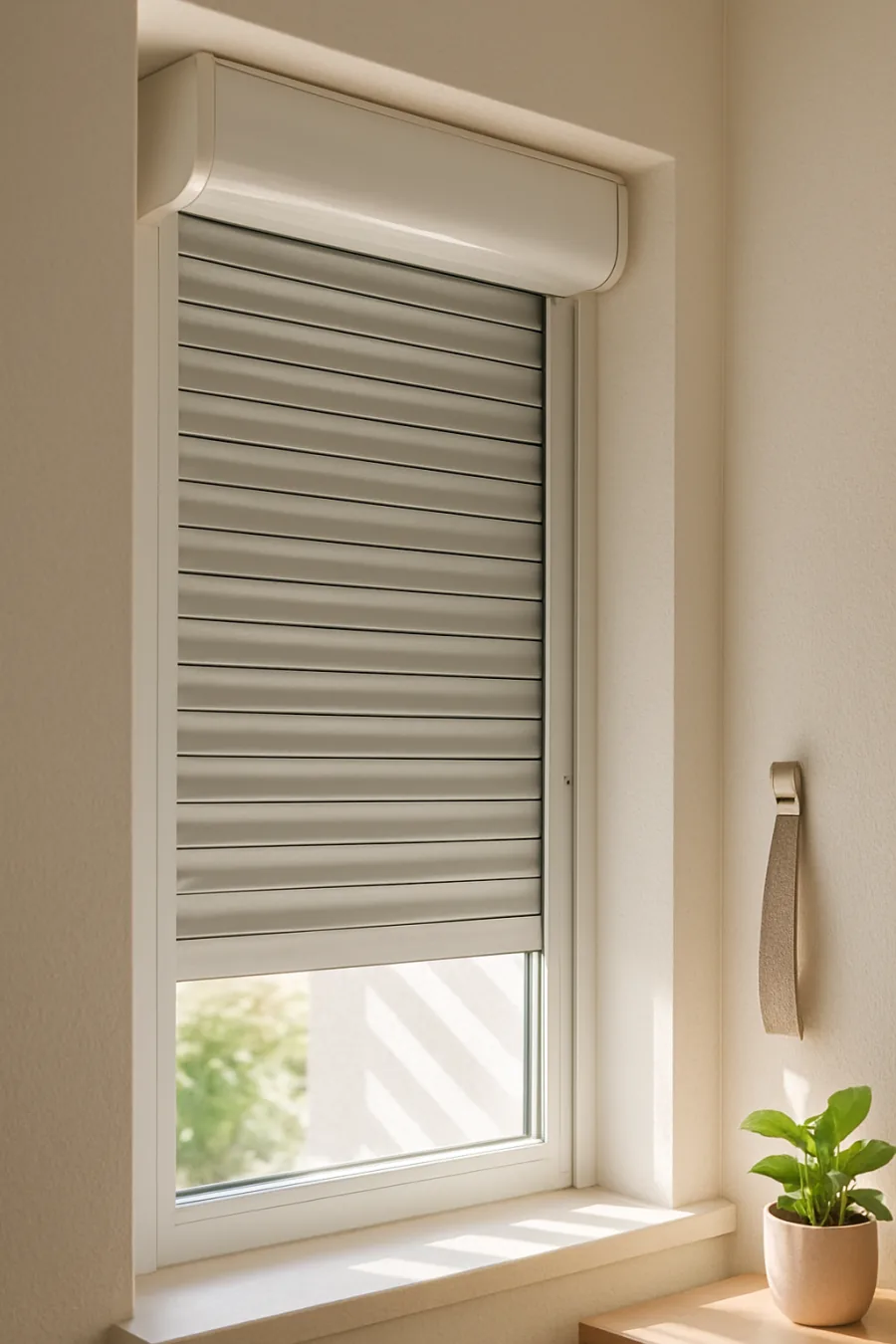


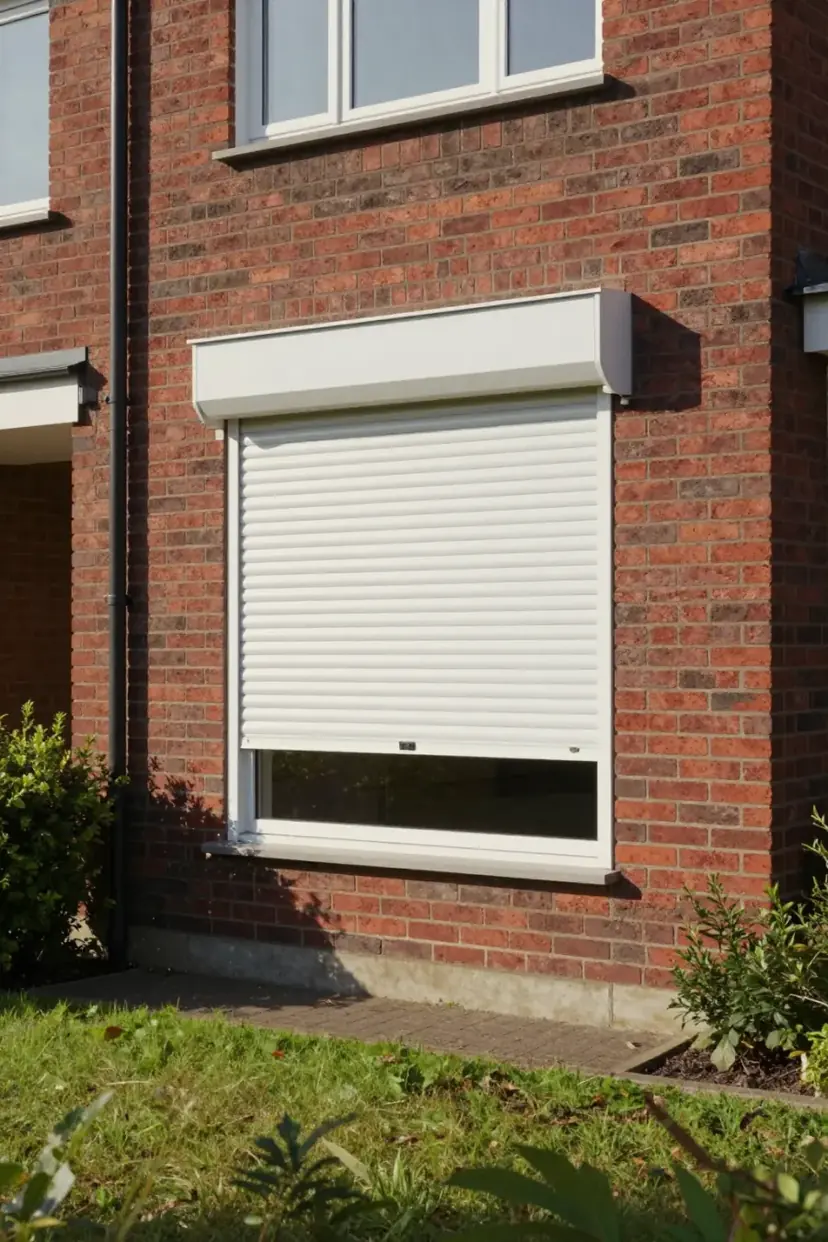


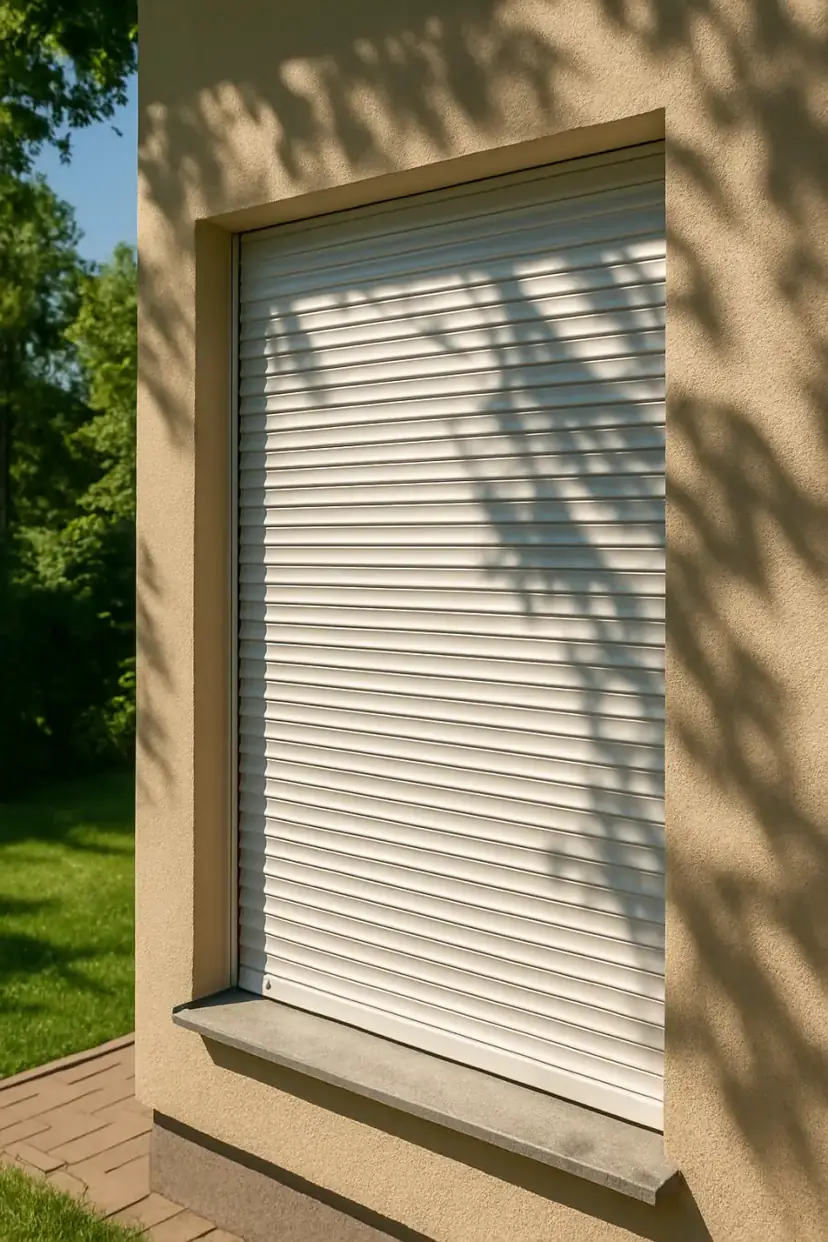


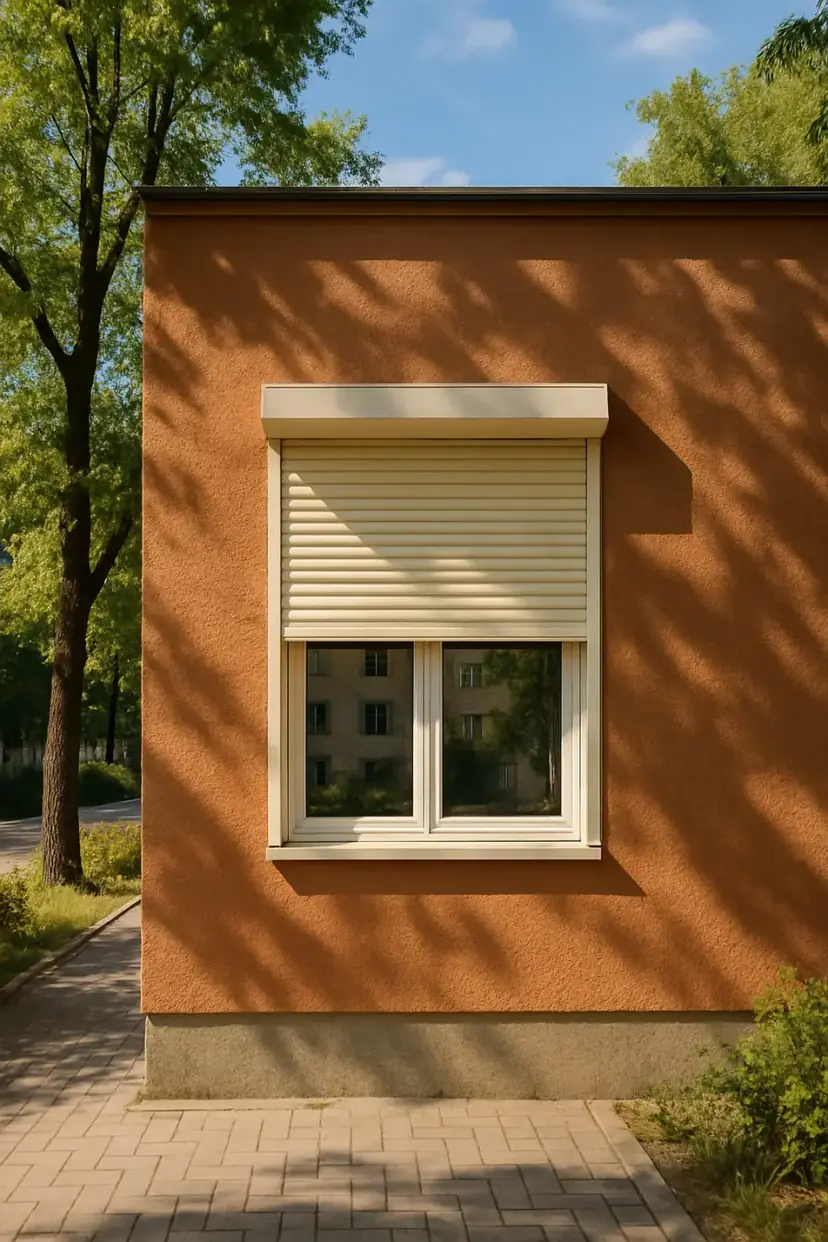


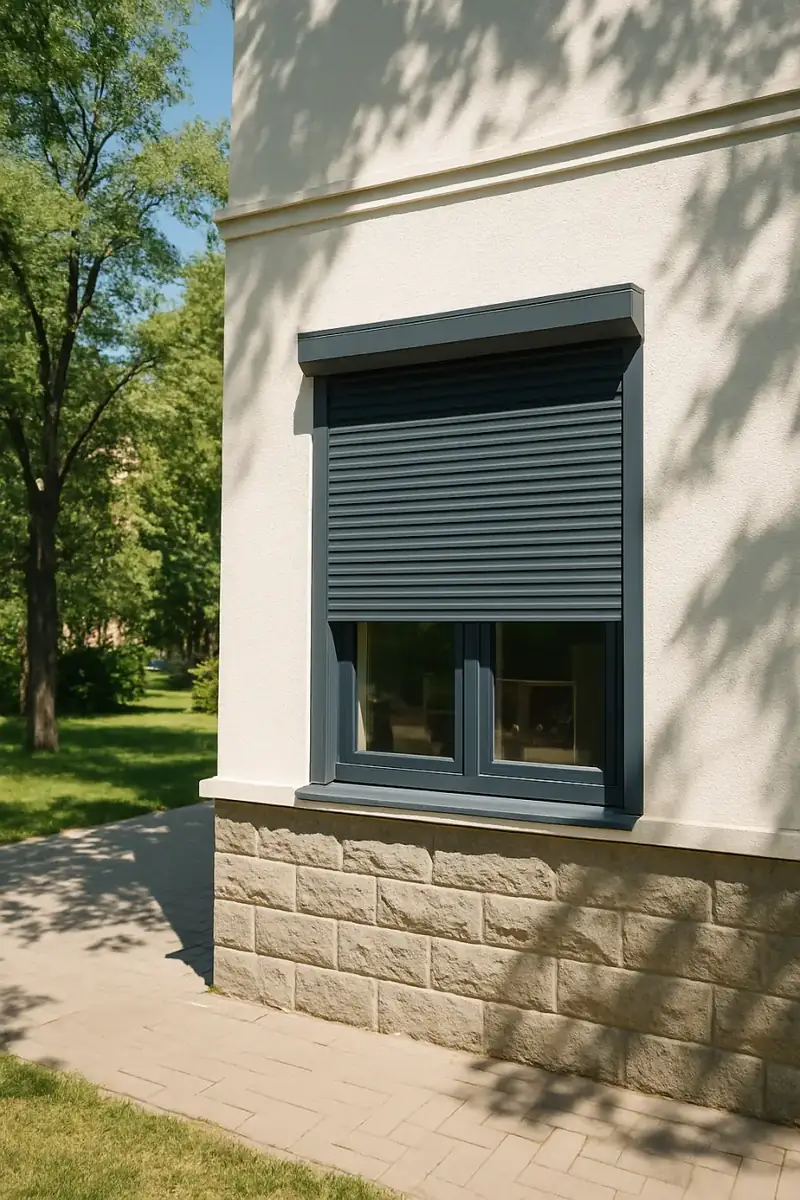
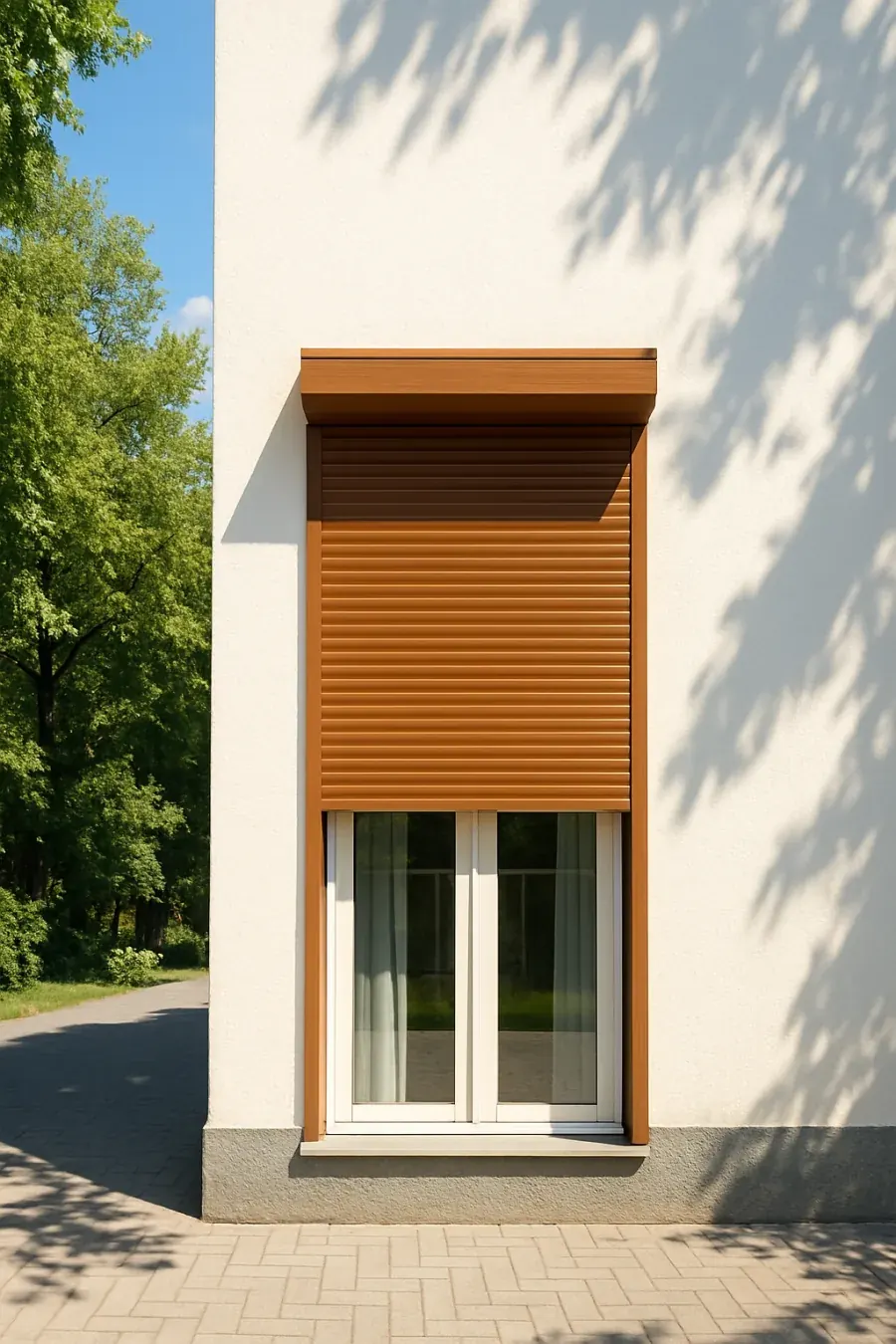


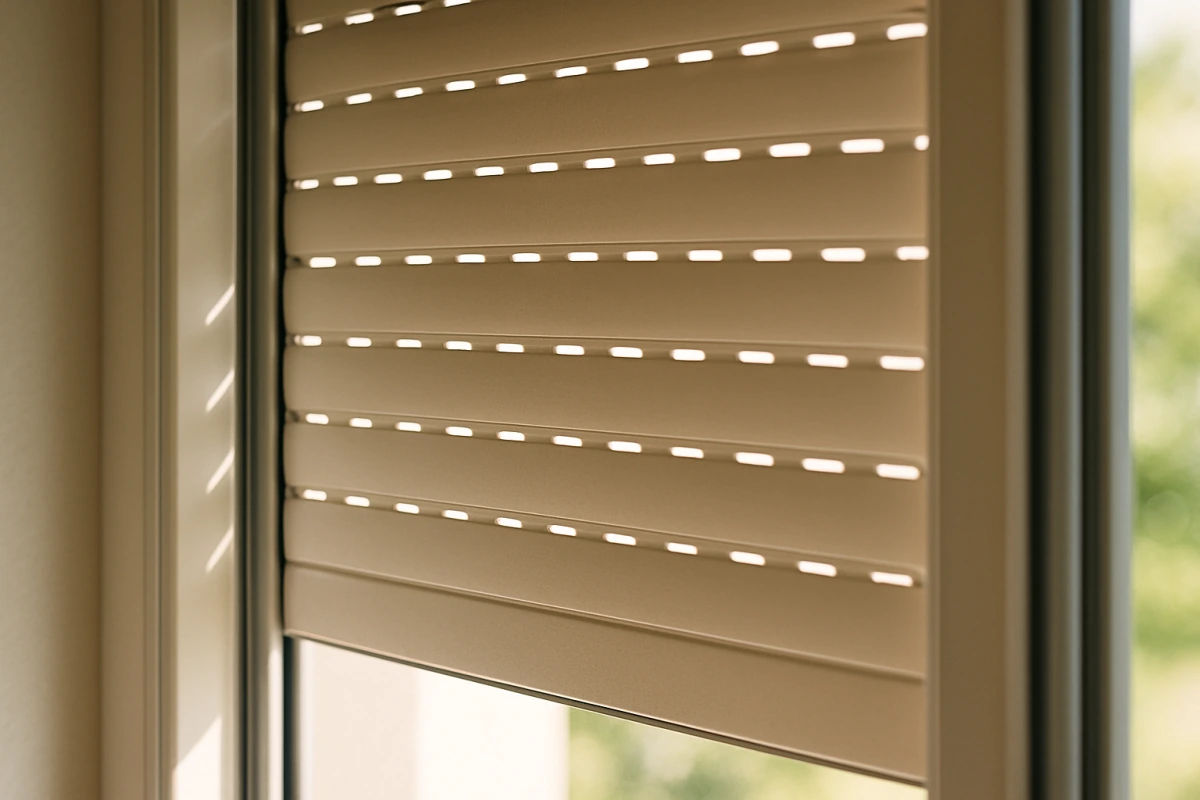
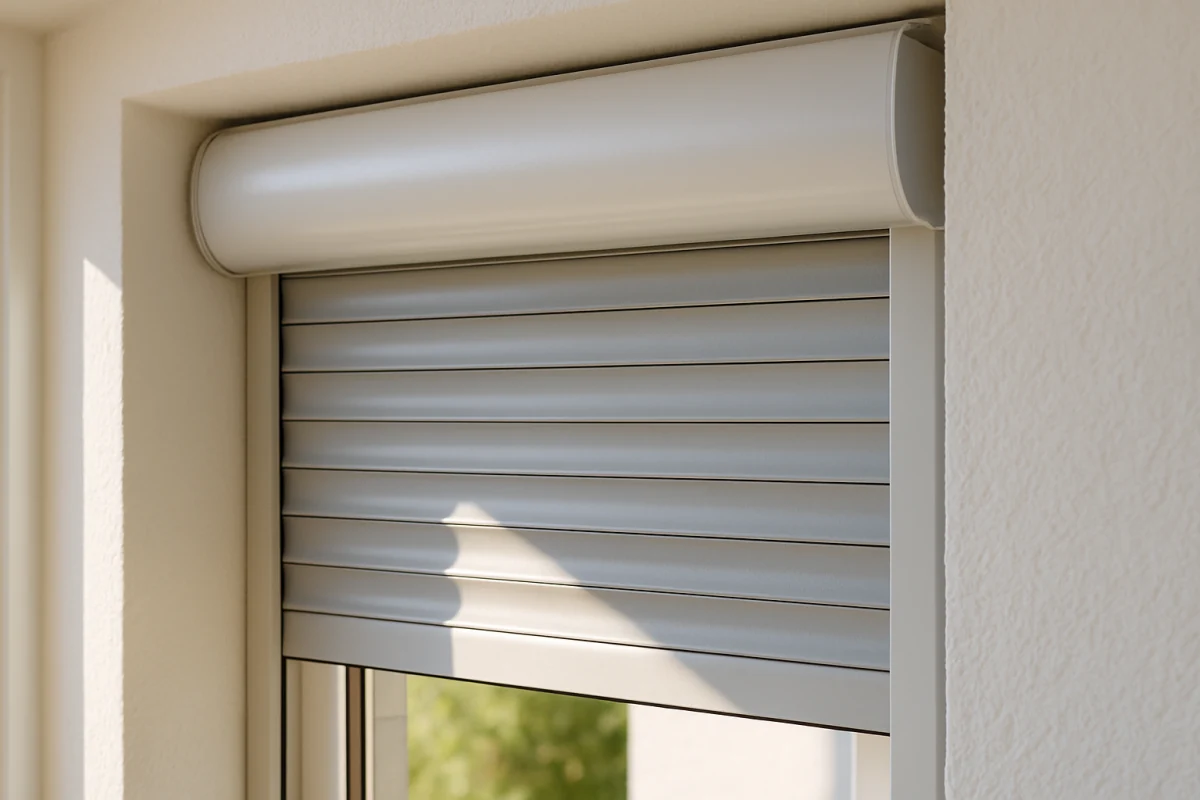











In Almaty catalogues, plastic roller shutters usually mean a light foam-filled curtain: the slat is roll-formed from an aluminium strip and filled with foam, so it does not rust and needs no painting. Real PVC is rare. Prices start from 17,500 ₸ per m², measurement is free.
What the “plastic” roller shutters sold in Almaty are made of
Under the name plastic roller shutters, Almaty sellers most often offer a foam-filled profile, not PVC. This is what a light roll-formed profile is called: the slat is roll-formed from a thin aluminium strip and filled with foam inside. The material here is the same metal as in an ordinary roller shutter slat, only thinner and with a filler.
Why the light slat is called plastic
The foam inside makes the curtain light. It also does not rust and needs no painting. That is why it seems to be plastic.
A customer comes in and asks for plastic roller shutters — something light, cheap and maintenance-free. The manager shows a sample, the customer feels the strap, sees the matte surface and the foam inside. It really does feel like plastic. We do not try to talk them out of it right away: first we let them hold the slat in their hands, and then we explain that it is aluminium with foam. That is more honest than selling different things under the same word.
Where real PVC is found
Real PVC is almost never found in Almaty. Slats made of PVC compound are produced by some Russian manufacturers, and local catalogues have only a few of them. The purpose of such a curtain is the same: to close a window from the sun, dust and prying eyes. No one expects it to provide security protection.
How the light curtain differs from aluminium and steel
The difference shows in three things: weight, rigidity and purpose. Comparison by material:
| Material | Weight | Bending strength | Purpose | Care |
|---|---|---|---|---|
| Foam-filled profile | Light | Medium | Windows of flats and residential houses | Wipe and lubricate the guide rails |
| Extruded aluminium | Heavier | High | Shop windows, garages, ground floors | The same |
| Steel slat | The heaviest | High | Openings that need rigidity | Protect the edge from corrosion |
A foam-filled profile bends more easily than an extruded one, because inside it has foam rather than solid metal. A steel slat is heavier than both and carries load better, but it rusts along the edge if the coating is damaged.
Within this group, the extruded plastic profile stands apart: the slat is formed from a PVC compound without foam. The blind is thinner than a foam-filled one, but stiffer against bending — it is chosen for openings that are opened frequently.
What local catalogues call plastic roller shutters depends on which profile the manufacturer used as the base. It is easy to check: look at the cut edge of the slat. If you see foam, it is aluminium with filler. If you see a uniform mass, you are looking at PVC or an extrusion.
Why “plastic” in Almaty costs as much as metal
Because in Almaty the word “plastic” most often hides a foam-filled profile, and its slat is rolled from aluminium strip and filled with foam. Making such a slat is no cheaper than a metal one: the metal is the same, and a foam-filling line is added on top. Plastic roller shutters in Almaty in a product name is a familiar customer word, not a grade of material.
Plastic roller shutters in Jalusso catalogues appear on the same line as other lightweight systems, and the price of the item depends on the profile and the configuration. Extruded aluminium is more expensive not because it is “real metal”, but because its slat is heavier, stiffer and formed from a compound without foam.
What is included in the price of the item
The size of the blind determines how much slat is used, and that is calculated by the area of the opening. The type of profile determines which strip goes into the work: roll-formed with foam, extruded, perforated or transparent. The type of housing box changes the assembly: a surface-mounted one is fixed to a finished facade, a cassette one is hidden in the opening. Controls and locks add the mechanics — a chain, a strap, an electric motor with a remote control and emergency lifting.
The starting price in the category is from 17,500 ₸ per m², and that is an item with a roll-formed foam-filled profile. You cannot quote a sum from a single word found online: it comes together at the measurement.
When paying extra for aluminium is justified
Extruded aluminium is installed on shop windows, garages and ground floors without security — where the blind must resist prying and not bend. On a third-floor window, where you need protection from sun, dust and prying eyes, there is no point paying extra for rigidity. And the difference shows not in the price of the blind, but in the task.
If the opening is opened frequently, a stiff slat is also appropriate. In other cases, a lightweight foam-filled profile covers the same windows for less money.
The price of the item depends on the profile and the configuration, not on the word “plastic” in the name: a foam-filled slat is an aluminium strip with foam, and making it is no cheaper than a metal one.
What a lightweight blind protects against, and what it does not
Plastic roller shutters in Almaty on windows protect against sun, dust and prying eyes — and do not protect against burglary. This is the main thing to understand before ordering: a foam-filled profile is lightweight, and it does not carry force loads.
A foam-filled profile takes the edge off street noise and overheating, because an air gap remains between the blind and the glass. Prying eyes cannot see into the room, and street dust settles on the slat rather than on the windowsill. In winter, a closed blind works as an extra barrier: the window cools down less. The thermal protection here is not absolute, but the difference is noticeable — especially on windows that face the sun all day.
But noise from a busy road is only partly muffled by the blind. There will be no complete quiet in the room if there is a stream of cars outside: a lightweight slat absorbs the hum, but does not remove it.
What the blind really takes away
- Prying eyes: in the evening the room is closed off, and the light inside is not visible from the street.
- Some street noise — thanks to the air gap between the slat and the glass.
- Some overheating of the glass on the sunny side: in summer the room heats up less.
- Dust: the slat takes it on itself, and the windowsill stays cleaner.
Plastic shutters on windows will hardly rattle in the wind: a lightweight slat sits tightly in the guide rails and does not flap the way thin metal does.
What the blind does not hold
A lightweight curtain does not stop burglary. It can be pried open with a crowbar, and counting on plastic roller shutters to protect a ground-floor flat will not pay off. Hail and a thrown stone are also not a scenario for a foam-filled profile: it is not guaranteed protection against such loads. The curtain may withstand a hit, or it may get a dent — we will not promise more.
The practice is simple: on a third-floor window, a lightweight profile is installed for sun and dust, while on a shop window, in a garage or on a ground floor without security, extruded aluminium is chosen. A lightweight blind is designed for sun, dust and prying eyes, not for force protection.
Plastic roller shutters on windows: winter, sun and care
In the Almaty frost, plastic roller shutters do not crack: the slat does not absorb moisture, and the profile itself handles cold calmly. The problem comes from another side — water gets into the guide rails and freezes there, and then ice holds the curtain. That is why the guide rails are cleaned and lubricated before the cold — this is the main seasonal procedure. The climate in Almaty is sharply continental: frosts in winter, and the temperature swings noticeably between day and night. After a night of sub-zero temperatures, the curtain is in no hurry to come down in the morning — not because it is broken, but because ice in the groove is holding it.
Winter: what happens to the blind and the guide rails
At minus twenty degrees, a foam-filled profile remains workable: the foam inside the slat does not take on water, the strip does not rust, the paint does not flake off. If the blind does freeze up, it must not be pulled by force — that is how the mechanics are torn and the slat is bent. Wait for the daytime thaw or carefully free the guide rails from ice. Frost creates ice in the guide rails, and the ice holds the blind — that is all the winter physics there is. In severe frost, we advise not touching the blind at all unless necessary.
The sunny side and colour
You can install on the south side, and people do. The factory coating does not spot or peel, but over the years on the sunny side a slight shift in shade is possible. On light colours it is almost invisible, so light-coloured blinds are more often chosen for south-facing windows. We select the colour from samples right at the measurement — holding it against the frame and looking at it in your own light is more honest than choosing from a picture in a catalogue. There is UV protection in the coating, but it does not make the slat eternal: the sunny side is the sunny side.
Care and washing
Maintenance is simple, and most of the work falls in autumn.
- Wash the blind and the guide rails with warm water and a mild detergent.
- Go over the grooves of the guide rails with a soft brush or cloth, and remove the sand and dust that have built up over the summer.
- Dry and lubricate the guide rails — in a thin layer, without excess.
- Check the strap or cord for wear, and the housing box for debris inside.
- Lubricate the mechanism before the first cold weather, not after it.
What not to wash with: abrasives, solvents, hard metal sponges and a pressure washer — they strip the coating and leave scratches on the slat. Care includes washing the curtain and lubricating the guide rails before the cold weather, and honestly, that’s all. Plastic roller shutters are chosen for windows precisely because they need no painting and no seasonal fussing around every sash. We come out after the warranty too: to tighten, adjust, replace the cord or chain.
How much plastic roller shutters for windows cost and what the price is made up of
For a flat window, plastic roller shutters cost from 17,500 ₸ per m² for the base price item — this is a roll-formed foam-filled profile with a manufacturing time of 10–14 days. But the final amount depends not on the name of the material, but on the size of the curtain, the type of profile, the type of housing box, the controls, the locks and the type of installation. The Jalusso measurer works all this out on site and gives you the exact figure.
Price table by price items
Each price item is a separate profile with its own purpose and lead time.
| Position | Profile | Price | Lead time |
|---|---|---|---|
| Roller shutters for windows | Roll-formed profile, foam-filled | from 17,500 ₸/m² | 10–14 days |
| Security roller shutters | Extruded aluminium | from 24,900 ₸/m² | 12–16 days |
| Perforated roller shutters | Perforated profile | from 27,800 ₸/m² | 12–16 days |
| Transparent roller shutters | Polycarbonate profile with UV protection | from 42,000 ₸/m² | 14–18 days |
| Motorised roller shutters | Motor, remote control, emergency lift | from 35,000 ₸/m² | 14–18 days |
The price per square metre is the cost of the blind with the housing box and basic mechanism, without installation. Installation is added separately, more on that below.
Calculator coefficients
The controls multiply the base price of the item: mechanical ×1, chain ×1.06, electric motor ×1.85, electric with remote control ×2.1. That is, a set with a motor and remote control comes out roughly twice as expensive as a mechanical one. Installation is calculated with its own multiplier: on the wall ×1, on the frame ×1.05, without drilling ×1.1, cassette system ×1.28. The cassette system is more expensive than the others because the housing box and guide rails are hidden inside the opening, and that requires separate preparation at the finishing stage.
The measurement determines the size of the blind, the type of profile and the type of controls — and it is these three things that decide which multipliers are applied to you.
Example calculation per price list
A kitchen window with a vent pane. We calculate the area of the blind by the base price item of the roll-formed foam-filled profile, multiply by the price from 17,500 ₸ per m², then add the chain as the control (×1.06) and wall installation (×1). Installation is paid per item — 4,500 ₸, and for orders from 150,000 ₸ it is free. The measurer will give you the exact amount for your dimensions.
Installation and warranty
Installation costs 4,500 ₸ per item. For orders from 150,000 ₸ it is included in the price — that is the threshold above which we do not charge for it. We give a 3-year warranty on the mechanism and a 1-year warranty on installation from the date the acceptance certificate is signed. If the case is recognised as a warranty case, we do the work free of charge — it will take up to 5 working days.
And one more thing: measurement and consultation are always free, the measurer comes with samples and calculates the cost on site. We have no ready-made products in stock — everything is made to your dimensions in our workshop.
How we work: measurement, workshop, installation
A measurement is essential: without it we cannot give you the size of the blind, the type of profile or the type of controls. We have no ready-made products in stock — everything is made for a specific opening, which is why measurement and consultation are always free. For the measurement, our specialist brings samples of profiles and gives you the price straight away.
Steps from request to installation
- You write to us on WhatsApp and briefly describe the opening — a window, a shopfront, a balcony unit.
- The measurer comes at a convenient time, takes the dimensions and lays out the samples: from them you choose the colour and see how a foam-filled profile differs from extruded aluminium.
- We calculate the cost on site, by price items and multipliers, with no “we’ll confirm later”.
- Then the Jalusso workshop takes over: the blind, the housing box and the guide rails are made to your dimensions.
- The installation foreman installs the product and hands it over to you by acceptance certificate.
It sounds simple — and it really is. The measurer with samples settles almost all the selection questions right on site.
Drilling the façade and the cassette option
You cannot do it entirely without drilling on a finished building. With surface-mounted installation, the housing box is placed on the finished façade above the opening, and the housing box and guide rails are fixed to the wall with anchors at the edges of the opening — otherwise the blind will not run straight. There is no need to open up the wall and re-insulate it.
The cassette system looks different: the housing box and guide rails are hidden inside the opening, only the clean blind remains outside, and the façade is not overloaded with surface-mounted elements. This option is planned at the finishing stage, while the opening is still open. On a finished building, the surface-mounted method is chosen more often — it is simpler and cheaper.
For a light blind on a residential window, the guide rails can be fixed to the frame: a foam-filled slat weighs little, and the frame can take that load. This method is not suitable for security protection — there the fixing goes into the load-bearing wall.
Area: the city and the suburbs
Within Almaty, measurement and delivery are free. To the suburbs — Kaskelen, Talgar, Issyk, Kapshagay — Jalusso does travel, and it tells you the cost of the visit before it comes, so there are no surprises in the invoice.
Warranty on the work: 3 years on the mechanism and 1 year on installation from the date the acceptance certificate is signed.
Which profiles and controls we install
A perforated profile is a slat with holes: light and air pass through them, so a shopfront or a room does not turn into a sealed box. The blind blocks prying eyes and the sun, while the room stays light. This profile is chosen for bathrooms, shopfronts and gazebos. A foam-filled profile works differently: the slat is rolled from a strip and filled with foam, and the air layer between the blind and the glass takes away some of the street noise and overheating. We install it on the windows of flats and residential houses, where comfort matters more than protection against break-ins. Extruded aluminium is formed without foam — the blind is thinner than a foam-filled one, but stiffer against bending, and it is chosen for openings that are opened frequently.
Profiles for different tasks
- Foam-filled profile — windows of flats and residential houses. Runs quietly, does not rust, needs no painting.
- Perforated profile — bathrooms, shopfronts, gazebos. Light and air pass through the holes, the room does not get dark.
- Extruded aluminium — openings that are opened frequently. Here the stiffness of the blind matters, not the weight.
Plastic roller shutters for a balcony are installed on the balcony unit: we bring the strap control out from inside the room, so it is convenient to close without going out onto the balcony or opening the sash. Inside the room the scheme is the same — the curtain runs along the guide rails, with the housing box above the opening. Just keep in mind: inside, the housing box and guide rails remain visible, while outside they are hidden behind the façade.
Control
Mechanical controls are a strap, cord or crank: the curtain is raised by hand, the mechanism is simple, with no electrics or remote control. The crank is convenient on high openings that you cannot reach by hand. A spring-inertia mechanism is found in light systems, but we do not use it for plastic roller shutters. An electric motor with a remote control and schedule is installed on the same curtain — if the power goes out, the curtain is raised by hand via the emergency release. We select the housing box and guide rails for the controls straight away, so it is best to mention upgrading the mechanism to a motor at the measurement.
For a light blind, both a mechanical mechanism and an electric motor with a remote control can be installed; if the power goes out, the blind is raised by hand via the emergency release.
Where a lightweight profile works, and where aluminium is the choice
On a flat window on floor 3–5, where sun and dust are the main concern, a foam-filled profile is installed. A heavy slat isn't needed there: no one will be prying the blind open from the street at that height, and a lightweight profile takes the edge off the glass overheating and some of the street noise. There's no point paying extra for extruded aluminium on a third-floor window.
Where a lightweight profile works
- A flat window above the first floor — sun, dust, prying eyes.
- A private house — windows of living rooms facing the facade.
- A country house while you're away: the openings are closed, no one can look in from the street.
- A balcony unit — the belt is operated from inside the room, you don't have to step out onto the balcony.
- A bathroom — a perforated profile, so the room stays bright.
- A gazebo — the same perforation, air passes through the slat.
- An office on the first floor — windows protected from the sun and prying eyes.
- An attic — a lightweight profile is used here if the window is non-standard: for arched and triangular openings it's selected by measurement.
Where aluminium is the choice
Extruded aluminium is installed on shopfronts, garages and first floors without security. It's also used for openings that are opened often: there, the rigidity of the blind matters more than its weight. On a shopfront, a perforated or foam-filled profile gives a bright room without a solid box, but it's no protector against force.
A cracked slat is a separate story. It's not one part that gets replaced but the whole blind: the slats interlock with each other, and you can't insert a single new one in the middle. And this applies to both lightweight and aluminium profiles.
Case study
Panoramic glazing in an office on the sunny side. We installed a foam-filled blind: it takes the edge off the glass overheating, rolls up into the box during the day, and the facade stays clean. Employees don't complain about stuffiness by the window at midday.
A lightweight blind works on windows of flats and residential houses above the first floor, while on shopfronts, in garages and on first floors without security, extruded aluminium is the choice.
FAQ
Here we've gathered the topics not covered in the sections above: blind colour, service life and slat replacement.
What colours are available and how to match them to your windows
The colour is chosen from samples at the measurement — the measurer brings them along and lays them out next to your window. We recommend looking at the slat not indoors but by the opening in daylight: the same shade reads differently in a kitchen and in a bedroom. For the sunny side, a light-coloured blind is more often chosen; for the shady side, whatever you like best on the facade.
UV protection works inside the factory coating, not as a separate film on top. On light shades, the possible shift in tone over the years is almost invisible, and that's one of the reasons light colours are chosen more often for south-facing windows. The measurement with samples is the colour selection.
How long plastic roller shutters last
We don't give a service life in years — it depends on how often the blind is raised and how it's looked after. The mechanism lasts longer if the guide rails are cleaned and lubricated before the cold weather, and the blind isn't yanked with force when it's held by ice. The factory coating on the slat doesn't peel or come off in patches: the manufacturer builds UV protection into the coating itself before the blind even reaches the workshop.
A cracked slat: replace one or the whole blind
A single damaged slat is replaced separately if the same item is available in the workshop: the blind is assembled from slats, and the end ones can be removed without taking the whole box apart. The whole blind is replaced only when several slats in a row are damaged or the guide rails are bent. Which case is yours can be seen on site — you can't tell from a photo.
What about maintenance after the warranty
The warranty is 3 years on the mechanism and 1 year on installation from the date the acceptance certificate is signed; a warranty case is fixed free of charge within 5 working days. Not covered by the warranty: mechanical damage, reinstallation on your own, exposure to water and natural fading. After the warranty we still come out: to tighten the mechanism, adjust the blind, replace the cord or chain — this is paid work, but it's the maintenance we're used to doing on our products.
Conclusion
Plastic roller shutters in Almaty are in most cases a foam-filled profile: the slat is rolled from aluminium strip and filled with foam. True PVC is rarely found in local catalogues. We covered this at the start of the article and repeat it briefly here, because everything else depends on the material — both the price and which tasks the curtain can actually handle.
A lightweight slat is designed for sun, dust and prying eyes. Don't expect force protection from it: it won't hold up as a guaranteed load against prying with a crowbar, a thrown stone or hail. Where actual protection is needed — a shopfront, a garage, a first floor without security — extruded aluminium is the choice. And it's not about paying extra for peace of mind: extrusion has a different blind rigidity, and such openings simply don't work on a weak slat.
The price for a flat window starts from 17,500 ₸ per m² for the base item in the price list with a roll-formed foam-filled profile and a manufacturing time of 10–14 days. Installation is 4,500 ₸ per unit, and for orders from 150,000 ₸ we don't charge for it. The measurer gives the timeline and the amount on site, because the blind size, profile type and control type are calculated for the specific opening, not from a photo.
Almaty's climate is sharply continental: cold winters, with frosts and a temperature swing between day and night. The slat doesn't absorb moisture, but water in the guide rails can freeze and hold the blind. That's why before the cold weather we clean and lubricate the guide rails, and we don't yank a frozen blind with force — we wait for the daytime thaw or carefully free the groove from ice.
Our advice is simple: before ordering, call a measurer with samples. They come free of charge, show the colour on site, determine the blind size, profile type and control type, and calculate the cost. We don't keep ready-made products in stock — everything is made to your dimensions in the workshop, so the measurement isn't a formality but the first step of production.

