
















Day-night Roman blinds in Almaty are either two blinds on one double rail or on two paired rails, or a single blind with alternating opaque and sheer stripes. We make both options to measure: the base rate for Roman blinds is from 8,100 ₸/m², manufacturing takes 7–10 days.
Why three different blinds are sold under the name “day-night”
Day-night Roman blinds in Almaty are not one product but three different designs under one name. Sellers use the term for any option where a sheer and an opaque layer work side by side. So at the measurement Jalusso first finds out what the customer means when they say “day-night Roman blind”.
A day-night Roman blind consists of a day layer and a night layer. The day layer is sewn from sheer, organza or mesh: it lets in diffused light and keeps the view. The night layer is made from blackout, dimout, jacquard or heavy curtain fabric — it blocks the view from the street in the evening. Then comes the fork in the road. The layers can be two separate blinds or one blind with stripes.
In Almaty, three products go by this name.
- A double Roman blind on one double rail: two blinds hang on a shared bar, each on its own tape, each with its own lifting mechanism.
- A double Roman blind on two separate rails: the same two blinds, but the rails are paired and mounted separately from each other.
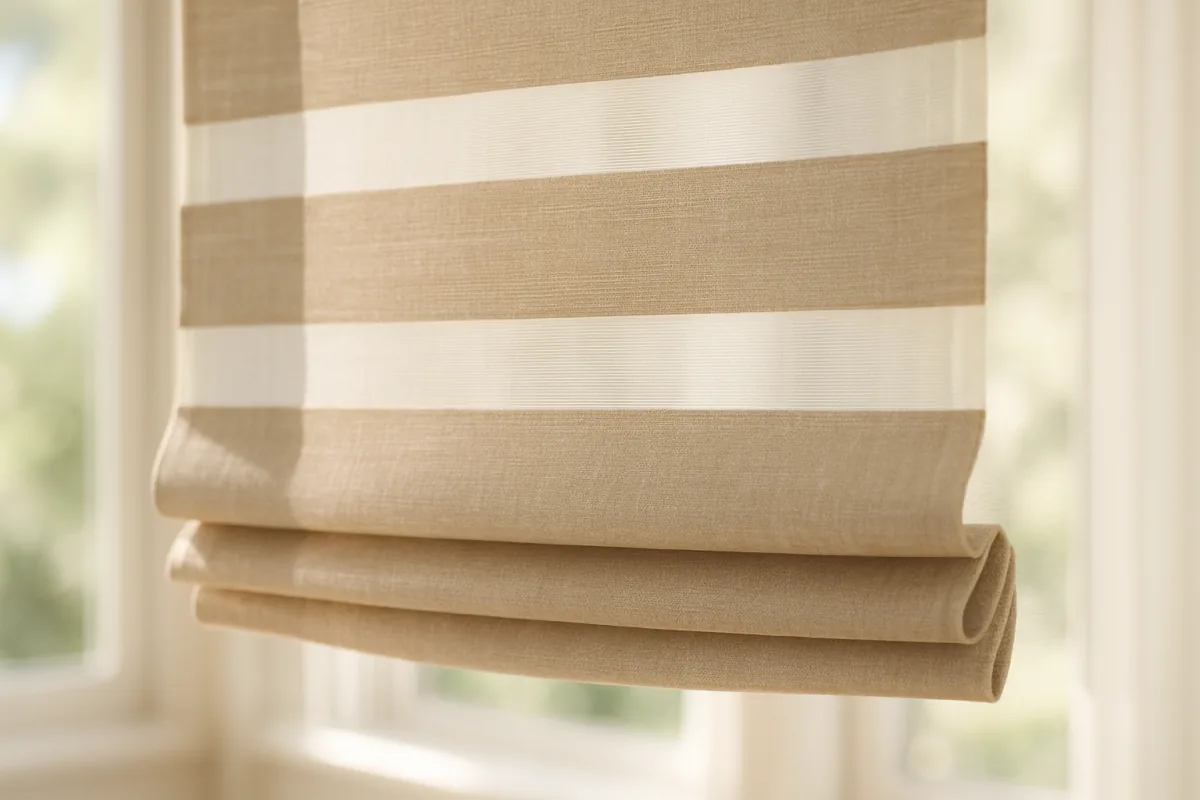
- Zebra blind: a single blind in which opaque and sheer stripes alternate at equal intervals.
A zebra blind differs from two separate blinds in that the light is adjusted not by raising the second layer but by the fabric pattern itself. A lowered zebra shows its stripes: the sheer sections let light through, the opaque ones give shade. For a living room and kitchen that's enough — they need soft diffused light without full darkening. For a bedroom, though, the fabric is weaker: it can't close the window completely.
Two blinds: opaque and sheer
A double Roman blind is two separate blinds, each on its own tape. The lifting mechanism stays Roman: the fabric folds into horizontal pleats rather than rolling up. The top edge of the blind is fixed to the rail, the bottom is held by a weight bar. Each blind runs on its own guides, so the layers don't catch on each other when raised.
Zebra blind: stripes in a single blind
Here the fabric is assembled from alternating opaque and sheer stripes. One blind works as two modes: by shifting the fabric you align the stripes and get either more light or more shade. Visually it's a Roman blind with soft pleats, not rigid slats. In our experience, people choose a zebra where they want the look of fabric rather than a second layer on the rail.
How this differs from a roller zebra
With a roller zebra, the fabric moves along guides and hangs flat and taut. With a Roman one, it folds into fabric pleats and doesn't cover the windowsill completely if mounted inside the opening. These are different products, and in Almaty they're often confused — at the measurement we show both samples side by side so the choice is an informed one.
In Almaty the name “day-night” is used for three different products: two blinds on one rail, two blinds on two paired rails, and a single blind with alternating stripes.
Will a double blind fit your opening, and will it get in the way of the sash
Yes, day-night Roman blinds can be fitted to a plastic window, with one caveat: two layers take up more space than one, so the depth of the reveal and the swing of the sash are checked before the order, not after. In Almaty, day-night Roman blinds are most often ordered for plastic windows in flats — and it almost always comes down to the same question: is there enough room for a double set. The depth of the opening decides whether it fits at all. The window sash limits the choice of mounting and the thickness of the set.
Let me start with the main point. A PVC window is no obstacle in itself — the only question is where the rail will go. Mounting inside the opening requires enough depth of the reveal: a double set is wider than a single one, and if the reveal is shallow, the blinds will press against the glass unit or the side of the reveal. Then the options are mounting on the wall, on the ceiling or on the frame. Frame mounting is chosen when you want to avoid drilling into the reveal — but that's a different assembly, and we discuss it on site.
The sash and the handle are the second tight spot. The blinds hang in front of the window and gather into pleats at the top when raised, rather than moving to the side. If the handle sticks out and the sash opens inwards, the set may catch on it. It can also be the other way round: the mounting turns out such that the handle ends up inside the pleats. We catch this at the measurement rather than guessing from a photo — a picture shows neither the travel of the sash nor how deep the window sits.
What the measurer checks
The measurement reveals the depth of the reveal, the travel of the sash, the position of the handle and the mounting point — four things that decide what the assembly will be. Measurement and consultation are free. The Jalusso measurer arrives with fabric samples and calculates the cost on site, so you see both the figure and what it's based on right away. In terms of time, installing two blinds takes the same work as one product: we mark out, fix the rail, hang the layers, adjust the chains. Manufacturing according to the Roman blinds price list takes 7–10 days.
If there isn't enough depth
Then we have three options: move the mounting to the wall, move it to the ceiling, or give up the double set in favour of a single layer. We go to the wall or ceiling when the reveal doesn't leave room — the rail then sits outside the opening, and the blinds run in front of the reveal. Giving up the second layer is an honest option if the window is narrow or the sash moves right up against it; a second layer in such an opening will get in the way every day.
Two layers take up more space than one, so we check the depth of the window reveal and how the sash opens before you order.
One double rail or two separate rails: which to choose
We mount day-night Roman blinds in Almaty in two ways: on one double rail or on two paired separate rails. For a standard window the first option is enough. For a wide window and panoramic glazing you need two separate rails, and here is why.
A double rail is two tracks on one bar. Compact, one mounting point, both fabrics hang neatly one behind the other. But this system has a width limit: the wider the fabric, the more it sways on the shared bar. And separate control of the layers requires each chain to run freely. A double rail limits the width of the fabric on one system — that is its main limitation.
Two separate rails are mounted in parallel, each with its own mounting. Installation takes more depth, but each fabric lives on its own system. A wide window requires two separate rails, and this is not about convenience but about physics: a heavy dense fabric and a light sheer behave differently on one bar. Two separate rails let you take down only the day layer for washing without touching the dense one. For a kitchen, where the sheer gets dirty faster, this is a decisive argument — Aida always starts the conversation with this at measurements.
| Criterion | Double rail | Two separate rails |
|---|---|---|
| Window type | standard window, opening of standard width | wide window, floor-to-ceiling window, panoramic glazing |
| Mounting point | one bar | two parallel mountings |
| Washing the layers | we take down the whole system | we take down only the day layer |
| Separate controls | both chains on one bar | each layer has its own bar and its own chain |
| Depth required | takes up less | takes up more |
Which layer to place closer to the glass
The order of the layers is a choice made at the measurement, not a hard rule. A sheer layer closer to the glass gives soft diffused light: the sun passes through the sheer and the room stays bright without direct rays. An opaque layer closer to the glass blocks the view better in the evening — from the street you only see a smooth fabric. Jalusso shows both options on samples so you choose by your own window, not by a picture. A double day-night Roman blind on a floor-to-ceiling window is always a compromise between light and privacy, and the order of the layers is what settles it.
What a regular Roman blind gives you
A regular Roman blind has one layer of fabric: it either lets light through or darkens the room, there is no third mode. A double construction works as two modes on one window, and that is exactly what sets it apart from a regular Roman blind. The fabric folds into the same horizontal pleats, the mechanism stays Roman, only the number of layers on the rail changes.
A double rail is more compact and suits a standard window, while two separate rails are needed for wide windows and panoramic glazing.
How to control two fabrics
Separate control of the layers means two chains, one for each fabric: one raises the day layer, the other the night layer. You cannot raise two fabrics with one chain, unless it is a zebra fabric with alternating stripes: there the mechanism is single. So on a double construction you decide yourself what to leave at the bottom — a sheer for soft light or a dense fabric that blocks the view from the street. The chain-and-rotor mechanism is the same on both fabrics, the only difference is which side the cord is brought out on.
Separate control gives you independent adjustment of light and view. What does that mean in practice? During the day you lower only the sheer, while the dense fabric is gathered in pleats at the top and does not intrude into the room. In the evening you raise the sheer and lower the dense layer — and you cannot be seen from the street even with the lights on. The two chains do not get in each other's way if they are routed correctly.
Control options we offer:
- Manual, with two chains — the basic option, coefficient 1.
- Manual, chain on one side — both cords brought to one point, handy when you approach the window from one side.
- Manual, chains on different sides of the rail — each chain closer to its own sash or to your hand.
- Electric motor — raise with a button or remote control, coefficient 1.85; motor with remote — 2.1.
Replacing one layer is a routine operation, not a remake of the whole blind: the day layer is taken off the tape separately from the night one, and we can replace only it, for example swap the sheer for another fabric. The dense fabric stays in place.
Where to bring the chains out
Both chains can be brought to one side or split to the sides of the rail — whichever is more convenient for opening the window and approaching the blind. If the sash opens to the right, it makes sense to bring both chains out to the left so the cords do not get in the way of the sash and handle. On a wide window or corner glazing the chains are split to the sides: it is easier to reach each cord from its own side than to reach across the whole window. We record this in the order so the workshop assembles the mechanism for your option right away.
Electric motor
We mount a day-night fabric on a motorised rail: raising is done with a remote control or a button. Electric motors are used on tall windows, double-height spaces and where a cord is undesirable — for example, in a child's room. You can put a motor only on the dense layer and leave the sheer on a chain: then in the evening you close the window with one button, and during the day you adjust the light by hand. We do not promise motor models and control of each layer with a separate motor at the measurement — first we look at the window and the scenario, then we name the option.
Each fabric is raised by its own chain, so light and view are adjusted independently.
How much a day-night Roman blind costs and how the price is calculated
The price of a day-night Roman blind is calculated from the base rate for Roman blinds — from 8,100 ₸/m². A double construction goes at the same base as a regular one: an extra charge applies only to the control method and the mounting. We do not add window height as a separate line — it is included in the area of the fabric, which is cut to individual sizes.
Simply put, you can buy a day-night Roman blind at the rate of an ordinary Roman blind, and the price difference comes from two coefficients. The first is the control coefficient: manual control comes with no surcharge, a chain adds 1.06, an electric motor 1.85, a motor with remote control 2.1. The second is the mounting coefficient: wall mounting with no surcharge, on the frame 1.05, no drilling 1.1, cassette system 1.28. That’s the whole arithmetic.
How the double construction is priced
The base rate is the price of a Roman blind made of fabric on a frame. A double blind is priced on the same base, even though it has two panels. The control coefficient is multiplied by the base rate; the mounting coefficient too. We don't present the product of the coefficients as the final price: the exact amount is quoted by the measurer on site, once they see the window and the chosen fabric.
Why is it done this way and not “price for two pieces”? Because the area is calculated by the opening, not by the number of panels, and a pair of sheer plus heavy fabric is cut from the same window footage. For panoramic glazing, multiplying coefficients by hand makes no sense at all — it has its own area and its own layout.
Manufacturing to individual sizes takes 7–10 days according to the Roman blinds price list. We count the lead time from the moment the fabric, control and mounting are agreed.
| What we choose | Coefficient | What it gives you on the window |
|---|---|---|
| Mechanical control | no surcharge | Manual lift, cord or tape |
| Chain control | 1.06 | Chain on the side, smoother movement |
| Electric motor | 1.85 | Push-button lift, for tall windows |
| Electric with remote control | 2.1 | Remote control, for double-height spaces |
| Mounting on the frame | 1.05 | Mounting on the sash, without drilling the wall |
| No-drill mounting | 1.1 | Installation without holes |
| Cassette system | 1.28 | Closed housing, the panel goes into the cassette |
We apply only one control coefficient and one mounting coefficient to the base rate.
Installation and site visit
Installation costs 4,500 ₸ per item. For orders from 150,000 ₸, installation is free. Measurement with fabric samples and consultation are always free: the measurer brings samples and calculates the cost on site. Within the city, measurement and delivery are also free; to the suburbs — Kaskelen, Talgar, Issyk, Kapshagay — we do travel, and we quote the travel cost before the visit, not after.
Let's estimate a typical situation: a kitchen window with a vent pane, a day layer of sheer and a night layer of heavy fabric, chain control, wall mounting. The base rate is multiplied by the chain coefficient 1.06, mounting comes without a surcharge, plus installation on top — 4,500 ₸ per item. The measurer will confirm the final figure based on the actual area of the opening.
The base rate for Roman blinds is from 8,100 ₸/m², and control and mounting are calculated as coefficients to it.
How to choose a pair of fabrics: day and night layer
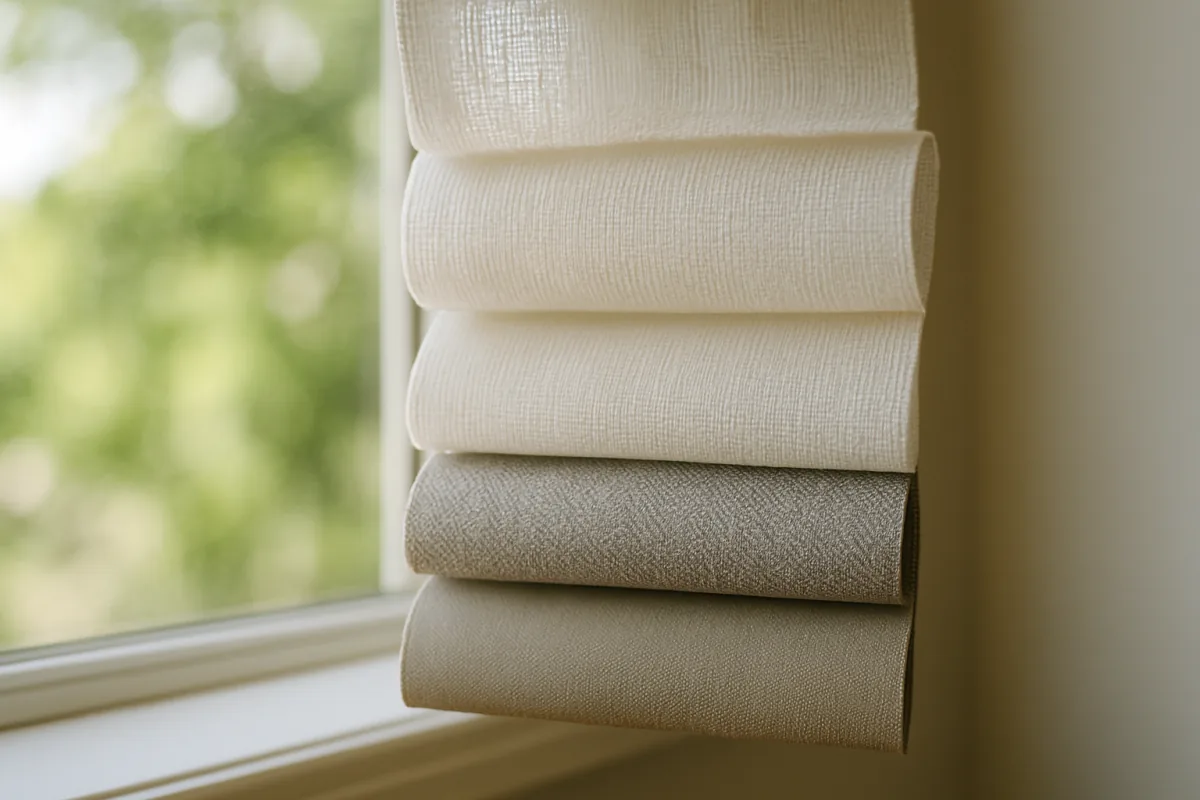
A pair of fabrics for day-night Roman blinds is put together based on what is visible from the street in the evening, when the light is on in the room. The day layer is made of sheer, organza or mesh; the night layer is made of heavy curtain fabric. The sheer layer lets through diffused light and during the day looks like an ordinary Roman blind with soft folds. The heavy layer blocks the view from the street in the evening. Hence the selection rule: first we decide what should be visible from outside in the dark, then we choose the fabric.
For the day layer, the main characteristic is the light transmission of the fabric, not the pattern. The thinner the thread and the looser the weave, the softer the light on the walls and the less the room is visible from the street during the day. Sheer, organza and mesh behave differently: mesh holds the fold shape more firmly and creases less, sheer drapes more softly and gives a warmer shade. Linen is also used for the day layer — it is denser than sheer, holds a fold and doesn't look like a kitchen curtain. But linen barely diffuses light: during the day the room will be darker than with sheer. That's why we use it less often on the south side.
What matters in our practice is the customer's fabric. Sometimes a person brings their own cut and asks us to sew the day layer from it. We look at the density and how the fabric behaves in a fold: not every material holds its shape on a Roman mechanism. If the cut isn't suitable, we say so honestly at the measurement, not in the workshop.
The night layer is blackout, dimout, jacquard or curtain fabric. The difference between them is not in colour, but in how much light they let through and how quickly they fade. Blackout has minimal light transmission, dimout lets some light through, jacquard and heavy curtain fabric sit in the middle.
What is visible from the street in the evening
With the light on in the room, the sheer layer shows through. This is physics, not a fabric defect. If the window is on the ground floor or faces a neighbouring building, in the evening the heavy panel is lowered and the sheer is left raised. During the day it's the opposite: the heavy layer is gathered in folds at the top, and only the sheer one works. At the measurement we show both positions on samples, so the person sees the difference with the light off and on.
Sunny side and the climate of Almaty
Summer in Almaty is hot and dusty, winter is cold, with frosts and a temperature swing between day and night. On the south side we choose heavy fabric with fading in mind: the sun speeds up discolouration, especially on saturated colours. Natural fading of fabric is not covered by the warranty — the warranty covers the mechanism and installation, so the colour on the sunny side is chosen consciously, more often in favour of light and medium tones. On windows that are opened for ventilation, we add a weight in the bottom pocket: it keeps the panel straight in a draught.
A pair of fabrics is chosen by the evening view from the street and by the side of the light, not by the whole catalogue.
Care for a two-layer blind
A day-night Roman blind is serviced layer by layer, not as a whole: the day layer is taken down for washing separately from the opaque one, and the latter stays hanging on the window. That’s easier both for the fabric and for timing — the sheer dries quickly, while the night fabric keeps covering the room. There is a second option too: the mounting unit lets you remove one band and replace it without taking the whole structure apart, if you decide to change the fabric or colour.
How to wash
The fabric is taken off the rail and washed according to the fabric manufacturer's label: by hand or on a delicate cycle without spinning, and dried flat away from the sun. It's better to iron the strips through gauze or from the wrong side at a low temperature — otherwise the sheer areas will get creases that won't iron out. We don't remove the frame rods when washing — they hold the shape of the folds. The kitchen is a separate conversation: steam and grease settle on the sheer there, so the day layer is washed more often than the heavy panel, and in a pair that doesn't create problems — you wash one tape and hang it back. Will sheer shrink? It depends on the fabric, not the construction: shrinkage comes from the material itself, and at the measurement Aida will tell you what to expect from a specific sample. Here's something else to keep in mind: heavy fabric on a wide panel loads the frame more than a thin one, and if you feel the folds have sagged, that's a reason to call us for a tightening, not to turn the mechanism yourself.
What about the warranty
We give 3 years of warranty on the mechanism and 1 year on installation, counted from the day the acceptance certificate is signed. Day-night Roman blinds recognised as a warranty case are repaired free of charge, and this takes at most 5 working days. At the same time, the warranty covers the mechanism and installation, but not fabric fading: natural loss of colour in the sun is not a defect. Even after the warranty expires, a technician will come: to tighten the construction, adjust it and replace a failed cord or chain. In my view, it's exactly this habit of returning to the product years later that distinguishes a manufacturer from a reseller.
Replacing one layer is a standard operation for a double construction: you change the sheer or the heavy panel separately, without ordering the whole item.
Kitchen, balcony, bedroom, kids' room, panoramic glazing: scenarios by room
The choice between a zebra panel and two separate layers is decided not by interior style, but by the room. For the kitchen, fabric that's easy to wipe clean of steam and grease is chosen; for a kids' room, a version without a hanging cord; for panoramic glazing, two separate rails. Below is what we suggest at the measurement for each type of room.
Kitchen and balcony
The kitchen needs a fabric that is easy to wipe: steam and grease settle on the fabric, and the sheer layer here is washed more often than the thick one. We choose the mounting so that the blind does not get in the way of opening the sash — most often this is mounting into the opening or onto the frame. For a balcony or loggia we install the fabric and mechanism with temperature swings in mind: if the balcony is cold, winter frost and summer heat affect the frame and the tape.
One practical note: in a kitchen with three sashes, the day layer is taken down for washing separately from the thick one, and the window stays covered while the sheer layer dries.
Bedroom, ground floor, kids’ room
In a ground-floor bedroom, the thick fabric is lowered in the evening while the sheer layer stays up — so the room is bright during the day, and once it gets dark the room cannot be seen from the street. The sheer layer is see-through when the light is on; that is a normal property of the fabric, not a defect.
For a kids’ room, instead of a hanging cord we offer an electric motor: raising is done with a remote control or a button, and the child does not pull on a chain. Electric motors are used on tall windows and where a cord is undesirable — a kids’ room is exactly such a case. If you need full blackout, let us be honest: a Roman blackout blind plus a separate sheer curtain is a different construction, and we make that too. A double Roman day-night blind gives controllable light and privacy, but does not create absolute darkness.
Studio apartment and panoramic glazing in an office
In a studio apartment with a corner window and in an office with panoramic glazing, we install two separate rails: on a wide window and on a floor-to-ceiling window, a single double rail does not cope. Two separate rails make it possible to take down only the day layer for washing and allow the chains to be brought out to a convenient side. For a meeting room with two sashes we did this: during the day the sheer layer is down, and for presentations the thick fabric is added.
A day-night Roman blind for the kitchen, balcony, bedroom or kids’ room is worth ordering only by measurement: one room needs a washable fabric, another a motor instead of a cord, a third two rails.
How we work: measurement, workshop, installation
You can order day-night Roman blinds in Almaty without driving round showrooms: the customer messages us on WhatsApp, then a measurer comes to the site, and the product goes to our workshop. We are a manufacturer with our own workshop in Almaty, and we don’t keep ready-made products in stock — every blind is made to measure, for a specific opening and a specific sash.
Consultation and measurement cost nothing, and within Almaty the measurer’s visit together with delivery is also free.
Order steps
- The client writes on WhatsApp and briefly describes the window: how many sashes, how they open, what gets in the way — a handle, a windowsill, a window reveal.
- The measurer arrives with fabric samples, checks the depth of the window reveal and the movement of the sash, and calculates the cost on the spot. Measurement and consultation are free, so you can make your decision right in the kitchen with the samples laid out on the windowsill.
- The workshop makes the fabrics to individual sizes and assembles the frame.
- Installation: mounting into the opening, onto the wall, onto the ceiling or onto the frame — we choose the option at the measurement, based on how the sash opens and where it is more convenient to reach the blind.
Installation costs 4,500 ₸ per product. For orders from 150,000 ₸ we do the installation free of charge. Warranty on the mechanism — 3 years, on installation — 1 year from the date the acceptance report is signed; we fix warranty cases free of charge within 5 working days. And once the warranty period is over, we will still come: tighten the mechanism, adjust the movement of the fabric, fit a new cord or chain. That, in my view, matters more than any advertising promise — a blind lives with you for years, not until the first breakdown.
Timelines and coverage
Manufacturing Roman blinds takes 7–10 days according to the price list. We count the timeline from the measurement, not from the messages: until the depth of the window reveal and the movement of the sash have been checked, there is no point in naming a date.
We work across Almaty. To the suburbs — Kaskelen, Talgar, Issyk, Kapshagay — we do travel, and we quote the visit cost before the visit so that it does not come up as a surprise on the day of the measurement — the distance to each town is different, hence the difference.
We make day-night Roman blinds with the same hand from the first sample to the last screw: the measurer, the workshop and the installation foreman work in one company, so dimensions aren’t passed on by phone between contractors.
FAQ
Are double Roman blinds and day-night blinds the same thing?
A double Roman blind is two fabrics, opaque and sheer, each on its own band. A zebra fabric is a single fabric made of alternating opaque and sheer stripes. Both are sold under the common name “day-night”, though the designs are different. The difference between a zebra fabric and two separate fabrics is clear from the samples: a zebra has one lift, while on a double day-night blind each part moves on its own.
How do you control two fabrics?
Separate control of the layers gives independent adjustment of light and view: two chains, one for each fabric. With one you raise the sheer layer, with the other the thick one. You can leave only the sheer layer or close both. Less often people choose a single mechanism for two tapes — then the layers move together, and some of the possibilities are lost. Where to bring the chains out, to one side or to different sides, we fix in the order.
Can I replace just one layer later?
Yes, if it is a double Roman blind on two separate rails: the day layer is taken down and replaced separately, while the night fabric stays on the window. With a zebra fabric that will not work — there is a single fabric there. Moreover, you can replace not only the sheer layer but also the thick one, if the interior has changed or you want a different density. We cut the new layer to the dimensions of your frame, and we do not drill anything again.
Can an electric motor be installed on the thick layer only?
Yes, we install a day-night fabric on a motorised rail, and we discuss the motor at the measurement. Electric motors are chosen for tall windows, double-height spaces and for a kids’ room, where a hanging cord is undesirable. The coefficient of the electric motor to the base rate is 1.85, with a remote control — 2.1; the base rate for Roman blinds does not change. We do not promise motor models or control of each layer with a separate motor on this page.
What if the depth of the opening is not enough?
Then we move the mounting onto the wall or onto the ceiling, rather than into the opening. Another option is to leave one layer instead of a double set. We decide this at the measurement, on site, not from a photo: the depth of the window reveal and the movement of the sash can only be seen in person. You do not have to pay for either the consultation or the measurement: a specialist will come with fabric samples and calculate the price right at your place.
The five questions most often asked at the measurement come down to the choice between a zebra fabric and two separate layers, to the control scheme and to the mounting.
Conclusion
Under the name “day-night” in Almaty, three different products are sold: two fabrics on one double rail, two fabrics on two paired rails, and a zebra fabric with alternating stripes. This is the first thing worth finding out before ordering — otherwise it is easy to get something other than what you imagined from a photo.
A double construction takes up more space than a single layer. That is why the depth of the window reveal and the movement of the sash are checked before the order, not after. If the depth is not enough, we move the mounting onto the wall or onto the ceiling.
For an ordinary window, a double rail is enough: it is more compact and hidden under the folds. For a wide floor-to-ceiling window and panoramic glazing, two separate rails are needed — such fabrics cannot be hung on a single system. Two separate rails also have an everyday advantage: the day layer is taken down for washing separately, while the thick fabric stays on the window.
Each fabric panel is raised by its own chain. Separate control of the layers gives you what these blinds are bought for: light and view are adjusted independently, not switched with a single lever. An electric motor on a motorised rail solves the problem of a hanging cord where it gets in the way — in a child's room or on a high window.
Here's how it breaks down in terms of money and time. The base rate for Roman blinds is from 8,100 ₸/m², controls and mounting are calculated as coefficients to it, and manufacturing takes 7–10 days. A double blind is calculated at the same base rate. Installation is 4,500 ₸ per item, and for orders from 150,000 ₸ we do it free of charge.
The practical recommendation is simple: start with a free measurement. Our measurer will bring samples, check the opening and the sash, and give you the exact price on the spot — without this, no figure in this article will turn into the price for your window.
We are a manufacturer with our own workshop in Almaty, and we don't keep ready-made items in stock: every blind is made to your measurements.

