












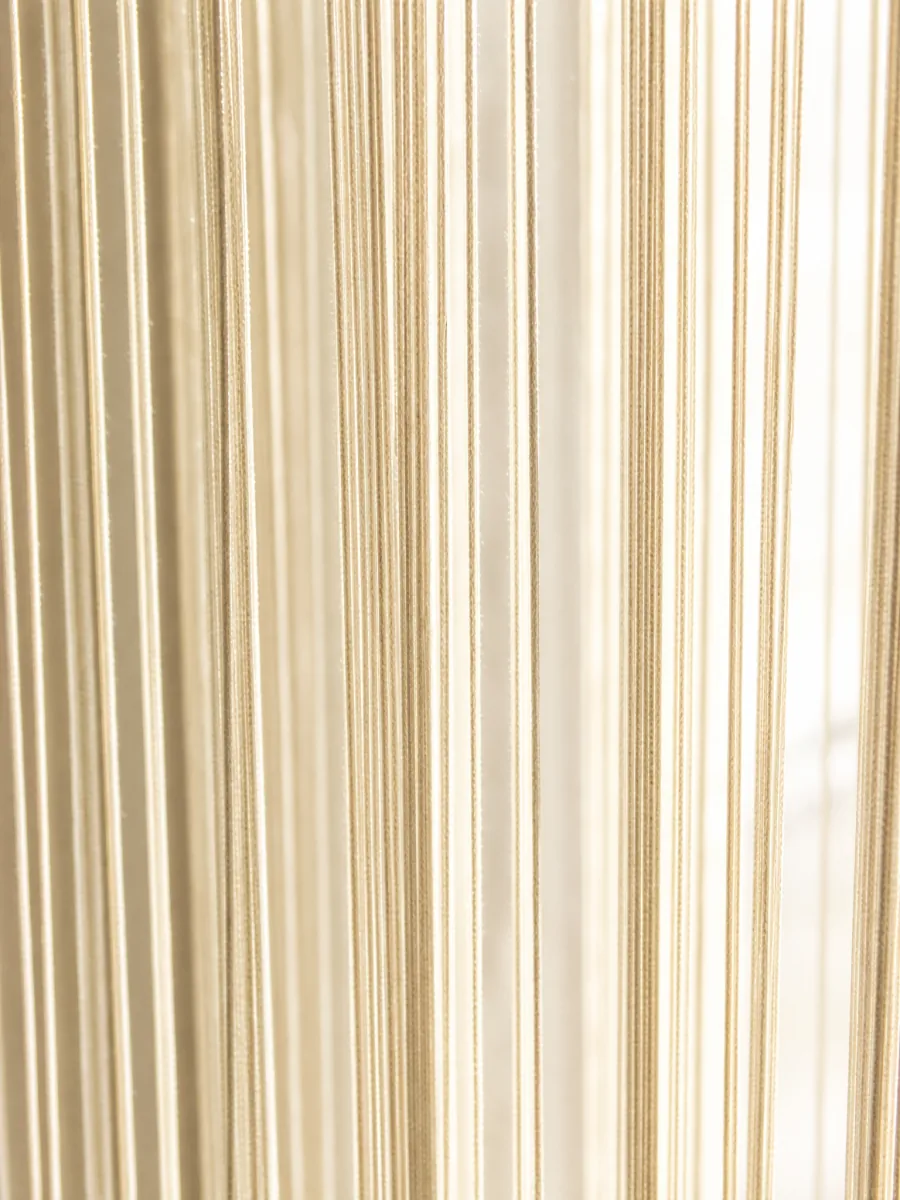


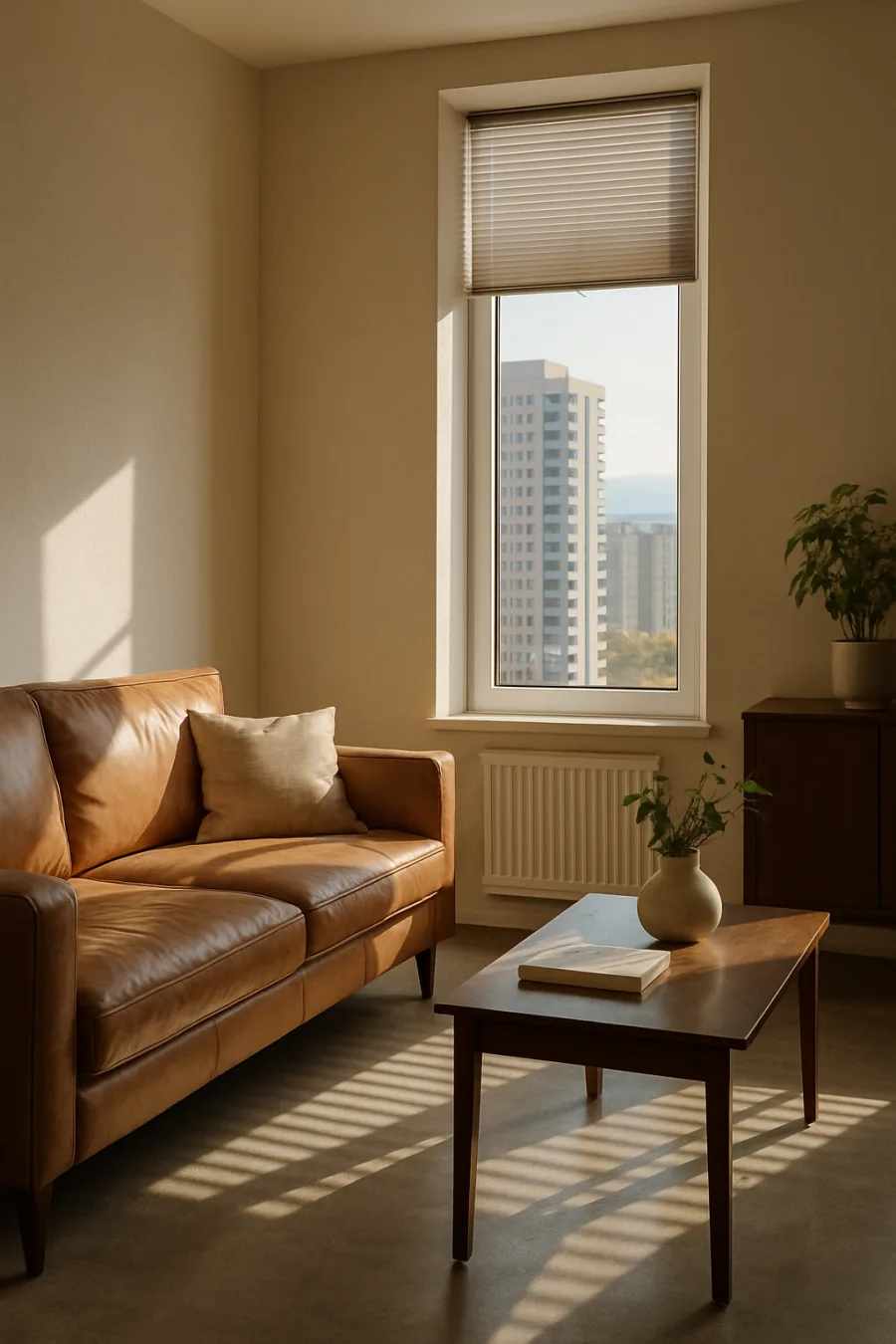











Pleated blinds in Almaty are an accordion-style fabric between two rails that mounts directly on the sash and is cut to a template made during measurement. A free-hanging system suits a straight window, while a tensioned system with guide rails suits sloped, attic and shaped windows. Prices start from 9,800 ₸/m², lead times from 7 to 16 days depending on the window shape.
What pleated blinds are and how they differ from roller blinds
Pleated blinds are an accordion-style fabric held between two moving rails. The pleat is set by heat: 20 or 25 mm, with the stack from 40 mm. That's why pleated blinds aren't confused with roller blinds — there the fabric winds onto a tube. In shops, pleated blinds are sometimes called pleated roller blinds or “pleated roll blinds”, but this system has no tube.
The difference shows in how they move. With a roller blind, only the bottom rail moves, while with pleated blinds both rails move: you can cover the bottom with the accordion and leave the top open, or the other way round. We often show this on a sample — people nod, and then at the measurement they still ask for “the usual kind”. And later they're glad they didn't go with the usual kind.
The folded accordion takes up 3–5 cm. How compact the folded fabric is matters more than it seems: on a narrow sash, ordinary pleated curtains would eat up half the glass.
Where the accordion came from
Pleated blinds came from Europe as a solution for roof windows, where roller blinds and horizontal blinds don't hold at an angle. Over time the system moved beyond attics and became a type of sun protection in its own right — now it's chosen for straight windows in apartments too.
What pleated blinds are not
They're not roller blinds: there the fabric winds onto a tube. And they're not horizontal blinds: their slats hang on cords and turn around an axis. Pleated blinds are a separate design with two rails and a pleat between them.
With a roller blind, only the bottom rail moves, while with pleated blinds both rails move — that's the main difference between the two systems.
Free-hanging or tensioned: which system suits your window
The system is chosen based on the geometry of the window. A free-hanging system suits a straight opening, while a tensioned system with guide rails suits sloped, attic and shaped windows, because its fabric is pressed against the glass and doesn't sag at an angle.
The difference isn't in the fabric or the price of the material. The difference is in what holds the accordion: in a free-hanging system only the cords hold it, in a tensioned system the guide rails at the sides do. A straight window works for years without complaints in the first case. A sloped one doesn't: gravity pulls the fabric down, the edge pulls away, and the gap at the sides grows every day. That's why pleated blinds for roof windows are made in the tensioned version.
When people ask for vertical pleated blinds, they usually mean the familiar accordion that moves from top to bottom and bottom to top. Vertical pleated blinds in the sense of side movement, like vertical blinds, are a different design, and whether it suits your window is something we decide at the measurement.
| Parameter | Free-hanging | Tensioned with guide rails |
|---|---|---|
| Where it is used | straight window, small sash | slope, bevel, attic, tall opening |
| What holds the fabric | cords | guide rails or cables |
| Contact with the glass | hangs at a distance | pressed tight against it |
| Sagging at an angle | possible | ruled out |
| Light gaps at the edges | remain | almost none |
Free-hanging: when it is enough
A straight window and a moderate sash — that is the case where a free-hanging system makes sense. The fabric hangs on cords without side guide rails, moves smoothly and takes up minimal space. Installation is simpler, the price is lower. A small pleated blind on a kitchen window with a vent or on a standard sash in the bedroom — here a free-hanging system is more than enough. But the taller the sash and the more noticeable the slope, the less sense it makes to save on the construction: under its own weight the fabric drifts towards or away from the glass.
Tensioned: where you cannot do without it
A sloped window requires profiles fixed along the bevel — there is no other way. A tensioned system guides the fabric along guide rails or cables and presses it against the glass along its entire length. On a roof window this is the only way to get a flat plane: the fabric moves along the guide rails, does not tilt anywhere and does not flap when the sash is opened. We install pleated blinds on roof windows exactly this way. The same principle works on tall openings two storeys high — there a large fabric on cords alone behaves unstably.
Why not use horizontal blinds in an attic? Slats on cords on a sloped window pull away from the glass and swing with every movement of the sash. A roller blind behaves the same way: the heavy roller skews, and the edge of the fabric pulls away from the frame. A pleated blind in a tensioned profile is free of this drawback — it travels along a rigid track instead of hanging freely. If the window is sloped, there is no longer a choice between systems: a tensioned one is the only option.
On a sloped window the fabric of a tensioned system is pressed against the glass by guide rails or cords and does not sag, whereas a roller blind and horizontal blinds pull away from the glass and swing when the sash is opened.
Mounting without drilling: how pleated blinds fit onto a plastic sash
Yes, pleated blinds on plastic windows can be installed without drilling. Jalusso mounts the system on clips that are inserted into the glazing bead of the frame — the frame stays intact, and the product itself hangs on the sash. This installation also solves the second issue: the sash opens together with the system.
Clips are not a “crutch” instead of proper fasteners. When mounting on the sash we do not touch a single seam of the frame. For a plastic window this is fundamental: any hole in the profile is a point by which the window manufacturer can void their warranty. That is exactly why we work without drilling, and the window manufacturer’s warranty remains fully intact.
The process looks like this:
- the measurer takes the dimensions of the sash and checks how the glazing bead is constructed;
- based on these dimensions the workshop prepares the fabric and profiles;
- during installation the clips snap into the glazing bead and the system takes its place;
- at the end we check the movement of the fabric and the operation of the hardware.
What happens to the sash when it is opened
The tilt-and-turn hardware continues to work as usual. The system is fixed to the sash and turns together with it — this is built into the construction itself, not solved afterwards. In the tilt position the pleated blind does not get in the way either: the fabric moves together with the sash, does not catch on anything and does not block the handle.
There is one nuance worth mentioning in advance. On a narrow sash with a wide windowsill the fabric may catch on the edge when opened. This is visible already during the measurement — that is where we decide whether an offset or a different mounting point is needed.
Wood and aluminium
On wooden and aluminium frames the mounting is selected individually during the measurement. There brackets with screws are more often needed: the geometry of the frame is different, and the clips simply will not fit into the glazing bead the way they do on plastic. Sometimes it is possible to avoid holes — it depends on the profile and on how the glazing bead is constructed. This is decided on site, based on an inspection of the window, not from a photograph.
The bottom line is simple: on plastic windows pleated blinds fit onto clips in the glazing bead, the frame stays intact, and the system opens together with the sash.
Arch, triangle and bevel: cutting to a template taken during measurement
An arched window, a triangular window and an opening with a bevel can only be covered with a product cut to a template taken during the measurement. Catalogue sizes do not work for an arch, a trapezoid or a triangle: the geometry of each opening is unique, and the fabric must repeat it to the millimetre — otherwise a light gap will run along the edge and all the work is wasted.
Here is how it looks in practice. The measurer arrives with fabric samples and template material. He takes the contour of the opening, transfers it to a template, and already in the workshop cuts the pleated fabric along this contour. The fabric for an arch is cut along the radius, for a triangle — along three sides with different angles, for a trapezoid — along four. A straight window is not prepared this way: there width and height are enough. Moreover, the more complex the shape, the more noticeable the difference between a product cut to a template and an attempt to fit a standard fabric.
What shapes we cover:
- arched window — the top part follows a curve, the moving section is below the bend line;
- triangular window — custom fabric geometry for each of the three corners;
- trapezoid — four sides, two of them slanted;
- half-arch — a straight bottom edge and an arc on top;
- circle — a rare option, the fabric is cut along a closed contour;
- slope — an angled plane, most often on a attic or corner window.
As for timelines, here is a rough guide: arched and triangular — 12–16 days, slanted — 10–14. We cover a straight window faster, but that does not apply to shaped openings.
What “part of the fabric is fixed” means
On arched and round windows, only part of the pleated fabric moves — the part below the bend line. The upper section is fixed to the shape of the opening and does not move. This is not a defect or a faulty installation, but the design: an arc does not fold into pleats the same way a flat plane does, so it is left static and all control is moved to the working part. For a bedroom or study this is a normal scenario — light is adjusted in the area where it is actually needed.
Glass door and partition
Pleated blinds are mounted not only on a frame, but also on a glass door or partition — the mounting is chosen during the measurement. Here it is important to understand what you can attach to at all: sometimes it is a profile along the edge of the glass, sometimes the door frame, sometimes both. On a partition in a conservatory or a meeting room, we usually run the fabric along guide rails so that the pleats stay flat across the full height. And one more point: we do not drill into the glass — the mounting points are chosen so as not to touch the fabric.
Fabric for an arch, triangle and slope is cut to a template taken during the measurement — such products are not ordered by catalogue sizes.
Fabrics and dimming: standard, sun protection, blackout, day-night
The density of the fabric determines how much light stays in the room. Standard fabric diffuses the flow, sun protection blocks part of the heat, blackout takes the room almost into night darkness. The choice depends not on the beauty of the shade, but on what should happen with the window during the day and in the evening.
Pleated polyester is the base material for all types of fabric. The pleat is held in it by heat-setting, not by a separate coating layer, so the pleats do not spread apart across the full height of the opening. Beyond that, the differences start in the layers and coatings.
| Fabric type | What it gives |
|---|---|
| Standard fabric | Diffuses light, soft half-shade |
| Sun protection | Blocks part of the heat and bright light |
| Blackout pleated blinds | Dense multi-layer pleats with an opaque layer |
| Day-night (double pleated) | Transparent and dense pleats on one rail |
Blackout pleated blinds are a multi-layer pleat with an opaque layer. With side guide rails they give darkness across the whole window area, not just in the centre. Up to 99 percent dimming — that is the figure we quote during the measurement when it comes to a bedroom or a mansard. Without guide rails, light strips remain at the edges, and then there is no question of full darkness.
Double pleated blinds, or day-night, are designed differently. Two pleats hang on one rail — a transparent one and a dense one. They move independently: you can close the bottom with the dense one while leaving the top transparent, or the other way round. For a kitchen and study this is more convenient than a single dense pleat across the full height. If you need to close the lower part of the room from prying eyes while leaving the top light — day-night solves this without a second system.
Perforated fabric is a rare option for pleated blinds, but it does occur. Small holes let some light through even when the fabric is closed, but they remove the feeling of a blank wall on the window. On the south side, perforated blinds are chosen less often: there it is more important to reflect heat than to add light. If you want to buy perforated blinds specifically in a pleated version, ask for samples during the measurement: against the light you can immediately see how much light passes through the holes.
Window orientation and heat
On the south and west, as well as under a mansard roof, fabric with a coating is chosen. The reverse side with a metallised layer reflects part of the solar heat outwards, while the inside of the fabric is matte. Fabric with a pearlescent coating reflects up to 80 percent of heat, so it is installed on the south side. In a mansard in summer the difference is noticeable: without the coating it is stuffy under the roof by evening, with it the heat comes later and more gently.
Day-night in practice
Two pleats on one rail — a transparent one and a dense one — move independently. Close the bottom, open the top: this is exactly how the system behaves in a child's room, where light is needed during the day and privacy in the evening. In terms of dimming, in a tension system the fabric runs along guide rails right up against the glass, there are almost no light gaps at the edges, so pleated blinds win over a roller blind on an open roller tube. With a roller blind, the roller tube does not press the fabric against the frame, and there is always a gap at the sides.
The pleat, heat-setting and care without washing
Two things hold the shape of the pleat: heat-setting of the polyester and the fabric coating. Heat-setting keeps the geometry of the pleats, the coating protects the fibre from moisture and dust. Remove at least one — and the pleat starts to sag. Pleated blinds made of fabric on cheap material without coating lose their shape faster than fabric pleated blinds with factory treatment.
The pleat can be 20 or 25 mm. A small pleat looks neater on a small window, a large one gives a sparser and calmer pattern on a wide opening. The stack when gathered starts from 40 mm. What should you look at when choosing pleated blinds? The density and evenness of the pleat across the full height of the fabric — that is the test.
How to check the pleat before ordering
The measurer comes with samples, and they show everything you need. Run your finger along the pleats: on quality fabric the ribs are even, of the same height, springy and return to their original position. On cheap fabric the pleat is creased in places, the spacing varies, the edge falls to one side. Another sign is the thickness and resilience of the fabric itself: a thin one crumples under your fingers and does not straighten out.
Care step by step
Washing and soaking are out of the question. This is the main rule, and it is not about caution but about the design: the coating goes and the shape of the pleat goes with it, and you will not be able to restore it at home.
- Remove dust with a dry brush or a vacuum cleaner on minimum power, with a soft attachment along the direction of the pleats.
- Blot a stain with a damp sponge, without rubbing and without cleaning agents.
- Let the fabric dry in a straightened form, do not gather the pleats while wet.
- Do not iron or steam: heat will destroy the heat-set finish.
A separate word about fading. It cannot be treated or restored, so for south- and west-facing windows we immediately suggest fabric with a coating — it takes the bulk of the ultraviolet on itself. If the window faces the sunny side all year round, it is not worth saving on the coating: redoing it will cost more than the difference in fabric.
Pleated blinds must not be washed or soaked: with the coating the shape of the fold is lost; on fabric with a factory coating the pleats keep their geometry for years, while on cheap fabric without a coating the fold sags.
Control: handle, cord, chain, electric motor
On a high or roof window that you cannot reach by hand, the answer is an electric motor with a remote control. Manual control at that height turns into a daily workout with a stepladder — and sooner or later the blind stops being lowered at all. On a sloped window under the ceiling this is especially noticeable: the sash is far away, and you have to reach for it over furniture or a windowsill.
The control options for pleated blinds look like this:
- Handle slider — the simplest option: you move the bottom rail with your hand and the fabric folds behind it. No cords or hanging elements, it looks neat in a child’s room.
- Cord — side control, the fabric runs along the cords. Suitable for an ordinary window where the top point is reachable from the floor.
- Control chain — a mechanical option with a price multiplier, convenient on a sash with a free-hanging system.
- Electric motor — a button on the wall or on the housing, no need to reach by hand.
- Electric motor with remote control — the same, but controlled from the sofa: suitable for panoramic glazing and tall openings.
The price multipliers for control are simple: mechanical comes with a base multiplier, the chain adds a little to it, the electric motor almost doubles the cost of the product, and with a remote control — a little more than that. The price difference between a slider and a motor looks impressive, but in an attic we do not advise saving: a system you cannot reach simply does not work.
Manual control vs motor
Manual control — handle slider, cord, chain. A motor is chosen where you cannot reach by hand: a high window, a roof window, a double-height space, panoramic glazing in an office. On an ordinary sash in an apartment, manual control is enough, and Jalusso will not push a motor on you.
An electric motor handles a high or roof window completely: one press — the blind moves, a second — it stops at the right point. Where there are many sections, as in a conservatory, a motor saves you from walking the perimeter with your hand held up.
Non-standard places: attic, bay window, balcony, glass door
An attic, a bay window, a balcony and a glass door — four places where pleated blinds cover the opening better than a roller blind. The reason is the same: the pleats are held in guide rails or on cords and do not move away from the glass, no matter how the plane of the window is turned.
A bay window requires a solution for each side separately. You cannot cover it with one blind — the sides stand at an angle to each other, and a single blind will sag at the joints. We count each side as a separate opening: its own geometry, its own height, its own mounting method. Three sides — three products, and they open independently. On a bay window, pleated blinds with guide rails are often chosen: the fabric runs along the profile right up against the glass, so neighbouring sides do not catch each other when raised.
On a balcony and a balcony door, pleated blinds run on cords and guide rails. A balcony door is a tall sash that opens every day, so we mount the system on the sash itself, not on the wall: then the pleated blinds on the door move together with the door leaf and do not get in the way. The same principle works on panoramic glazing and in a conservatory — there are many sections, and each is covered separately.
Pleated blinds on glass are not only mounted on the frame. A glass door and a partition are a common place for pleated blinds: we choose the mounting at the measurement, because glass is not drilled, and the type of bracket depends on whether there is a frame or a glazing bead along the edge. We covered a conservatory of nine sections in 16 days — that is the upper limit of our lead times, because each section is cut separately.
Pleated blinds fit interiors more widely than it seems. More than 150 shades, a fold of 20 and 25 mm, a stack from 40 mm — the pleats read as a detail of the interior, not as technical sun protection. For a child’s room, blackout is chosen: fabric with guide rails gives shading over the whole area, and the child sleeps in the dark during the day. On a roof window, pleated blinds with a coating are more often installed — the reverse side with a metallic layer reflects part of the solar heat outwards.
Case: attic of a country house
Four sloped windows, lead time 12 days. A tensioned system with guide rails: at an angle the fabric is pressed against the glass and does not sag when the sash is opened. For attics we usually suggest fabric with a coating: the reverse side reflects part of the solar heat outwards, and it is chosen for that, not for the colour.
Case: a bay window of three sides
Three separate blinds, lead time 12 days. Each side has its own geometry and its own mounting. All three blinds were made in one colour and with one fold, so that the bay window reads as a single line, not as three different windows.
A bay window requires a solution for each side separately, while on a balcony and a balcony door pleated blinds run on cords and guide rails — that is the answer to whether the system suits a non-standard place.
Peel-and-stick pleated blinds from a marketplace vs a made-to-measure product
A ready-made peel-and-stick product is designed for a standard rectangular opening. Peel-and-stick pleated blinds are attached to the frame or sash with adhesive tape, arrive in fixed sizes and are designed for a flat rectangle. A slope, an arch, a triangle — not its case: there the fabric is cut to a template taken at the measurement.
The difference shows in three places. Dimensions: a standard product either does not cover the opening at the edges or runs into the window reveal. Mounting: hook-and-loop tape only holds on a clean flat surface — on a glazing bead with a rounded edge or with a lip, the tape sits poorly. Geometry: a shaped opening requires its own contour, and you cannot get it from a catalogue grid of sizes.
Next — how these differences look in practice.
| What we compare | Peel-and-stick pleated blinds from a marketplace | Made-to-measure product |
|---|---|---|
| Size | fixed, from a grid | to the actual opening |
| Opening shape | rectangle | arch, triangle, trapezoid, slope |
| Mounting | adhesive tape | clips into the glazing bead, brackets, guide rails |
| Joint at the edges | gaps around the perimeter | fabric along the contour of the opening |
| On-site fitting | no | the measurer takes dimensions and samples before cutting |
And here's what's important to understand: it's not that a ready-made product is bad, it's that it follows a different logic. It's made for the most common case — a straight window of standard height. Anything beyond that case requires cutting to a template, and the template is taken during measurement.
That's why Jalusso starts with a measurement: the measurer arrives with samples and takes the dimensions, and then the fabric is cut for your specific opening, including the nuances of the frame, rather than picked from what happened to be in stock.
Buying pleated blinds from an online store makes sense if you know the exact dimensions of the opening and it's rectangular. If you buy ready-made pleated blinds for a shaped window, there will be gaps at the edges. And buying pleated blinds cut to a template from a measurement is no longer a purchase of a ready-made product — it's manufacturing.
Measurement comes before cutting to a template — and that sequence is where the whole difference lies between a ready-made product and one that fits your window.
What you can and can't expect from a ready-made product
On a straight window, a ready-made product sometimes fits — if the dimensions match the opening without gaps and the glazing bead is straight. Then you just need to check that the tape doesn't interfere with the tilt-and-turn hardware and that the bottom of the fabric doesn't rest on the windowsill.
On a shaped opening there's nothing to count on. An arch, a triangle and a slope require a template taken on site — the spec sheet of a ready-made product doesn't know that geometry.
How much pleated blinds cost and what affects the total
The price of pleated blinds starts from 9,800 ₸ per m². That's the base price line for fabric in profiles for a straight window. The total comes down to four things: the shape of the window, the type of fabric, the size of the opening and the control type. We take the size and shape during measurement and calculate the cost on site — so you see your own figure, not an average for the city. Calling an online store to ask “how much do pleated blinds cost” won't give you a precise answer: a ready-made product has neither your geometry nor your fabric.
What pushes the price up:
- Fabric density. Standard comes with a coefficient of 1.0, sun protection — 1.15, blackout — 1.35.
- Colour. White, beige and grey — 1.0; coloured — 1.08; patterned — 1.35.
- Window shape. Rectangular — base, sloped — from 12,700 ₸, arched — from 14,200 ₸, triangular — from 14,700 ₸ per m².
- Control. A slider handle and cord are mechanical, an electric motor is noticeably more expensive; the measurer calculates the cost of the motor on site.
From this list you can see the main thing: the shape of the window affects the final price more than other factors, because it determines both the cutting and the type of profile, and the timeline. Ordering pleated blinds for five sashes at the price of one won't work — each sash is calculated separately, with its own geometry and its own set. We charge 4,500 ₸ per item for installation, but if the order total reaches 150,000 ₸, installation comes at no extra charge.
Why pleated blinds cost more than roller blinds
Pleated fabric is cut to a template and assembled in profiles, while a roller blind is wound onto a roller tube of standard length. Hence the difference: we have more manual operations for the same window. Does that difference reach your pocket? Depends on the window. On a straight sash, the advantage of pleated blinds is in how precisely they fit, not in the price. On a slope, an arch or a mansard, a roller blind simply won't sit right, and the question of price takes a back seat.
Timelines by window shape
The timeline depends on the same geometry. A straight window — 7–10 days. A sloped one — 10–14 days, arched and triangular — 12–16 days. Anyone who tells you three days for an arch either didn't understand the shape of the opening or isn't planning to cut it.
The price of pleated blinds in Almaty starts from 9,800 ₸ per m²; the total is determined by the shape of the window, the density and colour of the fabric, the size and type of control, and installation costs 4,500 ₸ per item and becomes free for orders from 150,000 ₸.
How we work: measurement, workshop, installation
Pleated blinds in Almaty are ordered from the manufacturer, not picked from warehouse stock: the fabric is cut for your specific window. We have our own workshop in Almaty and handle the whole process from measurement to installation ourselves. There are no ready-made products from stock — otherwise it wouldn't be possible to cover an arch or a slope.
Next — five steps, and none can be skipped.
- You message us on WhatsApp. We agree on a time when it's convenient to let the measurer in.
- The measurer arrives with fabric samples. You look at the fabric in your hands, not on a screen, and choose the density and colour right there.
- We calculate the cost on site. The price starts from 9,800 ₸ per m², and the exact figure depends on the shape of the window, the fabric, the size and the control type.
- The workshop cuts the fabric to the template taken during measurement. For a straight window that's 7–10 days, for a sloped one — 10–14, for arched and triangular — 12–16.
- Installation. It costs 4,500 ₸ per item, and for orders from 150,000 ₸ we install for free.
Measurement and consultation are always free. Within the city, measurement and delivery are free too. To the suburbs — Kaskelen, Talgar, Issyk, Kapshagay — we do travel; the cost of the visit depends on the distance and is quoted before the visit, so there are no surprises in the invoice. Samples at the measurement are a must: a catalogue on a monitor doesn't show how the pleats fall or how dense the fold of the fabric is. Tell the measurer which way the window faces and the height of the opening — the control type depends on that.
What happens after the measurement
Measurement comes before cutting to a template. The workshop receives the dimensions and geometry taken, cuts the fabric and assembles it in profiles. For non-standard shapes the timeline is longer by 7–10 days — that's where the extra time goes.
Warranty and service after it
The warranty covers the mechanism for 3 years from the date the acceptance certificate is signed, and installation — 1 year. If a case is recognised as a warranty case, we'll do the work free of charge — it will take no more than 5 working days. Once the warranty period has expired, you can still call a technician: he'll tighten the mounts, adjust the movement, fit a new cord or chain. The warranty doesn't cover mechanical damage, re-installation on your own, water and natural fading of the fabric.
We're a manufacturer in Almaty with our own workshop, so measurement and installation are done by one team — with no middlemen between the window and the fabric.
FAQ
Below are short answers to what we're asked most often during measurement and on WhatsApp.
Will pleated blinds hold on a mansard window and won't they sag at an angle?
A mansard window is held by a tension system: the fabric is pressed against the glass by guide rails or cords and doesn't sag. A roller blind and horizontal blinds pull away from the glass on a slope. And when the sash is opened they dangle, while pleated blinds move with it.
Can pleated blinds be fitted to windows without drilling the frame?
Yes. On plastic windows we fit pleated blinds with clips into the glazing bead — the frame stays intact and the window manufacturer's warranty remains valid. For wooden and aluminium frames we choose the fixing at the measurement stage; there, brackets with screws are more often needed. The system hangs on the sash and opens together with it, and the tilt mode is not blocked.
How much does blackout darken a room?
Blackout pleated blinds are a multi-layer pleat with an opaque layer. With side guide rails, darkening reaches up to 99% across the whole area, and there are almost no light gaps at the edges. They are fitted in attics and bedrooms.
What about an arch — it isn't rectangular, after all?
An arch, half-arch, triangle, trapezoid, slope and circle are cut to a template taken at the measurement stage; such products are not ordered by catalogue sizes. On arched and round windows only part of the blind moves, while the other part is fixed to the shape of the opening — this is by design, not a defect.
Will I be able to reach the control on a tall window?
If the opening is tall and you can't reach it by hand, a manual mechanism makes no sense — an electric motor with a remote control is the answer. On an ordinary sash, a slider handle, cord or chain is enough.
How does pleated beat a roller blind when it comes to darkening?
In a tensioned system the fabric runs along the guide rails right up against the glass. With a roller blind the fabric is wound onto an open roller tube, and gaps remain at the edges. That's why pleated blinds beat roller blinds when it comes to darkening.
How do I care for them if they can't be washed?
Dust is removed with a dry brush or a vacuum cleaner on minimum power, stains with a damp sponge. Soaking and washing are not allowed: the fold loses its shape along with the treatment.
How much do pleated blinds for plastic windows cost?
The price of pleated blinds starts from 9,800 ₸ per m². The final figure is affected by the window shape, fabric type, size and control. Installing one unit costs 4,500 ₸; on orders from 150,000 ₸ we don't charge for it. We calculate the exact figure at the measurement: the measurer arrives with samples and gives the price on the spot.
Every answer here rests on one rule: the system, fabric and fixing are chosen for a specific window, not for a standard catalogue size.
Conclusion
Pleated blinds in Almaty are a system made for a specific window, not a ready-made product from stock. We manufacture them in our own workshop and always start with a measurement: the fabric for an arch, triangle or slope is cut to a template taken on site, not selected by a catalogue size.
The second thing worth keeping in mind before choosing: the system depends on the geometry. For a straight window, a free-hanging one is enough — the fabric hangs on cords. For a slope, an attic or a shaped opening, you need a tensioned system with guide rails — the fabric runs along them right up against the glass and doesn't pull away when the sash opens. Horizontal blinds and roller blinds hold up worse on a slope: the first pulls away at the slats, the second swings on its tube.
Fixing to a plastic sash is done with clips into the glazing bead. The frame stays intact, the window manufacturer's warranty remains valid, and the system itself turns together with the sash and doesn't interfere with the tilt mode.
On arched and round windows part of the blind is fixed — the other part is secured to the shape of the opening. This is by design, not a defect.
The fold keeps its shape thanks to heat-setting of the polyester and the fabric treatment. Washing and soaking are out of the question — the pleat loses its geometry along with the treatment; dust is removed with a dry brush or a vacuum cleaner on minimum power, stains with a damp sponge.
There is one practical recommendation. At the measurement, tell us three things: the shape of the window, which way it faces and the height of the opening. The first answer determines the system and the cutting, the second the fabric density and coating, the third the control — handle, cord, chain or electric motor with a remote control. The measurer's visit and advice cost nothing: he brings samples with him and gives you the price right there.

