

















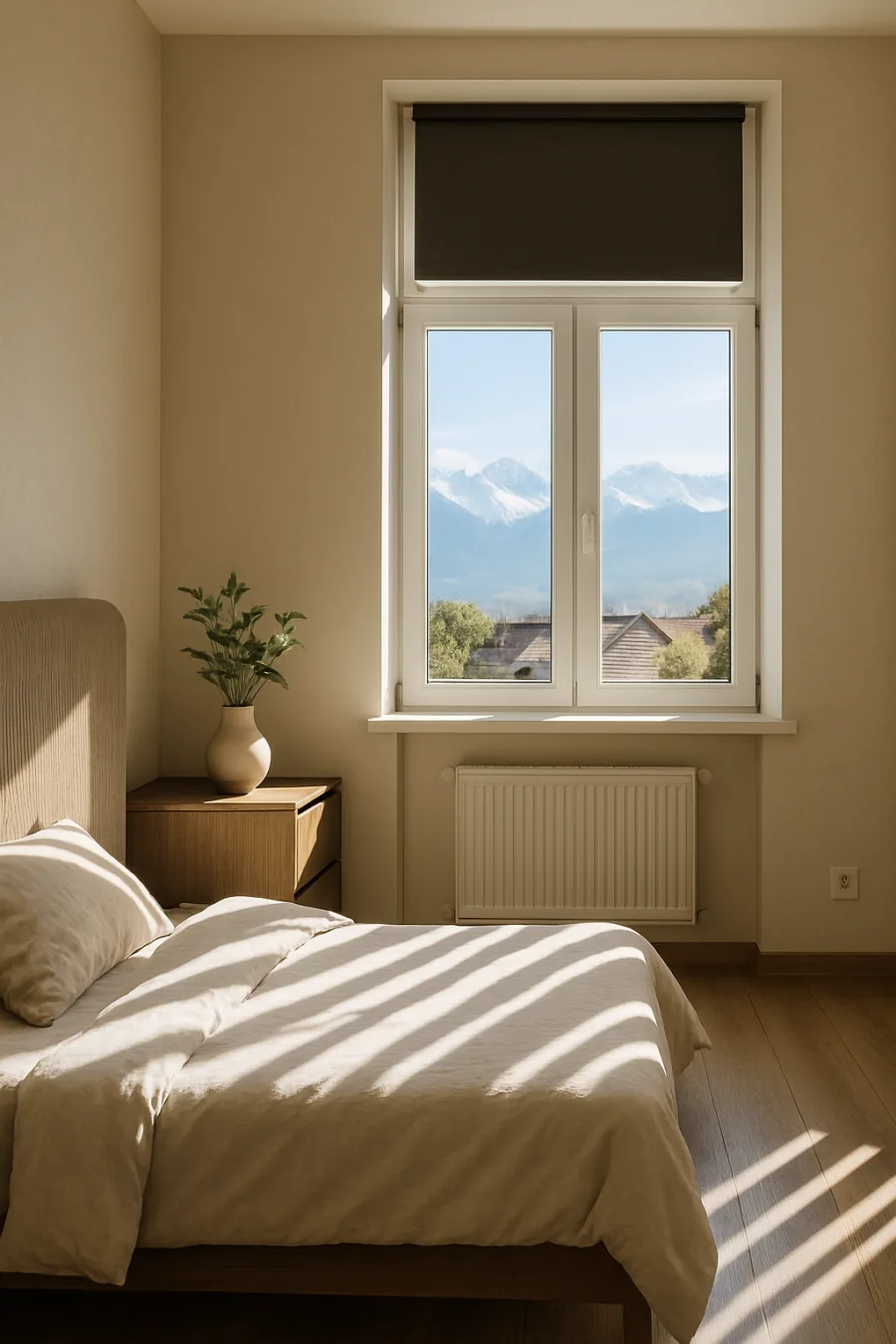
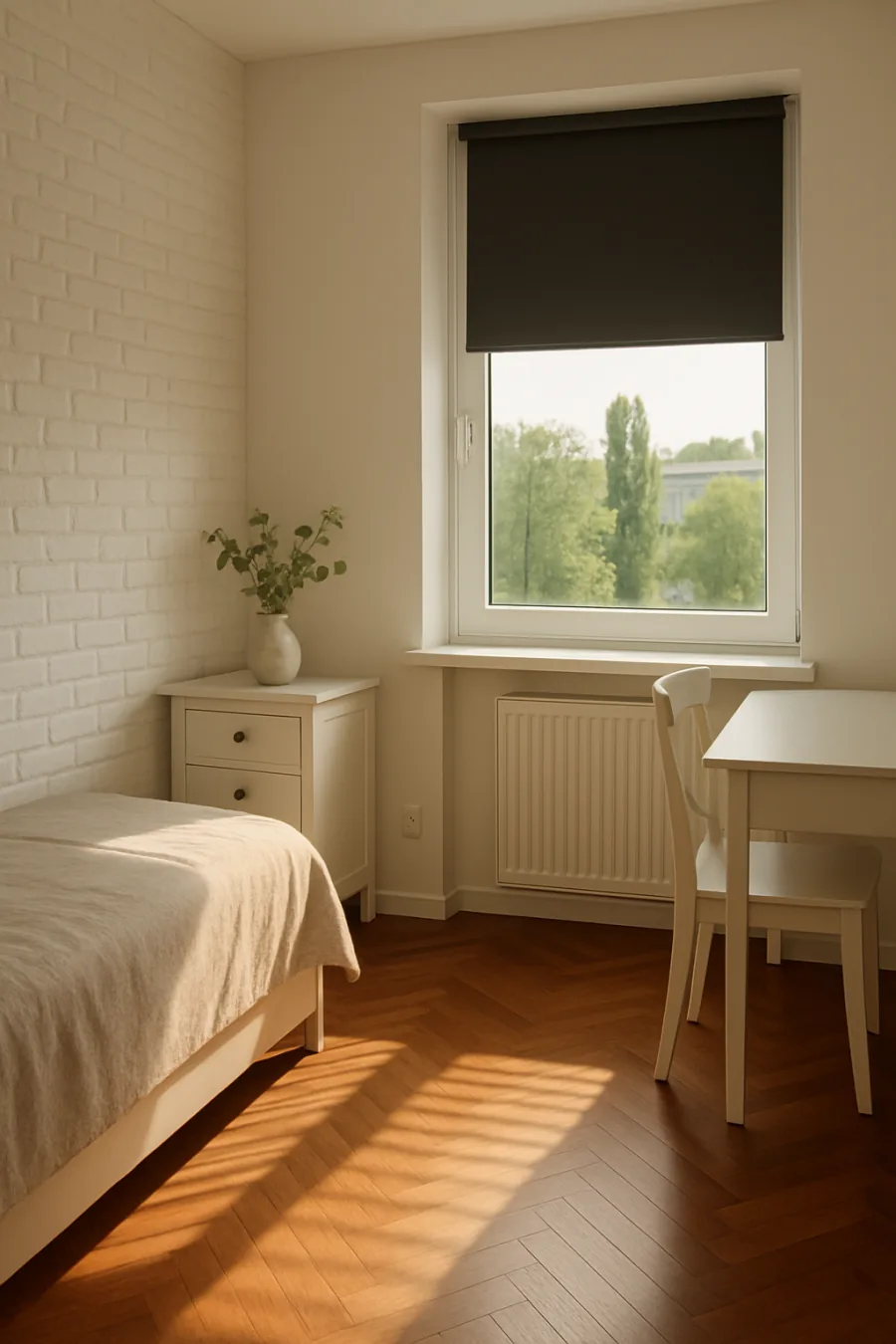
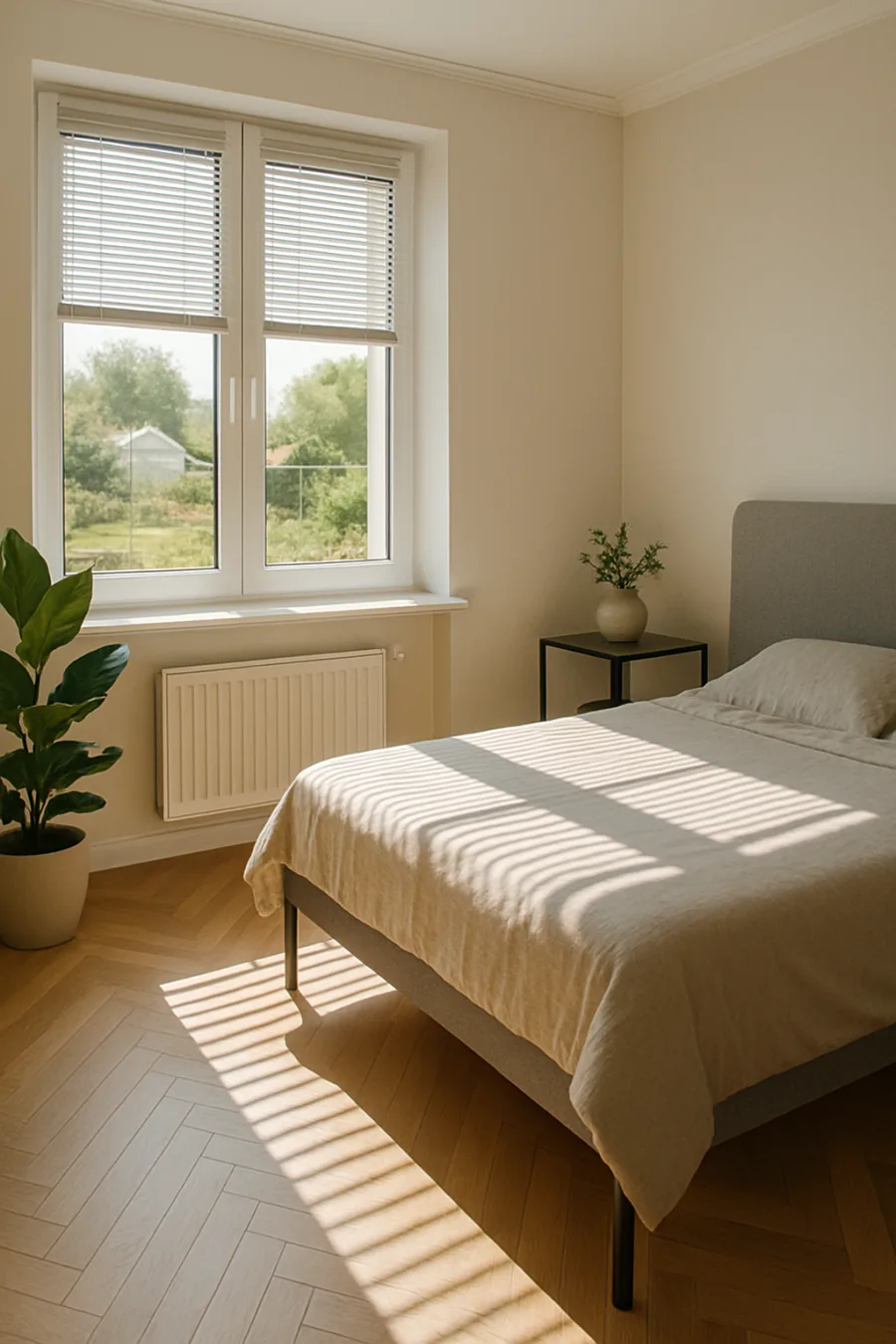


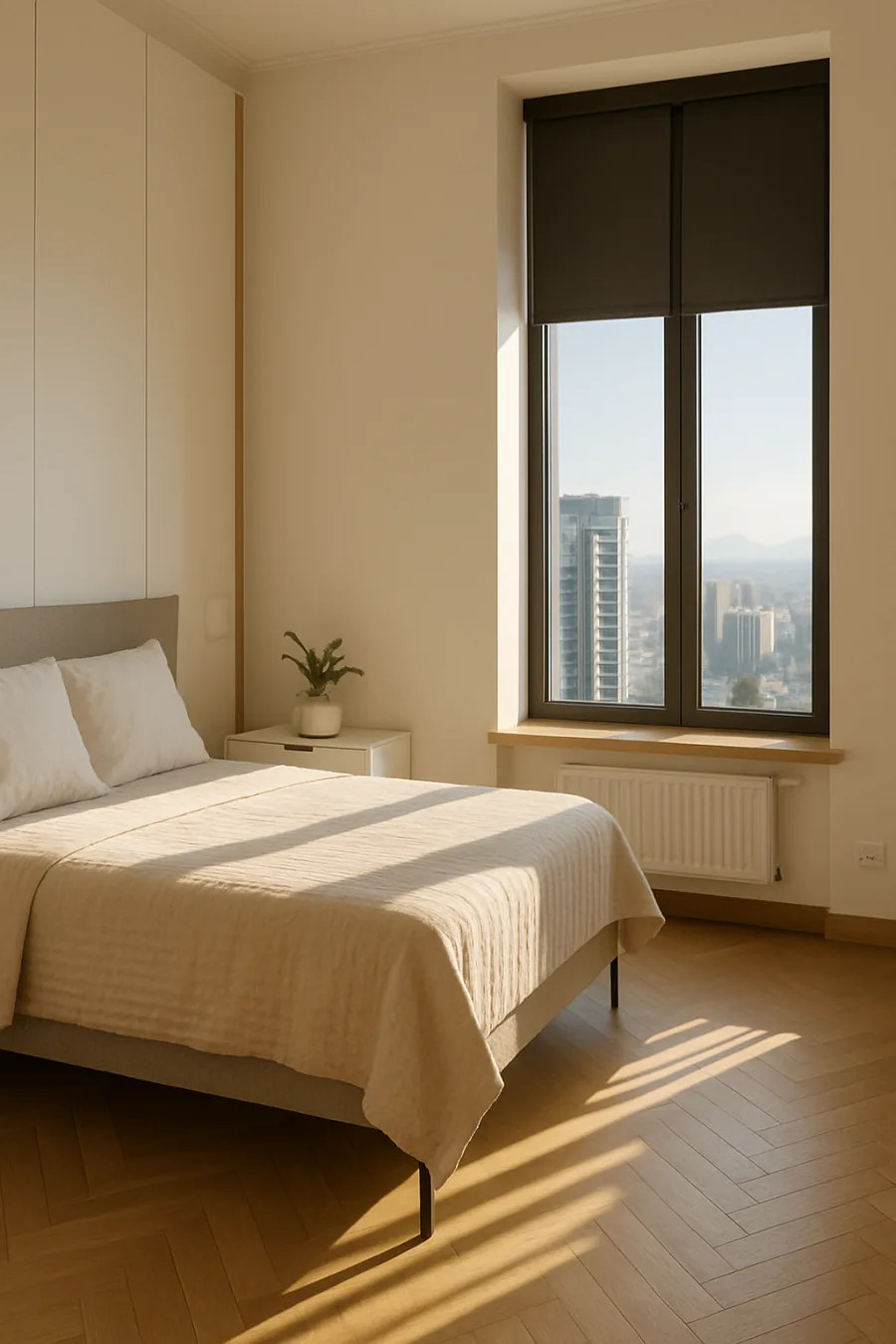











Blinds for the bedroom are chosen by the side of the light and your sleep routine: on the east — a dense fabric against the morning sun, on the ground floor — a dense fabric against silhouettes in the evening, for a child’s daytime nap — blackout or day-night. Mounting on the sash right up against the glazing bead reduces light bleed along the edge. Measurement and consultation are free.
Where light comes from in a darkened bedroom
Light bleed along the edge, light bleed at the top and the gaps between the slats — these are the three places light gets into the bedroom even with the blind closed. The blind is closed, a strip of light on the wall at the side — familiar? Mounting on the sash reduces light bleed along the edge, because the blind runs right up against the glazing bead. But horizontal slats don’t give complete darkness — light still passes between them.
Three sources of light
The first source is light bleed along the edge, the gap between the blind and the window reveal. The second is light bleed at the top, above the blind, if the mounting isn’t right up against the reveal. The third is the gaps between the slats of horizontal blinds or between the strips of day-night fabric. A thin strip along the edge is more annoying than it seems: it’s the one that lands on the pillow and gets in your eyes. And the width of that strip depends not on the colour of the slat, but on where the mounting sits.
What the mounting method changes
Mounting on the sash runs the blind right up against the glazing bead — the gap at the sides becomes minimal. Mounting on the opening covers the window entirely with an overlap at the sides, but a strip of light may remain at the top if it doesn’t reach the reveal. A cassette system hides the gaps at the edges of the blind with a housing box that covers the blind at the top and sides. For bedroom blinds this is often the deciding factor, and at the measurement we show both options on your window.
Mounting the blind right up against the glazing bead reduces light bleed along the edge, but horizontal slats don’t give complete darkness.
Blackout or day-night: what to choose for the bedroom
For complete darkness during the day in the bedroom you need blackout, and day-night won’t give it. The difference is in how the fabric is made: blackout is a light-proof fabric that blocks light across the whole window area, while day-night is a two-layer fabric of alternating transparent and dense strips. When the layers shift, the strips don’t close tight against each other, and narrow gaps remain between them. Light passes through them even in the closed position. Complete darkness doesn’t happen with them.
These two options handle privacy differently. Dense blackout closes off the room entirely — in the evening with the light on, neither silhouettes nor movement can be seen from the street. Day-night keeps privacy through the density of the fabric: the denser the blind, the less shows through. On the ground floor or with windows onto the street we usually look towards denser options — and at the measurement we show samples in different light.
When you need blackout
Blackout is chosen where real darkness is needed: a child’s daytime nap in a kids’ bedroom, working the night shift, an east-facing window with early sun. The blind covers the window entirely, and the morning light doesn’t wake you. Blackout is a type of fabric, it isn’t a separate item in the price list, so the measurer calculates the cost and lead time on site, based on your window and size.
When day-night is enough
Day-night works if you need soft light rather than total darkness. The layers shift gradually: in the morning the room fills with soft light, in the evening the blind closes and hides the room from the street. These blinds for the bedroom are chosen when you want to keep the feeling of a window and daylight, but not show what’s happening inside.
Where dimout fits in
Dimout is an intermediate density between day-night and blackout. It’s darker than regular day-night, but it isn’t a light-proof fabric. It’s chosen when the room should stay in soft shade rather than complete darkness.
Day-night in the closed position leaves gaps between the strips, so it doesn’t give complete darkness — complete darkness during the day in the bedroom comes only from blackout.
Blind on the sash or on the opening: what’s better for sleep
For the bedroom, mounting on the sash usually wins: the blind runs right up against the glazing bead, there’s less light bleed along the edge, and the window opens together with the blind — night-time ventilation isn’t blocked. Mounting on the opening covers the window entirely with an overlap at the sides, but is less tight against the frame.
What mounting on the sash gives you
Mounting on the sash reduces light bleed along the edge, because the blind sits right up against the glazing bead and moves with the hardware. The window opens without removing the blinds. In the morning you turn the handle — and the sash is on ventilation, while the blind stays in place and keeps blocking the light. And for tilt-and-turn hardware this matters: the sash moves in two planes, and the measurer selects brackets so that the blind doesn’t catch on anything.
What mounting on the opening gives you
Mounting on the opening covers the whole window with an overlap on the sides — that is its strong point, especially on wide bedroom windows where the sash is a non-standard width. But at the top there is often a narrow strip of light left if the blind is not pulled all the way to the ceiling or to the reveal. At the measurement we account for this gap: sometimes it is easier to close it than to argue with the geometry of the window.
Draughts and slat noise
Slat noise from draughts is a real story, but not a verdict. With the vent open, a narrow aluminium slat can tap if the frame moves in the wind. At the measurement we look at the hardware: sometimes it is enough to tighten the mechanism, sometimes it is better to take a fabric blind or a mounting that holds the slats more tightly.
What to check at the measurement:
- The side the sash opens on and the type of hardware — turn-only or tilt-and-turn.
- The gap at the top between the blind and the ceiling or reveal.
- The width of the sash: a narrow slat on a wide blind moves more.
- Whether there is a vent separate from the sash — for it we calculate its own blind.
A blind on the sash does not stop the window from being opened for ventilation if the mounting is matched to the hardware.
How the window’s orientation and your sleep routine shape the choice
The window’s orientation determines exactly which light you will have to block. An east window gives morning light, south and west give evening overheating, and a ground-floor window adds silhouettes from the street on top of that. From this comes the choice of fabric density, not the other way round: first we look at what is stopping you from sleeping, then we pick the blind.
Does the bedroom heat up in summer if a blackout blind is on a south window? A dense blind holds back the light, but the window itself does not cool anything — the heat comes from the glass and from the wall around the opening. In an Almaty summer with sun and dust, a south or west window without a blind heats the room noticeably more by evening. A light matte slat reflects part of the sun back, while a light glossy slat instead throws a glare into your eyes — we show this difference on samples at the measurement.
On the ground floor, fabric density decides privacy. In the evening with the lights on, a thin blind reads from the street as silhouettes, while a dense fabric and day-night with the layers closed do not. The ground floor calls for a dense blind: it also covers the window from prying eyes during the day.
In a child’s bedroom the logic is different. What matters here is the child’s daytime sleep, so we look not only at the density of the blind but also at safety: cords and chains are hidden or we take a side-handle control so the child cannot reach them.
What suits which situation — a short table.
| Window and situation | What is the problem | What fits |
|---|---|---|
| East, early waking | Early sun | Dense fabric, blackout |
| South and west, evening overheating | Heat and glare by evening | Dense fabric, light matte slat |
| Ground floor, silhouettes | Visible from the street in the evening | Dense fabric, day-night with the layers closed |
| Child’s bedroom, daytime sleep | The child cannot fall asleep during the day | Blackout, control without hanging cords |
| North, privacy only | Nothing but prying eyes | Day-night, bedroom blinds of medium density |
The window’s orientation determines exactly which light you will have to block: morning light in the east, evening overheating in the south and west, silhouettes from the street on the ground floor.
Comparing types of blinds for the bedroom
No type of slatted blinds gives complete darkness. Horizontal aluminium blinds with a 25 mm slat darken the room noticeably, but leave a narrow strip of light along the edge — this is a design feature, not a defect. Fabric solutions work differently: day-night gives smooth adjustment, blackout blocks the light more tightly than any other. The choice comes from what exactly you need in the bedroom — to block the morning sun, to hide from prying eyes in the evening, or to kill glare on a screen.
| Type | Darkening | Privacy | Care | Price from, ₸/m² | Lead time |
|---|---|---|---|---|---|
| Horizontal aluminium, 25 mm | dense, with a strip along the edge | full during the day with the slats closed | a damp cloth on the window | 4,200 | 3–5 days |
| Vertical fabric, 89 mm | medium | a closed slat does not let light through | vacuum cleaner, sponge | 4,600 | 3–5 days |
| Day-night | adjustable, smooth | when the layers are offset | vacuum cleaner, sponge | 7,300 | 5–7 days |
| With electric motor | depends on the fabric | depends on the fabric | by fabric material | 7,800 | 7–10 days |
| Pleated blinds | medium | the closed fold holds | vacuum cleaner, sponge | 9,800 | 7–10 days |
| Wooden, slat 50 mm | soft shade | full during the day | dry cloth | 12,400 | 7–12 days |
| Paper | light | partial | dry cloth | 3,200 | 2–3 days |
| Plastic, 25 mm | dense | full during the day | damp cloth | 3,600 | 3–5 days |
| Metal, 25 mm | dense | full during the day | damp cloth | 5,200 | 5–7 days |
| Cord-operated | light | partial | vacuum cleaner | 5,800 | 5–7 days |
| Multi-textured | adjustable | depends on the combination of fabrics | by fabric material | 7,200 | 7–10 days |
| With a pattern | depends on the base | depends on the base | by fabric material | 8,900 | 7–12 days |
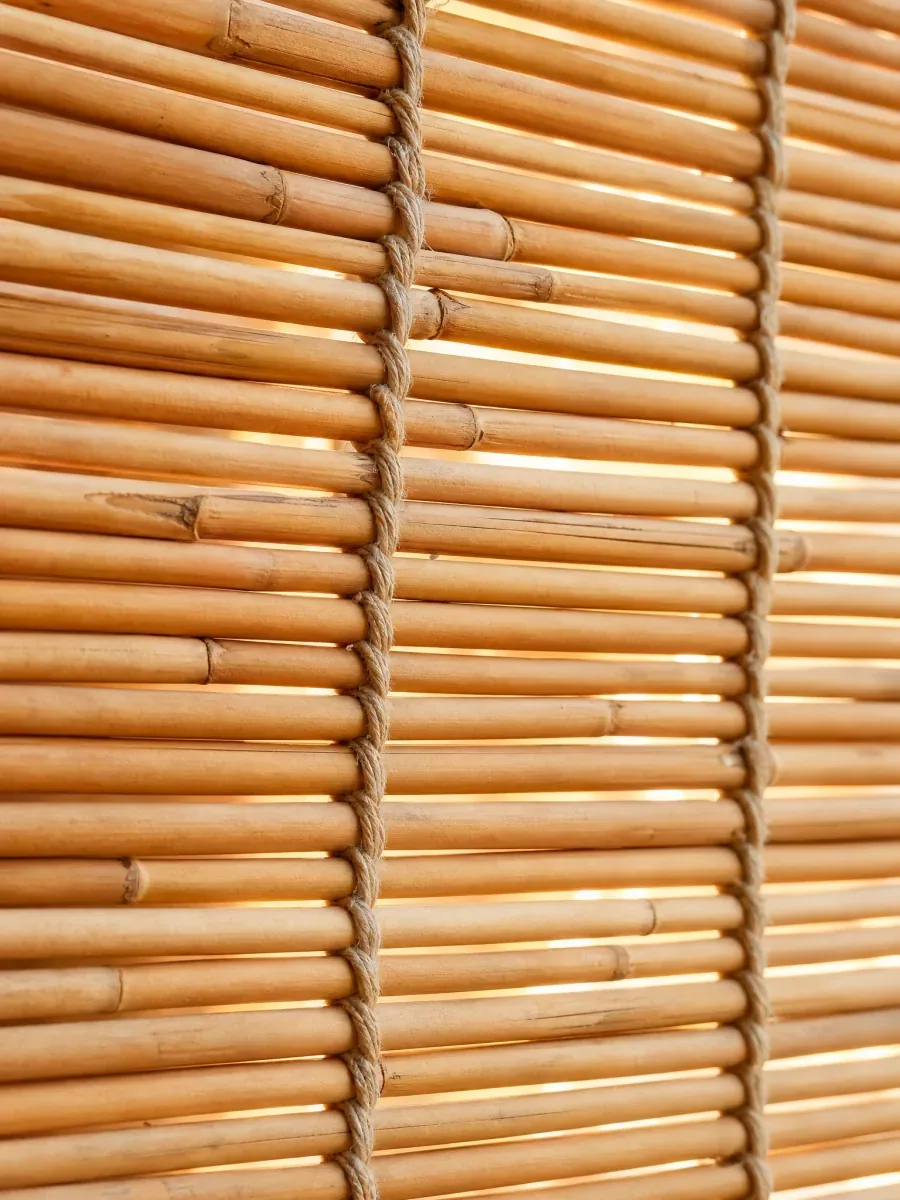
| Bamboo | soft shade | full during the day | dry cloth | 9,400 | 7–10 days |
Blackout comes as a fabric option, it has no separate line in the price list: the measurer calculates the density and the price on site, for your window.
What doesn’t look office-like
A bedroom is not a meeting room, and you can see it in the texture. Fabric blinds, vertical blinds, pleated blinds, wooden and bamboo slats read as a home interior, not an office one. A narrow aluminium slat in a calm colour is also appropriate — on a small window it doesn’t eat up height and doesn’t look clerical, if the tone is matched not to metal but to the walls or textiles. At the measurement we lay out samples by your window: in different light the same slat looks different.
Slat colour and morning glare
A light glossy slat catches the sun and throws it back into your eyes — in the morning this is felt most sharply. Matte and warm surfaces scatter light more softly, so for the bedroom we usually suggest those. If there is a TV or monitor in the room, glare on the screen is dampened by a dense matte fabric: gloss creates reflections, matte fabric doesn’t. We match the shade using samples on site, not from a catalogue.
Horizontal aluminium blinds don’t give full darkness because of the edge, wooden and bamboo ones give a soft shade without darkness, and pleated blinds hold their shape on sloped and roof windows, where a slat won’t sit straight.
A bedroom in Almaty: climate, dust and the suburbs
The climate of Almaty directly shapes the choice of fabric: summer is hot, sunny, with dust, winter is cold, with frosts and a temperature swing between day and night. The window’s orientation determines exactly how much overheating you’ll need to dampen, and dust determines how often the fabric will need cleaning. The measurer looks at both on site.
In summer dust settles on slats and fabric quickly, and that’s no reason to give up a dense fabric — the question is how to wash it. Aluminium and PVC are wiped with a damp cloth right on the window, no need to take the product down. Fabric with an impregnation absorbs less dust than fabric without it, and is cleaned with a vacuum cleaner on low power or a sponge without soaking. Wood and bamboo are enough to wipe with a dry cloth.
An air conditioner creates a second factor — dry air. Wooden blinds in a bedroom in Almaty next to a running air conditioner behave more calmly than fabric: linden and bamboo straw don’t stretch or sag from dryness the way thin day-night fabric does. But they don’t give full darkness — a soft shade always passes through the slats. If you need darkness during the day, wood is chosen for the texture, not for the blackout.
Measurement and delivery within the city are free. To the suburbs the measurer travels to:
- Kaskelen
- Talgar
- Issyk
- Kapshagay
The cost of a trip outside the city depends on the distance, and we name it before the visit, not after. The measurer brings samples and calculates the cost on site — for your window, orientation and the material you choose.
Bottom line: the climate of Almaty dictates not the type of blinds, but the fabric material and how to care for it.
How we calculate the cost of blinds for a bedroom
The price of blinds for a bedroom is made up of the window area, the type of construction, the density of the fabric and the controls. The price list range is simple: horizontal aluminium 25 mm — from 4,200 ₸/m², vertical fabric with a 89 mm slat — from 4,600 ₸/m², day-night — from 7,300 ₸/m², with an electric motor — from 7,800 ₸/m². The difference between the last two items answers a common question: day-night is cheaper, electric motor is more expensive, because the price includes a 220 V motor or a battery and its selection for the weight of the fabric. You can order blinds for a bedroom in Almaty from us: the measurer arrives with samples and calculates the cost on site, then the workshop and installation follow.
What affects the final price
Six things affect the final price: the type of construction, the material and density of the fabric, the controls, the shape of the window, the number of openings and the mounting method. A window and a balcony door are counted separately — the door opening is taller and wider, the fabric for it is cut to its own dimensions, so one window and a window with a balcony door in the same bedroom give different totals. Controls are chosen from manual, chain and electric motor; in the calculator these are coefficients: chain ×1.06, electric motor ×1.85, electric with remote control ×2.1. Mounting is also counted as a coefficient — on the frame ×1.05, without drilling ×1.1, cassette system ×1.28. Drilling-free installation is convenient, but it is not free, and we always name this before the order, not after.
How we work
You message us on WhatsApp, a measurer comes with samples, works out the price on the spot, then the workshop and installation follow. At the measurement we show you how the fabric will sit on your sash and what fixing it flush against the glazing bead gives you. Lead times follow the price list: paper — 2–3 days, aluminium and vertical — 3–5 days, day-night, metal and rope — 5–7 days, pleated, bamboo and multi-texture — 7–10 days, wooden and patterned — 7–12 days. We don’t have a blanket “two days for any window” promise.
Example calculation
A bedroom with one window, horizontal aluminium 25 mm at 4,200 ₸/m², chain control, mounted on the frame. We calculate by window area, multiply by the coefficient for the chain and the mounting, and add installation at 4,500 ₸ per item. If a bedroom order comes to 150,000 ₸ or more, we install for free. For panoramic glazing or a window with a balcony door, the measurer counts every sash and every opening, so the total there isn't based on a single area.
Installation costs 4,500 ₸ per item, and for orders from 150,000 ₸ it's free — the exact amount is still confirmed by the measurer on site.
No-drill mounting and a rented flat
You don't have to drill the frame. For a rented flat we mount bedroom blinds on glazing-bead brackets, spring clamps or mounting tape — the plastic stays intact and the window warranty from the window company remains valid. For a tenant that's the main thing: when you move out, the blind comes off without a trace, and the landlord has nothing to point to.
But there's a nuance that's rarely stated outright. No-drill mounting preserves the warranty on a plastic window, but it's counted with a calculator coefficient and isn't free. So it's not a case of “it'll do as it is” — it's a separate mounting method with its own surcharge in the quote. And it has a weight limit for the blind: a wide, heavy blind holds worse on clamps than on frame brackets, so the measurer works out the load on site and tells you what suits your window.
Now for what people ask about most when it comes to electrics. The electric motor runs on 220 V mains or on a battery if there's no socket by the window. A timer and schedule give you exactly the scenario it's all for: in the morning the blind rises on its own, by the time you get up, and in the evening it closes for sleep — no need to get up and go to the window. Can you hear the motor in a quiet bedroom? We don't call it silent. At the measurement we show how the motor works, and you decide for yourself whether it's comfortable for your room.
What to check at the measurement:
- Which mounting suits your window's hardware — glazing bead, clamps or tape
- Whether the mounting will hold the weight and width of the blind you've chosen
- Whether there's a socket by the window or you need a battery
- How the blind will sit when the sash opens
No-drill mounting is a workable solution for a rented flat, but it's a paid calculator option, not a free extra on your order.
Non-standard bedroom windows: panoramic, attic, balcony door
For a sloped or attic bedroom window we fit pleated blinds: the pleated fabric folds like an accordion and holds its shape where a slat won't sit straight. The blind runs on guide rails — it doesn't sag, doesn't catch on the reveal, and doesn't skew on the slope.
Panoramic glazing is covered differently. We cover each sash with its own blind, and the window opens together with it. We often fit an electric motor: wide blinds are awkward to raise by hand, and with a remote control they move effortlessly, running on 220 V mains or a battery. At the measurement we check how the guide rails will sit and whether the blind will run into the reveal.
A balcony door in the bedroom counts as a separate opening. It's calculated separately from the window, because the height and weight of the blind are different, and it opens wide.
- Sloped and roof window — pleated blinds on guide rails.
- Panoramic glazing — a blind for each sash, with an electric motor for wide ones.
- Balcony door — a separate opening in the quote.
- Combining with curtains — blind on the window, curtains on the rail.
About curtains, let me be straight: you can combine them, and you don't need a second rail for that. We fit the blinds on the window and hang the curtains on the rail over them — the blind stays functional, the fabric moves along its own track. We usually advise against doubling up on structures if one dense blind does the job: good-looking bedroom blinds in Almaty hold both light and privacy on their own, without a second layer of fabric. But if you already have curtains or want soft draping by the wall, mounting on the opening covers the window completely with an overlap at the sides and doesn't get in the way of the rail.
Pleated blinds fold like an accordion and hold their shape on sloped and roof windows, where a slat won't sit straight.
Caring for bedroom blinds
Fabric blinds can't be machine washed — they lose their treatment and shape, and after washing there's no bringing them back to how they were. For a bedroom this rule matters more than anywhere else: people often want to just take the blind down and throw it in the drum, and that's exactly what you mustn't do.
Stylish bedroom blinds in Almaty are cleaned according to the material, and there's no universal product for every case. Aluminium and PVC are wiped with a damp cloth and a mild detergent, no need to take them off the window — a 25 mm slat is washed in place. Fabric blinds collect dust differently: go over them with a vacuum on low power or a sponge without soaking, and for two-layer day-night blinds work along the stripes so you don't stretch the join between the layers.
If someone with a dust allergy sleeps in the bedroom, treated fabric collects less of it than loose untreated fabric. Wood and bamboo are wiped with a dry cloth: in a damp bedroom they behave worse, and we don't advise putting them there.
Once a year we clean the mechanism of dust — a sticking chain or cord usually starts with exactly that. The warranty covers the mechanism for 3 years and installation for 1 year from the date the acceptance form is signed; fabric fading isn't covered by the warranty, so we check the side of the building the window faces at the measurement too.
FAQ
Bedroom blinds usually raise the same doubts: will the blind get in the way of ventilation, will the slats rattle in a draught, and what will cost more. We'll answer them in order.
Will blinds on the sash get in the way of ventilation? No, if the mounting is matched to your window's hardware. The blind is fitted to the sash and opens together with it — a tilt-and-turn sash still ventilates as usual. What's true is that in freezing weather, with the sash open, the blind ends up in the cold air; at the measurement we check how the brackets will sit.
Will the slats rattle in a draught? A narrow aluminium slat sometimes taps when a vent is open. It's not a fault — the slats hang freely in the ladder and the airflow sways them. At the measurement we look at the hardware and pick the mounting; with dense fabric this sound barely shows up.
Can you hear the electric motor in a quiet bedroom? The motor is matched to the weight and width of the blind, and in a quiet room we don't single it out as silent — at the measurement we show how it works. Listen for yourself and decide.
Which costs more — day-night or with an electric motor? Day-night — from 7,300 ₸/m², the option with an electric motor — from 7,800 ₸/m². The price difference comes from the motor and the controls; the mechanism and chain are counted by the calculator coefficients.
Are wooden blinds suitable with air conditioning? Yes. In dry air, wood and bamboo behave more calmly than fabric blinds. But soft shade isn't darkness: if a child needs a daytime nap, wood won't give you full darkness. Here we come back to blackout — that's what gives full darkness during the day.
How do you keep silhouettes from showing through a ground-floor window? With a dense fabric. A thin fabric reads from the street in the evening when the lights are on, a dense one does not. The measurer brings samples and works out the price on site.
The exact price is given by the measurer on site; before the measurement it is always a range.
Conclusion
Light gets into a darkened bedroom in three places: along the edge between the fabric and the window reveal, from above the fabric, and between the slats or strips of fabric. Mounting flush against the glazing bead reduces light along the edge, but slats alone do not give complete darkness — that is a limitation of the design, not a faulty installation.
What this means in practice. For complete darkness during the day in a bedroom you need blackout. Day-night blinds in the closed position leave gaps between the strips, but they give soft light and privacy without total darkness — we show both at the measurement so you can choose according to how you sleep.
The choice then depends on which way the window faces. East calls for a dense fabric against the morning sun, south and west for protection from evening overheating, a ground floor for a dense fabric against silhouettes from the street, and in a child’s bedroom it is more important to cover the window completely and keep cords away from the bed. The Almaty climate adds its own factors: dust and heat in summer, a cold winter with sharp temperature swings.
Installation of one unit is 4,500 ₸, but if the order total reaches 150,000 ₸, we install it in the bedroom free of charge. A blinds specialist for the bedroom will come with slat samples and give you the price right there — you pay nothing for the consultation or the visit.
We make modern bedroom blinds only to measurement, so there is one practical recommendation: if you have decided to buy blinds for the bedroom, message us on WhatsApp, call out a measurer and work out your window together with which way it faces. Before the measurement any figure is a range, after the measurement it is an exact number for your opening.

