
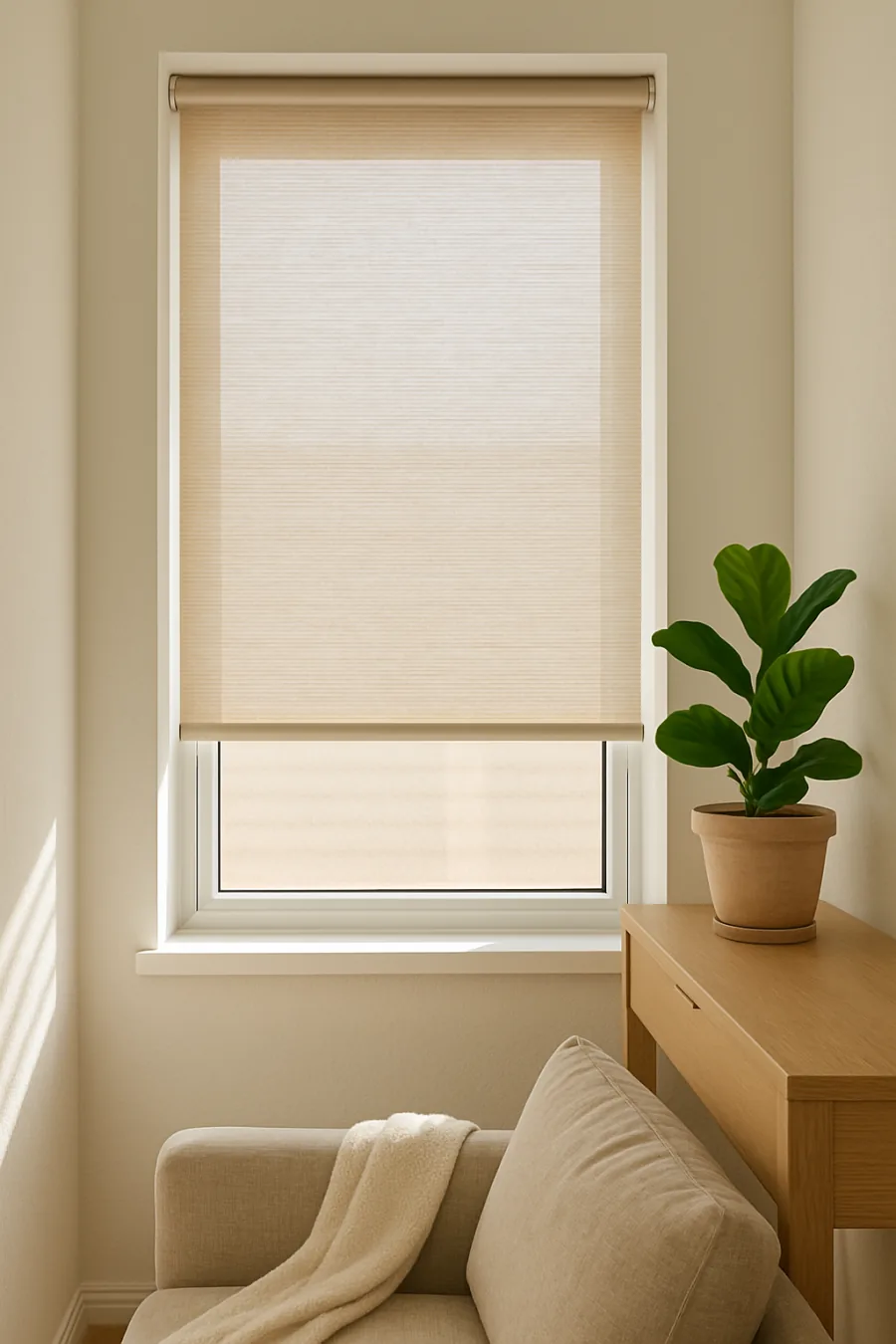

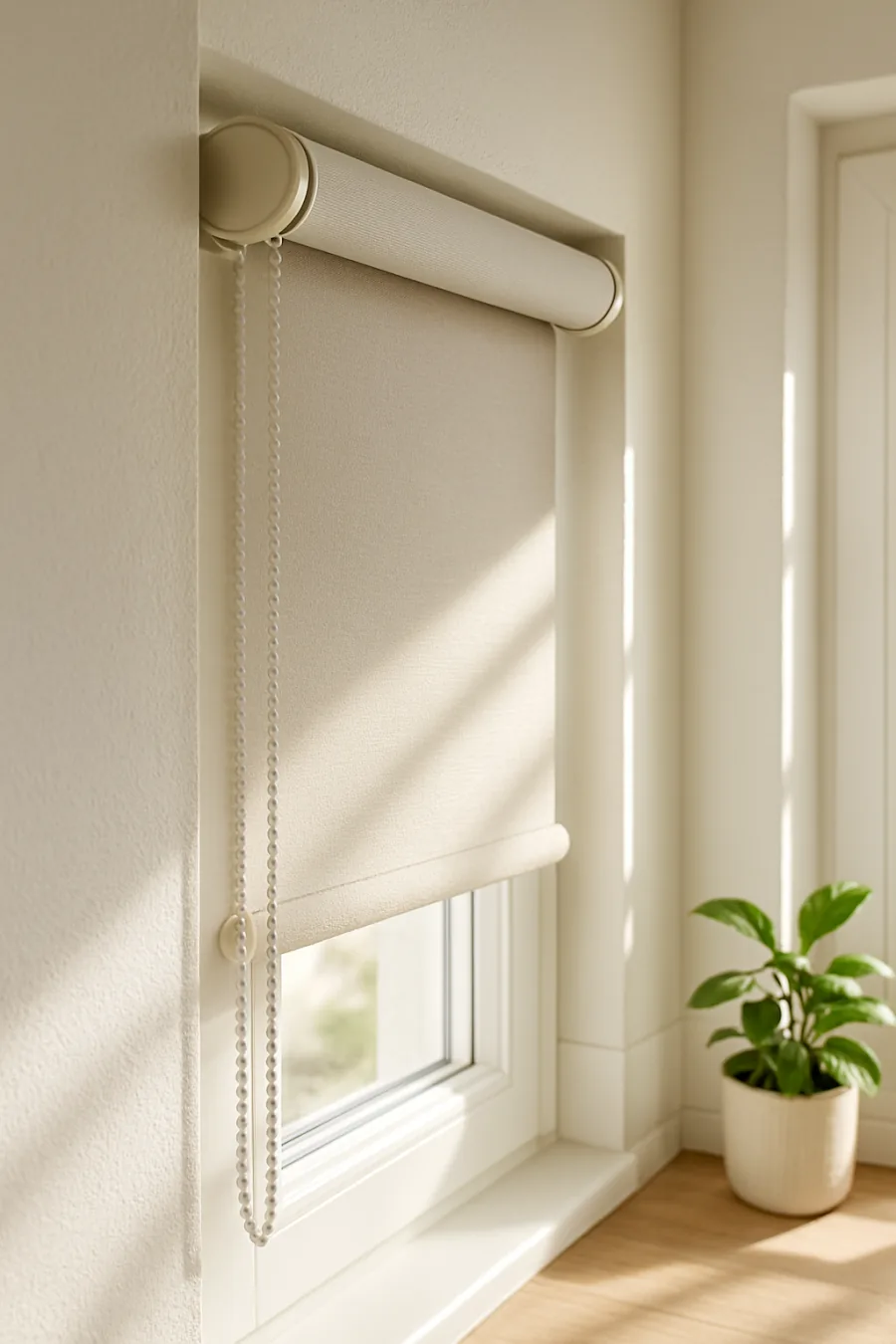


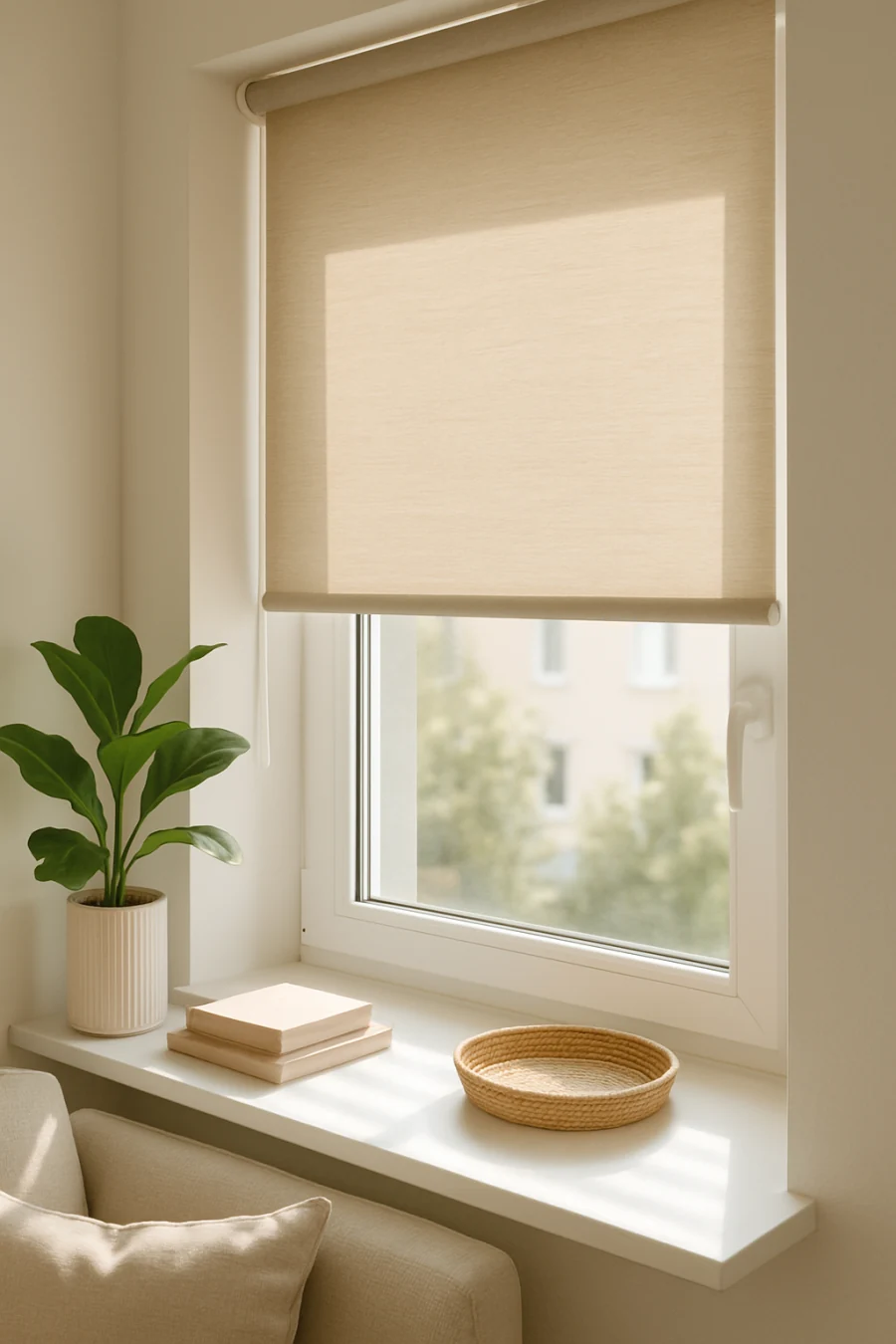


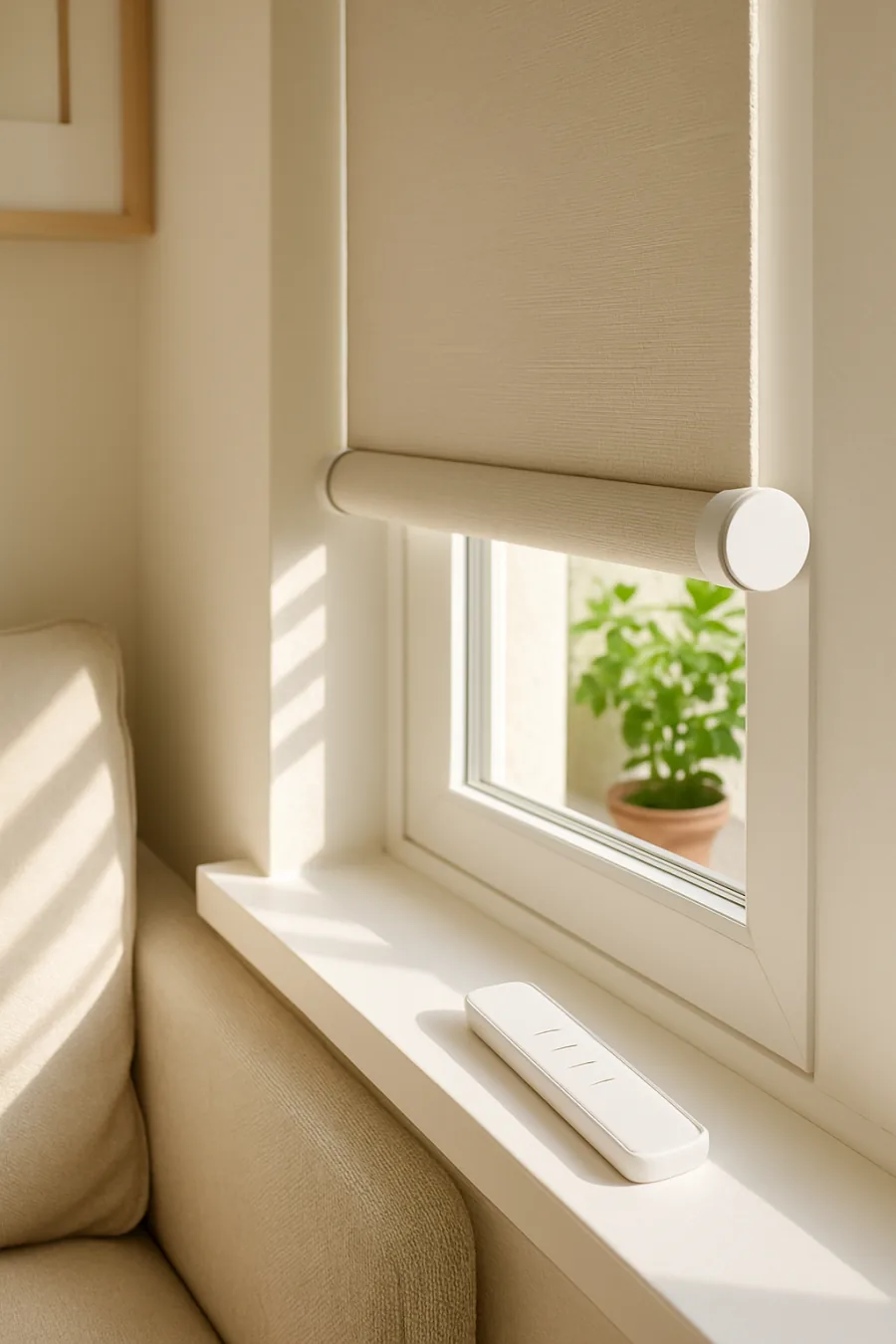


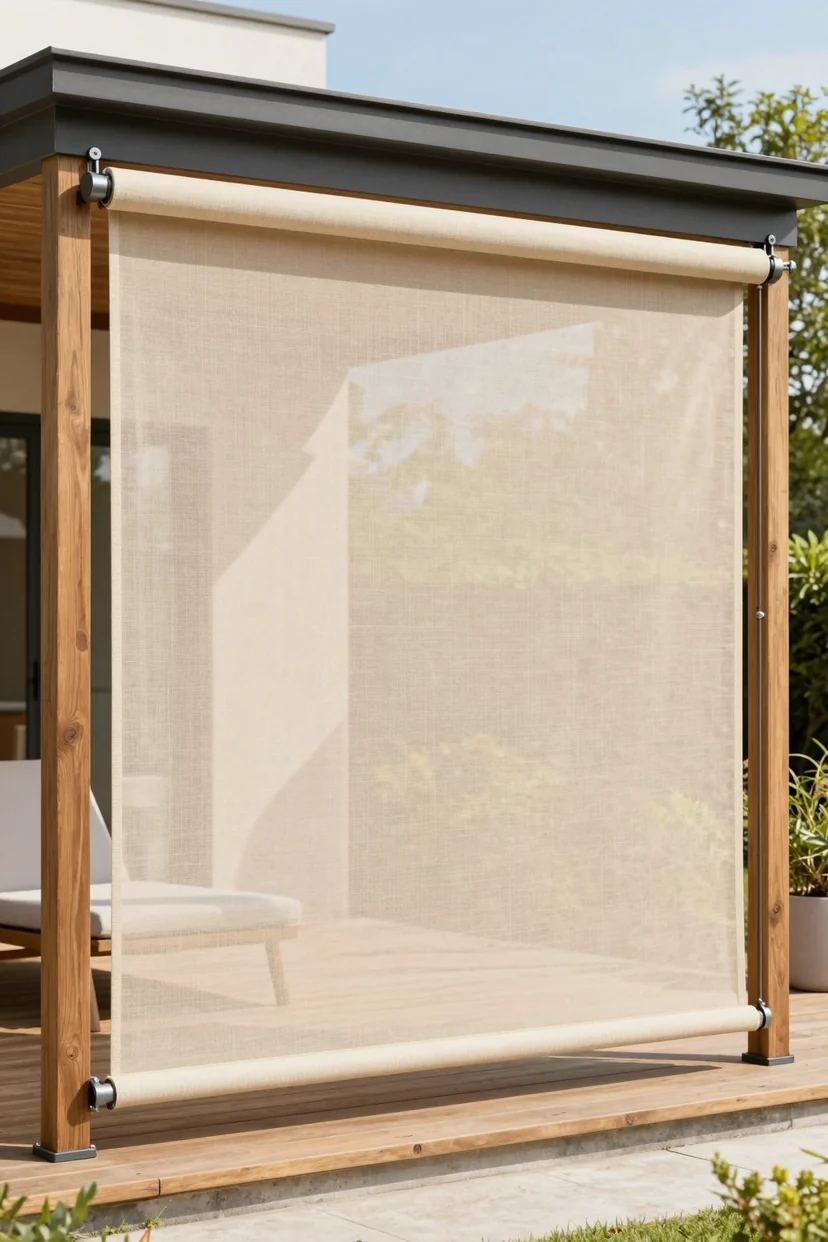


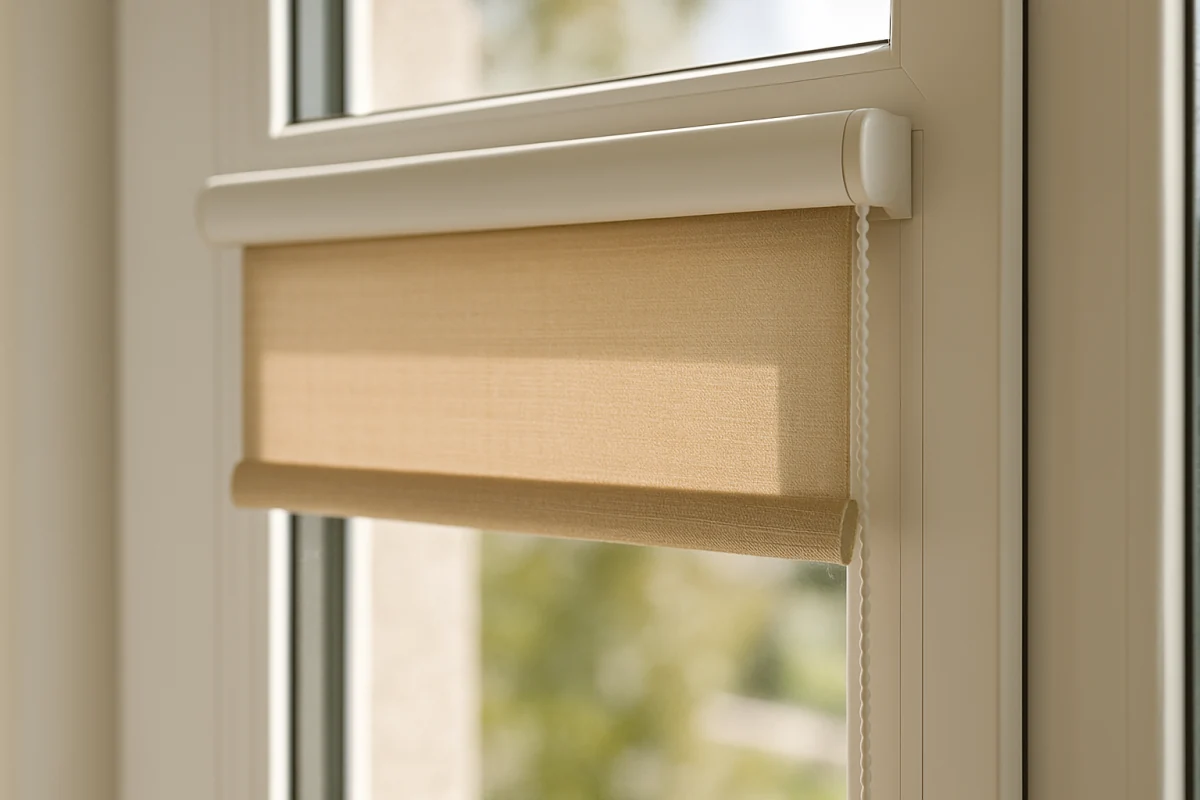
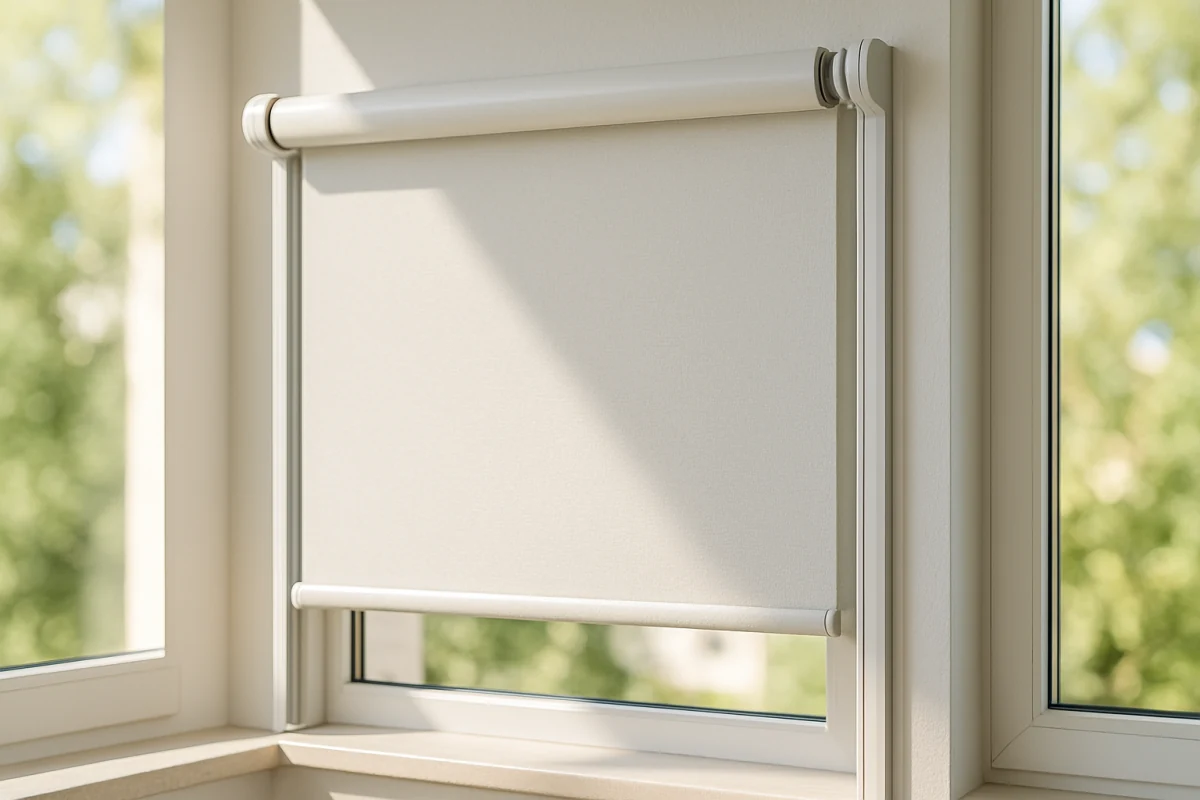
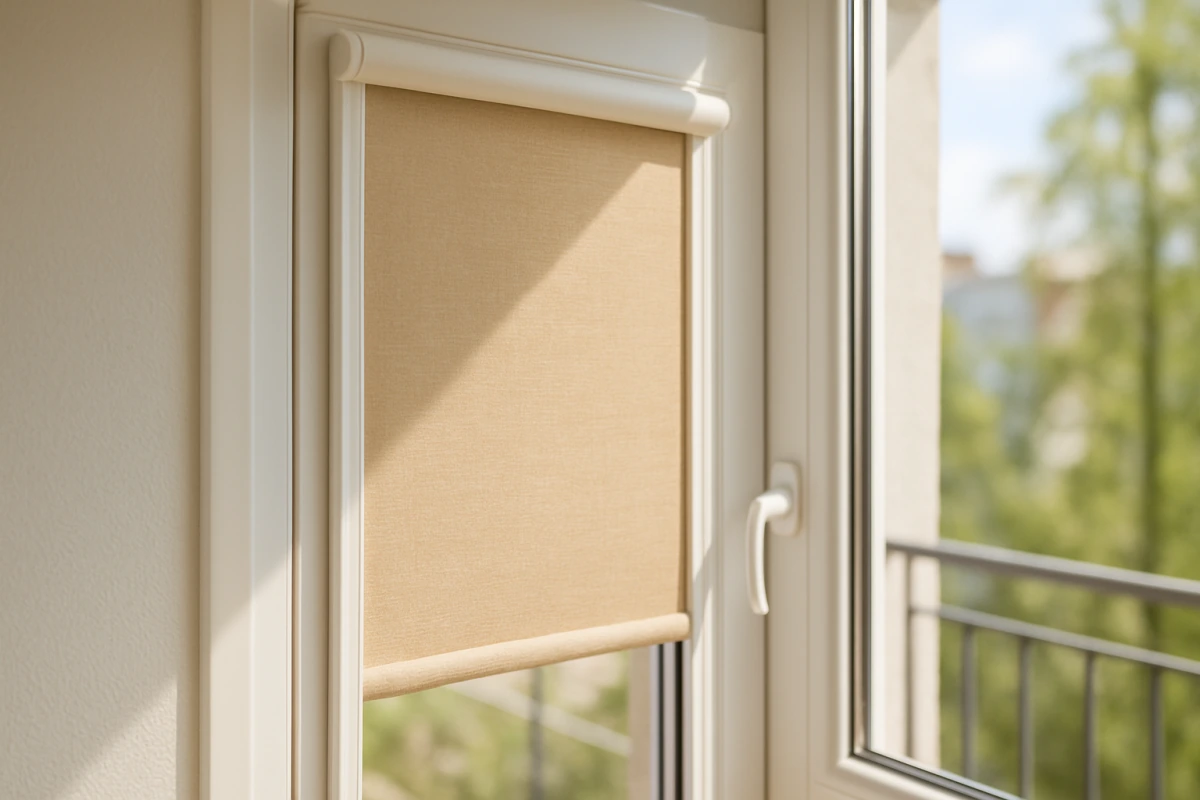
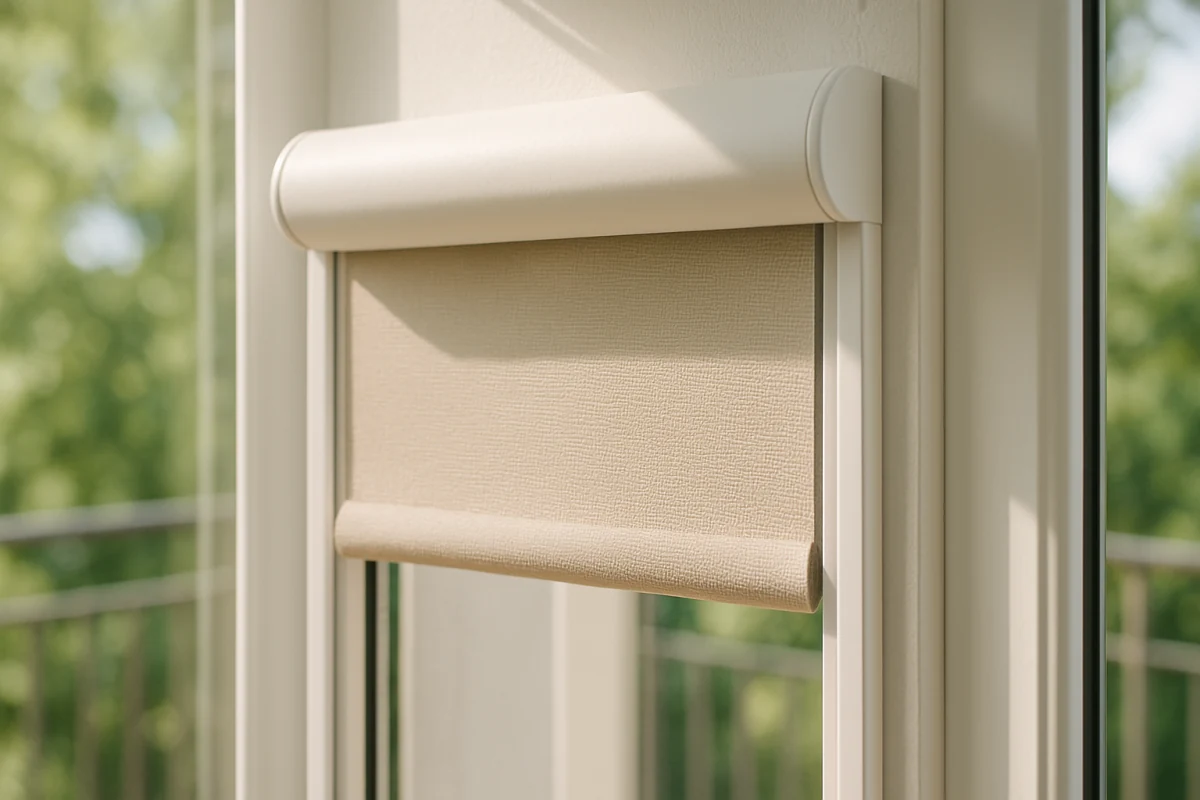
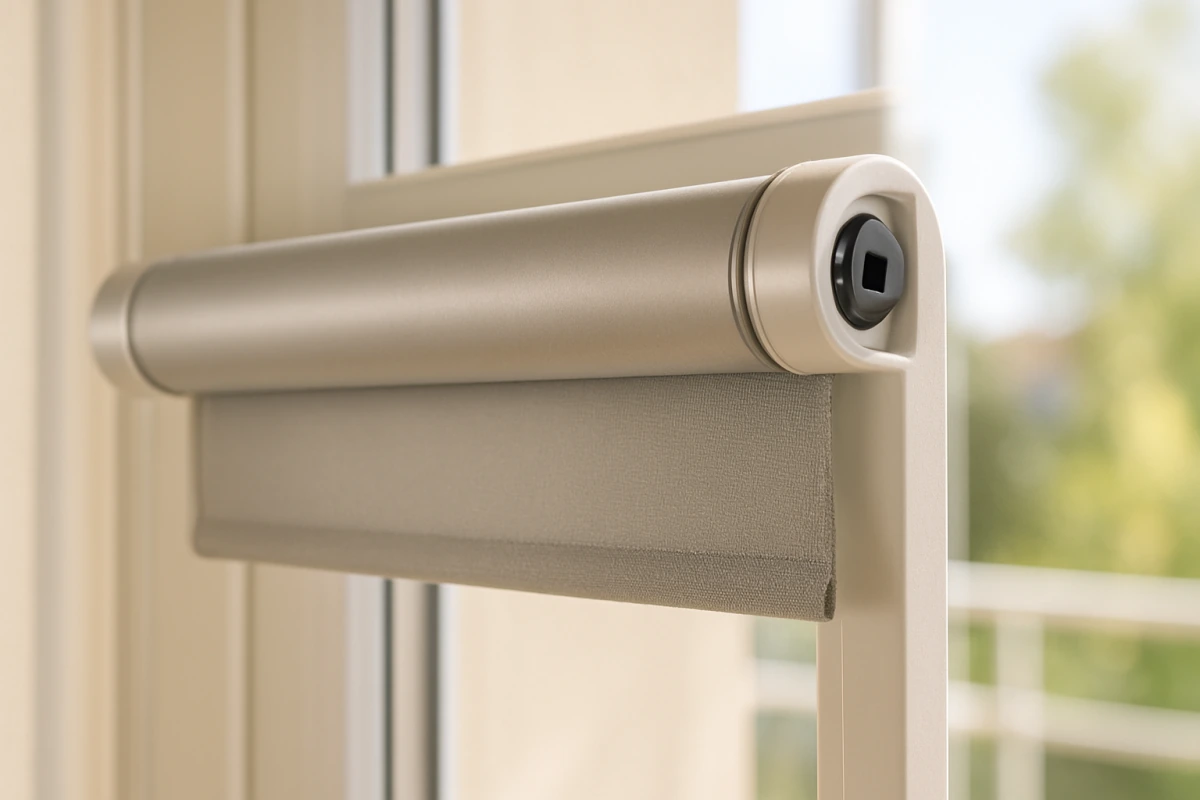
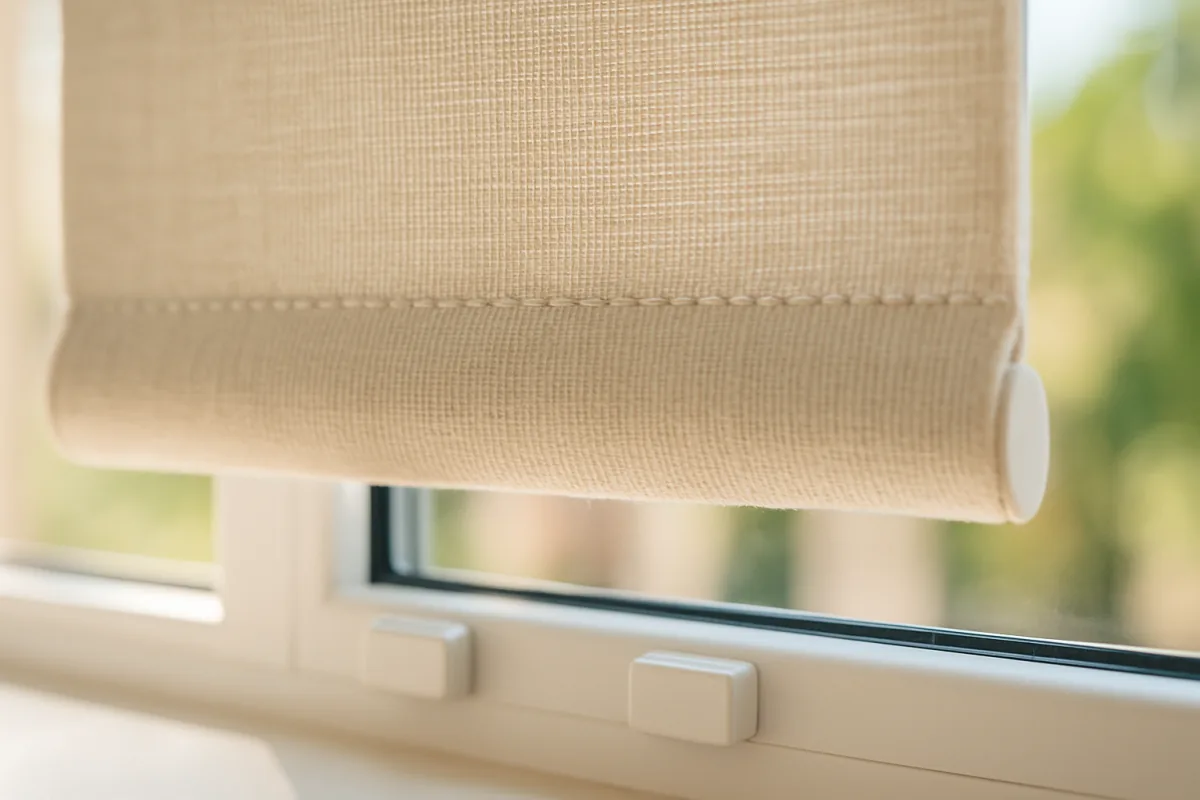









We make roller blinds for balconies and loggias in Almaty to measure: fabric on a tube at the glass, no rail, fabric from sheer to blackout. Price — from 5,400 ₸/m², manufacturing 4–6 days, installation 4,500 ₸ per item, free for orders from 150,000 ₸. The measurer comes with samples.
What kind of glazing you have: sliding aluminium or plastic
Both the mounting and the number of units depend on the type of balcony glazing. A blind is not hung on a sliding frame: the sliding sash goes behind the neighbouring one, and the structure will not work on it. On a plastic window, you can mount it directly on the frame.
Next Jalusso looks at the profile — whether it is aluminium or plastic — and at the window’s orientation. These are the two inputs that any measurement starts with.
- Sliding aluminium. The aluminium profile on old Almaty balconies is almost always sliding: the sash runs along a rail and goes behind the neighbouring one. There is no space on the frame itself for mounting, so the roller tube is placed above the frame or on the ceiling — to the upper glazing profile. This solution leaves the sash free, and the balcony is still ventilated.
- Plastic. On the loggias of new buildings, a plastic window with a turn sash is installed. The turn sash opens inwards, so roller blinds on balcony windows are mounted on the frame or on the wall next to it. If the handle is tilt-and-turn, the measurer allows a gap so that the fabric does not catch on it when turning. At the same time, we look at where the window faces — the sunny side or the shade.
How this looks in practice. On a plastic window with a turn sash, the blind sits tightly on the frame, while the handle remains accessible. On sliding aluminium, the same approach will not work: the roller tube will have to be moved upwards.
Sliding aluminium on old balconies
The sash goes behind the neighbouring one, and there is simply no strip on the frame for mounting. The roller tube is placed above the frame or on the ceiling, to the upper profile. The bottom edge is fixed so that the fabric does not flap in a draught.
Plastic on the loggias of new buildings
The turn sash gives space both on the frame and on the wall next to it. The tilt-and-turn handle sets the gap: mounting too close will mean the fabric catches on the handle. The measurer takes this gap on site — before calculating the unit.
Heat and dust: what this means for the fabric
The mini system is mounted on the sash and moves with it — convenient on turn plastic, impossible on sliding aluminium. The fabric on the balcony is in the sun all day, and summer in Almaty is hot and dusty, and dust makes the fabric darken faster. That is why on the sunny side a denser fabric is chosen: it holds back direct rays and is easier to clean. On the shady side, the requirements are milder. Aida selects the exact fabric group together with the measurer using samples.
Jalusso does not hang a roller blind on a sliding sash: on sliding aluminium, mounting goes above the frame or on the ceiling, and direct mounting on the sash is only possible on a turn plastic window.
How to hang a blind on sliding balcony windows
On a sliding frame, the blind is mounted above the frame or on the ceiling: the sliding sash goes behind the neighbouring one, so the mini system will not work on it. The guide rails press the fabric to the glass, and the bottom fixing protects it from flapping in a draught. The procedure is as follows:
- The measurer looks at the profile and checks where the roller tube will go — above the frame or on the ceiling.
- The roller tube is mounted to the upper profile of the frame or to the ceiling slab, stepping back from the glass so that the sash moves freely.
- Guide rails are placed at the edges — they hold the fabric by the glass and keep it from hitting the frame.
- Fixings or magnets are placed at the bottom: the fabric stays straight when the sash is open.
- The chain is shortened to a convenient height so that you can operate the blind without reaching.
The division into units and the mounting points depend on how many sashes there are and how they overlap. The fabric does not block the passage and does not interfere with ventilation.
Roller blinds for a balcony and roller shutters for a balcony in this case differ from the mini system only in the method of installation: the roller tube goes above the frame, not on the sash.
What to do if there is no space above the frame
There is not always space above the frame: a parapet, slab or box covers the top, and then the roller tube goes to the ceiling or into a niche. On a narrow loggia, where only a narrow strip remains above the frame, the wall-mounted option moves the roller tube away from the frame. The measurer decides on site — before inspection, no specific mounting is named. What can you say: guessing from a photo is pointless, the profile and gaps can only be seen on site.
On a sliding frame, mounting above the frame or on the ceiling is the only workable option, because the sliding sash goes behind the neighbouring one and the mini system will not work on it.
Which roller blinds are best for the sunny side
On the sunny side, screen with low openness is more often chosen: it removes direct rays and glare, but does not turn the balcony into a dark storeroom. Roller blinds on a loggia are generally chosen not by the beauty of the catalogue, but by the window’s orientation and by what is done on the balcony during the day. The sun in Almaty in summer is hot and dusty, windows facing south and west collect light from morning to evening — that is the load to calculate the fabric from.
Screen reduces heating on the sunny side: the dense weave diffuses light, and the material itself absorbs less heat than ordinary fabric. Sheer keeps the view from the balcony — through it you can see the courtyard and the mountains, but it does not hold back direct rays. Blackout darkens a balcony used as a bedroom or a home cinema. Dim-out is in the middle: it lets little light through, but does not give complete darkness. Day-night works as two fabrics on one roller tube — dense and transparent stripes alternate, and in the evening you cannot see from the window what is happening inside.
Fabric fading is a natural process, not a defect, and the warranty does not cover it: we give 3 years on the mechanism and 1 year on installation, but not on the colour of the fabric. Any fabric on a balcony lightens over time, the only question is how slowly. A denser fabric in a dark shade fades more slowly — in my opinion, that is more honest than promising that the fabric will stay like new.
| Fabric | What it does | Who it suits |
|---|---|---|
| Screen with low openness | Removes direct rays and glare, keeps the view | South and west, windows in the sun all day |
| Sheer | Soft light, the view is almost not lost | Shady side, balcony for relaxation |
| Blackout | Darkens completely | A balcony as a bedroom or a home cinema |
| Dim-out | Dims the light without making it dark | A balcony office that needs partial shade |
| Day-night | Adjusts the light in stripes | A balcony in full view of neighbouring buildings |
The objection about the view outside is easy to solve: if the balcony is used as an office or a reading room, the screen fabric goes on the windows, and one sash with a good view is left with a transparent sheer. That way roller blinds on a loggia both keep out the sun and don’t eat up the panorama. Our measurer picks the exact fabric group for your windows — he brings samples and shows how the fabric looks against the light.
The bottom line is simple: on a sunny side, choose a screen fabric with low openness, and fabric fading remains a natural process that is not covered by the warranty.
A blind on each sash or one fabric over the whole span
A blind on each sash is more convenient: it lets you open one sash and leave the other closed. One fabric over the whole span reduces the number of units and installation steps, and that is its only real advantage. The choice is dictated not by habit, but by how you use the balcony.
Let’s compare on four points.
| Criterion | A blind on each sash | One fabric over the whole span |
|---|---|---|
| Ventilation | You open one sash, the other stays in the shade | The open sash pulls the fabric with it |
| Number of units | More units and installation steps | Fewer units, faster installation |
| Control | Each blind separately, at its own height | One chain for the whole span |
| System type | A mini system right on the sash or an open roller tube above the frame | An open roller tube or a cassette system over the whole span |
A mini system is mounted on the sash and moves with it — this is the solution for opening plastic frames, where each sash lives its own life. An open roller tube above the frame is chosen when there are many narrow sashes: then each one gets its own blind at a different height. A cassette system over the whole span covers the roller tube with a housing box, but makes the unit more expensive — you can read more about it in the cassette section on the next page.
And here’s what settles it in practice. We installed roller blinds on a balcony with a drying rack under the ceiling — the owner lowered the fabric on the left sash, kept the right one raised, and the laundry dried under the open sky. With one fabric over the whole span, that wouldn’t work.
When one fabric gets in the way
If the balcony is aired often, a single fabric has to be raised entirely every time — you pull the chain for one sash, and the shade is gone from all the glazing. A weight is sewn into the bottom pocket of any roller blind, and on an open sash the fabric tends to slap against the frame until the bottom is secured.
A tall sash adds its own problem: reaching the chain of a shared fabric is harder than reaching a short one on each sash. That’s why on loggias with floor-to-ceiling glazing we more often calculate units per sash.
The bottom line is simple: a blind on each sash is more convenient in everyday use, one fabric is cheaper to install. A roller blind for a balcony is chosen by our measurer based on how you open your windows.
How much roller blinds for a balcony cost and what the price depends on
The price of roller blinds for a balcony is calculated from the base price item: an open roller tube — from 5,400 ₸/m². The open roller tube is included in the base item, and that’s what everything else is calculated from. Manufacturing takes 4–6 days from the moment of measurement and order confirmation. Installing one unit costs 4,500 ₸, but if the order total is from 150,000 ₸, we install it free of charge. The measurer’s visit and consultation cost nothing: he brings samples with him and gives you the price right at your place.
The final price is affected by the glazing area, the type of control and the mounting method. Control and installation are coefficients applied to the base, not separate line items.
| What we change | Coefficient |
|---|---|
| Manual control | ×1 |
| Chain | ×1.06 |
| Electric motor | ×1.85 |
| Electric + remote control | ×2.1 |
| Wall mounting | ×1 |
| Installation on the frame | ×1.05 |
| No drilling | ×1.1 |
| Cassette system | ×1.28 |
An electric motor almost doubles the price coefficient compared to manual control. A cassette system increases the cost of the unit by 28 percent over the base — if you want to understand the cassette itself in more detail, we have a separate page about cassette systems.
How the glazing is split into units directly affects the installation total. One fabric over the whole span — one unit, one installation. A blind on each sash — as many units as there are sashes, and installation is charged for each. On wide glazing the difference adds up noticeably.
You can only buy roller blinds for a balcony after a measurement: there are no ready-made units in stock, we are a manufacturer with our own workshop in Almaty. We calculate it like this: multiply the glazing area by 5,400 ₸, then by the control coefficient and the installation coefficient. The figure for the whole balcony can’t be given in advance — it depends on how many units the actual opening works out to.
On an unheated balcony, the same blind is installed without any special “frost-resistant” mechanisms: there are no such versions in our price list.
In my view, it’s not worth saving on how the glazing is split: one wide fabric over the whole span looks simpler, but pulling it up over the windowsill is inconvenient. A free measurement determines the number of units and the configuration, and the final total is built from those.
Mounting: on the frame, on the wall, on the ceiling, without drilling
There are four ways to mount roller blinds for a balcony: on the frame, on the wall, on the ceiling and without drilling. The choice is dictated not by taste, but by the glazing profile and the space around it.
It is mounted on the frame where the sash is turn-and-open and opens inwards — on the PVC windows of new buildings this is the most common option. Wall mounting works when there is a free section of wall next to the window. Ceiling mounting helps when the frame is sliding and there is nothing to attach above it, and you don't want to drill into the profile.
Without drilling, blinds are attached with hook-and-loop tape or suction cups — this is an option for rented housing, where it matters not to leave marks on the profile. Such a blind holds on a lightweight fabric; for a permanent balcony, frame or wall mounting is more often chosen, because it is more reliable and does not depend on how clean the surface is.
A narrow wall pier limits wall mounting: if the gap between the window and the corner is less than the width of the bracket, the bracket simply won't fit. In that case the blind is mounted on the frame or to the ceiling. And a sliding frame requires mounting above the frame or to the ceiling — a mini system is not mounted on a sliding sash.
How do you calculate the area for corner glazing or U-shaped glazing? You count not the individual windows but each sash with its own blind, and corner sections are counted according to the actual measurement. With corner glazing, two blinds meet in the corner, and the measurer checks that the tubes do not interfere with each other when raised. With U-shaped glazing, you end up with more units than the number of windows suggests — this directly affects the total, since installation is charged per unit.
One nuance from practice. We installed roller blinds for a balcony with U-shaped glazing: by the number of windows there are three, but by the sashes it came to five — two sections at the corners were split into narrow fabrics. The client expected an invoice for three units but got one for five. That is why we always state the number of units after the measurement, not from a photo.
Roller blinds for a balcony without drilling are attached with hook-and-loop tape or suction cups, but this is an option for rented housing: for a permanent balcony we more often install on the frame or on the wall.
External mounting
We do not hang blinds outside the frame. External mounting is a separate matter of the facade, wind loads and access to the window, and it has nothing to do with balcony glazing from the inside.
Balcony in winter: frost, condensation, an unheated space
On an unheated balcony in frost, the fabric of a roller blind becomes stiffer and rises with more effort. The mechanism keeps working, though. Condensation is another matter: moisture by the glass must not be trapped by a tightly closed fabric, otherwise it soaks into the fabric and the window reveals. The measurer on site checks whether the balcony is heated or not — both the fabric and the way we advise using it depend on this.
Winter in Almaty is sharply continental: cold, with a strong temperature difference between day and night. During the day the glass warms up, at night it cools again, and moisture settles on the inner side of the glazing. Fabric left pressed against the wet glass all winter absorbs this moisture and loses its appearance. That is exactly why, on an uninsulated balcony, we advise not keeping roller blinds for a balcony lowered to the windowsill all the time, especially if the sashes are closed.
What to do in practice:
- During the day, open the sash at least for ventilation — the moisture leaves, and the fabric does not absorb it.
- Do not place the blind right next to the ventilation duct and do not block the supply ventilation grille.
- Leave a gap between the fabric and the glass — the guide rails and frame mounting provide it.
- In severe frost, raise the fabric smoothly, without jerking: the fabric is stiffer in the cold.
The chain also behaves differently in frost — it becomes stiffer, but it still handles the control tasks. Mould on the fabric, however, appears not from frost but from moisture and lack of air movement, so ventilation is more important than any impregnation.
For fabric care in winter, simple steps are enough: if condensation has settled on the fabric, let it dry in the raised position, do not roll up wet fabric. Roller blinds for a balcony in our orders are almost always an open roller tube: it dries faster than a closed cassette.
We do not have a frost-resistant mechanism as a separate item. At the same time, an insulated and heated balcony removes almost all winter restrictions: there the fabric and the controls work just as they do in a room.
On an unheated balcony in frost, the fabric becomes stiffer and rises with more effort, and with condensation the blind is not kept tightly closed — ventilation is needed.
Narrow wall pier, corner glazing, drying rack, flowers, ventilation
Short answer: a narrow wall pier, a drying rack with laundry, boxes of flowers and wind on a high floor are not trifles but the things that determine the mounting and the fabric. We go through them by situation, because each one changes the configuration.
Drying rack for laundry on the balcony. The rack itself does not prevent the fabric from lowering — its height does. If the rack hangs above the bottom edge of the blind, the fabric will rest against the laundry and will not cover the glass completely. On a narrow balcony, the rack is placed by the solid wall, and the blind is hung on the glazing sashes: then they do not overlap. If the rack is already installed under the ceiling and cannot be moved, the measurer calculates the fabric length so that it stops before the rack. And on a wide loggia this is easier to solve than on a balcony with a single span. Roller blinds for a balcony are a flexible design, but they cannot get around the tube length under the ceiling.
Flowers on the balcony. At noon on the south side, seedlings burn under direct sun, and the question is not whether to close the window but with what. A dense blackout is not needed here: it would cut off the light completely. A semi-transparent linen or sheer is chosen — they cut some of the rays while leaving diffused light for the plants. On the sunny side, a screen with low openness is more often suitable for flowers: at noon the fabric is lowered, in the evening it is raised, and the seedlings do not stretch. Sheer keeps the view from the balcony, so it is chosen where you want to see the courtyard.
Wind on a high floor. On upper floors, with the sash open, the fabric behaves restlessly: the edge curls inwards, the fabric flaps against the frame. Bottom fixing protects against flapping in a draught — a weight is sewn into the bottom pocket, and magnets or fasteners are mounted on the frame to hold the fabric straight. A narrow wall pier limits wall mounting: there is simply no room for the bracket next to the frame, so the mounting goes onto the frame or to the ceiling. With corner glazing, two blinds meet in the corner — each on its own frame, and the fabrics do not touch each other when raised.
On a narrow wall pier, wall mounting does not fit, and with corner glazing two blinds meet in the corner — the measurer checks these two limitations before calculating.
What is better for a balcony: blinds or roller blinds
At the glass, a roller blind takes up less space than blinds, so on a narrow balcony it is more often chosen. The fabric rolls into a compact roll on the tube right by the frame and does not eat into the windowsill. Blinds take up more space: with horizontal ones the slats hang at an angle and catch on the windowsill, and vertical ones have their own bulky rail.
The difference is also in how the system behaves with the sash open. A mini system is mounted on the sash, and the fabric moves with it — convenient if the balcony is narrow and you have to open it often. Roller blinds for a balcony cannot be installed that way. On the other hand, a cassette system increases the cost of the unit, so on wide spans both options are calculated and you look at which comes out cheaper.
A short comparison by situation:
- Narrow balcony, sashes opened often — mini system on the sash.
- Wide glazing, price matters more — open roller tube on the frame or above the frame.
- A dusty yard and little time for cleaning — the fabric is rolled up more often than the slats are left open.
- Need full directional light control — blinds.
A separate case is a loggia combined with a room. Here roller blinds on a loggia are rarely hung: the opening and the balcony door already separate the warm room from the cold glazing. In this case the blind is mounted on the opening itself, on the room side — it covers both the window and the door in one movement, and the loggia keeps space for a wardrobe or a desk. And for the opening you take a denser fabric: silhouettes are visible behind it.
A roller blind takes up less space by the glass than blinds, and on a loggia combined with a room the blind is more often hung on the opening itself.
How we work: measurement, workshop, installation, warranty
Measurement and consultation are always free with us: the measurer arrives with fabric samples and calculates the cost on the spot. Buying roller blinds for a balcony from the manufacturer is simple — you message us on WhatsApp, arrange a visit, and then everything goes step by step.
Here is what the whole order looks like:
- A request on WhatsApp — we discuss what kind of glazing you have and what you want from the blind.
- The measurer visits with samples, measurement within the city is free.
- Choosing the fabric and mounting, calculating the number of items and the price on the spot.
- The workshop cuts the fabric to your sizes — there are no ready-made items in stock.
- Installation: 4,500 ₸ per item, free for orders from 150,000 ₸.
- After the acceptance report is signed, the warranty applies: mechanism — 3 years, installation — 1 year.
A free measurement determines the number of items and the configuration — how many sashes we cover, where we place the mounting, which fabric suits. Manufacturing takes 4–6 days from the moment of measurement and order confirmation. If the case is recognised as a warranty one, fixing it takes no more than 5 working days, and you don't have to pay for it. When the warranty has already expired, we still come — we tighten the fasteners, adjust the movement, fit a new cord or chain. But mechanical damage, self-reinstallation, water and natural fading of the fabric are not covered by the warranty.
Suburbs
We travel to Kaskelen, Talgar, Issyk and Kapshagay. The cost of the visit depends on the distance and is quoted before the visit — no surprises on the spot.
Electric motor and wiring
An electric motor requires a power point on the balcony. The socket for the motor is installed by an electrician — we don't do it. The wiring is decided at the measurement: the measurer looks at where the line runs and where it is convenient to bring the power. If there is no socket and you don't want to install one, a chain or manual control remains.
Fabric care
The fabric can be cleaned without taking it down: with a vacuum cleaner with a soft brush attachment or a dry sponge. A stain is removed with a mild soap solution and the fabric is dried immediately. Warranty service does not cover soiling — fabric care is up to you.
The price of roller blinds for a balcony is made up of the glazing area, fabric, control and installation, and the measurer gives the exact amount before the work begins.
FAQ
Here are short answers to what is most often asked after the inspection: about fabric, mounting and control. The measurer gives the technical details for your window.
Sheer, screen, blackout and dim-out are different fabric groups, not interchangeable words. Sheer keeps the view from the balcony and softly diffuses light. Screen removes direct rays and glare but keeps the street visible. Blackout darkens tightly, dim-out almost as much, with a slight light leak along the edge. If laundry is dried or seedlings are kept on the balcony, the dense fabric is lowered only at midday.
How does a mini system differ from a cassette one? The mini system is mounted on the sash and moves with it. The cassette system is more expensive: the fabric goes into a cassette, with guide rails on the sides.
Where exactly to hang it? On a plastic sash, mounting on the frame works and doesn't interfere with the tilt-and-turn handle if the measurer has left the necessary gap. On sliding aluminium this won't work — the sliding sash goes behind the neighbouring one, and the mounting is placed above the frame or on the ceiling.
Is an electric motor required? No. It is needed if the window is high or blocked by furniture, and it requires a power point on the balcony — the wiring is decided at the measurement, we don't do it.
How to clean the fabric without taking it down? Dust is brushed off with a soft brush or a dry cloth, stains are removed with a damp sponge without detergents. There is no need to take the fabric down for this.
We make roller blinds for balconies and loggias in Almaty to measure: there are no ready-made items in stock.
Conclusion
A solution for a balcony can be put together from five facts that we check at every measurement. First: roller blinds for balconies and loggias in Almaty are chosen by the type of glazing, not by the colour of the fabric. A sliding frame requires mounting above the frame or on the ceiling, because the sliding sash goes behind the neighbouring one. A plastic window allows installation on the frame or on the wall next to it.
Second fact: the fabric is chosen by the side of the light. On the sunny side, screen with low openness is more often chosen — it removes direct rays and glare. On the shady side, semi-transparent linen is enough.
Third: how the glazing is divided into items affects the result. A blind on each sash is more convenient — you open one and leave the other closed. One fabric panel per span reduces the number of items and installation operations.
Fourth: an open roller tube — from 5,400 ₸/m², manufacturing 4–6 days, installation 4,500 ₸ per item, free installation for orders from 150,000 ₸. A cassette system, an electric motor and drill-free mounting change the amount.
Fifth: the warranty — 3 years on the mechanism and 1 year on installation. Fabric fading is a natural process, it is not covered by the warranty, so on the south side the fabric changes tone over time.
There is one practical recommendation: before choosing the fabric and mounting, call a measurer with samples. He will determine the profile type, the side of the light and the number of items — and calculate the cost on the spot.
We are a manufacturer with our own workshop in Almaty. There are no ready-made items in stock — every blind is cut for a specific window after measurement.

