



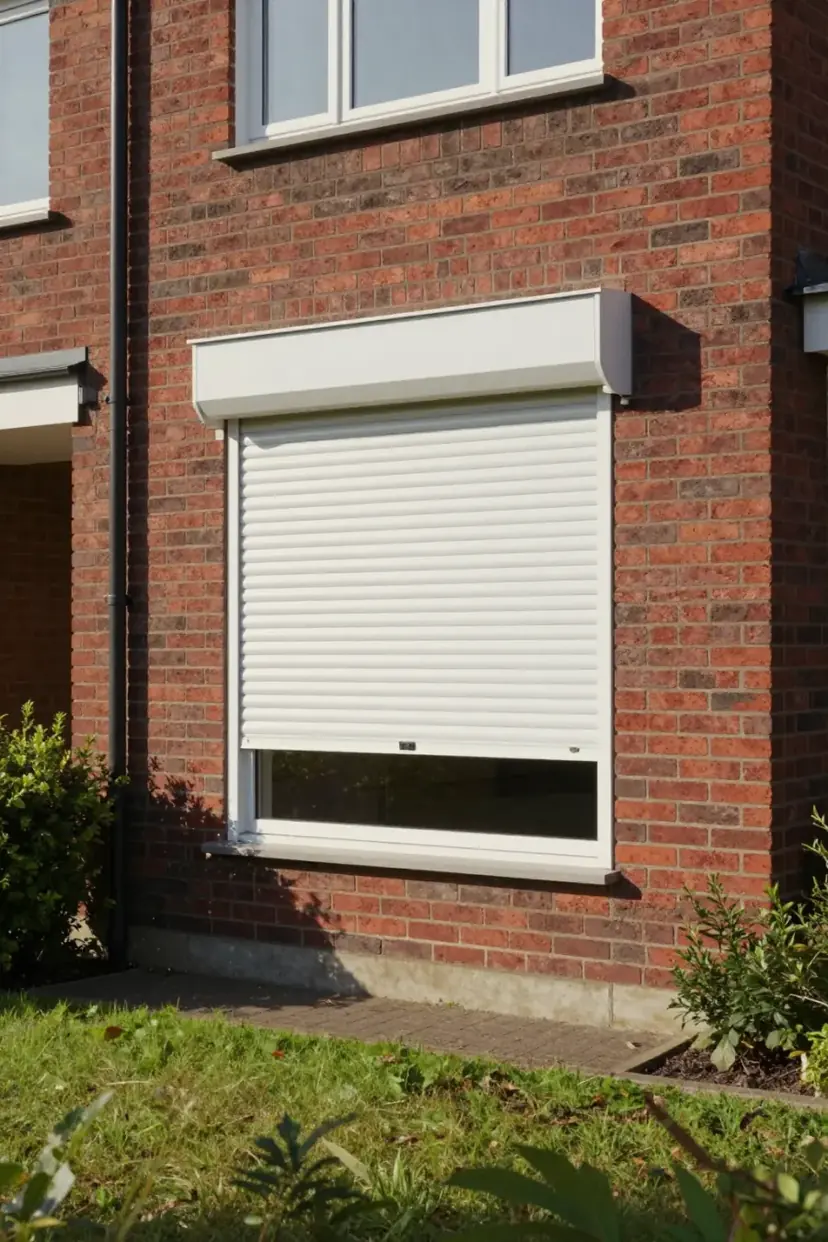


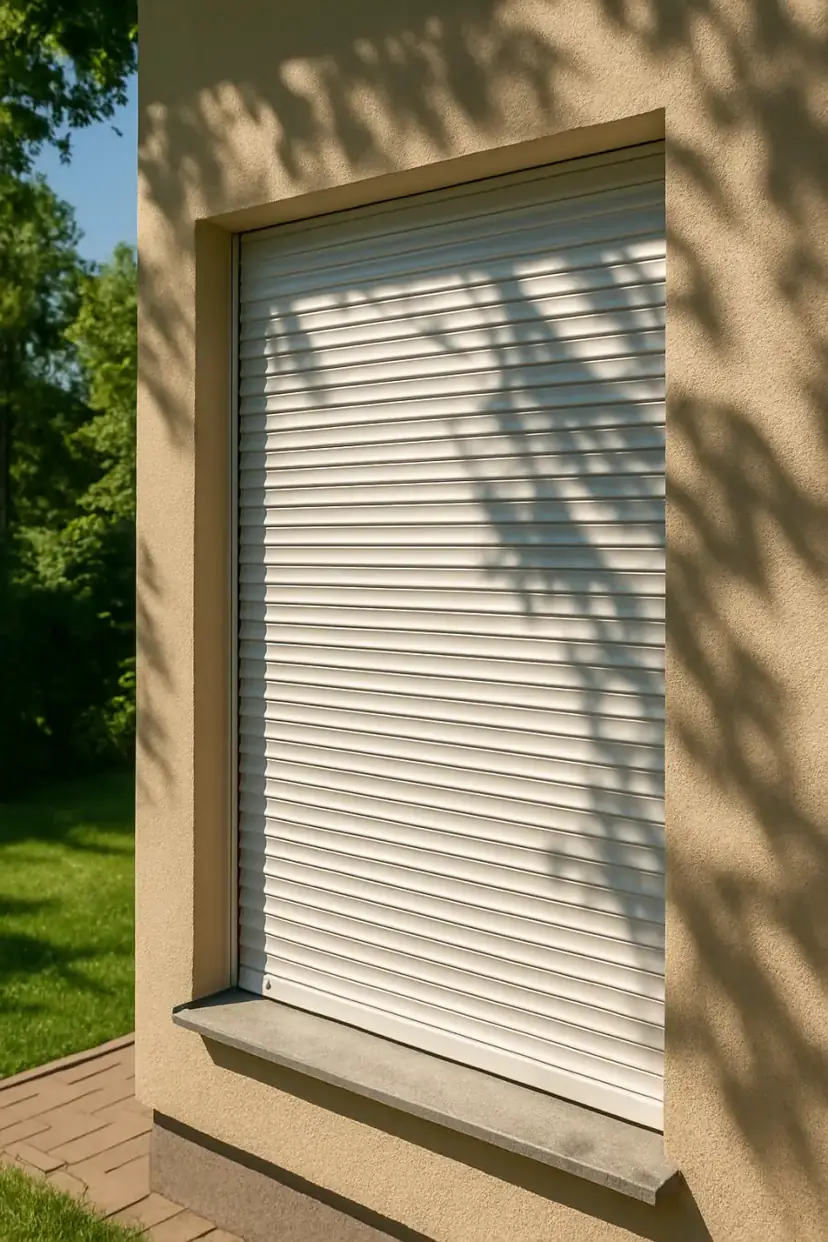











We manufacture roller shutters in Almaty to the dimensions of your property: measurement is free and on the day you call, manufacturing takes 10–18 days, prices start from 17,500 ₸/m² for a roll-formed foam-filled profile with manual operation. During the measurement we select the profile, housing box and controls for your window, door, shopfront or garage.
Roller shutters, rolling shutters and other names: sorting out the terms
Roller shutters, rolling shutters and roll-down shutters are all the same rolling system made of slats that closes a window, door or shopfront. “Roller-type shutters” is yet another name for the same product: a curtain of horizontal slats rises and lowers in the guide rails, and when rolled up it hides in the housing box above the opening.
Within one system, the profile, housing box, guide rails and controls differ — they determine what exactly you get at your property.
Outdoor roller shutters take on the weather: rain, dust, sun, attempts to break the curtain open from the street. Indoor ones close the opening from inside the room and work from a strap or cord — they are more often fitted on a storage room, a niche or a cupboard.
Why there are so many names
The Russian word for roller shutters came from European languages and is spelled and pronounced in several ways. These are all variants of one word, and there is more confusion in it than difference. Window roller shutters and rolling shutters, on the other hand, are descriptive names for the same system: the curtain rolls up into a roll, hence the word.
Sellers also mix these words freely, but behind all these shop signs there is one product.
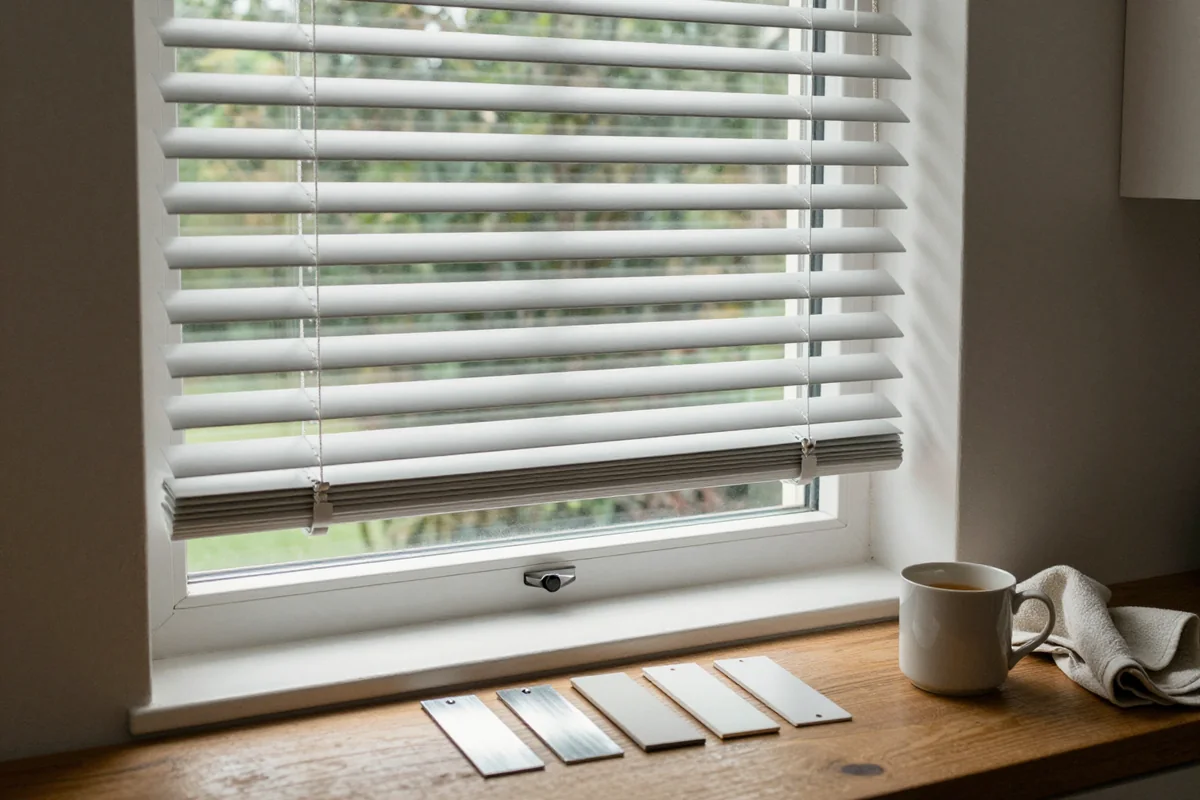
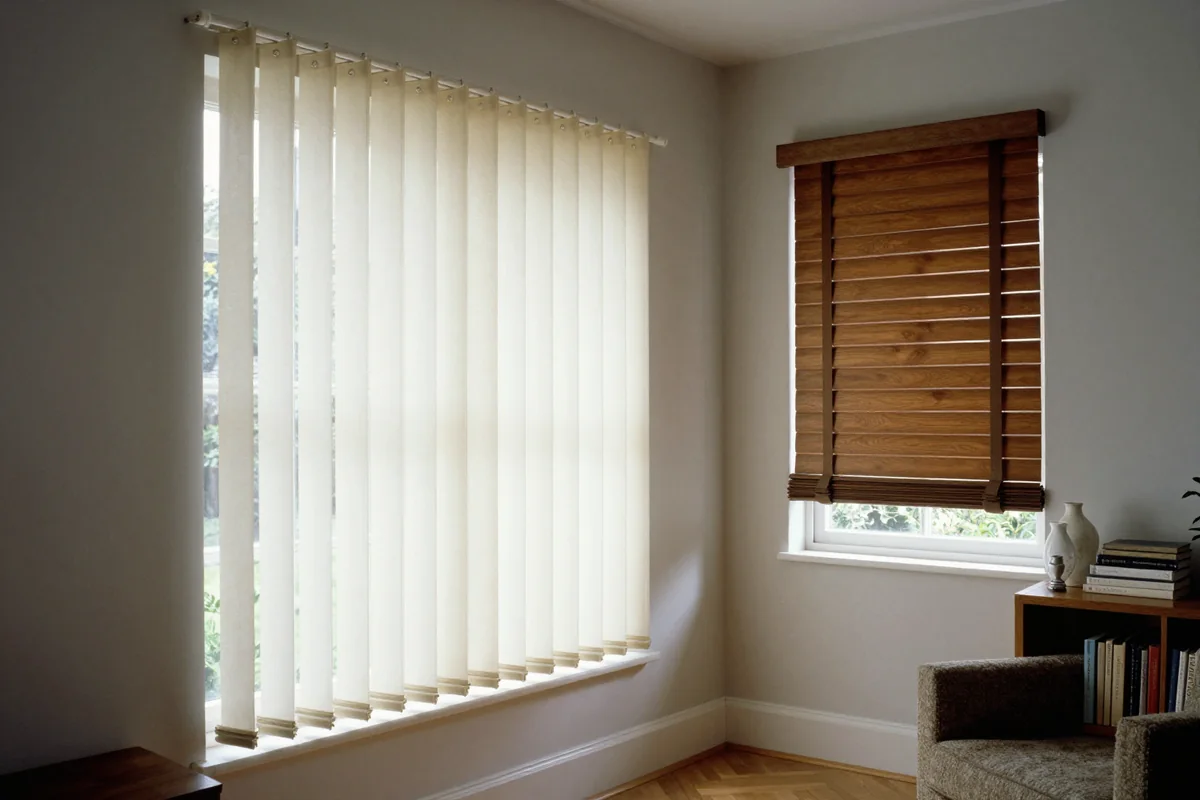
And what about blinds? People also say “roller-shutter blinds” for windows, but we make blinds and roller shutters as different systems: with blinds the slats turn, with roller shutters the blind rises as a whole.
Further in the text we call the product roller shutters, keeping in mind that rollets means the same thing.
Where roller shutters end and fabric blinds begin
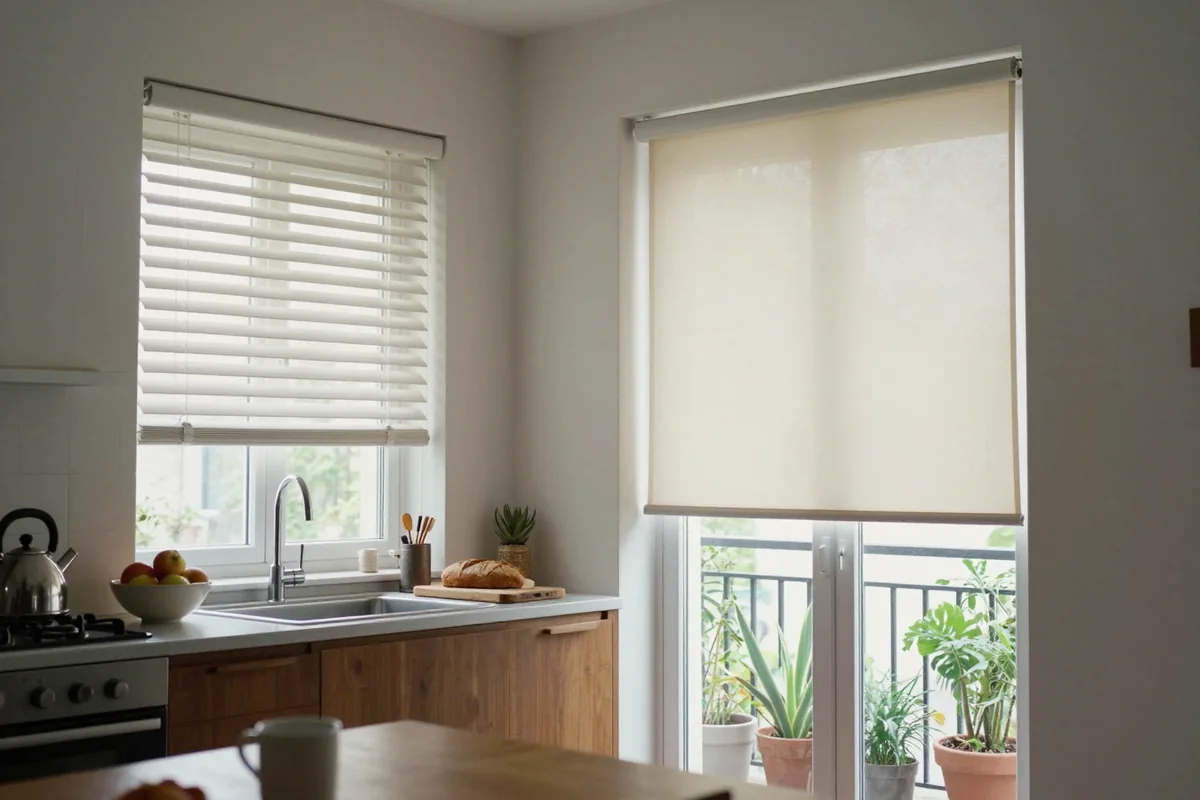
The most common confusion is with fabric roller blinds. They are sometimes called by the same word as shutters. When people talk about roller shades for windows or patterned roller shades for the kitchen, they almost always mean fabric or dense non-woven material, not aluminium slats. Fabric roller blinds differ from roller shutters in material and purpose: they are soft, do not cover the frame from the outside and do not protect against break-ins, but they do give colour, pattern and soft light.
Hence the caution with transparent roller shutters: it is not film or glass, but a curtain of slats with transparent inserts or holes — it closes the opening but keeps the shop window visible.
We do not make roller shutters with a pattern or roller shutters with photo printing from slats. If you need a pattern on the blind or light fabric for the kitchen, that is a different page — about fabric roller blinds. We make both products and do not substitute one for the other.
Roller shutters, rolling shutters and roll-down shutters are names for the same system of slats, while fabric roller blinds are a different product that we make separately.
Which profile and control your property needs
The profile and control are chosen for the property, not the other way around. We install the roll-formed foam-filled profile on apartment windows and balconies, the extruded aluminium profile on shop windows, garages and ground floors, the perforated one keeps the shop window visible, and galvanised steel goes on warehouses and technical rooms. Control is chosen after the profile: the heavier the blind, the more serious the mechanism.
| Profile | Property | Task |
|---|---|---|
| Roll-formed foam-filled, slat 39–45 mm | apartment windows, balcony and loggia | sun, noise, prying eyes |
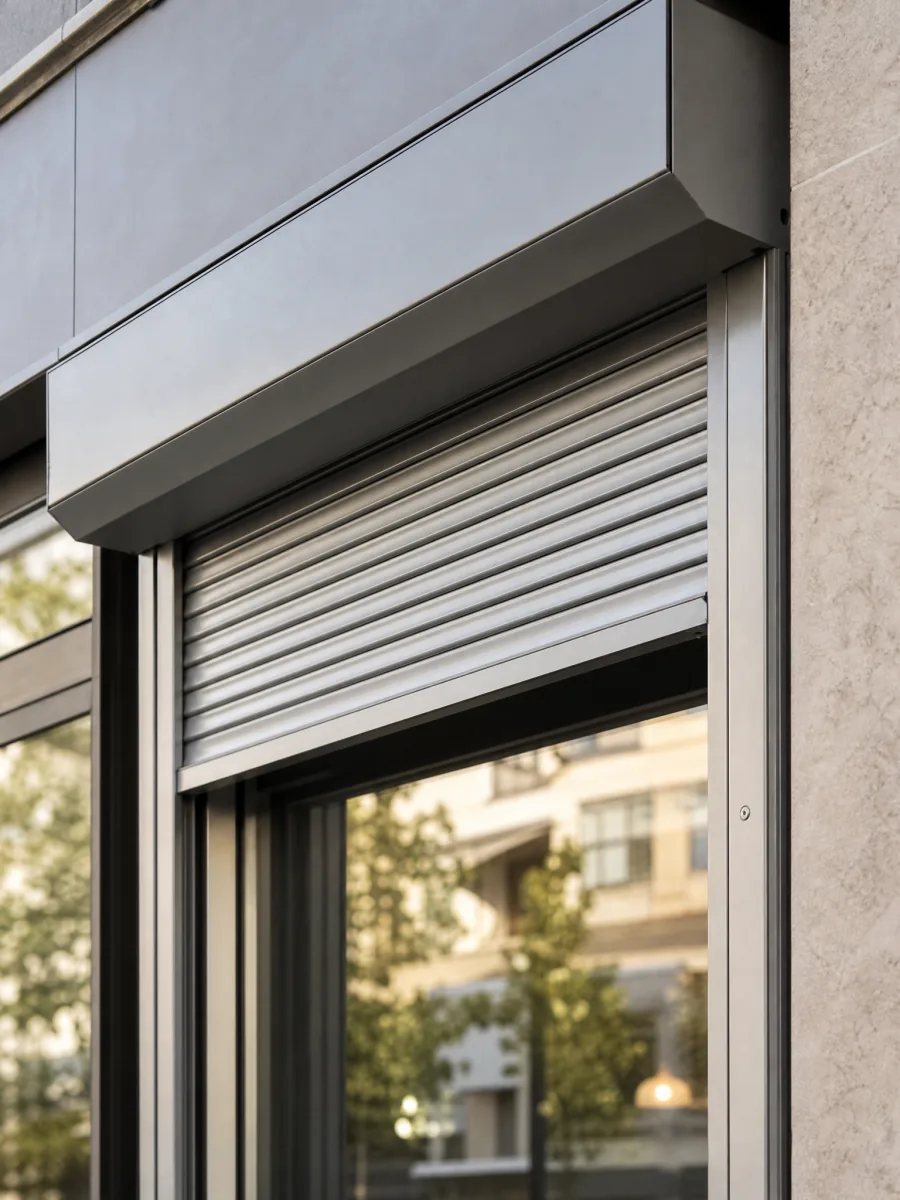
| Extruded aluminium, wall 1.2–1.5 mm | shop window, garage, ground floors | protection against break-ins |
| Perforated | shop window, café, car showroom | close but keep the view |
| Galvanised steel | warehouses, utility blocks, technical rooms | strength at a lower price |
Apartment, house, country house, shop — what we choose
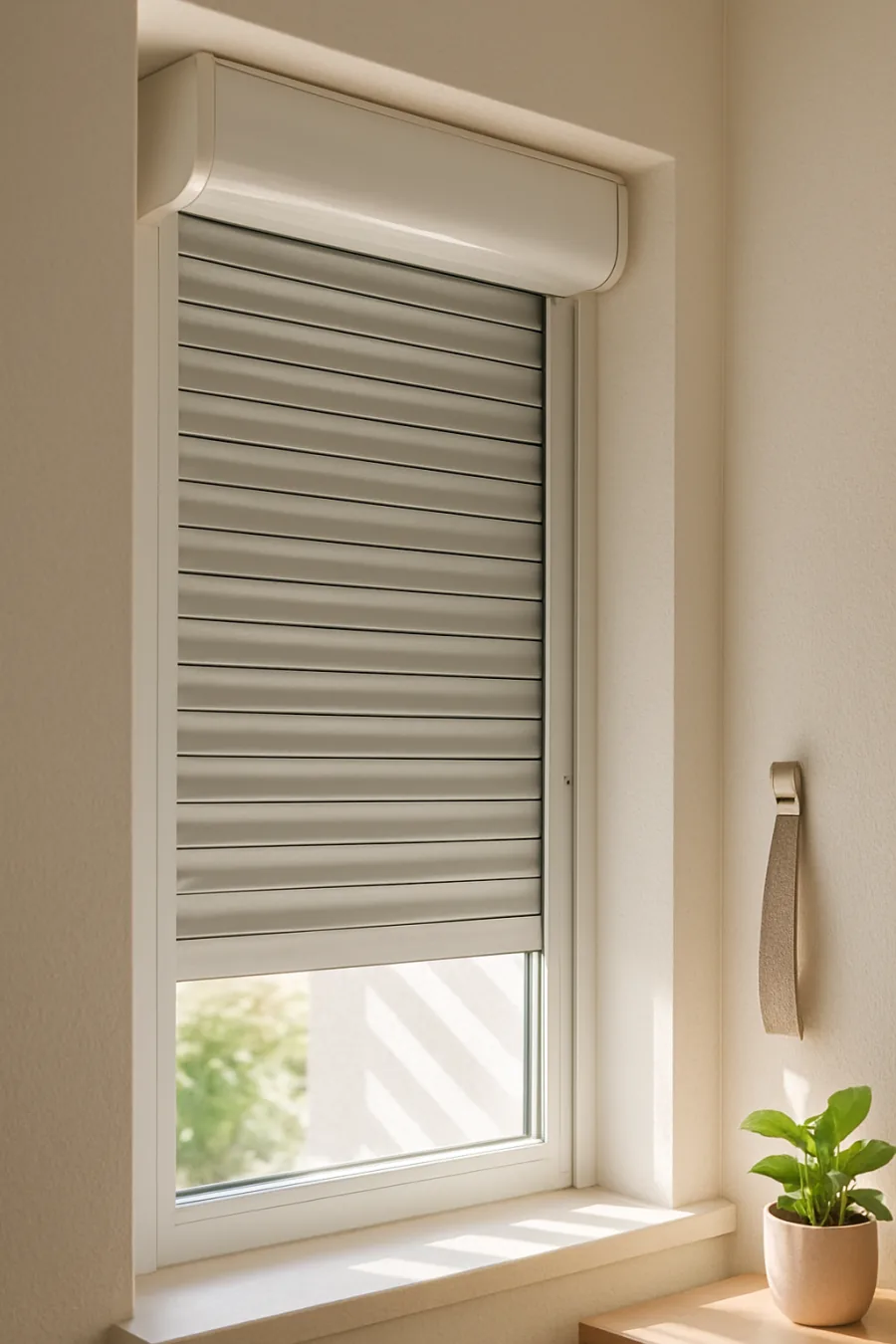
The roll-formed foam-filled profile is suitable for apartment windows and balconies. It is a rolled aluminium strip with foam filler: lightweight, quieter and warmer than extrusion, and for roller shutters on apartment windows above the ground floor it is more than enough. We install roller shutters in a room with a strap or cord from the inside.
For a house and a country house, the picture depends on the floor. Roller shutters on ground-floor windows of a house, if there is no security, are better assembled on extruded aluminium: a solid extruded profile, deadbolt locks. On the second floor and at a country house where people come for the weekend, a roll-formed foam-filled one is enough.
The perforated profile is for a shop window. Holes or transparent inserts let air through, the shop window stays visible, and the curtain is closed. We install steel roller shutters made of galvanised steel on warehouses and utility blocks: stronger and cheaper than aluminium, but heavier and sensitive to chips, so they go under powder coating.
At the measurement we ask one thing: what you are closing and from what. The answer determines the profile, the housing box and the control. A mistake here is expensive — no one will redo the guide rails after installation.
When the task is not protection but sun and quiet
Roller shutters against the sun work thanks to the air layer between the curtain and the glass. It takes off 2–4 dB of street noise and reduces heating on the south and west sides. For an apartment where you need quiet and shade, not protection against break-ins, this is enough — and there is no point in overpaying for extrusion.
Roller shutters do not replace a glass unit. The layer muffles part of the street noise but does not remove it completely: if the window faces a main road, do not expect quiet in the room. In our experience, people more often overpay for the profile here, when the problem is solved by control and by raising the curtain correctly during the day.
There is also a practical side. On a balcony, roller shutters protect the glazing from dust and poplar fluff, and the balcony has to be cleaned noticeably less often. On south-facing windows we keep the roller shutters down during the day for sun protection and raise them in a few seconds in the evening — only the housing box remains on the façade.
We install the roll-formed foam-filled profile on apartment windows and balconies, extruded aluminium on shop windows, garages and ground floors, the perforated one keeps the shop window visible, and galvanised steel goes on warehouses and technical rooms.
What the price of roller shutters in Almaty is made up of
The price of roller shutters is made up of five things: the profile, the control, the shape of the opening, the locks and the installation. The simplest set — a roll-formed foam-filled profile with a manual mechanism — starts from 17,500 ₸/m². A set with an electric motor and remote control — from 35,000 ₸/m².
The most expensive part is not the size of the window, but what you hang inside the housing box. The profile sets the weight of the blind, the weight sets the control, and the control pulls the housing box with guide rails along with it. Hence the spread across the options.
| Roller shutters | What for | Price from, ₸/m² | Manufacturing |
|---|---|---|---|
| Roll-formed foam-filled profile with a manual mechanism | Apartment windows and balconies | 17,500 | 10–14 days |
| Protective, made of extruded aluminium | Shop windows, garages, ground floors | 24,900 | 12–16 days |
| Perforated | Shop window visible, air passes through | 27,800 | 12–16 days |
| With electric motor and remote control | Many windows, a large blind | 35,000 | 14–18 days |
What is included in a square metre
A square metre includes the profile, the housing box, the guide rails and the mechanism. Locks, the shape of the opening and installation change the total, so we give the final amount for your opening after the measurement, when the shape of the window and the fixing points are visible.
A deadbolt lock strengthens protection against break-ins — this is the case where the extra payment changes not the appearance but the task itself. The burglary-resistance class depends on the profile, the locks and the installation together, and it cannot be raised by one item alone: an extruded aluminium profile with a deadbolt lock and automatic slat fixers takes a long time and makes noise to break open, while a roll-formed foam-filled profile does not solve the break-in task, no matter how many locks you put on it. If protection is not needed and you are closing the window from the sun and prying eyes, there is no reason to pay for a deadbolt lock. If you need roller shutters in Almaty inexpensively, start with this: a roll-formed profile with a manual mechanism is the lowest option on the list, and for an apartment it is usually enough. Inexpensive roller shutters means exactly this option, not perforation or a motor.
How the shape of the opening affects the price
The shape of the opening affects the price through a coefficient applied to the base price. A rectangular or square window — ×1.0. A sloped one — ×1.3. An arched one — ×1.45. A triangular one — ×1.5.
The reason is not aesthetics but cutting: the further the opening is from a rectangle, the more profile strip is wasted and the harder it is to set the guide rails so that the blind moves without jamming. A roll-formed foam-filled profile bends into an arch more easily, an extruded aluminium profile less so, and on a non-standard opening this shows up in the price and the lead time.
The control type is counted as a separate coefficient: manual ×1.0, chain ×1.06, electric motor ×1.85, electric motor with remote control ×2.1. The coefficients are multiplied, so an arched window with a motor comes out noticeably more expensive than a sloped one with a strap. On non-standard openings we advise against saving on the control: a manual mechanism on an arch is harder to service later.
Which costs more — manual or automatic
A set with an electric motor and remote control comes out roughly twice as expensive as a manual one. The remote, the schedule and the sun sensor are about convenience and predictability, not protection: the burglary resistance of the set does not depend on the motor.
When is automation justified? Many windows at once, a large and heavy blind, a shopfront that is opened and closed on a schedule. For a single kitchen window with a vent, a strap is cheaper and more reliable — there is nothing there to break. The price difference between a roll-formed and an extruded profile is about one and a half times, so changing the profile to save on the motor is a bad deal.
We price roller shutters in Almaty by the same logic every time: profile, control, shape of the opening, locks, installation. The price of roller shutters is never pulled out of thin air — it is made up of these five points.
The price of roller shutters is made up of the profile, the control, the shape of the opening, the locks and the installation, not of a single square metre.
Measurement: what we check on the facade before you order
The measurement determines two things: whether there is room on the facade for the housing box and where to fix the guide rails. Both are decided before the order, not after. The measurement is free and takes place on the day you get in touch, so our measurer can come as early as today.
What the measurer does
The measurer arrives with profile samples and a colour palette. This is not a formality — you choose the colour and thickness of the slats by hand, not from a picture in a chat.
What they check:
- The space above the opening for the housing box. Whether there is enough facade height, whether a canopy, external sill flashing or stretched siding gets in the way.
- The fixing points for the guide rails. We fix them into the load-bearing wall through the insulation, not into the insulation itself — on an insulated facade this is the main question, and it can only be resolved on site.
- The geometry of the opening. Slants, the depth of the window reveal, how even the wall is. This determines whether the blind will sit without gaps at the sides.
- The purpose. Are we closing off against burglary or against sun and noise? The difference is fundamental: protection requires an extruded profile and a deadbolt lock, while sun and quiet are easily handled by a roll-formed foam-filled profile.
And yes, the weak spot is almost always the same — the window reveal. Outside, the plaster holds firm, but underneath it is hollow, and the guide rail does not go into it. This only shows up during the measurement.
Can you take the measurements yourself
You can. You can measure the width and height of the opening with a tape measure, and we will make the blind to those dimensions. But without checking the facade on site, the decision on the housing box and the fixing remains up in the air: you will not see the slants or where exactly the fixings will go.
Here is how we work: if a client sends their own dimensions, we calculate an approximate price from them, but we still come out for the measurement. The measurement is free, and it is cheaper than redoing a finished product.
If you want to order roller shutters for windows or buy roller shutters in Almaty to your own measurements, the order is the same: first the dimensions, then the measurement, then the order.
During construction or after finishing
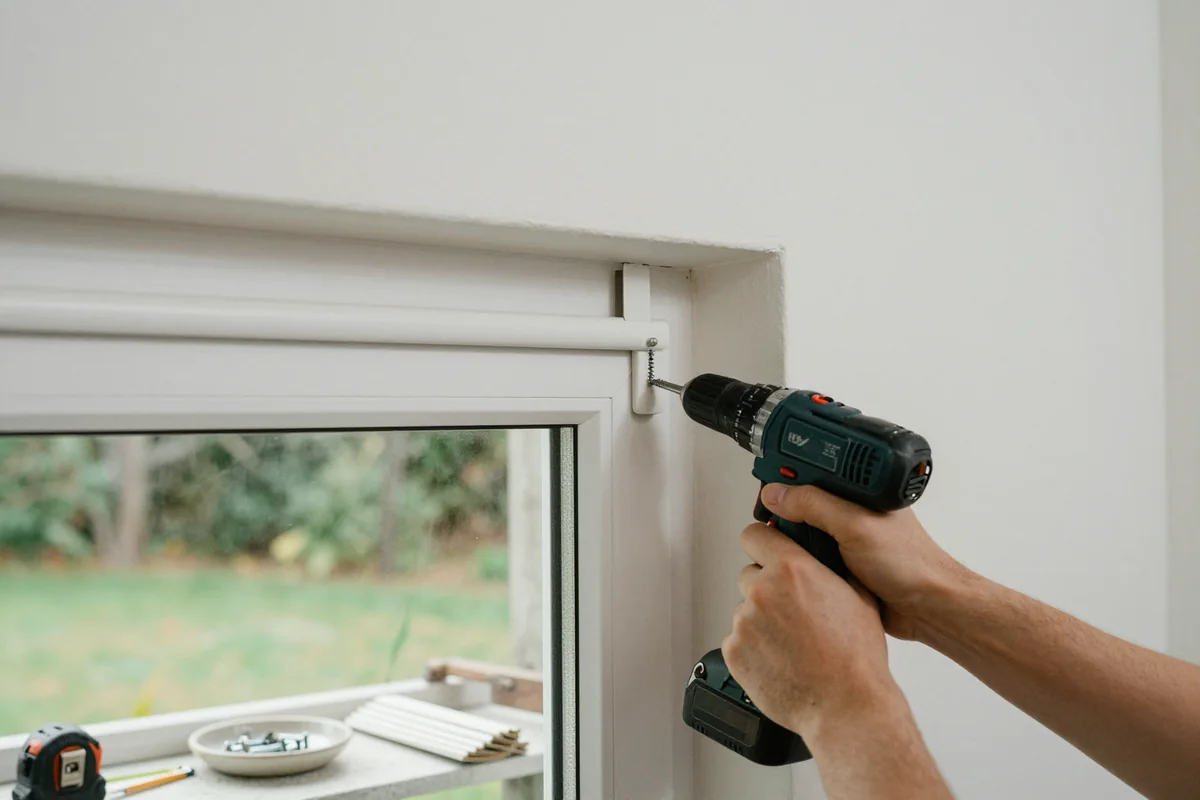
A surface-mounted housing box is fitted to a finished facade. There is no need to take apart the window reveals or replace the windows — the box sits on the outside above the opening. For most orders we choose exactly this one: made-to-order roller shutters after renovation are installed without rework.
A built-in housing box is installed together with the windows, at the construction stage. A concealed one — only at the facade finishing stage, under the plaster. If the house is already finished, you cannot go back to the concealed option.
During the measurement we check whether there is room on the facade for the housing box and where to fix the guide rails — this is decided before the order, not after.
How roller shutters behave in winter in Almaty
Almaty winters are sharply continental: hard frosts and a big temperature swing between day and night. For roller shutters this means one thing — the main battle is not with the cold but with moisture, which turns into ice in freezing weather. We install the housing box and guide rails so that water does not linger inside and the curtain does not freeze to the walls. And yes, in winter we always show the customer the emergency lift — it is part of the handover, not a minor formality.
Snow and ice on the housing box
Snow on the housing box is not a problem for roller shutters in itself. Ice is more dangerous. It appears where meltwater runs down the facade and gets into the gap between the curtain and the guide rail, then freezes overnight. In the morning the curtain simply will not go up: the mechanism pulls, but the slats stay put.
What to do if the roller shutters on the windows are frozen stuck? Do not yank the strap or force the motor. The ice needs to be removed — carefully, without metal, with warm water from a bottle or a soft scraper, and then wipe the guide rails dry. Once the curtain starts moving, it will go easily after that.
During installation we do two things: we set the guide rails so that water drains downwards instead of lingering in the groove, and we leave a gap in which ice does not lock the curtain. Outdoor roller shutters for windows and roller shutters on a balcony under a canopy freeze up less often — there is less water and less snow blowing in.
Frost and the electric motor
Automation works in winter, but with a caveat for thick grease and cold metal. For the first few seconds after a long night the motor runs harder. This is normal.
The emergency lift works during a power cut: the blind is raised by hand through an output for a crank handle. In winter this is not a backup option but a working scenario — ice and voltage swings happen in the same month. For a garage and a single entrance, a manual lift is a must. In the morning the power may be out, but you still need to drive out.
Galvanised steel handles the cold calmly. It is stronger and cheaper than aluminium, but sensitive to chips: if the powder coating is damaged, the metal starts to corrode at that spot. That is why at country houses we advise inspecting the blind before winter.
Will roller shutters at a country house rust over the winter? Roller shutters for a home and roller shutters for a country house with an intact coating — no. A scratch just needs touching up so that you do not find a rusty spot in spring.
Dust in the guide rails
In summer Almaty is dusty, and dust settles in the guide rails. On its own it is harmless, but together with winter moisture it turns into a paste that slows the blind and wears out the mechanism.
Cleaning the guide rails is simple: with a soft brush or a vacuum cleaner without a bristle attachment, once a season. Nothing needs to be taken apart. After cleaning, it helps to wipe the groove with a dry cloth rather than lubricant — excess lubricant will just collect dust.
The rhythm is this: in autumn — before the frosts, in spring — after. And then the mechanism runs smoothly all year round.
Almaty's sharply continental climate asks just one thing of a roller shutter owner: clean the guide rails in autumn and know where the emergency lift handle is — that is enough for the system to get through winter without surprises.
Surface-mounted, built-in or concealed housing box
The housing box can be surface-mounted, built-in or concealed, and what differs is not its shape but where it sits and how much space it takes. The surface-mounted box is the cheapest. It is installed outside above the opening, on a finished façade. A built-in box takes up 15–20 cm of the opening's height. A concealed box can only be planned at the façade finishing stage.
The surface-mounted box is the option chosen in most cases. When roller shutters are needed for an already glazed window, there is no need to take the reveals apart: the box is fixed to the wall above the opening, and the guide rails run along the sides. The window loses neither glass nor height. The same cannot be said for a built-in box.
A built-in box lives inside the opening and is planned together with the windows. It does not protrude onto the façade; only the curtain is visible from outside. The price for this is the height of the opening: 15–20 cm goes under the box, and the glass becomes lower. If you are ordering roller shutters for windows at the construction stage, the built-in box is worth considering right away. Once the finishing is done, it can no longer be built in.
The concealed box is the neatest from outside. It is hidden under the plaster, and neither the box nor the mechanism is visible on the façade. But it too can only be planned at the façade finishing stage (before the plaster goes on). Which is cheaper? The surface-mounted one. Which is more practical? Depends on what matters more to you — saving money or getting a clean façade.
Mounting on an insulated façade
We fix the guide rails into the load-bearing wall through the insulation, not into the insulation. This is fundamental. Insulation does not carry the load of the blind — over time the fixing in it works loose, and the guide rail shifts. A load-bearing wall holds.
The reveals do not have to be taken apart. An insulated façade is no obstacle in itself: the fixing goes through the insulation layer to the wall. If a turnkey price matters to you and you are buying roller shutters for windows in an insulated house, a surface-mounted box and this kind of fixing are a workable combination.
The measurer brings profile samples and a colour palette, and at the measurement you can already see whether the box will fit your façade or not.
Manual mechanism or electric motor
Manual control and an electric motor solve the same task — raising and lowering the blind — but in different ways. Manual control works by hand and does not depend on the mains. An electric motor means a motor, a remote control, a schedule and a sun sensor, and it is worth paying for where the blind is heavy, there are many windows, or you want to control them from a smartphone.
Strap, cord, crank, spring
Manual roller shutters are operated by a strap, a cord, a crank or a spring. A strap and a cord are the simplest manual control. A strap and a cord are designed for a curtain of roughly up to 6 m²: that is enough for an ordinary apartment window or a balcony block. Beyond that, other mechanisms come into play.
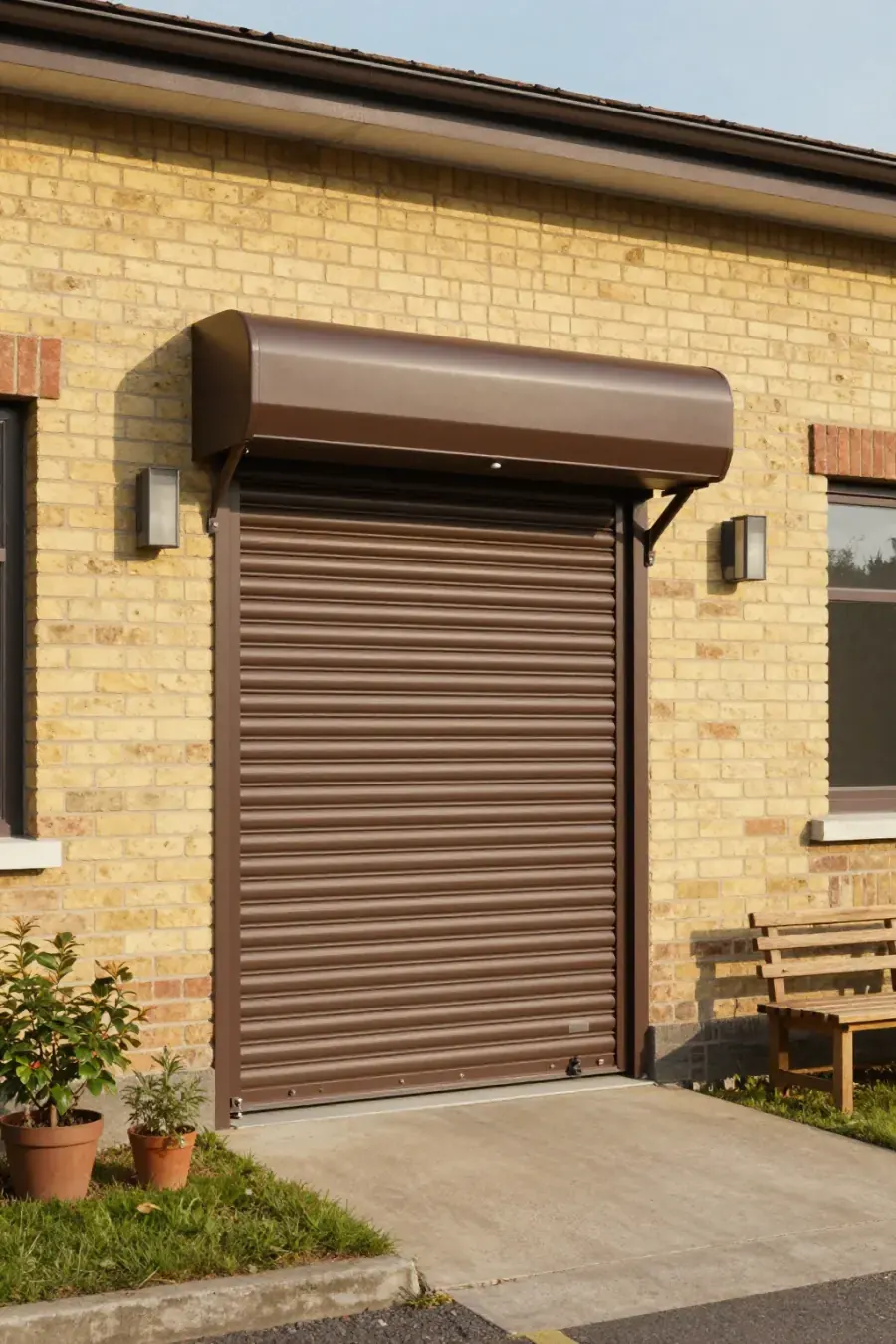
A crank lifts a heavy blind — shopfronts and garage doors, where a strap is no longer enough. A spring-inertia mechanism is used on doors: you push the blind, and it travels up the guide rails by itself, with no handle and no motor.
Which mechanism will fit your opening depends on the weight of the blind and the area of the window. That is why we select the box and guide rails for the control system right away, rather than buying them later.
When an electric motor is justified
An electric motor is justified in three cases. Many windows — one remote control instead of ten straps. A large curtain — lifting it by hand is hard, or even awkward. And the third case: you need a scenario where the roller shutters go up by themselves in the morning and close in the evening — that is control by schedule and sun sensor.
There is also a practical argument. In an office room where the sun moves across all the windows during the day, with a motor an employee does not run to each window with a strap but presses one button on the remote.
A set with an electric motor and remote control costs roughly twice as much as manual control. If there are two windows and the blind is light, that difference never pays off. But for a shopfront or a glazed loggia with several sections, automation is no longer a luxury.
Automating already installed roller shutters
Roller shutters with a strap drive can be automated — the motor is installed in the same box. But there is a condition: the box and guide rails must suit the motor in size and load. That is exactly why at the measurement we ask right away whether you plan to add automation later: reworking a box for a motor after the fact costs more than planning for it from the start.
How do you close roller shutters from inside without going outside? With manual control this is done with a strap or cord from inside the room, while a crank and a spring are solutions for the outside, for doors and gates. Hence the simple logic: if a window should close only from inside, choose a strap, a cord or a motor, but not a crank.
And one more thing we always show during installation. When the power goes out, the blind is raised by hand via the emergency lead with a crank handle. For a garage and a single entrance, manual lifting is essential — otherwise the car stays inside until the power comes back.
A blind of roughly up to 6 m² is closed with a strap and a cord, a crank lifts a heavy blind, a spring-inertia mechanism is used on doors, and an electric motor means a motor, a remote control, a schedule and a sun sensor.
Non-standard openings: arched, mansard, panoramic, narrow
A non-standard opening is not a separate type of product but the same roller shutter whose shape, width or curtain weight goes beyond the usual. We calculate arched, sloped and triangular openings with coefficients of ×1.3–1.5 on the base price. We select the width and control system based on the profile and the weight of the curtain: the heavier and wider it is, the more often an electric motor is needed.
Guiding a curtain along a curve is harder than along a straight line, so roller shutters require guide rails that follow the line of the opening. It is the guide rails, not the profile itself, that determine what the work will cost.
Arched, sloped, triangular
We calculate a sloped window, for example in a mansard, with a coefficient of ×1.3. An arched one — ×1.45, a triangular one — ×1.5. The difference is not in the material but in the cutting of the slats and in the guide rails shaped to the opening.
For such an opening we use a roll-formed foam-filled profile: it is lighter and follows a curve more precisely. We install extruded aluminium profile on mansard windows less often — a solid slat is stiffer, and this shows on a small radius. For sloped and arched windows the control is more often manual — a strap or a cord, if the blind is small in area.
Panoramic glazing and large widths
Roller shutters on panoramic windows are a matter of weight and width. The wider the curtain, the thicker the profile must be so that the roller tube does not sag under its own weight. On wide openings a roll-formed foam-filled profile is no longer enough, and we switch to extruded aluminium.
If you need roller shutters 6 metres wide for a shopfront or a garage, that is always a heavy curtain, and we decide whether it can be made at the measurement. Such a curtain is lifted by a crank or an electric motor — a strap and a cord will not cope here. When people ask about transparent roller shutters, we show a perforated profile: holes or transparent inserts keep the shopfront visible while letting air through.
Sliding roller shutters and sliding shutters for windows are not our system. Roller shutters always roll up into the housing box, they don't slide apart to the sides.
Narrow openings and colour
Narrow roller shutters are for stairwell windows, bathrooms, small openings in a storage room. Here the roll-formed foam-filled profile works: it's light, and on a narrow opening a strap or cord is enough. For a narrow opening the housing box can be surface-mounted or built-in — depending on the site.
You don't choose the colour in advance from a photo. We bring the colour palette to the measurement, and the customer picks the shade next to the facade — for example, brown roller shutters are chosen so they don't clash with the dark finish of the house. Roller-type shutters and rolling shutters are the same product, and their colour is likewise chosen from the palette on site.
We calculate arched, sloped and triangular openings with coefficients of ×1.3–1.5 to the base price, and we select the width and the control by the profile and the weight of the blind.
Roller shutters for a balcony, a storage room and indoors
On a balcony, roller shutters protect the glazing from dust and poplar fluff, while indoors they are fitted to a storage room, a niche or a cupboard — the housing box and the mounting are chosen for the place. External and internal roller shutters are not two different products, but one system in different conditions: outside it resists burglary, sun and noise, in a room it solves a narrow access task.
Balcony and loggia
For a balcony and a loggia we most often fit a roll-formed foam-filled profile — it's light and doesn't overload the glazing. The glazing stays in place, there's no need to take it apart. Roller shutters on a balcony are fitted outside, in front of the frames: the curtain lowers over the glass and the frame, and on the facade only the housing box remains when raised. For an enclosed balcony this noticeably changes daily life — less dust and fluff, and you have to clean half as often.
The air gap between the curtain and the glass reduces street noise and heat on the south and west sides. In summer on a sunny balcony you feel it right away, but roller shutters don't replace a glass unit, and in winter they won't make the balcony warm. The control on a balcony is usually manual — a strap or cord is routed inside, and you can raise the curtain without going outside.
There's also a limitation with the housing box. A surface-mounted box is fixed outside above the opening and takes up space on the facade; on a narrow balcony with a parapet you first need to find that space. That's exactly why the measurer looks at the balcony on site — such a decision can't be made from a photo.
Indoors
Indoors, roller shutters are fitted to a storage room, a niche, a cupboard, and sometimes in the kitchen — where you need an opening that closes, not protection against burglary. Roller shutters on a storage room protect the shelves from dust and other people's hands, roller shutters in the kitchen hide a niche with appliances or a work area. Roller shutters in a room are fitted less often — usually under a niche or a built-in cupboard.
The profile here is the same roll-formed foam-filled one: it's quiet and light, and heavy extruded aluminium makes no sense indoors — there's nothing to protect against. The housing box in a room is almost always surface-mounted, fixed to the wall or to the ceiling of the niche. A built-in box is only possible when the niche for it has already been provided — for example, when assembling a cupboard.
What you can't do indoors is route the curtain outside and expect it to protect. Roller shutters inside an apartment work as a closing sash, and their task is a domestic one: remove dust, hide the contents, free up space.
Installation and care: what we do and what's left to you
Installation takes from 2 hours, the warranty is 3 years, and care comes down to cleaning dust off the guide rails. There's no need to service the mechanism inside the housing box: it's enclosed, and you shouldn't go in there with oil — grease collects dust and turns into an abrasive. Let's go through it in order, because installation and care are two halves of one story.
How installation goes
We fix the guide rails into the load-bearing wall through the insulation, not into the insulation. This is a fundamental point. If you mount them in the layer of thermal insulation, the blind will shift over time and the mechanism will start working with a skew. That's why we determine the fixing points at the measurement — the same place where we check the space for the housing box.
Then step by step:
- We mark out and fix the guide rails by level.
- We fit the housing box and feed the blind into it.
- Jalusso adjusts the mechanism or the drive — it sets the travel so the blind moves evenly and without knocking.
- We show you the emergency lift and winter care.
- We check the operation in your presence and sign the acceptance report.
The last point is not a formality. The emergency lift works during a power outage: the blind is raised manually via the outlet for the crank handle. For a garage and the only entrance to a house, manual lifting is essential, and we insist that you try it yourself before the crew leaves.
Care
Clean dust off the guide rails. In Almaty it's dusty in summer, and the guide rails are the first to suffer — the blind starts to move more stiffly and a squeak appears. Wiping them with a soft cloth is enough, without abrasives or solvents.
In winter, ice adds to the dust. If the blind has frozen to the guide rails, don't pull with force — remove the ice first, then raise it.
What breaks most often? The control strap and the cord: these are consumables, they wear out from constant use. A single slat can be replaced, and most often that's enough to restore the look of the curtain. We manufacture our roller shutters ourselves, without intermediaries, so we match a replacement slat to our own profile. Roller shutters in Almaty are easier to service from the manufacturer than a product bought in a shop without a measurement.
Warranty and the suburbs
The mechanism of roller shutters has a warranty of 3 years, installation work — 1 year; the count starts from the day the acceptance report is signed. If the fault is covered by warranty, we repair it at our own expense and complete it within 5 working days of your request.
To the suburbs — Kaskelen, Talgar, Issyk, Kapshagay — we do travel out, and the cost of the visit is quoted before the visit, not after the fact. Within the city, measurement and delivery are free.
On approval for the facade of an apartment building: the roller shutter itself is fitted with a surface-mounted box outside above the opening, there's no need to take apart the window reveals, and the window doesn't lose its glass. But if your building is an apartment block with a shared facade, we clarify the approval procedure together with you before the order: it's a matter for your building's owners' association (KSK), not for the workshop.
In short: the guide rails are fixed into the load-bearing wall through the insulation, the emergency lift works during a power outage, and the installation stage takes from 2 hours.
Roller shutters and related systems: grilles, alarms, screens
A roller grille and roller shutters solve different tasks. A grille stays on the opening permanently: it blocks the view, and you can't remove it during the day — in a fire such an opening turns into a solid wall. Roller shutters are raised in a few seconds during the day, and only the housing box remains on the facade.
Grille or roller shutters
Permanent protection versus a lifting system — that's the difference. If you need a window or a shopfront to be open to light and air for most of the day, a grille doesn't work. If the opening is closed at night or while you're away, roller shutters are more convenient.
Roller shutters close a window, a door or a shopfront and at the same time remain part of the facade, not a separate structure in front of it. An extruded aluminium profile with a deadbolt lock gives protection, a roll-formed foam-filled one — sun and quiet on apartment windows. For entrances there are roller gates: the same rolling logic, only for a gate opening, and that's a separate system.
A roller grille wins where the opening should not be opened at all — for example, a utility room or a ventilation niche.
Alarm systems, insect screens, covers
A security alarm can be combined with roller shutters: the sensor of the alarm system can be positioned so that it triggers when someone tries to lift or pry the curtain. This is done by the company that services your alarm system.
An insect screen is a separate matter. It is fixed to the window frame, not to the roller shutters, and it is installed under the housing box or on the inner side of the opening. With an overlay housing box there is no conflict: the guide rails run along the edges of the opening, and the screen stays on the frame. With a built-in housing box, the screen is included in the design together with the window.
Decorative covers hide the housing box and the edges of the guide rails when the facade is already finished and you want the box not to read as a separate detail. And the last thing worth separating: window blinds and fabric roller blinds are not the same as roller shutters. Fabric roller blinds differ from roller shutters in material and purpose: they do not cover the opening from the outside and do not protect against burglary.
A roller grille stays in place permanently and blocks the view, while roller shutters are raised in seconds during the day — these are different systems for different tasks.
FAQ
We have gathered what people most often write to us on WhatsApp before the measurement — short and to the point.
How much does a square metre of roller shutters cost in Almaty?
Roller shutters for windows with a roll-formed foam-filled profile and manual operation start from 17,500 ₸/m². Protective ones made of extruded aluminium — from 24,900 ₸/m², perforated — from 27,800 ₸/m², a set with an electric motor — from 35,000 ₸/m². This is the price per square metre of the product; the shape of the opening, locks and controls change the total. We will give you the exact figure for your window after the measurement — it depends on the dimensions and the chosen controls.
What is the difference between a roll-formed foam-filled profile and an extruded one?
A roll-formed foam-filled profile is a rolled aluminium strip with foam filler, slat 39–45 mm, lightweight and quieter in operation. An extruded aluminium profile is a solid extruded profile with a wall of 1.2–1.5 mm: heavier, more expensive, but it is precisely for this that deadbolt locks and automatic slat retainers are installed. The price difference between them is about one and a half times, and you choose not by looks but by the task: a flat window or an unguarded shop window.
Can roller shutters be installed on plastic windows?
Yes. Roller shutters for windows are installed on the outside, with an overlay housing box above the opening, and you do not have to dismantle the window reveals or replace the glass unit itself. We fix the guide rails into the load-bearing wall, not into the insulation, so an insulated facade is no obstacle either.
What should I do if the power goes out?
The blind is raised manually via the emergency crank outlet, and this is not an emergency mode but a standard one. That is why for a garage and the only entrance to a house we make manual lifting mandatory: we will show it to you during installation so that you can try it yourself.
Can a single slat be replaced?
Yes, the blind is repairable: one damaged slat can be replaced without replacing the whole system. The warranty is 3 years, and we fix warranty cases free of charge within 5 working days from the moment you contact us.
How long does an order take?
Measurement — on the day you contact us, manufacturing — 10–18 days: the roll-formed profile is faster, the extruded one and automation take longer. Installation takes from 2 hours. The timeframe depends on the profile and controls, so we give it right away when you order.
The profile, housing box, controls, locks and installation together determine both the price and the burglary-resistance class of the roller shutters.
Conclusion
Roller shutters, rolling shutters and roll-down shutters are all the same roller system made of slats, while fabric roller blinds are a different product, and we make them separately. It is worth remembering this for one reason: half the confusion in a conversation starts with the name, not the task.
The profile, housing box and controls are selected for the property. A ground-floor flat, a house, a country house, a shop window, a garage — each has its own set. And it does not work the other way round: first the product, then the property — that is not how it goes.
The price is made up of the profile, controls, shape of the opening, locks and installation. Prices start from 17,500 ₸/m² for a roll-formed foam-filled profile with manual operation; a set with an electric motor and remote control costs about twice as much. The shape of the opening adds to the base price: a sloped window — ×1.3, an arched one — ×1.45, a triangular one — ×1.5.
Measurement is free and on the day you contact us. Manufacturing takes 10–18 days, the warranty is 3 years. We tell you this right away, not after signing.
In winter in Almaty, care of the guide rails and emergency lifting matter — we show it during installation so that you do not get flustered if the power goes out or the blind freezes.
There is one practical recommendation. Write to us on WhatsApp, tell us what you are covering — a window, a door, a shop window or a garage — and whether you need protection or sun and noise control. We will give you an approximate price right away.