




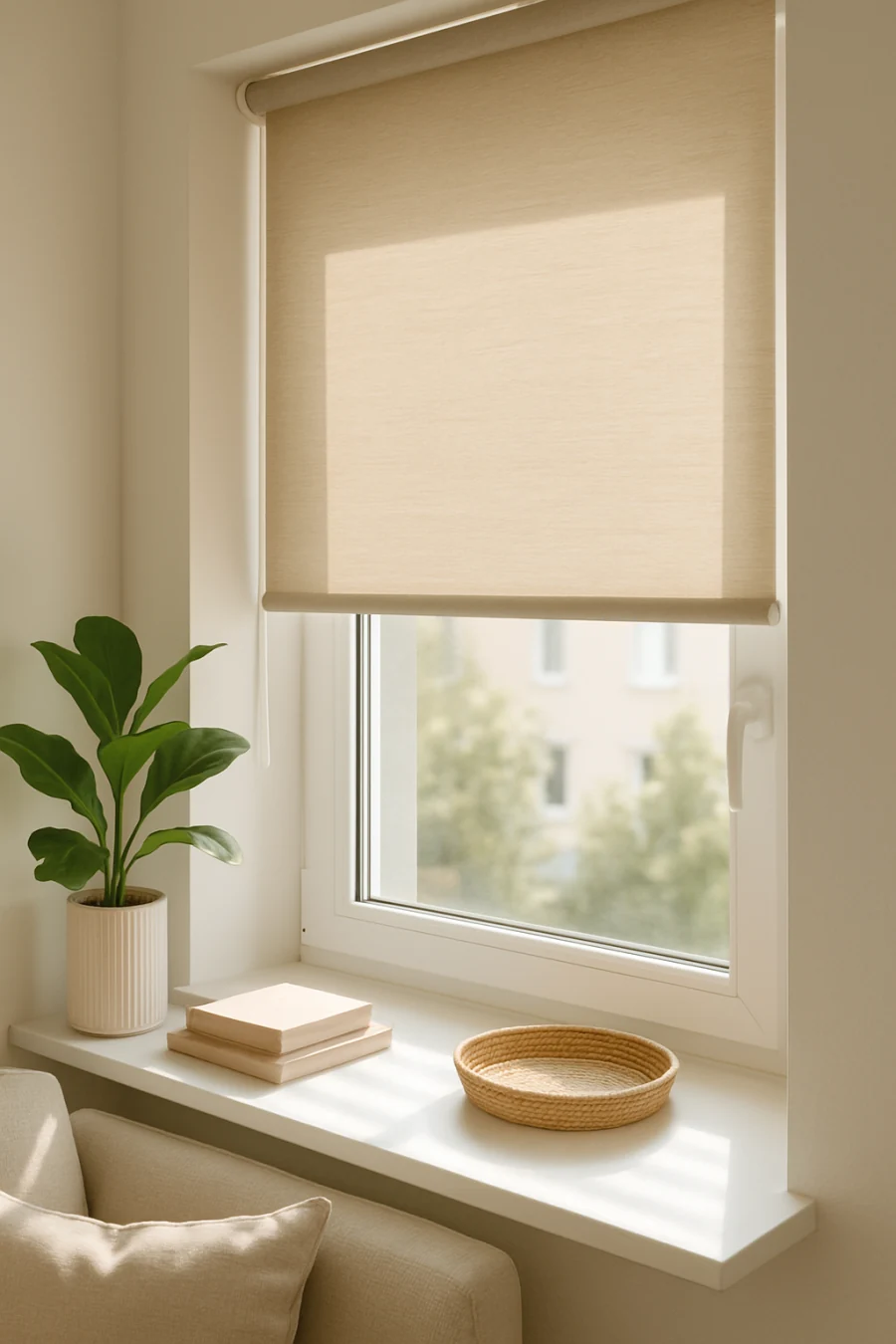


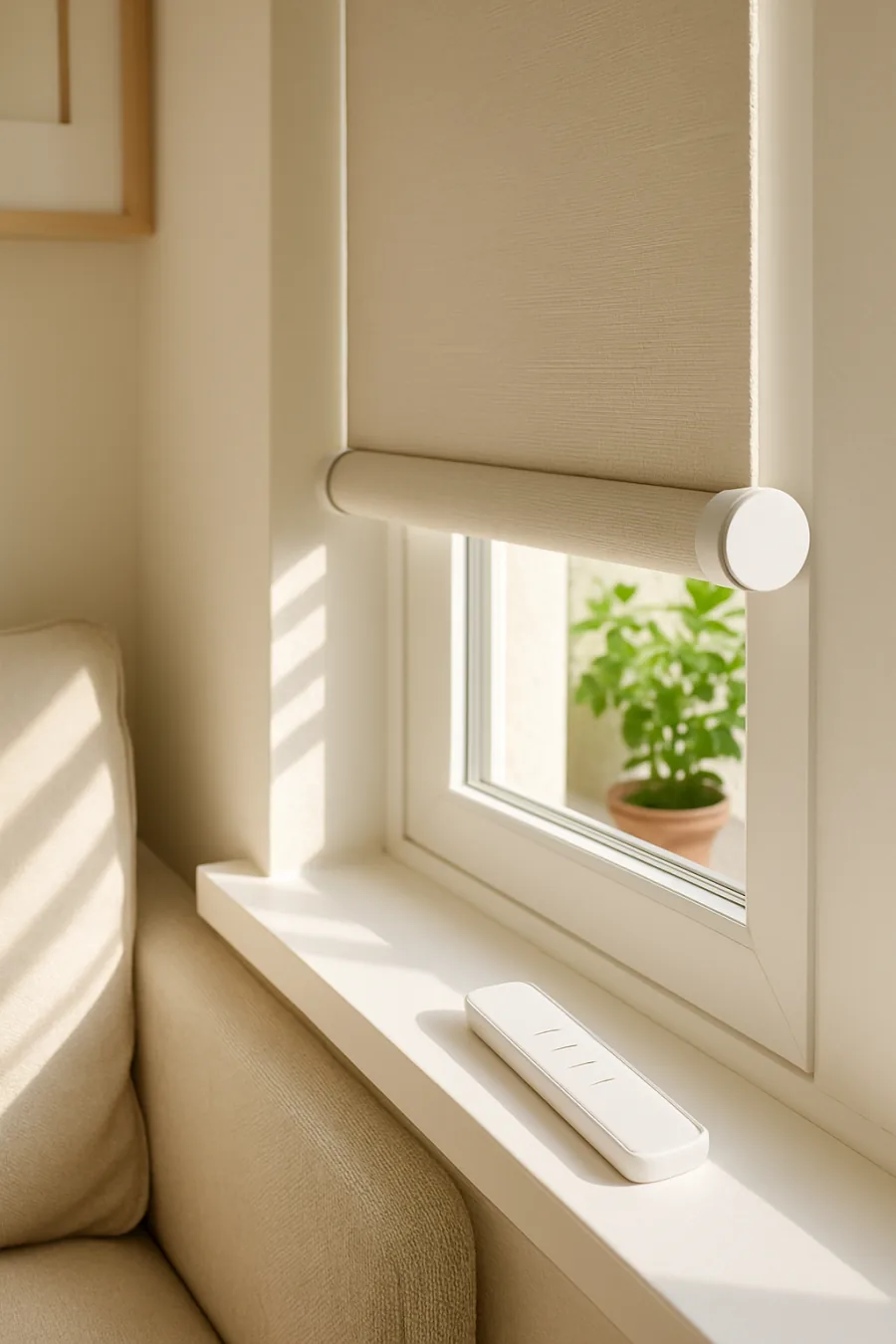


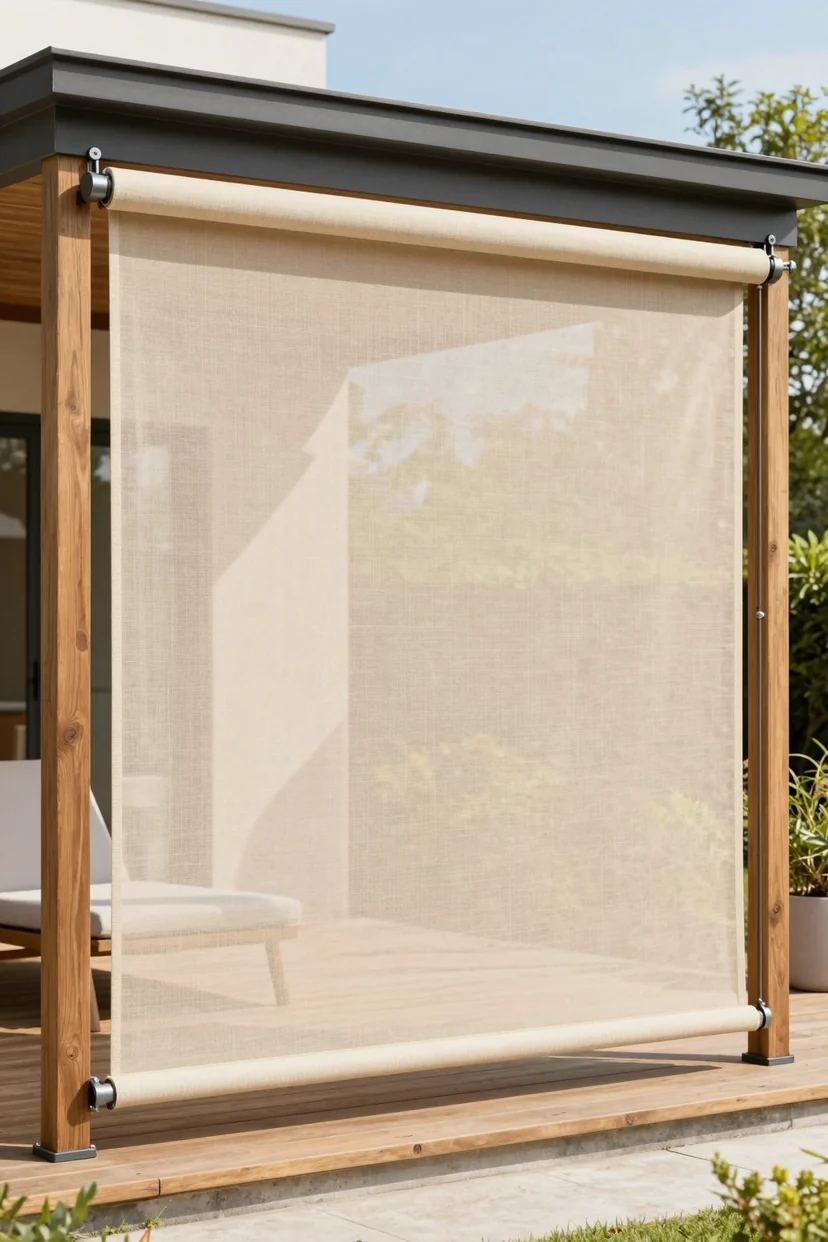











We make purple roller blinds to measure in our own workshop in Almaty: our measurer brings fabric samples, you hold them against your wallpaper and window frame in your own light and pick the shade. Fabric — from 5,400 ₸/m², manufacturing 4–6 days, installation 4,500 ₸ per item.
Why purple fabric on screen and on the window are two different colours
The shade of purple on screen and the shade of the same fabric on your window almost never match. The reason is how light behaves with fabric: in the catalogue you see a photo where light falls on the surface evenly and uniformly, but on the window some light passes through the fabric, some falls on it from outside, and the balance of these flows changes throughout the day.
Fabric held up to the light looks different from the catalogue on screen — this is not a defect or a difference between batches, but physics. Thin fabric lightens and shifts cool when backlit, while dense fabric barely lets light through and holds the colour you saw on the sample. Purple fabric behaves here just like any other coloured fabric.
What light changes
During the day on the sunny side the fabric glows, and a deep shade reads more easily than you expected: plum or aubergine lose some of their density in backlight. On a cloudy day the same fabric looks more even and darker. And in the evening under a warm lamp the picture is different again.
A warm lamp shifts how the shade is perceived in the evening: light with a yellow undertone mixes a warm note into the purple, and cool lavender can seem almost grey, while rich plum looks warmer than it does during the day. In my view, it is evening light that most often disappoints those who chose a blind from a picture on their phone.
How to check at your own window
There is no universal recipe like “take this or that shade”, because every window gets its own portion of light.
Our measurer brings fabric samples right to you: you hold them against the frame and wallpaper in your own light — first during the day, then with the lamp on. Trying fabric at the window takes a few minutes, but it removes the main risk — seeing the wrong purple at home. You can keep the sample for a day and see how it behaves in the morning and in the evening.
The same fabric reads differently depending on whether light falls on it or passes through it, so the shade is chosen at your own window, not from a picture.
Shade chart: lavender, lilac, heather, plum, aubergine and the edge of purple
Lavender and lilac are not the same, although both look light. Lavender is a clean light tone with a cool undertone and a matte surface. Lilac is dusty, with a grey note, and next to lavender it reads calmer and drier. To the eye the difference is small, but on the window it shows: lavender glows, lilac mutes the light.
We divide the whole range of purple roller blinds in our samples into three groups. The division is simple and practical: by lightness and by how the group behaves in a room.
- Light cool tones — lavender and lilac. They do not darken the room and keep a soft diffused light.
- Dusty muted tones — heather and shades close to it. The colour is noticeable but does not clash with the furniture.
- Deep dark tones — plum and aubergine. Dense, rich, they work as an accent.
A light shade suits a kids' room and a small living room: it does not press on the walls, and a narrow room does not look dark. A deep shade works differently — as an accent in a bedroom or study, where density matters more than light.
Light cool tones
Lavender is the lightest tone in the range, matte, without sheen. We often recommend it for a bedroom or kids' room: a calm colour and soft diffused light. Lilac differs from lavender by its grey undertone — the dustiness seems to blur the colour, which is why lilac is never bright. Both shades look soft on a white frame: the window does not dissolve, but it does not shout either.
Dusty muted tones
Heather is the middle ground between light and dark. There is colour, but it does not pull attention to the window: the eye goes to the furniture, the textiles, the walls. A good choice for a room that already has a lot of colour or where the blind should not be the main spot. In a classroom we installed exactly this kind of muted shade — colourful, but it does not distract the children.
Deep dark tones
Plum is a deep rich tone, aubergine is darker and cooler. Both are dense, both take on the accent. One small caveat: fuchsia and dark pink are neighbouring colours, close to purple, but they are not it. To the eye they are often confused, especially on screen. We do not have fuchsia in our range, and if that is exactly what you are looking for, the closest option is a rich plum. We say this honestly at the measurement, holding up the samples.
The purple range in our samples is divided into light cool, dusty muted and deep dark tones, and each group behaves differently in a room.
A shade for each room: bedroom, kids' room, living room, kitchen, study
Choosing a shade starts not with a picture, but with the question: what should this room do with light. A bedroom needs dense fabric, a kids' room needs soft diffused light, a kitchen needs fabric that can be wiped of grease. We make purple roller blinds in Almaty to measure and select the shade group and fabric density for the task of each specific room.
| Room | Shade group | Fabric density | What to consider |
|---|---|---|---|
| Bedroom | Plum, aubergine | Dense blackout | Window side: on south and west, dark tones change more noticeably |
| Kids' room | Lavender, light lilac | Soft diffused light | A mechanism without a chain — a spring or a control a child can’t reach |
| Living room | Lilac linen, plum satin | Texture or smooth fabric | How long the blind stays open during the day |
| Kitchen | Dark plum, treated aubergine | Washable fabric | Stains come off with a damp sponge, no rubbing |
| Study | Deep tone | Medium density | Colour as an accent, not tied to one texture |
The bedroom is the one room where a deep shade is chosen not for beauty but for density. Blackout keeps the light out, so plum and aubergine work here both as colour and as function. In a home cinema the logic is the same.
A child’s room works the other way round. A light shade doesn’t darken a small room, and lavender and lilac keep it visually spacious. Dense aubergine is only appropriate here if the child sleeps during the day and the room faces the sunny side.
The living room allows both. Lilac linen adds a fabric texture to the window, plum satin holds its shape and barely creases — choose by how often the blind is raised.
In the kitchen, purple works if you take it in a washable fabric. Dark treated plum or aubergine: drops roll off, and stains by the sink come off with a damp sponge. Light lavender next to the stove will need more frequent cleaning than you’re prepared to do.
The question of a small room feeling gloomy comes down to which side the light comes from: if the window faces north, a deep tone will take away the last of the light, and a small room will seem darker than it is. On a south window, a light shade won’t give you the density you need. The compromise is a muted heather: there’s colour, but it doesn’t clash with the furniture and doesn’t darken the corners.
Light shades don’t darken a small room, while deep dark tones work as an accent where you need dense light.
Window side, the Almaty sun and fading of coloured fabric
The side the window faces affects how quickly the fabric fades. On a south or west window the blind gets more sun, and rich dark shades change there more noticeably than light ones. This isn’t a fault or a defect — the fabric simply ages under ultraviolet light, like any other.
We look at which side the window faces during the measurement, not over the phone. There are two reasons. The first is the light itself: a south or west window gets more of it than a north one. The second is how you use that light. If the blind is down more often during the day, it collects more sun than one that’s raised in the morning. So the same plum on two windows in one flat can behave differently.
When it comes to fading, the order is this: the richest, darkest tones go first — plum, aubergine. Light cool shades, lavender and lilac, hold out longer. A deep tone seems more refined right up to the moment it starts to lighten at the edges, where the fabric spends the least time rolled up. The warranty doesn’t cover natural fading. This is written in the terms, and Jalusso tells you about it before the order, not after.
What to do with this:
- For a south or west window, choose from the light group if the shade matters to you more than depth.
- If you really want dark plum or aubergine, keep the blind raised during the day — that way it spends less time in direct light.
- On the sunny side, choose a blind you wash or take down more often: then the natural colour change doesn’t build up over years in one position.
Almaty dust
Summer in Almaty is hot and dusty, the window is often open, and dust settles on the fabric in an even layer. It shows up more on dark plum and aubergine than on light lavender — on a deep colour the grey film is immediately visible. For a room with a frequently open window, that’s a strong argument for the light group. Care is simple: vacuum with a soft brush attachment on low power, and remove stains from washable fabric with a damp sponge, no rubbing. And now let’s move on to how the blind looks from the street.
A purple blind reads darker from outside than from inside — you see the fabric against the light, while a passer-by sees its face. Dense dark tones give an even dark patch in the opening on the façade; light lavender almost merges with the frame. We don’t recommend putting purple roller blinds on every window of a house at once — on the façade it looks like a set of mismatched patches. If it’s just one window, that’s not an issue.
Rich dark shades on a south or west window change more noticeably than light ones, and this is factored into the choice before the order.
Fabric density and colour: blackout, linen, satin, polyester
Fabric density determines how much light stays in the room, and it also changes the shade itself: the same purple reads differently in blackout, textured linen and smooth satin. The difference isn’t in the colour of the dye, but in whether light passes through the fabric, reflects off it, or doesn’t pass at all. So when we hear “I want the same purple as in the photo”, the first thing we ask is which room it’s for — and from that we choose the density.
| Fabric | Surface | Light | Where it goes |
|---|---|---|---|
| Blackout | matte, dense | doesn’t let light through | bedroom, home cinema |
| Linen | texture with slubs | diffuses | living room, study |
| Satin | smooth, holds its shape | lets through less than linen | living room, dining room |
| Polyester | even, basic | diffuses | a universal option |
How colour differs in blackout, linen and semi-transparent fabric
Purple blackout gives the deepest tone: the fabric is dense, light does not pass through it, and the colour in the room looks almost the same as on the sample. Linen works differently — it has a texture with small knots and uneven threads, light catches on the relief, and the shade seems dustier and softer. Satin holds its shape and hardly creases: the surface is smooth, light falls evenly, and in the sun a slight sheen appears. Polyester is the basic fabric of our category, even and predictable in colour.
How dark it is in blackout and what colour the reverse side is
Blackout does not let light through — that is its main job, so in a bedroom with such fabric it stays dim during the day. The reverse side of blackout is lighter than the face, usually white or close to white; this inner side is needed for density. From the street the fabric reads differently than from the room: the window looks like a light patch, not a purple rectangle. If this matters to you, tell us at the measurement — we will look at it together.
Semi-transparent sheer and dim-out are types of fabric from the catalogue, not separate designs. Sheer lets through a lot of light and is better suited as an addition to a dense fabric; dim-out holds the middle: less light than through sheer, but the room does not go dark. For purple roller blinds Jalusso more often takes dense groups for the room's purpose, because a rich colour on semi-transparent fabric under bright sun fades into a pale tone.
The same shade in dense blackout, textured linen and smooth satin gives a different amount of light and a different surface — this is the main criterion for choosing.
How the measurement and shade selection go
The shade is matched to the sofa, upholstery or bedspread not from a photo, but from fabric samples that the measurer brings along. The measurement and consultation are free, and we calculate the cost for your windows on the spot. Purple roller blinds are made to measure in our workshop; there are no ready-made items in stock.
Here’s how it looks, step by step.
- You message us on WhatsApp and agree on a time. The measurer arrives with fabric samples.
- You hold the samples against the wallpaper, the sofa upholstery or the bedspread. Then — against the frame. This is the fabric test at the window: in your own light, during the day and with the lamp on.
- If there is no exact shade for your sample, we pick the closest one from the samples. We do not dye fabric to a customer's colour, and we will not promise an exact match with the upholstery.
- The measurer looks at the window profile and suggests a mounting: on the wall, on the frame or without drilling. Drilling-free mounting leaves no marks on the frame and suits rented housing.
- He calculates the cost on the spot. Then — the workshop and installation.
Within the city, measurement and delivery are free. Outside the city — to Kaskelen, Talgar, Issyk, Kapshagay — we also travel, but we tell you the call-out fee in advance, before we set off, so that there are no surprises.
People often ask the same thing about samples. How many do they bring? Exactly as many as you need to see the difference between lavender, lilac, plum and aubergine at your window. You can keep a sample for a day — look at it in the morning, during the day and in the evening. And yes, this works better than any picture on a screen: a colour that seemed cool during the day goes deep in the evening under a warm lamp.
The measurement includes selecting samples and calculating the cost, not just measuring the opening.
How much a purple roller blind costs and what the cassette changes
Purple roller blinds in Almaty cost from 5,400 ₸ per m² for the basic option with an open roller tube. This price includes the fabric, the tube, the control mechanism and the mounting hardware. Installation is calculated separately — 4,500 ₸ per item, and for orders from 150,000 ₸ it is free.
The total depends on three things: the area of the opening, the fabric group and the type of control. Blackout, linen and satin are not listed separately in the price list — they are calculated by area, and the measurer tells you the price difference on the spot. The cassette system covers the fabric and the tube with a housing box, so its coefficient is higher than other mountings. Exactly how much — you can see in the table.
A window with an area of 2 m², basic fabric, chain, frame mounting: we calculate by the price list and coefficients; the measurer gives the exact amount at your window. The spring mechanism is not part of the calculator, so we do not derive its price through coefficients and quote it separately.
| What changes | Coefficient |
|---|---|
| Manual control | ×1 |
| Chain | ×1.06 |
| Electric motor | ×1.85 |
| Electric with remote control | ×2.1 |
| Wall mounting | ×1 |
| Installation on the frame | ×1.05 |
| No drilling | ×1.1 |
| Cassette system | ×1.28 |
Which mechanism for which room
The control mechanism is chosen for the height of the window and the character of the room. The chain is the most common option: cheap and familiar. The electric motor is installed on tall sashes and panoramic glazing that you cannot reach by hand, and then the price difference pays off in convenience.
For a children's room, a spring or a chain is more often chosen. The spring rises with a light movement of the hand and locks at the desired height; children usually reach the chain without difficulty. A motor in a children's room is rare — it is not needed there.
The manufacturing time is 4–6 days from the moment of measurement and fabric selection. There are no ready-made items in stock: we are a manufacturer and make each blind to your sizes. This time cannot be sped up, but the shade and width will be yours, not averaged.
Purple in a commercial space: coffee shop, salon, clinic
In a commercial hall, purple fabric is used to support the colour of the sign or the brand style, not as a standalone accent for the whole wall. The hall should not turn into a purple room — here the colour works as a background that is recognisable but does not press on the visitor. Purple is chosen to match the brand style of the space: if the sign is plum-coloured, the windows support it from inside rather than argue with it.
The density of the fabric in a commercial hall matters no less than the shade. For a coffee shop, where the window is in the sun all day, a dense fabric is chosen: it holds the light and does not fade as quickly as a thin one. Daylight through a light fabric washes out the colour, and the sign outside starts to live separately from the interior. The control mechanism is chosen for the height of the window and the room: on tall sashes the chain is awkward to reach, so an electric motor is installed.
Panoramic glazing in cafés and salons means wide floor-to-ceiling sashes, often not one but several in a row. At such a width the roller tube must rise evenly, without skewing, otherwise the fabric will pull on the tube. For panoramic glazing we calculate each sash separately and select the tube for the width — on a wide window this is essential. We have a separate page, “Electric motor”, about choosing a motor and working with large openings.
In a clinic or salon the picture is different. There, pale muted tones are chosen — lavender, dusty lilac: the colour is visible but does not distract either the patient or the specialist at work. This is the case when purple stays in the room but does not announce itself.
An example from practice: a coffee shop with three sashes — purple repeats the colour of the sign, the windows support it from inside; an electric motor was installed on the tall sashes. In a clinic, pale lilac was chosen for two sashes: patients note that such light is calming.
We make purple roller blinds for a coffee shop, salon or clinic to measure, just like home ones: the measurer comes to the site with samples, holds the fabric against the wall and frame in your light and calculates the cost on the spot.
In a commercial space, purple fabric supports the brand colour rather than standing alone as an accent across the whole wall.
Combining with sheer curtains, drapes and a second shade in the room
In Almaty, purple roller blinds can be hung on one window together with a sheer curtain or drapes: the roller is mounted instead of a rail, takes up little space at the window and doesn't overload the opening. The sheer stays on its own rail, while the blind sits over or under it.
How exactly to combine them depends on how much light you want to let in.
- Roller plus sheer — for soft, diffused light. During the day the sheer shields the room from prying eyes, while lavender or light lilac adds colour without darkening the space.
- Roller plus drapes — for tight blackout. Plum or aubergine fabric covers the window, and drapes at the edges take care of the remaining light and the view outside.
- Two shades from the same palette in one room — for example, lavender on one window and lilac on another. We make this kind of solution to measure in our own workshop: the measurer takes the dimensions of each window separately and notes which shade goes on which.
- A deep tone on one window as an accent. Plum or aubergine on a corner window of an office works as a spot of colour, while the second window stays under a light blind.
What's important to remember about the side the window faces: a south or west window is flooded with sun during the day, and heavy drapes over a roller are hardly needed there — one blind is enough. A north or east window doesn't get enough light, so a sheer is more appropriate here than drapes. For example: in a living room with two windows, we left light lilac on the north window and plum on the south, where the sun already provides plenty of light. A light shade suits a child's room and a small living room, where you can't darken the corners, while in a large room you can afford a deep tone.
A rail for drapes and a roller on one window are installed so that the blind doesn't catch on the fabric when raised: the measurer checks where the edge of the drapes will run and selects the mounting for that gap. Combinations with wallpaper and furniture are covered in the questions on the category page; here we only talk about light and the side the window faces. A roller at the window takes up little space precisely because it replaces the rail, so a sheer and drapes remain an addition, not a necessity.
Caring for purple fabric
Dust on purple fabric is more visible the darker the shade: on plum and aubergine it shows up as a grey film, while on light lavender it's barely noticeable. This isn't a defect of the fabric but a normal property of a dark surface — any dark textile at a window behaves the same way.
Caring for the fabric comes down to a few simple steps.
- Vacuum the blind with a soft brush attachment on low power — once every few weeks, without pressing into the fabric.
- The fabric is not washed in a machine; it can be taken down and washed by hand only if the instructions for the specific fabric expressly allow it.
- Remove stains from washable fabric with a damp sponge without rubbing: you can't scrub the blind, or you'll leave a rubbed spot.
- In the kitchen, choose fabric with a treatment: drops roll off, and greasy marks come off with the same damp sponge.
In a child's room, dust is less visible on light lavender or lilac, so a dry soft brush is enough there. On the shady side, where the window is rarely opened, the blind gathers dust more slowly — a nice side effect that few people ask about during the measurement.
Polyester is the basic fabric of our category, and it doesn't mind damp cleaning: the surface doesn't absorb water the way natural linen or heavy satin does. But even here one rule matters: don't rub, blot. If a stain won't come out, it's better to call us than to experiment with household chemicals.
What care doesn't solve. The warranty doesn't cover cases where the blind has suffered mechanical damage, was reinstalled by hand, was damaged by water or simply faded over time. But Jalusso also comes after the warranty: to tighten the mechanism, adjust the blind, replace the cord or chain. This isn't a one-off service but routine work at your call.
The rule is simple: remove dust gently and regularly, and treat stains with a damp sponge without rubbing. Dark shades need a little more attention than light ones.
FAQ
How does purple fabric look from outside? From the street you see the back of the fabric, and on blackout it's lighter than the face. Dark plum on a façade reads as a deep patch of colour, while light lavender almost blends with the frame. What's more, from outside the shade always looks cooler than in the room: the sun lights the fabric from behind, and the colour shifts towards grey-lilac. During the measurement the measurer can show you a sample from both sides — so you see the difference before ordering.
Are there purple blackout roller blinds? Yes, aubergine and heavy plum come in blackout. This kind of roller is installed in a bedroom or home cinema where you need darkness. We cover this type of fabric in more detail on the “Blackout” page.
Are purple roller blinds suitable for the kitchen? Light tones hold up worse in the kitchen: near the sink and stove they're the first to pick up a greasy film. For the kitchen we use dark plum or aubergine with a water-repellent treatment — drops roll off, and stains come off with a damp sponge. More on this on the “For the kitchen” page.
Can they be installed without drilling into the frame? Yes, drill-free mounting leaves no marks on the frame: the blind is held by clamps or adhesive strips. This option is chosen for rented housing where you can't touch the frame. A breakdown of the options is on the “No drilling” page.
How many samples do you bring to the measurement? The measurer arrives with fabric samples and shows as many as you need to hold the fabric against your wallpaper, upholstery and frame in your own light. If there's no exact shade to match your sample, we pick the closest one: we don't do custom dyeing.
How much does it cost and how long is the wait? Purple roller blinds in Almaty — from 5,400 ₸ per m² for the basic open-roll option; installation 4,500 ₸ per item, free from 150,000 ₸. Manufacturing takes 4–6 days after the measurement and fabric selection.
Choosing the shade of purple, the blackout density and the drill-free mounting type all comes down to one action — a measurement with samples on site, because the result depends on your light, your opening and your frame.
The bottom line
In Almaty, purple roller blinds are chosen based on the light in your room, not a picture on a screen. That's the main takeaway from this article: the same shade reads differently during the day at a sunny window and in the evening under a warm lamp, and you can only see this on site. We don't keep ready-made products in stock — every blind is made to measure, so it's your shade and your width, not an average one.
Four takeaways in brief.
First: the colour at the window depends on the light and the side. On a south or west window, rich dark tones change more noticeably than light ones, so the side the window faces is checked before ordering, not after.
Second: the whole palette falls into three groups — light cool tones, dusty muted tones and deep dark tones. Lavender and lilac don't darken a small room, while plum and aubergine work as an accent where you need tight light control.
Third: fabric density is chosen for the room. Blackout goes in the bedroom and home cinema, linen or satin in the living room and office, and treated fabric in the kitchen so stains come off with a damp sponge.
Fourth: the price is made up of the area of the opening, the fabric group and the type of control. The basic option is from 5,400 ₸ per m², installation 4,500 ₸ per item, free from 150,000 ₸, manufacturing 4–6 days after the measurement.
There is one practical recommendation. Book a free measurement and hold the samples against your wallpaper and window frame in your own light — during the day and with the lamp on. Our measurer comes with samples and calculates the cost on the spot; measurement and delivery are free within the city, and we travel to Kaskelen, Talgar, Issyk and Kapshagay — we tell you the call-out cost before the visit. If the exact shade to match your sample is not in stock, we will find the closest one: we do not do custom dyeing.
The shade of purple is checked with a sample at your own window, and only there does it become clear how the colour will sit against the wallpaper, furniture and frame.

