





















Plastic blinds in Almaty are made from PVC slats to your window measurements: it is the most affordable material of those that last for years. They are not afraid of moisture, do not crease and cost from 3,600 ₸/m². But on south-facing and wide windows, a thin dark slat heats up and yellows — there we recommend aluminium.
What plastic blinds are and what the slat is made of
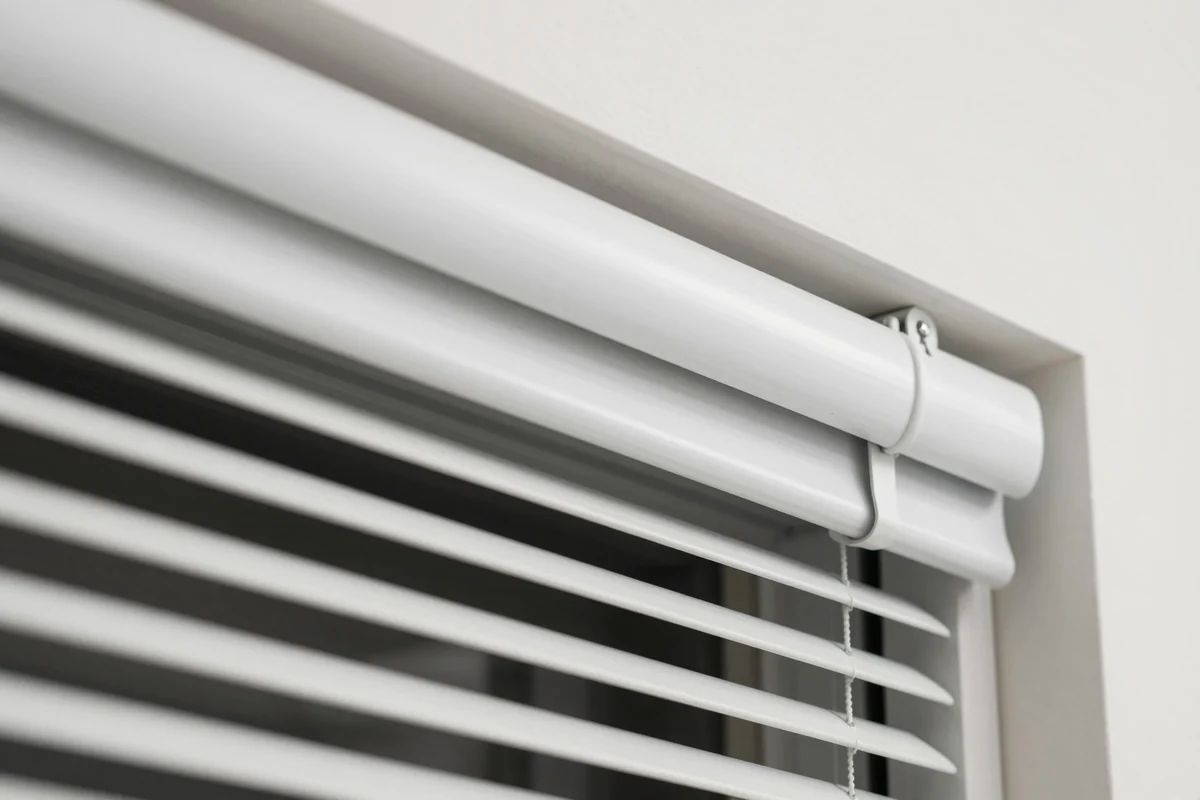
Plastic blinds are a light-control system made of narrow PVC slats that rotate around their axis and regulate how much light enters the room. The working element here is one — the PVC slat. White, beige or grey plastic is washed with a soap solution, is not afraid of moisture and does not rust, which is why PVC blinds are installed where aluminium copes worse or costs more.
What a slat is and why everything depends on it
A slat is an elongated strip with a lock along the edge: neighbouring strips hook onto each other and fold into an even blind when you pull the chain or cord. We have three common widths: two horizontal and one vertical.
- 16 mm — for narrow sashes, vent windows and small windows;
- 25 mm — the standard for an ordinary window in a flat or office;
- 89 mm — a vertical slat for tall and wide openings.
The width affects not only the look but also how the blind behaves. A thin slat turns more easily and sits more neatly on a small window. A wide one holds its shape at a large height, where a narrow strip starts to sway in a draught. Jalusso always confirms the slat width before calculating — it affects the price of the product.
How this differs from roller shutters
Plastic roller shutters and plastic blinds are confused because of the similar material, but their tasks are different. Roller shutters close the opening completely and protect it — from break-ins, from cold, from prying eyes. Blinds stand inside the room and regulate light: you turn the slat — it gets brighter, you turn it back — the room is in soft shade. Roller shutters are about protecting the perimeter, blinds are about controlling light in the room.
Plastic blinds are manufactured to your window measurements, not selected from ready-made sizes. The measurer comes with samples, shows the slats in person and takes the sash dimensions — hence the precise fit of the blind.
A PVC slat is not afraid of moisture or washing, so it can safely be installed in a bathroom or laundry room.
How much plastic blinds cost in Almaty and what the price depends on
Our plastic blinds start from 3,600 ₸ per square metre, and this is the price of a product made to measure, not a ready-made model from a catalogue. The final sum is made up of the window area and coefficients for colour, control and shape — that is, two windows that look identical in different flats can cost differently. Below is what the figure is made up of and how to reduce it without losing quality.
Plastic blinds are manufactured to the size of a specific window, so the area is calculated from the measurements, not from a standard size. The measurer comes with slat samples and calculates the cost on site — you see right away what you are getting.
What the figure in the invoice is made up of
The price includes five things:
- Slat and blind area: from 3,600 ₸/m² for PVC; wood-effect PVC — from 5,200 ₸/m², vertical PVC 89 mm — from 4,400 ₸/m².
- Slat colour: white, beige and grey come with a coefficient of 1.0, coloured — 1.08, patterned — 1.35.
- Control: manual — 1.0, chain — 1.06, electric motor — 1.85, electric motor with remote control — 2.1.
- Window shape: rectangular and square — 1.0, sloped — 1.3, arched — 1.45, triangular — 1.5.
- Installation: 4,500 ₸ per product, and free for orders from 150,000 ₸.
The warranty on the mechanism is 3 years, and it is included in the price, not charged as a separate line.
How to save without losing quality
Inexpensive blinds for plastic windows come from the simplest set — a white slat, manual control and rectangular windows: all coefficients equal one, and a white slat also does not fade the way a coloured one does.
The coefficient of 1.0 in the window shape line applies only to rectangular and square openings. Arched, triangular and roof windows are the kind of work that needs an experienced measurer: we have Kirill, our lead measurer, handling such windows. A sloped window gives 1.3, an arched one — 1.45, a triangular one — 1.5. The difference is not a whim but the cutting of the slat.
If you want to cover a whole flat or country house and stay within budget, count on a white slat and manual control. The more windows in the order, the easier it is to reach the threshold of 150,000 ₸, after which we do not charge for installation separately.
The price is made up of the area of the product according to the measurement plus coefficients for colour, control type and window shape, and installation costs 4,500 ₸ per product and becomes free for orders from 150,000 ₸.
Plastic or aluminium: what to choose for your windows
Short answer: aluminium beats PVC in heat resistance and heat reflection, while PVC beats aluminium in resistance to dents and in price. That is why the best blinds for plastic windows are not chosen by material at all — they are chosen by window. Do plastic slats rattle in a draught? No — and this is exactly the case where the material behaves more quietly than metal.
Aluminium blinds hold their shape where a PVC slat gives way: by the glass, above a radiator, on the sunny side. A PVC slat heats up under the same conditions, and with prolonged heating it can warp. There is a second layer of difference too. Light-coloured aluminium reflects some of the sun's heat back outside the glass. PVC cannot do this — it simply blocks the light. On the other hand, an aluminium slat is resonant: in a draught from a slightly open sash the metal responds with a characteristic rattle, while a PVC slat dampens this sound because it is softer as a material. In a bedroom by the vent window the difference is immediately audible.
| Property | Aluminium blinds | PVC slat |
|---|---|---|
| Heat resistance | High | Medium |
| Heat reflection | Yes | No |
| Dents from touching | Remain | Springs back and returns to shape |
| Moisture resistance | Doesn’t rust | Not afraid of moisture or washing |
| Noise in a draught | Rattles | Quieter |
| Price | Higher | Lower |
Where aluminium wins
Three situations where we ourselves recommend metal. The sunny side: in summer the glass and the slat heat up, and a thin dark PVC slat warps there. A window above a radiator: a constant flow of hot air comes from below, and for PVC this is an extra load. Wide openings: over a large width a PVC slat sags in a wave, while aluminium holds the line. If you have panoramic glazing or a window across the whole wall — go with metal, not plastic.
Where plastic wins
A children's room and a hallway are the territory of the PVC slat. A ball, elbows, an accidental touch: aluminium will leave a dent, PVC springs back and returns to shape. A bathroom and a laundry room are also for plastic, its moisture resistance works here without reservations. And budget. When you need to cover many windows in an apartment or a country house with blinds, the price difference between aluminium and PVC adds up to a noticeable sum, while you may not notice the difference in everyday use.
Moisture resistance means that a PVC slat is not afraid of water or washing, not that it can be installed anywhere. This is the boundary worth keeping in mind.
The conclusion of this section is simple: aluminium blinds beat PVC in heat resistance and heat reflection, while a PVC slat beats aluminium in resistance to dents and in price — the choice is determined by the window, not by the material as such.
Do plastic blinds yellow in the sun and how to prevent it
Yes, they yellow — but not all of them and not at the same rate. The yellowing of a slat depends not only on how sunny the window is, but also on what was added to the PVC during production. White colour lasts exactly as long as the light-stabilising additive in the material works.
Why a slat changes colour
Polyvinyl chloride itself is not resistant to ultraviolet. Under the sun chemical reactions take place in it, because of which a PVC slat first turns grey, then goes yellow. The manufacturer solves this problem in one way: by introducing light-stabilising additives — they suppress the breakdown of the polymer and keep the white colour.
There is a second line of defence too — pigment. Cheap PVC is often made without either additive, and then fading in the sun happens quickly. Jalusso uses slats with light stabilisers, so on the sunny side the white colour lasts noticeably longer.
A dark slat yellows less noticeably than a white one. Makes sense: against a brown background the shift to yellow is not visible to the eye. But a dark slat heats up more, and here another limitation applies — it is covered in the next section.
How to tell a durable slat from one that will yellow
You cannot check this right at the display: fading in the sun happens over years, not in a minute. But there are a few things a seller is obliged to name without hesitation.
- The name of the slat material and whether it contains light-stabilising additives.
- Whether there is a pigment designed for ultraviolet, or the colour holds “however it turns out”.
- What the warranty covers on the mechanism and whether it extends to colour change.
- How many years this slat has been installed in Almaty, and not “across the market in general”.
Silence on any of these questions is almost always an honest answer.
Let us be direct: the warranty on the mechanism does not cover natural fading, and we say this before the measurement, not after. Hence a simple rule. If the window faces south and you want white plastic blinds specifically, take a slat with light stabilisers — or consider aluminium.
If you want to buy plastic blinds that won't turn yellow in a couple of years, don't ask about the price — ask about the composition of the material. Cheap PVC without stabilisers yellows in the sun within a few years, while a slat with additives holds its white colour longer.
Which windows are best not fitted with plastic
There are three situations where we honestly advise against PVC: a south-facing window, a wide opening, and a window directly above a radiator. A thin dark slat on a south-facing window heats up, and on a wide opening it ripples — in these cases we suggest aluminium or a different type of system.
Deformation from heat is the main enemy of plastic, and it doesn't show up right away. A dark-coloured slat absorbs the sun more strongly than a white one, heats up, and cools down at night. In Almaty the temperature difference between day and night is noticeable all year round, and a slat that constantly expands and contracts loses its geometry over time. What's more, on a white slat this is almost invisible, while on a dark one it's clearly visible.
Here are the situations where we advise against plastic.
- A south-facing window with direct sun. A dark slat 16 mm heats up fastest here and holds its shape worse than the rest.
- A wide opening. Over a large width the slat sags in the centre and ripples, and that can no longer be straightened out.
- Panoramic glazing. A large area, a lot of glass, heat from all sides — plastic can't handle it here.
- A window directly above a radiator. Heat from below dries out the slat, and the sun from above adds more load.
- A balcony on the sunny side. We look at the side of the building: a south or west balcony heats up more than a north or east one.
The south side and summer in Almaty
Summer in Almaty is hot, sunny and dusty, and winter is cold and frosty. This climate tests a slat for durability twice a year. A slat yellowing on a south-facing window is not unusual even when the material has stabilizers; it just happens more slowly. A south-facing window calls for care when choosing slat color and width: a white twenty-five-millimetre slat will last noticeably longer here than a dark sixteen-millimetre one.
Wide openings and panoramic glazing
A wide opening leads to rippling on the slat, and that's pure mechanics: the longer the strip, the more it sags under its own weight. With panoramic glazing, heat along the full height adds to it. On such windows we fit aluminium blinds or a vertical system — a vertical slat holds its shape on a wide opening better than a horizontal one.
Plastic window blinds are most often chosen precisely to save money, and in most flats that's justified. But saving on a south-facing or very wide window means replacing them in a couple of years — and that's no longer saving. Plastic window blinds make sense where the window doesn't overheat: on the north and east sides, on narrow sashes, in rooms with diffused light. Plastic blinds on a south-facing window are better replaced with aluminium or a thick fabric.
Horizontal or vertical plastic blinds
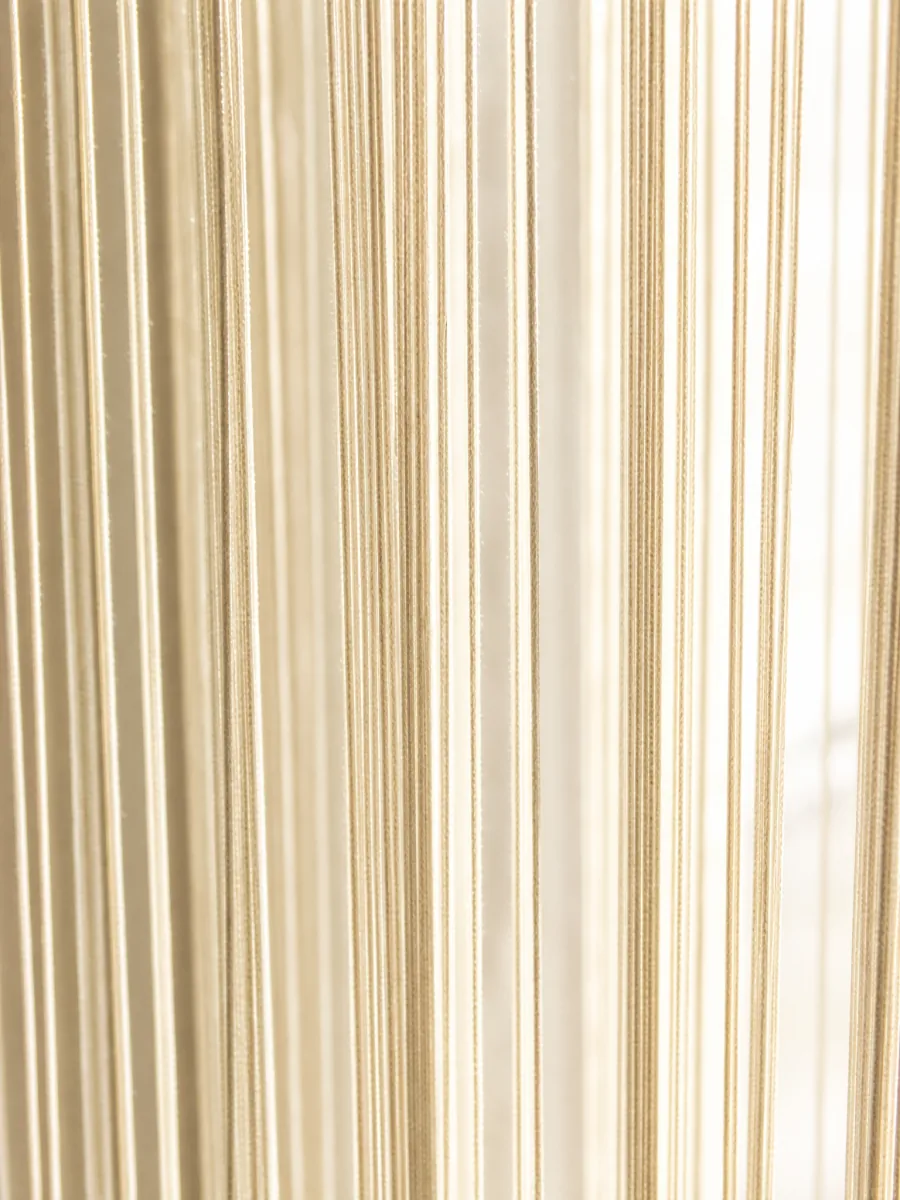
The choice depends on the proportions of the window, not on fashion. Horizontal plastic blinds are made up of slats that turn on a cord across the glass, and they work on windows of normal height. Vertical plastic blinds are made up of long strips hung on carriages, and they hold their shape where a horizontal one sags.
| Window type | What we install | Slat width |
|---|---|---|
| Narrow sash, vent | horizontal | 16 mm |
| A normal flat window | horizontal | 25 mm |
| A tall opening, a shop window, a panorama | vertical | 89 mm |
The logic is simple. A horizontal slat of 16 mm suits a narrow sash and a vent: it's light, doesn't catch the handle and doesn't get in the way of opening the window for ventilation. A horizontal slat of 25 mm is the standard for a normal room window, and we fit it in most flats. A vertical slat of 89 mm is fitted on tall and wide openings, where a crosswise strip simply wouldn't hold the fabric.
And what if the window is wider than it is tall? Panoramic glazing and shop windows almost always go vertical — the strip is made up along the height, not the width, and the fabric doesn't sag between the fixing points. On a wide opening we don't advise horizontal: the slat starts to ripple.
Balcony door and window unit
A balcony unit is handled with two different logics, and that's normal. On the door we fit vertical plastic blinds: the fabric moves to the side, doesn't get in the way of the doorway and doesn't catch the threshold. On the sash next to the door — horizontal ones, a slat of 25 mm, if the window is standard.
A separate subtlety is the vent. It's opened more often than the other parts of the window, so a slat of 16 mm goes on the vent: short and light, it doesn't hit the glass during ventilation. In a project with a balcony unit we usually count the door and the sash as two separate items with different slat types, and this is visible line by line in the invoice.
What to choose by window proportion: a horizontal slat of 16 mm suits a narrow sash and a vent, 25 mm is the standard for a normal window, and a vertical slat of 89 mm goes on tall and wide openings.
Wood-effect plastic and transparent vertical: what they really are
Yes, they exist. Wood-effect plastic blinds are a PVC slat with a textured film carrying a wood pattern applied to it. There's no real veneer there, and that's not a drawback.
With wood it's different. Wooden blinds are made from linden, and linden is beautiful right up until the first damp winter: from the change in humidity it warps, and the slat bends like a screw. Wood-effect plastic withstands the humidity at which linden warps within a couple of years — that's why we fit it in bedrooms and living rooms, where windows are opened in the rain. Moisture resistance here isn't marketing but a property of the material itself: PVC doesn't absorb water at all.
And where is the difference noticeable? By touch and up close. Run your finger along a wooden slat — you feel the warm unevenness of the grain. Along the film — a smooth coolness. The film is good at arm's length and beyond, but from twenty centimetres you can see that the pattern repeats.
Where the pattern shows and where it doesn't
Up close you notice the pattern repeating every few centimetres — that's a feature of printed film, not a defective batch. In the kitchen, where you stand a metre from the window, the eye doesn't catch it. Above a desk, where you look from below upwards, either. But if the blinds hang at face level by the head of the bed, the pattern right in front of you will be an eyesore, and then it's more honest to take a plain slat.
Transparent vertical: what they are
Transparent vertical blinds are semi-transparent slats that let light through but blur the view from the street. Vertical plastic blinds in this version are fitted on panoramic glazing and loggias: the room stays bright, while from outside only silhouettes are visible. They don't give full privacy — at night with the light on you can be seen — and it's worth remembering this before ordering, not after.
If you want exactly the look of wood and moisture resistance in one product, choose horizontal wood-effect plastic blinds: they hold their colour and shape where wood would already have warped.
Kitchen, bathroom, balcony: where plastic works in your favour and where it suffers
In the kitchen, plastic blinds can be hung, and most often that's where we fit them. A PVC slat isn't afraid of moisture, doesn't rust and can be washed with soapy water — for a room where something is constantly boiling and splashing, that's exactly what's needed. But kitchens aren't all the same: by the stove and by the sink the conditions for a slat are different.
By the stove
Fat and cooking vapours settle on the slats in a thin layer, and that layer works like glue: it collects dust, darkens and speeds up the loss of whiteness. Not because the plastic is bad — but because any surface next to a hot frying pan lives in an aggressive environment. White PVC slats hold up longer; coloured and wood-effect ones lose their look faster, since the pattern and pigment sit in the top layer. What do we advise? If the stove is right under the window or half a metre from the windowsill, go for white slats and wash them more often than usual. No paradox here: the sooner you wash off the fat, the longer the slat stays bright.
By the sink
Here it’s simpler. Moisture resistance is a strong point of PVC blinds, and splashes from the sink don’t bother them. Water runs off, dries, and leaves no marks. Soap, dishwashing liquid, household cleaners — the slat handles all of it calmly. Abrasive powders it does not: they leave matte scratches that can’t be polished out.
Bathroom, washroom, laundry
A wet room suits PVC blinds better than any other material. In a bathroom and laundry, moisture is always present, and that’s exactly where plastic beats wood: wood warps from moisture, while PVC doesn’t absorb water. Plastic blinds are also appropriate here — the fabric can be taken down, washed whole and hung back up if the mounting is removable.
Balcony
The balcony is the only area where we look at which way it faces. On a glazed balcony facing south, the slat heats up more in summer than in a room: the glass works like a greenhouse. There the service life is shorter and the whiteness fades faster. On a north- or east-facing balcony, plastic blinds are fine with no reservations.
Plastic blinds work well in a bathroom, laundry and hallway, while by the stove fat and vapours speed up the loss of whiteness, whereas by the sink moisture doesn’t bother them.
How to hang plastic blinds without drilling the frame
Plastic blinds are mounted without drilling the frame — into the glazing bead, on brackets, spring clips or adhesive tape. The frame stays intact, and the window manufacturer’s warranty remains valid. For many clients this is the deciding factor: the windows are under warranty, and they don’t want to drill them.
Here’s how it looks, step by step.
- You send a request on WhatsApp and describe the windows: how many sashes, whether there’s a vent, and which way the window faces.
- A Jalusso measurer comes with samples. He checks where the glazing bead runs, whether there’s enough depth for the bracket, and whether the sash handle will get in the way.
- We price the product based on the measurement and agree on the mounting. The calculator on the page has a separate “No drilling” option — you can see it in the estimate in advance.
- The workshop makes the blinds to your size, then we install them in the city.
- The installer puts the brackets into the glazing bead, clicks the system into place and checks the slat rotation on each sash separately.
A narrow sash and a vent are the most common case where no-drilling mounting comes out neatest. On a vent, the mechanism is mounted on top, on the short side, so the slat doesn’t get in the way of opening the sash. On a narrow sash, narrower than usual, the slat isn’t cut on site — it’s ordered to size.
We also cover arched, triangular and mansard windows. Kirill, our lead measurer, has worked with non-standard windows for nine years precisely because the mounting there is calculated for each radius and angle. There’s no ready-made out-of-the-box solution for such a window.
Mounting into the glazing bead on brackets, spring clips or adhesive tape doesn’t require drilling the frame, so the window manufacturer’s warranty remains valid.
What to choose for control
Control can be mechanical, chain or electric motor. Mechanical means turning the slats with a cord or pull cord and raising the blind by hand: the simplest option and the base one in the calculator. A chain is more convenient for everyday use — you pull it and the slats set at the right angle without effort. We install an electric motor where you can’t reach the window: high windows, a conservatory, panoramic glazing in an office.
The logic is simple. The taller and wider the window, the more sense a chain or motor makes. On a kitchen sash with a vent, manual control is more than enough.
For a high window in a stairwell or in an office with floor-to-ceiling glazing, we almost always recommend an electric motor — otherwise every turn of the slats becomes an exercise with a long rod. On panoramic projects we calculate the control together with the mounting: over a large slat area the load on the mechanism is higher.
PVC windows with blinds that are mounted without drilling are no different from ordinary ones in functionality — the only difference is the mounting method.
Care, service life and what wears out first
Under normal conditions, plastic blinds last 7–10 years. The main wear is appearance: on the sunny side the whiteness gradually fades, and that’s the sun fading. The cord and chain also wear out, but we replace them on a visit, and the blind keeps serving.
A PVC slat springs back and returns to shape after being pressed. A ball, an elbow, the edge of a table — the dent smooths out on its own, because plastic works like a spring, not like sheet metal. That’s exactly why we install plastic in kids’ rooms and hallways more often than aluminium: things are constantly hitting the blind there. But a thin slat on a wide opening behaves differently — we talked about that in the section on south-facing windows, so we won’t repeat ourselves.
About pets, let’s be direct: a cat hanging on the cord ruins the mechanism faster than the slat itself breaks. And a dog jumping onto the windowsill can pull the blind off its mounting. Such damage counts as mechanical and isn’t covered by the warranty.
“Plastic blinds” break from a rough yank, from trying to take the blind down with two people pulling in different directions, from skewing during installation. On its own, with time, a slat doesn’t fall apart.
How to wash them properly
Soapy water removes dirt from the slat. Warm water, a little liquid soap, a soft cloth — that’s enough.
A soft cloth isn’t a polite formality. Abrasive leaves matte scratches on PVC, and they can’t be polished out: powder, the rough side of a sponge, a metal scouring pad rub the gloss down to a grey haze. Wash along the slat, not across it, and don’t press hard.
If the mounting is removable, the blind can be taken down and washed whole. That’s faster than fussing with each slat separately, and more convenient for vertical systems — take it down, wash it in the bathtub, hang it back up.
- Wipe with a soft cloth and soapy water.
- Don’t use abrasive powders or hard sponges.
- Don’t pour water on the turning mechanism.
- Wash a removable blind whole, not slat by slat.
- Don’t dry with a hairdryer or hang it up wet in the sun.
What’s covered by the warranty and what isn’t
We give 3 years of warranty on the mechanism itself and 1 year on installation, counted from the day the acceptance report is signed. We fix warranty cases free of charge within 5 working days, and after the warranty we still come out: to tighten, adjust, replace the cord or chain.
The warranty doesn’t cover mechanical damage, reinstallation on your own, water or natural fading. Water means a flood, when the blind gets soaked through — not the humidity of a kitchen or bathroom.
With careful use, plastic blinds last 7–10 years, and their main wear is fading on the sunny side.
Gloss or matte, a narrow sash and a vent window: special cases
A glossy slat visually widens a narrow room, a matte one kills glare on the monitor, and a 16 mm slat is used for a narrow sash and a vent window. Let's look at the two cases that come up most often.
Gloss or matte
Gloss reflects light and works like a small mirror — in a narrow room this visually adds volume. But that same reflected light causes glare: if the window is behind you or to the side of your workspace, stripes will appear on the monitor screen. In such a room we recommend matte.
A matte slat absorbs light and does not reflect glare from the frame. It looks calmer, there's no arguing with that.
In terms of care there's almost no difference: both gloss and matte are washed with a soft cloth. But abrasives leave matte scratches on gloss more noticeably — they show up as light spots on the smooth surface.
Narrow sash and vent window
For a narrow sash and a vent window we use a 16 mm horizontal slat. It's lighter than 25 mm, and the blind doesn't sag over a short span.
An important point: the wider the slat, the worse it fits a small window. A 25 mm slat looks bulky on a vent window and catches the sash next to it when opening. That's why for such windows we always suggest 16 mm.
For the kitchen, bathroom and balcony — see the separate section above, the conditions there are different in terms of moisture and heat.
How we work: measurement, workshop, installation
In short: you can only buy plastic blinds in Almaty from us by measurement. There are no ready-made products in stock. We are a manufacturer with our own workshop, so every blind is assembled for a specific window, not picked off a shelf.
How an order works, step by step.
- You message us on WhatsApp. A photo of the window and the approximate width of the opening is enough — that's sufficient to give you a price range.
- A measurer comes with samples. Measurement to the size of the window is free anywhere in the city. The measurer brings slats — white, beige, grey, coloured, wood-effect — and calculates the cost on the spot. Seeing the material in your hand is more useful than on a screen: you can see both the shade and how the slat flexes.
- We calculate and agree. The cost depends on the area of the product and coefficients for colour, control and window shape. Non-standard windows — arched, triangular, attic — are calculated by our lead measurer Kirill, he has nine years on such openings.
- The workshop manufactures. According to the price list: PVC 16 and 25 mm — 3–5 days, wood-effect PVC and vertical PVC — 5–7 days.
- Installation. 4,500 ₸ per product, from 150,000 ₸ per order — free.
We mount without drilling the frame: into the glazing bead, on brackets and spring clips. We don't touch the frame, the window manufacturer's warranty stays valid. We install horizontal, vertical, wood-effect — all of this is done in our own workshop.
The warranty covers the mechanism and installation: three years on the mechanism, one year on installation from the date the acceptance report is signed. We fix warranty cases free of charge within five working days. And after the warranty we still come out — to tighten, adjust, replace the cord or chain.
Trips to the suburbs
We travel not only within the city. Kaskelen, Talgar, Issyk, Kapshagay — our measurer goes there too, the call-out cost depends on distance and is quoted before the visit, so there are no surprises in the invoice.
The easiest way to start is with a free measurement with samples: the measurer will show you the slats in person and calculate the cost for your windows — and you can buy plastic blinds or vertical plastic blinds once you have the figure in hand.
Questions and answers
We've collected here what people most often ask on WhatsApp before the measurement — short and to the point.
How much do plastic blinds cost
From 3,600 ₸ per square metre. The exact figure depends on the window area from the measurement and coefficients for colour, control and window shape. The measurer calculates the cost on the spot, with samples in hand.
Do they yellow in the sun
Cheap PVC without stabilisers — yes, over a few years. We work with slats that have light stabilisers added: they hold their white colour longer. To be honest: on a south-facing window the whiteness still fades over time, it's natural fading, and it's not covered by the warranty.
Can they be installed in the kitchen
Yes, and most often that's where we install them. PVC slats are not afraid of moisture or washing — by the sink they don't care. But by the stove, grease and steam speed up the loss of whiteness, so near the hob it's better to take a white slat and wash it more often.
How long do they last
Under normal conditions — 7–10 years, aluminium lasts 15–20. The main wear is fading and loss of whiteness on the sunny side; we replace the cord or chain on a call-out.
Is wood-effect real wood?
No. Wood-effect plastic is a textured film with a wood grain pattern over the same PVC slat. It differs from wood in that it withstands humidity, which warps linden within a couple of years. Up close you can see the pattern repeat every few centimetres — from a distance it's not noticeable.
Can they be hung without drilling the frame?
Yes. Plastic blinds are mounted into the glazing bead on brackets, on spring clips or on adhesive tape — we don't drill the frame, the window manufacturer's warranty is preserved. This option is available in the calculator on the page.
How to wash them
With soapy water and a soft cloth. Abrasives leave matte scratches on PVC, so we don't use powders or hard sponges. If the mount is removable, the blind is taken down and washed whole.
What if there are children and pets in the house
PVC slats don't crease — they flex and return to shape after being pressed. A ball or a cat won't crush them the way they would aluminium. But the cord, which children or a cat pull on, is the first to suffer, and mechanical damage is not covered by the warranty.
Vertical or horizontal — is that even about plastic?
It's about plastic too. Horizontal plastic blinds are chosen for regular windows and vent windows, vertical plastic blinds — for tall and wide openings. Both are assembled by measurement, so you can buy horizontal plastic blinds or order vertical plastic blinds for a specific window, not a standard size.
Every answer rests on the same set of facts: the properties of the PVC slat, the operating conditions and the warranty terms — 3 years on the mechanism and 1 year on installation.
Conclusion
Plastic blinds in Almaty remain the most affordable material of those that last for years rather than a season. The price starts from 3,600 ₸ per square metre, and it is calculated not from the catalogue but from the area of your window after measurement. The difference from aluminium here is not a marketing trick — it is built into the slat itself and into how it behaves on the wall.
Then comes what PVC is actually chosen for. Moisture does not bother it: a bathroom, a laundry room, a pantry, a hallway — plastic blinds work well everywhere, because they do not rust or swell. A PVC slat does not crease: after being pressed by a hand or a ball it springs back and returns to shape. It can be washed with soapy water and a soft cloth, and a removable blind can be taken down and washed entirely.
But there are places where we honestly advise against it. On a south-facing window, on a wide opening and right by the stove, a thin dark slat heats up and loses its whiteness — there aluminium blinds or another type of system are more suitable. That is why we use slats with light-stabilising additives: they keep their white colour noticeably longer than a cheap one.
The service life of PVC under normal conditions is 7–10 years. The main wear is appearance: fading and loss of whiteness on the sunny side. We cover the mechanism with a three-year warranty, and installation — for a year from the date of the acceptance report.
What to do next? Don't guess from catalogue photos. Start with a free measurement with samples: our measurer will bring the slats, show them in the light at your window and calculate the cost for your specific opening. That way the decision is made on the spot, not from a picture.

