


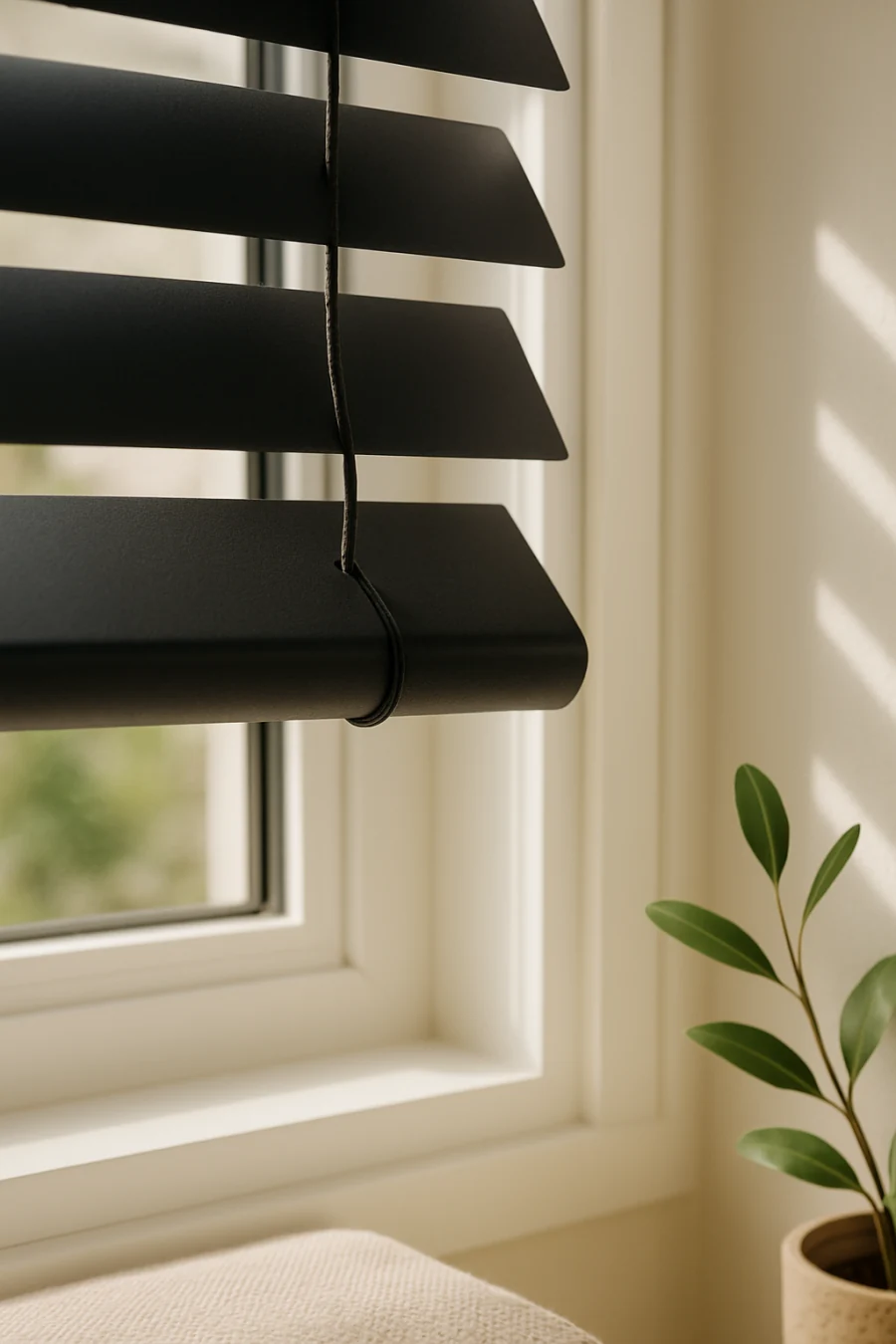






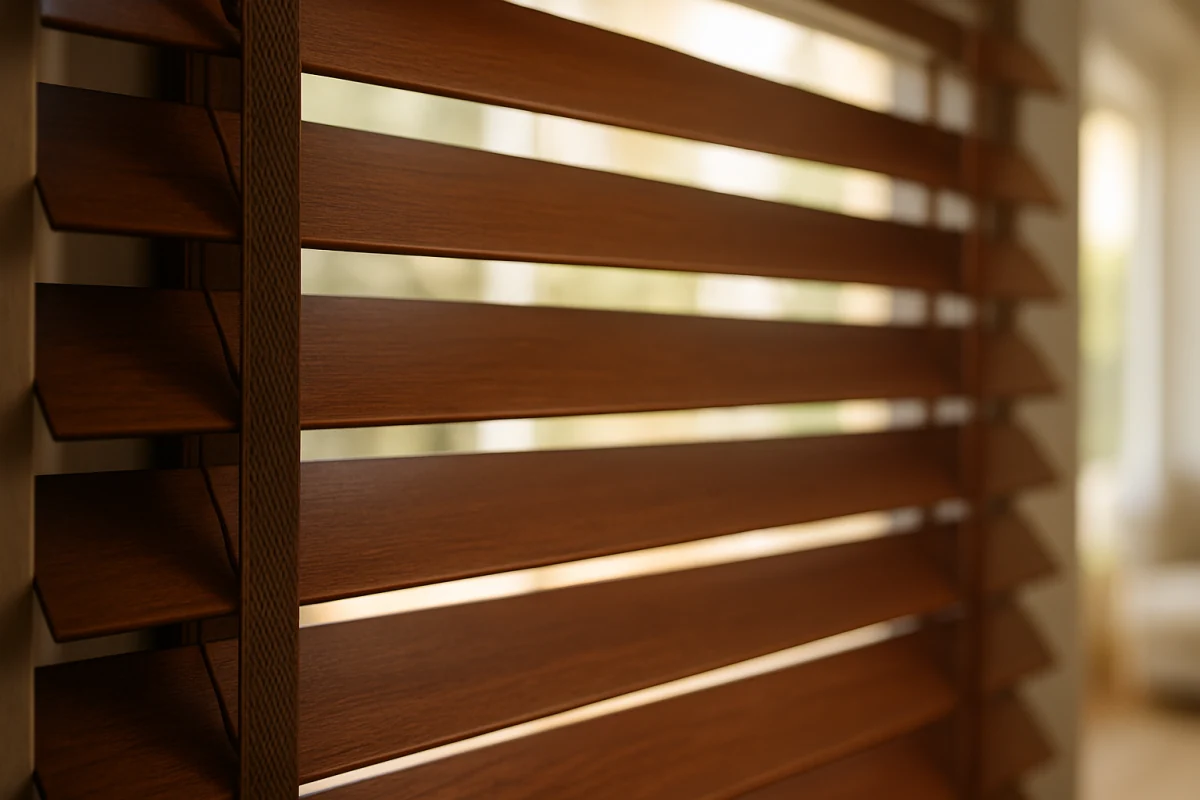











We make brown blinds in Almaty to measure: the measurer comes with samples, you look at the tone at your own window and choose the material. The price depends on the type of system, not the colour: horizontal aluminium — from 4,200 ₸/m², day-night — from 7,300 ₸/m², wooden — from 12,400 ₸/m².
One colour — four different surfaces
Jalusso makes brown blinds in Almaty from four materials, and brown on each of them is its own surface, not the same shade. Horizontal blinds are assembled from an aluminium slat 25 mm with a polymer coating, a PVC slat 25 mm is dyed plastic, roller blinds are a dyed fabric, and wooden blinds get their colour from stain on linden. A brown slat that looks the same at first glance behaves differently on the window: it catches the light differently, ages differently, washes differently.
Brown on aluminium is held by a polymer coating. The shade is applied to the metal in a layer that does not soak into the base, so the colour goes on evenly, with no pattern and no transition. The polymer coating gives a dense surface: the slat is not afraid of moisture or steam, and it can be wiped right on the window. That is why its main area of use is the kitchen, bathroom and balcony.
Brown on wood is created by stain on linden. Stain does not cover the material but brings out the grain: the wood pattern stays visible, and every gap between the slats reads a little differently. Wooden blinds are chosen where the grain itself is what you want — on wide living-room windows with solid wood and dark parquet.
Brown on PVC is dyed plastic. The slat is matte, without the sheen of metal, and the surface feels calmer and a little softer to the touch. Dyed fabric fibre works in a third way: the fabric absorbs the dye, light passes through the fibre and scatters inside it. That is why the same brown by name on aluminium, PVC, fabric and wood looks like four different shades in one room.
How it looks on the window
The polymer coating gives an even shade with a slight sheen. Plastic is matte and reads a little flat. Fabric adds a fuzzy depth, and wood shows its grain. The difference is noticeable in an interior where the floor, door and furniture stand next to each other.
Vertical blinds and roller blinds — day-night, screen, blackout — use fabric, and the colour on it is the most “breathing” of the four. On horizontal blinds made of an aluminium slat 25 mm and on a PVC slat 25 mm the shade goes on denser and looks more stable in a photo. The practical conclusion is simple: if you are afraid brown will play out differently than in the picture, compare samples of different materials at your own window, not different shades of one material.
My experience tells me the argument “aluminium or plastic” misses the point entirely: what you choose is not the material itself but how it holds colour and where it stands.
Comparison table: material — how it holds colour — where to install
| Material and slat | How it holds colour | Where it works well |
|---|---|---|
| Aluminium, slat 25 mm | Polymer coating, even shade with a slight sheen, does not absorb moisture | Kitchen, bathroom, balcony, study |
| PVC, slat 25 mm | Dyed plastic, matte surface, the slat flexes | Living rooms, utility rooms |
| Fabric: day-night, screen, blackout | Dyed fibre, fuzzy depth, scatters light | Living room, bedroom, office, commercial hall |
| Wood: linden, slat 50 mm | Stain on linden, the grain pattern is visible | Wide living-room windows, solid wood and dark parquet |
Brown on aluminium, PVC, fabric and wood means four different surfaces: polymer coating, dyed plastic, dyed fibre and stain on linden, and they all behave differently.
What brown blinds cost in Almaty by type
The colour itself does not change the price. A brown model costs the same as any other in the same type and material: you pay for the system, the slat and the controls, not for the shade. Horizontal aluminium start from 4,200 ₸/m², vertical fabric — from 4,600 ₸/m², day-night — from 7,300 ₸/m², wooden — from 12,400 ₸/m².
Why is the range so wide? The material sets the base, and the controls and mounting add a coefficient to it.
Table: type, price from, lead time
| Type and material | Price from | Lead time |
|---|---|---|
| Horizontal, aluminium, 25 mm | 4,200 ₸/m² | 3–5 days |
| Vertical, fabric, slat 89 mm | 4,600 ₸/m² | 3–5 days |
| Day-night, two-layer fabric | 7,300 ₸/m² | 5–7 days |
| Electric motor, 220 V or battery | 7,800 ₸/m² | 7–10 days |
| Pleated blinds, pleated fabric | 9,800 ₸/m² | 7–10 days |
| Wooden, linden, 50 mm | 12,400 ₸/m² | 7–12 days |
| Paper, pleated paper | 3,200 ₸/m² | 2–3 days |
| Plastic, PVC, 25 mm | 3,600 ₸/m² | 3–5 days |
| Metal, steel, 25 mm | 5,200 ₸/m² | 5–7 days |
| String curtains, polyester | 5,800 ₸/m² | 5–7 days |
| Multitexture, dense and transparent slats | 7,200 ₸/m² | 7–10 days |
| With a pattern, photo print | 8,900 ₸/m² | 7–12 days |
| Bamboo, straw | 9,400 ₸/m² | 7–10 days |
The manufacturing time depends on the type of system, not on the colour: brown fabric and white fabric from the same batch take the same time to make.
What the total is made up of
Controls multiply the base price: mechanical — ×1, chain — ×1.06, electric motor — ×1.85, electric with remote control — ×2.1. Mounting is counted as a separate coefficient: on the wall — ×1, on the frame — ×1.05, without drilling — ×1.1, cassette system — ×1.28.
Installation costs 4,500 ₸ per item. For orders from 150,000 ₸ we install free of charge. Measurement and consultation are always free — we come with samples and calculate the cost on site, and delivery within the city is free too.
And here is what is important not to confuse. PVC is cheaper than aluminium, so calling 4,200 ₸ the lowest price for brown blinds is simply wrong — that is the price of one specific type. At the measurement you will see your own total for your own window.
Colour changes neither the price nor the lead time: the total is set by the type of system, the material, the controls and the mounting.
How to match brown to the floor, door and frame
Brown blinds are chosen not to match the wall, but to match what is already in the room: the floor, the door and the window frame. And the main rule here is simple — a close but not exact brown looks worse than a contrasting one. The eye catches the half-tone difference, and the window starts to look out of place. That is why for a white frame Jalusso more often recommends a deliberate contrast, and for a wood-look frame — either an exact match or a noticeable step in lightness.
The shade is chosen using a sample at your window, not from a picture on your phone. Laminate or parquet gives a warm or cool base, and it determines how the tone of the slat reads.
White frame, wood-look frame, dark profile
A white window frame is the most common case in Almaty apartments. Brown blinds are installed on it as a contrast: a dark opening against a white background looks put-together and does not clash with the profile. There is no point trying to pick a brown that is “almost white” — it will just look muddy.
A wood-look frame requires a different approach. If the pattern of the profile and the pattern of the slat match, the window reads as a single surface. If the match is only approximate, it is better to go a step lighter or darker, so the difference reads as a deliberate choice rather than a mistake.
A dark profile leaves almost no options: it calls for a rich tone, otherwise a light slat “falls out” of the opening.
Why a sample under a lamp is misleading
The tone is judged in daylight, and always at different times of day. A lamp gives a yellow shift, under which brown turns reddish or, conversely, grey. A piece of wallpaper or a photo of the floor helps narrow the choice, but the samples at the window are what decide it — there you can see how the tone sits next to your laminate, parquet and door.
Measurement is always free, and the measurer arrives with samples: he lays them out on the windowsill and on the floor, and calculates the price on the spot.
How many shades of brown are there for one type? For horizontal aluminium and PVC blinds we show several wood-look and neutral coffee tones; for fabric blinds the choice is wider thanks to the density and texture. The exact range is best seen at the measurement.
You can use brown for just one window and leave the rest white. This is done when one window faces the sun or the street. But if there are several brown openings in the home, one shade for all windows reads calmer than different tones in neighbouring rooms.
A close but not exact brown looks worse than a contrasting one — this is the main rule of selection, and it can only be checked with samples at your window.
Lighter or darker: how brown reads in the room and in the sun
Brown blinds do not make a room dark if they are slats and not a heavy curtain. Brown works as a warm background: the slats diffuse the light, and the room does not lose its sense of space, even though the tone itself is dark.
The day decides more than the colour. On an east window in the morning the light comes in low and direct, and a brown slat reads lighter and softer than you expected from the sample. On a west window, by evening the sun falls at a different angle, the tone deepens and seems darker. The same material in the same apartment looks different in the day and in the evening — and that is normal. We recommend looking at samples at your window twice: in the morning and closer to sunset.
In the climate of Almaty there is a second side to this. Summers here are hot and sunny, winters are cold, with frosts and a big temperature difference between day and night, and in spring and summer dust is added to the window. Horizontal blinds take on part of the solar flow and shield the room from overheating if the slats are turned at an angle to the light. They do not fully protect from the heat — that is the job of a dense fabric, not a grid of slats.
Semi-transparent or dense? Here the choice is dictated by the room, not by the fashion for a shade.
Semi-transparent and dense
Slats — aluminium, plastic or wooden — give soft half-shade and let light through. For an office this is enough: horizontal blinds remove glare from the monitor but do not darken the room, and you can work during the day without a lamp. Fabric works differently: day-night dims the morning light but does not darken a bedroom like blackout. Blackout darkens more, and for a bedroom where morning light interferes with sleep, it is the one to choose.
There is a nuance you only learn after installation: light passes along the edge of the fabric. Not through the fabric, but through the gap between the fabric and the window reveal. A cassette system with guide rails closes this gap — in the calculator it is added as a coefficient of 1.28 to the installation. For an office a cassette is not needed; for a bedroom with light-sensitive sleep it is worth discussing at the measurement.
We select the brown tone based on the light of a specific window, not a picture in a catalogue: in the morning on the east side the tone reads lighter, in the evening on the west side — deeper, and for a bedroom the difference is solved by choosing the density of the fabric, not by changing the shade.
What holds its colour and what fades
Brown aluminium holds its colour the longest: a 25 mm slat is coated with a polymer compound, and it does not lighten in the sun. The surface under the polymer coating is fully covered, so ultraviolet does not reach the metal. With PVC it is different.
Brown on PVC lightens over time — this is noticeable specifically on the south side, where the sun stays the longest. On a dark tone this lightening shows up later than on white plastic, but the process goes on. We say this openly at the measurement, not after installation.
Brown fabric blinds fade faster than a slat. Fabric is dyed through the fibre, and the pigment loses its richness in the sun — on brown this shows as fading into a warm, slightly reddish shade. The colour goes fastest along the edge, which is always exposed to light; if the fabric is raised during the day, the fading is distributed more evenly.
And here is an important point that people usually learn about only after ordering: natural fading of fabric is not covered by the warranty. We state this before signing, so there are no surprises.
What to do on the sunny side:
- For south and west windows we install fabric with a sun-protective treatment — it slows the loss of pigment, though it does not stop it completely.
- For windows in direct sun we offer aluminium: the polymer coating holds the tone, and the slat itself is not afraid of heat.
- In rooms where it is important to keep a rich brown, a slat is preferable to fabric.
What the warranty covers
The 3-year warranty covers the mechanism, not the fading of fabric. Separately there is 1 year on installation from the date of signing the acceptance report. For brown blinds under warranty we come out and fix everything free of charge; this takes 5 working days.
Not covered: mechanical damage, re-installation on your own, water and natural fading of fabric. When the warranty ends, you can still call us: we will tighten the mounts, adjust the movement, and fit a new cord or chain.
We do not name a period in years over which fabric fades: it depends on the window, the window’s orientation and how often the fabric is lowered. And we do not promise fade-proof fabric — we do not have such a material. The 3-year warranty covers the mechanism, but not the natural fading of fabric.
A dark tone in everyday use: dust, heat, the view from the street
Brown blinds do not create the everyday inconveniences sometimes attributed to them. Dust is indeed more noticeable on a dark slat than on a light one. Heat on a south window is higher with a dark tone — but this concerns the slat itself, not the room.
Let us go through it in order, because each point is solved at the measurement stage, not by redoing it later.
- Dust and streaks. A dark tone makes dust and streaks more noticeable. A light slat hides them, a brown one shows them. In practice this means one thing: horizontal blinds in the kitchen will need wiping more often than white ones on the same window.
- Slat heating. A dark slat heats up more than a light one on a south-facing window. Aluminium gives off heat to the air by the glass, but not much noticeable heat goes into the room. Fabric heats up less than a slat — it has a different density, and it scatters part of the light.
- Light and privacy. Slats rotate: during the day you set them at an angle and stay in the light, in the evening you close them tight. Fabric is adjusted by raising it, and the fine-tuning here is coarser.
Care without taking it down
The kitchen and bathroom mean moisture, steam and grease, so there we almost always install aluminium or plastic slats. Neither absorbs grease, neither is afraid of steam, and both can be wiped with a damp cloth and a mild product right on the window. There is no need to take the blind down and carry it to the bathroom — in my view, that is the main argument against fabric in the kitchen. We install fabric systems in kitchens less often, and only with a coating that can be cleaned with a sponge without soaking.
How the window reads from the street
One brown opening among white neighbours looks calm — the facade does not become patchy because of it. It looks patchy when a house mixes systems of different tones and types: white horizontal here, brown vertical there, and in a third window a fabric of yet another shade. But if you take brown for the whole house at once, the question disappears by itself. And for many people the view from the street turns out to matter more than they thought at the start: brown blinds in Almaty on windows of one shade read as a neat detail of the facade, not as a set of random decisions.
A dark tone changes not the use itself but the attention to it: wipe the slats more often and keep one shade for the whole house.
How an order goes: from samples at your window to installation
We make brown blinds in Almaty to measure, not from stock: we have no ready-made products, each one is assembled for a specific window. You write to us on WhatsApp, a measurer arrives with samples, then the workshop and installation on site. Measurement and consultation are always free, because without them it is impossible to honestly name the shade, the material or the price.
Step-by-step order checklist
- You write to us on WhatsApp and briefly describe the window.
- A measurer arrives with samples, you look at the shade at your window.
- The measurer calculates the cost on site, you choose the material and the control type.
- The workshop manufactures the product to measure.
- Installation on site — 4,500 ₸ per product, free for orders from 150,000 ₸.
The cost of a visit to the suburbs is quoted before the visit, and within the city measurement and delivery are free. The geography is simple: Almaty and the suburbs — Kaskelen, Talgar, Issyk, Kapshagay. And the amount is not pulled out of thin air: the measurer calculates it from the price list in front of you, taking into account the control type and the mounting.
Drill-free mounting and slat replacement
You can hang brown blinds on a plastic window without drilling — brackets into the glazing bead, spring clips and mounting tape are made exactly for this. Mounting into the glazing bead lets you avoid drilling the frame: the plastic stays intact, the window warranty is not lost. For a heavy fabric the measurer checks the weight and selects a mounting with a margin, otherwise it is risky to put it into the glazing bead.
If one slat is damaged a year later, on horizontal aluminium blinds it is replaced one at a time — we come, tighten, adjust, fit a new one. Such repairs are also done after the warranty: the 3-year warranty covers the mechanism, but we are ready to come and replace a cord or chain later too.
Free measurement covers Almaty and the suburbs, and it is the measurer with samples who finally determines the shade, the mounting and the price of the product.
Brown blinds for the kitchen, bedroom, study and kids’ room
On a wide living-room window, fewer lines in the frame come from brown vertical blinds with a 89 mm slat or a 50 mm wooden slat. A narrow 25 mm slat across three metres of width turns into a palisade. Vertical blinds gather to the side and do not cut the opening across. A 50 mm wooden slat goes with solid wood and dark parquet.
For the kitchen and bathroom, vertical blinds are rarely chosen — there it matters more to wash the slat in place. Brown aluminium 25 mm does not absorb grease or steam, it is wiped with a damp cloth right on the window, there is no need to take the blind down. Plastic 25 mm behaves similarly and costs less, but on a south-facing window it lightens over time.
In a kids’ room the main thing is the control. We remove the chain and cord altogether. A side handle eliminates hanging cords, the child does not pull them and nothing gets pulled down on them. An electric motor with a remote control operates the slats without a chain by the glass — we install the same option on high windows that you cannot reach by hand.
Panoramic glazing almost always calls for a motor. Slats at a height of two or three metres cannot be turned by hand, and with a remote they move on a schedule: up in the morning, closed in the evening while the owners are away. The motor runs on 220 V or from a battery — the second option is chosen when there is no socket by the window.
A practical example: a living room with a wooden floor
A typical situation: a solid wood floor, doors to match, light walls. We install horizontal aluminium 25 mm, and match the slat shade to the floor colour. The window reads as a single line, without patchiness — the slats and the floor sound in one key, the wall stays a background. The exact shade and size are chosen at the measurement: you cannot catch the tone from a photo of the floor, the slat should lie by your window in your light.
Bedroom and study
For a bedroom where morning light gets in the way, you need blackout. Day-night dims the light but does not darken like blackout. For a study, horizontal 25 mm removes glare from the monitor and does not darken the room — you work during the day without a lamp.
One brown opening among white windows is a workable situation, and we do not talk you out of it. The facade looks patchy when a house mixes systems of different tones and types. Keep one shade for the whole house — then brown blinds read as a decision, not as a random purchase.
Brown in a commercial space and in a rented flat
Brown blinds in a commercial space work as part of the brand palette: during the day the room stays light, in the evening it is closed off from passers-by. In an office with panoramic glazing the same tone solves a different task — it removes glare from monitors without turning the room into a dark one. That is exactly why in coffee shops and offices brown is chosen not “for beauty” but as a working colour that holds both light and privacy.
For wide windows in a hall and a meeting room, vertical slats 89 mm are suitable. A blind of vertical slats is assembled to the width of the opening, rotates around its axis and gives smooth adjustment: during the day the slats are open, in the evening they are closed. Fabric vertical blinds with a 89 mm slat start from 4,600 ₸/m², lead time — 3–5 days.
Example: a coffee shop on a main street
We worked through a typical situation: a hall with a shopfront on a main street, with warm brown in the brand palette. We installed vertical fabric blinds with a 89 mm slat. During the day the slats are turned open, the hall is light, guests see the interior. In the evening the blind is closed — and the hall is hidden from passers-by, while the opening itself reads from the street as an even brown plane, not as a set of stripes. For panoramic glazing in such halls we more often suggest an electric motor: the opening is tall, and reaching for a chain by hand is inconvenient. An electric motor starts from 7,800 ₸/m², lead time — 7–10 days.
Rented apartment: no-drill mounting
Mounting into the glazing bead means no drilling into the frame — this answers the question of whether you can hang brown blinds on a plastic window without touching the profile itself. The glazing bead is the strip that holds the glass unit; the bracket slides under it, and the frame stays intact. Spring clips and mounting tape work on the same principle. The window warranty is not affected, and when you move out, the blinds come off without marks on the profile. For heavy fabric, we check the weight during the measurement and choose a mounting with a safety margin: a thin sash should not carry more than it is designed for.
A brown tone in a commercial space and in a rented apartment serves one purpose — not to stand out from the interior but to support it, while remaining a removable solution that does not interfere with the window.
FAQ
Colour changes neither the price nor the manufacturing time — the system type and material do. Brown is a tone, not a separate price list item.
Does colour affect the price and lead time?
No. Horizontal aluminium start from 4,200 ₸/m², vertical fabric — from 4,600 ₸/m², day-night — from 7,300 ₸/m², wooden — from 12,400 ₸/m², and these are prices by type, not by shade. Lead time is also calculated by system: horizontal and vertical — 3–5 days, day-night — 5–7 days, wooden — 7–12 days.
Can you match the tone to a piece of wallpaper or a photo of the floor?
As a hint — yes, but the samples at your window are what decide. A piece of wallpaper and a photo of the floor help narrow the choice, but the final shade is judged in daylight: a lamp in the room shifts the tone, and brown under it goes in a different direction. The measurer comes with samples precisely for this.
What happens if one slat gets damaged after a year?
On horizontal aluminium, slats are replaced one by one, and on 25 mm aluminium we match the same coating position. On wooden blinds, linden with stain is harder to repeat — there the tone depends on the batch. The mechanism remains under the 3-year warranty, but the slat damage itself is not covered.
Can I get brown for just one window?
Yes, and it works. One brown opening among white ones does not look random; a facade looks patchy when systems of different tones and types sit side by side in the same home. Keeping one shade throughout the house is not a requirement — it is simply easier on the eye.
Do you travel to Kaskelen, Talgar, Issyk, Kapshagay?
Yes, we travel to the suburbs. Within the city, measurement and delivery are free, and the cost of a trip outside the city depends on the distance and is quoted before the visit — we do not pull it out of thin air afterwards. The measurement and consultation themselves are always free.
Does a dark slat heat up more than a light one on a south-facing window?
Yes, a dark slat on a south-facing window heats up more than a light one with the same glass. That is the physics of tone, and there is no way around it, but on a horizontal system the slats are tilted, and some of the heat escapes with the airflow between them rather than into the room. The measurer looks at the window orientation and selects the control and system type accordingly.
Price by type, lead time by system type, a 3-year warranty on the mechanism and 1 year on installation, no-drill mounting — all the answers rest on these facts, not on the shade.
Conclusion
Brown blinds are chosen by three things: material, shade and system type. Colour matters less than it seems at the start.
Five conclusions we reach at every measurement.
First: brown on aluminium, PVC, fabric and wood are four different surfaces. Polymer coating, dyed plastic, dyed fibre and stain on linden hold the tone differently, so a shade that looks identical reads differently in the room.
Second: colour does not change the price. Horizontal aluminium start from 4,200 ₸/m², vertical fabric — from 4,600 ₸/m², day-night — from 7,300 ₸/m², wooden — from 12,400 ₸/m². Lead time is also calculated by system type, not by tone.
Third: a close but not matching brown looks worse than a contrasting one. With a white frame, a deliberate contrast is calmer; with a wood-effect frame — either an exact match or a step in lightness.
Fourth: brown works as a warm background, not as a blackout curtain. The slats diffuse light, and the room does not lose its sense of space. But if morning light bothers you in the bedroom, day-night only dims it — you need blackout for darkness. Light still comes through along the edge of the fabric without a cassette with guide rails.
Fifth: the 3-year warranty covers the mechanism and 1 year covers installation from the date the acceptance act is signed. The warranty does not cover cases where the slats were damaged mechanically, rehung by hand, got wet, or the fabric faded over time.
The practical recommendation is simple. Message us on WhatsApp and call a measurer with samples: the tone is finally chosen at your window in your lighting, and the measurement and consultation are free.

