































White horizontal blinds are narrow slats on the sash or in the window reveal, controlled by tilting and raising the blind. We make them to measure in Almaty: white aluminium or PVC, 25 mm slats, installation on the frame, on the wall or without drilling. Price from 4,200 ₸/m², lead time 3–5 days.
Why white on a window is a task of its own
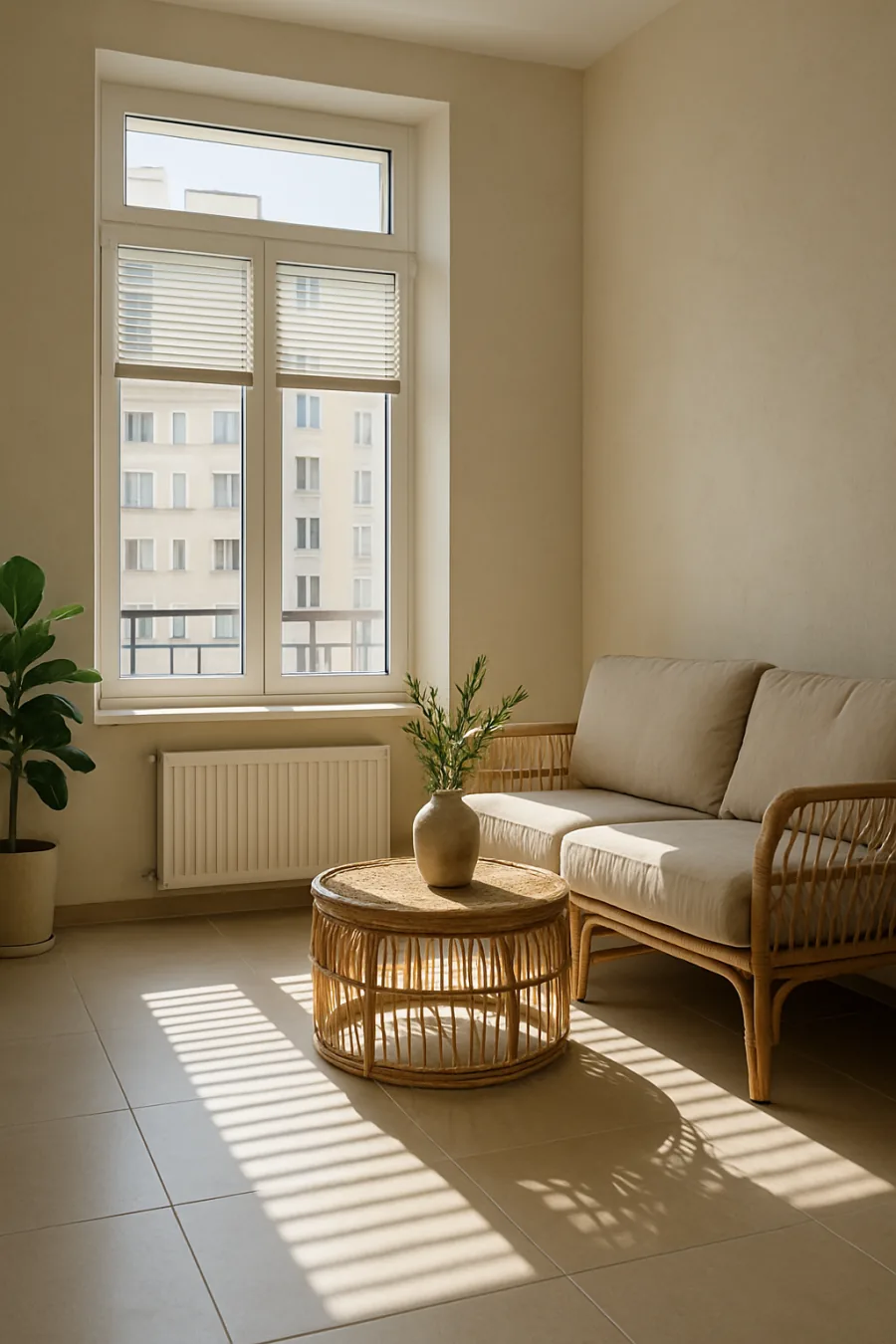
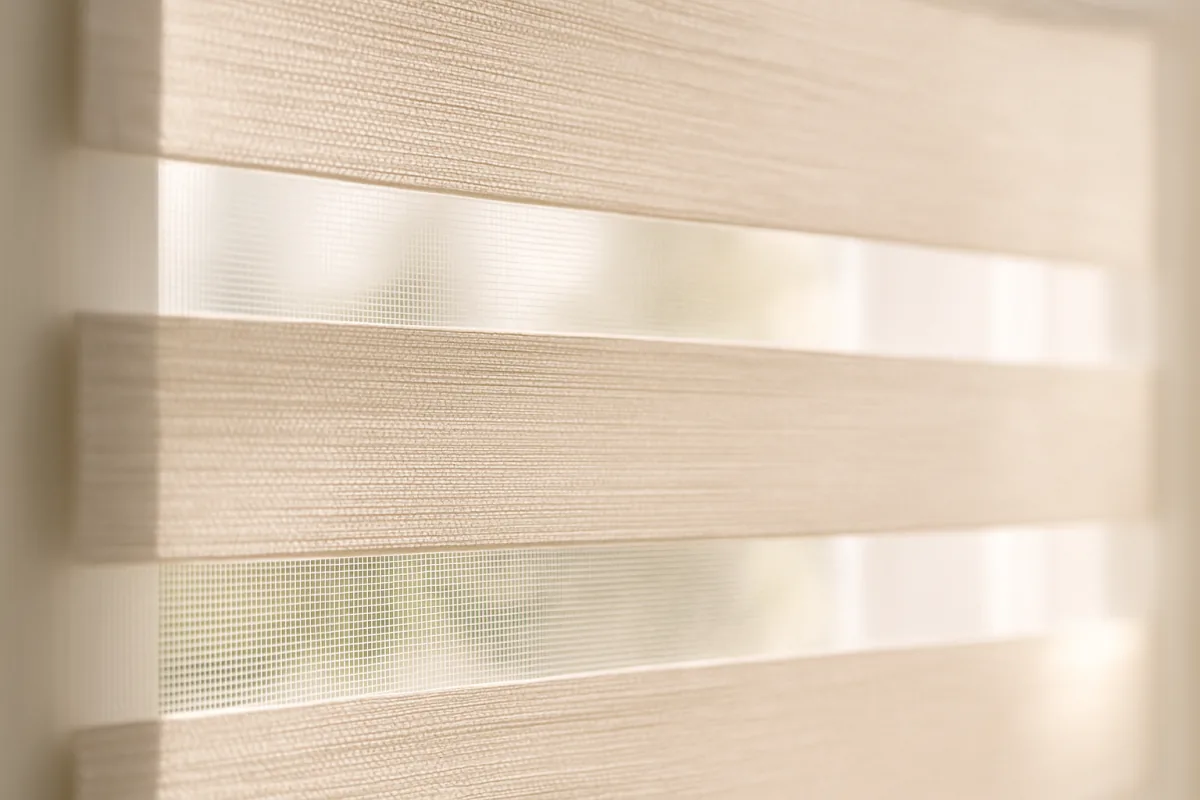
White slats diffuse light instead of cutting it, so the room stays bright even with the blind closed. Dust shows up more on white than on grey or beige slats. But it comes off with an ordinary damp cloth. That’s exactly why white horizontal blinds are not just a colour but a task of its own in everyday use.
What white horizontal blinds are
These are narrow horizontal slats mounted on the sash or in the window reveal. Operation is simple: turn to tilt the slats, pull the chain to raise the blind to the rail. No electronics, no complicated mechanisms.
White slats behave differently on a window than coloured ones. Almaty dust settles on them noticeably, because the light background doesn’t hide the grey film. On coloured slats the dust simply gets lost. But on white you can see right away where to run a cloth — and that’s more of a plus than a minus.
How white differs from coloured in everyday use
The question of evening light is easy to solve. A white fabric doesn’t darken the room completely: with a lamp on, silhouettes are visible from the street, but not details. If you need full privacy in the evening, a white horizontal option doesn’t provide it — that’s something to understand right away.
As for dust, on a white window frame and a white windowsill the film is just as visible as on a slat. People are often surprised that white blinds look neat in an interior only with regular care — but that applies to any light-coloured surface. The Jalusso measurer comes with samples and shows how white will behave next to your frame.
A white slat diffuses light rather than cutting it, so the room stays bright even with the blind closed.
Aluminium or PVC: which white material to choose
Short answer: for the kitchen, bathroom and balcony, people choose white aluminium, while white PVC is installed where price matters and a soft slat is fine. Both options come with a 25 mm slat, both can be washed right on the window, and neither absorbs grease. The difference is in how the material behaves and how it holds white on the sunny side.
Let’s compare on four points.
| Feature | White aluminium, slat 25 mm | White PVC, slat 25 mm |
|---|---|---|
| Moisture and steam | not afraid of | not afraid of |
| Grease and soot | does not absorb | does not absorb |
| Slat behaviour | rigid, holds its shape | flexes when touched |
| On a south-facing window | holds its colour | UV stabilisers needed |
| Price list price | from 4,200 ₸/m² | from 3,600 ₸/m² |
White aluminium is not afraid of moisture and steam — that’s why we install it in the kitchen by the stove, in the bathroom and on the balcony, where a white fabric lasts longer than a coloured one. The polymer coating holds its colour, and the slat doesn’t warp from the temperature difference between a warm room and a cold loggia. Aluminium can be washed with a cloth right on the window, no need to take the structure down.
White aluminium with polymer coating
Kitchen grease and steam settle on the surface of the slat and come off with a damp cloth and a mild product. Grease doesn’t soak into the slat — the film sits on top.
Take an ordinary kitchen window: a thin layer settles by the stove over a month, and it’s removed in a couple of minutes without touching the mechanism. Aluminium is more predictable here: it doesn’t soften and doesn’t behave differently because a pot is boiling nearby. In my view, for the kitchen this is overrated luxury — in practice the difference from PVC is noticeable only by touch, not in use.
White PVC
White PVC is the most affordable of the durable options: a 25 mm slat is not afraid of moisture and flexes when touched. If you brush the blind with your hand, it gently gives and returns, rather than clattering like metal.
UV stabilisers in plastic protect white PVC from yellowing, so for south-facing windows we recommend only plastic with them. Cheap plastic without UV stabilisers really does turn yellow on the sunny side — we don’t install it on such windows. But where there’s little direct sun, white PVC lasts for years and costs less than aluminium by the price list: from 3,600 ₸/m² versus 4,200 ₸/m².
White aluminium is not afraid of moisture and steam, while white PVC flexes when touched and costs less by the price list.
Slat width: 16, 25 or 50 mm
For white horizontal blinds in the kitchen, bedroom and on the balcony, the standard is a 25 mm slat. This width lets in more light than a wide slat, and the blind still looks light next to it: the white row doesn’t turn into a solid band. A slat width of 16 mm gives a different picture, a slat width of 50 mm a third.
A slat width of 16 mm reads as a light grid. The blind is almost transparent against the light, you don’t notice the blinds during the day — the window seems to be covered by nothing. But such a slat has more edges for the same area, which means more places where Almaty dust settles, and more work when wiping. On a wide window a narrow slat is reluctant: the blind gets heavy in terms of the number of strips.
A slat width of 50 mm is the opposite. A wide slat gives noticeable stripes of shadow on the windowsill and floor, and white works differently here: it no longer dissolves, but reads as wide panels. For panoramic glazing this option is sometimes chosen on purpose — but for a kitchen with a standard sash we rarely install it.
How width changes the look of a white blind
| Slat width | What the fabric looks like | Where it fits |
|---|---|---|
| 16 mm | Light grid, window almost open | Small windows where maximum light matters |
| 25 mm | A neat white row without a heavy band | Kitchen, bedroom, balcony — the standard |
| 50 mm | Noticeable stripes of shadow | Wide openings, panoramic glazing |
A white slat works with light: the narrower it is, the less shadow each strip gives and the brighter the room stays with the blind closed. In my view, talk about “a wide slat like wooden ones” on a plastic window is an overrated story: 50 mm is good on a large opening, but on an ordinary sash it just steals light.
Jalusso makes white horizontal blinds to measure, so it selects the slat width for a specific window, not a universal size. A narrow slat reads as a light grid, a wide one gives stripes of shadow, and 25 mm is the standard for white horizontals in the kitchen, bedroom and on the balcony.
“Two whites” on a window: slat, frame, windowsill
A white slat and a white window frame don’t always match in tone, and that’s where half of orders fall apart. The frame of a plastic window is almost always cool, with a slight blue tint, while a slat in the catalogue may turn out milky or with a pearlescent sheen. Next to each other, two whites start to argue: one looks greyish, the other yellowish, and the window reads as dirty, even though both products are new. This is what’s called “two whites”: not about colour, but about the fact that there are many shades of white, and they don’t get along with each other.
A window usually has four different whites. Slat, frame, windowsill and window reveals — each surface has its own tone, because plastic, paint and aluminium give white differently. A white windowsill is often warmer than the frame, the reveals after renovation are cooler than both. Cool, milky and pearlescent white next to the frame read completely differently than in the showroom under different light. In my view, choosing a shade from a photo is a losing game from the start: the camera lies both in tone and temperature.
What to do if the windowsill is white but you want a coloured blind? Coloured blinds next to a white windowsill give the same problem from the other side — the windowsill starts to seem a bit dirty. It’s easier not to bring a second shade onto the window, but to match the slat to the frame.
A white slat is compared with a white frame and windowsill only in person, at the window. The measurer comes with samples and calculates the cost on site: holds the slat against the frame, the windowsill, the reveal, looks in daylight and with a lamp on. You can’t guess from a photo — this isn’t overcaution, it’s a practical necessity.
Why this needs to be decided on site
Cool, milky and pearlescent white behave differently at the window, and the difference shows up precisely in contrast with the frame. A sample in your hands settles the question in a minute: you can see which shade blends into the frame and which stands out as a patch. The shade of white is chosen from the measurer's samples on site, because the slat, the frame, the windowsill and the window reveals are four different whites.
A ready-made product versus one made to measure
A ready-made product in a standard size does not match the sash of a real window. That is why we make white horizontal blinds in Almaty only to measure — for a specific sash or opening.
A standard width off the shelf follows its own rules: the slat is already cut, the rail is already sewn on, and the fittings are designed for an average frame. A real window in a new building is rarely exactly that. The sash may be narrower or wider, the glazing bead a different depth, and the reveal may run off to one side. What then? Either the blind does not sit along the edge, or it has to be adjusted on site, and the adjustment eats up exactly the margin you bought the product for.
A product made to measure removes all this mismatch. The measurer arrives with samples, measures the glass unit and the glazing bead, and calculates the price on site. We cut the slat exactly for your sash, choose the mounting — on the frame, on the wall or without drilling — and bring the finished product.
In my view, a ready-made size makes sense in exactly one case: when the window really does match a standard grid. In all other cases, the difference in price does not make up for the hassle of adjusting it.
We cut white aluminium and white PVC for a specific sash or opening, so the product arrives with the right slat length and suitable fittings.
Mounting: on the sash, on the opening or without drilling
Yes, you can hang white horizontal blinds on a plastic window without drilling. The brackets are clamped into the glazing bead in the groove between the glass unit and the frame, and the profile stays intact. Nothing needs to be drilled.
We offer four mounting options, and they are chosen not by taste but by the window and by whose apartment it is.
- On the sash, without drilling. Brackets into the glazing bead or spring clamps on the sash. The frame stays intact, and the window warranty remains valid. Suitable both for rented housing and for new windows under warranty.
- On the frame, with fittings. Classic installation with screws into the profile. Holds firmly, the blind sits straight, but holes are left in the frame.
- On the wall or into the reveal. When the blind is wider than the sash and covers the whole opening. Then the blinds do not get in the way of opening the window, but they do take up space at the reveal.
- Cassette system. The blind goes into a housing box at the glazing bead. The neatest installation on narrow sashes, but also the most expensive per unit.
Drill-free mounting preserves the warranty on a plastic window — for a new building this is often the deciding factor. The developer installs the windows themselves, and extra holes in the profile give grounds to void the warranty. Jalusso specialists have seen this more than once: people ask to hang something, and then it turns out that drilling is not allowed. Brackets into the glazing bead leave the frame intact, and the problem goes away.
There is also a practical side. The chain on the sash does not catch the handle when the blind is raised, if the bracket is set at the height of the glazing bead. A small thing, but it is exactly why blinds on the sash sometimes get in the way of closing the window.
What to choose for a rented apartment and a new window
For rented housing and a new window under warranty, choose drill-free mounting. The frame stays intact, the structure can be removed without traces when you move, and the installers leave no holes in the profile. If the window is yours and already has fittings from previous curtains, you can mount on the frame — it holds more firmly.
Living with a window: ventilation, balcony door, handle
For a window that is opened regularly, a blind on the sash is more convenient than a structure covering the whole opening. We see this on every second order: a person first wants to cover the whole opening with white horizontal blinds, and then it turns out that they open the vent every day. A blind on the sash moves together with the sash during ventilation — when you turn the handle, the frame swings outward, and the slats go with it. Nothing catches, nothing jams, nothing needs to be removed.
White horizontal blinds are installed across the whole opening where the window is fixed or rarely opened. An opening-wide structure covers both the frame and the reveals with a single blind, looks calmer and costs less per area, because the slats are cut to one wide size. But if a sash moves across the window every day, the opening-wide option will get in the way. The answer is simple: count not the area, but how many times a day the window is opened.
With a balcony door the logic is different. Horizontal blinds on a balcony door rise upward and open together with the door: the blind is attached to the door leaf, so when you pull the handle, the slats travel up to the rail. Nothing gets in the way of walking around the room with the door open. The only thing to consider in advance is that the handle must remain accessible, so we raise the bottom of the blind a couple of centimetres above it. A couple of centimetres — and nothing rubs.
Non-standard windows
A mansard or sloped window can be covered with white horizontal blinds — the question is the mounting and how the blind behaves at an angle. On such openings the slats do not run strictly horizontally but along the plane of the glass, and the blind is raised downward, not upward. Such orders are handled by our lead measurer Kirill, who has 9 years on non-standard windows: arched, triangular, mansard. He also works out where to bring the control so that it can be reached.
We make everything to measure: the slat width, the material, the lifting direction and the mounting point are calculated for a specific sash. A blind on the sash moves together with the sash during ventilation, horizontal blinds on a balcony door rise upward and open together with the door — both are determined at the measurement, not picked from a ready-made size.
Yellowing: what washes off and what does not
Yellowing on white horizontal blinds appears for two different reasons, and they must not be confused. A film from the kitchen and tobacco is dirt on the surface of the slat, and it comes off with a damp cloth and a mild product. UV fading is a change in the material itself under the sun, and washing will not remove it. Hence a simple conclusion: first work out what exactly is on your slat, and only then reach for the cloth.
Kitchen grease and steam settle as a thin layer and darken over time. Tobacco smoke gives the same picture — a yellowish film that stays on the surface rather than going deeper.
Can white plastic blinds be whitened? If the yellowing is on the surface — yes, with a mild product. Abrasives and bleach only do harm here: they strip the protective layer, and the slat starts to yellow faster.
What washes off and what does not
| Cause | Washes off | With what |
|---|---|---|
| Film from the kitchen | Yes | Damp cloth with a mild product |
| Film from tobacco | Yes | Damp cloth with a mild product |
| UV fading | No | Washing does not help |
| Cheap plastic without UV stabilisers | Partially | The surface layer is gone, it cannot be restored |
UV fading is not dirt, so neither soda, nor vinegar, nor bleach will give a result. The material has changed through the entire thickness of the slat.
White horizontal blinds made of aluminium with a polymer coating hold their colour differently from plastic: the coating works as protection, and on a south-facing side aluminium behaves more calmly. In my view, saving on the quality of PVC costs you the most precisely on a sunny window — after a season the fabric is no longer white, and no amount of cleaning will bring that back.
What to do on a south-facing window
On a south-facing side we recommend aluminium or PVC with UV stabilisers. Cheap plastic without them does not hold white — stabilisers are exactly what keeps the pigment from breaking down under the sun. On a west- and south-facing window this choice is critical, on a north-facing one it matters noticeably less.
On an unheated balcony, where the fabric is under open sky all day, the difference between materials shows up even more sharply. Fabric without impregnation also loses its look faster than anything there.
Kitchen and tobacco film comes off with a damp cloth and a mild product, but UV fading cannot be washed off.
Caring for a white fabric without taking it off the window
White horizontal blinds are washed right on the window and there is no need to take the fabric down for this. Almaty dust settles on the slats in a thin layer and comes off with a damp cloth. Kitchen grease and steam behave differently: the film settles more densely, but it does not soak into the slat.
The process is simple.
- We close the fabric — the slats lie in one plane, and it is easier to wipe them that way.
- We go over the slats with a damp cloth from top to bottom, without taking the structure apart.
- In the kitchen we add a mild product and repeat until the film comes off.
- We keep the mechanism dry: we do not wet the chain or the turning unit.
- We open the fabric and let the slats dry in place.
In the kitchen we wipe more often than in a living room — there the grease load is its own. In a bedroom and a kids’ room, ordinary damp cleaning as visible dust appears is enough. Why can’t white PVC be scrubbed with an abrasive? The coating holds its colour precisely thanks to a smooth surface, and a hard sponge kills it.
Repairability
We replace a bent slat separately — the whole blind does not need to be changed. This happens more often on a balcony door, where the slat gets caught by a hand or an object. We bring a slat of the right width and put it in place. The mechanism and the other slats stay as they were.
Aluminium and plastic slats do not absorb grease — the film settles on the surface and comes off with a damp cloth right on the window.
How much white horizontal blinds cost in Almaty
White horizontal blinds start from 4,200 ₸ per square metre, manufacturing time is 3–5 days. This price includes a product made to measurement: we do not sell ready-made boxes from a warehouse, every fabric is cut for a specific sash or opening.
The total is made up of three things. The material and density of the slat — white aluminium with a polymer coating is more expensive than white PVC. The control: mechanical comes with a coefficient of ×1, chain — ×1.06, an electric motor 220 V or battery — ×1.85, electric with a remote control — ×2.1. And installation: on the wall ×1, on the frame ×1.05, without drilling ×1.1, cassette system ×1.28. The window size is multiplied by these coefficients — that is why the same fabric on a small bathroom sash and on a panoramic opening gives a different sum.
Chain control adjusts the tilt of the slats and the raising of the fabric — this is the familiar manual option, and on the price list it comes out at almost the same as mechanical. An electric motor is chosen for high and hard-to-reach windows, where you cannot reach the chain.
| What’s included | Condition | Figure |
|---|---|---|
| Horizontal blinds | base position | from 4,200 ₸/m² |
| Manufacturing time | per workshop | 3–5 days |
| Installation | per item | 4,500 ₸ |
| Installation | for orders from 150,000 ₸ | free |
| Warranty on the mechanism | from the date of the act | 3 years |
| Warranty on installation | from the date of the act | 1 year |
What makes up the price
The material decides more than the size of the window. White aluminium and PVC in a 25 mm slat are two different price-list positions, and on a sunny side the difference in price does not justify itself through savings: cheap plastic without UV stabilisers does not hold white. Installation is included in the order cost in one of two ways: either 4,500 ₸ per product, or free for a sum from 150,000 ₸. The second option usually comes up in flats where several windows are covered at once — the kitchen, the bedroom, the kids’ room.
Measurement and delivery
Measurement and consultation are always free, and the measurer arrives with samples and calculates the cost on the spot, not from a photo. Within the city, measurement and delivery are free. To the suburbs — Kaskelen, Talgar, Issyk, Kapshagay — Jalusso does travel, the cost of the visit depends on the distance and is quoted before the visit. You cannot guess the price per square metre by eye: two sashes of the same width but with different controls and mounting give a different sum, and the exact figure is quoted by the measurer.
Horizontal blinds start from 4,200 ₸/m², manufacturing time is 3–5 days, installation is 4,500 ₸ per product, and from 150,000 ₸ it is free; the warranty on the mechanism is valid for 3 years from the date of signing the act.
In practice: typical windows and what we fit on them
On typical windows, white horizontal blinds behave predictably: everything is decided by the material, the side the window faces and how the fabric is fixed relative to the sash. Below is what we most often fit and why.
Kitchen, bedroom, kids’ room
Kitchen — white aluminium or white PVC: the slat does not absorb kitchen grease and steam, and is washed right on the window. In the bedroom we fit the fabric right up against the glazing bead: morning light does not break through along the edge, but the white slat diffuses it, and the room stays bright. In the kids’ room we make the control without hanging cords and chains — there is nothing for a child to pull. And mounting without drilling is also appropriate here: the frame stays intact. In the evening with a lamp on, the white fabric is almost invisible from the street, but inside it does not darken the room completely — if you need full darkness, white does not solve that task.
Balcony and office
On an unheated balcony in winter, the white fabric and mechanism get through the winter calmly if it is aluminium or PVC: moisture and temperature swings mean nothing to the material. We do not recommend fabric without impregnation on a balcony — it loses its look faster. The noise of the slats in a draught with the sash open is a question of material: white aluminium in a strong air flow rings more noticeably than PVC, which flexes and dampens the sound. In the office, glare on monitors is removed by tilting the slat, not by closing it fully — the light stays even all day. For high and hard-to-reach windows we fit an electric motor: control by a 220 V motor or a battery removes the need to reach for the rail.
The reflection of heat by a white slat on a south-facing window is felt as a soft shade: the fabric does not heat up and does not give heat back into the room, but it also does not turn the space into a dark corner. How long white horizontal blinds last before replacement depends on the material and conditions, not on the colour; our mechanism comes with a warranty, and after it we come to tighten, adjust or replace the cord and chain. For example, on a balcony unit with a door, the fabric rises upwards and moves with the door — this does not get in the way of opening it. On non-standard windows — arched, triangular, mansard — the selection is done by our lead measurer Kirill, he has nine years on such openings.
On an unheated balcony, the white fabric and mechanism get through the winter calmly, and in an office white horizontal blinds are fitted with the slat tilted so that there is no glare on monitors.
FAQ
Below are the questions we are asked most often after a measurement and over the phone: about choosing white metal versus white plastic, about replacing a slat, noise in a draught, non-standard sashes and the warranty.
What is better for a south-facing window — white PVC or white aluminium?
White aluminium with a polymer coating holds its colour for years and does not react to moisture or steam. White PVC is chosen where price matters and a soft slat is fine. But on the south side we recommend plastic with UV stabilisers, otherwise the white turns yellow. Cheap PVC without them does not stay white. We do not install it on sunny windows.
Can one bent slat be replaced, or is the whole blind replaced?
One. We take out the bent slat and insert a new one — the whole blind does not need to be replaced.
Do white aluminium slats rattle in a draught when the sash is open?
The blind on the sash opens together with the sash, so the wind does not flap it. An aluminium slat in a draught does not rattle the way uncoated metal does.
Can white horizontal blinds be installed on a sloped window?
Yes, but such a window needs a measurement. It is handled by Kirill, our lead measurer: over nine years he has dealt with non-standard openings, including sloped ones.
What does the warranty cover?
The warranty on the mechanism is valid for 3 years, on installation — 1 year from the date the acceptance report is signed. We fix a warranty case within 5 working days. The warranty does not cover cases where the white horizontal blinds have received mechanical damage, were reinstalled on your own, got wet, or the fabric has faded over time.
Is no-drill mounting about the warranty on the window?
Yes. The brackets slide into the glazing bead, the frame stays intact, and the warranty on the plastic window remains valid.
Conclusion
The material for white horizontal blinds is chosen by the side the window faces. On the south we install white aluminium or white PVC with UV stabilisers — there the blind is in direct sun all day. For the kitchen and the balcony, the same aluminium and PVC are used: moisture and steam do not affect them, and the slat can be washed right on the window.
A slat of 25 mm remains the standard for white horizontal blinds. A narrow slat reads as a light grid, a wide one gives noticeable shadow stripes, and 25 mm keeps a neat white row without a heavy stripe.
The shade of white is chosen from samples on site. The slat, frame, windowsill and window reveals are four different whites, and from a photo you cannot guess how a cool or milky tone will sit next to your window.
No-drill mounting keeps the frame intact and the warranty on the plastic window valid. The brackets slide into the glazing bead or snap onto the sash — for a rented flat and a new window this is the safest option.
The recommendation is simple: call a measurer with samples. He will select the material, slat width and mounting for your specific sash and calculate the cost on site — measurement and consultation are free with us, and within the city measurement and delivery are free too. The price of horizontal blinds starts from 4,200 ₸ per m², manufacturing time — 3–5 days, warranty on the mechanism — 3 years. We make white horizontal blinds in Almaty in our own workshop and install them after measurement; we do not keep ready-made products in stock.

