














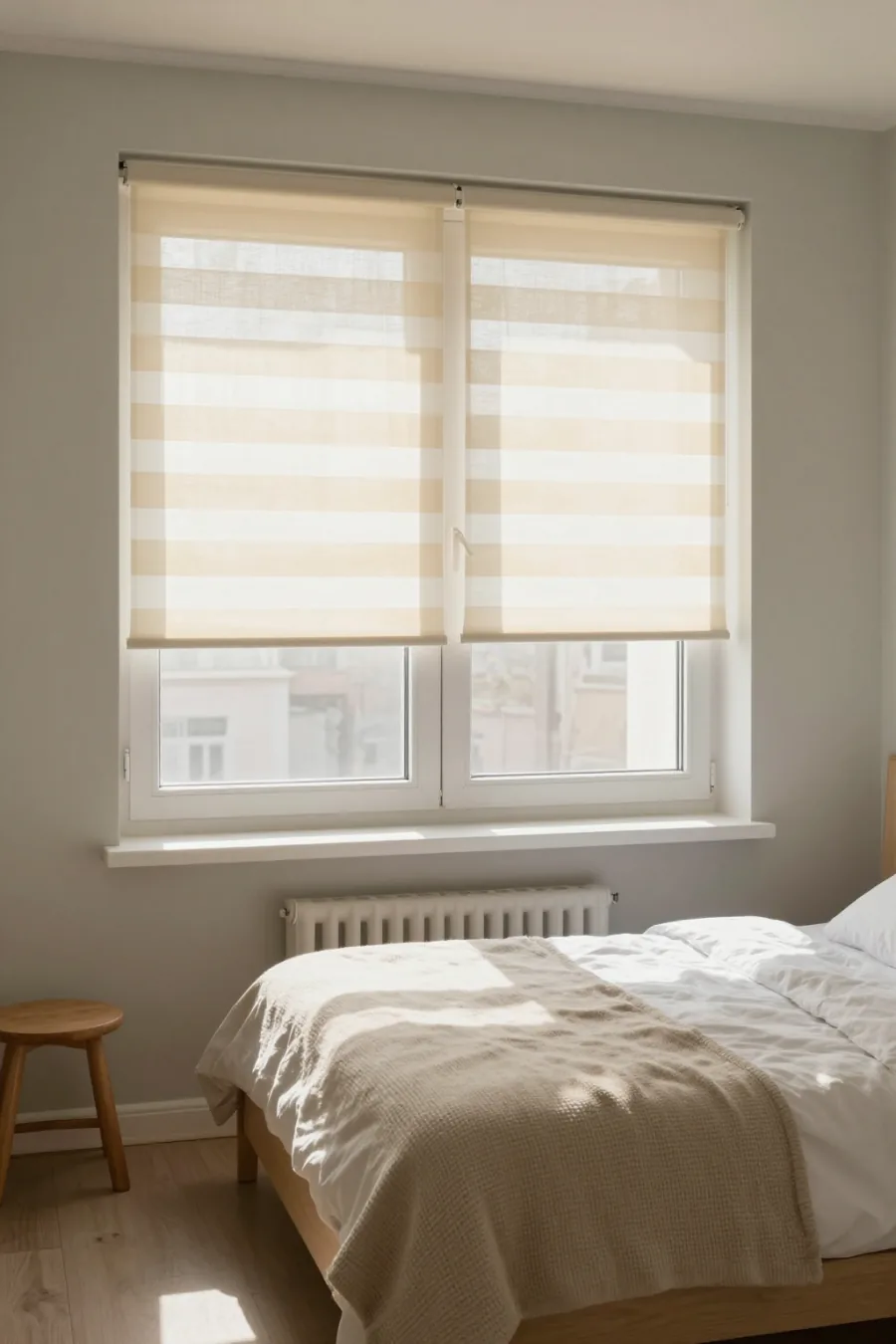











Day-night blinds are a two-layer fabric of alternating transparent and dense stripes: by shifting the layers, you smoothly change the light in the room from full to dimming. We make them in Almaty to measure: open system — from 7,300 ₸/m², cassette with guide rails — from 9,400 ₸/m², manufacturing 5–7 days.
How day-night blinds are built and what happens in the room
Day-night blinds are a two-layer fabric with alternating sheer and dense stripes. Both layers hang on a single roller tube, and shifting the layers relative to each other smoothly changes the light in the room: from full light to dimming, without jerks and without a “half the window closed” position.
The design is simple. Each layer is a band with sheer and dense sections at regular intervals. While the stripes of the top and bottom layers line up, light passes freely. Shift the layers and the dense stripe of one lines up with the sheer stripe of the other, and the room darkens. The fabric stays taut rather than folding up like an accordion. In my view, that continuity of the blind is the main convenience: the window doesn’t open and close in pieces.
| Position of the layers | What's in the room |
|---|---|
| Stripes lined up | Plenty of light, the street is visible |
| Shifted halfway | Soft diffused light |
| Shifted fully | Dimmed, views from the street are blocked |
Classic zebra is the most popular day-night option: the stripes run in a 1:1 ratio, the pattern is even and calm, and it suits both the living room and the kitchen.
The density of the fabric determines how much light the blind holds back when closed and how much the room can be seen from the street. Dense stripes block both light and looks; sheer ones let them through. The denser the fabric, the stronger the dimming — and the less light is left during the day. It’s always a compromise, and at the measurement Jalusso shows it on samples, not in words.
The first system people usually start with is the open roller tube. The mechanism stays visible, but the design is simpler and cheaper than a cassette; we have a separate breakdown of the differences between systems.
Open roller tube, cassette or cassette with guide rails: what changes on the window
The open roller tube, the cassette and the cassette with guide rails differ in what stays visible on the window and how the blind is held at the edges. The fabric and controls are the same for all three.
| System | What is covered on the window | How the fabric behaves | Who it suits |
|---|---|---|---|
| Open roller tube | the roller tube and the top of the blind are visible | hangs freely, leaving a narrow strip of light at the edges | when the window is out of sight and you want a simpler system |
| Cassette | the roller tube and the top of the fabric are hidden by a cassette | runs straight down from the cassette, the edge of the fabric doesn’t curl up | when it matters that everything looks neat at the top |
| Cassette with guide rails | the roller tube is covered by a cassette, the edges run in a profile | fixed at the sides, doesn’t sway in a draught and doesn’t flap | for lower floors, balcony doors, windows in busy spots |
The difference shows up on the window within the first few days. With an open roller tube the fabric hangs free: the bottom pulls slightly away from the frame, and a strip of light runs along the side edges that the dense stripes don’t cover. In a cassette the housing hides the roller tube, and the fabric drops from it as a flat surface. Guide rails add a side profile to the cassette, and then the fabric doesn’t sway when someone opens a door nearby or the extractor fan is running.
Why is a cassette more expensive than an open system? The housing and side profiles are separate parts, made and fitted to a specific opening. An open system needs only a roller tube and brackets, so it costs less. The measurer works out both options on site, and the difference then shows on your particular window.
Will the system fit plastic windows in a ground-floor flat in a built-up area? Any of the three will. We fit day-night blinds on plastic windows both to the frame and to the sash. If the window faces the street and everything below is overlooked, guide rails are nicer: the fabric keeps its shape across the whole opening, not just in the middle.
The difference between the three systems comes down to the cassette and the guide rails: they cover the roller tube at the top and hold the fabric at the sides of the opening, and you pay for a neat look and for the fabric not swaying.
How much does the fabric darken the room during the day?
With standard fabric in the closed position the room is in soft semi-darkness, but it will not be completely dark. During the day the stripes overlap and noticeably dim the light — enough to take the sun off the screen and stop squinting, but not enough to fall asleep at noon. Only blackout day-night gives full darkness, and even then in a cassette system with guide rails, where there are no gaps at the edges.
How does blackout feel different from a regular zebra? In a regular zebra, light still passes through the entire area of the fabric, just diffused. In blackout, the dense stripes are made of fabric with a darkening layer, and in the closed position the room goes into darkness down to 95%. The difference is visible at once: with standard fabric the eye adjusts after a minute and makes out objects, with blackout it no longer does.
Fabric density determines two things at once: how much the fabric darkens the room during the day and how much the room can be seen into in the evening. Thin fabric takes less light on itself, but also holds less. Dense fabric works both ways — the room is darker and less is visible from the street. That is why choosing fabric by colour alone is wrong: light beige and dense beige are different fabrics.
| Fabric type | What the room looks like during the day | Where we install |
|---|---|---|
| Classic zebra | Soft semi-darkness, stripes 1:1 | Living room, kitchen |
| Wide stripe | Denser semi-darkness, pattern more visible | Windows from one and a half metres |
| Blackout day-night | Darkness down to 95% | Bedroom, kids’ room |
| Sheer zebra | Diffused light, the room is visible | North side |
Fabric for the room’s purpose
The classic zebra with stripes 1:1 covers the living room and kitchen: during the day it gives even light without direct sun. The wide stripe — from 90 mm — goes on windows from one and a half metres, where the stripes read as a pattern and work on the wall sections. We install blackout day-night in the bedroom and kids’ room, where daytime sleep is needed. The sheer zebra is an option for the north side: both layers are light, and the view from the window is preserved.
At the measurement we lay the samples out side by side on the same frame. That way you see how the same stripe looks in different tones: white day-night blinds give the brightest pattern, beige and grey are calmer.
With standard fabric in the closed position you get soft semi-darkness, not full darkness: for night-like darkness you need blackout in a cassette system with guide rails.
What is visible from the street in the evening and how to close the room from prying eyes
During the day the room cannot be seen from the street, while inside it is light. In the evening the picture changes: with the lights on, silhouettes are distinguishable through the transparent stripes. This is the physics of the fabric, not a defect — the light inside is brighter than the street light, and the fabric starts to work like a screen. Privacy in the evening is determined by fabric density: the denser the stripes, the fewer details are visible from outside. Closed layers give more than half-open ones, but even they do not turn the window into a solid wall if the fabric is standard.
Here are the situations people most often come to us with for a measurement.
- An apartment on the first or second floor, windows facing the courtyard and the neighbouring building — people choose fabric with denser stripes or blackout day-night.
- A window directly opposite a neighbour’s — here even a standard zebra in the closed position does not help, and the conversation turns to blackout.
- A bedroom with a window onto the street — a typical choice, in the evening we close the layers fully.
- A kids’ room, where the lights are turned on earlier than in the rest of the apartment — the same solution, only with controls without a hanging chain.
Ground floor and dense development
For the first floor and dense development we recommend fabric with denser stripes or day-night paired with roller shutters. Roller shutters close the opening from outside and remove the issue of evening viewing entirely; day-night inside remains for daylight. We put such a set together at one measurement — the mounting and dimensions are calculated together so that the fabric and roller shutters do not compete for space on the frame.
Shop window: coffee shop, salon, office
A coffee shop’s shop window solves two tasks at once: during the day to close the space from the street without turning it into a dark box, in the evening to remove the space from passers-by’s view. For a salon with a glazed front the logic is the same, only there are more sections. And in an office the fabric also removes glare from the monitor — dense stripes damp the harsh light from the street, and the screen is easy to read.
The main thing to remember: during the day day-night works on light, and in the evening fabric density decides everything.
How much do day-night blinds cost and what the price is made up of
The price of day-night blinds is calculated per m² of the finished product including the mechanism, not for the fabric separately. A rough guide for the basic systems: open roller tube — from 7,300 ₸/m², cassette with guide rails — from 9,400 ₸/m², blackout — from 9,900 ₸/m², electric motor — from 13,500 ₸/m². The remote control for the electric motor is bought separately.
After that, four things move the total: area, fabric density, system type and controls. It’s easier to look at the adjustments to the price list than at the price list itself.
| What affects the price | Coefficient | What this means on the window |
|---|---|---|
| Controls: cord or handle | ×1.0 | basic mechanical |
| Control: chain | ×1.06 | a surcharge on the manual cord, not a separate system |
| Control: electric motor | ×1.85 | motor included, remote control separate |
| Controls: electric motor with remote control | ×2.1 | top adjustment |
| Fabric: standard | ×1.0 | classic zebra |
| Fabric: sun protection | ×1.15 | denser stripes for a bright window |
| Fabric: blackout | ×1.35 | bedroom and kids’ room |
| Mounting: on the frame | ×1.0 | basic |
| Mounting: no drilling | ×1.1 | brackets into the glazing bead or spring clips |
| Mounting: on the wall | ×1.02 | minimal surcharge |
| Colour: white, beige, grey | ×1.0 | base group |
| Colour: dark | ×1.04 | the only colour with a surcharge |
This shows why the same window costs different people different amounts. White and beige day-night blinds on the frame with a cord go at the base rate. A zebra for a south-facing window with dense sun-protection fabric comes out dearer — by ×1.15.
How the total is calculated
Open system — from 7,300 ₸/m² and 5–7 days. Cassette and blackout — from 9,400 and from 9,900 ₸/m², same lead time, 5–7 days. Electric motor — from 13,500 ₸/m² and 7–10 days. Installation costs 4,500 ₸ per item; for orders from 150,000 ₸ installation is free.
Measurement and consultation are always free: our measurer arrives with samples and works out the price on the spot, and delivery within the city is free too. Manufacturing time counts from the measurement, not from the call.
The warranty covers the mechanism and installation — 3 years and 1 year from the date the acceptance certificate is signed — but not mechanical damage, reinstallation on your own, water or natural fading of the fabric.
Let’s check it on a kitchen window: an open system, white fabric, frame mounting, cord control. All coefficients are one, and you pay for the area at the price list plus installation. If you want it without drilling the frame, the total is multiplied by 1.1.
Fabric for the window orientation and the Almaty climate: white, beige, grey
In Almaty, the shade of the fabric is chosen by which way the window faces, not by the room's interior. White, beige and grey heat up less in the sun and don't fade as noticeably as dark ones. For the south and west sides, denser stripes are chosen; for the north, a classic zebra or sheer is enough.
Summers here are hot and sunny, winters are cold, with frosts and a temperature difference between day and night. The fabric works against both light and dust — this determines how often you'll have to reach for the brush.
By orientation, the breakdown is like this:
- South and west. The sun hits the window almost all day. Here white and beige day-night blinds are chosen with denser stripes: they hold back light better and the room heats up less.
- North. There's little light, and you want to keep the view from the window. A sheer zebra suits best — both layers are light, and what stays outside the window is a picture, not a grey wall.
- Kitchen and living room. Grey or white day-night blinds with the classic 1:1 stripe work well here.
Double blinds for windows — zebra day-night — come in our basic tones: white, beige and grey; the calculator applies a coefficient of 1.04 to dark fabric, and it heats up more in the sun.
Light shades and south-facing windows
The difference between light and dark fabric on a south-facing window shows already in the first hot season. White, beige and grey heat up less in the sun and don't fade as noticeably as dark ones; for the south and west sides, denser stripes are chosen. We recommend light shades for south and west almost always — we make an exception when the room is already done in a dark palette and the client is ready for the fabric to heat up more.
Dust between the layers
Dust settles on both layers — this is the main feature of the double construction. The sun and dust of Almaty speed up both the fading of the fabric and the accumulation of dust between the layers, so we clean the fabric with a dry brush or a vacuum cleaner on minimum power. Washing and soaking are not allowed: the coating washes out, the fabric loses its shape and stops holding the stripes evenly. If the window faces a dusty street, go over the layers with a brush more often: dust between the layers stops the stripes from moving smoothly.
Summers in Almaty are hot and sunny, winters are cold with a temperature difference, so the fabric works against both light and dust.
A system for the sash, balcony and balcony door
For a balcony and balcony door we install day-night in a cassette with guide rails. Fabric of that height on an open system swings from draughts and gets in the way of the passage. The guide rails hold it at the sides, and the bottom rail moves along them evenly.
For a glazed balcony this is the main option. The fabric covers both the windows and the door in one contour, but you can control the light on each part separately.
For a balcony door, day-night comes with guide rails so the fabric doesn't dangle and doesn't get in the way of the passage. That's the only way it works: without side guide rails, the bottom edge sways with every movement of the sash.
What to check before ordering for a balcony:
- Whether the door opens into the room or out onto the balcony — this determines which side the housing box goes on.
- Whether the sash has a handle that sticks out beyond the plane of the frame; the measurer checks whether the mechanism hits it.
- How tall the opening is — on tall fabric the guide rails are essential, otherwise the bottom will sag.
- How many sashes and doors are in the contour: we calculate a separate fabric for each, so you can control the light by side.
- Which way the balcony faces — south, west or north; this determines the density of the stripes.
A tilt-and-turn sash requires the bottom rail to be fixed. Without it, the fabric dangles when the sash is tilted, and can get pinched when it closes. We install the system directly on the sash, and it moves together with it.
Kitchen window
A kitchen window lets you air the room without raising the fabric. You open the sash together with it, and the fabric stays in place. This is the main reason kitchens get day-night rather than a roller blind.
If the window is next to the stove, we choose a fabric that is easy to wipe with a damp sponge without household chemicals. Greasy film settles on the dense stripes, and the sponge handles it without soaking. The fabric must not be washed: the coating washes out, the fabric loses its shape and stops holding the stripes evenly.
Day-night fabrics for the kitchen are chosen with stripes of 1:1 or a little denser — when cooking it's important to block the light quickly, but not to shut the room off completely.
Wide openings, bay windows and shopfronts: why we install several sections
We build a wide opening from several sections rather than one long blind. That way the system runs more smoothly, the fabric doesn’t sag in the middle, and later you can replace one section instead of the whole opening. A floor-to-ceiling window is exactly the case where saving on sections backfires: one long blind is pulled down by its own weight, the stripes stop holding a straight line, and lifting it with a single chain becomes hard.
A bay window works differently. Each sash gets its own blind, and the corners between them aren’t covered at all — light is controlled side by side: the south part is lowered more, the north part is left open. That’s exactly what makes fabric day-night blinds convenient in a bay window: the room is made up of zones with different light levels, and one blind for the whole bay window would force them to be equal.
What does a wide stripe change? The pattern. On windows from one and a half metres, stripes from 90 mm read more calmly than the classic 1:1, which start to shimmer over a large area. For commercial premises with a shopfront this is also an argument: guests from the street see an even rhythm of stripes, not a fine mesh.
A real example
Living room with a bay window: we make each sash a separate fabric, so the owners control the light by side instead of guessing which edge to raise.
A coffee shop with a six-metre shopfront and a beauty salon with a four-metre glazed front — here we installed sections instead of one long blind. The reason is simple: the fabric doesn’t sag and runs more smoothly, and during the day the space is closed off from the street without turning into a dark box.
If you’re choosing day-night blinds for a wide opening, tell the measurer how many sashes there are and where they open — we work out the section layout on the spot.
On wide openings we install several sections instead of one blind: it runs more smoothly and doesn’t sag.
How an order works: measurement, workshop, installation
Measurement is always free with us, and it decides more than choosing fabric in the catalogue. There are no ready-made products in stock — every blind is made for a specific window, so the measurer is the person who turns your “I want to close myself off from the neighbours in the evening” into dimensions, a system and a price.
Before the visit, it’s worth preparing three things: access to the window (nothing should stand right up against the windowsill), an answer to the question of who lives in the room, and a rough idea of when you need the blinds. Manufacturing time depends on the system: open roller tube, cassette and blackout — 5–7 days, with an electric motor — 7–10 days, and the remote control for it is bought separately. If you want a day-night blinds catalogue, you look at it during the measurement: the measurer brings fabric samples, not a link to a website.
Then he asks his own questions.
- Which way the window faces — the window’s orientation sets the density of the stripes, not just the shade.
- Whether the sash opens and in which direction, and where the handle is.
- What kind of windowsill it is and whether there are reveals to attach to.
- Who will lower the blind and how often — this determines the choice of control.
- Whether the room needs to be fully closed off during the day or soft diffused light is enough.
Choose the fabric in the light you’ll use it in. During the day a sample by the window looks different from how it looks in the evening with a lamp on — Jalusso usually asks you to look at the stripe both ways before ordering day-night blinds. Don’t choose “by eye” from a phone photo: the density of the stripes doesn’t come across on a screen.
Decide on the control and the profile colour in advance. A chain, a spring, a side handle or an electric motor isn’t a small detail to be changed later — it’s part of the mechanism. And the colour of the cassette housing is best chosen before the quote, not after.
The easiest way to buy day-night blinds cheaply is through an accurate measurement, not through haggling: extra centimetres of fabric mean extra money per m². The measurer takes the exact dimensions, and he also calculates the cost for the chosen system and fabric, so you get the total on the spot.
As for installation, it’s a separate line in the invoice. Installation costs 4,500 ₸ per item, and for orders from 150,000 ₸ we do it free. On wooden and aluminium frames we choose the mounting method during the measurement: there it all depends on the profile.
City and suburbs
Measurement and delivery within the city are free. We travel to Kaskelen, Talgar, Issyk and Kapshagay, and the cost of the visit depends on the distance and is quoted before the visit — that is, before you make a decision.
If the window is outside the city, we quote the visit fee straight away so you can decide whether the option suits you before the measurer arrives.
Control: chain, spring, side handle or electric motor
Control is chosen based on who will approach the window and how often, not on the price of the blind. The chain is the most familiar option: the blind is moved by a cord on the side, the movement is smooth, and it stays in any position. The spring works without anything hanging down: pull the bottom rail and the blind goes up or down and stays where you let go. The side handle is fitted on narrow sashes and on windows where there’s simply nowhere to put a chain. The electric motor covers the cases you can’t reach by hand.
| Control method | Where it works well |
|---|---|
| Chain | Living room, kitchen, study — windows within arm’s reach |
| Spring | Bedroom and kids’ room: nothing hangs down, a child can’t pull on a cord |
| Side handle | Narrow sashes, windows with furniture placed close by |
| Electric motor | Tall windows, floor-to-ceiling glazing, shop windows; remote control bought separately |
In bedrooms and kids’ rooms, people more often choose a spring or a side handle. Parents bring this up separately: a chain by a child’s bed is a cord that sooner or later will get pulled. A spring removes the issue entirely.
On a tall window you can’t reach even from a chair, the answer is short — an electric motor. The remote sits on the table, and the blind moves at the touch of a button. This is the case where the price is higher, but there’s simply no alternative for convenience.
Mechanical control comes at the base price of the system, the chain has a coefficient of 1.06. The electric motor is calculated separately: from 13,500 ₸/m², manufacturing in 7–10 days instead of 5–7. If it’s a single tall window, the difference in lead time usually isn’t critical — the order is made to measure anyway.
We also install motors on commercial premises: it’s easier to open and close a coffee shop’s shopfront with a remote than to walk along the whole pane.
An electric motor is convenient on tall windows and in a kids’ room, where you don’t want a hanging chain.
Caring for the blind and what it doesn’t like in Almaty conditions
Caring for day-night fabric means dry dusting as dust builds up: a soft brush or a vacuum cleaner on the lowest power. No solvents, bleach or abrasive products — they break down the treatment and change the shade of the fabric.
Dust between the layers builds up noticeably in Almaty: the summer is hot and sunny, the city carries fine dust, and in winter smog is added to it. On south- and west-facing windows the sun adds to the dust — it speeds up natural fading, and light tones win here: loss of richness shows later on them than on dark ones.
The rules are simple:
- Dust — a dry brush or a vacuum cleaner on the lowest power, as soon as it becomes noticeable.
- Kitchen film — a damp sponge without household chemicals, as soon as it appears.
- Solvents, bleach, stiff brushes — we don’t use them.
- The mechanism — don’t lubricate it yourself; we come to tighten it.
When to call a technician? If the stripes stop moving evenly and go crooked, the chain slips or the fabric jams at the edge — that’s no longer care but adjustment. We handle such requests under warranty.
What the warranty covers
We give 3 years on the day-night blinds mechanism and 1 year on installation from the date the acceptance certificate is signed. We fix warranty cases free of charge, within 5 working days. After the warranty the technician still comes: to tighten, adjust, replace the cord or chain.
The warranty does not cover mechanical damage, reinstallation on your own, water or natural fading of the fabric.
The service life of day-night fabric in Almaty depends on which way the window faces, how often it’s touched and how regularly dust is removed between the layers. We don’t name exact years — we name the conditions under which the fabric keeps its shape and the stripes run evenly.
When day-night blinds are not suitable: sloping windows and other cases
For sloping and roof windows, day-night blinds are not the best option — there we suggest pleated blinds. The reason is simple: a day-night blind holds its shape thanks to its own weight and an even vertical run along the roller tube. A slope breaks that geometry. Pleated blinds, unlike day-night, fold into pleats and slide along guide rails on the frame, so they work on any plane — both sloping and roof.
Yes, day-night blinds are horizontal blinds, but not in the usual sense. There are no rigid slats that turn around an axis, as with aluminium horizontal blinds. The light is controlled by two fabric layers, shifting the stripes relative to each other. That is why a slope is bad for this kind of blind: a slat would turn, but the fabric will sag.
When we suggest something else
- Sloping and roof window. Day-night gives way to pleated blinds: only they run evenly along a sloping frame.
- A ground floor with dense buildings around, if you need full opacity in the evening. Here day-night blinds paired with roller shutters or blackout day-night blinds — an ordinary zebra blind leaves silhouettes.
- Arched and triangular openings. The measurer looks at the geometry and says straight away whether a day-night blind will fit or whether pleated blinds are easier.
Let us be honest: if the window is non-standard, it is not worth insisting on day-night blinds just because you liked them at a friend’s place. Day-night fabric is a good thing, but not universal; in some cases it is fairer to suggest another system right away than to redo the mounting later.
For sloping and roof windows, day-night blinds are not suitable — we suggest pleated blinds, while blackout day-night blinds and roller shutters solve the task where solid privacy is needed.
FAQ
The questions below are the ones that remain after choosing the fabric: they’re about combining it with other textiles, replacing the fabric, and windows where day-night behaves differently.
Can day-night blinds be hung together with a sheer or a curtain?
Yes, but with a caveat. A sheer zebra replaces a sheer on its own: both of its layers are light and the view out of the window is kept. A curtain is hung over day-night blinds on a separate rail, and then the cassette doesn’t get in the way — the housing is already hidden from view. A heavy curtain is chosen for the evening privacy that the sheer stripes don’t give.
Can the fabric be replaced with another one later?
Partly. The fabric can be replaced with the same type of system: if you have an open roller tube, the new fabric goes onto it without changing the mounting. But switching from an open system to a cassette with guide rails means a different housing and different brackets, so that decision is made straight away. We make linen-textured and blackout day-night fabric to the same dimensions as the standard.
What if the stripes are uneven after installation?
First check the bottom bar — most often that’s the cause. Raise the blind all the way up, let the layers even out, and lower it again without pulling the chain at an angle. If the stripes still drift apart, our technician comes out: the mechanism is adjusted under warranty, which covers it for 3 years. Washing and soaking won’t help here — the fabric is only ever dry dusted.
Are day-night blinds suitable for an unheated loggia?
Yes: we often fit day-night blinds on balconies and loggias, but with the temperature swings in mind. Winters in Almaty are cold, and on an unheated loggia the fabric works in tough conditions. Side guide rails keep the fabric straight, while the fixing to a cold frame is something our measurer chooses case by case. For floor-to-ceiling glazing on a loggia we fit several sections.
Can I put day-night blinds in a child’s room where a night light is on?
Yes. The sheer stripes let the night light through, so the room doesn’t turn into a dark box and your child isn’t left in complete darkness. If you need it dark like at night, go for blackout day-night blinds in a cassette. For a child’s room, controls are more often a side handle — no hanging chain.
We make day-night blinds in Almaty to order, so we go through each of these questions at a free measurement with samples.
The bottom line
Four tips that cover almost any order. Bedroom and child’s room — blackout day-night blinds in a cassette with guide rails: the dense stripes give the strongest darkening, made in 5–7 days. For the living room and kitchen — an open roller tube: cheaper, from 7,300 ₸ per m², and the fabric is easier to take down for cleaning. Balcony door — cassette with guide rails only, otherwise the fabric flaps in the walkway. A window above arm’s reach, or a room where you don’t want a hanging chain — electric motor, 7–10 days, and the remote control is bought separately.
One practical recommendation: start with a measurement, not with the catalogue. Our measurer arrives with samples, holds the fabric against your window in your light and works out the price on the spot — this is free across the city.

