



























Bathroom blinds are made from aluminium or PVC with a 25 mm slat: these materials don’t absorb moisture and don’t swell from steam, and the slats are washed right on the window. We manufacture them in our own workshop in Almaty to your measurements, aluminium from 4,200 ₸/m², PVC from 3,600 ₸/m².
How bathroom window blinds differ from plumbing blinds for pipes
Bathroom blinds in Almaty are a system for the window, not for pipes: the blind is fitted to the glass, and the slats turn to adjust the light. Plumbing blinds for pipes are a different product. They hide the utility unit behind the toilet: pipes, meters and shut-off valves. The confusion comes from one word, and someone looking to cover a window sees something completely different in the photos.
Plumbing blinds and roller shutters for pipes
Plumbing blinds cover a section of wall or the riser behind the toilet. Roller shutters solve the same task but differently: the blind made of plastic profiles moves up and down along guide rails instead of turning slats. The size of such a product is tied to the bathroom niche, not the window, and it is fixed to the wall or floor.
Why separate them? A product for pipes doesn’t cover a window, and a product for a window won’t hide a meter. If you’re talking about blinds for a toilet, first ask yourself: what exactly are we covering — the opening with glass or the utility unit?
Blinds for a bathroom window
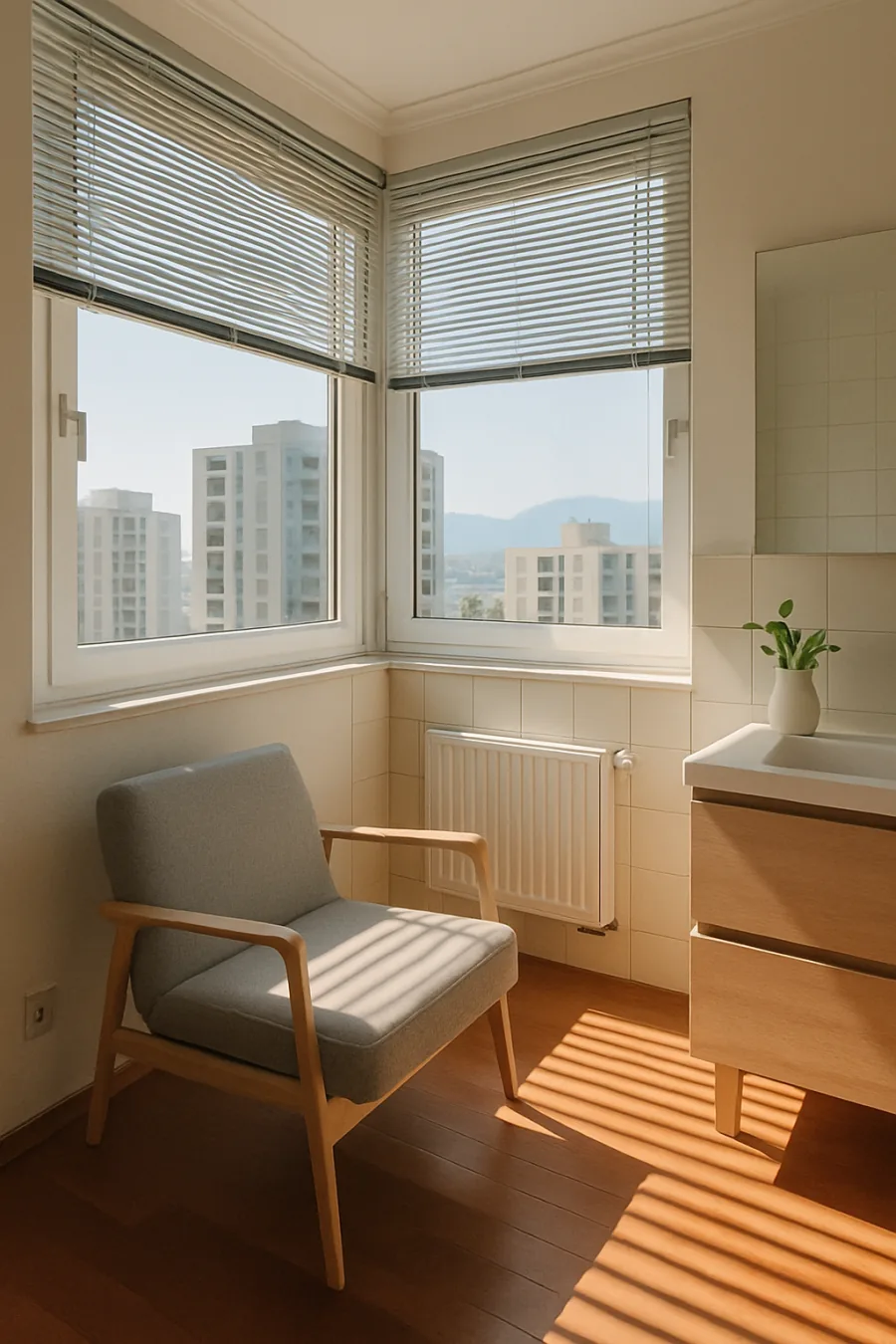
We manufacture horizontal blinds for windows in bathrooms, toilets and combined bathrooms. The blind made of a narrow 25 mm slat fits onto the sash or into the opening, and the tilt of the slats sets how much light enters the room. Measuring the bathroom window determines the size of the system and the mounting method: whether it will fit on the reveal, whether it will cover the handle, and whether there is enough space between the frame and the plumbing below.
The dimensions are calculated from the glass and frame, so the system doesn’t conflict with the toilet and pipes. During the measurement, the measurer arrives with samples and shows how a specific slat will fit your window.
Plumbing blinds cover the pipes, meters and valves behind the toilet, while window blinds are mounted on the glass and control the light — these are two different products under one word.
Aluminium or PVC: what to choose for the window in a bathroom, toilet and combined bathroom
Two materials are suitable for the window — aluminium and PVC. We make blinds for bathrooms in Almaty from exactly these: both do not absorb moisture, do not swell from steam, and both are assembled with a 25 mm slat so that the blind fits a small window. The choice between them is a choice between durability and price.
Below is a comparison by four criteria: durability, care, reaction to moisture and cost per square metre.
| Feature | Aluminium, slat 25 mm | PVC, slat 25 mm |
|---|---|---|
| Moisture and steam | Does not absorb, does not swell | Does not absorb, does not swell |
| Care | Wiped clean on the window | Wiped clean on the window |
| Durability | Higher: does not yellow, holds its shape | Lower: may warp on a wide blind |
| Price | from 4,200 ₸/m² | from 3,600 ₸/m² |
| Manufacturing time | 3–5 days | 3–5 days |
Aluminium, slat 25 mm
Aluminium blinds are stronger than plastic and do not yellow over time. Metal does not absorb odours, so in a combined bathroom the blind does not hold the smell of laundry or bleach. The 25 mm slat is narrow — on the window by the sink the blind does not block the handle and does not rest against the reveal. Aluminium slats are washed right on the window, there is no need to take them down.
PVC, slat 25 mm
PVC plastic blinds are the budget option among the durable ones. Moisture is not a problem for them, they are washed with a cloth, they do not absorb odours. There are wood-look textures and matte shades — if you want the bathroom window to look warmer than bare metal. Price — from 3,600 ₸/m², the same lead time: 3–5 days. Aluminium wins over PVC in service life: metal does not darken and does not lose its shape in heat and damp. Plastic may warp over time on a wide blind, but on a narrow bathroom window the difference is almost invisible.
Why fabric and wood do not work in a bathroom
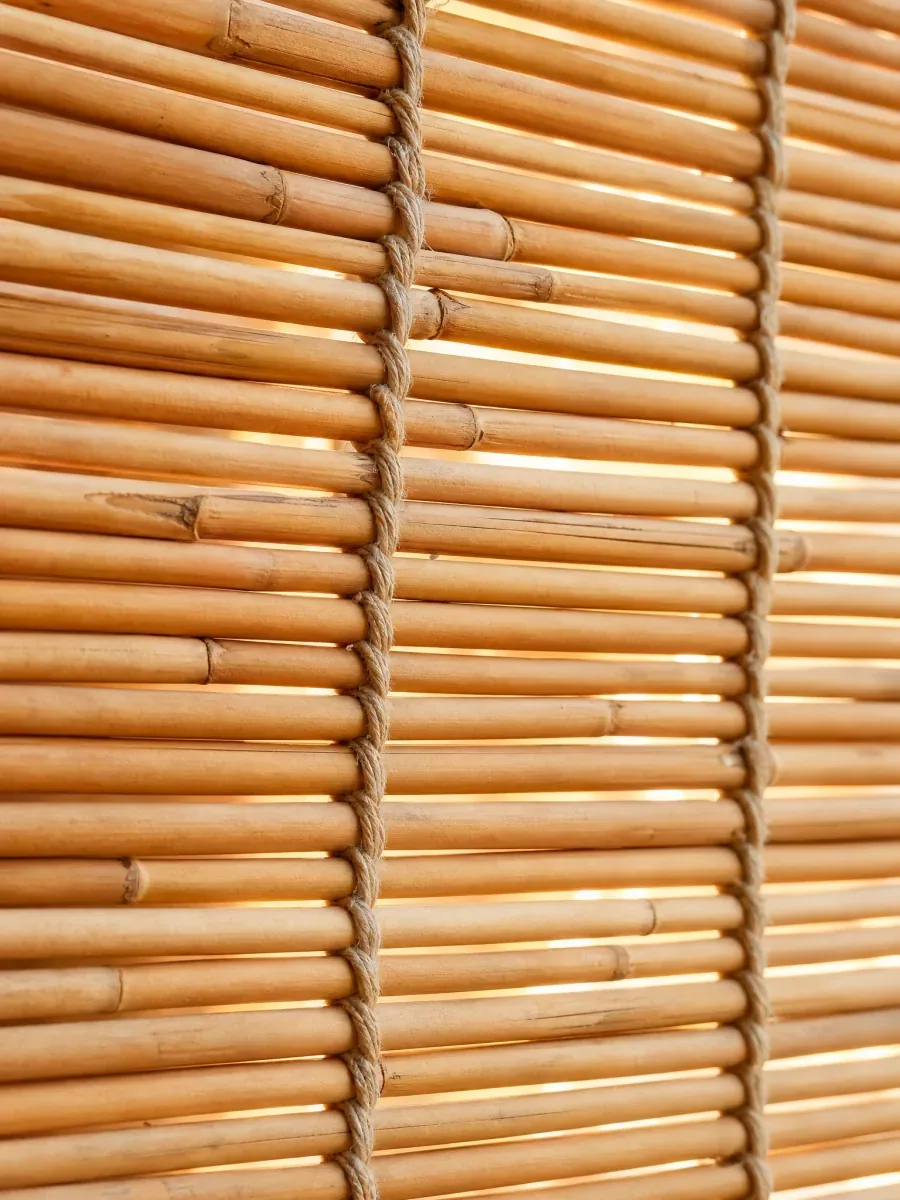
Fabric blinds and pleated curtains lose their treatment in constant moisture. Wooden blinds may warp from moisture in a bathroom — steam softens linden and bamboo straw, and the blind buckles. Bamboo blinds in a bathroom behave the same way as wood. Jalusso makes blinds for bathrooms from metal or plastic, and this is not caution for caution's sake: fabric blinds from bathrooms regularly come into the workshop for re-stringing, while aluminium ones come back only for scheduled cleaning.
Hardware: why cheap steel parts rust
A mechanism made of aluminium and plastic handles moisture calmly. Only cheap uncoated steel parts rust — this is the main reason the blind starts to jam. We install coated hardware, and the brackets for drilling-free installation are made of plastic. If the mechanism does start to stick a year after installation, it is a warranty case: the mechanism has a 3-year warranty from the date of signing the acceptance report.
Aluminium and PVC do not absorb moisture and do not swell from steam, while fabric loses its treatment and wood may warp — that is why blinds in a bathroom are made from metal or plastic.
How to hang blinds on a small window without drilling the frame
The frame can be left intact. Glazing-bead brackets and spring clamps hold the system without drilling, and this type of installation is chosen for windows under warranty and in rented flats. The order is: measurement, choice of mounting, manufacturing of a mini system to the size of the sash, installation.
Drilling-free mounting keeps the window intact — not a single hole in the profile. For a rented flat this is a decisive argument: the landlord does not always allow drilling, and screw marks stay forever. We do such orders regularly.
Brackets into the glazing bead
Glazing-bead brackets are fixed without drilling the frame: the clamp sits on the glazing bead — the strip that holds the glass unit — and holds the system by its fit. The PVC window is not touched with tools, so the window warranty is not voided. This is the usual choice for new builds where the windows are still under the developer's warranty.
Spring clips
Spring clamps are removed without traces when you move — that is their main feature. The system is held by a spring, and when dismantled a clean profile remains. At the measurement we calculate the weight of the system: the wider the blind, the stronger the spring must be so that the mounting holds with a margin and does not sag after a month.
Installation on the sash
When mounted on the sash, the blinds rise together with it. The blind is fixed to the moving part of the window, so it does not interfere with opening the sash and does not rest against the reveal. For a fixed bathroom window that does not open, mounting on the frame or into the opening is used — no sash is needed there, and the blind stays in place. For a narrow opening we install a mini system with a narrow 25 mm slat: it is assembled to the size of the glass of a typical bathroom, does not block the handle and leaves access to the vent.
For drilling-free mounting on the frame the calculator applies a coefficient of ×1.1 — this is cheaper than a cassette system with a housing box (×1.28), but more expensive than ordinary wall mounting. How much drilling-free mounting on the frame costs in a particular case, the measurer calculates by the size of the window and the weight of the blind.
Measurement is free, the measurer comes with samples of mountings and shows on site which system will fit a particular window. The frame can be left intact: glazing-bead brackets and spring clamps hold the system without drilling, and this type of installation is chosen for windows under warranty and in rented flats.
Typical bathroom windows: tilt sash, fixed window, window above the bathtub
Every bathroom window sets its own task for the system, and it is solved at the measurement. Let us look at four common cases that people most often come to us with.
Tilt sash and frequent ventilation
If the bathroom window is a tilt one and is ventilated often, the blind must rise together with the sash. Then the blinds are mounted on the sash itself, not on the reveal: when the handle is turned, the system moves together with the frame and does not block the air flow.
The main problem with such a window is a draught. Light aluminium slats with no load start to flap and ride up. That is why we make the bottom rail with a weight: it keeps the blind in a straight line, and the blinds do not rattle even in a strong draught. The weight is enclosed, so no deposit collects on it.
Fixed window
On a fixed window the sash does not open, so the question “what to mount it on” is solved differently. The system is installed into the opening or on the frame, and the slats are simply turned to the required angle. Ventilation through such a window is impossible, but the blind does not interfere with opening either.
A mini system with a narrow slat fits a fixed window well. It is assembled to the size of the glass and does not eat up light. If the window is small, this is the only option that does not argue with the geometry of the opening.
Window above the bathtub and window between the bathroom and the kitchen
A window right above the bathtub requires protecting the blind from shower splashes. Here horizontal aluminium or PVC blinds with a 25 mm slat are used: they do not absorb water, and splashes simply run down the slats. Jalusso does not recommend fabric and wood for such a window — constant splashes are bad for them.
In older housing stock a window between the bathroom and the kitchen is common. It opens into the kitchen, so the sash has to be opened from the kitchen. We install the blinds on the side from which the window is used. The measurer looks at which way the sash tilts and chooses the mounting accordingly.
And if the bathroom window faces the street on the ground floor of a private house, privacy is added to the question. A dense blind hides the room from prying eyes, while the slats can be turned to let in daylight.
For a very narrow toilet window there is a mini system with a 25 mm slat. It is suitable for a small and narrow bathroom window: the narrow slat does not block the handle and does not rest against the reveals.
Blinds for a toilet and bathroom are assembled for a specific opening: on a tilt sash the blind rises together with it, the window above the bathtub gets protection from splashes, and for a narrow opening a mini system with a 25 mm slat is installed. We go through each of these cases at a free measurement.
Steam, condensation and ventilation: what happens to the fabric in a bathroom
Aluminium and plastic slats don't absorb steam and don't swell from moisture. Condensation does settle on them, though — and the worse your ventilation works, the more often you have to wipe the slats. The material itself isn't the issue. The only question is how quickly the air in the room changes.
What ventilation does
Ventilation in a bathroom carries steam away before it settles on cold surfaces. No ventilation — the steam stays in the room and settles on the slats, the glass, the tiles. You end up wiping more often.
Bathroom blinds don't get damaged by this, but the upkeep takes more time. If ventilation works, it's enough to wipe the slats as grime builds up. If there's none or it's weak — roughly twice as often, because condensation with lime dries out and leaves streaks.
The mechanism under constant humidity
The mechanism is the cord, chain or spring in the roller tube. It handles moisture fine: aluminium and plastic don't rust. Cheap uncoated steel parts rust — we don't use those in our systems.
The mechanism usually jams not from water. It jams from dust and soap residue: they build up where the cord turns and in the spring assembly. Maintenance is simple — clean the mechanism of dust once a year. Our warranty on the mechanism is 3 years from the date the acceptance certificate is signed, and after the warranty we still come out: to tighten, adjust, replace the cord or chain.
You don't need to take the blinds out of the bathroom. It's enough to ventilate the room and clean the mechanism once a year — that's all it takes.
Almaty climate: dust in summer and frost in winter
Summer in Almaty is hot and dusty: dust settles on the slats in a thin layer and, together with condensation, turns into grime. In winter the climate is sharply continental — frost and temperature swings between day and night. Condensation collects on the glass by the frame, and the slats at the bottom of the blind get dirty faster than the top ones.
Mould in a bathroom doesn't grow on the slats. Aluminium and PVC don't feed it — it spreads along tile joints and sealant where water sits. The slats just need a wipe with a damp cloth as grime builds up, and you can do it right on the window without taking the blind down.
The slats should be washed when you can see grime or streaks from droplets on them. With working ventilation in an ordinary apartment that's about once a month, without it — more often.
Aluminium and PVC don't absorb moisture and don't swell from steam, but with constant damp and no ventilation condensation settles on the slats, and the main cause of the mechanism jamming is dust and soap residue, not moisture itself.
How to wash slats of lime and soap residue
Aluminium and plastic slats are wiped with a damp cloth and a mild product right on the window — there's no need to take the blind down. Soap residue and lime are left behind after every wet cleaning of the bathroom: droplets from a spray dry on the slats, and bathroom cleaning products settle with them. This isn't a defect in the material, just ordinary surface grime.
Here's the order for caring for the slats.
- Lower the blind and turn the slats to horizontal — that way the cloth passes over the whole surface, not just the edge.
- Wipe each slat with a damp cloth and a mild product. Move along it, from the top rail to the bottom.
- Separately wipe the top rail, the bottom weight and the turning drum — grime builds up most heavily on them.
- Let the blind dry in the open position, don't roll it up wet.
- Once a year, clean the mechanism of dust with a soft brush so the cord and turning assembly don't jam.
On the frequent question about vinegar, I'll say it straight: it's best not to pour acid on aluminium. Acid and abrasives damage the slat coating, and mechanical damage isn't covered by the warranty — it covers the mechanism for 3 years and installation for 1 year. Always test any new product first on an inconspicuous slat at the edge: apply, wait, check whether a mark is left.
Stains on bathroom slats are most often leftover soap residue and droplets from hard water. They wash off with the same mild product if you wipe the blind regularly rather than once a season. Condensation and soap residue call for regular wiping of the slats: an old layer has to be soaked and removed in several passes. Tilting the slat doesn't help here — that serves a different purpose, which we'll cover separately under evening privacy.
It also happens that there's one window in the bathroom and one cloth for the whole apartment — and bathroom blinds in Almaty get washed with the same product as the tiles. Tile soap leaves a film on the slats that then collects dust on its own. Keep a separate cloth and a mild product without abrasives or acid — that's enough.
Aluminium slats are washed right on the window with a damp cloth; abrasives and acid damage their coating.
Evening privacy: your silhouette from the street and the tilt of the slats
In the evening, when the light is on in the bathroom, a person's silhouette is visible from the street not through the blinds but past them. The tilt of the slats solves this: plates turned at an angle block the direct line of sight, and from outside only a narrow strip of light remains. Fully closed slats give the tightest cover, slightly open ones leave the room bright. For toilet and bathroom blinds this is the main advantage over any fixed covering on the glass: you adjust how tightly they close by hand, from fully open to fully closed.
Blinds or frosted film on a bathroom window
Frosted film covers the window but doesn't control the light — and that's its main limitation. During the day the bathroom gets darker, in the evening with the light on the room still glows outward, and you can't change how closed it is. Blinds do the same thing, only with control: during the day the slats are open and let light through, in the evening they close into a tight row. For a window on the ground floor or facing a courtyard, the difference is noticeable.
Tilting the slats hides the room from prying eyes in the evening with the light on, while frosted film covers the window but doesn't control the light.
Slat colour, droplets and grime
On light-coloured slats, droplets and lime marks are more noticeable than on coloured and matte ones. This isn't about the quality of the coating — the contrast between a clear droplet and a light surface is higher. If the bathroom is cleaned often and you'd rather notice streaks less, we recommend not white or cream but grey, beige or a wood-look finish in PVC. Dark colours, on the other hand, show dust in summer.
Do aluminium slats rattle in a draught
Light aluminium slats tap in a draught if the bottom rail has no weight. In a bathroom the window is opened often, and a blind without a weight starts to lift and slap against the frame. A weighted bottom rail solves this: the edge stays straight and the slats don't catch on the sash when you air the room. At the measurement we look at where the window faces and choose the system with the airflow in mind.
In a bathroom, privacy is decided not by the blind itself but by the ability to change the tilt of the slats — something neither film nor an ordinary curtain gives you.
What it costs to cover a bathroom window and how long to wait
Covering a bathroom window is calculated not by the area of the apartment but by the square metres of the blind itself. PVC plastic blinds cost from 3,600 ₸/m², aluminium ones from 4,200 ₸/m², and manufacturing for both takes 3–5 days. Installing one item costs 4,500 ₸, but if the order total reaches 150,000 ₸, we install at no extra charge.
Prices by the price list
| Position | Price | Lead time |
|---|---|---|
| Plastic blinds, PVC, slat 25 mm | from 3,600 ₸/m² | 3–5 days |
| Horizontal blinds, aluminium, 25 mm | from 4,200 ₸/m² | 3–5 days |
| Installation | 4,500 ₸ per item | — |
Coefficients are added to the price of the blind. Chain control — ×1.06 on the base mechanical system. Frame mounting gives a coefficient of ×1.05, the no-drilling option — ×1.1, and the cassette system — ×1.28. A small toilet window rarely ends up expensive precisely because the blind area is small.
What is included in the price
Measurement and consultation are always free. Our measurer arrives with samples and calculates the cost on the spot, so you see the figure before you order. Delivery within the city is free too. Measuring the bathroom window determines the size of the system and the mounting method — this affects both the price and how the blind sits on the sash.
Measurement and installation in Almaty and the suburbs
We make blinds in our own workshop in Almaty, so everything is made to measure. There are no ready-made products in stock — each blind is assembled for your window. You can order blinds for a bathroom window via WhatsApp: you write to us, we agree on a time and come over.
We do travel to the suburbs. Kaskelen, Talgar, Issyk, Kapshagay — the distances vary, so we quote the call-out cost before we come, not after.
Sometimes a customer needs to cover both the window and the pipes behind the toilet. These are two different products: we make blinds for windows, but we do not make plumbing blinds for pipes and meters. We will be honest about the pipes during the measurement, so you don’t expect more from your order than you’ll get.
The warranty on the mechanism is 3 years from the date the acceptance certificate is signed, and on installation — 1 year. The same rule applies to bathrooms: if a breakdown is covered by the warranty, we fix it free of charge within 5 working days. Aluminium blinds and PVC toilet blinds have the same lead times: 3–5 days for manufacturing, then installation at a time we agree on.
FAQ
Here are short answers to questions that did not make it into the sections above — about non-standard rooms, private houses, and a single order for both a window and pipes.
Are blinds suitable for a bathroom if it is a laundry area or a boiler room?
Yes. In a laundry room and a boiler room, moisture stays in the air longer than in a bathroom, but aluminium and PVC do not absorb it. The blind is washed together with the tiles and does not need separate drying. The main thing is that the room has working ventilation, otherwise condensation will settle on the slats and you will have to wipe them more often.
What to do if the bathroom window of a private house faces the street on the ground floor
A bathroom window in a private house faces the street on the ground floor, so it has two requirements at once: it must not let people see in from the street, and it must not darken the room during the day. Both are handled by a dense aluminium blind with a 25 mm slat: during the day the slats are turned open, in the evening they are turned shut — from the street you only see a flat line.
Can I order blinds for a window and plumbing blinds for pipes together?
Yes, these are two different products, but the bathroom window and the pipe niche are measured by one measurer in a single visit. The lead times for the items differ, so within one order they are made in parallel and arrive for installation when both are ready.
What the warranty covers
The warranty on the mechanism of bathroom blinds and their installation: 3 years and 1 year respectively, counted from the day the acceptance certificate is signed. We allow 5 working days to fix a warranty case on bathroom blinds, and there is no charge for it. However, water and natural fading of the blind are not covered by the warranty, nor are mechanical damage or re-installation on your own. After the warranty expires, we still come — to tighten and adjust.
Conclusion
Bathroom blinds in Almaty are horizontal aluminium or PVC blinds with a 25 mm slat, installed on the window to measure. Steam and splashes do not harm them: aluminium blinds do not absorb moisture and do not swell from steam, and plastic PVC blinds handle the same load at a lower price. We do not keep ready-made products in stock — the system is assembled for a specific window, so it fits precisely in both width and mounting.
The second point concerns the most common confusion. Blinds for a bathroom window differ from plumbing blinds for pipes in their purpose: the former cover the glass and control light, the latter hide meters, valves and plumbing behind the toilet. We make the former.
The third point is about mounting. The frame can be left intact: brackets in the glazing bead and spring clips hold the system without drilling, and this type of installation is chosen for windows under warranty and in rented apartments.
The fourth point is about care. Aluminium and plastic slats are wiped with a damp cloth and a mild detergent right on the window, without taking the blind down. Once a year we clean the mechanism of dust — that is enough to keep it from jamming. The main cause of jamming is dust and soap residue, not moisture itself.
There is one practical recommendation. Start with a measurement, not with choosing a colour: the measurer arrives with samples, shows how the system will sit on your specific sash, and calculates the cost on the spot. Aluminium starts from 4,200 ₸/m², PVC — from 3,600 ₸/m², manufacturing takes 3–5 days, installation costs 4,500 ₸ per item, and for orders from 150,000 ₸ we do it free of charge. Measurement and consultation are always free, and delivery within the city is free too. If the bathroom window is narrow or the sash is tilt-and-turn, tell us right away — a mini system is selected for such a window, and the solution is found before the workshop starts work.

