




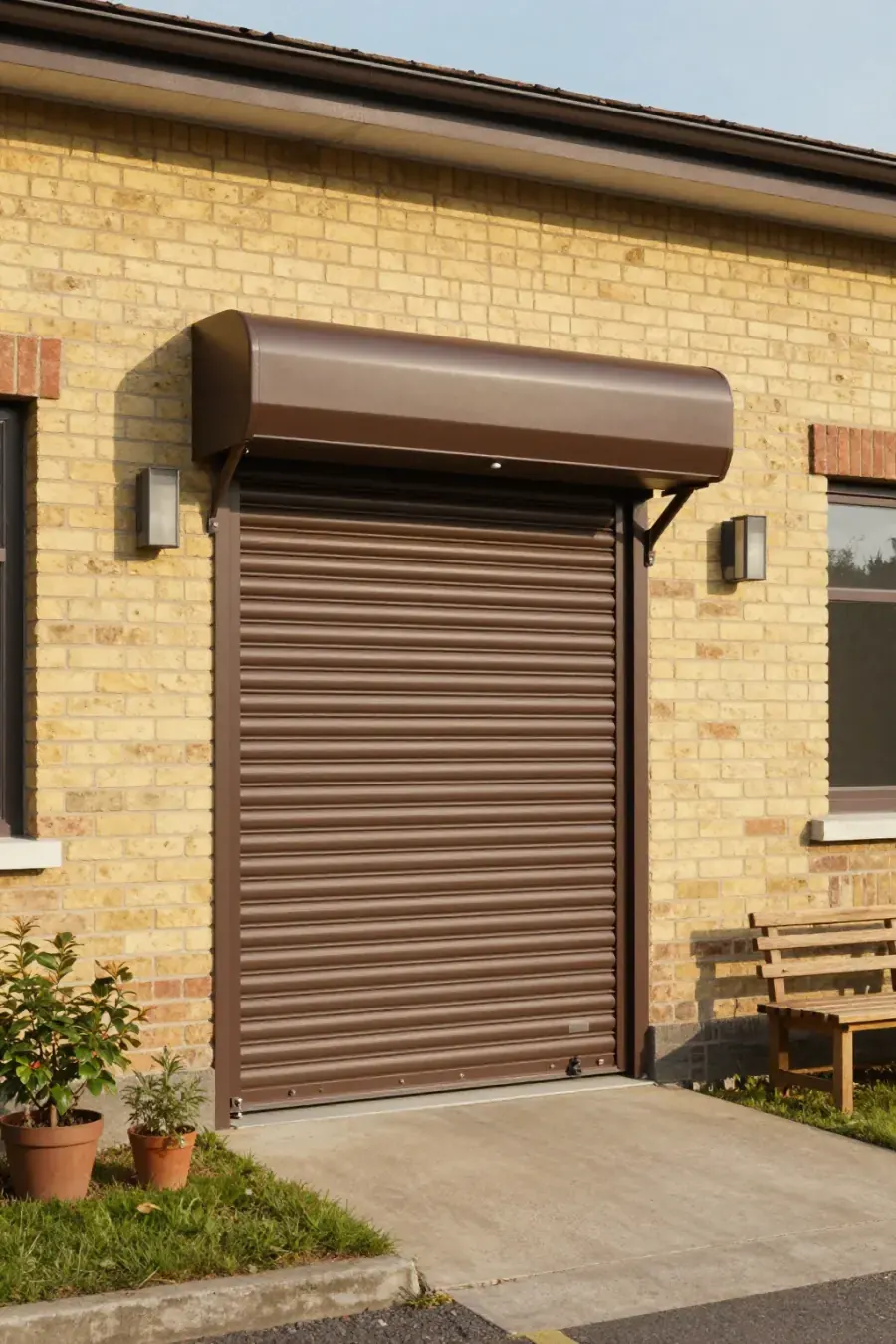

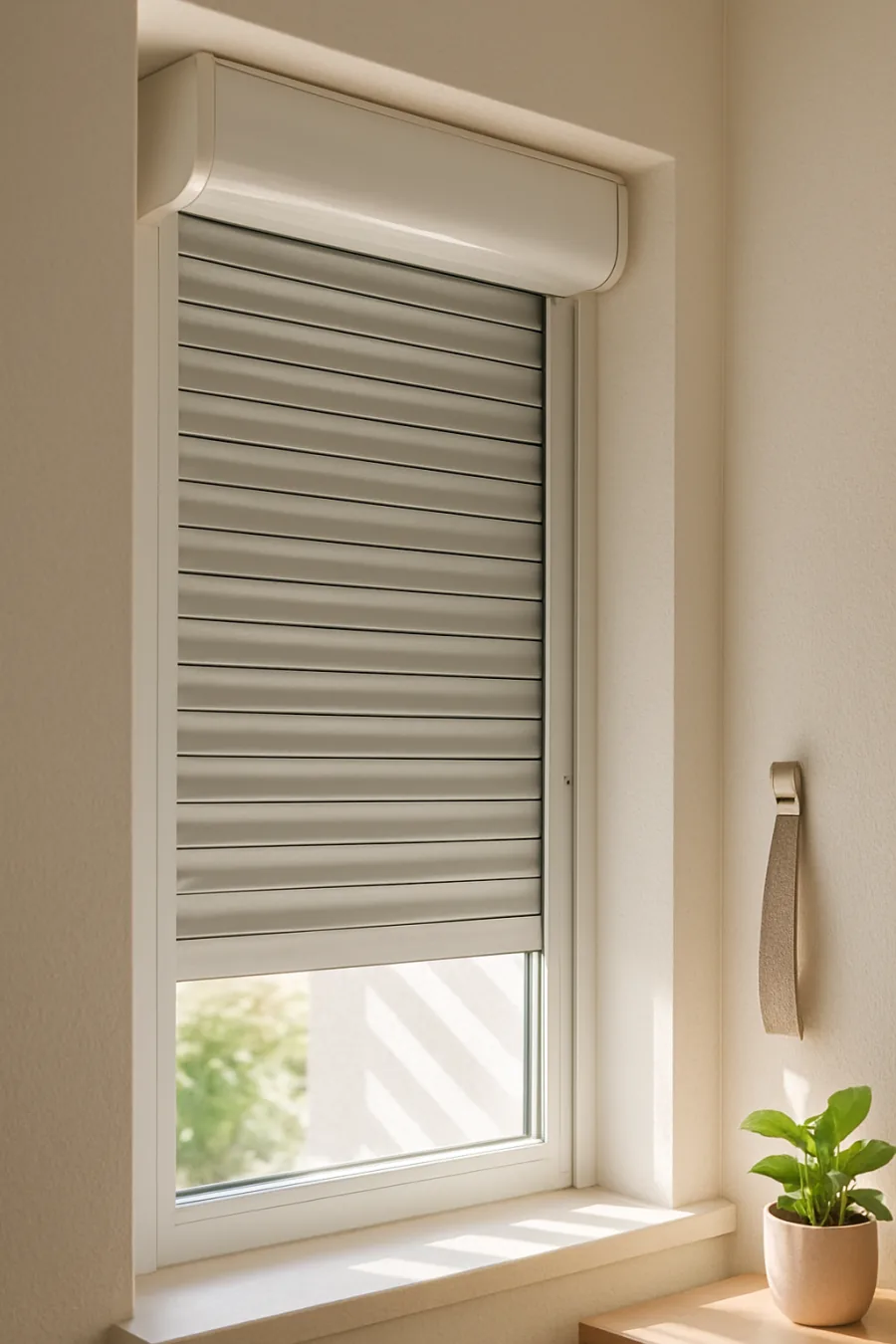


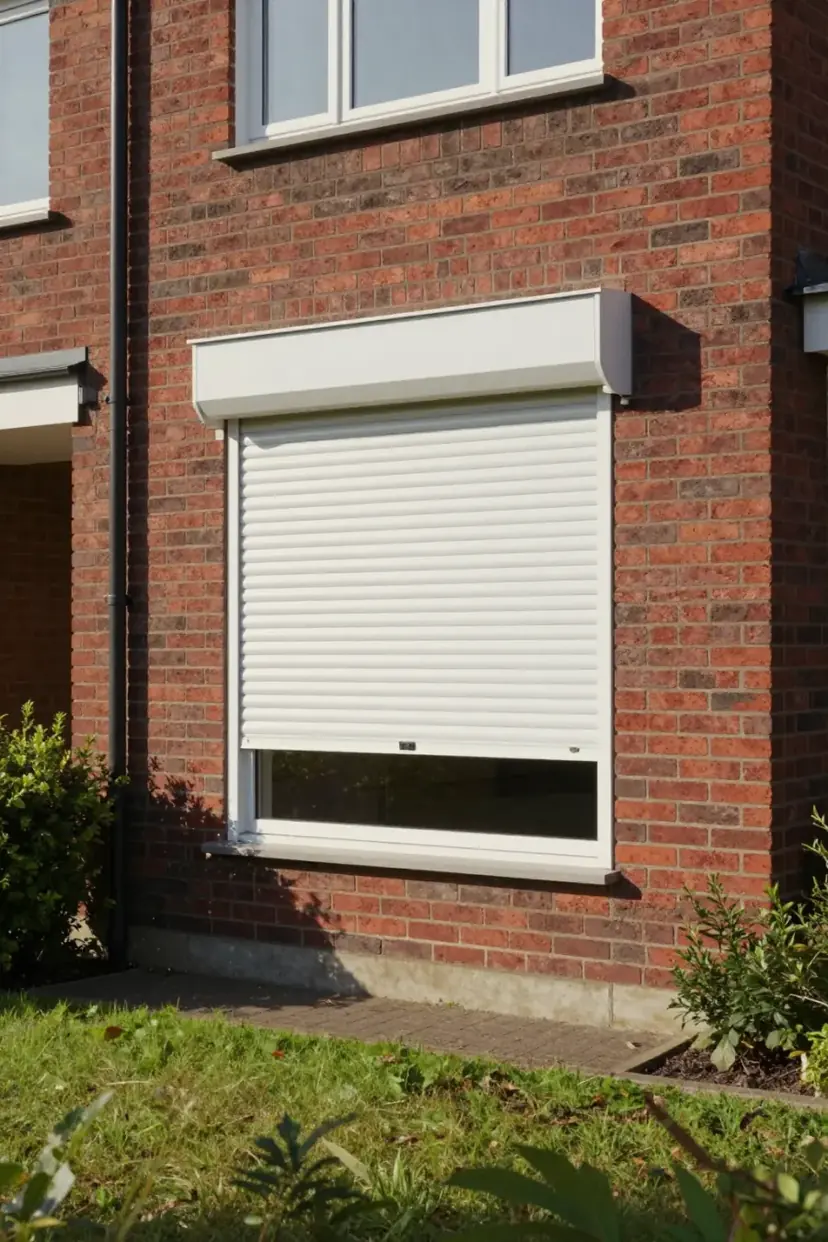


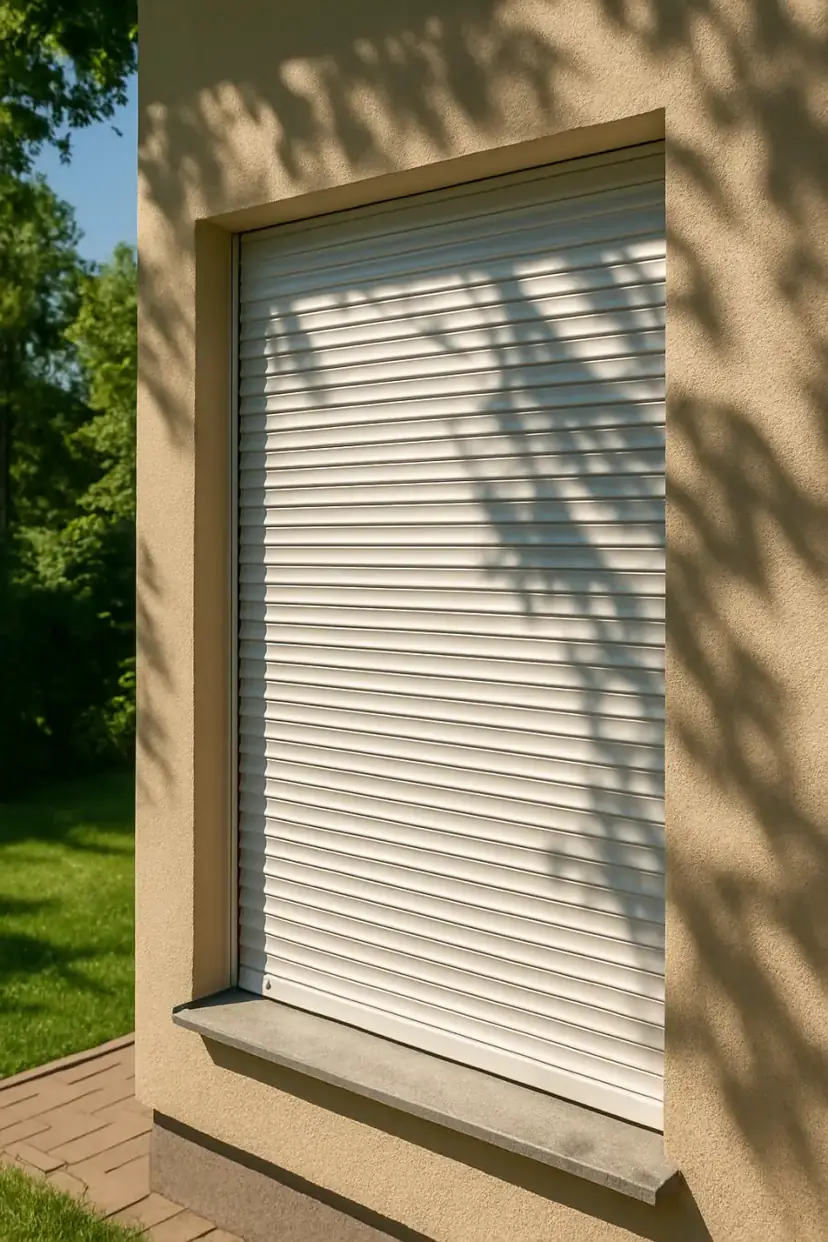











We manufacture aluminium roller shutters to measure in Almaty: roll-formed foam-filled profile — from 17,500 ₸/m² for windows of apartments and houses, extruded — from 24,900 ₸/m² for shop windows, ground floors and garages, perforated — from 27,800 ₸/m² where light is needed. Measurement is free, the measurer comes with samples.
Which aluminium profile your opening needs
The profile is chosen by what the opening is for, not by price. Roll-formed foam-filled aluminium handles sun, dust and prying eyes, extruded withstands prying, perforated lets light and air through. Aluminium roller shutters of one type for all openings in a house — that's almost never done, and below you can see why.
Let's start with the one that handles most jobs. The roll-formed foam-filled profile is rolled from aluminium strip and filled with foam: the slat comes out light, runs quietly and slightly muffles street noise. It is fitted on windows of flats and residential houses, where sun, dust and prying eyes matter more than burglary protection. This profile is easy to pry open — it is not designed for that.
Extruded aluminium is pressed from solid metal. The wall is thicker, the slat is heavier, the deadbolt lock and retainers take the load, and the guide rails go into the load-bearing wall. This profile is fitted on a shop window, a ground floor without security and a garage. The perforated profile is a slat with punched holes: light and air pass through, while prying eyes and sun stay outside.
Window of a flat or residential house
For a window of a flat or residential house, choose the roll-formed foam-filled profile. Sun, dust, prying eyes in the evening — it handles that, and it does not overload the frame. On the third floor and above, a security profile is not needed: no one can reach it from the ground.
Shop window, ground floor without security, garage
For a shop window, a ground floor without security and a garage, extruded aluminium is fitted. A solid profile, a deadbolt lock, slat retainers, guide rails fixed into the load-bearing wall — you cannot pry such a slat open with a crowbar. If the shop window must stay visible, there is a perforated profile: the holes let light and air through but hide the goods from prying eyes. On one house, the profile is chosen for each opening separately — foam-filled for residential windows, extruded for a garage or shop window; more on this in the section with an example.
The profile is chosen by the purpose of the opening, not by price: foam-filled aluminium handles sun, dust and prying eyes, extruded resists prying open, perforated lets light and air through.
Foam-filled and extruded: what the difference is and why it shows in the price
The roll-formed foam-filled profile is rolled from aluminium strip and filled with foam, while the extruded aluminium profile is pressed from solid metal. The same aluminium, but two different technologies — hence the difference in weight, strength and price per m². The roll-formed foam-filled profile does not protect against burglary: its job is sun, dust and prying eyes. Extruded aluminium takes the load and resists prying open, so it is fitted where the blind must hold up.
Why is the metal the same but the weight different? The roll-formed profile is a thin strip rolled into a slat, with the voids inside filled with foam: the foam filling of the slat adds rigidity but almost no mass.
Extruded aluminium is solid metal, the wall is thicker, and the slat comes out heavy. Burglary resistance depends on exactly this: the denser and thicker the profile, the harder it is to pry open with a crowbar. The roll-formed one has no such reserve — and Jalusso always says this straight, not after the fact.
Table: roll-formed, extruded, perforated
| Profile | How it is made | Where to install | Price from, ₸/m² | Lead time |
|---|---|---|---|---|
| Roll-formed foam-filled | Aluminium strip, filled with foam | Windows of flats and residential houses | 17,500 | 10–14 days |
| Extruded aluminium | Pressed from solid metal | Shop window, ground floor without security, garage | 24,900 | 12–16 days |
| Perforated | Perforated profile | Shop windows and openings where light is needed | 27,800 | 12–16 days |
The difference between the light and the security profile is about one and a half times: 17,500 versus 24,900 ₸/m².
When you do not need to pay extra for extrusion
A window above the first floor, a country house, a bedroom on a noisy street — here the foam-filled profile is enough: it blocks sun, dust and prying eyes, and no one will climb to the fourth floor with a crowbar. Aluminium roller shutters on a kitchen window in a private house are the same story: the foam filling works for warmth and quiet, and security properties are not needed there. Extrusion is chosen not because it is better in general, but because a particular opening is at ground level.
The roll-formed profile is rolled from aluminium strip and filled with foam, the extruded one is pressed from solid metal — this difference in manufacturing determines the weight, strength and price of the blind.
How much aluminium roller shutters cost in Almaty and what the sum is made up of
Roller shutters for windows cost from 17,500 ₸ per m², security ones from 24,900 ₸ per m², perforated ones from 27,800 ₸ per m². These are the prices of the price-list items, and the profile in them is not the only thing that affects the total.
The price per m² is made up of the profile, the size of the blind, the housing box, the controls and the locks. The profile sets the lower limit: the roll-formed foam-filled one is about one and a half times cheaper than the extruded one. The size of the blind multiplies this rate by the area of the opening — a wide window or shop window gives more square metres, and therefore a larger sum. The housing box adds its share: a surface-mounted one on a finished wall is simpler, a cassette system is more expensive. The lock and slat retainers come with the security profile, on the light one they are not needed. The controls change the price more noticeably than anything else — more on this below. And the manufacturing time is tied to the price-list item.
| Profile | Where to install | Price from, ₸/m² | Time, days |
|---|---|---|---|
| Roll-formed foam-filled | Windows of flats and houses | 17,500 | 10–14 |
| Extruded | Shop window, ground floor, garage | 24,900 | 12–16 |
| Perforated | Shop window and openings with ventilation | 27,800 | 12–16 |
| With electric motor | Tall windows, shop windows | 35,000 | 14–18 |
The difference between the light and the security profile is about one and a half times: 17,500 versus 24,900 ₸ per m². We calculate per m² not out of a love of arithmetic — it lets three profiles be put side by side and compared. A card with a price “per item” gives no such comparison: it is unclear either which profile is inside or what size the blind is.
Why prices vary in the search results
Some sellers calculate per item, others per m², and others mix both methods in one card. Hence the spread: the figure “per item” says nothing about which profile is inside or what size the blind is. We calculate per m² so that the foam-filled, extruded and perforated profile can be compared on equal terms. The measurer will still recalculate for your specific opening — but you will already be comparing options by comparable numbers.
Control and installation coefficients
Controls and the type of installation raise the price through calculator coefficients: basic mechanics and wall installation come with a coefficient of ×1, and from there the price grows.
- Controls: chain — ×1.06
- Electric motor — ×1.85
- Electric motor with remote control — ×2.1
- Installation on the frame — ×1.05
- Installation without drilling — ×1.1
- Cassette system — ×1.28
Installation as a separate line costs 4,500 ₸ per item and becomes free for orders from 150,000 ₸. At the measurement it is clear which fixing scheme suits your facade: if the wall is finished and cannot be opened up, count on a cassette system right away.
The word “cheap” in someone else's listing almost always means a roll-formed profile without locks and with manual control — and that's a normal choice for a window above the first floor. There's no point paying extra for a security profile where nobody will touch it.
Aluminium, steel or plastic: what to choose for an apartment window
For an apartment window, aluminium is the more common choice: it's lighter than steel and doesn't rust, so it needs no painting and puts less load on the frame. Aluminium roller shutters for windows beat metal and plastic precisely on a residential opening. Below is a comparison across four parameters that really affect the choice.
Aluminium roller shutters don't rust, so they don't need repainting every few years like steel ones. A steel profile is stronger against breaking, but over time it corrodes and needs care — especially on the first floor, where moisture and road chemicals hit the curtain. A plastic profile is cheaper and doesn't fear moisture, but it fades in the sun and doesn't resist burglary: it can be forced open just as easily as light roll-formed aluminium, if not more easily.
Table: weight, corrosion, burglary resistance, where to install
Blind weight, corrosion, burglary resistance and purpose — these are what distinguish the materials.
Material: aluminium — lighter than steel, doesn't rust, resists burglary in the extruded version, installed on apartment windows, shopfronts and garages. Steel — heavier than aluminium, corrodes, resists burglary well, installed on openings that need maximum strength. Plastic — light, doesn't fear moisture, doesn't resist burglary, fades in the sun, suitable for utility openings.
Steel and aluminium blinds have similar thermal insulation: metal itself doesn't hold heat, and the effect comes from the air gap between the blind and the glass. The difference is that aluminium doesn't absorb moisture, while unpainted steel does.
Why aluminium is the more common choice for a residential window
Three reasons. Less load on the frame — an aluminium blind doesn't pull it down like a steel one. No painting needed — aluminium doesn't rust, and paint on the south side fades noticeably faster than in the shade of a courtyard. It doesn't fear moisture or sun — neither slanting rain nor summer heat harms the blind.
In practice, on a noisy street and on the south side, we install foam-filled roll-formed profiles on apartment windows: they block the sun, muffle street noise and don't load the frame. There's no point paying extra for extruded here — nobody is going to force open a third-floor window.
Aluminium is lighter than steel and doesn't rust, so it needs no painting and puts less load on the frame; plastic is cheaper, but it fades in the sun and doesn't resist burglary.
What the foam inside the slat does and why perforation is needed
The foam inside the slat works as insulation: it fills the cavity of the profile and keeps the metal from heating up quickly in the sun and cooling down in the frost. In a foam-filled roll-formed profile, the strip is rolled from aluminium and filled with foam — the foam filling reduces glass heating in summer and heat loss in winter. And it doesn't only work for warmth. The same foam muffles street noise, so aluminium roller shutters on a bedroom window on a noisy side handle the flow of traffic differently from an empty slat.
A perforated profile solves the opposite problem. Holes are punched in the slat: light and air pass inside, while prying eyes and the sun stay outside. It's needed where the room should stay bright during the day — a shop window, a first-floor window, an opening with ventilation.
The air gap between the blind and the glass
Air remains between the closed curtain and the glass unit. The curtain is outside, the glass unit inside, and the gap between them — that's where both warmth and quiet come from. It's a second contour over the window, and it works even without foam in the slat itself. And what about condensation in winter? Moisture has nowhere to come from between the curtain and the glass: aluminium doesn't absorb water, and the gap is ventilated at the edges. The window doesn't fog up more than without roller shutters.
Where perforation is needed
A shop window. A first-floor window. An opening with ventilation. A perforated profile is installed where a closed blind shouldn't turn the room into a dark box. On residential windows above the first floor it isn't needed — there, warmth and quiet matter more than daylight through the slat. And one more point: perforation doesn't replace a security profile. It doesn't resist burglary; its job is light and air.
Foam filling reduces glass heating in summer and heat loss in winter, and muffles street noise; a perforated profile lets in light and air, but keeps out prying eyes and the sun.
Control: chain, electric motor and emergency lifting
Manual or electric drive is chosen by how often you close the opening and whether you can reach the roller tube with your hand. A manual chain drive lifts the blind through a gearbox: smooth movement, and the blind stops in any position. An electric motor with a remote control operates the blind at the push of a button and on a schedule. For many apartment and house windows a chain is enough — but not for all.
The price difference between them is noticeable. In the calculator, manual control comes with a factor of ×1, chain — ×1.06, electric motor — ×1.85, and electric with remote — ×2.1. That is, a chain barely changes the total, while a motor roughly doubles it. Paying for automation makes sense where you open and close the opening every day or where the blind is large.
When a chain is enough
A manual chain drive is installed on an apartment or house window where there's no socket by the opening and the curtain is lifted by hand. The chain runs through a gearbox, so even a heavy curtain moves without jerking, and you can stop it at any height — open it halfway, leave a gap for air. Aluminium roller shutters on residential windows are in most cases closed exactly this way: raised in the morning, lowered in the evening, with no socket to run.
What's important to know about weight: an aluminium blind on an ordinary window can be lifted by one person, and a chain gearbox handles it without effort. If you're not sure whether manual control will manage your opening, the measurer looks at the blind size on site and tells you straight.
When a motor is needed
An electric motor with a remote control is needed on tall windows, shopfronts and openings you can't reach by hand, as well as where there are several curtains and it's easier to press one button. The remote controls one roller shutter or a group, and you can set a schedule and a sun sensor — the curtain will close by itself towards evening or in the heat.
And automation can be planned for in advance rather than at once. Fitting an electric motor to manual roller shutters later is possible, but the housing box and guide rails are chosen for the type of control in advance: a motor needs a different roller tube and room for the motor. So it's better to decide at the measurement stage, not a year later.
Separately about emergency manual lifting: when the power goes out, the roller tube is unlocked by an emergency handle or lever in the motor, and the curtain is lifted by hand. This is essential where roller shutters cover an entrance, a shopfront or a garage and must open without electricity. We don't install aluminium roller shutters with a motor without such an unlock on openings you pass through every day.
A chain drive lifts the blind through a gearbox and holds it in any position, while an electric motor adds a remote control, a schedule and an emergency manual unlock in case of a power outage.
Installation and housing box: how roller shutters are mounted on a finished facade
On a finished site, a surface-mounted housing box is most often used: it sits on the wall above the opening rather than being hidden inside it. The guide rails are fixed into the load-bearing wall, not into insulation or cladding. The roller shutter housing box holds the roller tube with the curtain and protects the mechanism from dust and rain.
The mounting scheme is determined by the measurement of the opening. The measurer looks at what the wall is made of, whether there is room for the housing box and where the guide rails will go. This determines which of the three installation types will work: surface-mounted, built-in or cassette.
A built-in housing box is set into the wall during construction or renovation — on a finished facade this can no longer be done. A cassette system lets you avoid cutting into the facade: the blind and the roller tube go into a compact housing box that is mounted above the window or on the frame. For a plastic window this is a workable option. Drilling is still needed, but it goes into the frame or into the wall next to the opening, not into the facade.
External installation puts the protection on the street side: the curtain covers the window from outside, and the housing box and guide rails are visible on the facade. Internal installation is chosen when the facade cannot be touched — for example, in an apartment with finished decor or in a building with architectural restrictions. In this case aluminium roller shutters work from inside, but they still close the opening from the sun and prying eyes.
Checklist: what the measurer checks
- Room for the housing box: whether there is enough above the opening, whether the window reveals and windowsill get in the way
- Wall material: concrete, brick, aerated block — the fasteners depend on this
- Fastening of the guide rails: into the load-bearing wall, not into the insulation
- Control side: which side is more convenient for pulling the chain or placing the remote control
- Lifting height of the blind: so that when raised it goes fully into the housing box
External and internal installation
External installation gives protection from the street: a stranger cannot get right up to the glass. Internal installation helps when the facade cannot be cut into due to the building’s rules. The measurer calculates both options on site — he brings the samples with him.
Aluminium roller shutters in the Almaty climate: summer, winter, wind
Aluminium roller shutters in Almaty handle both hot summers and frosty winters: aluminium does not absorb moisture, so the curtain does not freeze to the frame. Only ice in the guide rails can jam it, if water got in there and froze. Let’s go through the seasons and see what happens to the curtain and what to do about it.
Summer: sun and dust
In summer the blind’s main job is to take the heat off the glass. During the day the aluminium slat takes the sun on itself, the glass unit stays in the shade, and heat does not build up in the room. In the evening the blind goes into the housing box and the opening is clear. On the south side, people close the window in the morning and raise it by sunset — that way the room stays cool longer.
There is plenty of dust in Almaty in summer, and it settles on the slats outside. Aluminium is unaffected by moisture, so the blind can be washed with water and a soft cloth. Washing takes a couple of minutes per window.
Winter: frost and temperature swings
Winter in Almaty is cold and sharp: a thaw during the day, frost at night. Aluminium handles this temperature difference without consequences — it does not absorb moisture, and the blind does not freeze to the frame. Ice in the guide rails is the only thing that really blocks the blind’s movement after a frosty night: if water got into the groove and froze, the slat gets stuck. To prevent this, we install the guide rails with a gap, and we simply clean snow off them.
And one more thing: a motor with emergency manual lifting helps if the blind will not move in the morning. You unlock the roller tube with a handle and open the opening by hand.
Aluminium stands up to wind and hail
A blind made of roll-formed or extruded profile sits tightly in the guide rails, so it does not rattle in the wind like a sheet of tin. Hail is no threat to an aluminium slat — the metal takes the impact without cracks. The wind region is not an empty formality for us: we fasten the guide rails into the load-bearing wall, not into the insulation, and the blind holds.
Out-of-town visits
We travel not only within the city: we also come to Kaskelen, Talgar, Issyk and Kapshagay. The cost of the visit is determined by the distance — we tell you this amount in advance, before the technician sets off to you. On site the measurer looks at the opening, the wind load on that side and the room for the housing box — and we calculate based on the measurement.
An aluminium blind stands up to February frost, August dust and wind with hail — only ice in the guide rails breaks it, if the groove is not looked after.
How ordering works: from measurement to installation
Measurement is free and mandatory: we do not keep finished products in stock, every curtain is made for a specific opening. Aluminium roller shutters are manufactured to the measurement of the opening, so an order does not start without a measurer’s visit.
Order steps
- You message us on WhatsApp and describe the opening.
- The measurer arrives with samples, inspects the room for the housing box and the fastening of the guide rails, and calculates the cost on site.
- The workshop manufactures the product according to the price list item: roller shutters for windows — 10–14 days, security and perforated — 12–16 days, with an electric motor — 14–18 days.
- The Jalusso foreman installs the blind, you sign the acceptance report.
The measurement determines the mounting scheme and the room for the housing box — this decides whether the blind will sit straight and not catch on the window reveal. Within the city, measurement and delivery are free. Installation costs 4,500 ₸ per product; if the order total reaches 150,000 ₸, we install at no extra charge. We also travel to the suburbs — Kaskelen, Talgar, Issyk, Kapshagay — the cost of the visit depends on the distance and is quoted before the visit.
Warranty and service
The mechanism is covered by a 3-year warranty, and the installation work by a 1-year warranty, counted from the day the acceptance report is signed. If a breakdown is covered by the warranty, we repair it free of charge — this takes no more than 5 working days.
What does it not cover? Mechanical damage, reinstallation on your own, water and natural fading of the fabric. It is important to understand this in advance, not at the moment of a dispute.
After the warranty we also come out: to tighten the blind, adjust its movement, replace the cord or chain. From experience: one of our teams had a call four years after installation — the blind had skewed because the owner had removed and repositioned a guide rail himself. We handle such cases, but as paid repairs.
Measurement remains a free and mandatory step for any order of aluminium roller shutters in Almaty, and it is what starts the whole process.
A real-world example: one house, different profiles
Yes, on a single project the profile can differ: each opening gets its own blind. For residential windows we use roll-formed foam-filled aluminium, while for a shopfront and a garage we use extruded. This is not a compromise or a “mismatch”, but normal logic: a second-floor opening and a street-facing shopfront have different jobs.
Breakdown: a house with windows, a shopfront and a garage
Let’s imagine a typical situation: a private house where people live on the ground floor, the garage is in the basement, and a small shop’s shopfront is attached to the house from the street. What would we suggest?
Residential windows — roll-formed foam-filled profile: from 17,500 ₸/m², manufacturing time 10–14 days. Here what matters is sun, dust and prying eyes, not burglary protection.
Shopfront — extruded aluminium: from 24,900 ₸/m², time 12–16 days. A solid profile, deadbolt lock, slat retainers — the shopfront cannot be forced open. If the shopfront needs to stay visible during the day, a perforated profile is used: from 27,800 ₸/m², time 12–16 days.
Garage in a private house — the same extruded aluminium, 12–16 days. A closed blind cannot be forced open or quietly broken into.
A country house used seasonally — roll-formed aluminium on the windows, 10–14 days. While you are away the openings stay closed: no one can look into the house from the street.
On a single site the profile is chosen for each opening separately. That is how we quote too — by price-list items, not one figure for the whole house.
Repair instead of replacement
A dented slat is replaced on its own — the whole curtain is not remade. Replacing a slat restores the curtain without a full rebuild: just remove the damaged element and fit a new one. It costs less than ordering roller shutters again, and it is done on site.
As for aluminium shutters on windows — they are not remade entirely either: if the curtain has skewed, we adjust the mechanism and replace worn parts. We come out after the warranty period too.
FAQ
How long aluminium roller shutters last depends on the mechanism, not the curtain. Aluminium roller shutters do not rust and need no painting, so the profile itself has almost nothing to wear out: only the lacquer on the slat fades over time. But the gearbox, cord and chain work every day, and they are what sets the service life of the product. We cover the mechanism with a 3-year warranty.
How do you wash aluminium roller shutters and what should you not use? A soft cloth with water and a neutral product is enough. Abrasives and solvents wash off the slat coating, so we do not use them: after them the curtain loses its look, and that is no longer a warranty case. We clean the guide rails separately, because dust in them hinders the movement of the curtain. In Almaty there is a lot of dust in summer, so a couple of minutes on this once a season pays off.
What should you do if the blind has skewed after the warranty? We come and fix it on site: tighten the fastening, adjust the roller tube, and replace the cord or chain if needed. A dented slat is replaced on its own — the whole blind does not need to be remade. Repairs after the warranty are chargeable, but it is cheaper than a new product.
And it is worth requesting a visit as soon as the blind starts moving unevenly: a skew rarely corrects itself, and a worn cord breaks at the most inconvenient moment.
Aluminium roller shutters do not rust and need no painting, so all the care they need comes down to washing the slats and cleaning the guide rails, and we fix a skew after the warranty on site.
What to remember
The profile is chosen by the opening, not by the price. Roll-formed foam-filled aluminium closes the windows of a home from the sun, dust and prying eyes. Extruded is fitted on a shopfront, a ground floor without security and a garage where someone might try to pry the blind open. Perforated is chosen where you need to keep light and ventilation but block outside eyes.
The price difference between a light and a security profile is about one and a half times: 17,500 ₸ per m² versus 24,900 ₸ per m². On a window above the ground floor this extra cost adds nothing — a security profile works against prying, not against the sun.
Aluminium is lighter than steel and does not rust, so it needs no painting and puts less load on the frame. Plastic is cheaper, but it fades in the sun and does not resist break-ins. For a residential window and a shopfront, aluminium remains a reasonable compromise in weight, durability and price — and this is our practice, not general theory.
The total comes from the profile, the size of the blind, the housing box, the controls and the locks. Controls and the type of installation add coefficients: electric with a remote control ×2.1 to the base mechanics, a cassette system ×1.28 to installation. It is worth keeping these multipliers in mind when you compare quotes.
Start with a free measurement. The measurer comes with samples, checks the space for the housing box and the fastening of the guide rails, and calculates the cost on the spot; within the city measurement and delivery are free. Aluminium roller shutters in Almaty are made for a specific opening, so the talk about figures starts with the measurement, not the catalogue.

