







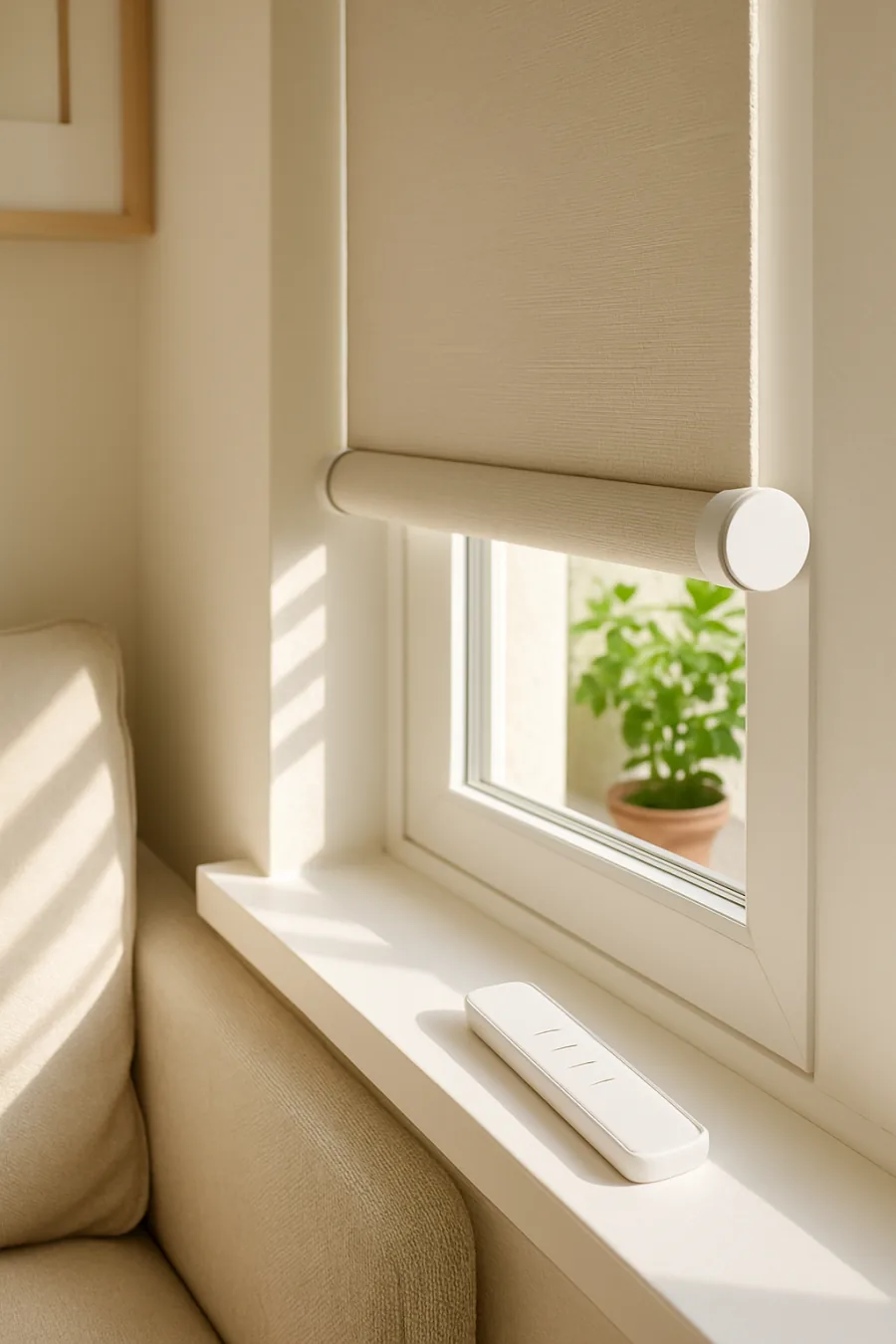














Roller blinds on suction cups in Almaty are mounted with the roller tube attached to smooth glass or a plastic profile without drilling the frame. What holds them isn't “the suction cup itself” but a clean, even glass unit, the weight of the fabric and the number of mounting points. We make them to measure, price from 5,400 ₸/m², lead time 4–6 days.
How a suction cup holds a roller blind on glass
Roller blinds on suction cups in Almaty are attached to smooth glass or a plastic frame profile, and the roller tube holds without a single hole. The vacuum suction cup holds the blind's roller thanks to the pressure difference: air escapes from under the rubber, and the atmosphere outside presses the mount against the glass. It's not the suction cup itself that holds — it's the glass unit beneath it.
Over time a blind doesn't fall “for no reason”. It happens when dust has worked its way under the rubber, when the glass wasn't degreased before installation, or when the mount took on fabric heavier than it was designed for. A suction cup on glass behaves like a load on a single point: the longer the lever, the sooner the vacuum gives up. The roller blind mechanism has nothing to do with it.
What actually holds the blind
A vacuum suction cup needs three conditions, and all three have to come together at one point.
First — a smooth, even surface: on a glass unit and on a smooth plastic frame profile the rubber sits flat across its whole surface. Second — cleanliness: a greasy fingerprint or street grime eats away part of the vacuum. Third — the weight of the fabric: a light mesh and a dense fabric press on the mount differently.
If even one condition isn't met, the suction cup will hold for a couple of days and then come loose. That's not a defect of the product, it's physics, and it can be predicted in advance during the measurement.
Where a suction cup works
Glass and a smooth plastic profile without texture are the working pair for a vacuum mount. On such a profile the rubber sits tight, and the roller blind stays level.
A wood-laminated frame, a textured profile and any embossed surface won't hold a vacuum: air seeps in along the grooves, and no pressure difference forms. For such windows we choose a different mount, and that's a separate conversation.
A suction cup holds the blind's roller thanks to the vacuum: air escapes from under the rubber, and the pressure difference presses the mount against the glass.
What a suction cup holds on to and what makes it fall off
A suction cup holds on a smooth, even surface — on glass and on a plastic profile without texture. It falls off for one of four reasons: dust under the rubber, heavy and wide fabric, too few mounting points, or an uneven surface itself. The measurer checks all four and only then specifies the kit.
The weight and width of the fabric determine the load on the suction cup. Dense blackout fabric pulls down harder than mesh fabric of the same width, and that's not a question of rubber quality — it's physics. The number of suction cups distributes the load across the width of the window. Three points on a wide glass work differently from three points on a narrow sash, and the difference shows not on the first day but after a week.
Any suction cup works not by “stickiness” but by vacuum: air escapes from under the rubber, and the pressure difference presses it against the glass. What kills a vacuum fastest? Dust. In Almaty there's plenty of it at any time of year, especially on windows facing a courtyard with open ground.
- Smooth glass without coating holds a vacuum most evenly.
- Smooth plastic profile with no texture — suitable for mounting.
- Tinted glass — the vacuum behaves differently, so an on-site inspection is needed.
- Rough and textured frame — no vacuum forms, so another method is needed.
Lever suction cup vs. a regular one
A lever suction cup creates a vacuum with a single press, and it holds tighter than a regular one. It is used where the glass is smooth and the fabric is heavy — for blackout or a wide blind. On a narrow window with light fabric the difference is barely noticeable, so there is no point paying extra for a lever just for mesh fabric.
Coatings and tinting
Energy-saving coated glass and tinted glass are a separate story. The coating changes how the vacuum behaves under the rubber, and you cannot predict this from a photo of the window. In my view, this is a case for the measurer rather than the buyer: they will press the suction cup to the specific glass and show you the result before you order.
The wider and heavier the fabric and the more mounting points there are, the lower the load on each suction cup — the layout is determined by the measurement.
Preparing the glass before installation and what to do if a suction cup stops holding
A vacuum holds only on clean glass. Before installation the glass is degreased and wiped clean, and a suction cup that has stopped holding is removed, washed and reattached. These are two sides of the same rule: the surface under the rubber must be free of grease and dust, otherwise roller blinds on suction cups will not stay on the window for long. Degreasing the glass improves the reliability of the vacuum, because a film from kitchen vapours or a fingerprint prevents the rubber from pressing against the glass over its entire area. A glass cleaner and a lint-free cloth are enough — and do not rush the installation until the surface is completely dry.
Step-by-step
- Degrease the glass at the points where the suction cups will go and let it dry.
- Press the suction cup firmly against the glass, pushing the air out from under the rubber.
- Check the vacuum — the suction cup should sit tight, with no play.
- Only then hang the blind's roller tube and check how the fabric moves up and down.
Washing a window and installing a blind are different things: if the glass was wiped dry but not degreased, the vacuum will be weaker. On a site with panoramic glazing we first prepare the mounting points and only then hang the fabrics — this way, in a single visit, you can see where the suction cup has seated tightly and where it needs to be repositioned.
If a suction cup falls off
This is not a broken blind, but a signal that there is dust under the rubber or the surface was dirty. Dust under the rubber reduces the holding power of the suction cup, and in Almaty with its dry air and dusty winds this happens faster than somewhere by the sea. The suction cup is removed, washed with warm water, dried and reattached to the prepared glass. Caring for suction cups extends their service life: from time to time they are washed the same way, and replacing suction cups takes minutes if the old rubber has hardened.
What's more, a falling roller tube is usually not about the mount, but about the window not having been washed inside for a long time. In my view, the habit of wiping the glass before every repositioning of the blind saves far more time than dealing with the consequences.
A vacuum suction cup holds the blind's roller tube only on glass that has been degreased and cleaned of dust, so preparing the surface is not a formality but a condition of mounting.
A made-to-measure blind or a ready-made standard-size blind from a marketplace
A made-to-measure blind differs from a ready-made standard-size blind from a marketplace in that it follows the geometry of a specific glass unit rather than being adjusted to one universal size. A ready-made blind is designed for an average window. A made-to-measure blind is cut to your opening, so it sits evenly and leaves no exposed strips at the sides. It can be made in Almaty: we are a manufacturer with our own workshop, not a reseller of ready-made kits.
| Criterion | Ready-made standard-size blind | Made-to-measure blind |
|---|---|---|
| Width | One universal size, either trimmed or hanging past the glass | Exactly to the glass unit, taking the glazing bead and handle into account |
| Fit on the glass | May not reach the edge, may catch on the handle | The fabric lies along the edge of the glass |
| Mounting | Suction cups are included, but the layout is fixed | Measuring the window determines the fabric width and the layout of the suction cups for the weight of the fabric |
| Control | Mechanical, no choice | We select it for the sash: pull the tab or a chain |
| Look on the window | The fabric is “cut off” at the edge, gaps are visible | The fabric hides what you need and leaves what you want |
Measuring the window is not a formality for the sake of a number. The measurer looks at the width of the glass, the thickness of the profile, how the sash opens and where the handle will be. Both the width of the fabric and the number of mounting points depend on these details. A ready-made blind does not solve these questions — you get what is in the box.
I remember bringing samples to a measurement, and the person had already bought such a blind on a marketplace. We laid it on the glass — it was short at the edge, the suction cups went where they shouldn't. They ordered made-to-measure. The difference is immediately visible when the fabric lies along the edge rather than hanging over it.
We make roller blinds on suction cups in Almaty to measure, so the width, the number of suction cups and the mounting position are selected for a specific glass unit, not for an average size from a marketplace.
Suction cups in Almaty heat and in winter
A vacuum does not hold forever: in some conditions a suction cup stays put for months, in others it needs attention every few weeks. Almaty has a sharply continental climate: hot, sunny summers and cold winters with frosts and a big difference between day and night. And each season tests the mount in its own way.
In summer, glass on a south-facing window heats up so much during the day that you cannot bear to touch it. Warm glass is not a problem in itself, but the heat affects the elasticity of the suction cup’s rubber: it softens, the vacuum weakens, and in the morning the blind may hold worse than it did yesterday. On a south-facing window I always advise checking the suction cups more often than on a north-facing one, and not waiting for the roller tube to sag. Press it back on and the vacuum is restored.
In winter the picture is the opposite. Condensation appears on the glass: moisture gets under the rubber, weakening the grip, and in the cold the rubber loses its elasticity. A suction cup will not hold on cold, wet glass — the glass is first wiped dry, then the mount is pressed on. And only after that is the roller tube hung.
Dust is the third factor, and it works all year round. There is a lot of dust in Almaty, especially in the dry months: it settles on the glass and gets under the rubber. Dust under the rubber reduces the holding force of the suction cup — this is the most common reason why a mount “suddenly” stops holding.
We make suction-cup roller blinds to measure, so during the measurement we look at which way the window faces and how often it will need checking.
A short seasonal checklist
- Summer: every couple of weeks, take off the suction cup, wash the rubber and the glass, and press it back on.
- Winter: watch for condensation, wipe the glass dry before installing.
- Dust: when a mark appears under the rubber — take it off, wash it, put it back.
The main fact here is simple: heating of the glass in the sun, condensation on the glass and dust under the rubber are the three forces that weaken a suction-cup mount in any season.
Suction cup, hook-and-loop tape, glazing bead and safety bar: comparing no-drill methods
A suction cup is not the only way to hang a roller blind without drilling into the frame. Each mount has its own surface on which it works, and its own limit. We look at four options that we install during measurements in Almaty.
| Method | On which surface | When it is chosen | Limitation |
|---|---|---|---|
| Suction cup | Smooth glass, plastic profile without texture | Rented housing, a glass unit that cannot be drilled | Does not hold on a rough or textured frame |
| Hook-and-loop tape | Even plastic, painted profile | When the glass is thin or a suction cup is inconvenient to install | Over time the adhesive layer collects dust |
| Installation on the glazing bead | The glazing bead of the glass unit | The frame cannot be drilled, but the profile is textured | An even glazing bead is needed along the whole length |
| Safety bar | Frame or glazing bead, in addition to suction cups | Heavy and wide blind | This is reinforcement, not a separate mount |
Hook-and-loop tape and installation on the glazing bead serve as an alternative to a suction cup on a difficult surface. If the profile is textured — a wood-look laminated frame, embossed plastic — a vacuum does not form on it, and a textured profile rules out a suction-cup mount. In that case we look towards the glazing bead or hook-and-loop tape.
The question “can we have both suction cups and hook-and-loop tape at once?” comes up often during measurements. You can — but not as a duplicate. The safety bar complements a suction-cup mount when the blind is wide and heavy: it takes on part of the load that the suction cups distribute across the glass. The bottom holder solves a different task — it keeps the blind from swinging in a draught, and it has nothing to do with how the roller tube is mounted. And for a narrow window with light fabric, none of this is needed: suction cups are enough.
Jalusso's approach is simple: not to sell one method to everyone, but to pick the one that holds on your particular window.
A suction cup is one of the no-drill methods, and on a textured profile hook-and-loop tape or the glazing bead is more reliable.
Suction cups and an opening sash: ventilation, handle, tilt mode
On an opening sash, suction-cup roller blinds are fitted so that the blind does not cover the handle or bump into it when it turns. An opening sash requires one thing: the right place for the suction cups. Move the mount a couple of centimetres away from the handle — and the blind hangs freely while the sash opens as usual. During the measurement we check which way the handle turns, which way the sash opens and whether there is a gap between the blind and the profile. Sometimes it is more convenient to cover the fixed part of the window with the blind and leave the opening part free. Ventilation does not suffer: the blind does not stop you from either opening the sash wide or putting it in tilt mode.
Tilt ventilation is a separate story. When the sash tilts inwards, the top edge of the blind stays on the glass, because the suction cups hold the roller tube against the glass itself. The blind does not flap, does not catch on the windowsill and does not block the airflow. On narrow sashes and balcony doors this is a real help — every centimetre counts there.
The control is chosen to match how you use the window:
- Manual control — you pull the blind by hand and fix it at the height you need.
- Chain — the blind moves smoothly, the edge stays even, and you can reach the chain from either side of the roller tube.
- Spring return (mini roller blind) — you pull the tab and the blind rises by itself. Spring return lets you do without a chain, so nothing hangs or dangles on the sash when it opens.
During the measurement we look at a wide sash with heavy fabric separately: the number of suction cups and their placement are calculated from the weight of the fabric, not by eye. On an opening sash, the suction cups are positioned so that the fabric does not get in the way of the handle turning or the tilt position.
How much a suction-cup roller blind costs and how no-drill mounting is priced
Roller blinds — from 5,400 ₸/m², manufacturing time 4–6 days. This is the base price for the category, and it is the same for all versions; from there the price grows with the size of the opening, the fabric group and the type of control. No-drill mounting is calculated as a separate coefficient in the calculator, not as a separate line “for the suction cups”. We are a manufacturer with our own workshop in Almaty, so the price does not depend on what ready-made products suppliers happen to have in stock.
What makes up the price
First — the size of the opening. The blind is measured by the glass, not by the outer size of the window with the frame: the fabric covers the glass unit and does not go onto the profile. Second — the fabric group. Heavy blackout fabric costs more than mesh, because more fabric is used and it is heavier. Third — the type of control: manual, chain, electric motor. For suction-cup blinds we discuss manual control and chain — we do not offer a motor on a vacuum mount to glass, that is a questionable combination. And fourth — no-drill mounting is applied as a coefficient of ×1.1 to the base price. This coefficient applies specifically to the mounting, not to a “free kit” — that is fairer and clearer when calculating.
Example calculation
A kitchen window with a vent pane. The measurer looks at the glass and the profile, determines the width of the fabric and the placement of the suction cups, and we calculate by the glass area: base from 5,400 ₸/m², no-drill mounting ×1.1, installation 4,500 ₸ per item. If the order comes to 150,000 ₸ or more, installation is free. The measurer gives you the exact amount on site — before you confirm anything. Our installation comes with a warranty: 1 year from the date the acceptance report is signed, and 3 years on the mechanism.
Measuring the window determines the width of the fabric and the placement of the suction cups, and therefore the final figure on the invoice; a made-to-measure blind differs from a ready-made blind from a marketplace precisely in that it is calculated for a specific glass unit rather than sold in one size.
Limitations: when a suction cup will not work
A suction cup will not work on a textured profile or on a wide window with heavy fabric. In the first case, a vacuum simply does not form; in the second, the load on the mount grows along with the weight and width. Let us go through the points one by one: what exactly gets in the way and what we do in each case.
A textured profile with relief is the main limitation of suction-cup mounting. A vacuum requires a flat surface: the air must escape from under the rubber completely, and on a rough or ribbed surface it gets sucked back in. A laminated wood-effect frame with embossing falls into the same category. What to do? The measurer looks at the profile and suggests mounting on the glazing bead or with hook-and-loop tape. We do not drill the frame.
Blackout on suction cups requires more frequent mounting points or a safety bar. Dense fabric is heavier than mesh, and on a wide window its weight is redistributed across additional points. On a narrow sash, heavy fabric works on suction cups too — here it is only a matter of careful installation. But Jalusso will not promise that any fabric will hold on suction cups alone: a wide window with blackout is for the measurer to decide, and sometimes he adds a safety bar on the frame or suggests a combined kit.
There is also a nuance with energy-saving coated glass and with tinted glass. The coating changes how the vacuum behaves, and you cannot predict from the appearance how a suction cup will perform. This is a job for the measurement, not for choosing on your own in a store.
- Textured or relief profile: the suction cup does not hold, you need a glazing bead or hook-and-loop tape.
- Laminated wood-effect frame with embossing: the same limitation.
- Wide window and heavy blackout: we add mounting points or a safety bar.
- Coated glass and tinted glass: the measurer decides after inspection.
- Tall floor-to-ceiling window: the top is mounted on suction cups, the bottom is fixed separately — otherwise the fabric sways.
On a textured profile a vacuum does not form, and a wide heavy fabric requires additional mounting — the measurer decides this on site.
Suction cup care, moving home and warranty
Suction-cup roller blinds need no scheduled maintenance — you take the suction cup off and wash it when it stops holding. Suction cup care comes down to three steps: remove, wash with warm soapy water, wipe dry and press back into place. There is no separate “once a month” rule. But if the window faces south and the glass is hot in summer, it is worth checking the mount more often — we mentioned this above. We do supply replacement suction cups: the rubber hardens over time, and we match a new one to the same tube. And for older orders too — we find the mounting by the width of the fabric.
What you should not do: move the blind to another window yourself. Reinstalling the blind on your own voids the installation warranty.
We give 1 year on the installation of roller blinds — counted from the date the acceptance report is signed — and the mechanism has a 3-year warranty. Five working days — that is how long we allow to repair roller blinds under warranty without charging the client a single tenge. Once the warranty period has passed, we still come — we tighten the mount, adjust the travel of the fabric, fit a new cord or chain. Mechanical damage, water and natural fading of the fabric are not covered by the warranty.
Moving
The blind is taken down and taken with you — this is one of the main advantages of suction-cup mounting. The frame is left without holes, the glass without marks. If the sizes fit, we install it on the new window on the same principle. If the window is a different width, we make a new fabric to measure, while the tube and mechanism often remain from the previous blind. Installation after moving is not covered by the warranty — it is a separate job.
Suburbs
We travel outside the city: Kaskelen, Talgar, Issyk, Kapshagay. We quote the call-out cost before we set off, so there are no surprises. Measurement and consultation are always free, and within the city measurement and delivery are free too.
Warranty — 3 years on the mechanism and 1 year on installation, and reinstalling the blind on your own voids the installation warranty.
FAQ
A suction cup does not stick — it is pressed on. Air escapes from under the rubber, and the vacuum holds the mount on the glass; there is no adhesive layer there. That is why the marks after removal are different too: what is left is not a sticky strip but a rubber imprint that wipes off with a damp cloth in a couple of strokes.
And what if the glass is thin or has a crack near the glazing bead? Then Jalusso does not put suction-cup mounting in that spot. The measurer looks at the whole glass, not just the centre of the opening.
A transparent suction cup is almost invisible on the glass — that is its main advantage in rented housing, where the window should look as it did before installation. A transparent suction cup is a little less noticeable than a regular black one, but the rules are the same: a smooth surface, cleanliness, and mounting matched to the weight of the fabric. We make suction-cup roller blinds in Almaty to measure, so we match the mounting to the specific window, not to a picture from the internet.
What happens to the frame after the blind is taken down? Nothing. Suction-cup mounting leaves the frame without holes, and that is what tenants choose it for: the landlord will not have to be told where the holes in the profile came from.
Can a suction-cup blind be installed on a sloped or roof window? On sloped glass the vacuum works less well, because part of the load is not pulling away but sliding. Kirill looks at such windows separately and suggests another solution — our production makes products for non-standard geometry.
How much does one suction cup hold? We don't quote a specific load: it depends on the diameter of the suction cup, the weight of the blind and the condition of the glass. The number of fixing points and their placement are determined by the measurer on site.
A suction-cup roller blind is fixed to smooth glass or a smooth plastic profile, and whether the fixing holds depends on the condition of the surface and the weight of the blind.
Bottom line
A suction-cup roller blind is fixed to smooth glass or the smooth plastic profile of the frame, and what holds it is not the suction cup itself but the vacuum under the rubber seal together with the placement of the fixing points. Four points worth keeping in mind before you order.
First: the reliability of the fixing is determined by clean smooth glass, the weight and width of the blind and the number of suction cups. On a glass unit with a flat surface and a light mesh fabric there is more margin than on a wide window with a dense blackout, where the measurer will add a safety bar. Second: a suction cup that has stopped holding is a matter of maintenance, not a breakdown. It is removed, washed, dried and put back, and usually that is enough.
Third: a made-to-measure blind differs from a ready-made standard-size blind from a marketplace in that it follows the geometry of a specific glass unit — in the width of the blind and in how it sits on the sash. Fourth: heat, condensation and dust affect the vacuum, so the fixing is chosen for a specific window, not by a general rule. On the sunny side the suction cup is checked more often, and in winter the glass is wiped dry.
There is one practical recommendation. Before ordering, call a measurer with samples.
Measuring the window determines the width of the blind and the placement of the suction cups, and the price is quoted on site. Measurement and consultation are free, and delivery within the city is free too; we travel to Kaskelen, Talgar, Issyk and Kapshagay, and we quote the call-out cost before the visit. We make suction-cup roller blinds in Almaty to measure, from 5,400 ₸/m², manufacturing time 4–6 days.

