




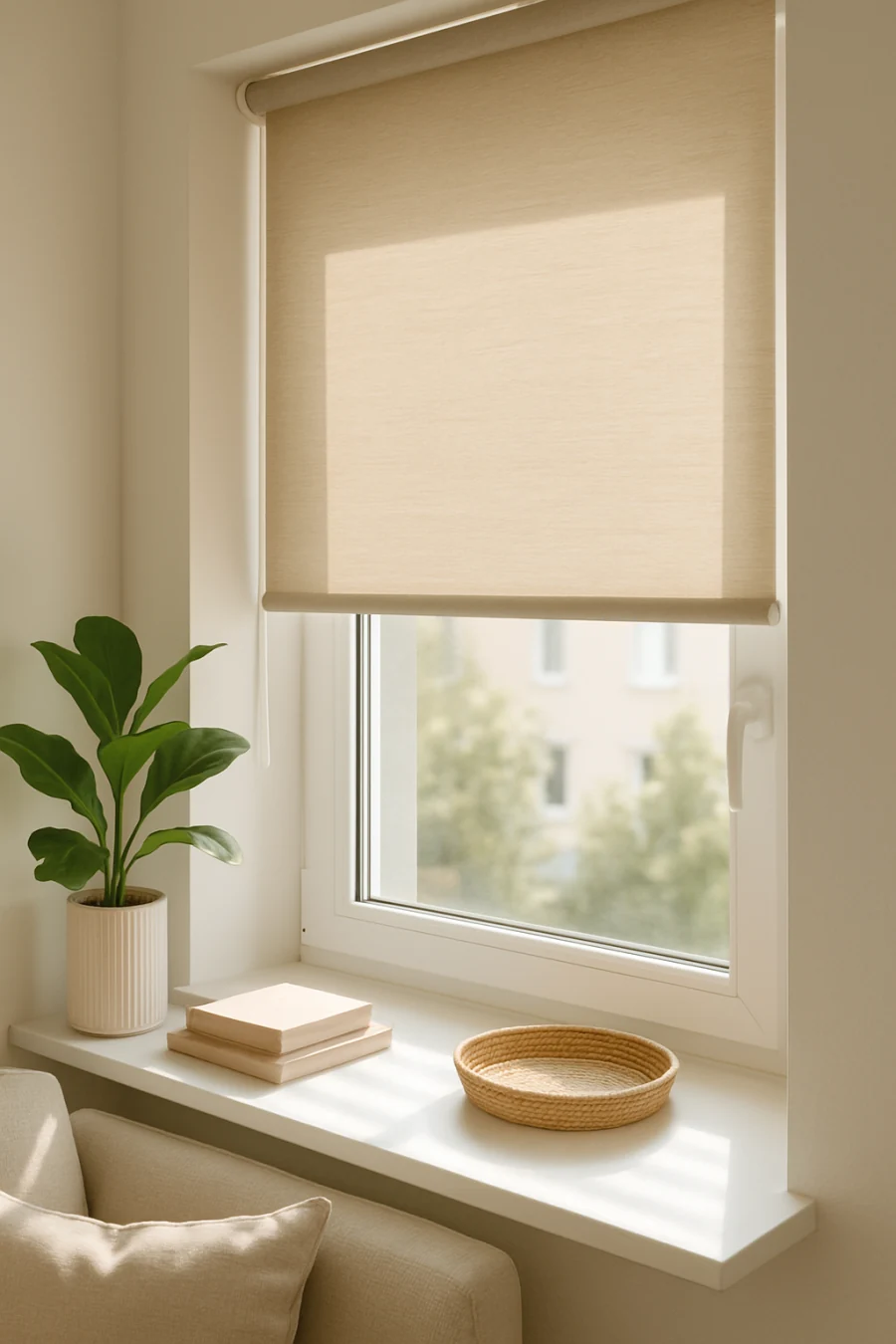


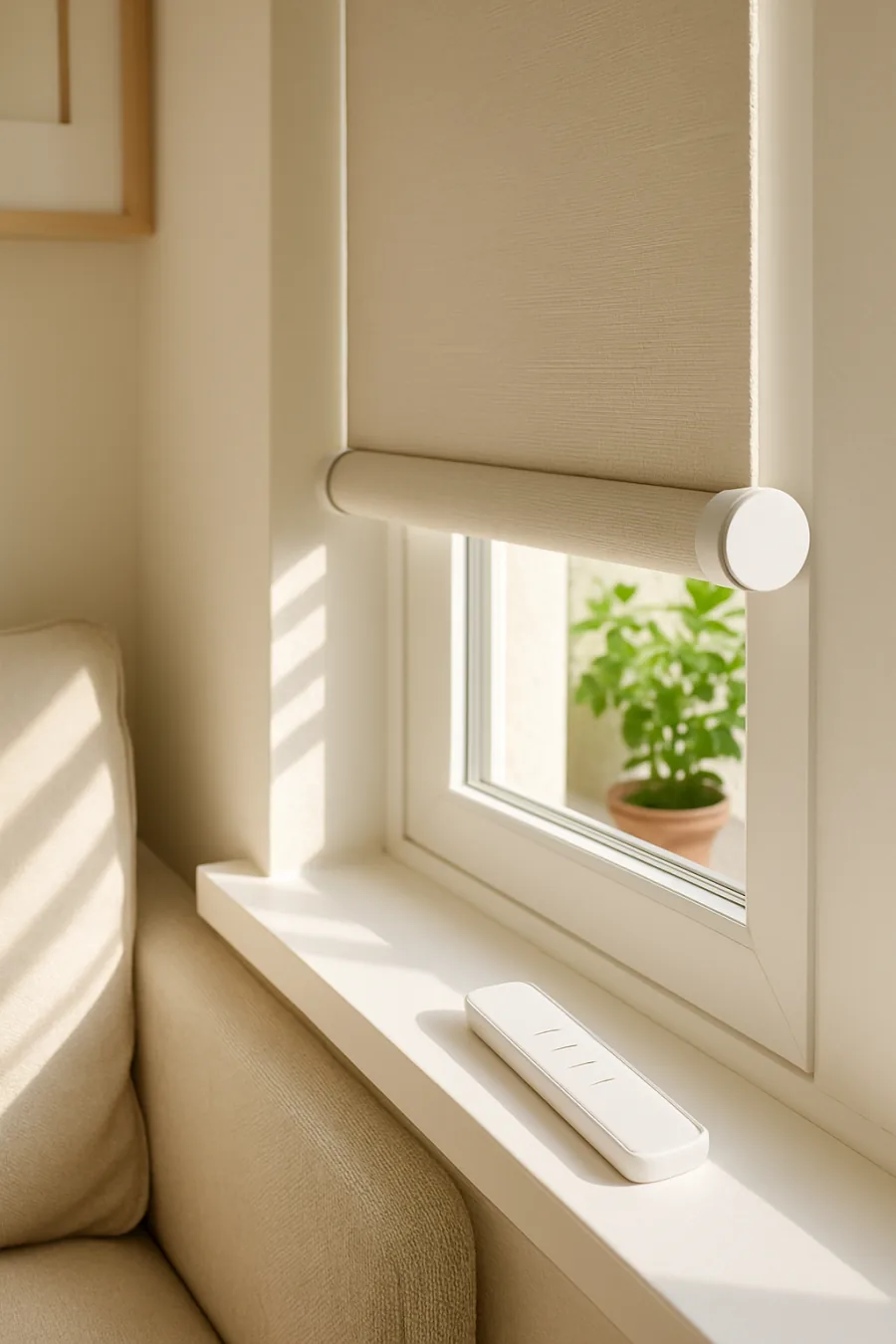


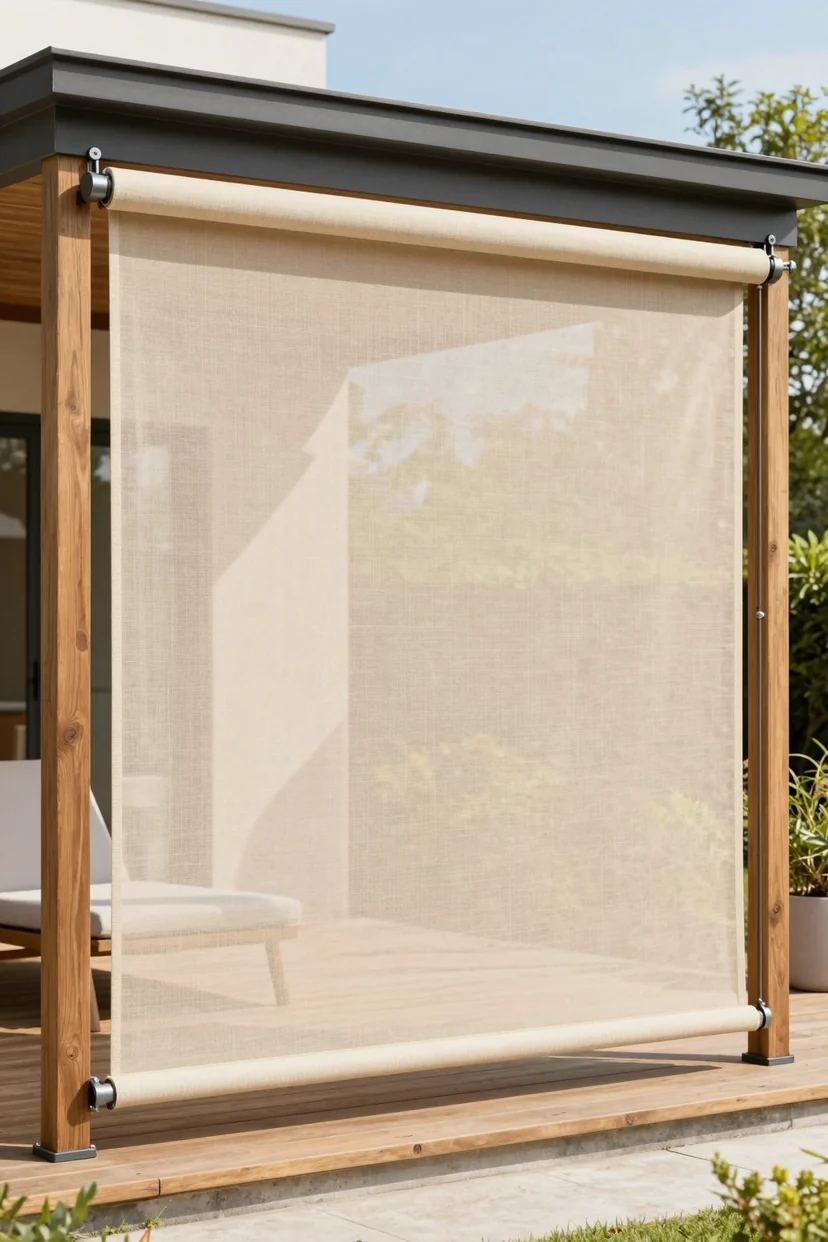











Roller blinds with hook-and-loop tape are fixed to the frame without drilling: one half of the tape runs along the fabric or the mounting bar, the matching part is glued to a degreased frame, and the fabric can be removed without tools. This name covers different designs, and not every window and not every fabric will hold hook-and-loop tape. We make them to measure in Almaty.
What is called a peel-and-stick roller blind
Peel-and-stick roller blinds in Almaty is a common everyday name for several different products that share one thing: they attach to the window frame with hook-and-loop tape, without drilling. The hook-and-loop tape consists of two halves — a soft, fuzzy side and a stiff, hooked side. One half goes on the fabric or on the mounting strip, the other is glued to the frame. After that, the differences begin, and they are significant.
Three designs hiding behind one word
The first is a blind without a tube. Here the fabric is not wound onto a mechanism at all: the soft half of the tape is sewn along the top edge of the fabric, the stiff half is glued to the frame, and the blind is raised with tie-backs. There is no tube as a part, and no chain either.
The second is a roller blind with a tube on an adhesive strip. The fabric is wound onto the tube, the tube sits in brackets, and the brackets sit on a mounting strip glued to the frame. It is operated by chain or manually.
The third is fabric fastened directly to the tube, without a separate strip. It is less common and is not used in our products.
The difference between the first and second designs is not a minor detail. A blind without a tube has no mechanism that can break, but you cannot raise it with one hand either. A roller blind with a tube has a chain and smooth operation, but it adds a component that needs extra strength at the attachment point. That is why the question “will the hook-and-loop hold” sounds different for these two products.
Which of them we make
Jalusso manufactures both options. In the “hook-and-loop tape” version, the fabric is held directly on the frame and is removed as a whole. In the tie-back version, the fabric is tied up with two ribbons in bows — convenient for windows that are opened often. The hook-and-loop strip gives a straight attachment line where there are protruding elements on the frame. Side guide rails hold the fabric against the sash when ventilating, a weight in the pocket keeps the fabric from curling, and dense blackout fabric blocks light from the room.
Under the name “peel-and-stick”, different products are sold: fabric on tape without a tube, a blind with a tube on an adhesive strip, and fabric fastened to the tube. Before estimating the cost, we figure out which of these designs you need — both the price and where the attachment can be used at all depend on it.
How a peel-and-stick blind attaches to the frame
Peel-and-stick roller blinds attach to the window frame with hook-and-loop tape: one half of the tape runs along the top edge of the fabric, the other is glued to the degreased surface of the frame. No holes are left behind. Adhesive mounting without drilling is the only way to cover a window where drilling is not allowed: in a rented apartment under a lease agreement, in a new building under the developer’s warranty.
The hook-and-loop tape consists of two halves. The soft half is sewn to the top edge of the fabric. The stiff half is glued to the degreased frame. Until the protective adhesive layer is removed, the layout can still be adjusted. After that, it cannot.
The work sequence on site looks like this:
- The measurer takes the dimensions of the opening and checks the profile. They also check whether the frame surface is even — adhesive bonds more reliably to smooth plastic than to a rough surface.
- The frame is prepared: dust and grease are removed, the surface is degreased. This determines how the tape lies and how long it lasts.
- The stiff half of the tape is glued to the frame according to the markings.
- The fabric is fastened with its soft side to the frame. Done.
Why the halves of the tape cannot be swapped
If the soft half is placed on the frame and the stiff half is sewn to the fabric, the grip will be weaker and the edge of the fabric will start to pucker. That is why the layout is fixed: the soft part always goes on the fabric, the stiff part always on the frame. The user does not change it.
Sash, handle and window reveal
Peel-and-stick roller blinds can also be installed on an opening sash. Attaching to the sash lets the blind move with it — this does not interfere with ventilation. At the measurement, one thing is checked: whether the fabric hits the handle or catches on the window reveal when opening. If the sash is a tilt-and-turn one, the measurer chooses the tape position with a margin.
The soft half of the tape runs along the top edge of the fabric, the stiff half is glued to the degreased frame, so the fabric can be removed without tools.
Where hook-and-loop honestly works and where it does not
Hook-and-loop tape is designed for lightweight fabrics: sheer, semi-transparent linen, polyester. Anything heavier holds worse, and Jalusso says so directly at the measurement, not after installation. The limitation here is one and simple — the weight of the fabric. The larger the window area and the denser the fabric, the more load falls on the adhesive seam.
Dense blackout, wide fabric and floor-to-ceiling windows are heavier than lightweight fabrics, so a glazing bead clip or screw mounting to the frame is more reliable there. A glazing bead clip is installed without holes in the profile, screws give the strongest fixation. The measurer selects either one for the specific window — there is no universal answer for all windows.
We do not recommend blackout fabric for hook-and-loop if the blind goes to the floor: a long, dense fabric by itself creates load on the top edge. A different mounting method is needed here.
Kitchen by the stove and bathroom
In the kitchen, the decisive factor is not the fabric but where the window is. If it is directly above the hob, heat accelerates the aging of the adhesive, and the hook-and-loop loses its grip faster over time than on an ordinary window. In this case, we first degrease the frame, and if the window is right next to the stove, we suggest a glazing bead clip instead of adhesive.
For the bathroom, hook-and-loop is suitable on the same principle: it is important that there is no constant dampness and condensation on the frame. The measurer looks at the conditions and says which option will not come off.
| Situation | Is hook-and-loop suitable | What instead |
|---|---|---|
| Lightweight fabric, small window | Yes | — |
| Wide fabric or floor-to-ceiling window | No | Glazing bead clip or screws |
| Floor-length blackout fabric | No | Glazing bead clip or screws |
| Window directly above the stove | With a caveat | Clip into the glazing bead |
| Cold balcony, unheated room | With a caveat | The measurer checks the conditions |
Almaty summer and winter
Almaty's climate is sharply continental: hot, sunny summers with dust, cold winters with frost and temperature swings between day and night. Heat and frost affect the adhesive differently: in summer, on a sunny frame, it softens; in winter, on a cold one, it becomes stiffer and grips worse when you pull the blind off.
That is exactly why Jalusso doesn't promise that the hook-and-loop tape will last equally long on any window. The answer to “how long does it hold” depends on the fabric, the area and the conditions on a specific frame. More on frost and sun — in the article about drilling-free mounting.
Hook-and-loop tape is a mounting for light fabrics and suitable conditions, while dense blackout, a wide blind and a floor-to-ceiling window require glazing-bead clamping or screws.
Removable fabric: take it down, wash it, put it back
The fabric of a hook-and-loop roller blind comes off the frame entirely — the soft half of the tape, sewn along the top edge, comes off with it. The matching rigid half stays stuck to the frame. The removed fabric is washed by hand only and only if the label allows it; it never goes in the machine. Dry it laid out flat and fasten it back: the grip is restored on the same tape.
It is precisely for this property that hook-and-loop roller blinds are chosen for a child's room, where the fabric gets dirty fastest. The fabric goes off to be washed, the frame stays untouched, the hook-and-loop tape waits for its return. For a window by the bed, this is simpler than unscrewing the brackets every time.
Suction cups and spring mounting solve the same task differently. Suction cups hold by vacuum and come off on a rough or dusty profile; a spring wedges between the window reveals and requires an even opening. Hook-and-loop tape depends on neither vacuum nor the geometry of the reveal — it is glued to a prepared surface, and the fabric sits on the tape.
- Rented housing: a frame without holes, the blind is taken down without tools when you move.
- Child's room: the fabric goes off to be washed, the hook-and-loop tape stays on the frame.
- A window that is opened often: the fabric is taken down so it doesn't get in the way, and put back in place.
An important caveat: you can move the blind to another window yourself, but re-installing it on your own voids the installation warranty. So it's better to plan a move with the mounting together with us.
The fabric is taken down entirely for washing, while the hook-and-loop tape stays on the frame — this is the second reason to choose hook-and-loop, besides the absence of holes in the profile.
A rented flat and a child's room
In a rented flat, the window frame stays intact: no screws, no bracket marks that the landlord would notice at handover. The hook-and-loop fabric is taken down before you leave, the hook-and-loop tape comes off the degreased profile, a thin layer of adhesive remains — it is removed with alcohol.
In a child's room the logic is different. Stains from juice, modelling clay and felt-tip pens appear faster than you'd like, and the fabric is taken down for washing more often than in any other room. Example: a corner window in a child's room — one fabric goes off to be washed, the second stays hanging, and both mating parts of the tape keep holding the mounting on the frame.
This scenario is exactly the point of hook-and-loop: not only “no holes”, but also “take down and put back”.
Ties, the weight bar and side guides
Ties are two straps with which a fabric without a roller tube is raised and held in a soft roll. There is no chain in this design, so it is raised by hand: the fabric is rolled up and tied. For windows that are opened often, this is a convenient option — nothing gets in the way of the sash moving. We sew the ties to match the fabric or pick contrasting ones if the customer wants an accent.
The weight bar is sewn into a pocket along the bottom edge. It keeps the fabric from curling and hanging unevenly — the blind drops in a straight line even in a draught. On wide windows this element is especially noticeable: without it the edge sways. For lighter fabrics, like polyester, the standard weight is enough; on dense fabric the measurer checks which weight to fit.
Side guides are thin strips along the edges that hold the fabric against the frame. The fabric doesn't pull away from the sash and doesn't flap when you air the room. We fit them when the window faces a windy street or when tight blackout at the edges matters.
And can a hook-and-loop blind be hung on an opening sash? Yes, the bracket is glued directly to the sash, and the fabric moves with it. At the measurement we check one thing: whether the fabric hits the handle and whether it catches the reveal when opening. For a tilt-and-turn sash we choose the bracket position with a margin. There is a nuance here: if the sash is wide and the fabric heavy, hook-and-loop is no longer the best solution — we wrote about this in the section on fabric weight.
A blind without a roller tube is raised with ties, not a chain, so it's not worth comparing it with a roller tube roller blind for ease of control — they are different things under one name. The weight bar in the pocket and the side guides keep the fabric straight against the frame when the blind is down. If the sash opens, these three elements don't get in the way of its movement.
How hook-and-loop differs from tape, glazing-bead clamping and screws
Hook-and-loop tape belongs to drilling-free mounting and gives a removable fabric. Double-sided tape is also glued without tools, but comes off together with the adhesive backing: you can't peel the blind off and put it back. The difference is not in stickiness, but in the fact that hook-and-loop is a reusable mounting, while tape is single-use.
A mounting plate with hook-and-loop tape glued on works differently from tape on the fabric itself. The plate is fixed above the window or on the reveal and sets a straight line, while the fabric is fastened to it and taken down at any moment. The Z-shaped clips often offered in kits are designed for a ready-made store product with a fixed width — when ordering by measurement, the plate takes on their role.
Let's compare the methods by three criteria.
| Mounting method | Holes in the frame | Removable fabric | For which fabric |
|---|---|---|---|
| Hook-and-loop tape | no | yes | light fabrics: sheer, polyester |
| Double-sided tape | no | no | a light ready-made product |
| Clip into the glazing bead | no | yes | medium and dense fabrics |
| Screws into the frame | yes | the bracket stays | any, including blackout |
Mounting to the frame with screws is the only option without weight restrictions. Heavy fabric requires glazing-bead clamping or screws: hook-and-loop won't hold a wide floor-to-ceiling fabric. On one installation we dealt with exactly such a case — the customer brought a piece of dense blackout and wanted it on tape. The fabric is massive, the adhesive under it works on pull-off, so the measurer suggested glazing-bead clamping. Glazing-bead clamping is selected individually and is not a separate item in the price list, so its cost is quoted after inspecting the window.
Clips and tape give the appearance of a simple solution as long as it's a light fabric on a small window. As soon as the fabric or the width of the opening changes, reliability is decided by the mounting, not the adhesive.
Hook-and-loop tape gives you a removable fabric with no holes, while tape and clips are meant for ready-made store products, and clamping into the glazing bead and screws are more reliable for heavy fabric.
Blind on brackets
Brackets are metal supports that are fixed to the frame or wall with screws, and the blind's roller tube sits on them. The fabric does not come off the bracket in one motion: to remove the blind, the tube is taken out of the supports. For rented housing this option is inconvenient, but it holds any weight, including dense polyester and blackout.
Tape as a consumable: wear, cleaning, replacing the mating part
Hook-and-loop tape is better treated as a consumable than as a permanent part. Frequent unfastening wears the hook-and-loop tape: the pile on the soft half gets flattened, the hooks on the hard half lose their grip. Dust and lint reduce the tape's grip — in Almaty in summer fine dust settles on the frame, and in winter lint from clothes and bed linen settles on the tape if the blind is often taken down in a child's room. The mating part of the tape can be replaced without replacing the fabric: the old strip is removed from the frame, a new one is glued in its place, and the fabric itself stays the same.
Cleaning the tape is simple, and it does not require calling a technician.
- Unfasten the fabric from the frame and set it aside.
- Go over both halves of the tape with a soft brush — dry and without metal bristles.
- Pick threads and hairs out of the pile with tweezers, without cutting them with scissors.
- Blot the tape with a damp cloth and let it dry before fastening the fabric back.
You should not wash the tape with soap or powder: soap leaves a film on the pile, and the grip weakens even faster. But for hook-and-loop roller blinds in a child's room, such cleaning is a normal thing, because there the fabric is taken down and washed more often than in other rooms.
What to do if the tape has come off
If the tape has come off the frame, do not try to glue it back with whatever glue you have at hand — contact us. The installation warranty is valid for 1 year from the date of signing the acceptance report, and we fix warranty cases free of charge within 5 working days. We will come, look at what exactly happened: the mating part came unstuck, the pile got flattened, or the frame was poorly prepared during installation. Most often it is enough to replace the mating part of the tape without touching the fabric.
Moving to another window
You can move the blind to another window, but this is exactly the case where reinstalling it yourself voids the installation warranty. You are free to take down the fabric and peel the tape off the frame at any time — that is what the fastening is made for. It is a different matter when it comes to preparing a new frame and gluing the mating part: we do this work ourselves, and it is covered by the warranty. For owners of rented housing, it is calmer to call us when moving than to deal with a peeling tape already at the new place.
Frequent unfastening wears the hook-and-loop tape, dust and lint reduce the tape's grip, and the mating part of the tape can be replaced without touching the fabric.
How much a hook-and-loop roller blind costs in Almaty
Polyester roller blinds cost from 5,400 ₸/m², installation — 4,500 ₸ per item, and for orders from 150,000 ₸ we install free of charge. Manufacturing time — 4–6 days from the moment of measurement. And yes, in Almaty hook-and-loop roller blinds in Almaty are made to measure: we have no ready-made products in stock, every fabric is sewn in the workshop for a specific opening.
Drill-free fastening is not a separate service, but a calculator coefficient of ×1.1 to the price of the item. Adhesive drill-free installation requires more time to prepare the frame and care during installation, so it costs more than usual. For fastening to a cassette system, the calculator multiplies the price by ×1.28, for drill-free installation — by ×1.1, for installation on the frame — by ×1.05, and the wall goes without a surcharge, that is ×1.
What the price depends on
First — the area of the opening. Second — the fabric group: polyester is cheaper than dense fabrics. Third — the type of control: mechanical comes with a coefficient of ×1, chain — ×1.06, electric motor — ×1.85, electric with remote control — ×2.1.
Example calculation per price list
Let's take a conventional window with an area of 2 m² in a new building where drilling is not allowed. We calculate like this: 5,400 ₸ multiplied by 2 m², then by the drill-free fastening coefficient ×1.1. We get the cost of the item with adhesive installation. This figure is conventional — the measurer gives the exact amount on site, after seeing the window and the chosen fabric. Note: the coefficient ×1.1 applies specifically to the price of the item, not to installation — installation is calculated at a fixed rate of 4,500 ₸ per item.
At the measurement you get a full calculation: area, fabric group, control, fastening and the total amount. Measurement and consultation are free — the measurer comes with samples, shows the options and selects the fastening for your window. Installation warranty — 1 year from the date of signing the acceptance report, for the mechanism — 3 years.
Roller blinds are made to measure in 4–6 days, and drill-free installation gives a calculator coefficient of ×1.1 to the price of the item.
How we work: measurement, workshop, installation
Hook-and-loop roller blinds in Almaty made to measure are produced by our company: we are a manufacturer with our own workshop, there are no ready-made products in stock, every fabric is sewn for a specific opening. Measurement and consultation are always free.
What the ordering process looks like:
- You write to us on WhatsApp, describe the window and send a photo. We agree on a time.
- The measurer comes with samples of fabrics and fastenings. He looks at the frame profile, the sash, the handle and the window reveal, checks whether the surface under the tape is even, and selects the fastening for the specific window. He also calculates the cost on site.
- The workshop makes the fabric to the measured dimensions. The time for roller blinds is 4–6 days.
- Installation. The frame is prepared and degreased on site, the tape is glued and the fabric is fastened.
This order matters for rented housing: until you have seen how the fastening will sit on your frame, there is nothing to promise. The measurer will suggest clamping into the glazing bead instead of hook-and-loop tape himself if he sees that the adhesive will not hold on this surface.
Installation costs 4,500 ₸ per item, for orders from 150,000 ₸ we install free of charge. The installation warranty is valid for 1 year from the date of signing the acceptance report, for the mechanism — 3 years; we fix warranty cases free of charge within 5 working days.
Visits in the city and to the suburbs
In Almaty, measurement and delivery are free. To the suburbs — Kaskelen, Talgar, Issyk, Kapshagay — we do travel, and we tell you the cost of the visit before the visit, so that it does not become a surprise.
The measurer selects the fastening for the specific window, and it is at the measurement that it becomes clear where hook-and-loop tape will work and where another option is needed.
FAQ
Yes, the fabric of a hook-and-loop roller blind is removed entirely and washed separately from the tape. The hook-and-loop tape stays on the window frame, and you wash only the fabric. Below are short answers to what is asked most often at measurements.
Questions about fastening and care
Can a hook-and-loop blind be taken down and washed? Yes. The fabric comes off the window frame entirely, together with the soft half of the tape sewn along the top edge. The rigid half stays on the frame — it is not removed. The fabric is washed by hand and only if the label allows it; a washing machine is not suitable for it.
What to do if the tape has come off after a month? Call us. The installation warranty is valid for 1 year from the date of signing the acceptance report, and we fix warranty cases free of charge within 5 working days. If you moved the blind yourself, the installation warranty does not remain valid, but we can still come and take a look — for a separate fee.
How to clean hook-and-loop tape if dust and lint have got into it? Dust and lint reduce the grip, so the tape is cleaned with a soft brush, without water or soap. The mating part of the tape is replaced when heavily worn, and the fabric stays the same.
Questions about the window and the fabric
What happens to the adhesive in winter on a cold frame? We do adhesive installation without drilling only on a prepared surface, and we don't stick the tape to a cold frame: first the frame must be clean, dry and degreased. The adhesive itself in cold weather is described in detail in the article about drill-free mounting.
Will hook-and-loop tape work in a kitchen by the stove and in a bathroom? The adhesive by the stove ages faster because of the heat, so in the kitchen we first degrease the frame, and if the window is right above the hob, we suggest a glazing bead clamp instead of glue. For a bathroom, hook-and-loop tape is fine as long as the window isn't in a constantly damp area.
Will hook-and-loop tape hold blackout fabric? No, hook-and-loop tape is limited by the weight of the blind: it's designed for light fabrics, while dense blackout or a wide blind is heavier. For blackout, floor-to-ceiling windows and wide fabric, the measurer selects a glazing bead clamp or mounting to the frame with screws.
How long does installation take? Manufacturing time for roller blinds is 4–6 days from the measurement, including installation. There are no ready-made products in stock: we are the manufacturer, and every blind is sewn to fit your opening.
Hook-and-loop tape suits light fabrics and rented housing, while for blackout, floor-to-ceiling windows and a kitchen by the stove, the measurer selects a different mounting.
What to remember
Roller blinds on hook-and-loop tape in Almaty are not one product but several designs under a common name. A blind without a tube on tape is raised with tie-backs, a blind with a tube is held on an adhesive strip, and a third variety is a blind fastened to the tube. Which design you have in front of you also determines the weight the tape can take.
Key takeaways in brief.
- The soft half of the tape runs along the top edge of the blind, the hard half is stuck to the degreased frame. The blind is removed without tools, and no screw holes are left behind.
- Hook-and-loop tape is designed for light fabrics: sheer, semi-transparent linen, polyester. Dense blackout, a wide blind and floor-to-ceiling windows are heavier — there, a glazing bead clamp or mounting to the frame with screws is more reliable.
- Heat speeds up the ageing of the adhesive. That's why in a kitchen right above the hob we first degrease the frame, and if conditions are tough, we suggest a different mounting.
- Hook-and-loop tape is better thought of as a consumable: frequent unfastening and dust with lint reduce the grip. The mating half of the tape can be replaced without touching the blind.
- Polyester roller blinds cost from 5,400 ₸/m², manufacturing takes 4–6 days, installation is 4,500 ₸ per item, and drill-free mounting gives a calculator coefficient of ×1.1 to the price of the item.
There is one practical recommendation. Don't choose a mounting from a photo on the internet — call a measurer. He will look at the frame profile, the sash, the handle and the window reveal, assess which fabric will suit the window, and tell you where hook-and-loop tape will hold and where it won't. Measurement and consultation are free with us, the measurer comes with samples and calculates the cost on site. Warranty on installation is 1 year from the date of signing the acceptance report, on the mechanism — 3 years.
Hook-and-loop tape honestly works where the blind is light and you don't want to drill into the frame.

