













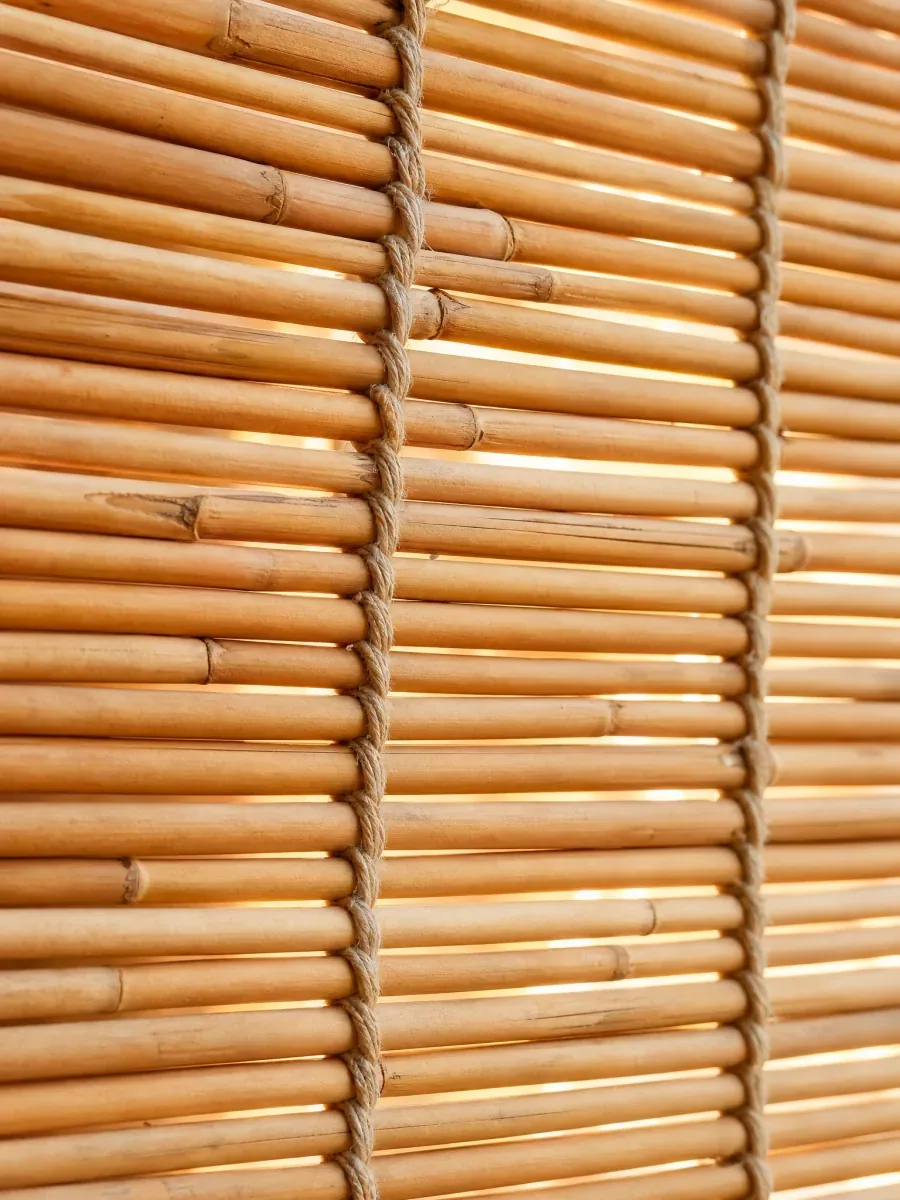











For a sloped sash we install pleated blinds, horizontal aluminium blinds or a cassette system. The fabric is held by two side support points — guide rails or tensioned cords — so it does not slide down the slope and moves together with the window. Pleated blinds — from 9,800 ₸/m², horizontal aluminium — from 4,200 ₸/m². Measurement is free; we work across Almaty and the suburbs.
Why ordinary blinds do not hold on a slope
Ordinary blinds hang from a top rail and slide down a sloped sash under their own weight. A roof window sits in the plane of the roof, and the fabric on it is pulled down not vertically, but at an angle to the horizon. That is where the sagging, the skew and the endless fuss with a slat that has fallen out come from.
What happens to an ordinary blind and rail on a slope
The rail is fixed above the opening and holds the fabric at a single top point. On a vertical window that is enough: gravity presses the fabric against the frame, and it hangs straight. On a slope, that single top point of support is exactly what is missing. The fabric turns to follow the tilt, the bottom edge drifts to the side, and the pleats or the cloth bunch up in one place and stretch out in another. And then you can’t reach the sash — it opens into the room, and the blind hangs right in its path. We see such windows regularly at measurements: the owners have already tried an ordinary blind and took it down a month later.
Two points of support instead of one
Blinds for roof windows are held differently — they are fixed at the sides. Guide rails run along the edges of the opening, and a tensioned cord runs along the edge of the sash. A sloped sash needs two side points of support for the fabric, and then it stays put at any point of the slope, does not slide down and does not tip sideways. Pleated blinds — a pleated fabric in slim profiles — work on exactly this principle: they are guided along rails or cords rather than hung from above. The same cord is tensioned without drilling the frame, which we talk about separately at the measurement.
Will the fabric slide down if the window stays open for a long time? It won’t — the side guides hold it, not its own tension. And there is a warranty for that: 3 years on the mechanism, 1 year on installation.
On a sloped sash the fabric is pulled down at an angle, so it needs two side points of support rather than a single top rail.
Which blinds suit roof windows
For a sloped sash we install three systems: pleated, horizontal aluminium blinds and cassette. Pleated blinds cover most roof windows, because they are fixed at any point of the slope thanks to guide rails or cords and do not slide down under their own weight. Horizontal aluminium blinds hold their geometry thanks to the side cord. The cassette system covers the roller tube in a housing box and removes light gaps along the edges of the slope.
As for the timeline: according to the price list, pleated blinds take 7–10 days, horizontal aluminium blinds 3–5 days, and the cassette is assembled from the same components based on the measurement.
- Pleated blinds — a pleated fabric in slim profiles for a sloped sash.
- Horizontal aluminium blinds — a rigid 25 mm slat cut to the slope.
- Cassette system — a roller in a housing box, with guide rails along the edges of the slope.
If you need just one piece of advice — go for pleated blinds. In my opinion, this is the basic option for a slope, and here is why.
Pleated blinds — the basic option for a slope
Pleated blinds are a pleated fabric in slim profiles. They are fixed at any point of the slope and do not sag, because they are held in guide rails with tensioned cords rather than hanging from a single top rail. A dense fabric is chosen for a bedroom under the roof, a combined one — when you need soft light control without full darkening, and a coated fabric — if the window faces the sunny side and it matters to remove some of the heat from the glass.
Jalusso cuts pleated blinds for sloped, triangular and trapezoidal openings. Are pleated blinds suitable for roof windows on a steep slope? They are — that is exactly where they work best, because the angle does not affect how they are fixed: the cord is tensioned along the edge of the sash, and the fabric stays in place in any position.
Horizontal aluminium blinds — when you need a rigid slat
We install horizontal aluminium blinds on a roof window when a rigid 25 mm slat is needed. The slat holds its geometry on a sloped sash, and turning it removes glare from a screen and a desk — handy in an office or a kids’ room where people sit at a monitor during the day.
They are held by side fixing: the cord runs along the edges and keeps the slats from drifting apart on the slope. Will a horizontal aluminium blind suit a steep slope? With an honest answer: on a steep slope you choose pleated blinds, and we install horizontal ones where the measurer has calculated the angle and confirmed that the cord will hold the system. On a very steep sash the slat sags — we won’t promise that horizontal blinds will fit any tilt.
Cassette system — minimum light gaps along the edges
The cassette system is a roller covered by a housing box, with guide rails along the edges of the slope. The fabric does not move away from the glass, so there are almost no side light gaps — it is chosen for a bedroom when you want it dark in the morning. In an attic, the cassette is mounted on the sash so that the window opens together with the fabric.
We do not give the price of the cassette in the category price list: it has no separate line, and the cost is calculated by the measurer based on the components for a specific window. What darkens a bedroom under the roof better? A dense pleated blind with side guide rails or a cassette: both systems close the gaps along the edges, while an ordinary light fabric will leave strips of light along the slope.
To sum up the options: pleated blinds are fixed at any point of the slope thanks to guide rails or cords and do not slide down under their own weight, while horizontal aluminium blinds and the cassette are chosen based on the tilt angle and the light requirements.
How a roof window differs from a ceiling window
A ceiling window differs from a roof window in its tilt angle and, as a result, in the choice of fabric. On a roof window the sash sits in the plane of the roof at a noticeable angle to the vertical. On a ceiling window the tilt angle is closer to horizontal, sometimes the sash is almost flat. Everything else grows out of this difference: the load on the fabric, the type of fixing and the material.
The tilt changes the load on the fabric
The steeper the slope, the more the fabric is pulled down under its own weight. A sloped sash needs side points of support — guide rails or tensioned cords that hold the fabric at any point. On an almost horizontal ceiling window the load vector is different, but the requirements do not get any lighter. The fabric must not move away from the glass: a gap above your head immediately turns into a strip of light along the edge. If you are looking for ceiling blinds, the measurer looks at the tilt angle first — both the fixing and the cutting depend on it. In an attic we most often install pleated blinds: a pleated fabric in slim profiles is fixed at any point of the slope and does not slide down. On a ceiling window pleated blinds work too, but the length of the pleats is calculated differently.
Why it is hot under the roof in Almaty
The heat under the roof determines the choice of a light and reflective fabric. Summer in Almaty is hot and sunny, and above an attic there is no second thermal layer: the roof heats up first and gives the heat back inside. A light fabric with a coating reflects part of the solar energy and reduces heating at the glass. A dense dark fabric, on the contrary, accumulates heat and fades faster — fading is noticeable already after the first season, especially on windows where the sun hits from morning till night. A ceiling window exposes almost the entire area of the fabric to the sun, so here the light side with a reflective layer matters more than density. We do not promise exact degrees and percentages: the result depends on the size of the window and its orientation to the cardinal points.
The closer the sash is to horizontal, the more important the light and reflective side of the fabric is, rather than its density.
How the fabric is fixed so that the window opens together with it
The fabric is mounted on the sash, not on the window reveal or the wall, so when the roof window is opened it moves together with it. This is the answer to the main question: blinds for roof windows do not interfere with ventilation, because the fixing goes on the moving part of the window, not on the fixed frame. Fixing on the sash lets the window open together with the fabric — the turning mechanism stays free. At our measurements this is the first thing Kirill checks: how exactly your window opens.
Three mounting options
The mounting method depends on the window and its glazing bead. Jalusso uses three options.
- Into the glazing bead — the bracket slides into the window groove, and the frame stays intact. This is drilling-free mounting: not a single hole in the profile, and the warranty on the roof window remains valid. For pleated blinds these brackets are standard, and for new windows under warranty we install exactly these.
- Onto the sash — the blind is attached directly to the moving part, so it moves with the window when it opens. Suitable for turn and tilt-and-turn models.
- Onto the frame with a profile — when the glazing bead doesn’t fit the size or isn’t there. Then a guide rail runs along the edge of the opening, and the blind is held in it.
Drilling-free mounting is also chosen for rented housing: the frame stays untouched, and when you move, the product is taken down and installed on a new window.
Cord, profile and line — what’s the difference
A profile is a rigid guide rail along the edge of the opening. A cord is tensioned along the edge of the sash without drilling the frame and holds the pleated fabric. A line secures the slats of horizontal blinds at the sides. All three solve the same task — keeping the blind from sliding down the slope — but behave differently.
A profile holds its shape rigidly, but it’s noticeable on the frame and requires space at the edges. A cord is almost invisible and doesn’t get in the way, but works only with a light blind such as pleated. A line is a thin side fixing for slats: it’s unnoticeable, but not designed for a heavy blind. Guide rails are installed where maximum stability and minimum light gaps at the sides are needed.
The practical conclusion is simple: for pleated blinds on a roof window, a cord or guide rails are more often chosen; for horizontal aluminium blinds, a line at the sides.
Tilt-and-turn sash and handle
A tilt-and-turn sash requires mounting that doesn’t interfere with the handle and turning. On a roof window the handle is usually at the top or side — if the blind moves towards it, you simply won’t be able to close the window. During the measurement we look at the handle position, the depth of the glazing bead and how the sash turns, and select the mounting for the specific model.
A case from practice: a window with a handle at the top, where the customer wanted to install ordinary horizontal blinds. The blind would run right through the handle. We installed pleated blinds with cord fixing — the pleated fabric folds up and down and doesn’t block the handle, and the window opens freely.
And most importantly: a blind attached to the sash doesn’t need to be raised before airing. It moves together with the window.
Comparison of options: what to choose for the task
In short: for a roof window, choose pleated blinds, not roller blinds. Roller blinds on a sloped sash are held on a roller tube at the top, and they have no support at the sides — the blind pulls away from the glass and flaps when the window opens. Pleated blinds win precisely because of their side fixing.
Next we look at the tasks. Below is a comparison of how each option behaves on a slope, how tightly it closes the window and where it’s appropriate.
| Option | How it holds on a slope | Darkening | Where it works well |
|---|---|---|---|
| Pleated blinds | Guide rails or cords along the edge of the sash, fixing at any point | From soft to full, depends on the fabric | Bedroom, kids’ room, study under a slope |
| Horizontal aluminium | A side line holds the slats, cut to the slope | Medium, doesn’t give full blackout | Kitchen, study, where a view is needed |
| Cassette system | The roller tube is covered by a housing box, guide rails along the edges of the slope | Strong, almost no light gaps at the edges | Bedroom, if it’s important to remove side light |
| Zebra blinds (day-night) | A blind of two layers of fabric, mounted on the sash | Adjustable: from diffused to strong shading | Living room under the roof, lounge area |
| Roller blinds | Roller tube at the top, no side support — pulls away from the glass | Strong in the centre, but the edges let light through | We don’t use for roof windows |
| Vertical blinds | Slats on a rail, nothing to hold them at the sides | Weak on a slope | Not suitable for roof windows |
Vertical blinds and heavy curtains on a rail don’t work on a slope, because there’s nothing to hold them at the sides.
Zebra blinds (day-night) on roof windows are less common than pleated, but the option works: two fabrics in one blind give smooth light adjustment. If the roof window is in a living room or lounge area and full darkness isn’t needed, day-night blinds will do.
How tightly do blinds close a sloped window? It depends on the system. A cassette system covers the roller tube with a housing box and removes light gaps at the edges. Pleated blinds in guide rails run right up to the profile, and side light is minimal. Horizontal aluminium blinds with a side line, however, darken only moderately — they’re more often chosen where a view is needed, not darkness.
What to choose for a bedroom and kids’ room
For a bedroom under the roof — dense pleated blinds with side guide rails or a cassette system: they block both side light and the glare from the glass in the morning.
In a child's room under the roof, not only the fabric matters but also the hardware. Hanging cords and long chains are an extra risk if a child can reach the window. A child's room under the roof needs a blind without hanging cords: pleated blinds with a spring mechanism or guide-rail control, or an electric motor with a remote control. In the Jalusso workshop, they assemble such options for a specific window after measurement.
The fabric itself on the slope is held by two side support points, so vertical blinds and curtains on a rail are not suitable for an attic window.
How much do blinds for roof windows cost
We price blinds for roof windows in Almaty by the area of the fabric, not per piece. A guide from our price list: pleated blinds — from 9,800 ₸/m², horizontal aluminium — from 4,200 ₸/m². Then coefficients for the control type and installation method are added to the base price. The exact cost is given by the measurer on site — after measuring the window.
| Option | Price | Lead time |
|---|---|---|
| Pleated blinds, pleated fabric | from 9,800 ₸/m² | 7–10 days |
| Horizontal, aluminium, 25 mm | from 4,200 ₸/m² | 3–5 days |
| Day-night, two-layer fabric | from 7,300 ₸/m² | 5–7 days |
| With electric motor, 220 V or battery | from 7,800 ₸/m² | 7–10 days |
| Wooden, linden, 50 mm | from 12,400 ₸/m² | 7–12 days |
The figure in the “with electric motor” column is the price of that price-list item, not a pleated blind with a motor: for an attic window the motor is calculated separately, as a coefficient. To avoid confusion, base your calculation on the fabric material.
What makes up the price
Four things: the area of the fabric, the type of control, the installation method and the tilt angle. The area is taken by the opening, not by the glass — on a slope the fabric is cut with a margin. Control adds cost as follows: mechanical — base price, chain — coefficient ×1.06, electric motor — ×1.85, electric with remote — ×2.1. Installation: on the wall — ×1, on the frame — ×1.05, without drilling — ×1.1. The cassette system comes with a coefficient of ×1.28, but we don't quote the price of the cassette itself — it's not in that price-list category. Measuring a sloped window determines the angle, the size and the type of mounting, and the final price depends on these three things. Kirill, our lead measurer, usually gives a range right on site — from the samples you can see which fabric and which mounting will suit a particular slope.
Example calculation
One sloped window with an area of 1.5 m² in pleated blinds with a chain. We calculate the fabric: 9,800 × 1.5 × 1.06 = 15,582 ₸. A sloped window adds a calculator coefficient of ×1.3 — about 20,260 ₸. Plus installation at 4,500 ₸ per item — a total of about 24,760 ₸. If an order includes several windows of different sizes, the area is summed up, and the coefficients are applied to each item separately: one window has chain control, another has mechanical — and they can't be calculated as one line. For orders from 150,000 ₸, installation is free, and with three or four attic windows that amount adds up.
Installation and warranty
Installation costs 4,500 ₸ per item. From 150,000 ₸ per order — free. The warranty covers the mechanism and the installation separately: 3 years on the mechanism and 1 year on the installation from the date the acceptance certificate is signed. If a case is recognised as a warranty case, we do the work free of charge — it will take no more than 5 working days. Not covered by the warranty: water, mechanical damage, natural fading of the fabric, and cases where the item was moved by the customer. After the warranty expires we still come out — to tighten and adjust.
The price depends on the size of the window, the tilt angle, the fabric material and the type of control, and the exact cost is given by the measurer on site.
How measurement and installation work
We measure from inside the room — from outside, a sloped window gives neither the right geometry nor access. A sloped window is measured by a measurer with samples: he immediately gives the angle, the size and the type of mounting, and calculates the cost on site.
What the measurer measures
The width and height of the opening, the tilt angle of the sash, the type of window mechanism, the position of the handle, the depth of the glazing bead. He also looks at how the window opens and turns: on tilt-and-turn models the mounting is chosen so that the fabric doesn't catch on the handle. The slope angle determines what will fit here — pleated blinds on guide rails or horizontal aluminium with side fixing. And on a steep slope we honestly recommend pleated blinds, even if you were looking at slats.
Where to see fabric samples
The same measurer brings the samples — that's the answer to the question of where to see them. Pleated, horizontal aluminium, day-night, wood: you can touch the fabric, hold it up to the light and see how dense the shading will be. Jalusso fabric consultant Aida helps you choose a shade to match the attic interior, rather than “by eye” from a phone screen.
Measurement is free — always within the city
Within Almaty, measurement and delivery are free, and this is not a one-off promotion: measurement and consultation are always free, the measurer comes with samples and calculates the cost on site. No “preliminary” paid visits.
We also travel to the suburbs of Almaty — Kaskelen, Talgar, Issyk, Kapshagay. We tell you the cost of the visit in advance, before the specialist sets off to you — and it depends on the distance. So for a house outside the city the procedure is the same: measurement, calculation on site, workshop, installation.
How we work
- You message us on WhatsApp.
- A measurer comes with samples and calculates on site.
- The workshop makes the item — for attic-window price-list items this is 7–10 days for pleated blinds.
- Installation: 4,500 ₸ per item, free for orders from 150,000 ₸.
Measuring a sloped window determines the angle, the size and the type of mounting; without these three values an attic-window order can't be started.
Control, care and condensation in winter
If you can't reach the window in the roof by hand, the fabric is controlled by an electric motor — battery-powered or mains 220 V. This is not a luxury but a way to avoid reaching across a bed or table to a sloped sash. The motor opens and closes the pleated blinds smoothly while you stand on the floor.
How many windows can be paired with one remote control? Several — the motors in the roof work as one group, and you close the whole attic with one button. In practice, people more often take one remote for two or three windows in one room, so they don't have to look for the second one in the dark.
Blinds for roof windows can be left in any position on the slope: pleated blinds are held in the guide rails, not hanging free, so the fabric won't slide down while you sleep or work. Want to close the window halfway — and it will stay that way until you raise the fabric yourself.
Caring for the fabric and the window
Caring for the fabric is simple:
- Pleated blinds are cleaned with a vacuum cleaner on low power or a soft sponge without soaking.
- You usually don't need to remove the fabric from a roof window: the pleats fold up, and you can reach the glass.
- To wash the window itself, move the fabric up or down along the guide rails.
We advise against soaking the fabric or wiping it with a wet cloth — this leaves streaks, and in the sun the fabric fades faster. A soft dry sponge and a vacuum cleaner handle settled dust.
Condensation on sloped glass
In winter, moisture settles on sloped glass. Almaty's climate is sharply continental: frosts and the temperature difference between day and night make themselves felt, and condensation forms on the inner side of the window. Wet glass and fabric should not be in constant contact.
The measurer on site takes into account the gap between the fabric and the glass, and we keep the fabric slightly open so the glass can air out. If condensation is constant, it's worth checking the ventilation under the roof — that's a matter for the house, not for the blinds.
The fabric is fixed in any position on the slope, so the window can be closed halfway and left that way — both for the night and for the day.
Non-standard windows: triangular, panoramic, a door on a slope
We cover a triangular window in a gable with pleated blinds: the fabric is cut to the shape of the opening, not adapted to it with makeshift means. If there's a roof window with a slope nearby, we make both fabrics from the same material and with the same control, so they read as one set. The difficulty here is not the fabric but the geometry — the pleats have to be assembled so that they follow the roof slope and still fold properly.
Panoramic glazing under a roof calls for a different approach. Each sash is covered by its own fabric, and the window closes completely, with no attempt to stretch one wide pleated blind across three sashes. In a conservatory with sloped glazing, people more often choose combined pleated blinds or a light fabric — you need soft shading, not total darkness, so the view of the garden stays readable.
A separate case is a balcony door on a slope. A pleated blind on a door is mounted on the sash and moves along the guide rails, so the door opens freely. This can only be checked on site: it matters that the fabric does not catch the handle and does not hit the threshold when the door is tilted.
Can you close the window halfway and leave it like that? Yes, a pleated blind locks at any point on the slope, because it is held in the guide rails and on cords rather than hanging free. That is exactly why pleated blinds are more often chosen for an attic — horizontal and vertical systems on such an opening do not give you the same freedom.
A real example
In a gable next to a roof window, the fabric is made to follow the roof slope: it repeats the shape of the opening, not the rectangle of the neighbouring window. An ordinary pleated blind would not work there — cutting to a triangle is done by the measurer together with the workshop craftsman. Pleated blinds are cut for sloped, triangular and trapezoidal openings — that is the answer to the question of what to do with a non-standard-shaped window.
FAQ
We measure a sloped window from inside the room. From outside, you cannot reach the sash in the plane of the roof, and you cannot take the geometry of the opening from there — the measurer works from the room side, and there also checks how the window opens and where the handle goes.
We cover a triangular gable window with pleated blinds. The pleated fabric is cut to the shape of the opening: triangle, trapezoid, roof slope — the workshop cuts to your dimensions rather than fitting a rectangular fabric to a non-right angle. If there is an ordinary roof window next to it, we make a separate product for each: they have different geometry and different fixings.
Blinds for roof windows in Almaty and the suburbs — Kaskelen, Talgar, Issyk, Kapshagay — are made in one workshop; the cost of trips outside the city depends on the distance and is quoted before we set off.
We give 3 years on the mechanism and 1 year on installation; the count starts from the day the acceptance certificate is signed. If a case is recognised as a warranty case, we carry out the visit and repair on roof windows free of charge and within 5 working days. Mechanical damage, re-installation on your own, water and natural fading of the fabric are not covered — but we do come to tighten, adjust, or replace a cord or chain even after the warranty.
Drill-free mounting preserves the warranty on a roof window: the bracket slides into the glazing bead or is mounted on the sash, and the frame stays intact. We do not sell or install roof windows themselves — we only select the fixing and the fabric for the window you already have. If the window in the roof is out of reach, we offer pleated blinds with an electric motor: the fabric is controlled by a remote from a battery or mains 220 V. The measurer selects the specific fixing for your window on site.
Conclusion
If you boil all of this down to one sentence: on a slope, the fabric is held by two side points of support — guide rails along the edges of the opening or tensioned cords along the edge of the sash — not by a top rail. An ordinary curtain on a roof window sags precisely because it has only one support, at the top.
Next comes the choice of system. Pleated blinds remain the basic option for a sloped sash: the pleated fabric locks at any point on the slope and does not slide down under its own weight. Horizontal aluminium blinds also work, but they are held by a side cord, and on a steep slope we still recommend pleated blinds. And on a tilt-and-turn window, the fixing matters most: we mount the fabric on the sash, so the window opens together with it, and the drill-free option preserves the warranty on the window itself.
The price is made up of the area of the fabric, the material and the type of control. Pleated blinds — from 9,800 ₸/m², horizontal aluminium — from 4,200 ₸/m². The mechanism of blinds and pleated blinds for roof windows carries a 3-year warranty, and installation work a 1-year warranty; the term is counted from the date of the acceptance certificate.
A tip from practice: invite a measurer who will bring samples with them. They will determine the angle of the slope, select the fixing for your window's mechanism and give you the exact price on site — measurement and consultation are free, and we do not quote catalogue prices “per unit”, because every roof window is calculated separately.
We make blinds for roof windows in Almaty in our own workshop and install them after measurement. If it is hot under the roof and the sun shines straight onto the bed, start with a measurement — the rest is decided on site.

