
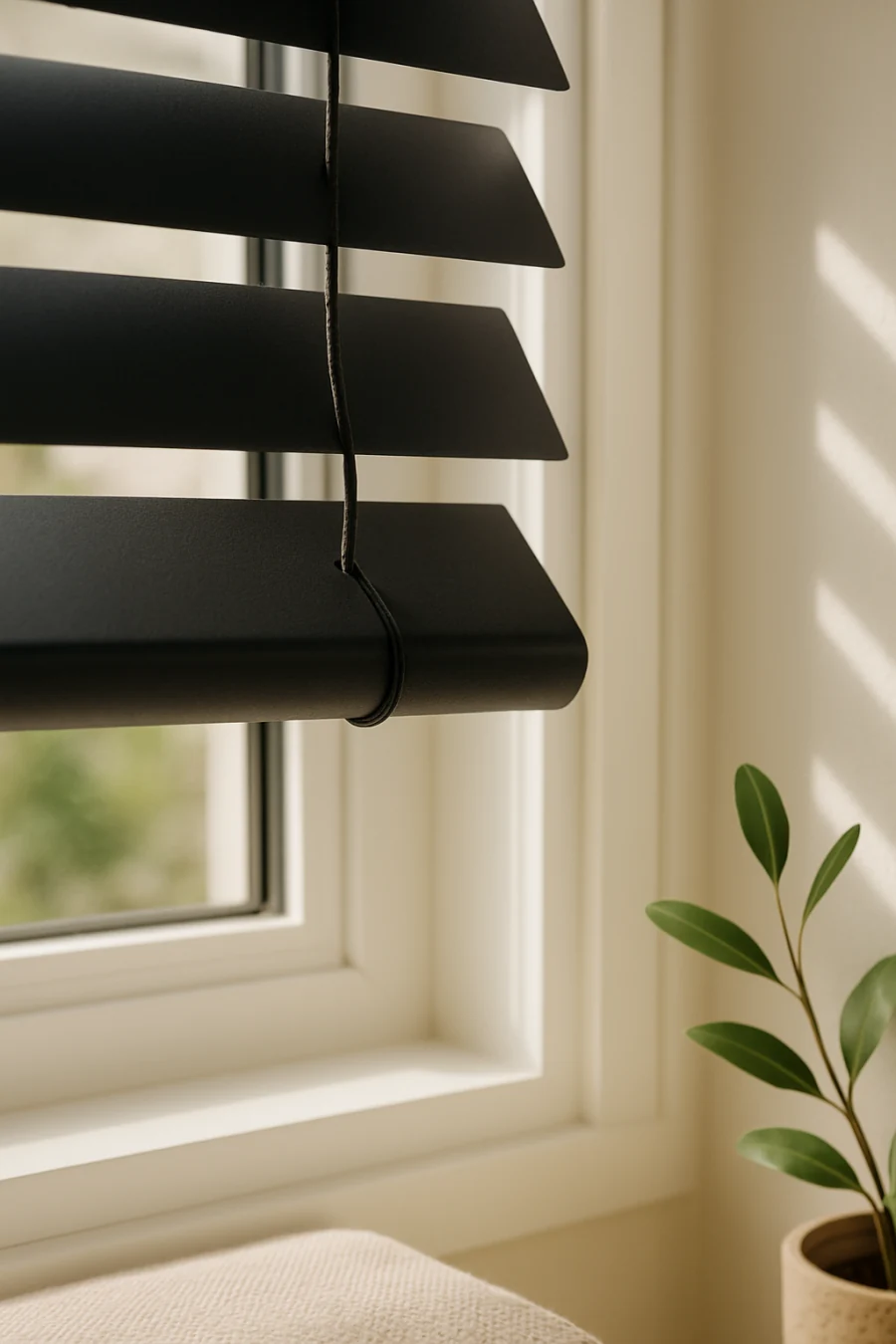
















We make black blinds in Almaty to measure from black aluminium slats, black fabric and black PVC. Dense fabric darkens the most, metal holds its colour in the sun better, PVC fades more slowly than fabric. Prices — from 3,600 ₸/m², and the black colour itself doesn't change the price of an item.
What is darker with the slats closed: aluminium, PVC or fabric
No material gives full blackout. Black blinds give dense shade during the day and a graphic line at the window, but they don't turn the room into a photo lab. The difference between aluminium, PVC and fabric is in how much light passes around the blind and how that light feels to the eye.
Why horizontal slats don't give full darkness
Horizontal blinds let light through between the slats and along the edges of the blind. When you close an aluminium slat 25 mm by turning it, the plates overlap, but a gap remains between them — thin, yet still letting light through. Then there is the ladder: the cord or tape that holds the slats runs through the blind, and at those points light finds its way too. And the side edges: between the blind and the window reveal there is almost always a strip through which the morning sun seeps in.
So when people ask whether black aluminium or black PVC blinds completely darken a room, the honest answer is no. Both materials work the same way: metal and plastic alike cover the window with dense shade, but not with a solid wall. Yet in terms of darkening they do not differ from each other — here it is not the material that decides, but the installation method and how neatly the blind is fitted to the opening.
What dense fabric changes
Black fabric darkens differently. Vertical blinds with black slats 89 mm cover the window in solid strips, and there are fewer gaps between them — provided the fabric is dense and the slats overlap each other. Day-night blinds work even better: two layers of fabric shift, and you choose whether to leave a strip of light or remove it almost completely.
But even dense fabric is not blackout. A day-night blind holds deep shade, not absolute blackness. By the way, in my opinion, the race for “total darkening” in a living room is overrated anyway: people more often need not darkness itself, but the ability to get it — in the evening, for sleep or for a screen.
So what does this mean for your choice? If depth of shade is decisive, look at the density of the fabric: black fabric and day-night blinds beat horizontal slats. If practicality and the look of the window are decisive, black aluminium and PVC give a clean graphic line without any claim to being lightproof. Installing blinds and expecting the effect of dense curtains is not worth it — these are different tasks.
Colour affects the feeling of shade more than the amount of light: a horizontal slat in any colour lets light through between the slats and along the edges, while dense black fabric darkens more.
Black in the Almaty sun: heat, fading and the south side
A black aluminium slat 25 mm heats up on the south side more noticeably than a light one. This is normal for metal and does not mean black blinds cannot be installed on a sunny window. Heating and fading are different things, and they are most often confused. A slat may become hot to the touch, yet hold its colour for years. Fabric behaves the opposite way: it barely heats up, but loses depth of tone.
In Almaty the sun is harsh, and in summer dust is added to it. A south window gets light all day, a west window — in the second half of the day, when the air is already scorching. Black PVC and black fabric behave differently on such windows, and the difference shows not in the first month, but over time.
Metal: heat without loss of colour
Aluminium heats up, but holds its colour. A black aluminium slat 25 mm on the south side can heat up noticeably — metal is metal. Direct light does not eat away the coating: aluminium holds its colour without change. Dust settles on it just as on any horizontal surface, and is wiped off with a cloth or a soft brush. A slat can be replaced one at a time if one is accidentally bent. That is why for south and west windows we more often recommend horizontal aluminium blinds rather than fabric: the heat is unpleasant for the hand, but harmless to the look.
Fabric and PVC: where depth of tone is lost
Black fabric without treatment loses depth of tone fastest. Black in particular — it fades more noticeably than light fabric, because loss of depth on a dark background is immediately visible. If the window faces south or west, a sun-protective treatment slows down the fading of the fabric. This is an option, not a mandatory condition, and we discuss it at the measurement with samples.
Black PVC fades more slowly than fabric. But I will not promise “years without change”: plastic in direct sun gradually loses its richness, just more slowly than fabric. In a rented flat or a utility room, where the window is not the main thing, black PVC is well worth its price.
What to do if the window faces south or west
If the window faces south or west, you can go with black. But the choice should be made consciously.
- Aluminium. A black aluminium slat 25 mm is a workable solution for the south: there is heat, but no loss of colour.
- Fabric with a sun-protective treatment. Dense black fabric with a treatment holds up in the sun better than ordinary fabric. We discuss it at the measurement with samples.
- A neutral tone instead of black. If the window faces south and you are worried about depth of tone, grey or graphite fade more calmly. But that is no longer black.
In one typical situation — panoramic glazing in an office on the south side — we installed black horizontal aluminium blinds rather than fabric. A fabric blind over such an area would fade noticeably faster. And yes, even in the south I do not talk people out of black: it holds up if you choose the right material.
A black aluminium slat heats up on the south side more noticeably than a light one, but holds its colour; black fabric without treatment loses depth of tone fastest, while black PVC fades more slowly than fabric.
Will the room become gloomy: on which windows black is appropriate
A room becomes gloomy not because of the black colour, but because of the area it occupies. Black blinds in Almaty on a wide window read as a graphic line and pull the interior together; the same blind on a narrow kitchen window in a panel building visually narrows the space. The difference lies in the ratio of the window width to the wall around it.
A black window narrows a small room precisely because it works as the darkest point on a light wall: the eye catches on it first, and the room seems smaller. On a wide window this effect does not arise — there the dark plane is proportionate to the wall, not competing with it.
Where it fits
- Loft. Black blinds match the tone of concrete, metal and black frames — the window becomes part of the interior’s material, not a spot on it.
- Minimalism. The same principle works here: one graphic line instead of several colours. Both horizontal blinds and dense black fabric will do.
- Panoramic glazing. The more glass there is, the calmer a dark blind looks. On a panorama black does not press — it holds the plane.
- A shopfront of a commercial space. A coffee shop, barbershop, photo studio or office takes black as part of the brand: the shopfront reads from the street as a single dark stripe.
- A wide living room. If the window takes up a noticeable part of the wall, and the furniture and textiles are in a calm palette, dark window blinds will sit well.
Where it is not worth it
- A small bedroom. A solid blind across the full height of the window makes an already small room feel tighter. If you want black precisely there, we usually recommend black fabric with sheer stripes or leaving the upper part of the window open.
- A child’s room. A black blind is chosen less often for a child’s room: there soft diffused light is more often needed, not deep shade. We do make dark blinds for a child’s room, but without covering the whole wall.
- A narrow window on a light wall. When the window is small and the wall around it is large and light, black works against the room.
A separate case is black on only some of the windows. This is done when dark is needed in one zone: for example, black blinds in an office or bedroom, while the other windows in the flat stay light. We do not advise mixing colours on neighbouring windows in one room — it looks like an unfinished renovation, not like a design move. If black is chosen for two windows in one room, then for both.
Black blinds work well on wide windows, in lofts and commercial interiors, while in a small room a solid black fabric visually narrows the space. So you don't have to guess by eye, our measurer comes with samples of black material and looks at them on your window and in your light.
Dust, streaks and fingerprints on a dark surface
Yes, dust shows up more on black blinds than on light ones. Almaty dust is light, almost grey, and on a dark slat it reads as a thin film. On beige or white blinds the same layer is almost invisible. The same amount of dust settles — only the contrast changes.
Black blinds in a dark colour scheme need wiping a little more often than light ones. But the tone itself is forgiving in another sense: small scuffs and fingerprints near the chain don't show on it, while on light plastic they stand out as grey marks. In my experience, people with dark interiors are ready for this — they chose their furniture with the same caveat.
How to wash black slats and black PVC
An aluminium slat 25 mm and black PVC are washed the same way: a soft cloth, warm water, a little dish soap. No abrasives and no rough side of the sponge — they leave micro-scratches on the dark coating that then collect dust.
Vertical black fabric and day-night blinds are vacuumed with a soft brush attachment or wiped with a dry cloth; it's better not to pour water on fabric: it leaves streaks along the edges of the slat. If a black slat is damaged, it is replaced one at a time, without taking down the whole structure. Metal blinds start from 5,200 ₸/m² in the price list, lead time 5–7 days — that's relevant if the old slats can no longer be washed clean.
What's more practical — matte or gloss
A matte finish is more practical for a window: it forgives streaks after washing and diffuses light more softly. Gloss shows fingerprints and water marks, but gives a deeper black and looks more put-together in an interior with glossy surfaces.
Anthracite and graphite behave as in-between tones: they are darker than light colours but don't give such sharp contrast with dust as deep black. For a kitchen, where something constantly flies onto the window, this is a calm compromise — the dark palette is kept, but daily care is less.
The main thing to remember: light dust is more noticeable on a black surface than on a light one, and gloss shows fingerprints and streaks after washing more than matte does.
How much black blinds cost: price list items, controls, installation
The price is set by the price list item, not the colour. Horizontal blinds with an aluminium slat 25 mm — from 4,200 ₸/m², vertical fabric blinds — from 4,600 ₸/m², day-night blinds — from 7,300 ₸/m², black PVC 25 mm — from 3,600 ₸/m². We don't charge extra for black.
| Price list item | Price from | Manufacturing time |
|---|---|---|
| Plastic blinds, PVC, slat 25 mm | 3,600 ₸/m² | 3–5 days |
| Horizontal blinds, aluminium, 25 mm | 4,200 ₸/m² | 3–5 days |
| Vertical blinds, fabric, slat 89 mm | 4,600 ₸/m² | 3–5 days |
| Day-night blinds, two-layer fabric | 7,300 ₸/m² | 5–7 days |
| Blinds with an electric motor, 220 V motor or battery | 7,800 ₸/m² | 7–10 days |
Black doesn't make the lead time longer: the price list item sets both the price and the workshop schedule. The final amount is made up of the window area, the type of controls and the installation method.
Three things move the total the most. First — area: a wide window takes more fabric and slats. Second — controls: a chain and an electric motor are calculated differently (calculator coefficients). Third — installation: fixing into the opening, onto the frame or a cassette system. Measurement and consultation are always free with us, and within the city both measurement and delivery are free: the measurer comes with samples and works out the cost on site.
Controls and installation: calculator coefficients
The base price of the fabric is multiplied by a coefficient. Mechanical controls — ×1, chain — ×1.06, electric motor — ×1.85, electric motor with remote control — ×2.1. The installation coefficients are: wall — ×1, frame — ×1.05, no-drill option — ×1.1, cassette system — ×1.28. These are calculator coefficients, not a separate line on the invoice.
An electric motor is handy on tall windows and panoramic glazing, where you have to reach for the chain. In the price list the item “Blinds with electric motor” starts from 7,800 ₸/m², and the same system is applied as a ×1.85 coefficient to the fabric.
Timelines by item
The manufacturing time depends on the item. Horizontal and vertical blinds — 3–5 days, day-night — 5–7 days, electric motor — 7–10 days. The motor adds time in the workshop: the motor and electronics are fitted as a separate stage.
We charge 4,500 ₸ for installing each unit, but if the order total reaches 150,000 ₸, we install at no extra cost.
The mechanism is covered by a 3-year warranty, installation — 1 year; we count the term from the date the acceptance act is signed.
The exact amount for your window is quoted by the measurer on site — that's the only figure worth treating as final.
Comparison table: black aluminium, black fabric, black PVC
In short: for darkening, dense black fabric and day-night blinds are stronger than a horizontal slat; for colour fastness, aluminium is ahead; for price, black PVC is cheaper than the rest.
| Material and system | Darkening | Behaviour in the sun | Price from | Lead time |
|---|---|---|---|---|
| Aluminium slat 25 mm, horizontal blinds | medium: light passes between the slats | the metal heats up more noticeably than a light one, the colour holds | 4,200 ₸/m² | 3–5 days |
| Black fabric, vertical blinds, slat 89 mm | deep, soft | without treatment it loses depth of tone on south and west windows | 4,600 ₸/m² | 3–5 days |
| Black fabric, day-night blinds | adjustable: from sheer to dense shade | without treatment it fades the same way, treatment slows it down | 7,300 ₸/m² | 5–7 days |
| Black PVC, slat 25 mm | medium, like metal | fades more slowly than fabric | 3,600 ₸/m² | 3–5 days |
How to read this table for your own window. Horizontal blinds with a black aluminium slat 25 mm are chosen for the kitchen, balcony and office: the slat can be washed, replaced one at a time, and the metal doesn't mind moisture or heat. Fabric is chosen where softness of light matters more: vertical blinds diffuse light more softly than metal, and day-night blinds adjust the density of light by shifting the layers — handy in a living room and bedroom, where you want to change the light through the day, not just open and close.
Black PVC is a budget entry into a dark palette. Plastic doesn't mind moisture, the slat springs back and doesn't crease from an accidental touch, and it fades more slowly than fabric. On heating and fading, keep one simple link in mind: a slat heating up in the sun and fading are different processes. Aluminium on a south-facing side gets noticeably hot, but doesn't lose its colour. Fabric heats up less, but loses depth of tone in direct sun first.
If the window is wide and tall and the chain is inconvenient, look at the same system with a motor: the price list item “Blinds with electric motor” — from 7,800 ₸/m², lead time 7–10 days.
To sum up on choosing a material for black blinds: darkening is set by the density of the fabric, colour fastness by the material, and the price by the price list item.
How an order goes: measurement, manufacturing, installation
The measurer arrives with samples of black material and calculates the cost on the spot. Within the city, the visit is free. We do not keep ready-made products in stock — every pair of black blinds starts with a window, not a shelf.
Then the order goes like this:
- You write to us on WhatsApp, and we agree on a time for the visit.
- The measurer takes the dimensions of the opening or the sash, lays out samples of black aluminium slat, black fabric and black PVC, and gives you the total according to the price list items.
- The workshop makes the fabric to your size.
- Installation takes one visit: on the wall, on the frame, without drilling, or with a cassette system — we choose the mounting to suit the material of the window reveal and the sash.
Mounting in the opening places the fabric flush with the window reveal. The slats do not get in the way of the windowsill, curtains or opening the sash. For a standard plastic window this is enough. On wide glazing, the measurer will suggest a variant that will not interfere with the hardware.
If in a year you want a different shade or density, only the fabric is replaced. The mounting stays in place, and we do not touch the walls or window reveals. The workshop will make a new fabric to the same dimensions, and the installation team will refit it in one visit. This is cheaper than replacing the whole product — the rail, brackets and motor are already there.
We give 3 years of warranty on the mechanism and 1 year on the installation, counted from the day the acceptance certificate is signed. Fixing such a fault on black blinds takes our technician up to 5 working days, and there is no charge for it. Once the warranty period has passed, the technician will still come — tighten the mounting, adjust the movement, fit a new cord or chain. Not covered by the warranty: mechanical damage, reinstallation by yourself, exposure to water and natural fading of the fabric.
A practical case: a panoramic window in an office
An office with wide glazing in a single line is a typical situation where the chain is inconvenient: you cannot reach the top edge of the fabric. For such windows we install black blinds with an electric motor, controlled by one remote for the whole line. We choose the motor to suit the weight and width of the fabric; according to the price list this is from 7,800 ₸/m² and 7–10 days. Set it up once — then the window works on its own, and staff are not distracted by the slats.
Trips to the suburbs
To the suburbs — Kaskelen, Talgar, Issyk, Kapshagay — we do travel, and the cost of the visit depends on the distance and is quoted before the visit.
Every order for black blinds is based on a measurement: the measurer brings samples of black, calculates the cost on the spot, and within the city the measurement and delivery are free.
A black window from the street and inside: frame, hardware, privacy in the evening
During the day, from the street, black blinds read as an even dark field: a horizontal slat or dense fabric closes the glass tightly, and the window stops reflecting light. Such a facade looks calm and whole. Inside during the day the picture is the opposite — the room stays dark only where the fabric is really dense. A dark slat behaves like a light filter: it cuts glare but does not switch off the day. In my view, that is exactly the point of a black window — it gives depth of tone, not full night.
In the evening, everything is decided by the density of the material, not its colour. Dense black fabric hides the room from the street in the evening better than a light one: with the lights on inside, silhouettes can be seen through white or beige slats, while opaque black fabric keeps privacy. Day-night blinds work more flexibly — shift the layers, and the dense stripes block the view from the street. A horizontal slat, though, is not for privacy: gaps remain between the plates. If you turn on the light by the window in the evening, count on density, not colour.
Hardware and the rail are the point people ask about most often at the measurement. We assemble the set to suit your interior: the lift mechanism, the tilt rod and the brackets come in the same tone as the slat, so the top of the product does not stand out as a white stripe. A black window frame requires a decision: blinds in the colour of the frame blend in and the window becomes one graphic spot, while contrast with a white frame gives a clear pattern. A white plastic window and black blinds go together fine. But remember: on a white frame, the white frame is visible between the black slats — when the slats are tilted, it shows through in stripes. Some like it as a rhythm, others find it distracting.
Combining with wallpaper and curtains also follows the logic of contrast. On light neutral walls, a black window works as an accent and does not argue with the furniture. On dark wallpaper, black blinds dissolve — then the window stops being a line. With dense curtains in a matching tone, a black facade lives calmly, while with a light sheer over it, it loses its graphic quality, because the fabric softens the silhouette of the slat. In a living room with panoramic glazing, we more often leave black slats without curtains: the window holds the interior on its own.
If you are unsure, the measurer will come with samples of black material and show you how the fabric will sit on your frame. The conclusion is simple: dense black fabric hides the room from the street in the evening better than a light one, and the contrast of black with white plastic only works when it is a deliberate choice.
When black does not suit: a small bedroom, a child’s room, some of the windows
Black does not suit every window, and for some rooms we advise against it right away. A child’s room and a small bedroom are first on that list: there a solid dark fabric feels oppressive, and parents later regret the choice. But there is almost always a solution, and it does not require giving up the colour you had in mind.
What we do in typical cases:
- A child’s room and a small bedroom. We take not solid black but fabric with transparent stripes or day-night: the density of the fabric changes by shifting the layers, and during the day the room stays light. On a narrow window, this variant reads more calmly than an opaque slat.
- A home cinema. Horizontal blinds lose out here: the slat lets light through between the plates, and glare remains on the screen. Dense black fabric works better — it blocks side light and does not create flares on the picture.
- One window out of several. Nothing stops you from having black blinds on only some of the windows and light ones on the rest. In an apartment this works: a dark accent on the wide living-room window, neutral tones in the bedrooms and the kitchen. A single colour for all windows is not obligatory.
- Close dark tones. Anthracite and graphite are never darker than black — they are shades of the same dark range, and in terms of darkening they are comparable. The difference shows in the interior: graphite leans softer towards grey, anthracite is closer to coal.
The general rule is simple. Black blinds work on wide windows, in a loft and in a commercial interior, where the dark field reads as a line of the interior rather than a blot. In a small room, darkening and the size of the window matter more than the colour itself: we choose the density of the fabric by the side of the light, not by a picture from a catalogue.
Conclusion
Let us gather what is important to remember about black blinds in Almaty into five short statements. Colour changes the feeling of shade but not the amount of light: a horizontal slat lets light through between the plates, however black it is. That is why we do not promise full blackout from aluminium or PVC — deep shade comes from dense black fabric, and even then not as a blackout.
In the Almaty sun, materials behave differently. A black aluminium slat of 25 mm holds its colour, though on the south side it heats up more noticeably than a light one. Black fabric without treatment loses its depth of tone fastest. Black PVC fades more slowly than fabric — but not “for years without change”.
Where is black appropriate? On wide windows, in a loft, in a commercial interior — a coffee shop, a barbershop, a photo studio. In a small room, a solid black blind visually narrows the space, so there we more often suggest black fabric with sheer stripes or leave the top of the window open. For a child’s room, black is chosen less often.
On price, the answer is simple: you pay for the price-list item, not for the colour. Horizontal aluminium — from 4,200 ₸/m², vertical fabric — from 4,600 ₸/m², plastic — from 3,600 ₸/m². The exact amount is quoted by our measurer on site, after seeing the window and which side the light comes from.
The practical step is one: call a measurer with samples of black material for your window. Samples in your hands on your own windowsill say more about the density of the shade than any article. Measurement and a visit within the city are free with us; we also travel to Kaskelen, Talgar, Issyk and Kapshagay — we quote the cost of the visit before we come.

