



















We manufacture roller shutters for shops in Almaty to measure: for the shop window and entrance we install extruded aluminium from 24,900 ₸/m², perforated profile from 27,800 ₸/m², and with an electric motor from 35,000 ₸/m². Measurement and delivery within the city are free, installation is 4,500 ₸ per unit.
Shop window, entrance and pavilion: three different openings
We do not keep finished products in stock: roller shutters for shops in Almaty are made only to measure. You write on WhatsApp, the measurer comes with samples and calculates the cost on the spot. And yes — you cannot measure one opening and close the second one later: a shop window and an entrance are counted as separate sets, because they have different heights, different curtains and often different controls.
Technically, you can close only the entrance and leave the shop window open. The question is different: whether the shop window will stay without protection at night. If there are goods behind the glass that can be seen from the street, we usually suggest closing both openings — otherwise the whole point is lost. The decision is yours, but the measurer will honestly say what each part gives.
Shop window and entrance — two sets
A shop window is a wide opening with a large curtain. The wider and taller the opening, the heavier the curtain, and for a shop window we install extruded aluminium. The entrance is a narrow opening, and here it is more often decided how to open it: with a crank handle from the outside or with an electric motor. The control is also counted separately — for the shop window and for the door.
A pavilion at a market and on the street
Roller shutters for retail pavilions differ in how they are fixed. A pavilion has no load-bearing wall to run the guide rails into, so the fixing goes into the frame, not the wall. The measurer checks what the frame is made of and selects the right mounting unit for it.
We travel to the suburbs of Almaty — Kaskelen, Talgar, Issyk, Kapshagay. The cost of the visit depends on the distance, and it is quoted before the visit: within the city, measurement and delivery are free.
For a shop, it is not one opening that gets closed but two or three separate ones — the shop window, the entrance door and, if the outlet is at a market or on the street, the pavilion — and each set is calculated separately.
Which profile for the shop window and which for the entrance
The profile is chosen not by the shop’s name but by the opening: the width and height of the curtain, the floor, the neighbours along the façade, and whether the shopfront will be lit at night. The same extruded aluminium profile behaves differently on a narrow door and on a wide shopfront — the wider the curtain, the more noticeable the play in the guide rails and the more important the rigidity of the slat.
A wide shopfront opening is the first reason not to skimp on the profile. A curtain spanning the full width of the window sags under its own weight, and if the slat is light, it is easier to pry up from the corner. A narrow entrance to a back room or a service door needs no such reserve — a light profile copes there.
The floor and the surroundings change the picture more than you might think. A shopfront on the ground floor of a residential building at the end wall, where nobody looks at night, and a shopfront on a busy street are two different calculations: in the second case it matters more that the curtain cannot be pried up in view, in the first — that the closed façade does not spoil the look during the day.
Night lighting of the shopfront is a separate matter. If the goods should be visible after closing too, a perforated profile keeps the sales floor in view with the curtain closed: the display can be seen through the holes, and the light from inside reads from the street. A solid extruded aluminium profile does not offer this — it closes the shopfront completely, though in durability the perforated profile is inferior to the solid one, because the holes weaken the slat. It is a choice, not an improvement: visibility or strength.
A separate note on market pavilions: they have no load-bearing wall, the guide rails are fixed to the frame, and a heavy profile carries the load together with the frame rather than on its own. That is why for a pavilion the profile is chosen only after the measurer has seen the frame.
The selection mistakes we see at measurements repeat themselves. A foam-filled roll-formed profile is put on a shopfront because it is lighter and cheaper — and the result is a curtain that can be pried up from the corner. Or a perforated one is taken for visibility, and then people are surprised that dust blows in from the street through the holes and snow drifts in during winter. Or a solid profile is ordered and only later does it come back that the shopfront should be lit at night.
At the measurement it is worth asking three questions: how wide the curtain is, whether there will be night lighting, and what the structure behind the opening is — a load-bearing wall or a frame. The answers determine the position in the price list.
| Profile | For which opening | Price from, per m² | Manufacturing time |
|---|---|---|---|
| Extruded aluminium | Shop window and entrance | from 24,900 ₸ | 12–16 days |
| Perforated | Shop window on the sunny side | from 27,800 ₸ | 12–16 days |
| Foam-filled roll-formed | Windows of utility rooms | from 17,500 ₸ | 10–14 days |
Extruded — for the shop window and entrance
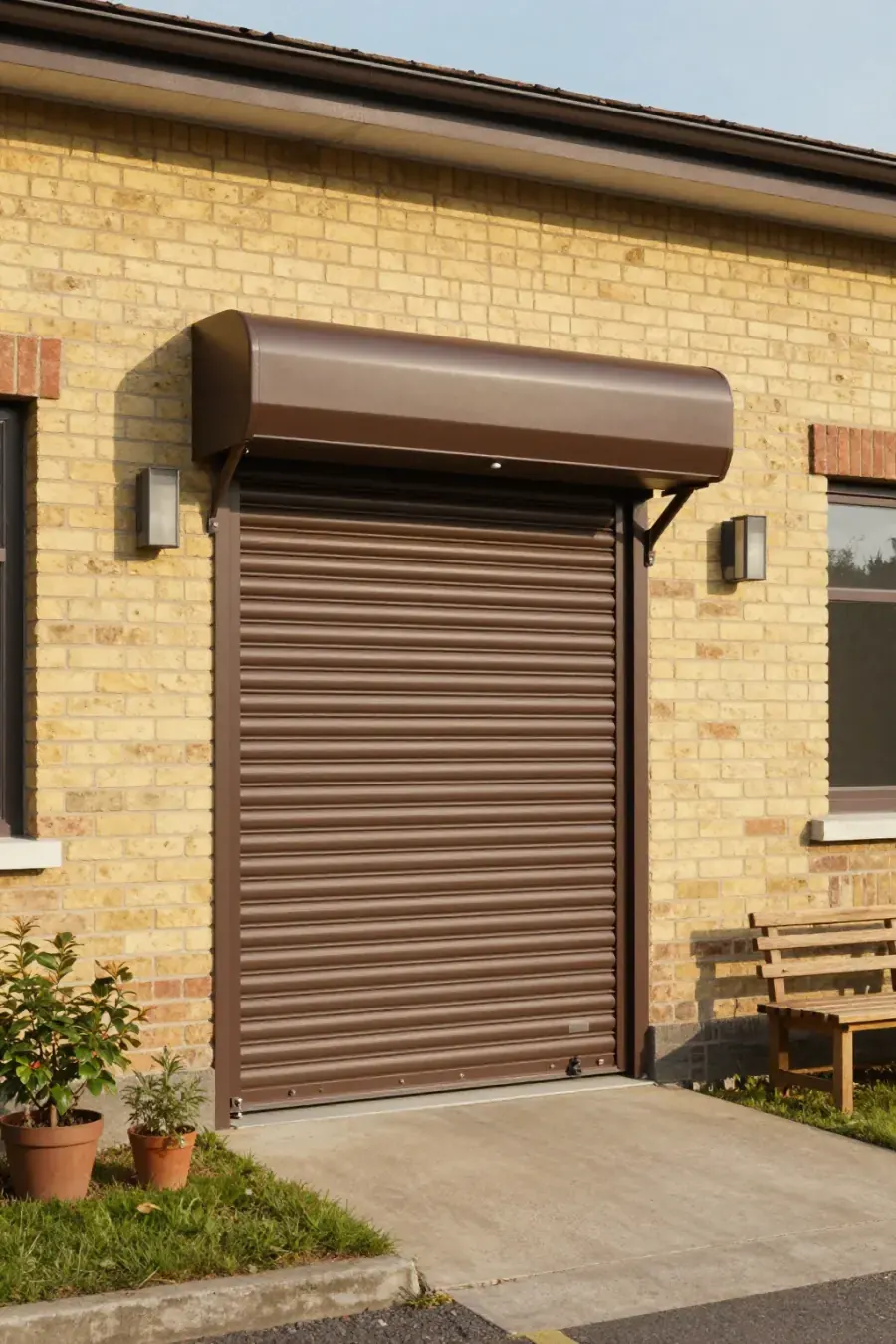
Extruded aluminium profile is installed on a shopfront and entrance group without security. It is extruded from solid aluminium, the wall is thicker, the slat is heavier — on a wide opening this gives the rigidity that light profiles lack. The deadbolt lock works together with this profile: the bolt goes into the guide rails and holds the curtain along its height, not at a single point. The guide rails are fixed into the load-bearing wall, not into the insulation.
Perforated — when visibility is needed
Perforated profile is more often chosen for the sunny side: the curtain is lowered during the day, the shopfront does not overheat, and the customer on the pavement still sees the display. On an entrance door in a quiet side street where nobody is around at night, we do not recommend it — there a solid slat is more needed.
Foam-filled — only for utility windows
Foam-filled roll-formed profile is light: there is foam filler inside the slat and less metal. We do not install it on a shopfront or entrance — on a wide curtain it is easier to force open. But the foam in the slat damps street noise, and on a warehouse or back-room window facing a busy street this is noticeable.
For roller shutters in a shop, the profile matters more than the colour and the hardware: colour changes the look of the façade, while the profile decides how long an attempt to break the curtain open will take.
Roller shutters or a roller grille: what closes the shop window
The choice between roller shutters for a shop and a roller grille is decided not by the strength of the metal but by how your day is organised. A grille keeps the opening closed around the clock — it hangs there during the day too. Roller shutters for a shop close the shopfront and entrance for the night, and in the morning the curtain goes up into the housing box, and the shopfront shows the goods to the street again.
Then come the details that surface once the work begins.
A pharmacy and a grocery store work with the flow of people passing by who drop in on impulse. Here the shopfront is the sign. A jeweller’s is the opposite: it needs a solid wall and no view inside. A roller grille loses in both cases — it either gets in the way of showing the goods or does not hide them. A coffee shop with seating by the window suffers from a grille in terms of light as well: during the day the mesh cuts the light falling on the windowsill.
What people ask before installation
The first question is the neighbours along the façade. In a shopping arcade where units stand right next to each other, a grille turns a row of shopfronts into a row of cages, while a housing box above the opening is almost invisible. If the building has façade requirements, find them out from the landlord in advance: we do not handle approvals.
The second question is night visibility. Through a perforated roller shutter curtain, lit goods can be seen from the street; through a grille they can be seen too, but the grille itself is visible along with them.
How it works in practice
The daily routine of opening and closing is the main argument for roller shutters. The curtain is raised and lowered every day, twice, all year round; a grille is not moved at all. Commercial roller shutters win in this scenario not by strength but by the fact that every morning they return the façade to a working look.
We install roller shutters, while a grille we can only compare by task — we do not offer them. At the measurement it becomes clear what the opening calls for: if the unit is on a night street and the goods should be visible around the clock, the conversation is about perforation, not mesh.
Price: what the total for a shop is made up of
We calculate how much roller shutters for a shop in Almaty cost by the area of the curtain and the components, not by a single figure per square metre. The price per square metre is the base. Then the roller shutter housing box, guide rails, controls and locks are added to it. The difference between two shopfronts of the same area builds up right here.
What the price per metre includes
We quote price-list positions per square metre by profile — and that is only the curtain.
- Extruded security profile — from 24,900 ₸/m², manufacturing time 12–16 days.
- Perforated profile — from 27,800 ₸/m², 12–16 days.
- Profile with an electric motor, remote control and emergency lift — from 35,000 ₸/m², 14–18 days.
- Foam-filled roll-formed profile for windows of utility rooms — from 17,500 ₸/m², 10–14 days.
The size of the curtain does not affect the price linearly. The wider and taller the opening, the more massive the slats and the larger the housing box: when raised, the curtain goes entirely inside, and the box must accommodate it. A surface-mounted box does not cut into the wall, a built-in one is set into the opening, and a third option is hidden under the façade finish — each is calculated in its own way. Controls are the next multiplier in the calculator’s coefficients: a chain adds 1.06 to the base, an electric motor 1.85, an electric motor with remote control 2.1. We install the deadbolt lock together with the extruded profile on a shopfront and entrance group; it has no separate price in the price list, the measurer includes the locks in the quote for the set. Whether to combine it with automation is a question for the specific opening, and it is decided at the measurement.
Let us calculate using the example of a protective extruded profile from 24,900 ₸/m². Installation is not included in the calculation; more on that below.
| Opening | Area | Control | Calculation | Curtain, approx. |
|---|---|---|---|---|
| Shopfront 3 × 2.5 m | 7.5 m² | chain ×1.06 | 7,5 × 24 900 × 1,06 | 198,000 ₸ |
| Shopfront 3 × 2.5 m | 7.5 m² | electric motor with remote control ×2.1 | 7,5 × 24 900 × 2,1 | 392,000 ₸ |
| Entrance door 1 × 2.2 m | 2.2 m² | chain ×1.06 | 2,2 × 24 900 × 1,06 | 58,000 ₸ |
Installation and several openings
Installation is 4,500 ₸ per item, and for orders from 150,000 ₸ it is free. A shopfront and an entrance count as two items, so installation for them adds up from two positions, but it usually does not come to that: one shopfront from the table already costs more than 150,000 ₸, and installation for the whole order comes out free. Within the city, measurement and delivery are free. Outside the city — to Kaskelen, Talgar, Issyk, Kapshagay — we also travel: we will tell you what the trip will cost before we set out, it depends on the distance.
Don’t skimp on the housing box and guide rails: a weak assembly cancels out an expensive curtain. On a wide shopfront that is opened every morning, it’s worth budgeting for an electric motor from the start: the price difference is visible in the table above. And lead times follow the price-list item: if you need to be ready by opening, a manual set is made faster than a motorised one.
Controls for a daily routine: manual or automatic
A daily opening and closing routine means two lifts and two lowerings a day all year round. Such a schedule places higher demands on the mechanism and service than a flat where the curtain is lowered occasionally. That's why for a shop, controls are chosen not by the price of the remote, but by who will open the entrance each morning and how.
What does this change in practice? The mechanism wears out faster in a daily routine, and it has to be serviced more often. After the warranty, Jalusso comes to tighten, adjust, replace the cord or chain — and for a retail outlet this isn't a one-off story, but a regular one.
The control options look like this:
- Manual controls, crank winch. Suitable for a heavy shop window curtain made of extruded aluminium.
- Manual controls, chain. We install it on light openings where the curtain is small.
- Electric motor with a remote control. The curtain is raised with a button or from the remote; you can set a schedule and a sun sensor.
- Electric motor with a remote control and emergency manual lift. For a shop this is a mandatory configuration, not an option.
Manual: crank winch or chain
For a heavy shop window curtain we install a crank winch: a chain isn't wound onto such a slat — it isn't designed for the weight. The chain remains an option for light openings where the curtain is small and is raised by hand without effort. Here the decision is dictated not by the seller's habit, but by the weight of the slat; and at the measurement we talk this through, so that in the morning it doesn't turn out that there's no way to open the entrance.
Electric motor: remote control, schedule, sun sensor
An electric motor with a remote control removes the daily manual work: the curtain rises with a button, on a schedule or from a sun sensor. There is a nuance: the housing box and guide rails are selected for the motor right away, so the controls are decided at the measurement, not ordered later. And an electric motor requires an emergency manual lift — when the power goes out, the curtain is raised with the crank, otherwise a closed entrance can't be opened.
In terms of cost, automation is noticeably more expensive than manual controls. For roller shutters for a shop this is justified where the opening is high and there is only one seller: lifting a heavy curtain by hand twice a day is an extra load both on the person and on the mechanism.
A daily routine — two lifts and two lowerings a day all year round — places higher demands on the mechanism and service than a flat where the curtain is lowered occasionally.
Morning without power: how to open the shop
You can open the entrance in the morning without electricity if you thought about it during the measurement. Emergency manual lifting is not an option you buy separately: for a shop it is mandatory and comes with the motor, and the housing box and guide rails are chosen for the motor from the start. That’s why the controls and the location of the emergency output are decided before manufacturing, not on the first morning after a power cut.
Two options we discuss with the shop owner. The first is manual control on the entrance: the curtain is pulled with a crank handle, and no electricity is needed at all. The second is an electric motor with a remote control plus an emergency output for a removable crank handle: on a normal day the salesperson works with the remote, and during a power cut takes out the handle. Without electricity, a motorised curtain won’t move on its own, so you decide in advance where the handle is kept and who on the shift can get to it when the entrance is closed.
What to check on acceptance while the crew is still on site:
- The crank handle is included and its storage place has been agreed with the salesperson.
- The salesperson inserted it into the emergency output and raised the curtain themselves — from start to finish, with their own hands.
- The curtain moved up smoothly, without jamming on the guide rails.
- The procedure is written down and hangs at the entrance: take out the handle, insert it into the output on the housing box, turn evenly, remove and put away.
The daily routine of opening and closing quickly reveals the weak point: if the crank turns stiffly, the salesperson will start rushing and jerking, and a jerk pulls the slats off the seal. About security alarms, we’ll be direct: we don’t connect roller shutters to alarm systems or install sensors. Roller shutters close the opening of a shop mechanically — that’s their job, and we don’t do integration with a security remote.
Measurement, manufacturing and installation: how the work goes
It’s worth preparing for the measurement in advance, and that saves more time than the installation itself. What you need: the exact dimensions of the opening, if you have already taken them, a facade plan showing the place for the sign and canopy, and the contact of the person responsible for the building. The measurer arrives with profile samples and calculates the cost on site, but half the decisions can be made before they arrive.
Agree with the landlord and the management company before the measurement, not after. The roller shutter housing box changes the look of the facade, and any approval, if needed, is up to the tenant: we don’t handle it, but the look of the housing box and the mounting method are visible in the measurer’s quote. In a shopping centre, access rules are added to this — when you can make noise and bring in the set. If you rent the premises, check whether the contract has a clause about external works.
Three mistakes we see most often. The first is measuring the opening without accounting for the thickness of the finish, so the housing box then doesn’t fit into place. The second is getting approval after manufacturing: the set is ready, but the facade can’t be changed. The third is trying to fix the guide rails to the cladding. These mistakes are not about the quality of the curtain, but about preparation.
It’s more convenient to plan the installation around your schedule. We install on the day when customer traffic is lowest — usually the morning before opening. The shop is closed for those hours, but not for days: the crew arrives with a ready set from the workshop, installs the housing box, guide rails and curtain, and checks the movement. If there are several shopfronts and entrances, installation is split by opening so that trading can continue through at least one entrance.
Surface-mounted housing box on a finished facade
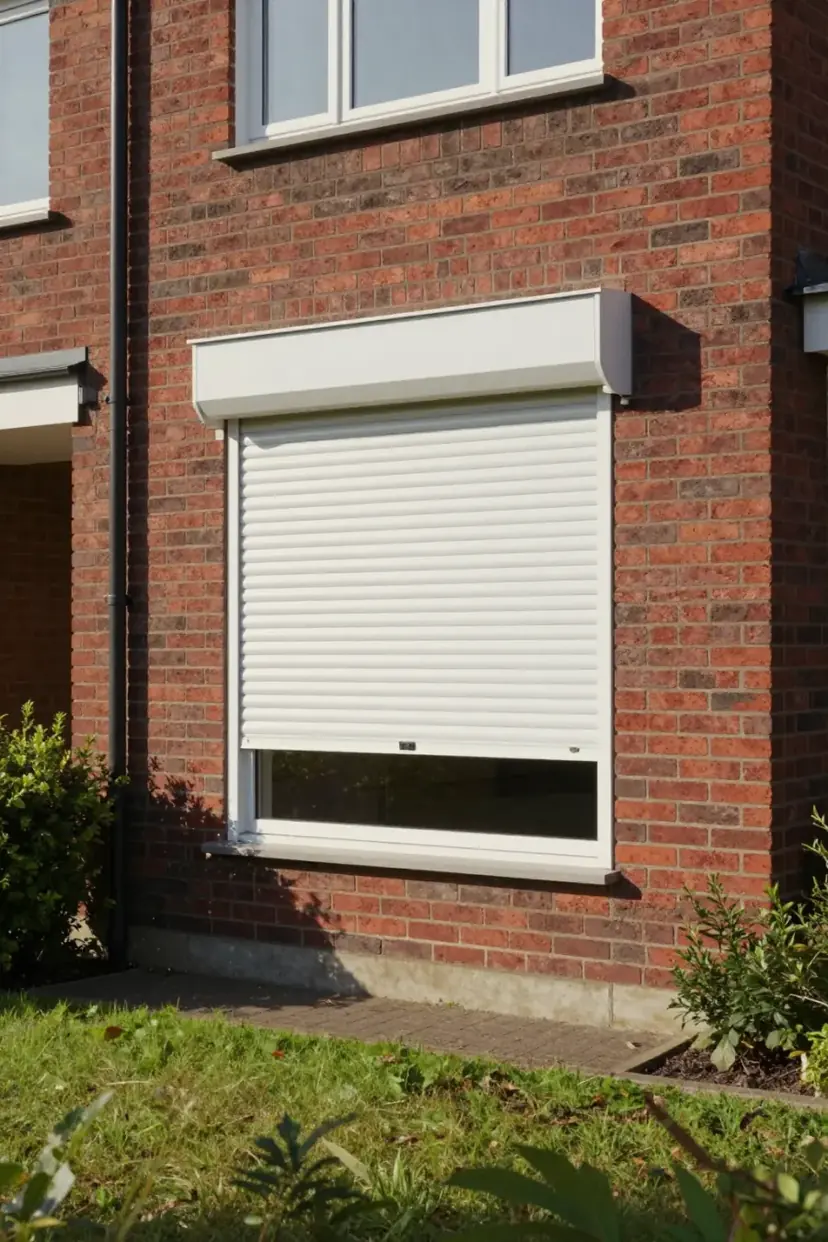
Installation on a finished facade almost always uses a surface-mounted housing box — why this is so and where the guide rails are fixed is covered in the answers to questions on this page. What matters for the order of works is something else: tiles, plaster and cladding are not removed, so there is almost no debris or dust in the sales area, and you don’t need to clear the entire shopfront display.
On acceptance, check three things: the curtain moves without jerking and doesn’t catch on the guide rails, the housing box is firmly fixed, and the lock and retainers work. And ask them to show you how the curtain is removed for servicing.
Pavilion made of sandwich panels
Roller shutters for retail pavilions are calculated separately: a pavilion has no load-bearing wall. Sandwich panels don’t carry load, and you can’t drive an anchor into them — fixing goes into the frame, into the posts and bracing behind the panel. Measuring the opening here comes down to finding the frame: the measurer looks at where the posts run and what their spacing is, and from that calculates the spacing of the guide rail fixings.
If the posts are awkwardly placed for the guide rails, the mounting assembly is selected separately, and this is also decided before the workshop: there are no ready-made items in Jalusso's stock, the set is made for the frame that is found.
Winter and summer: freezing, overheating and noise
Roller shutters for a shop do more than one job. During the day, a lowered curtain keeps prying eyes out of the sales area, reduces overheating of the shopfront and blocks street noise. But seasonal operation depends on how you treated the guide rails in autumn and what you managed to do on a frosty morning when there are only minutes until opening.
Winter: freezing up and temperature swings
In autumn, wipe the guide rails with a dry cloth and remove the sand that gets packed into the groove along with street dust. In winter, a clogged groove becomes a trap for moisture: condensation settles on the dirt, the night frost freezes it, and the slat jams solid. A clean groove and our seals keep the slats from freezing up more reliably than any lubricant over dirt.
If the curtain won’t move in the morning, don’t yank it with the crank handle and don’t pour water on the guide rails — it will freeze again, deeper in the groove. Let the ice thaw from the heat inside the premises or in the daytime sun and raise it smoothly. A jerk in freezing weather means a bent slat or a snapped chain, and that case is no longer covered by warranty.
What’s more, the Almaty winter with its day-to-night temperature swings tests the mechanism twice a day: during the day moisture gets into the housing box, at night it freezes. For an unheated opening — a cold vestibule or a pavilion without heating — we select the seals and gaps during the measurement.
Summer: overheating, dust and visibility
A solid curtain on the shopfront reduces overheating: the display doesn’t fade under the glass. A shop on the sunny side is a typical case where a perforated profile is chosen for airflow: the shopfront is ventilated through the holes and visibility is kept. The trade-off is known — perforation lets in dust and smog, and the curtain has to be washed more often.
At night, goods can be seen through a perforated curtain if the interior lighting is on. The shopfront keeps working for passers-by — for some that’s a plus. But for a shop in a residential building and a shop in a market, the opposite matters more, and there we install a solid extruded profile.
Stickers, prying from below and moving premises
Extruded aluminium is washed with a cloth and soapy water. Graffiti and stickers are removed with a mild solvent and a plastic scraper — a wire brush leaves scratches that dust then gets into.
People do try prying from below, but the curtain won’t be forced open: the guide rails are fixed into the load-bearing wall, the slats are held by retainers, and the lock works together with them. This holds true for the extruded profile, which is why for an unguarded shopfront we don’t recommend the lightweight foam-filled one — that’s for back-room windows.
When moving premises, the housing box, guide rails and curtain can be removed, but the new opening almost never matches the old one in size and fixing. Whether the old set will fit is decided by the measurer at the new site; reinstalling it yourself voids the warranty.
FAQ
Can a logo or advertising be printed on the roller shutter curtain? No, we do not offer photo printing, logos or advertising on the curtain. A shop window attracts passers-by in another way: during the day the curtain rolls up into the housing box and the facade stays clean. If you need advertising, it belongs on the sign above the entrance, not on the slats.
What happens to the roller shutters if the shop gets a new tenant? Who keeps the set is decided by the tenant and the property owner: the housing box and guide rails are fixed into the facade, and they can be removed, but it does not always come off without marks on the wall. If the set stays, the new tenant only needs to take the crank handle or the remote controls. On a new opening the old curtain rarely fits the size, so a measurer is called in for it.
Who is responsible for the keys and remote controls when there are several sales assistants? There is no single rule, and it is worth agreeing on this before installation, not after. With a mechanical curtain, access is via the crank handle; with an electric motor, via the remote control or a button; both are easy to hand over from shift to shift. The practice is simple: a shift leader is appointed, they keep the access, and the spare set is kept out of the sales floor.
How often do shop roller shutters need servicing? We do not have a separate service schedule, but with daily use the mechanism should be checked at least once a year: tightened, adjusted, the cord or chain replaced. We also come out after the warranty period — it is 3 years for the mechanism and 1 year for installation.
How does the housing box get along with the sign and the canopy? The housing box goes above the opening, which is exactly where the sign or canopy usually hangs. That is why the measurer checks their height and projection together with the opening: sometimes the sign has to be raised, sometimes the box is recessed into the opening. In a shopping centre, where the shop window sits inside a gallery, this is decided the same way — at the measurement.
In short: what matters for a shop
Shop roller shutters (that is what people often call rolleta) are chosen by how the shop stands on the street and what is visible from the pavement.
For a pharmacy or a boutique with open displays, extruded aluminium for the shop window and entrance is enough: the customer needs to see the goods through the glass, not through the slats. For a grocery shop at a market, where the facade is unattended at night, the same solid profile goes on both openings — visibility is not the priority there. If the shop window faces the sunny side and the goods need to be readable until closing, choose a perforated profile, but remember: it is less durable than the solid one. For a pavilion made of sandwich panels, discuss fixing into the frame straight away — whether the structure holds depends on it.
We advise against deciding remotely: a measurer comes with samples, you feel the slat and choose the control on the spot.

