

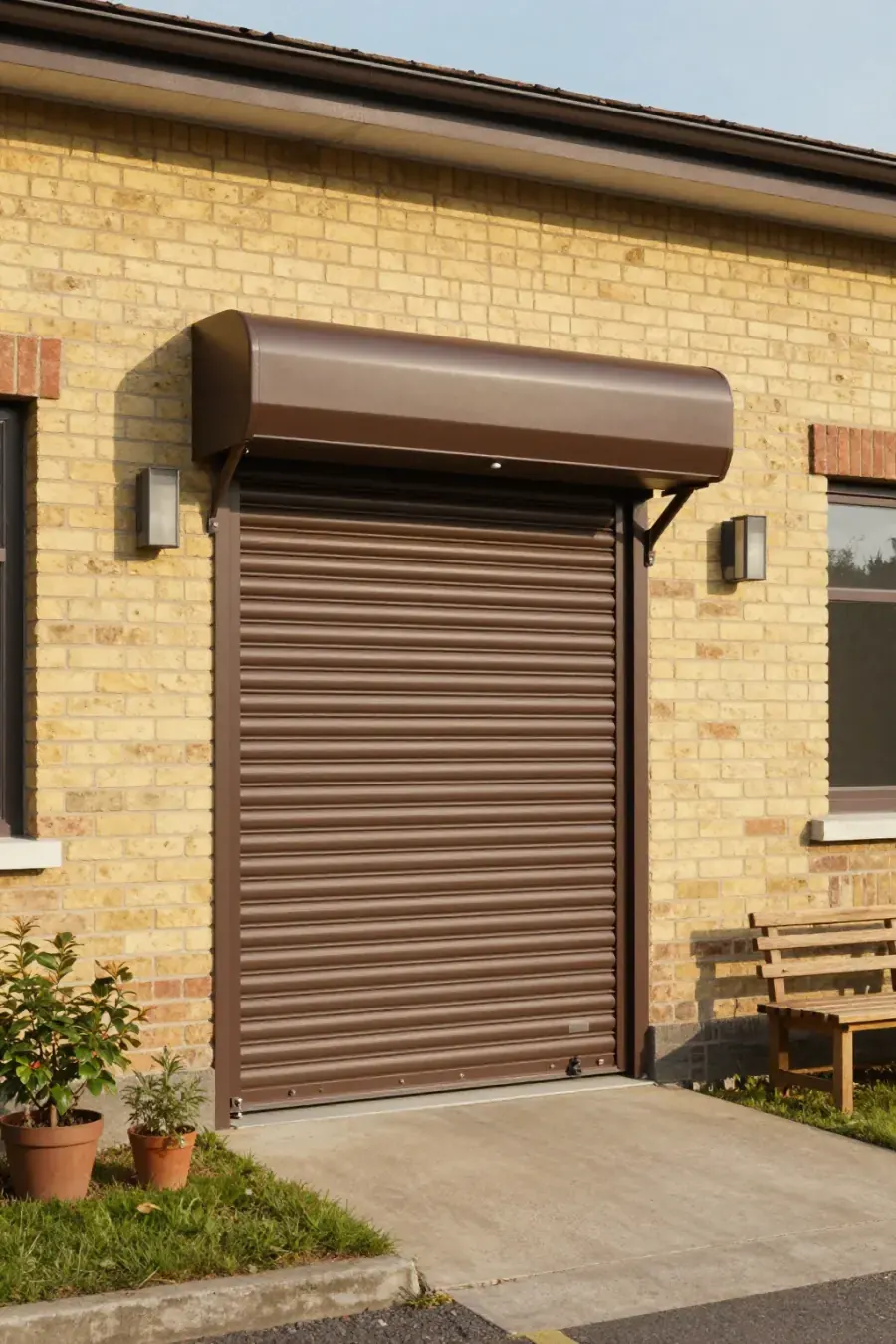


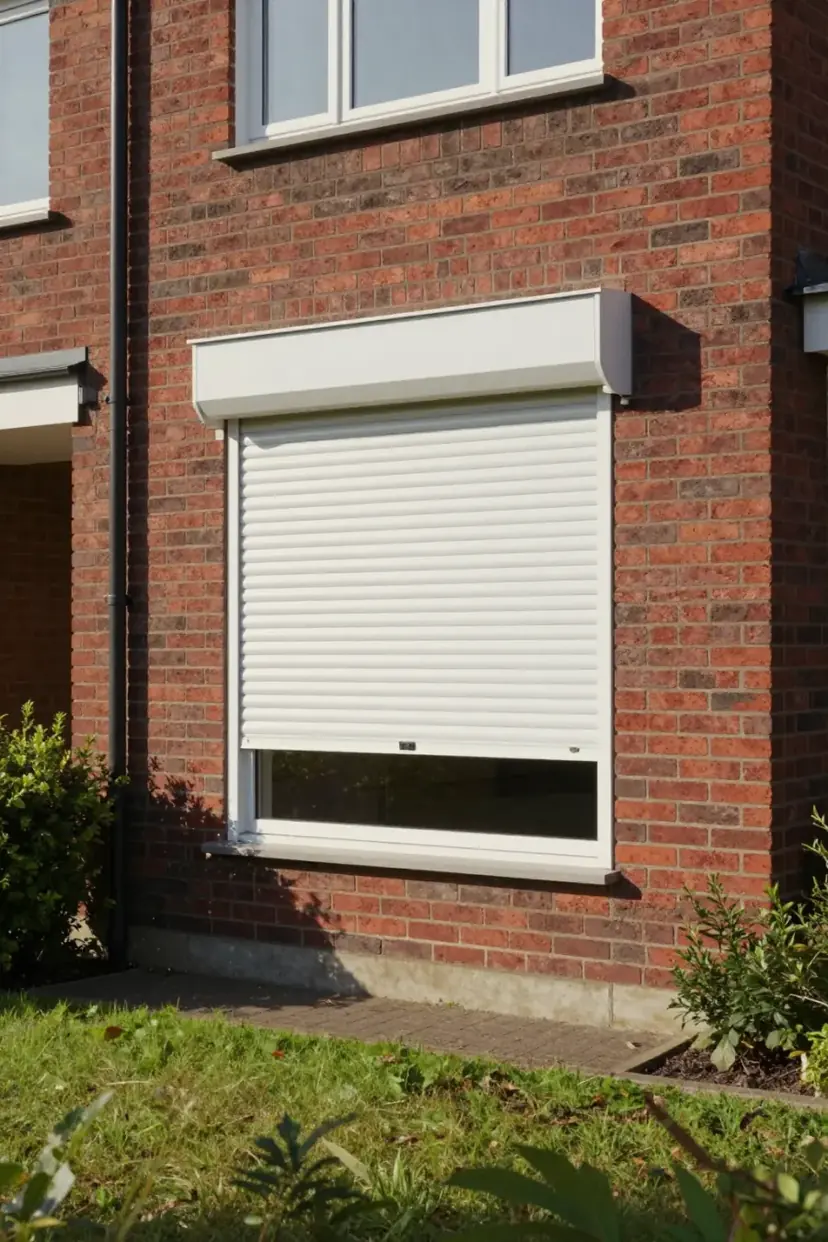


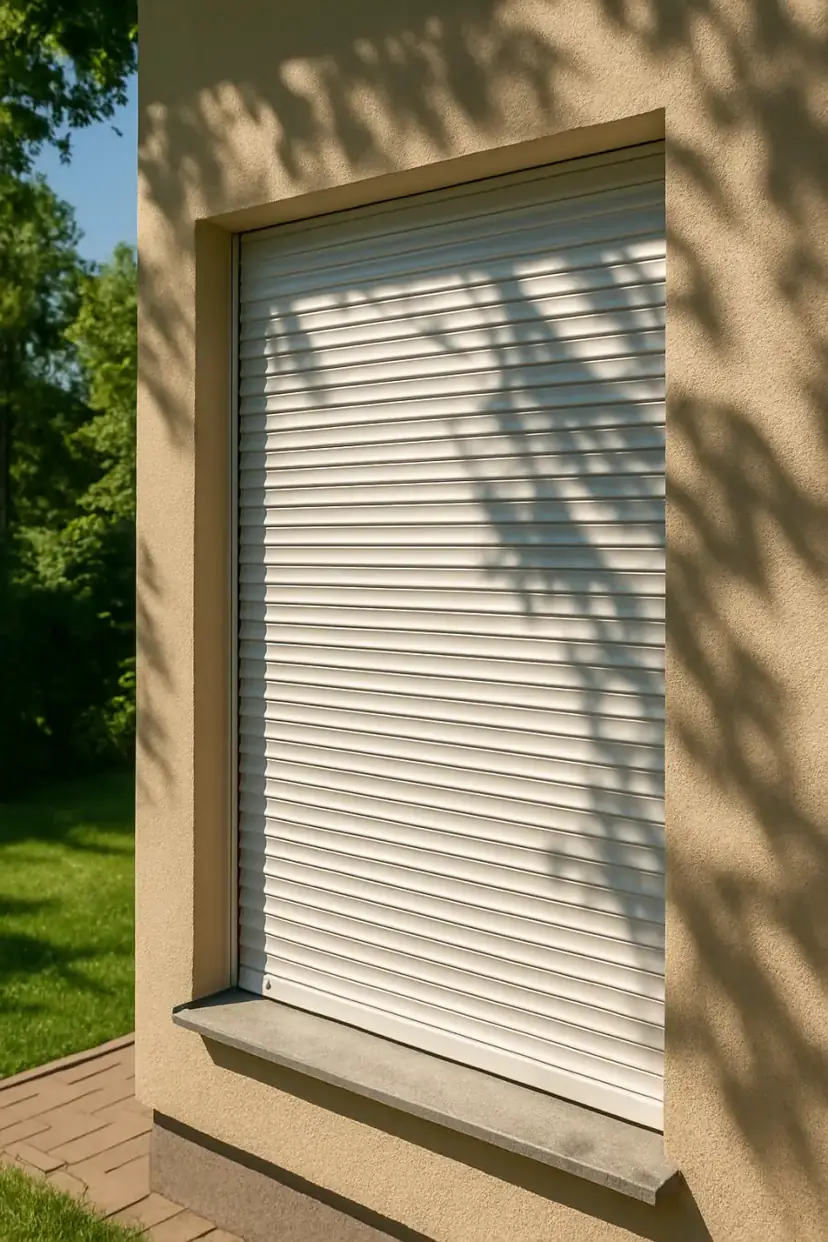











We manufacture internal roller shutters in Almaty to your measurements: the curtain rolls up into a housing box above the opening inside the room, and the controls stay within reach. Price — from 17,500 ₸/m², made in 10–14 days, installation 4,500 ₸ per unit. Our measurer comes with samples and checks on site how the structure will fit with the sash, windowsill and radiator.
What internal roller shutters are and how indoor installation differs from outdoor
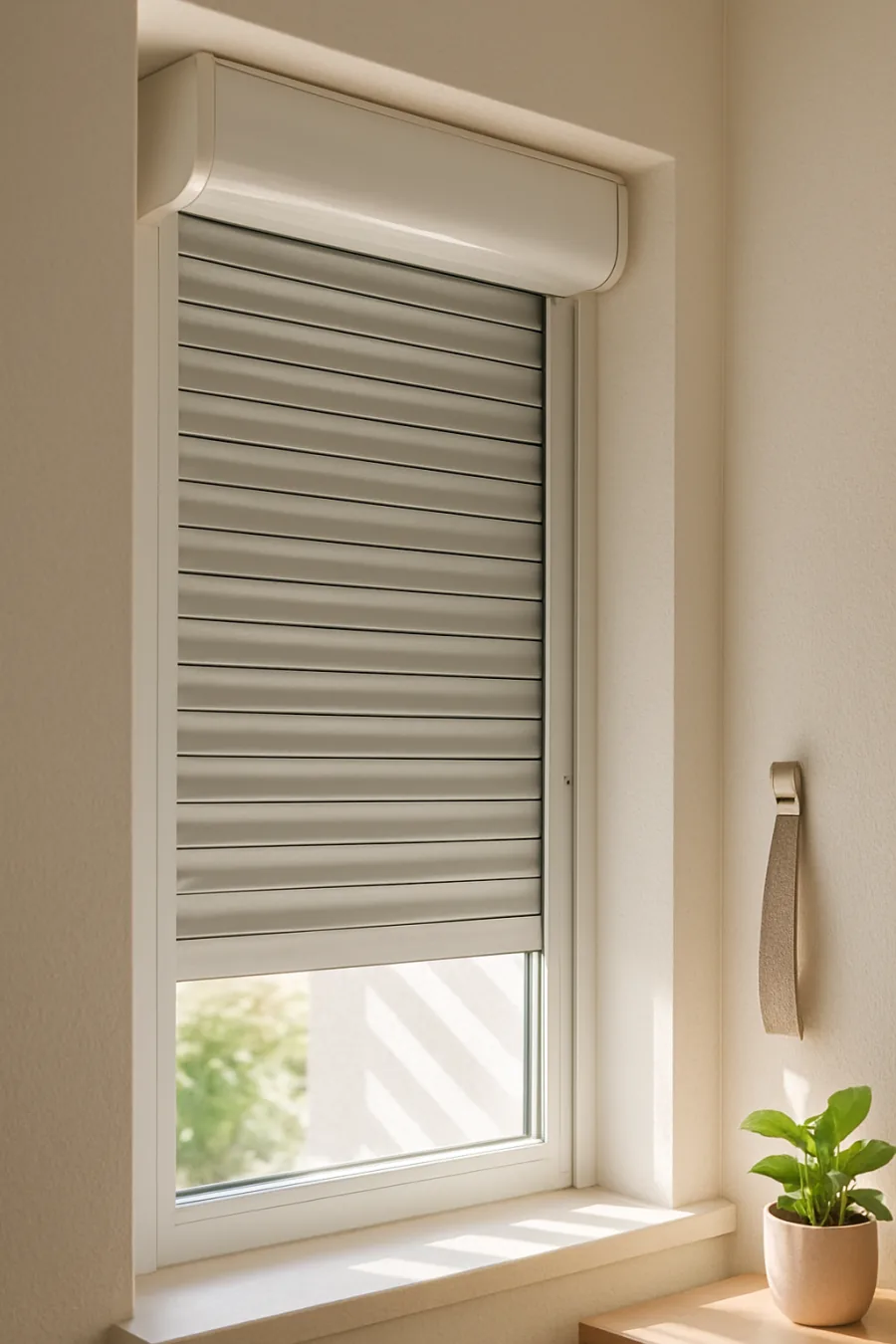
Internal roller shutters are a system where the curtain, housing box and guide rails sit inside the room, not on the facade. The curtain rolls up and disappears into the box above the opening. Indoor installation needs no facade work and no scaffolding. For an apartment on the fourth floor it is often the only option: outside there is simply nowhere and nothing to mount the system on.
What “inside” means
The box above the opening goes up, not to the side. So the windowsill and the approach to the window stay clear — nothing presses on them or hangs over them. The guide rails run along the sides of the opening, on the window reveal. The controls — a chain or a button — are also inside the room. Jalusso makes such roller shutters in Almaty to measure, all to the dimensions of your particular window.
Outdoor installation solves a different problem. There the system protects the glass from the street and often requires access to the facade, and sometimes lifting equipment. Indoor installation works from inside the room: the installer needs no facade, no neighbour below, no approval from anyone else.
Where sellers are not being straight
The system really does look like an outdoor one — the same profile, the same principle. But indoor installation has different tasks. Three things are decided on site, not in a catalogue: access to the window reveal, the free swing of the sash and servicing the system from inside the room.
The sash is the main thing. If the window has to open fully, the guide rails are set beyond the sash, otherwise the blind will hit the handle. You can only see this on the window itself.
And here is what matters: when people say “the only difference is which side it is installed on”, they leave out the most important part. Internal roller shutters live inside the warm envelope, and that changes how they behave in winter. But more on that below.
How internal roller shutters are mounted and whether they get in the way of opening the window
Internal roller shutters are mounted to the window reveal, the wall or the frame — the option is chosen during measurement, and it determines whether the sash keeps its free swing. The box above the opening goes up, not to the side, so the windowsill and access to the radiator stay clear. Internal roller shutters for windows differ from outdoor ones in exactly this: the fixings and guide rails are inside the room, and anything that gets in the way of the sash or handle is sorted out at measurement, not by redoing the job after installation.
Three mounting options
An internal roller shutter kit consists of four structural elements: the box above the opening, two guide rails, the curtain and the control mechanism. The box covers the curtain at the top, the guide rails guide it at the sides, and it is they that determine how freely the sash swings.
The mounting option is chosen on site:
- To a load-bearing wall — the most rigid option, but it needs a level surface and enough depth.
- To the side of the window reveal — an option for a finished renovation, when the reveal is already decorated and you would rather not drill into the wall.
- To the frame — when the reveal is too narrow, but the frame has to carry the weight; with extruded aluminium this is already critical.
The same opening may allow two options — then the measurer decides together with you. Internal roller shutters for windows are also fitted to panoramic glazing: there the guide rails are set so that the sash does not catch the curtain when it opens.
Sash, vent, handle
The main thing the measurer checks is the size of the sash, not the thickness of the box. The box above the opening can be recessed into the reveal or made narrower, but the sash cannot be moved: its hinges and swing are set by the frame. So if the window has to stay openable, the guide rails are set beyond the sash — then it opens into the room and does not hit the blind. The vent and the handle are checked separately: the handle is sometimes replaced with a low-profile one, otherwise it catches the guide rail. There is a second way, too — leave the sash fixed and use the door to get into the room, but that is a different window in terms of function. The practice is simple: Kirill, our lead measurer, comes out and shows you on site where the guide rails will sit and how the sash will open. In terms of height, the box above the opening almost always fits between the top of the window and the ceiling or reveal; we do not touch the threshold or the windowsill, and access to the radiator stays clear.
The windowsill and radiator stay clear, the box goes up, and the free swing of the sash is set by the guide rails placed beyond it — and all of this is decided at measurement, not from a photo.
Burglar protection or just protection from the sun and prying eyes
Internal security roller shutters for windows give real protection, but they do not turn a window into a safe. Protection comes from the profile, the roller shutter locks and the guide rails being fixed into a load-bearing wall — and only all three together give a result. Where the curtain sits is secondary here. The curtain is inside the room, and a burglar still ends up at the glass on the outside first.
What does that mean in practice? The glass remains the first barrier, and it is fragile. While a burglar is working on it, he is making noise — and a closed blind amplifies that noise and stops him from quickly swinging the sash open and climbing in. Time and noise are what the system adds. Let me be blunt: we will not sell indoor installation as full burglar resistance for a window.
What an internal blind does and does not give you
It gives you: the roller shutter lock holds the curtain down, the guide rails stop the slats being bent to the side, and the foam filling deadens the sound of an attempt. It does not give you: a replacement for a grille, outdoor roller shutters or security — the glass is still the first thing a burglar meets.
The comparison is simple. An outdoor blind meets a burglar before the glass, an indoor one after. So for a ground-floor window with no security the difference is noticeable, while for a fourth floor with a closed courtyard it hardly matters.
When to choose extruded
Extruded aluminium is a heavy slat that cannot be prised open with a crowbar. It is the option for a ground floor with no security, where the window faces a courtyard or the street. The profile is more expensive than the base option, with a manufacturing time of 12–16 days.
We also cover a balcony door-window with extruded: the blind there is long, and a soft slat is easier to pry up from below. And fixing the guide rails into a load-bearing wall matters more here than the profile itself — a weak fixing point cancels out any slat.
The protection of internal roller shutters comes from the profile, the locks and the guide rails being fixed into a load-bearing wall, and whatever the setup, a burglar ends up at the glass outside first, not at the curtain.
What the price is made up of and how much installation costs
The price of internal roller shutters for windows is based on four things: the area of the opening, the profile, the type of control and the mounting method. The base option is from 17,500 ₸ per m², installation is 4,500 ₸ per item, and for orders from 150,000 ₸ installation is free.
The area of the opening is taken not by the glass but by the size the blind covers. The wider and taller the window, the more metal goes into the slats and the box — hence the difference between a kitchen window with a vent and a full-height balcony door-window.
| Profile and configuration | Price from, per m² | Manufacturing time |
|---|---|---|
| Roller shutters on windows, roll-formed foam-filled profile, mechanical mechanism included | from 17,500 ₸ | 10–14 days |
| Security, extruded aluminium | from 24,900 ₸ | 12–16 days |
| Perforated, profile with perforation | from 27,800 ₸ | 12–16 days |
| With electric motor | from 35,000 ₸ | 14–18 days |
Control and installation are calculated as coefficients to the base price. Manual — ×1.0, chain — ×1.06, electric motor — ×1.85, electric motor with remote control — ×2.1. The mounting method also affects the price: wall — ×1.0, frame — ×1.05, installation without drilling — ×1.1, cassette option — ×1.28. An electric motor with remote control comes out almost twice as expensive as manual — that is where the gap between 2.1 and 1.0 comes from.
Why internal installation is not automatically cheaper than external
I consider this the most common misconception during measurements. The client is sure: since the structure is inside, there is less work and the price is lower. In fact, the cost is determined not by the side of installation, but by the mounting method and the configuration. Frame mounting requires a coefficient of 1.05 to the base price, drilling-free mounting — 1.1, and a cassette system multiplies the cost by 1.28. None of these coefficients depends on which side of the window the blind is on.
There is no saving on external installation either — it has its own difficulties: scaffolding, working at height, fastening to the facade. So you should choose between internal and external based on the task, not the price. If you want to reduce the estimate, look at the profile and controls, not the side of the window.
The price consists of the area, profile, controls and installation method; the base position is from 17,500 ₸/m², installation is 4,500 ₸ per unit, and for orders from 150,000 ₸ installation is free.
Can you do without drilling the frame and chasing the window reveal
Yes, you can. Internal roller shutters for windows are installed without drilling the frame if drilling-free mounting is chosen: it comes with a coefficient of 1.1 to the base price. The window reveal also remains intact with the surface-mounted option — it does not need to be chased, because the housing box sits on top of the finish. The logic is simple: the fasteners go not into the plastic, but into the window reveal or the wall, and the frame keeps its integrity.
What does drilling-free mounting give in practice? It allows roller shutters to be installed on a non-drillable frame — for example, when the window was recently replaced and you don't want to drill the profile. The measurement determines the mounting method and compatibility with the sash: the measurer looks at where the fasteners can actually go and whether the sash will still open freely. And this is not a compromise for the sake of saving — just a different mounting assembly.
Checklist in order.
- We check if the renovation is finished. If the window reveal is already finished and you don't want to touch it, we go with surface-mounted installation.
- We check the frame. If drilling is impossible or undesirable — we take the drilling-free option, coefficient 1.1.
- We calculate the sash dimensions. Opening must remain free, otherwise we move the mounting.
- We clarify whether a built-in option is needed. It requires space in the window reveal, but the housing box sits flush with the finish.
- We decide on summer removal. If you plan to remove and reinstall the structure, the fasteners are selected so that no rework is needed.
Surface-mounted or built-in
Surface-mounted installation is placed over the window reveal. It suits a finished renovation: no chasing, no dust, no dismantled finish. Built-in installation looks neater — the housing box is recessed into the window reveal — but it needs space that is simply not available in an already finished opening. There is also a third option: a cassette system multiplies the cost by 1.28 and gives a neater assembly when the geometry of the housing box matters. In my opinion, for a finished renovation the surface-mounted option more often wins precisely because it does not touch what you have already done.
Summer removal
A rented apartment and the desire to remove the structure for the warm season — this is solved by fasteners, not by force. At the measurement you need to say directly: the blind will be removed and reinstalled. Then the specialist selects fasteners so that the structure can be removed and put back without rework. You should not reposition the assemblies yourself — that is already outside the warranty.
Drilling-free frame mounting and the surface-mounted window reveal option are two independent solutions, and both are available for a finished renovation.
Which profile to choose: roll-formed foam-filled, extruded, perforated
The choice of profile for internal roller shutters is decided by three things: the weight of the curtain, the light requirement and how serious a barrier you want. Roll-formed foam-filled profile is chosen for apartments and living rooms — it is light, quieter in operation and costs from 17,500 ₸/m², manufacturing time 10–14 days. Extruded aluminium is a heavy slat that cannot be bent with a crowbar; it is installed on the ground floor without security, takes 12–16 days to make and costs more than the base position. Perforated profile has holes along the entire slat, so the room is closed but not darkened; price from 27,800 ₸/m², time 12–16 days.
Three positions side by side so you can see the difference in light, price and time:
| Profile | Light in the room when closed | Price per m² | Production time | Where we install |
|---|---|---|---|---|
| Roll-formed foam-filled | completely dark | from 17,500 ₸ | 10–14 days | apartment, bedroom, room from 2 floor |
| Extruded aluminium | completely dark | from 24,900 ₸ | 12–16 days | ground floor without security, shop window |
| Perforated | diffused light passes through | from 27,800 ₸ | 12–16 days | kitchen, study — close but not darken |
What each position gives:
- Roll-formed foam-filled profile. Foam inside the slat, hence the low weight and smooth operation. The foam filling reduces street noise by about 2–4 dB — this is not silence, but the background from the street is noticeably more even.
- Extruded aluminium. A solid heavy slat without filler. Extruded aluminium is suitable for the ground floor without security: the blind is stiffer and withstands impact instead of bending.
- Perforated profile. Holes through the body of the slat. Perforated profile lets light and air through when closed, so it is often chosen for the kitchen and study, where what is needed is not darkness but a closed sash.
Jalusso usually advises against extrusion for a bedroom on a quiet street — it is an overpayment for stiffness that does not solve anything there. The question of light is decided once: an opaque slat darkens the room completely, even during the day you will have to turn on the light; perforation does not do this.
How much light remains in the room
An opaque profile darkens the room completely, perforation does not. If the window faces the sunny side and you work at a desk by the window during the day, the perforated profile leaves diffused light and at the same time screens the room from prying eyes. The opposite case is just as clear: in a bedroom on the sunny side, perforation will not give the darkness for which the blind is installed — there you need an opaque profile.
Light and noise decide the choice of profile more than the side of installation: foam filling reduces street noise by about 2–4 dB, and perforated profile lets light and air through when closed.
Mechanics, chain or electric motor with remote control
Internal roller shutters can be automated: an electric motor is installed in the roller tube inside the housing box, and control goes to a remote. The question is not whether it is possible, but whether the extra payment pays off on your particular window. Let's count honestly. Mechanical control comes with a coefficient of 1.0 — this is the base price level. A chain adds 1.06 to it: the same mechanics, but with a chain drive that is easier to reach. An electric motor multiplies the cost by 1.85, and an electric motor with remote control by 2.1. The difference between a sash you open by hand and a button on a remote is noticeable.
Manufacturing time is also different. A set with a motor is assembled in 14–18 days, while mechanics on a roll-formed foam-filled profile is ready in 10–14 days. A motor is not just a motor in the roller tube, it is also a control unit, limit switches and power wiring, hence the longer time.
Where automation is justified
Where you cannot reach the chain or do not want to reach for it. A tall opening, a full-height window, panoramic glazing in an office — with a remote the blind goes up and down with one press, not ten turns of the chain. The second case is a window behind furniture: a sofa, shelving or desk is positioned so that access to the chain is blocked. The third is several openings in one room that you want to close at once.
But in a bedroom on an ordinary window, where your hand reaches freely, paying 2.1 times as much rarely pays off. This is my personal assessment from practice: most often automation is chosen not for everyday convenience, but for one or two windows where mechanics are physically inconvenient.
An electric motor with a remote control costs almost twice as much as a manual one — a coefficient of 2.1 versus 1.0 — and a set with a motor takes 14–18 days to manufacture.
How the measurement works and what the measurer checks
We make internal window shutters only to measure — we don’t keep ready-made ones in stock, every product is made for a specific opening. Measurement and consultation are always free: the measurer comes with samples of profiles and controls, examines the window and calculates the price on the spot. This is not a formality. The mounting method and whether the sash can stay hinged both depend on what he sees.
The measurement determines the mounting method and compatibility with the sash — that is the main result of the visit, not just the dimensions taken. Here is what the measurer checks:
- The dimensions of the sash and its free movement. If the window needs to open, the guide rails are moved beyond the sash dimensions, otherwise the blind will hit the frame.
- The window reveal: its depth and evenness. This is where we decide whether the housing box can be mounted on the surface or recessed, and whether it will interfere with a finished renovation.
- The load-bearing wall next to the opening. The guide rails are fixed to it where rigidity is needed.
- The windowsill and the radiator. The housing box goes upward, not to the side, so access to the window and radiator usually stays open — but this needs to be checked before manufacturing, not after.
- The frame material. It determines whether drilling is possible or the mounting is done without drilling.
- The vent and the handle: the sash movement and the turning mechanism must not catch on the guide rails.
The housing box is fixed to the window reveal, the wall or the frame — three options, and the measurer chooses between them based on the actual window, not a photo.
What to prepare before the measurer arrives
Clear access to the window and take down heavy curtains — the measurer needs to see the window reveal and the frame in full, not by touch. Decide in advance whether the sash should stay hinged: if so, the structure will shift relative to the opening, and it’s better to discuss this before the quote. If the renovation is already done, say so right away: then we consider a surface-mounted option without wall chasing.
Area
Almaty is our main city: measurement and delivery within the city are free. We travel to the suburbs — Kaskelen, Talgar, Issyk, Kapshagay — and the cost of the visit depends on the distance and is quoted before the visit, before you decide anything.
Jalusso consultation and measurer’s visit are free on any day: he brings samples with him and gives you the price right at your home.
Light, quiet and winter: what happens in the room when the blind is closed
Internal protective roller shutters for windows sit in the warm contour of the apartment, so ice build-up and the curtain freezing to the frame — familiar to owners of external structures — don’t happen: the curtain doesn’t come into direct contact with the outdoor frost. External installation looks different in winter — the slats freeze over, and in the morning the curtain has to be pulled off the guide rails. With internal installation, this problem doesn’t exist by the very design of the setup.
What really changes in the room when the blind is lowered is light, noise and air. Let’s go through it point by point.
- An opaque profile blocks light completely: during the day the room is as dark as late in the evening, and you’ll have to turn on the light even to read.
- A perforated profile lets in light and air: the room doesn’t get dark, but it also doesn’t give full isolation from the street.
- Foam filling reduces street noise by about 2–4 dB. That’s a noticeable improvement if the window faces a noisy street, but it’s not studio silence.
- In winter, the blind in the warm contour works as an additional barrier between the room and the cold glass.
Ice build-up deserves a separate mention. With external structures it appears on the slats and in the guide rails, but with internal ones this scenario is impossible — the frost simply doesn’t reach the curtain. That’s exactly why internal protective roller shutters for windows are more often chosen for bedrooms and kids’ rooms: in the morning you don’t have to deal with a frozen mechanism.
How dark is the room during the day when the blind is closed? It depends on the profile. Opaque roll-formed foam-filled or extruded aluminium gives full blackout, while the perforated option keeps the room lit.
About saving on heating
We don’t claim heating savings in percentages. They depend on the quality of the window itself, the walls and the heating system of a particular home — promising percentages without knowing these parameters would be dishonest. The blind in the warm contour works as an additional barrier and reduces losses through the glass, but only a calculation for your apartment can give a specific figure.
Dust in the housing box
The housing box inside the room is part of the interior, not a hidden cavity: it’s visible, and when cleaning you can easily reach it with an ordinary cloth or a vacuum cleaner with an attachment. Dust collects in the housing box just like on a windowsill or window reveal — that is, exactly as much as you collect if you don’t clean. There’s no hidden accumulation like in a ventilation duct.
The internal blind sits in the warm contour and doesn’t freeze like an external one, and the foam filling reduces street noise by about 2–4 dB.
Caring for a blind that’s always in sight
Internal roller shutters are cleaned with a dry or slightly damp cloth along the slats, without abrasives or solvents. The curtain sits in the room, not outside, so it has neither street dust from the road nor traces of rain — a regular cleaning once every couple of weeks is enough. A curtain that’s always in sight in the room does need care, but it’s simpler than it seems: this is not a facade structure that you still have to get to.
The process is as follows:
- Lower the blind completely and run a soft cloth along the slats from top to bottom.
- Stubborn marks — for example, fingerprints near the chain handle — wipe with a damp cloth and let dry.
- Wipe the guide rails along the groove so that dust and small debris don’t build up in them.
- The housing box above the opening — with a dry cloth or a soft vacuum attachment.
- Once a season, check the movement of the blind: it should raise and lower evenly, without jerking.
A perforated profile requires the same, and the only subtlety is not to scrub the holes with a stiff brush: dust from the perforation is blown out with a vacuum cleaner on low power or washed off with a damp cloth. As for the mechanism, the warranty covers it for 3 years, and installation for 1 year from the date the acceptance report is signed. And we also come after the warranty: to tighten, adjust, replace the cord or chain. If the product has mechanical damage, was reinstalled by hand, got wet or the fabric has faded naturally — warranty obligations don’t apply to such cases.
In my opinion, the fear that “every speck of dust will be visible inside” is overblown: in a year of working with internal structures, we more often hear the opposite — that the housing box is easier to reach than an external one.
Surface-mounted or built-in installation
Surface-mounted installation places the housing box over the window reveal. Recessed installation sinks it into the reveal. The only difference is how much space you are willing to give up for the structure and how neat it needs to look in the room.
The surface-mounted option is chosen more often. It does not require chasing the reveal, does not disturb a finished renovation and does not force you to redo the reveal after installation. The housing box does protrude into the room — surface-mounted installation honestly takes up its place in the interior, but it is easier to remove and put the structure back.
Recessed installation sinks the housing box into the reveal, and only the guide rail is visible in the room. For this neatness you have to prepare the reveal in advance: if the renovation is already done, recessed installation will require opening it up. Customers who are starting their finishing work from scratch usually choose this option, but in an apartment with a finished renovation we almost never suggest it.
There is a third way — the cassette system. It increases the cost by a factor of 1.28: the cassette covers the fabric and the housing box with a neat casing, and indoor roller shutters in this version look more put-together than a surface-mounted box without a casing. At the same time, indoor installation does not require opening the facade or scaffolding in any of the three options — the facade stays untouched.
What decides the choice? The condition of the reveal and how important it is for you to keep the housing box out of sight. If the renovation is done and the box does not get in the way — surface-mounted. If the reveal is still being prepared for finishing — recessed or cassette.
Surface-mounted installation goes over the reveal and does not require chasing, recessed installation sinks the housing box into the reveal, and the cassette system comes with a factor of 1.28.
Who indoor installation suits: apartment, kitchen, kids’ room, study, panoramic window
Indoor roller shutters on windows solve different problems — and the room matters more here than which way the window faces. A bedroom on a noisy street. A kids’ room on the sunny side, where the room heats up by midday. A kitchen where you want to close the window from prying eyes without going out into the yard. A study where the sun shines straight onto the monitor. A living room in a private house without security. A balcony door-window where the shutter rolls upward and does not block the passage. And a window above the canopy — you cannot reach it from outside, but from inside it closes in the usual way.
Let’s go through the situations, because there is no universal answer.
Bedroom and kids’ room. On a noisy street, foam filling does the job: it cuts street noise by about 2–4 dB. On the sunny side, the density of the fabric matters more — an opaque slat keeps the room dark while you sleep or put a child down for a nap during the day.
Kitchen. Here people more often choose a perforated profile: it lets in light and air when closed, so the room does not get dark and stuffiness from cooking does not build up. The fabric stays in place — nobody has cancelled ventilation through the sash.
Study. Perforation helps when the sun is bright outside and you need to work all day: the room does not turn into a dark room, but direct light does not fall on the desk. In my opinion, for a workspace this is noticeably more convenient than a dense slat.
Living room in a private house without security. Extruded aluminium is appropriate here — a heavy slat that cannot be pried open with a crowbar. It is more expensive than the base option, manufacturing takes 12–16 days, but a ground-floor window gets a serious barrier.
A balcony door-window and a window above the canopy are exactly the openings where outdoor installation is problematic: you cannot get to the canopy, and on a balcony door the structure outside gets in the way of going out. From inside, both situations are solved without scaffolding.
Panoramic glazing and non-standard openings
A full-height panoramic window — yes, indoor installation suits it. The housing box goes upward, beyond the glazing dimensions, and does not block the view from the room: the fabric rises to the ceiling line and stays there. For wide openings we calculate several sections, and we bring the controls to wherever is convenient to reach — on a panorama, a chain in one corner is inconvenient, so here we more often discuss an electric motor.
Arched, triangular and mansard windows are calculated separately; they have their own cutting and their own mounting. Lead measurer Kirill has worked with such windows for 9 years, and sun-protection engineer Yerlan has handled panoramic glazing and commercial properties for 7 years — for a non-standard opening we bring both in for the measurement.
Radiator and windowsill in a real room
The housing box above the opening goes upward, not to the side, so the windowsill and access to the radiator stay clear. Indoor window shutters do not block the radiator and do not get in the way of reading the meter or washing the windowsill. The only thing the measurer checks in advance is the height from the top of the opening to the ceiling or to the reveal: the housing box needs space, and on a window with a narrow wall section this is solved with surface mounting.
Indoor installation suits both an apartment and a private house — what matters is not the room, but how a specific window will work with the housing box, the sash and the windowsill.
Questions we get most often
Short answers to what people ask before the measurement. They all rely on the facts already covered above, so here it is just the condensed form.
Will the housing box above the opening get in the way of opening the sash?
The housing box above the opening is positioned so that it does not block the sash’s movement. If the window needs to stay openable, the guide rails are moved beyond the sash dimensions — then the fabric passes by it. This is exactly what the measurement determines first: the mounting method and compatibility with the sash. If the window is fixed or opens outward, the question goes away by itself.
Will the room stay light with perforation?
Yes. A perforated profile lets in light and air when closed, and the room does not turn into a dark room. An opaque profile darkens it completely — the choice here is clear-cut, with no middle ground.
Can indoor roller shutters be installed on windows without drilling the frame?
Yes. Installation without drilling comes with a factor of 1.1 to the base price, and the cassette system with a factor of 1.28. We select the mounting method for the frame: in some cases a surface-mounted option on the reveal works, in others mounting to the wall.
Does the fabric freeze to the window in winter?
No. The indoor fabric sits in the warm contour and does not freeze like an outdoor one: it does not come into direct contact with the outdoor frost. The temperature difference between day and night in Almaty does not affect the fabric inside the room.
What does the price per m² depend on?
The price per m² is calculated from the area of the opening, the profile, the controls and the installation method. Roll-formed foam-filled profile — from 17,500 ₸/m², extruded aluminium — from 24,900 ₸/m², perforated — from 27,800 ₸/m², a set with an electric motor — from 35,000 ₸/m². A chain gives a factor of 1.06, an electric motor with a remote control — 2.1.
Does it need special care?
No, the fabric does not require separate maintenance. The mechanism is covered by a warranty for 3 years, installation for 1 year, and after the warranty we still come out: to tighten, adjust, replace the cord or chain.
This list could go on forever — in practice, the fastest way to settle the question about the sash and the windowsill is a measurer with samples right at the window. The answers on this page give a general guide, but the specific window is still what decides the measurement.
What to remember
Indoor roller shutters in Almaty do not require opening the facade or scaffolding. The housing box above the opening is installed inside the room, the fabric goes upward, and no outdoor work is needed. For a house where the facade cannot be changed or the renovation is already done, this is the only way to install the structure without permits and without construction equipment in the yard.
Whether the blinds fit with the sash, windowsill and radiator is decided at the measurement, not in a chat. It is the measurer who determines whether the window will keep the sash's free swing, where the guide rails will go, and whether the blind will hit the reveal. If the sash has to stay openable, the guide rails are moved beyond its dimensions — otherwise the window simply stops opening.
Protection comes from the profile, the locks and the fastening of the guide rails into the load-bearing wall, not from where the blind sits. A burglar still reaches the glass from the outside first. A foam-filled roll-formed profile is quieter and lighter, extruded aluminium cannot be pried open with a crowbar, and a perforated one lets light and air into the room. A lock buys time, fastening into a load-bearing wall adds strength. Only together do these things mean anything.
The price depends on the opening area, the profile, the controls and the installation method. The base price is from 17,500 ₸/m². An electric motor with a remote control is almost twice as expensive as a manual one. Installation on the frame adds a factor of 1.05 to the base price, no-drill installation — 1.1, a cassette system — 1.28. We charge 4,500 ₸ for installing each unit, but if the order total reaches 150,000 ₸, installation is free.
The practical advice is simple: if you are choosing internal roller shutters in Almaty, message us on WhatsApp and call a measurer. He will come with profile samples, check the reveal, the sash, the windowsill and the radiator, and calculate the cost on the spot. The measurer will come and explain everything free of charge, and delivery within the city is free too.

