







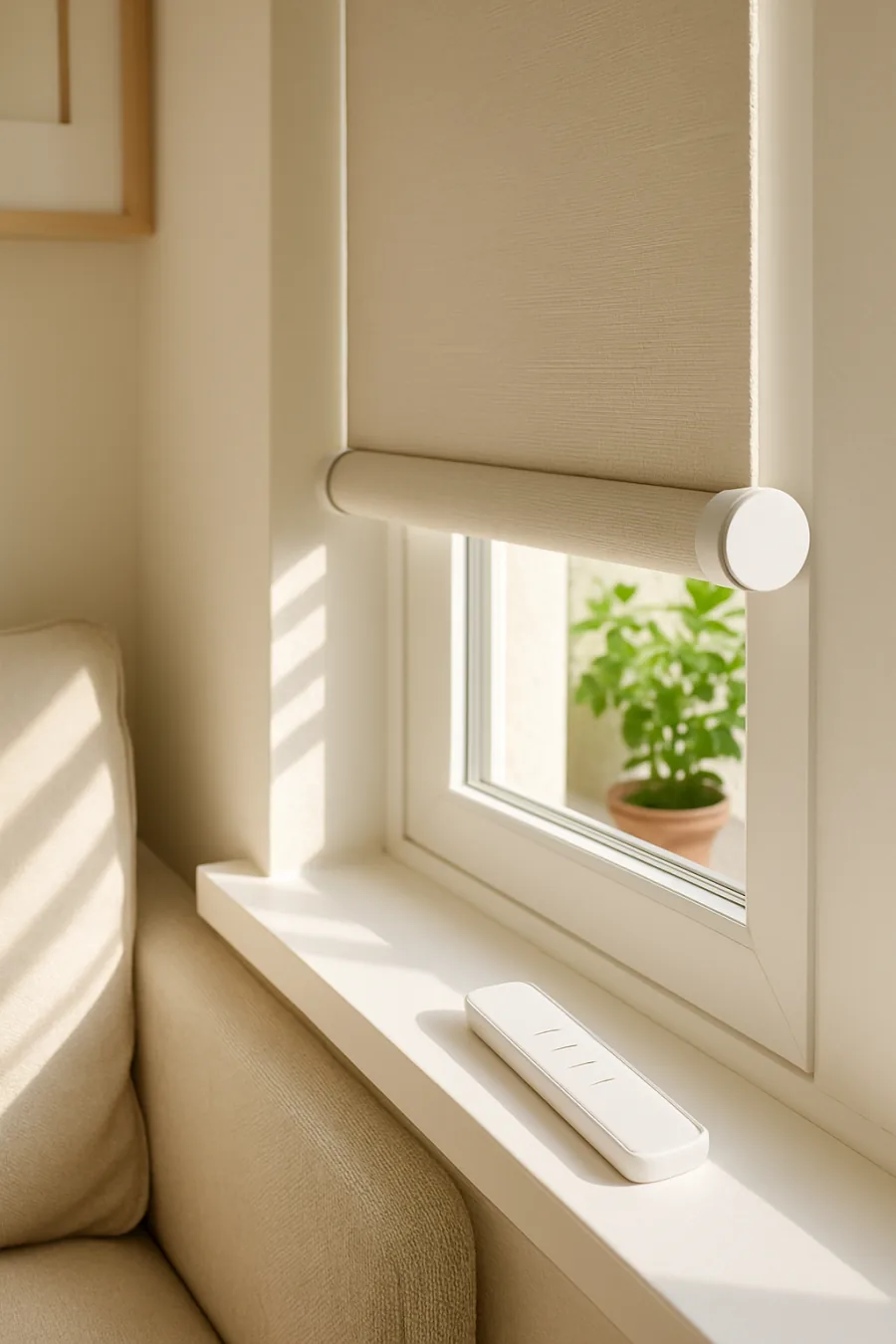


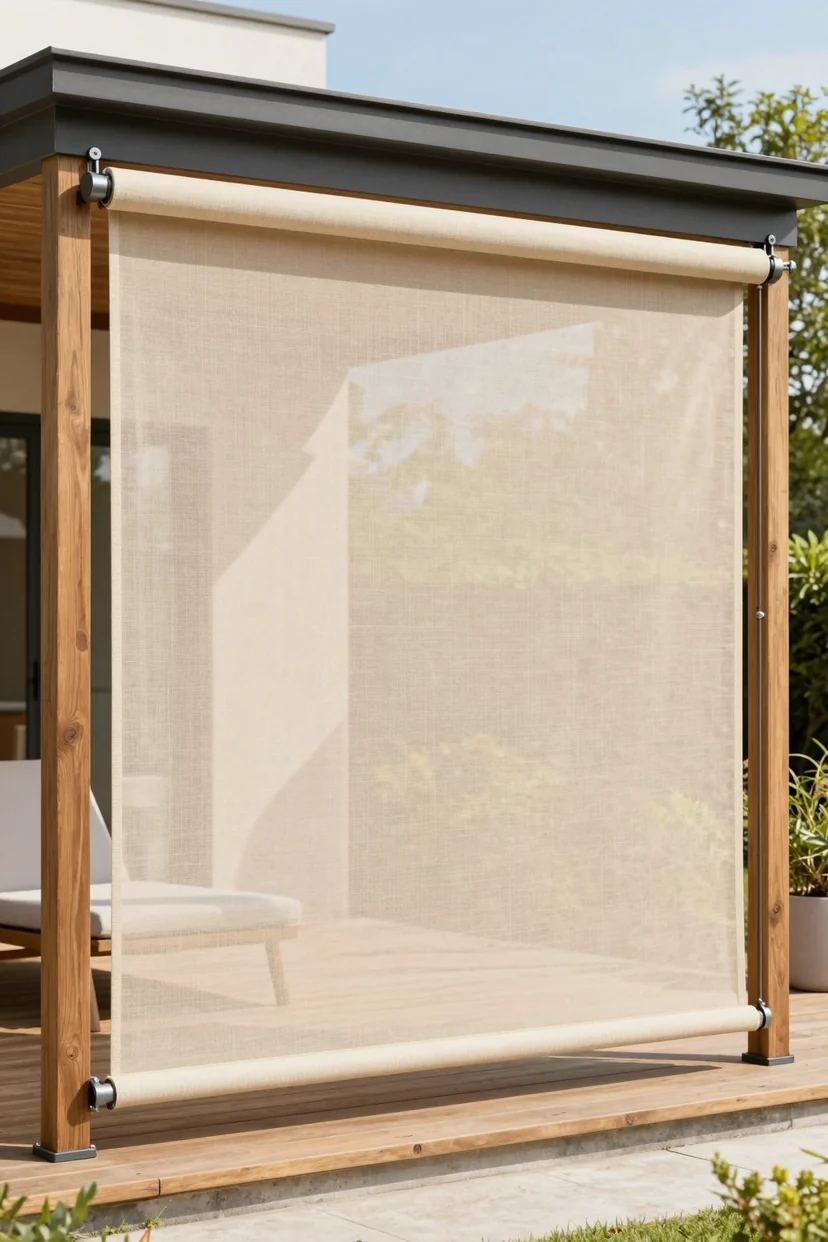














We make spring roller blinds in Almaty to measure in our own workshop: the fabric is lifted by a steel spring inside the tube, controlled by hand using the handle on the bottom bar, with no side chain. Price — from 5,400 ₸/m², lead time 4–6 days, 3-year warranty on the mechanism. A spring is not suitable for every window — the measurer determines the limit.
How the spring mechanism of a roller blind works
The fabric of a roller blind is lifted by a steel spring hidden inside the tube. The spring mechanism is tensioned to the weight of the fabric: pull the handle on the bottom bar down — the fabric goes down, let go — the spring rolls it back up. Nothing hangs at the side.
Let’s look at the details of what actually moves the blind. Inside the tube is a spring. It is connected to the tube so that when the fabric is pulled out it winds up and builds tension. The heavier the fabric and the larger the opening, the more the spring must be tensioned. That is why spring roller blinds are made to measure: the tension is set for the specific fabric, not taken as an average.
The handle on the bottom rail replaces the chain on the side. You pull it by hand — down to lower the blind, or up to let the spring raise the fabric. It stays at the height you want without a separate lock: the fabric stops where you let go.
How a spring differs from an inertia system and from a ball brake
These are three different principles, and they shouldn’t be confused. The spring is tensioned to match the weight of the fabric and raises the roll on its own. An inertia system raises the blind by spinning up the roller tube — a quick flick of the hand, not energy stored in a spring. A ball brake doesn’t raise anything at all: it holds the fabric by friction so it doesn’t slide down.
That’s why they’re handled differently. A spring blind is moved smoothly, an inertia one — with a short tug to raise it. In Jalusso practice, a spring is more often chosen where you want predictable movement and minimum effort, not the “flick it and it goes” effect.
What’s inside the roller tube and what you see from outside
Inside the tube is the spring, outside is an open roller tube with no housing box. This is important to understand about an open system: the spring isn’t hidden in a separate closed casing, but in the roller tube itself. No chain or cord hangs on the side, so the blind takes up little space at the sides.
Dust and accidental snags don’t bother the spring. The mechanism is enclosed by the tube, and the fabric winds onto the roller tube on the outside. The only thing left within reach is the handle on the bottom rail.
The fabric is raised by a steel spring inside the roller tube, and you lower it and stop it by hand using the handle on the bottom rail.
Will a spring suit your window: the limits of what it can do
A spring is designed for a small blind. On a wide or tall window it won’t hold heavy fabric, and a chain mechanism is more reliable there. Jalusso always says this straight, because spring roller blinds in Almaty aren’t fitted to every opening, and promising otherwise would be dishonest.
The spring tension is matched to the weight of the fabric. And the weight comes from two things: the width and the height of the roll. The width of the fabric increases the weight on the roller tube — metre by metre, and no amount of extra spring turns will help there. The height of the roll limits how many turns the spring has: the longer the fabric, the more turns there must be in the tube to raise it all the way. And then there’s the fabric group: a dense, heavy material on the same window will need a different spring than a light one.
How do you know if this is the right window for it? Here are the signs that make us suggest a chain or an electric motor instead:
- The opening is wide — the fabric is heavy, and the spring won’t hold it at the top.
- The window is tall, the fabric is long — the spring’s turns aren’t designed for that much travel.
- The sash opens and the window is large — a mini system is used on the sash, and it too is matched by weight.
- You can’t reach the handle without a stepladder — then manual control is inconvenient, and an electric motor is considered.
- There are elderly people in the home who find it hard to pull the fabric down — a chain with smooth movement is easier for them.
All these signs are a guide, not a verdict. Whether a spring works on a particular window is finally determined by a measurement based on the window’s dimensions, not by a table from the internet or our guess from a photo in a chat.
Why different manufacturers give different limit figures
Spring mechanisms come in different classes. The larger the roller tube diameter and the more turns the spring has, the taller and wider the fabric can be. That’s why one system handles one window and another doesn’t. Comparing figures from different sources is pointless: the same wording can hide different roller tubes and different springs. We give the maximum dimensions not in an article, but at the measurement — for your opening and your fabric.
When you need a chain or an electric motor instead of a spring
On a wide or tall window a spring won’t hold heavy fabric — a chain mechanism is more reliable there. If manual control is inconvenient, for example on a tall window where you can’t reach the handle, an electric motor is considered. Jalusso makes both, so it won’t push you toward a spring if it doesn’t suit you.
A spring is designed for a small blind, and whether it works is finally determined by the measurer based on the dimensions and weight of the fabric.
Spring or chain: what to choose for your situation
The choice between a spring and a chain isn’t decided by fashion, but by what’s next to the window. The fabric of a spring roller blind is raised by a steel spring inside the roller tube, and you lower it and hold it by hand using the handle on the bottom rail — nothing hangs on the side. A chain mechanism works differently: the fabric runs on guide rails, and you set the height with a chain on the side of the window. And that chain is no bother at all in some places, while in others it gets in the way.
When we come to measure, the first thing we look at isn’t the fabric but what stands by the window. A stove, a desk, a child’s cot, a windowsill crowded with jars — all of this tells us which control will be convenient. Spring roller blinds in Almaty are worth buying precisely for windows like these, where the sides should be clear.
Comparison table by situation
| Situation | Spring | Chain |
|---|---|---|
| Kitchen by the stove | Wins: no chain hangs on the side, nothing for a frying pan handle to catch on | The chain has to be moved aside from the work area |
| Child’s room | Wins: a child can’t reach the hanging chain or get tangled in it | The chain is hung with safety for children and pets in mind |
| A desk right up against the window | Wins: no side cords, the desk can be pushed right up to the window | The chain hits the desktop or gets in the way |
| An opening sash | Mounted on the sash: the blind moves with it, the frame has no holes | Mounted on the sash is possible, but the chain adds a part on the side |
| Wide window | The spring won’t hold heavy fabric | Suitable: the mechanism holds a large blind |
| High window | The handle on the bottom bar is out of reach | Suitable, especially when the chain is brought down to a convenient height |
A kitchen by the stove benefits from having no chain on the side — this is the most common reason to choose a spring mechanism. A child’s room benefits for the same reason, only the logic is different: there it’s not about convenience but about safety for children and pets, because a hanging chain is something you can pull on. A chain mechanism, in turn, suits wide and tall windows, where a spring wouldn’t have enough travel.
Why the price of a spring and a chain mechanism is similar with the same fabric
The category base is the same — roller blinds from 5,400 ₸/m². The total depends on the opening area, the fabric group and the type of mounting, not on the mechanism alone. Our measurer calculates the exact amount on site.
The price difference between a spring and a chain mechanism isn’t in the spring itself. The cost is affected by the mounting: on the wall, on the frame, without drilling the frame, or a cassette system. Plus the fabric group — the dense polyester we use on an open roller tube — and the size of the blind. We charge 4,500 ₸ for installing one blind; if the order total reaches 150,000 ₸, installation is included at no extra charge. Manufacturing time is 4–6 days, the same for both mechanisms.
Let me be straight: a spring wins where nothing should hang on the side — by the stove, in a child’s room, by a desk right up against the window. If your window is wide or tall, it’s more honest to look at a chain mechanism right away.
Free-hanging or cassette system
With a free-hanging system the roller tube is open; with a cassette system it’s covered by a housing above or below the sash. The difference is visible to the naked eye, and it determines how the blind looks on the window and how tightly it fits against the frame.
A free-hanging system means an open roller tube. The tube with the spring inside is visible, the fabric comes off it and hangs freely, with no guide rails on the sides. Such a roller blind with a spring mechanism is mounted on the wall, in the window reveal or on the sash. If it’s mounted on the sash, the brackets go straight onto the profile, and the frame stays undrilled. The roller tube is on show, but mounting without drilling the frame takes less time, and the blind itself looks lighter — with the blinds closed, the window isn’t squeezed by a housing.
A cassette system covers the roller tube with a housing. The fabric runs along guide rails that press it against the sash, so less light comes through at the edges. The housing sits either above or below the sash, depending on which way the window opens. A spring mechanism can be fitted into a cassette too, but such a design is heavier and more noticeable: it takes up part of the glass and clashes with a slim profile.
What to choose? In my view, a free-hanging option makes more sense for a spring: the mechanism is simple here, and there’s little point in hiding it in a housing. A cassette is chosen when a tight fit at the edges matters — for example, if the window faces south and light at the sides is a problem. And we make both options to measure: the measurer looks at the profile, the direction the sash opens and suggests a mounting that keeps the frame intact.
With a free-hanging system the roller tube is open; with a cassette system it’s covered by a housing above or below the sash — that’s the main difference between them.
How to use a spring blind so the mechanism lasts a long time
Roller blinds with a spring mechanism are operated by hand: you move the fabric by the handle on the bottom bar smoothly, without jerking, and you don’t wet the roller tube when cleaning. There are few rules, but they’re exactly what determines how long the spring will hold the fabric.
The spring tension is matched to the weight of the fabric, and a sharp movement of your hand throws off that setting faster than years of gentle use. In our workshop we’ve seen plenty of blinds whose springs were overtightened precisely because of the habit of yanking the fabric down. Don’t yank. The mechanism has a short travel and doesn’t like to be rushed.
- Lower and raise the fabric by the handle on the bottom bar. Don’t pull on the fabric or the edge of the blind: that stretches the fabric along the edge and skews the roller tube.
- Move the fabric smoothly, with one hand. A jerk down or up is the main reason the stopper later won’t hold the height.
- Stop the blind where you need it and let go of the handle. The fabric will stay at the chosen height with no extra catches and no side chain.
- Don’t leave the blind down the whole time it isn’t in use. A raised blind means an unloaded spring.
- Wipe the fabric with a dry or slightly damp cloth. Don’t wet the roller tube, and don’t pour water into the tube with the spring.
- Once a year you can check how it runs: raise and lower the fabric several times and see whether it holds at the height you need and doesn’t creep up on its own.
What happens to the spring if the blind stays down for years
The spring stays stretched for a long time, and its tension gradually weakens. The fabric starts creeping up or runs stiffly. So it’s better to raise the blind when the room isn’t in use: at night in a study, during the day in a bedroom.
How to clean the fabric without wetting the roller tube
Dense polyester is wiped with a dry or slightly damp cloth — the material can take careful damp cleaning. The bottom bar is removed, the fabric is separated from the roller tube and washed separately — by hand and according to the label, not in a machine. The fabric can be replaced without replacing the mechanism: the spring and the roller tube stay the same, only the fabric changes. This is convenient when you want a different fabric group and the mechanism itself is working properly.
If the spring does weaken, its tension is adjusted, and after the warranty period we come out and tighten the mechanism. Replacing the fabric doesn’t affect how the spring works — it’s attached to the roller tube, not to the mechanism.
What to do if the blind won’t hold its height
If spring roller blinds in Almaty creep up on their own or run too stiffly, it’s solved by adjusting the tension. The spring is matched to the weight of the fabric, but over time its tension weakens — and then we tighten the mechanism. Nothing needs to be taken apart or replaced.
Why does the spring weaken at all? It’s constantly under tension: when the fabric is down, the coils carry the load. Leaving the blind down for years is a bad habit, and it’s what wears out the mechanism fastest. The life of the spring depends on two things: how often the blind is used and what position it’s left in.
Separately, about “creeping up”. That isn’t a fault in itself — it’s how a spring behaves when its tension reserve turns out to be higher than the weight of the fabric. The fabric rises on its own, and you can’t hold the height you need. The setting is done once, on site. The measurer checks how the mechanism works during the measurement, and the installer fine-tunes the blind’s travel after installation.
How to check the blind’s travel when accepting the installation
Accepting the installation takes five minutes that save you a lot of hassle. Lower and raise the fabric several times in a row: it should move smoothly, without jerking and without effort. Let go of it halfway and watch — the blind must stay where you left it, not slide down and not run up.
Not right? Tell the installer straight away, while he’s still there. He adjusts the tension on the spot, and you won’t need a second visit. It’s best to check at the height you use every day — for example, shading a desk right up against the window.
How to replace the fabric without changing the mechanism
The fabric can be replaced without replacing the mechanism. The bottom bar is removed, the fabric is detached from the roller tube, and the new fabric is fitted onto the same tube with the spring. The spring itself isn’t touched — it stays in working order.
We do this when you’re tired of the fabric or it’s damaged, and the mechanism is fine. The opposite happens too: the fabric is intact but the spring has weakened. Then the mechanism is repaired and the fabric is kept.
What about the timeline? The mechanism is covered by a 3-year warranty. If it's a warranty case, we fix it free of charge within 5 working days. After the warranty expires, we still come out: to tighten, adjust, replace. That's what after-warranty service is — it doesn't end when the warranty period does.
If the blind creeps up or runs stiffly, the spring tension is adjusted, and after the warranty we come out and tighten the mechanism.
How much does a spring roller blind cost in Almaty
Roller blinds — from 5,400 ₸/m², installation — 4,500 ₸ per item, and for orders from 150,000 ₸ we install free of charge. Manufacturing time — 4–6 days. So you can estimate the cost right away, even before calling.
What changes it? The area of the opening, the fabric group and the type of mounting. The width of the fabric and the height of the roll determine how much material goes into the item, and dense polyester winds onto an open roller tube — the very one with the spring inside. Hence the base: the bigger the window, the more square metres in the calculation.
| Position | Cost |
|---|---|
| Roller blinds, polyester, open roller tube | from 5,400 ₸/m² |
| Installation | 4,500 ₸ per item |
| Installation free on orders from 150,000 ₸ | free |
| Manufacturing time | 4–6 days |
What's included in the price and what changes it
A spring blind is operated only manually, by hand using the handle on the bottom bar. There's no chain, electric motor or remote control here, so no control coefficients apply to it. The cost is affected by the mounting: on the wall, on the frame, without drilling, or a cassette system. Mounting on the sash keeps the frame free of drilling — in my view, that's the main argument for a rented apartment, although the mounting coefficient itself is slightly above the base one.
Measurement and delivery
Measurement to the window dimensions and consultation are always free. The measurer arrives with samples, looks at the profile, checks how the sash opens, and calculates the cost on the spot. Within the city, measurement and delivery are also free. To the suburbs — Kaskelen, Talgar, Issyk, Kapshagay — we do travel, and we quote the call-out cost before the visit, with no surprises on the spot.
We don't keep ready-made items in stock: everything is made to measure in our own workshop. Spring roller blinds to buy in Almaty start at 5,400 ₸/m², because there's no other source for the figure — the total depends on your opening. Spring roller blinds — from 5,400 ₸/m², installation 4,500 ₸ per item, for orders from 150,000 ₸ installation is free, manufacturing time 4–6 days.
How ordering works: from measurement to installation
You can only buy spring roller blinds from us in Almaty by measurement: we don't keep ready-made items in stock. We're a manufacturer with our own workshop in Almaty, so the fabric is sewn to the dimensions of your window rather than picked from ready-made stock. Below is what the journey from the first message to the finished blind looks like.
- You message us on WhatsApp and give the approximate window dimensions.
- The measurer arrives with samples of fabrics and mountings.
- The workshop makes the blind to your dimensions.
- The installer fits the item to the window and checks how the fabric runs.
Each step takes its own time, and we give the exact date after the measurement. Manufacturing time for roller blinds is 4–6 days.
What happens during the measurement
The measurer arrives with samples, looks at the window profile and how the sash opens, checks the dimensions of the opening and selects the mounting. They also quote the cost on the spot.
Measurement to the window dimensions determines whether a spring will work on a particular window: the tension is selected for the weight of the fabric, and for a wide or tall opening we suggest a different system. Measurement and consultation are always free. Within the city, measurement and delivery are free. To the suburbs of Almaty — Kaskelen, Talgar, Issyk, Kapshagay — we do travel, and we quote the call-out cost before the visit, so the amount doesn't grow on the day of the visit.
Mounting on the sash keeps the frame free of drilling: the brackets are fitted to the sash, and the blind rises together with it. For rented housing that's a noticeable plus. And you can visit our workshop in Almaty — come by and we'll show you how the fabric is cut and the tube assembled.
A case from practice: a kitchen with a corner window
A customer came to us about a kitchen where the window sits at a corner and the stove is nearby. The side chain got in the way: a frying pan handle kept catching on it. We fitted a spring blind with mounting on the sash — nothing hangs at the side, and the frame was left without holes. Manufacturing time came in at 4–6 days.
We do the manufacturing ourselves — the workshop is in Almaty, every roller blind is made to a specific measurement, and we don't hand out ready-made items from stock.
Warranty and service for the spring mechanism
We give a 3-year warranty on the mechanism of a spring blind and a 1-year warranty on installation from the date the acceptance report is signed. If it's recognised as a warranty case, we'll repair it free of charge — it will take no more than 5 working days. This also applies to spring roller blinds: their mechanism is the same — a spring in the tube, a handle on the bottom bar.
What we consider a warranty case:
- Spring failure: it stopped holding the fabric at the required height or snapped.
- Tube failure: the fabric runs with jamming, the tube has play or squeaks.
- Spring weakening under normal use — we adjust the tension or replace the mechanism.
- Installation defects: the mounting on the sash or frame doesn't hold reliably.
Not covered by the warranty: mechanical damage, re-installation by hand, contact with water and fabric fading over time. The tube must not be wetted during care — water inside the tube is exactly what causes failure. If the blind was removed and fitted to another window by hand, the warranty on the mechanism also stops applying.
And if the warranty has already expired? We still come out: to tighten the spring, adjust how the fabric runs, fix the mounting. The spring mechanism isn't a disposable part: it's repairable, and a weakened spring is almost always solved by adjusting the tension rather than replacing the whole unit.
What the warranty covers and what it doesn’t
The warranty on the mechanism covers spring and tube failure — that is, the units we manufacture and install ourselves. It doesn't extend to mechanical damage, re-installation by hand, water and natural fading of the fabric. In our experience, the most common disputed case is exactly water: the fabric was wiped with a wet cloth, moisture got into the tube, and the spring rusted. That's why, for care, we always ask you not to wet the tube.
Can a chain blind be converted to a spring blind
Not every ready-made blind can be converted to a spring: it depends on the tube and the fabric. A spring won't hold a wide and heavy fabric, and a thin tube isn't designed for the tension. The question is settled at the measurement — we look at the specific item and tell you what can be done with it: change the mechanism, or it's simpler to order a new blind to size. Sometimes it's enough to replace the tube with the spring, keeping your fabric.
FAQ
We've gathered the questions most often asked about spring roller blinds in Almaty. Short answers — based on our price list and our measurement and installation practice in Almaty. Details on each point are in the sections above.
Is a spring suitable for a kitchen, where the fabric is taken down and washed more often
Yes, if the fabric label allows washing. The bottom bar is removed, the fabric is separated from the roller tube and hand-washed, not in a machine, and the mechanism stays in place. The roller tube must not be washed: water harms the spring mechanism. If the stain is small, a damp sponge is enough — dense polyester cleans easily.
Can a spring blind be fitted to a mansard or sloping window
Yes. The spring was historically designed for roof windows, so a slope is no obstacle. The measurer selects the mounting for such a window: they look at how the sash opens and check whether the spring tension is enough for the specific blind. This is exactly the case where the measurement, not the catalogue, defines the limit.
Are there spring blinds that rise from the bottom up?
This design is found in cassette systems. We don’t promise it in advance and discuss each case separately at the measurement. Tell us what you want from the window, and we’ll see what can actually be done for your opening.
Can day-night or blackout blinds be made with a spring?
A combined fabric and blackout are about the fabric group, not the mechanism. The spring is responsible for lifting and holding at the desired height, while the fabric itself lets light through or blocks it. We’ll tell you which of these will work for your window after the measurement.
What happens if the spring does weaken?
The blind will start creeping up or become hard to move. This isn’t a write-off: the tension can be adjusted. The mechanism warranty is 3 years, and we fix warranty cases free of charge within 5 working days. And even after the warranty we still come out: to tighten and adjust.
Can a blind be mounted on the sash without drilling the frame?
Yes, sash mounting is done with hook brackets or a clip into the glazing bead, and the frame stays intact. The blind rises together with the sash and doesn’t interfere with opening it. This is convenient in rented housing too: when you move, the blind comes off without a trace. The measurer looks at the window profile and selects the mounting option.
Will a spring cover a wide window?
No. A spring won’t hold a heavy blind on a wide or tall window — a chain mechanism is more reliable there. If the window is panoramic or the blind goes down to the floor, we’ll tell you honestly at the measurement and suggest another system. Whether a spring is suitable for a specific window is always determined by the measurement based on dimensions and fabric weight, not by a promise from an ad.
Conclusion
We make spring roller blinds in Almaty to measure, and here’s what’s important to know before ordering.
The blind is lifted by a steel spring inside the tube. You operate it by hand using the handle on the bottom bar, with no chain on the side. This mechanism doesn’t hang by the window and doesn’t get in the way of a stove or a desk placed right up against the windowsill.
The spring is designed for a small blind. Whether it will suit your window is decided by the measurer — they look at the opening dimensions, the fabric weight and how the sash opens. On a wide or tall window a chain mechanism is more reliable: a spring won’t hold a heavy blind.
The mechanism lasts longer if you move the blind smoothly, without jerking, and don’t leave it down for years. A spring that stays stretched for a long time gradually loses tension. This isn’t a breakdown — the tension can be adjusted. Once the warranty period has passed, a visit is still possible: we’ll tighten the weakened spring, adjust the movement, and fit a new cord or chain.
Price — from 5,400 ₸/m². Installation — 4,500 ₸ per item, free for orders from 150,000 ₸. Manufacturing time — 4–6 days, mechanism warranty — 3 years.
The practical advice is simple. Message us on WhatsApp, give the approximate window dimensions and how it opens. The measurer will come with samples, check whether a spring will suit your opening, and calculate the cost on the spot. Measurement and consultation are free, and so is the visit within the city.

