




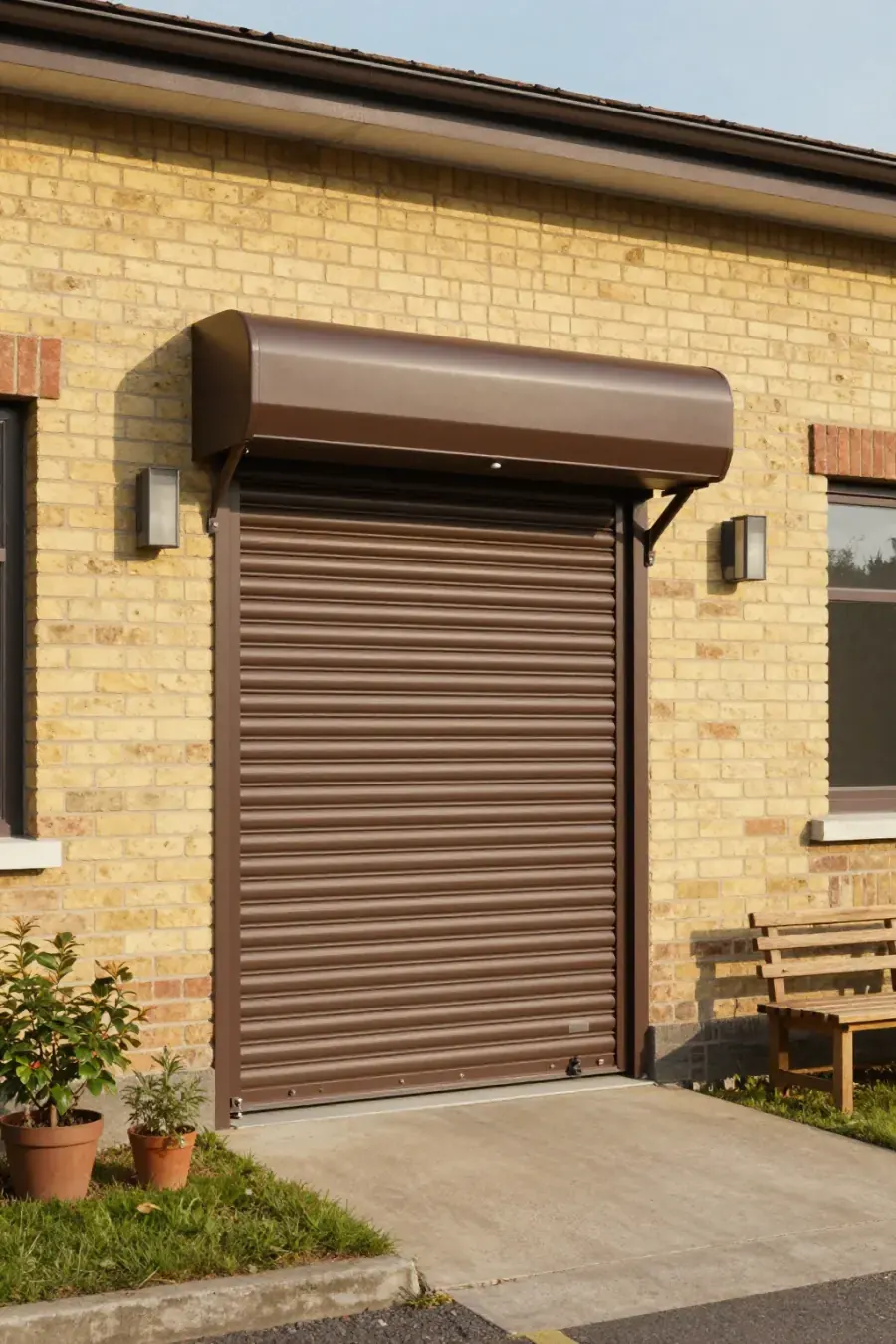

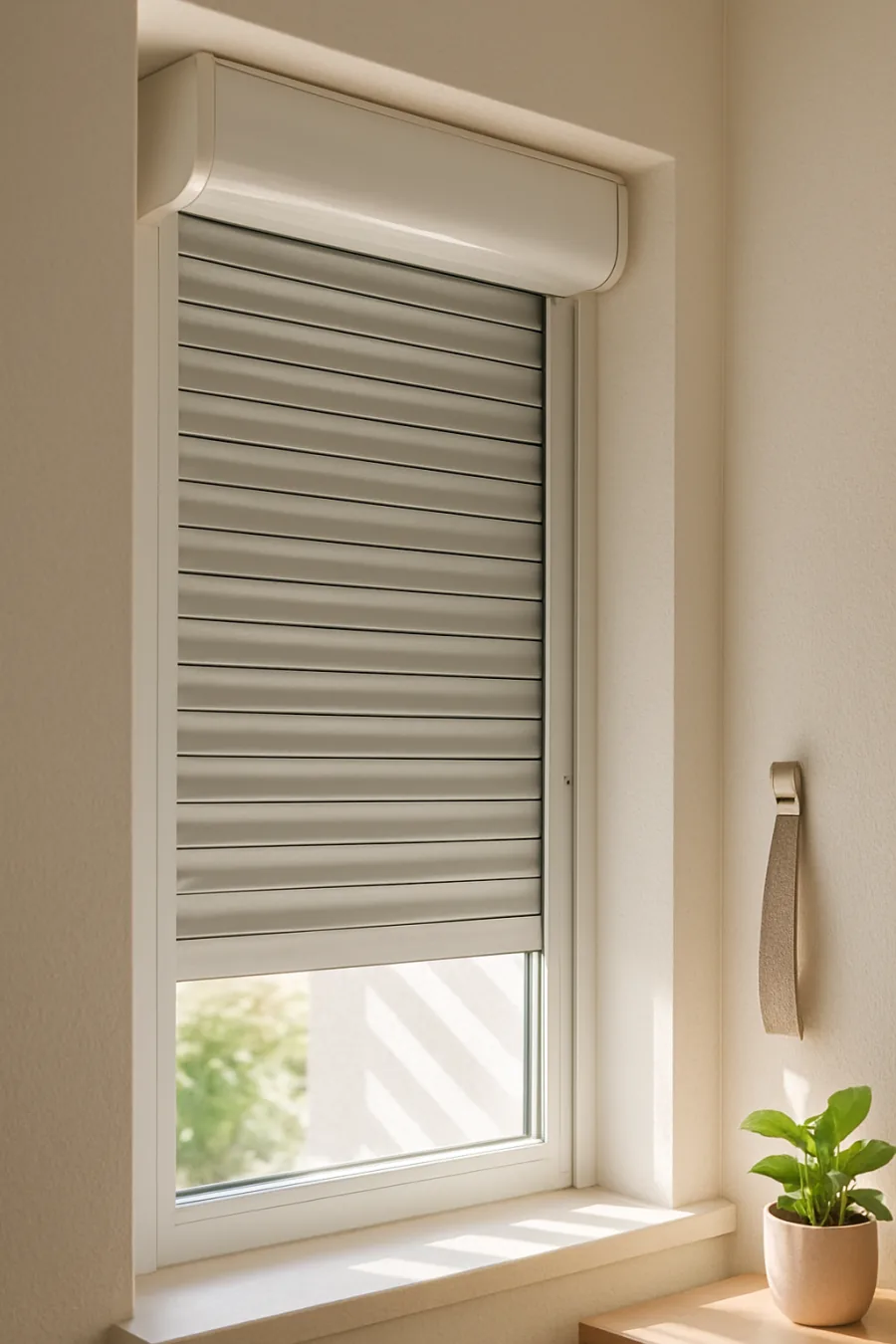


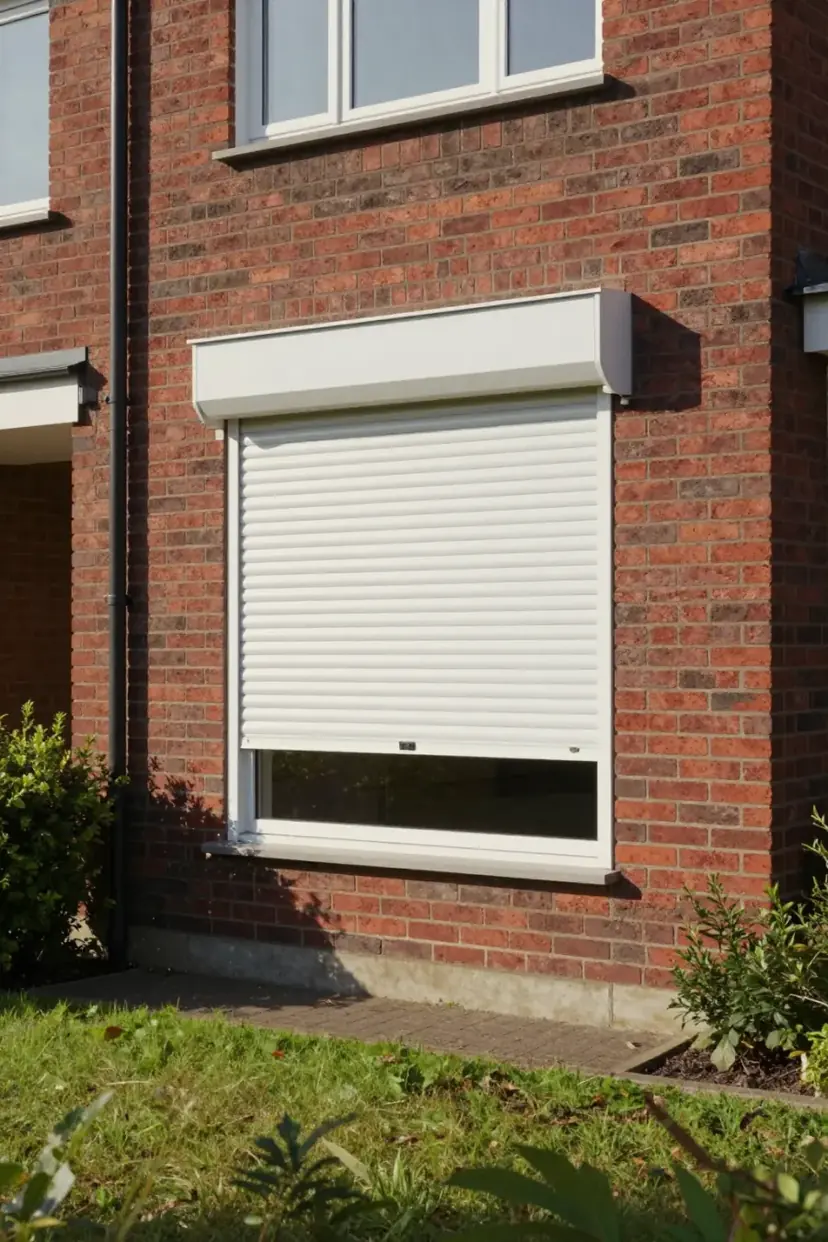


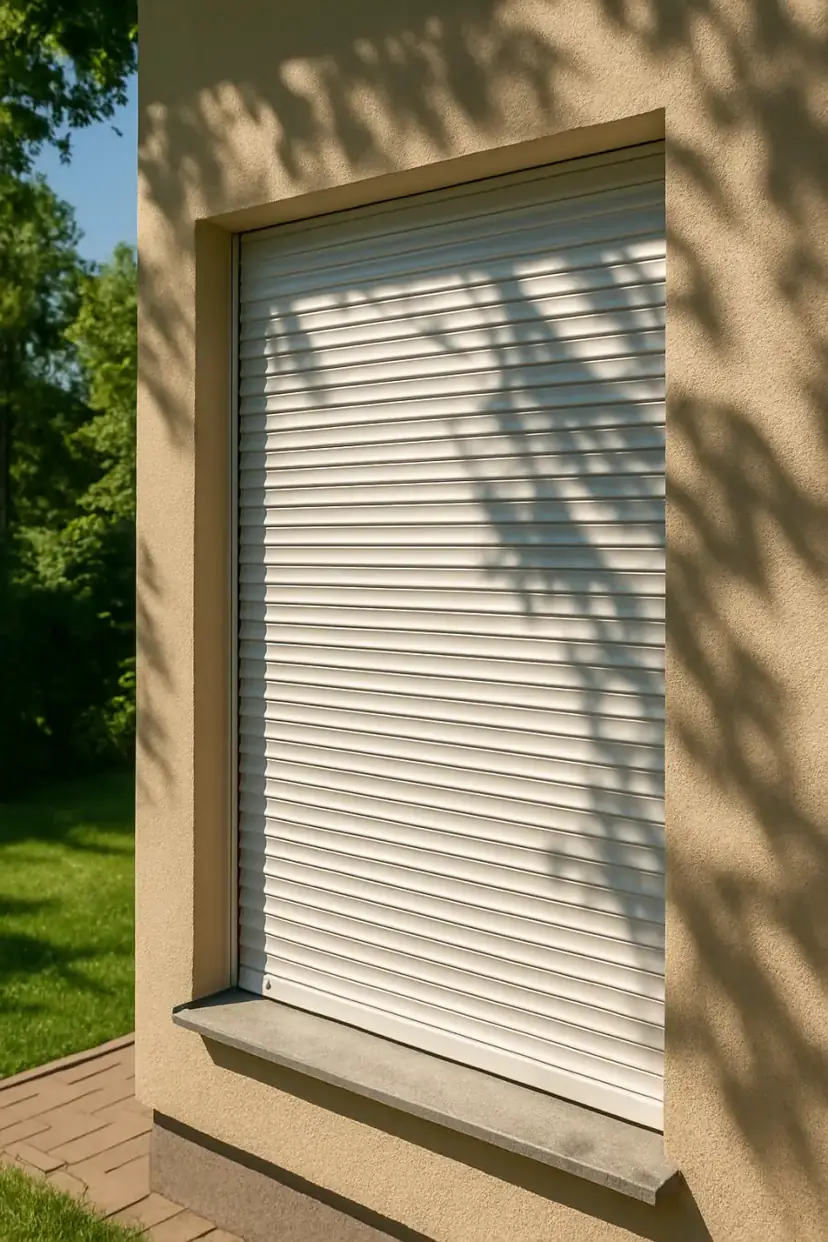











Wooden roller shutters are a curtain made of slats with a wood grain that retracts into a box above the opening and takes up no space on the window. We manufacture them to measure in Almaty: basic roller shutters for windows from 17,500 ₸ per m², manufacturing time 10–14 days. Measurement and consultation are free.
What are called wooden roller shutters in Almaty
Wooden roller shutters in Almaty are a curtain made of slats that rises and goes into a housing box above the opening. When lowered, it covers the window from the outside or the inside. The curtain takes up no space on the windowsill: the raised slat goes into the housing box instead of folding up like an accordion at the frame.
The name covers several versions, and this is where the confusion starts. Wood-look roller shutters often turn out to be an aluminium slat with wood-effect paint or thermal printing — outside it looks like wood, but it stays metal. We don’t split these options into “right” and “wrong”: both designs work the same way — the slat runs up and down along the guide rails.
What exactly covers the opening in each case is clear from the sample. The measurer brings several profiles, and on site it becomes clear how the texture looks and how the blind will behave on your window.
Three names that get confused
Wood-textured roller shutters. A curtain made of slats, rises into the housing box above the opening.
Wood-look aluminium roller shutters. Metal with paint or thermal printing: the colour and grain of wood, but different care.
Hinged wooden shutters. Two sashes on hinges, opening outwards or inwards. They are not roller shutters: the sashes stay on the opening and need room to open.
Jalusso doesn’t name the wood species, the slat composition or its thickness in the description — these parameters are confirmed from samples at the measurement.
No ready-made products in stock
We manufacture roller shutters in Almaty in our own workshop, and every product is made to measure. There are no ready-made wooden roller shutters in stock: the size of the curtain, the length of the guide rails and the housing box depend on the specific opening. The order is: you message us on WhatsApp, the measurer comes with samples, then the workshop, then installation.
Within the city, measurement and consultation are always free, and delivery is free too. The roller shutter curtain is assembled from slats and, when raised, goes into the housing box above the opening, so it takes up neither the windowsill nor the approach to the frame.
Wooden roller shutters, decorated aluminium and hinged shutters: three different products
Wooden roller shutters in Almaty differ from hinged wooden shutters and from wooden blinds in how the blind leaves the opening. With roller shutters, the blind rises and hides in the housing box above the window. Shutters swing open on hinges to the side. Blinds stay on the frame or on cords and don’t leave the opening at all.
Table: design, what it covers, where it’s used
| What it is | How it opens | Does it take up space on the window | Where it’s used |
|---|---|---|---|
| Blind in the housing box | Rises up into the housing box | No, the opening is fully cleared | Windows of flats, residential houses, openings with finished trim |
| Aluminium with wood-look decoration | Rises up into the housing box | No | The same places as roller shutters, plus sites with high durability requirements |
| Hinged wooden shutters | Swing open on hinges | Yes, the sash runs along the facade and needs room | Houses with a facade where shutters are part of the look |
| Wooden blinds | Slats turn in the frame or on cords | Yes, they stay on the opening | Interiors, windows inside rooms, verandas |
Below the table is a short breakdown. Wood-look roller shutters and decorated aluminium work the same way mechanically: both go into the housing box. The difference is in the material of the curtain and in how it’s cared for.
On a window in one room, wooden roller shutters cover the opening completely, while wooden blinds only block the light between the slats. The second option gives neither a tight fit at the edges nor a blind that leaves the window. We’ve installed both products in one house: blinds in the kitchen, where someone is always around, roller shutters in the bedroom, which needs to be closed tightly for the night.
Why wood-look decoration is not the same thing
Thermal printing and powder coating give the colour and grain of wood, but the texture stays applied to metal. An aluminium blind is easier to care for: there’s no need to refresh the tinting, because there is none. A wooden blind needs impregnation and refreshing of the coating — maintenance that metal never needs.
I wouldn’t call it “worse” or “better”. These are different tasks: one person wants the look of wood without the care, another wants the wood itself in hand, with its texture and weight.
All three products cover the window, but in different ways: the blind goes into the housing box, the sashes swing open on hinges, and blinds stay in the frame or on cords and don’t leave the opening.
Wood or aluminium: an honest comparison by task
Wooden roller shutters in Almaty and extruded aluminium roller shutters are not competitors — they are two tools for different jobs. Aluminium is chosen where an opening has to stand up to burglary and hold back the street. Wood is chosen for warmth, quiet and looks. So the question “which is better for windows” is decided not by the material, but by what you want from the opening.
In short, the difference lies in how the blind behaves in the opening. A wooden blind absorbs street noise: when closed, it muffles sound from the street more than an open sash does, and a room on the noisy side becomes quieter. An air gap remains between the blind and the glass. It reduces heat loss through the window in winter, and in summer the glass does not heat up as much. Extruded aluminium is worse at thermal insulation — but it has no impregnation that needs renewing, and outdoors it lasts longer.
Table: task — what people choose
| Task | What fits |
|---|---|
| Warmth in winter, less heating in summer | Wooden blind: air gap between the blind and the glass |
| Quiet on the noisy side | Wooden blind: a closed slat muffles street noise |
| Looks: wood texture to match the facade or interior | Wooden blind with tinting |
| Outdoor durability, long service life without maintenance | Extruded aluminium |
| Burglary protection | Extruded aluminium with a deadbolt lock |
I will say a separate word about fading, because it is asked about most often. Tinting on the south side loses its looks over time. This is not a defect and not a reason to replace the blind — it is renewed as needed, just like the impregnation.
Controls for the blind
Is a chain or a strap enough? Yes, both options work: chain control and strap control are standard mechanisms for a wooden blind, and nothing special needs to be provided for them. In my view, a chain is more convenient on a window you can reach by hand, and a strap where you have to pull from a distance.
An electric motor is another matter. For a wooden blind, the housing box and guide rails are chosen for the automation from the start: redoing it later costs more. According to the calculator coefficients, a chain adds 1.06 to the base price, an electric motor — 1.85, electric with a remote control — 2.1. So the automation itself is noticeably more expensive than the manual option, and the weight of the blind has nothing to do with it — it is all about the motor.
The same design on different windows solves different tasks: on the sunny side of a private house, the gap between the blind and the glass matters more, while in a bedroom on a noisy street it is the closed slat. No material wins on all points at once.
Wooden roller shutters and burglary protection
Wooden roller shutters do not protect against burglary. They close the opening from the sun, dust and prying eyes, and Jalusso says this plainly, not between the lines — so that no one expects from the curtain what it does not do. A curtain made of slats is responsible for warmth, quiet and texture, and that is where its job ends.
When protection comes up during the measurement, we offer a different product. The job of burglary protection is solved by extruded aluminium: it has a strong blind that cannot be pried open with a crowbar, and a different set of reinforcement.
What exactly sets a security system apart? The guide rails are fixed into the load-bearing wall — not into the finish, not into the cladding, but into the layer that carries the load. A deadbolt lock is fitted on security systems and secures the blind in the guide rails across its full width, not just in the centre. In this case, wall mounting is calculated separately from decorative mounting: what matters here is not how neatly the housing box sits, but how much force the assembly can withstand. The foam-filled profile that we fit on the windows of flats and residential houses does not replace that reinforcement.
So it comes down to a fork by task, not by price. A wooden blind is chosen when a window needs to be closed off from the sun and prying eyes while keeping a warm texture in the interior. Extruded aluminium is chosen when a ground floor stands unguarded and there are no plans to install an alarm.
A wooden blind handles the sun, dust and prying eyes, while for protection you choose extruded aluminium with a deadbolt lock and guide rails fixed into the load-bearing wall.
How a wooden blind performs in the climate of Almaty
The climate of Almaty is sharply continental: cold winters with frosts and a day-to-night temperature swing, and hot, sunny summers with dust. A wooden blind works in these conditions, but not “on its own”: it needs impregnation with a moisture-protection compound and periodic renewal of the facade tinting. We talk about this during the measurement, before calculating the cost — otherwise, after a couple of seasons, the client is surprised why the blind has warped.
The climate of Almaty brings temperature swings and thaws. For roller shutters this means one main thing: moisture. The slat is impregnated with a moisture-protection compound, and it is the impregnation that keeps the ends sealed. As soon as it stops being renewed, the ends take on moisture and warping from moisture begins — the curtain warps, and the slat no longer fits evenly into the guide rails.
Winter and thaws
Frost itself is not a problem for the blind — a thaw is more dangerous, after which water gets into the joints and freezes again. To keep the blind from jamming, the guide rails keep a gap, and the housing box is fitted with a slope away from the wall: water runs off instead of standing on the slats. The gap is not play, but a working tolerance that we allow for during installation.
Summer, dust and the south side
In summer, two factors press on the blind: sun and dust. Facade tinting on the south side loses its looks over time — fading in the sun goes faster where the wall is in direct light all day. Tinting is renewed as needed, judging by the condition of the blind, not by the calendar.
As for insects and mould — they do not appear in an impregnated slat, but where the impregnation has been neglected and the wood is constantly damp. Impregnation with a moisture-protection compound closes off that scenario; for outdoor use and damp rooms, a profile with reinforced impregnation is chosen.
In winter, a wooden blind does not freeze to the frame the way metal does to metal, but you should not count on this as a guarantee: the gap and the slope of the housing box solve the issue more reliably.
The sharply continental climate of Almaty tests a wooden blind not with frost, but with moisture during a thaw and sun on the south side, so impregnation and tinting are not cosmetics but working parts of the design.
Caring for a wooden blind: impregnation, tinting, cleaning
Caring for a wooden blind comes down to three actions: renew the impregnation, maintain the tinting and keep the slats clean. The slat is impregnated with a moisture-protection compound at the factory, but the impregnation needs renewing as needed — it is not a one-off procedure for the whole service life.
The order of work looks like this.
- Inspect the blind as it goes up and down: cracks, dark ends, signs of warping from moisture.
- Wipe the slats with a soft cloth to remove dust and streaks. Abrasives and stiff brushes leave scratches that dirt gets packed into.
- Renew the impregnation with a moisture-protection compound — with a brush along the ends and over the face of the slat.
- Refresh the facade tinting if the colour has lost its evenness.
- Once a season, check how the blind moves in the guide rails: unusual noise and stiff movement are a reason to call a technician.
Don't wash the blind with a pressure washer: pressurized water gets forced into the joints between the slats and into the housing box. A shower from a hose is enough to rinse off dust without flooding the mechanism.
Can you install wooden roller shutters yourself? Technically, the surface-mounted housing box design allows it. But installing it yourself voids the warranty, and during measurement we usually advise against it: the fasteners are chosen to match the wall material, and the housing box is set with a slope away from the wall so the curtain doesn't jam.
What to do if a slat cracks or warps? A slat can be replaced without dismantling the whole structure: we remove the bottom weight bar, take out the damaged slat, fit a new one and reassemble the blind.
What we do when the blind warps
We give 3 years on the mechanism and 1 year on installation work; the count starts from the day the acceptance report is signed. A warranty case is fixed free of charge within 5 working days. Water and natural fading are not covered by the warranty, and we say this straight during measurement, not in fine print: if the treatment isn't renewed for years, the ends will absorb moisture and the blind will warp — that's not a manufacturing defect.
Why installing it yourself voids the warranty
Mechanical damage, self-installation, water and natural fading are not covered by the warranty. The reason is simple: we don't see how the blind was removed and refitted, so we can't tell our mistake from someone else's. It sounds harsh, but it's a fair condition.
Once the warranty has expired, a visit is still possible: we'll tighten the mechanism, adjust it, fit a new cord or chain. For a fee, based on the work done.
The slats are treated with a moisture-protection compound, and if the treatment isn't renewed, the ends absorb moisture and the blind warps.
Operation: chain, strap, electric motor
We do fit an electric motor on a wooden blind — the motor takes on the weight of the blind, and there's nothing to lift by hand. Automation adds a factor of 1.85 to the base price, and a set with a remote control — 2.1. Manual operation remains the base: a chain comes with a factor of 1.06, and a strap with one.
Let's break down what the operating system actually consists of. The blind is pulled down by the bottom weight bar — a strip in the bottom slat that keeps the blind taut and stops it rattling in the guide rails. The spring-and-inertia mechanism in the housing box raises and lowers the blind: the spring balances the weight, and inertia gives smooth movement. The mechanism works the same with a chain, a strap or a motor — the only thing that changes is what you use to drive it.
Chain operation is the simplest option. The chain hangs at the side of the housing box and you pull it by hand; we fit it on bedroom and kitchen windows, where the blind is moved once a day. Strap operation is more convenient on wide and heavy openings: the strap runs the full height of the opening and pulls more smoothly than a chain. On a balcony door-window, the strap helps precisely because you can close it at night from inside the room without stepping out onto the balcony.
Electric motor and emergency lifting
The electric motor has an emergency output for a removable crank handle: if the power goes out, the blind is raised by hand by inserting the handle into the motor. We fit the motor on a schedule and with a sun sensor — then the blind closes by itself in the morning and opens in the evening. The housing box and guide rails for a motor are chosen right away, during measurement, because the structure can't be reworked later.
Budget for the price difference on automation: a factor of 1.85 versus one for manual operation. For wooden roller shutters with an electric motor, manufacturing takes 14–18 days, and the price starts from 35,000 ₸ per m².
An electric motor on a wooden blind doesn't change the window structure — the only thing that changes is what you use to drive the mechanism, and how much it costs.
Installation: surface-mounted housing box, cassette system, frame mounting
There are three ways to fit a wooden blind on a PVC window: a surface-mounted housing box outside above the opening, mounting the housing box on the frame, and a cassette system with concealed installation. The surface-mounted housing box is the basic option: it's fitted to the wall above the window, and the wall isn't opened up. The housing box on the frame is fixed to the window frame itself — this is done when the reveal is narrow and the housing box can't be mounted on the wall. The cassette system hides the blind completely: from outside you can't see the housing box or the guide rails, because both go into the cassette.
The guide rails leave a gap for the curtain: there's play between the slat and the wall of the guide rail, otherwise the curtain will jam. Inside the guide rails there's a guide seal — it sits against the slat and muffles the curtain knocking against the metal. Without the seal, a closed roller shutter rattles in the wind.
Installation factors
Wall mounting comes with a factor of ×1, frame mounting — ×1.05, no-drill — ×1.1, cassette system — ×1.28. Installation itself costs 4,500 ₸ per unit, and for orders from 150,000 ₸ we do it free of charge. For two windows in a room, the difference between wall mounting and a cassette is noticeable, so it's better to confirm the scheme during measurement, not after the blind has been measured.
Wooden house, log house, veranda
Fasteners are chosen to match the wall material — brick, aerated concrete or wood. On a log house and a wooden house, it's important to hit the load-bearing element, otherwise the housing box will shift along with the settling of the wall. For a bathhouse, veranda and gazebo, I'll say it straight: we fit a wooden blind only with reinforced treatment and with a note about care. A damp room requires the treatment to be renewed regularly, not once in a lifetime. The warranty doesn't cover water, and that's worth accepting before ordering, not after.
The cassette system adds a factor of 1.28 to the base price, but from outside you can't see the housing box or the guide rails.
What makes up the price of wooden roller shutters
The price of wooden roller shutters is calculated by the area of the opening, not per finished unit: basic roller shutters for windows start from 17,500 ₸ per m² with a manufacturing time of 10–14 days, a set with an electric motor — from 35,000 ₸ per m² with a time of 14–18 days. Measuring the opening determines the size of the curtain and the type of housing box, and almost the entire final sum depends on those two things.
A wooden blind costs more than aluminium not because of the “species” or a separate markup for the texture, but because a blind made of slats with treatment and tinting requires different processing in the workshop. We roll an aluminium slat from a profile, and we treat and tint a wooden one to match the facade or interior. Hence the difference in labour, not in the status of the material. The base price per m² already includes the blind, housing box, guide rails and a standard mechanism; anything on top is calculated by factors.
Item table
| Position | Price | Manufacturing time |
|---|---|---|
| Roller shutters for windows | from 17,500 ₸/m² | 10–14 days |
| Roller shutters with an electric motor (motor, remote control, emergency lifting) | from 35,000 ₸/m² | 14–18 days |
Example calculation
Let's take one window and see how the total changes with the type of operation and installation. Manual — a factor of ×1. A chain instead of a strap — ×1.06. Electric motor — ×1.85, electric with remote control — ×2.1. A cassette system, where the blind goes into a concealed housing box, adds ×1.28. Installation costs 4,500 ₸ per unit, and for orders from 150,000 ₸ we do it free of charge.
The same opening with manual operation and with a motor and remote control set differs in price by almost half — with the same blind. So it's better to decide on the housing box and operation during measurement, not after: you can't convert a cassette to a motor after the fact. The exact sum is quoted by the measurer after inspecting the opening.
Measurement and manufacturing: step-by-step order
Manufacturing wooden roller shutters takes 10–14 days for the basic “Roller shutters for windows” option and 14–18 days if an electric motor is included. The countdown starts not from the call, but from the measurement of the opening — before it, the size of the curtain and the type of housing box are unknown, and the workshop cannot start anything.
Here’s how it works.
- You message us on WhatsApp. We discuss what kind of opening it is and what task it should solve: sun, prying eyes, noise from the street.
- A measurer comes with samples. The measurement of the opening is free both in the city and in the suburbs. The measurer looks at the window reveals, the external sill flashing, the wall material and decides how the housing box will be mounted.
- We calculate the cost on site. The measurement determines the size of the blind and the type of housing box, and these in turn dictate the control: for an electric motor, the housing box and guide rails are selected right away — they cannot be changed later.
- The workshop manufactures the product to your dimensions. There are no ready-made products in stock — everything is made to measure.
- Installation on the wall or on the frame. Installation costs 4,500 ₸ per product; for orders from 150,000 ₸ it is free. From the moment the acceptance certificate is signed, the warranty applies: 3 years on the mechanism and 1 year on installation.
Kirill, Jalusso lead measurer, has been working with non-standard windows for nine years — arched, triangular, attic. On such an opening, the housing box and guide rails have to be selected on site, which is why the measurer comes with samples instead of sending a price list in a messenger.
Suburbs
Kaskelen, Talgar, Issyk, Kapshagay — we travel there. The cost of the visit depends on the distance and is quoted before the visit, so it does not come up after the work is done. Measurement and consultation are always free: the measurer comes with samples and calculates the cost on site.
Where wooden roller shutters should not be installed
Wooden roller shutters should not be installed where the curtain is constantly getting wet: in a sauna, in an open-air gazebo, on a veranda without a canopy. The slat is treated with a moisture-protective compound, and short-term rain is not a problem for it. But a damp room requires enhanced treatment and constant care, and the warranty does not cover water.
Let us go through the points where we advise against it and what we suggest instead.
- Sauna and steam room. Steam and the temperature difference between the room and the outside work against the blind all year round. Here the treatment would have to be renewed constantly, and the ends still absorb moisture. We install extruded aluminium — it is not afraid of steam or water.
- A gazebo without a canopy and an open veranda. Rain and snow fall directly on the blind, and the housing box has no protection. In such places wood lasts less than in a room. From experience: on open structures we suggest aluminium, and we keep wood for openings under a roof.
- A bathroom with poor ventilation. Constant dampness is the same story as with a sauna, only slower. If ventilation works, a wooden profile with enhanced treatment holds up; if not, we do not recommend it.
- Panoramic glazing across the whole wall. The blind area is large, which means both the load on the mechanism and the price of the set go up. For such openings we more often quote aluminium with an electric motor.
About beetles and fungus, let me be direct: as long as the slat is treated and the tinting is intact, the surfaces are protected. They appear where the treatment has not been renewed for years and the blind stays damp. This is a matter of care, not of the material as such.
Wooden curtains are not chosen for protection against break-ins — that task is handled by extruded aluminium with a deadbolt lock. Wooden roller shutters close the opening against sun, dust and prying eyes.
A case from practice: four openings and different tasks
The same wooden roller shutter design solves different tasks — it all depends on where the window faces, what is behind it and how often you will close the curtain. Four typical situations people come to us with for a measurement.
A living room window on the sunny side
The main thing here is the air gap between the blind and the glass. It reduces overheating of the glass in summer and heat loss from the window in winter: the blind takes most of the heat and cold on itself instead of letting it into the room. The air gap reduces heat loss from the window — this is the main argument for a living room with large glazing facing south.
Bedroom on a noisy street
A foam-filled wooden blind absorbs street noise. It does not silence it completely — but a closed blind on the window does its job. A wooden blind absorbs street noise, and for a bedroom on a busy road this is a noticeable difference. We usually recommend installing it in the bedroom: prying eyes in the evening and noise from the street are closed off with one movement.
Balcony door-window
Controlling the strap from inside the room is the most convenient solution for a balcony door. It is convenient to close at night without stepping onto the balcony or opening the sash. And you do not have to reach for the chain through the glass.
Window above the canopy
The surface-mounted housing box was installed on the finished facade above the canopy, the wall was not opened up — the wall and the finish stayed intact. The guide rails go into the load-bearing wall, so the housing box holds securely, and the facade does not have to be taken apart.
The measurement of the opening determines which of the four schemes suits you: the height and width of the opening, which way it faces, the type of wall and the way the sashes open decide everything. The same design solves different tasks depending on the opening: on the sunny side the gap between the blind and the glass matters, in a bedroom on a busy street — a closed blind, on a balcony door — controlling the strap from inside the room.
Questions asked during the measurement
The decision about the housing box and guide rails is made during the measurement of the opening: both the control and the final price depend on them. Below are the five questions wooden roller shutters are asked about most often during a measurement.
How does a wooden blind differ from a decorated aluminium one in terms of care? On a wooden slat the surface is treated with a moisture-protective compound and tinted, and this treatment is renewed over time. On an aluminium blind with a “wood-look” decor there is nothing to renew — the pattern is applied to the metal, but the texture remains a pattern on metal, not wood under your hand. We do not divide these options into good and bad: the difference is precisely in maintenance.
Can the blind be installed inside the room? Yes. The surface-mounted housing box is fixed above the opening on the room side, and then the control stays inside. For a first-floor apartment this is often more convenient — you close it at night without going outside. But the housing box is then visible in the interior, so some customers choose a cassette system: it hides both the housing box and the guide rails.
What does the warranty cover and what does it not cover? We give 1 year on the installation of wooden roller shutters and 3 years on the mechanism; the countdown starts from the day the acceptance certificate is signed. If a case is recognised as a warranty case, we do the work free of charge — within 5 working days. Mechanical damage, reinstallation on your own, water and natural fading are not covered by the warranty.
How long does the product take? Roller shutters for windows — 10–14 days, a set with an electric motor — 14–18 days. The time is counted from the measurement and confirmation of dimensions, not from the first message on WhatsApp.
Do you travel to the suburbs of Almaty? We do: Kaskelen, Talgar, Issyk, Kapshagay. The cost of the visit depends on the distance, and we quote it before the visit, not after the fact.
The measurement of the opening determines the size of the blind and the type of housing box, and the warranty on the mechanism and installation is recorded in the acceptance certificate, so both matters should be settled before signing, not after.
Conclusion
Wooden roller shutters in Almaty are a blind made of slats that retracts into a housing box above the opening. Not hinged wooden shutters on hinges. Not wooden blinds that stay in the frame or hang on cords. We manufacture such blinds to measure, so the size, the type of housing box and the lifting side are determined for your opening, rather than adjusting a ready-made product.
Wood is chosen for warmth, quiet and texture. An air gap remains between the blind and the glass — in winter the window loses less heat, in summer the glass heats up less, and a closed slat absorbs street noise. For protection against break-ins you need a different material: extruded aluminium with a deadbolt lock and guide rails anchored into the load-bearing wall.
In the Almaty climate the blind needs treatment with a water-repellent compound and a refresh of the tint to match the facade. The treatment is renewed as needed: if it is left alone, the ends absorb moisture and the blind warps. The warranty does not cover water — that is worth keeping in mind from day one.
The price is calculated by the area of the opening and the calculator coefficients. Roller shutters for windows — from 17,500 ₸ per m², a set with an electric motor — from 35,000 ₸ per m². Manual operation comes with a coefficient of 1, a chain — 1.06, an electric motor — 1.85, a cassette system adds 1.28.
A practical tip: call a measurer with samples. They will determine the size of the blind, the type of housing box and calculate the cost on site — measurement and consultation are free, and delivery within the city is free too.

