




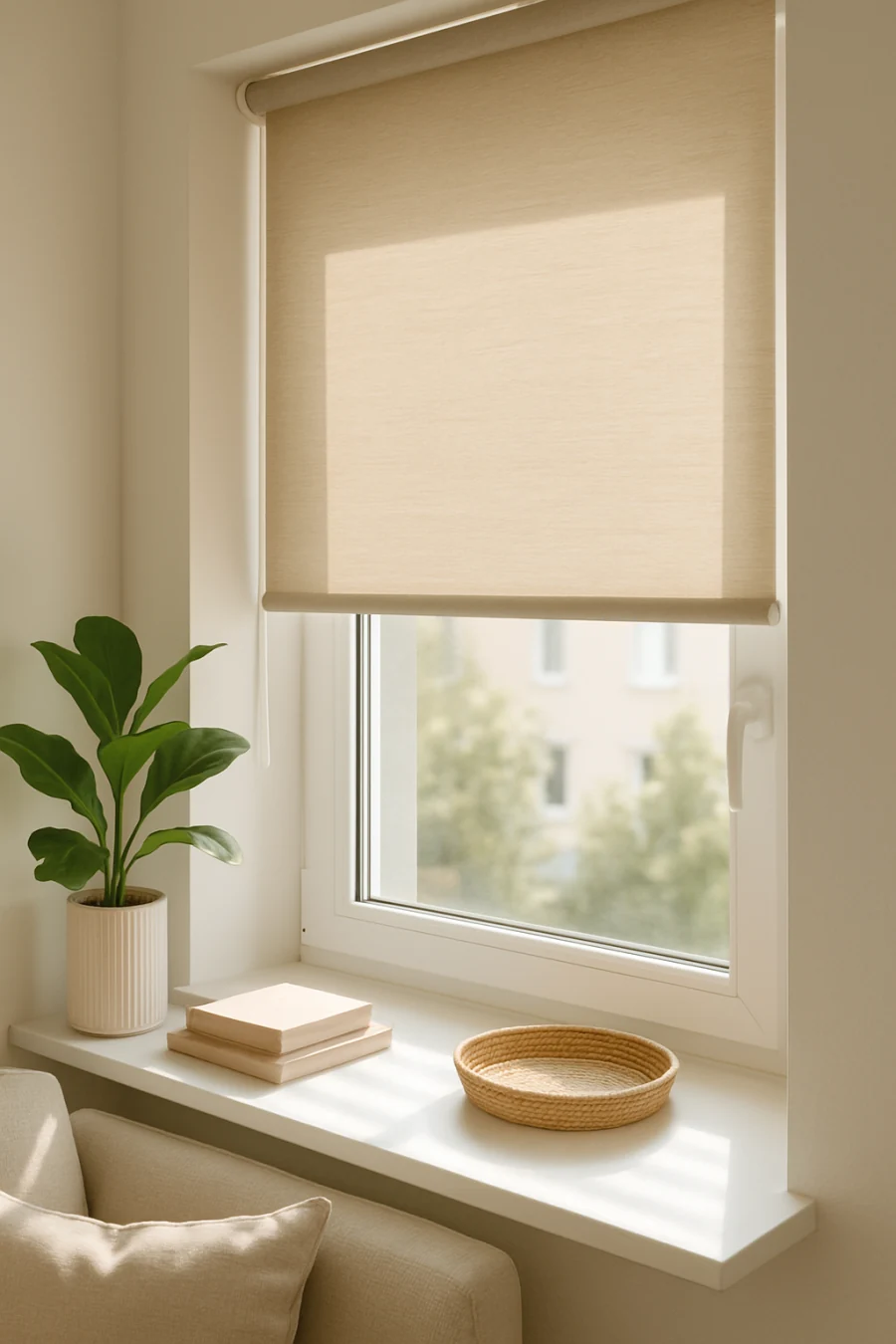


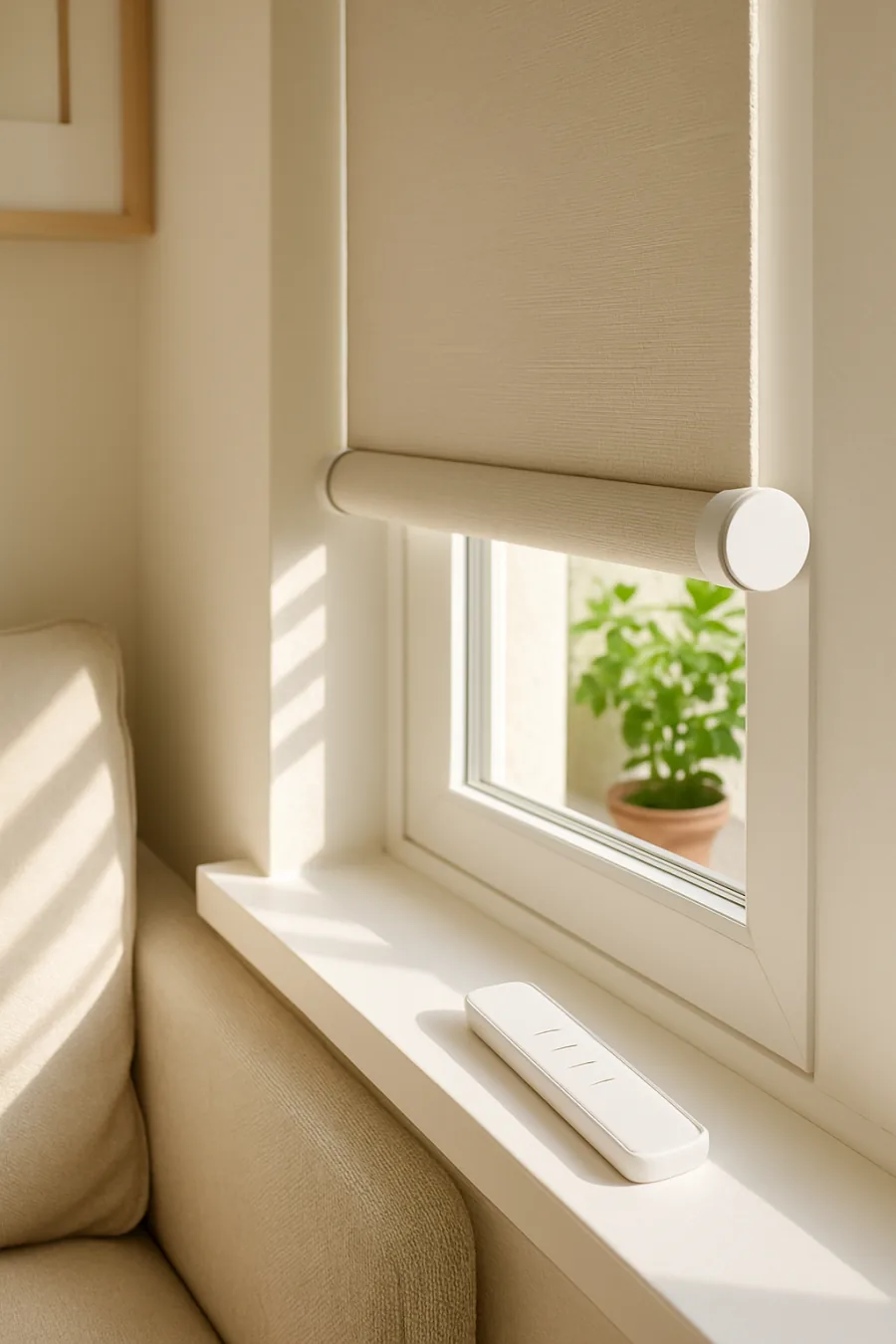













A roller blind on a door is mounted right on the door leaf itself or on the frame next to it and moves together with the sash — no rail or curtains needed, and the passage stays clear. We make them to measure in our own workshop in Almaty, measurement is free, manufacturing takes 4–6 days, price from 5,400 ₸/m².
What a roller blind on a door is and how it differs from a blind on a window
A roller blind for a door is a fabric on a roller tube that mounts directly on the door leaf or on the frame next to it. The difference from a window blind is not the size but the attachment to the moving part. The fabric moves with the sash, so the glass insert in the door stays covered whether the door is open or closed. In search, people often call these roll blinds for doors — same thing, a roller blind for a door.
On a window, the blind is hung on the fixed wall or frame, and the question of “where the fabric will go” does not even come up. A door is another matter: it has the sash travel, hinges and a handle, and all of this dictates exactly where the tube will be and where the control will come out.
Design: what changes compared to a window blind
Three things change places. First, the mounting: the brackets go on the door leaf or on the frame, not on the window reveal. Second, the length: the fabric is made down to the bottom of the door so that no strip is left at the threshold that can be seen from the street or from the hallway. Third, the control: the chain is brought out at arm's height, because reaching up on a door is awkward, and sometimes there is nowhere to reach.
The length, the mounting method and the side of the control are determined by the measurement. You can't guess from a photo here — sashes differ in thickness, hardware and the way they open.
How the door is used
A door is used differently from a window. It is opened all day, it gets slammed, and draughts from the stairwell or the terrace move across it. Draughts and frequent opening of the door raise the demands on the fasteners: what holds calmly on a windowsill for years behaves differently on a slamming sash.
That is why in the door version the fasteners and the bottom retainer are taken with a margin, not the way they are for a window. A door is opened and closed dozens of times more often than a window — this is the main reason why roller blinds on a door in Almaty are treated as a separate task, and not as a window blind hung on a sash.
A blind on the door glass or a blind instead of a door in the opening: we separate two different orders
A roller blind on a door covers the glass insert in the door: the product stays on the door leaf or on the frame next to it and moves together with the sash. A blind instead of a door in the opening — when the roller fabric itself becomes the barrier between rooms instead of an open sash — we do not make.
The difference is simple. In the first case the door leaf stays in place, you open and close it as usual, and the fabric simply hangs on it. In the second case there is no door as such: the opening is covered by something, and that is already a different order with a different calculation and different mounting.
There is also a third option, which is often confused with the first two — wall mounting above the door. Such a rail is placed on the wall above the opening, and the fabric comes down from above. Blinds on a sash and blinds above an opening behave differently: wall mounting above the door does not let the fabric reach the bottom of the door, and a gap remains at the threshold. On the other hand, it helps on a wide opening and on a double-leaf door, where one blind covers the glazing above both sashes.
Buying a roller blind for a door with glass is exactly our case: we measure the glass insert and the door leaf, select the mounting for the way the sash moves, and calculate by the area of the fabric. And at the measurement you can see right away which of the options is even possible on your door.
We make a blind for a door leaf with glass — the product stays on the door and moves together with the sash; we do not make a blind instead of a door in the opening.
How to choose the mounting for your door: a table by sash types
The mounting is chosen not by looks and not by the size of the glass, but by the way the sash moves. A hinged door takes the fabric into the room or outwards, a sliding door moves across the opening, and an all-glass door has no frame at all — all these are different points of support. The measurer looks at the door and only then suggests the version.
The table below follows the same logic Jalusso uses to work through an order on site.
Table: door type, version, what the measurer looks at
- A hinged door to a room or a kitchen. Mounting on the door leaf — the brackets are placed on the top rail of the sash, no rail or wall drilling needed. The measurer checks which way the door opens and whether the fabric will be pinched between the sash and the reveal.
- A hinged door with wide glass or a balcony block. Mounting on the frame next to the glass often fits. The measurer looks at whether the frame has a flat surface for the bracket and whether it blocks the movement of the sash.
- A sliding wardrobe door with glass. The measurer looks at where the sash slides: a blind on the moving sash must travel with it and not catch on the other half of the opening.
- An all-glass door without a frame. Here you cannot drill the leaf, so a no-drilling option is used. The measurer checks the thickness and profile of the glass — what fastener will hold at all depends on this.
- A double-leaf door. One blind covers the glazing above both sashes — wall mounting above the door; if the glass is set into each sash, blinds for the door are made separately or mounted on the frame.
The door opens inwards or outwards
The direction of opening determines where the fabric goes when the door opens. If a hinged door opens into the room, the blind on the sash goes into the room together with it, and nothing is left in the opening. When it opens outwards, the gap between the sash and the reveal is usually larger, but here too the measurement decides everything.
A door with a narrow glass insert
A narrow cassette for the door glass covers the glass insert exactly to its width, not across the whole sash. In this case the tube and the fabric are hidden in the housing, and the fabric does not go beyond the glazing. It turns out neat: the area of the fabric is smaller than the door itself, because the fabric is calculated by the glass.
For a door with an insert in the middle of the leaf, Jalusso most often recommends the cassette — it holds its geometry and does not argue with the panel. A simple open roller tube on such a door looks rougher, but also costs less.
The mounting version is chosen by the way the sash moves: for a hinged door, mounting on the leaf; for a wide opening, wall mounting above the door; for an all-glass door without a frame, a no-drilling option.
Does the blind get in the way of the handle, the hinges and the opening angle: what the measurer checks
No, roller blinds on a door do not get in the way if the mounting and the control outlet are matched to the specific sash. What gets in the way is not the blind as a product, but an unchecked gap: fabric fitted blindly to the size of the glass hits the door handle or gets pinched between the sash and the reveal. That is why everything to do with the movement of the sash is checked at the measurement, before the order.
Mounting on the door leaf requires checking the gap to the handle. The measurer opens and closes the door, looks at which side the handle is on and at what height it sits, and from this calculates where the edge of the fabric will pass. If the handle is close to the glass, the fabric is shifted or a narrow cassette is used.
Second — the movement of the sash. The door opens inwards or outwards, and in both cases the fabric must not fall into the zone where the sash travels along the reveal. The door reveal limits how far the housing box can protrude on the sash: if the box protrudes more than the depth of the reveal allows, it catches when opening. Our task is to keep the passage clear, not to adjust it after installation.
Here is what we check, in order:
- The gap between the edge of the fabric and the door handle — along the whole opening arc, not in one position.
- The movement of the sash inwards and outwards: where the fabric passes the reveal and where it goes into the opening.
- The protrusion of the housing box relative to the door reveal — whether there is enough depth for the box not to catch.
- The side where the chain comes out and its height, so you don't have to reach for it across the door.
- The hinges: whether the mounting gets in their way and whether access to adjustment remains.
Where to bring the chain out
The chain drive is brought out at arm's height on the side, on the side where there is no door handle. Then the chain does not catch on the handle when opening and does not hit the glass when the door is slammed. If the door is narrow and both sides are taken, the measurer suggests a spring mechanism or an electric motor — there is no chain at all. We talk about this at the measurement, not after installation.
The clearance to the handle, the swing of the sash and how far the cassette protrudes past the window reveal are all checked at the measurement stage, before the order, not after installation. We don't charge extra for that check itself: measurement and consultation are free, and our measurer arrives with samples and works out the price on the spot.
Keeping the fabric from swinging and banging: the bottom holder and fixing requirements
The fabric stops swaying when its bottom edge is held by a magnetic bottom holder. It pulls the lower edge of the fabric to the frame, so a draught can't catch the blind and it doesn't bang against the door every time the sash moves. Without a holder, a roller blind on a door is noticeably livelier: draughts pull at it and it slaps against the glass whenever the door is closed.
What else keeps the fabric calm? A magnetic bottom holder doesn't work on its own — it works together with the fixing. When the fixing on the door leaf is done according to the measurement, the tube sits level above the glass insert, the fabric runs without skewing and presses against the keeper plate across its full width. Skew by a couple of millimetres and the magnet catches only the edge, and the fabric twists. That's why the measurer looks not only at the width of the glass but also at the geometry of the door leaf.
A door leaf has a harder life than a window. A door is opened and closed all day, it gets slammed, and draughts from the stairwell, the terrace or the corridor move across it. That's why the fixing requirements are higher than on a window: the brackets have to take the load of a yank, not just the weight of the fabric.
What this means in practice:
- A fixing on a door leaf is screwed into the body of the leaf, not into a thin glazing bead or a decorative trim.
- The support has to land on a solid spot, otherwise a slam makes the screw chew out the hole and the bracket starts to wobble.
- We fit a magnetic bottom holder if the door opens onto the street, a balcony or a stairwell where there's a draught.
- We check how the fabric sits in the holder with the sash closed and open — the fabric shouldn't be stretched tight in the extreme position.
A separate word about adhesive fixing. It isn't suitable for a door that gets slammed regularly: the glue holds right up to the first good knock, and then the bracket comes away along with a piece of the tape. In a rented flat where you can't drill, glue is an understandable compromise, and we say so before the order, because re-installing the blind yourself isn't covered by the warranty. For a permanent door we usually go with a fixing on the frame or on the wall above the opening.
A magnetic bottom holder presses the lower edge of the fabric to the frame so the fabric doesn't sway in a draught and doesn't bang against the door.
Operating a blind on a door: chain, spring or electric motor
The control is chosen by how often you touch the blind and at what height the drive ends up. For a door to a room or the kitchen a chain is enough, for a narrow glass insert a spring, and an electric motor with a remote control makes sense where you can't reach the fabric by hand. Roller blinds on a door in Almaty don't tolerate guesswork: the drive sits on a moving sash, and anything that hangs down will sooner or later meet the handle.
Comparing the three options
| Control | Where it fits | What to consider |
|---|---|---|
| Chain control | Doors to a room and the kitchen, balcony units | The chain is brought out at hand height to the side of the handle, otherwise it catches when the door is opened |
| Spring mechanism | A glass insert in a door, a low door | The fabric stays at the level you set by itself, there's no cord — nothing gets in the way of the doorway |
| Electric motor with remote control | Wall fixing above a tall door or a glass partition | Requires a power supply and a fixed support |
A chain drive lets you leave a gap for ventilation: the fabric locks in any position and air comes through the open part of the glass. Mechanical control is the simplest and most predictable: one chain, no electronics on the sash. A spring mechanism suits a glass insert or a low door, where the fabric is light and doesn't need raising often. An electric motor with a remote control requires a wall fixing, not a sash.
Why an electric motor isn't fitted to a moving sash
We fit an electric motor on a wall fixing above a tall door or partition, not on a blind on a moving sash where there's no way to run the cable. The door moves together with the leaf, and there's nowhere to run the cable behind it — we don't bring power to a moving sash and we don't promise it in the project. If the door is tall and you can't reach the chain, there's one option: a fixing above the opening, where the blind comes down from above and is operated by remote control. This scenario comes up more often on commercial premises — for example, in a yoga studio with a full-glass door we fitted the brackets with adhesive, and the control question was solved by the wall-mounted option rather than a drive on the sash.
Where to bring the chain out
The chain is placed at hand height, to the side of the door handle, closer to the hinges. Then when the door opens it runs along the sash and meets neither the handle nor the glass. And this is checked at the measurement stage together with the clearance to the reveal: moving the chain outlet later, after installation, won't be possible.
Fabric for the job a door does: sheer, dense, blackout
Fabric is chosen by light transmission, not by colour: that's what determines what you actually get on the door. Light transmission is the main characteristic of the fabric, and it's what decides whether a roller blind on a door will screen the room from prying eyes or just soften the light.
Sheer and semi-sheer fabric keeps the light and the view. During the day the sun comes through the glass insert in the door, the room doesn't go dark, and from outside you can see what's happening inside. For the kitchen and dining room this option is taken most often — it keeps the feeling of open space. But it gives no privacy.
Dense fabric and blackout provide privacy and darkening. From the street you can no longer make out what's happening in the room, and blackout blocks the light completely. The logic is simple: the denser the fabric, the less light it lets through and the less of you can be seen.
What we put where in practice:
- Hallway — dense fabric. The glass by the entrance is overlooked from the stairwell landing, and a semi-sheer fabric doesn't help here.
- A door to a terrace or the yard — dense fabric or blackout. In the evening you can see clearly from the plot what's going on in the house, and dense fabric blocks that.
- Bedroom and kids' room — blackout. In the morning light through the door glass wakes you before the alarm, and dense fabric solves exactly that.
- Kitchen and dining room — sheer or semi-sheer. Light and the view matter more here than privacy.
About the front door of a private house, where the glass faces straight onto the street, I'll say a separate word. A roller blind on a door works here — but the fabric needs to be dense so passers-by can't look inside. And it's not only the glass that faces the street: the door itself is used often, and the fixing is chosen as carefully as the fabric.
Fabric on a front door collects more dust than on an interior door, so it's taken with a dense weave — it's easier to brush off with a soft brush. And one more thing: the measurer brings samples, and the fabric is chosen on the spot, in daylight. In a catalogue the shade and density read quite differently.
Only dense fabric and blackout give privacy and darkening — sheer fabrics leave both the light and the view.
How area and price are calculated: pricing from the price list with coefficients
A roller blind on a door costs from 5,400 ₸/m², and manufacturing takes 4–6 days. The total depends on the area of the fabric, the type of control and the method of installation — three multipliers on top of the base price.
The area of the fabric is calculated not by the door but by what the fabric will actually cover. A door a metre wide with a narrow glass insert in the middle gives a fabric of less than a square metre. Many people are surprised: they expected a price “for the door” and got a price for the glass. That works in our favour if the glass is narrow, and against it if the glazing covers almost the whole sash — then the area of the fabric approaches the area of the door.
The measurement determines both the mounting design and the final price. Precise dimensions are taken by our measurer, who also checks how the sash moves and the clearance to the handle. The warranty runs from the date the acceptance certificate is signed: 3 years for the mechanism, 1 year for installation.
Base price and coefficients
The base is 5,400 ₸/m² for polyester with an open roller tube. From there the price grows by coefficients:
| What we change | Coefficient |
|---|---|
| Control: manual | ×1 |
| Control: chain | ×1.06 |
| Control: electric motor | ×1.85 |
| Control: electric with remote | ×2.1 |
| Installation: wall-mounted | ×1 |
| Installation: frame-mounted | ×1.05 |
| Installation: no drilling | ×1.1 |
| Installation: cassette system | ×1.28 |
The control and installation coefficients are multiplied by the base and the area — not added. The cassette system adds the most to the price of all the installation options, because the cassette covers the roller tube and the fabric completely.
Example calculation with the calculator
Let’s take a door with a blind area of 1 m², a chain drive, and frame-mounted installation. The calculator multiplies: 5,400 × 1 × 1.06 × 1.05. This illustrates how the calculation works, not the price for a specific door — the measurer gives you the exact amount on site.
Installing one unit costs 4,500 ₸, and if the order total reaches 150,000 ₸, installation is free. If you want to buy a roller blind for a door without extra markups, factor in installation from the start: the difference between wall-mounted installation and a cassette system adds up to a noticeable amount.
The price is calculated by the area of the blind, not the area of the door, so for a door with a narrow insert the product comes out smaller than the sash size suggests.
No-drill mounting: when it works and what to expect
Yes, you can install roller blinds on a door without drilling into the door leaf — the mount attaches with adhesive or a clamp and leaves no marks on the door. This option is chosen where drilling isn’t possible: a rented flat, someone else’s door, a thin sash profile. But there’s a catch. The adhesive joint works against sliding and pulling, and a door is not a window: it gets slammed, pulled by the handle, and the leaf vibrates every time it closes. That’s why we don’t use no-drill mounting on a door that’s used all day. For such a door, frame-mounted or wall-mounted above the door is more honest — they hold onto a fixed structure, not a moving sash.
Here’s what to weigh before ordering.
- Load. The blind with its roller tube hangs on the adhesive joint permanently, not “sometime later.” The wider the glass insert, the heavier the product and the less margin the adhesive has.
- Slamming and drafts. Adhesive mounting isn’t suitable for a door that’s regularly slammed: the impact load loosens the joint and it comes away at the edge. On a door with a draft, the bottom of the blind is pulled down even more.
- Door profile. Adhesive bonds well to a smooth profile and poorly to a rough, painted, or textured one. The measurer checks the surface and tells you whether it makes sense at all.
- Condition of the surface. Degreasing and waiting the required time are part of the job, not a formality. If these steps are skipped, the mount won’t hold firmly.
And most importantly, about the warranty. Reinstalling the blind yourself voids the warranty: the warranty covers the mechanism and installation done by us, not an adhesive joint that was re-glued by hand. Mechanical damage is also outside the warranty. So if you’re moving the blind from one flat to another, tell us in advance — it’s easier for us to rehang it than to deal with adhesive that has come off.
No-drill mounting leaves no marks on the door leaf, but on a door that’s regularly slammed it’s weaker than frame-mounted or wall-mounted, and we tell you this before you order.
How we work: measurement, workshop, installation, warranty
You can order a roller blind for a door in Almaty from us in four steps: request, measurement, workshop, installation. There are no ready-made products in stock — each one is made for your door. Measurement and consultation are always free: the measurer arrives with fabric samples and calculates the price on site for your door.
- Request. You write to us on WhatsApp, describe the door, and attach a photo if you like. We discuss which mounting is even possible given how your sash moves, and agree on a time for the measurement.
- Measurement. The measurer brings samples, checks how the door opens, where the handle is, and how far the reveal protrudes. The exact price is calculated here too: blind area, fabric, control, mounting. Measurement and consultation are free, and travel within the city is free as well.
- Workshop. The door leaf is measured again on site, the fabric is cut, and the roller tube and mechanism are assembled. Manufacturing takes 4–6 days.
- Installation. We mount the product on the door leaf or on the frame, and check that the sash moves freely and the blind doesn’t catch on the handle. Installation is 4,500 ₸ per unit, free for orders from 150,000 ₸.
We travel to the suburbs — Kaskelen, Talgar, Issyk, Kapshagay. The travel cost depends on the distance, and we tell you before we set out so there are no surprises afterwards.
A quick word on care: you don’t need to take down a roller blind on a door to wash it. Dust the blind with a soft brush or a vacuum with a fabric attachment, remove stains with a damp cloth without rubbing hard, and don’t use harsh products. The mechanism doesn’t need lubrication — but if the chain starts to run stiff, we come out and adjust it, and not only during the warranty period.
Warranty and what it doesn’t cover
We give 3 years on the mechanism and 1 year on installation work, counted from the moment the acceptance certificate is signed. If a case is recognised as a warranty case, fixing it takes no more than 5 working days and costs you nothing. Once the warranty period has ended, our technician still comes out — to adjust the mechanism, tighten the mount, or replace the cord or chain on a roller blind.
What the warranty doesn’t cover: mechanical damage, water, natural fading of the fabric, and reinstalling the blind yourself. The practical takeaway is simple — don’t move the product to another door yourself and don’t try to rehang the mount without us.
Conclusion
In short. A roller blind for a door is mounted on the door leaf or on the frame next to it — not instead of the door in the opening. We don’t make a blind in the opening that would replace the door itself; the product always stays on the sash and moves with it.
The mounting design is chosen based on how the sash moves. A hinged door, a sliding door, a double-leaf door, a frameless all-glass door — each has its own option: mounting on the leaf, mounting on the frame, or wall-mounted above the door. Getting this wrong is expensive: repositioning the brackets on a finished product without leaving marks isn’t possible, and reinstalling the blind yourself voids the warranty.
The clearance to the handle, how far the housing box protrudes past the reveal, and how the sash moves are all checked at the measurement before you order. These are the three things that most often cause a blind to catch or jam. The measurer looks at the door in person, brings fabric samples, and calculates the price on site — measurement and consultation are free, and travel and delivery within the city are free too.
A bottom holder is needed where there’s a draft at the door or it’s often slammed. A magnetic holder presses the bottom edge of the blind to the frame so the fabric doesn’t sway or bang. On a moving sash this matters more than on a window: the door is used dozens of times a day.
The price is calculated by the area of the fabric, not by the area of the door. A roller blind for a door costs from 5,400 ₸/m², manufacturing takes 4–6 days, installation is 4,500 ₸ per item, and for orders from 150,000 ₸ it is free. For a door with a narrow glass insert, the fabric comes out smaller than it seems from the size of the sash, and this is visible in the calculation.
There is one practical recommendation: call a measurer with samples. It is impossible to choose the mounting from a photo and the size of the glass — you need to see which way the sash opens, where the handle is and how much space there is to the reveal. We make all roller blinds for doors in Almaty by measurement in our own workshop in Almaty; there are no ready-made items from stock.

