




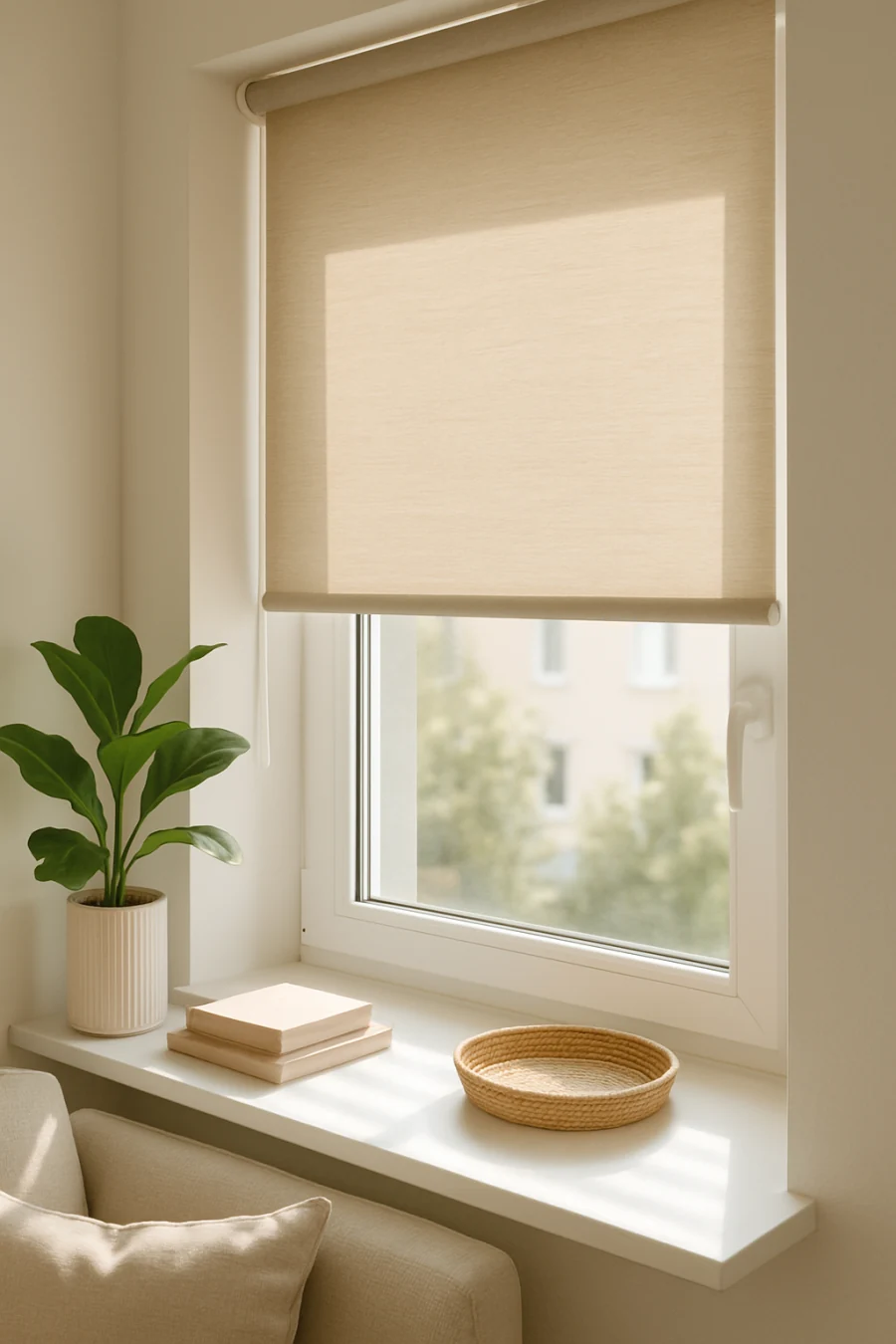















We make roller blinds with a pattern in Almaty to the size of your window: we print the design on fabric or use a panel with a woven pattern. Measurement is free, and the measurer comes with samples. Price — from 5,400 ₸/m², manufacturing 4–6 days, installation 4,500 ₸ per item.
Three different patterns on a roller blind: print, woven pattern and photo printing
A pattern on a roller blind can be printed on the surface of the fabric or woven into the panel itself. These are two different products — in how they behave in the light, in how they feel and in how they're cared for. The third case is when your image is transferred onto the fabric in full.
In our workshop we work with both printing and woven panels, so we see the difference not in a catalogue but on finished products. It shows up already at the measurement: the customer runs a hand over the sample and almost always is surprised at how differently two pieces of fabric with a similar pattern behave.
A printed design lies in a thin layer on the surface of the polyester. The ink doesn't penetrate deep into the fibre — it stays on the face side, so the pattern reads flat and bright. In side light it gives no texture at all. Such a layer doesn't like friction or soaking: printing forgives dust, but not a wet cloth or washing. We print with UV printing — it gives dense, even colour on polyester without the streaks that happen with other application methods.
A woven jacquard pattern is built differently. Here the pattern isn't printed — it's woven into the panel itself, tone on tone, from threads of different thickness and weave. In side light the woven jacquard pattern stands out in relief that you can see and feel. This option is chosen by those who want the natural look of fabric without a bright print: the pattern reads from close up rather than hitting the eye across the whole room. And — what matters in everyday use — a woven pattern withstands damp cleaning better than printing.
| What we compare | Printed design | Woven jacquard pattern | Photo printing |
|---|---|---|---|
| How the pattern is applied | ink on the surface of the polyester | the pattern is woven with tone-on-tone threads | your image on the fabric |
| How it reads | flat and bright | with relief in side light | as intended in the file |
| Care | a soft dry cloth, without rubbing | can be wiped with a damp cloth | a soft dry cloth |
Photo printing is third in the list for a reason: this is a roller blind with a pattern where the customer brings the image. We apply your photo, map or logo to the fabric cut to the size of the opening. You can read more about it on the next page, “With photo printing” — we won’t go into it here.
The main thing to take away from this section: before choosing a pattern, decide how it should sit on the fabric.
How the scale of a pattern reads on a window
The scale of a pattern on a roller blind depends on the size of the window and the distance to the viewer. A small fabric sample doesn’t convey this. In your hand you hold one fragment the size of your palm, while on the blind several repeats of the pattern are visible at once — and the pattern starts to work differently. The repeat, that is the step of the pattern, reads as a single element on the sample, but on a full window it turns into a rhythm.
This is where the main mistake in choosing comes from. A person lays the sample out on a table, likes a small check, orders it — and then sees that on a two-metre window that check has turned into a dense grid that makes the eyes swim. Or the opposite: a large floral motif looks noble in the hand, but across the whole window it will lie as two or three large leaves.
The distance to the viewer matters no less than the size of the window. From a sofa three metres away, a small pattern looks like a calm texture, but up close, at the windowsill, it breaks up into separate elements. That is why we ask you to look at the sample not in your hand, but on the window.
How to check the scale before ordering:
- place the fabric sample on the windowsill level with where the blind will be;
- step back to the distance from which you usually look at the window;
- look at the pattern as a whole, not at the weave of the threads;
- check the same sample up close, right at the glass;
- look at it in the evening with the light on.
Замерщик Jalusso привозит образцы и показывает, как рисунок читается на вашем проёме, — на месте это видно точнее, чем на любой фотографии.
A palm-sized sample doesn’t convey how the pattern will lie across the whole window, because several repeats of the pattern are visible on the blind at once.
How to check the scale before ordering
Lay the sample on the windowsill, step back to the distance from which you usually look at the window, and look at the pattern, not at the fabric. Our measurer brings samples and shows how the pattern reads on your opening — this is the only reliable way to see the scale.
Pattern on sashes: repeat, mullion and the cut line
The image doesn’t break: the blind is divided across the window sashes, and the pattern is matched at the joints. Roller blinds with a pattern on two or three sashes look like a single whole if the split was calculated before printing. The repeat sets the step of the pattern, so it is exactly what determines whether the picture will line up at the joint.
A window sash is the unit of the split. At the measurement Jalusso calculates the width of each sash separately, rather than dividing the opening in half. The mullion — the vertical post between the sashes — becomes a natural boundary: the cut is tied to the mullion so that the joint line hides behind the frame. If you cut the blind in the middle of the pattern, the joint will be visible even with precise matching.
The order of the split at the measurement:
- The measurer takes the width and height of each sash and notes where the mullions are.
- Using the fabric sample, determines the repeat step — the distance over which the pattern repeats.
- Calculates how many repeats will fit on each sash as a whole, without cutting through the middle of the pattern.
- Checks whether the pattern will match at the joint and, if necessary, shifts the blind so that the match falls on the mullion.
- Agrees the split with you before printing.
On neighbouring windows in the same room, the pattern is kept in the same rhythm: if on the first window the pattern starts from the windowsill, on the second it also runs from the windowsill. Otherwise two windows side by side look random, even when the fabric is the same. And on a corner window, where the sashes meet at a right angle, the split is calculated separately for each plane — a shared repeat doesn’t work here.
The pattern on a roller blind is cut across the sashes, and the quality of the joint is determined by how precisely the repeat is matched at the mullion.
What happens to the pattern in a rolled-up blind
In the raised position you see the bottom edge of the blind and the reverse side — the pattern reads differently there than when unrolled. A dense print looks darker in the roll than on an open window. This is checked on the sample before ordering: the measurer shows the fabric both unrolled and rolled up.
Large or small pattern for a small room and a window with several sashes
A small pattern suits a small room and a workspace, while a large one requires a big window and space around it. Jalusso’s advice is this: first the area of the room, then the scale of the pattern. A small room — the pattern should read from arm’s length, that is, run as a small repeat. A tall wall and a wide opening — then a large pattern is appropriate.
Why does a large pattern work against the owner in a small room? It takes up almost the whole fabric — there are few repeats, and the eye keeps hitting the same fragment. In a bedroom this tires you out fastest: the room is small, the bed is close to the window, and by evening the large pattern starts to feel oppressive. In an office the same thing happens — the monitor and papers are right there, and the eye keeps returning to the window. A small repeating pattern is different up close: it reads only at close range and doesn't distract from your desk. That's the answer about a pattern that doesn't make your eyes swim.
There's a second layer too. When a window has several sashes, a large pattern behaves more unpredictably: part of the design disappears behind the mullion, and the whole no longer comes together. The smaller the repeat, the calmer the split looks. That's why for a multi-sash window we more often recommend a small or medium pattern.
Let's compare on two points.
| Feature | Large pattern | Small pattern |
|---|---|---|
| Room | Large, spacious | Small |
| Office and bedroom | Tiring up close | Doesn't make your eyes swim |
| Multi-sash window | Cut by the mullion | Runs calmly across the sashes |
An example from practice: at the “Bedroom in a new build” project we settled on a fine diagonal instead of a wide stripe — in a bedroom it doesn't make your eyes swim. And in the “Classroom”, small stars on a white background are visible up close but don't distract from a desk.
A small pattern suits a small room and a workspace, while a large one needs a big window and space around it — start from that when choosing. Always check the scale of the pattern on your own window, not from a picture.
Light through the pattern: how it looks by day and in the evening
How light passes through the fabric decides how the pattern behaves on the window throughout the day. Backlit by daylight, the print reads brighter than in a roll against the wall: sunlight passes through the fabric and lights the ink from inside. In the evening the picture changes — with a lamp on, the pattern fades, because the room becomes brighter than the street and the fabric stops working as a screen.
Here's what you see on the same window:
- By day, with light from the street: the pattern on light-filtering polyester reads more clearly than against the wall, especially if the sun hits the window from the side or straight on.
- In the evening, with a lamp on: the pattern fades into shadow, the fabric looks darker and calmer; a print that was bright by day is almost invisible at this time.
- On dense fabric the difference between day and evening is smaller — there the pattern always reads from the front side, not backlit.
Blackout is a separate story. This fabric doesn't let light through, so the pattern doesn't show through or glow from inside — the design is visible only on the side where it's printed. Dense fabric hides the yard and neighbouring windows, but doesn't add light to the room: the space stays in shadow while the blind is down. Day-night blinds work differently — they alternate dense and sheer stripes, and we don't apply photo printing to that kind of fabric, so roller blinds with a print are made on a single-piece fabric.
The reverse question is how the window looks from outside. From the street, silhouettes and the light in the room show through the blind, but the pattern itself reads faintly: reflection on the glass and the distance to the facade get in the way. If the window faces a neighbouring building or a road, dense fabric hides what's happening in the room more reliably than light-filtering fabric. In my view, it's not worth choosing a blind for the sake of how it looks from outside — customers rarely think about this, while the backlit look by day and in the evening is visible every day.
Light-filtering fabric makes the pattern bright when backlit by day and fades it in the evening, while dense fabric hides the yard and neighbouring windows but doesn't add light to the room.
Stripe, ornament, plants, a children's scene: what a pattern does to a window
A stripe changes the proportions of a window more than any other pattern. A vertical stripe visually stretches the window — this is noticeable if the opening is wide and looks squat. A horizontal stripe works the other way: it widens the window and shortens it in height. For a narrow, tall window a horizontal stripe will balance it; for a low, wide one it will only emphasise the width more.
A geometric ornament holds the shape of the window and doesn't argue with the furniture. A fine grid, a small check, a diagonal — these roller blinds with a pattern are chosen when the room already has active surfaces: granite in the kitchen, tiles in the bathroom, laminate with a pronounced pattern. An ornament with a curl — a monogram, damask — reads more dressy, but needs space around the window. In a small room a large damask starts to feel oppressive, and we usually suggest replacing it with the same motif in a smaller scale.
A plant pattern — leaves, branches, muted greens — brings the window to life and replaces a sheer curtain. In a living room this motif works calmly if the lines are fine: dense greenery with large leaves looks like a separate object and pulls attention away from the furniture.
A children's scene print goes out of date faster than a child grows up. Clouds, stars, little animals are liked at one age and annoying at another, and the fabric is replaced entirely. That's why in a child's room we more often recommend neutral geometry instead of a scene: at the “Kids' room” project we chose a fine geometric grid — the pattern won't feel childish once the child grows up. The same approach worked in a teenager's room, where the blue wave on the blind was matched to the bedspread and rug: the pattern tied the room together instead of being tied to an age.
There's another way too: match the pattern on the blind with the wallpaper and textiles in the room in advance. Then the blind works as a continuation of the interior, not as a bright spot on the window.
A vertical stripe stretches a window, a horizontal one widens it, and a children's scene print lives a shorter life than a child's room.
Case: a fine geometric grid in a child's room
At the “Kids' room” project we used a fine geometric grid on two windows. The parents wanted a pattern but didn't want to change the blind in a couple of years when the child starts school. The grid solved this: it reads as a pattern, not as a picture about an age.
We used the same approach in a teenager's room — the blue wave was matched to the bedspread and rug. The blind tied the room together instead of being tied to an age.
A pattern that doesn't make your eyes swim in an office or meeting room
A small repeating pattern reads up close but doesn't distract from your desk. In a classroom we used small stars on a white background: the pattern is visible from the board, but from a desk it doesn't get in the way of looking at the board. The same trick works in an office and a meeting room — there roller blinds with a pattern cover the window and don't create a shimmer behind the monitor.
The pattern and the rest of the room: wallpaper, textiles, sheer curtain
You don't need a sheer curtain with a patterned roller blind. A patterned roller blind holds the window on its own and replaces a sheer curtain, and two layers of textile argue with each other: the mesh creates a fine shimmer, and the print behind it looks muddy. If you still want a semi-transparent layer, choose a plain white one, without a pattern and without shine.
The pattern on the blind is matched with the wallpaper and textiles in the room by a simple rule: there should be only one pattern. A wall with a monogram or damask, a rug with an ornament, a checked bedspread and a patterned blind in one room — that's four separate stories, and the window gets lost among them. If the wallpaper already has a pattern, a patterned roller blind takes a plain setting or the calmest repeat — a fine diagonal, a small grid, a barely noticeable branch.
- A wall with a large pattern — a blind with a small, sparse design or a plain one with a woven jacquard pattern tone on tone.
- Plain wallpaper and neutral textiles — you can go for an ornament (scroll, damask) or a stripe, and the pattern will become the accent of the room.
- Busy textiles (cushions, bedspread, rug) — pull one colour out of the print and use the same colour in the blind pattern, then the window supports the palette instead of clashing with it.
- The sheer curtain, if you keep one, should be without a pattern, otherwise the mesh and the print will give you a double pattern against the light.
The pattern you tire of less often is not the quieter one, but the one tied to the colour of the room rather than to fashion. Practice shows the opposite: what you tire of most often is the most fashionable, the largest and the brightest design — it is the first to grow old and the first to need replacing. Our recommendation is a small repeat in a muted tone.
And one more observation from measurements. Clients often point to a wardrobe or a sofa and say: match something to this. That is not the way to do it. Furniture and textiles change more often than a blind, and the fabric is harder to re-cover or replace. It is worth buying roller blinds with a pattern with an eye on the walls and the window, not on the soft furniture that will live in the room for less time.
The main rule of matching: if the wallpaper already has a pattern, a patterned blind takes a plain setting or the calmest repeat, and it needs no sheer curtain.
Rooms: bedroom, kids’ room, kitchen, study, living room
The room dictates the pattern more than personal taste does. The same stripe that works in a living room starts to shimmer in a bedroom by evening. Let us go room by room through what we advise our customers in Almaty.
- Bedroom. Here people choose a calm small repeat: a thin diagonal, a grid or a plant pattern in muted tones. A small pattern suits a small room, and in the morning it does not hurt your eyes. Customers at the “Bedroom in a new building” project chose exactly a thin diagonal for two windows — a large stripe shimmers in a bedroom.
- Kids’ room. Roller blinds with a pattern for a kids’ room are chosen with an eye on age: a story print with cars or animals grows outdated faster than the child grows up. We advise geometry, stars or a background pattern — they will outlive changes in taste. The kids’ room from one of our projects lived on a thin geometric grid: the pattern will not look childish once the child grows up.
- Kitchen. Here the main thing is not the pattern itself, but how the fabric handles splashes and grease. Go for dense polyester with a small print: it is easier to wipe, and traces of cooking are unnoticeable on a busy fabric. A striped print looks tidy in a kitchen.
- Study. The pattern should not shimmer from your workplace. A small repeating pattern reads up close, and at arm’s length it does not distract. In a classroom, small stars on a white background did not get in the way from a desk — the same principle works in a study.
- Living room. The space allows a large ornament: damask, scroll, a wide stripe. In the meeting room from one of our projects, a Scandinavian polka dot removed the official look — in a living room the effect is similar.
Replacing the fabric is possible: the mechanism stays in place, the workshop prints a new piece and swaps it. That is how people solve the issue if they have tired of the pattern but do not want to touch the system.
Kids’ room and safety
In a kids’ room, the control chain is fixed so that the child cannot reach it. This is a separate conversation at the measurement: we look at the height of the window, the height of the windowsill and how far the child can reach. We fix the cord and chain to the wall or hide them behind the fabric, and we place the control so that an adult can reach it, not a small child. The warranty on the mechanism is 3 years, on installation — 1 year, so if you move the furniture, the mount can be re-hung.
Caring for patterned fabric and what the sun does to it
You cannot wash a patterned roller blind. Caring for printed fabric rules out soaking and rubbing: water makes the ink on polyester spread through the fibres, and rubbing wears it off faster the harder you rub. The routine is simple.
- Lower the fabric fully and let the dust settle instead of flying around the room.
- Go over the fabric with a soft dry cloth without pressing — from top to bottom, following the fabric.
- Vacuum on low power with a soft brush attachment, without pressing it against the fabric.
- Wipe fresh splashes in the kitchen with a dry cloth right away, before the stain soaks in.
A pressed attachment leaves creases on the fabric that do not smooth out afterwards. And washing the fabric is not worth it even on a gentle cycle — the mechanism and the roller tube will suffer from water before the fabric does.
Next comes the sun. On a south-facing window, the sun gradually reduces the brightness of the pattern over time, and this is a normal process, not a defect: the pigment reacts to light just as fabric does on any other blind. Dense polyester holds colour longer than thin, but you cannot stop the pattern from fading completely. A woven jacquard pattern fades differently from a print: it is woven into the fabric itself, so it is not the pattern that dulls but the tone of the fabric as a whole. The warranty does not cover natural fading of the fabric — this is written into the terms, and we talk about it at the measurement, not afterwards.
If the window faces south, Kirill will select fabric for such a print and advise whether to go for dense fabric. On the north side, the issue of fading hardly comes up.
No-drill mounting
Drill-free mounting on the frame leaves no marks and suits rented housing. The measurer looks at the window profile and selects an option that will not stop the sash from opening: the system is held on the frame, not on the wall, so when you move, the blind comes off together with the mount. The coefficient for this type of installation is ×1.1 to the price of the product. We install patterned roller blinds on this mount as often as on the wall — there is only one limitation here: the profile must allow the clamp.
How much a patterned roller blind costs and what the price depends on
Roller blinds made of polyester with an open roller tube cost from 5,400 ₸ per square metre. The base figure is calculated by the area of the opening, and then coefficients for the control and the mounting method are applied to it. We do not list printing on fabric as a separate line here — the price of the category is one, and the measurer puts together the exact amount on site for your window.
Measurement is where any figure begins. It determines not only the area of the fabric but also the split into sashes, and the split changes both the metres and the cost of the product. Someone might say it is easier to measure the window yourself with a tape measure. In my view, that is an overrated approach: a skew of a couple of centimetres on a sash — and the fabric will have to be re-cut at your own expense.
Control and installation coefficients
| Control | Coefficient |
|---|---|
| Mechanical | ×1 |
| Chain | ×1.06 |
| Electric motor | ×1.85 |
| Electric with remote control | ×2.1 |
| Installation | Coefficient |
|---|---|
| Wall-mounted | ×1 |
| Frame-mounted | ×1.05 |
| No drilling | ×1.1 |
| Cassette system | ×1.28 |
A chain and an electric motor affect the cost of the product differently. A chain adds six percent to the base price, an electric motor — almost double, and an electric one with a remote control even more. The difference is not in the fabric: you are paying for the mechanism that raises the fabric.
The mounting method also moves the price. Drill-free mounting is more expensive than wall mounting, but it leaves no marks on the frame — in a rented flat this is often the deciding argument. The measurer looks at the window profile and selects an option where the sash opens freely.
And now about savings: for orders from 150,000 ₸ we do the installation free of charge; below that amount it costs 4,500 ₸ per product. Manufacturing roller blinds takes 4–6 days.
You can order roller blinds with a pattern in Almaty to your own sizes directly from us, without a middleman: we are a manufacturer with our own workshop, so there is no reseller’s markup in the chain. The price of a patterned roller blind is calculated by the area of the opening from 5,400 ₸/m², and the type of control and the mounting method change it through coefficients.
How to order: from a WhatsApp message to installation
Our measurer arrives with fabric and pattern samples — not with a catalogue on a tablet. You message us on WhatsApp, give us the address, and he brings the fabrics you will actually be choosing from. Kirill, our lead measurer, has been working with non-standard windows for nine years, and on site he works out not only the dimensions but also how the pattern will sit on your window opening.
Then the order is as follows.
- You message us on WhatsApp and agree on a time.
- The measurer arrives with samples, looks at the window and profile, and suggests a mounting option.
- On site he calculates the price: the area of the opening, the fabric, the type of control, and installation.
- The workshop prints the fabric and mounts the system on polyester.
- The installer arrives and fits the blind.
We manufacture in our own workshop in Almaty. A roller blind with a pattern is made to the dimensions of a specific window, not picked from ready-made stock. We do not keep finished products in stock — everything is made to measurement.
We discuss no-drill mounting on the frame during the measurement. If the window is a rental or the frame cannot be drilled, we look at the profile and choose an option with hook-and-loop tape or suction cups, so the blind does not stop the sash from opening.
One extra question that almost everyone asks: do you come outside the city? We do travel to Kaskelen, Talgar, Issyk and Kapshagay; the call-out fee depends on the distance and is quoted before the visit. Within the city, measurement and delivery are free.
Measurement and consultation are always free — it does not depend on whether you place an order or not.
Trips to the suburbs
We travel to Kaskelen, Talgar, Issyk and Kapshagay; the call-out fee depends on the distance and is quoted before the visit. On this page we work in Almaty.
FAQ
We have collected what people most often ask during the measurement, once the decision to go with a patterned roller blind has already been made.
How does a woven pattern differ from a print when it comes to care?
A printed design sits on the surface of the polyester as a thin layer and does not like rubbing or soaking. A woven jacquard pattern is woven into the fabric itself, tone on tone, so it has no surface layer of ink. You can wipe both with a soft dry cloth, but a print needs a gentler touch. Neither can be washed in a machine.
What if you tire of the pattern: can you replace just the fabric?
The mechanism stays, the fabric is replaced. The measurer comes and takes the dimensions again: if the window has not been changed, the dimensions will match, but they still need to be checked. Then the workshop prepares a new fabric with a different print or woven pattern, and the installer fits it onto the same system. This is noticeably cheaper than replacing the whole patterned roller blind.
Do you need a blackout blind with a pattern in the bedroom?
Blackout does not let light through, and the pattern on it does not show through: the design is only visible in reflected light, from inside the room. If it matters to you to wake up at sunrise, a blackout fabric is not for you. If the bedroom faces south and the sun hits the window in the morning, a blackout fabric is a workable option. The exact choice depends on the orientation and your sleep pattern, and we discuss this during the measurement.
How does the pattern look from the street?
On a light-transmitting fabric the pattern is visible from the street during the day — backlit, the design reads more clearly than from inside. In the evening, when the light is on in the room, the picture changes: from outside you see the silhouette of the pattern, while from inside it fades. A blackout fabric blocks the view, but it does not add light to the room either.
Can you match a pattern to textiles you already have?
Yes. The measurer arrives with samples, and we lay them out next to your bedspread, curtains or a piece of wallpaper. If the wallpaper already has a pattern, we pick a calm repeat for it rather than a second bold design. You can send photos of your textiles to WhatsApp in advance — we will use them to shortlist options before the measurer arrives.
A woven jacquard pattern stands out in relief in side light, while a print gives a flat patch of colour — this is the main difference, and it determines both how the window looks and how you care for it.
Conclusion
A pattern on a roller blind behaves differently from one on ordinary fabric: it works backlit, rolls up into a roller and is cut to fit the sashes. That is where all the selection difficulties we discussed above come from.
A printed design and a woven jacquard pattern are different products. A printed design sits as a thin layer on the surface of the polyester: it reads more brightly in the light, but does not like rubbing or soaking. A woven pattern is woven into the fabric itself, tone on tone, stands out in relief in side light and is calmer to care for. If the pattern as a picture matters more to you, go for print. If the texture of the fabric matters more, go for jacquard.
The scale of a pattern is checked on the window, not on a palm-sized sample. Lay the sample on the windowsill and step back to the distance from which you usually look at the window.
The measurer works out the split of the fabric across the sashes and the cut line on site. They try to align the cut with the mullion and match the repeat at the joins — this is work done for your specific windows, and it cannot be done from a photo.
The price is calculated from 5,400 ₸ per square metre, and the type of control and mounting method change it through coefficients. Manufacturing roller blinds takes 4–6 days.
What to do right now? Message us on WhatsApp and book a measurer with samples. You will never have to pay for the consultation or the measurement, and within Almaty the call-out and delivery are free as well. See the pattern on your own window, in your own light and with your own furniture — and only then order roller blinds with a pattern in Almaty.

