


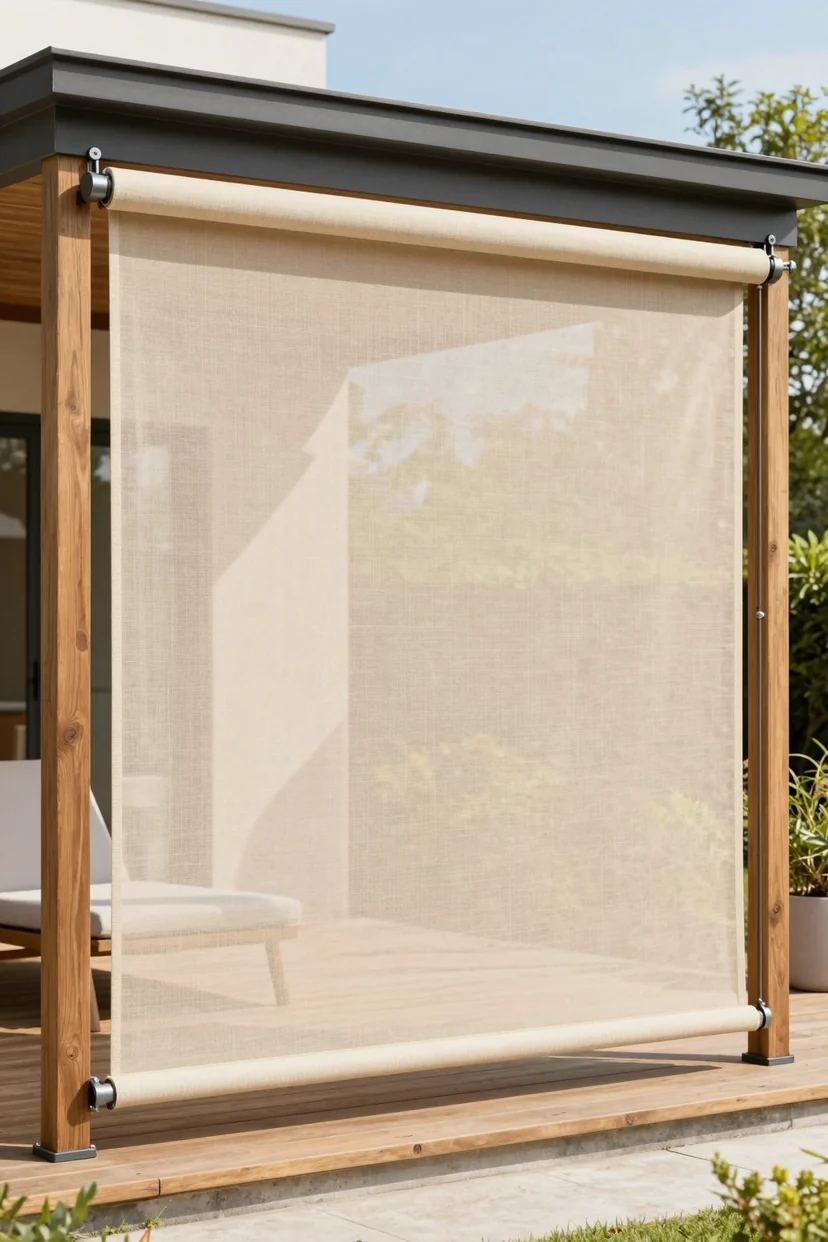


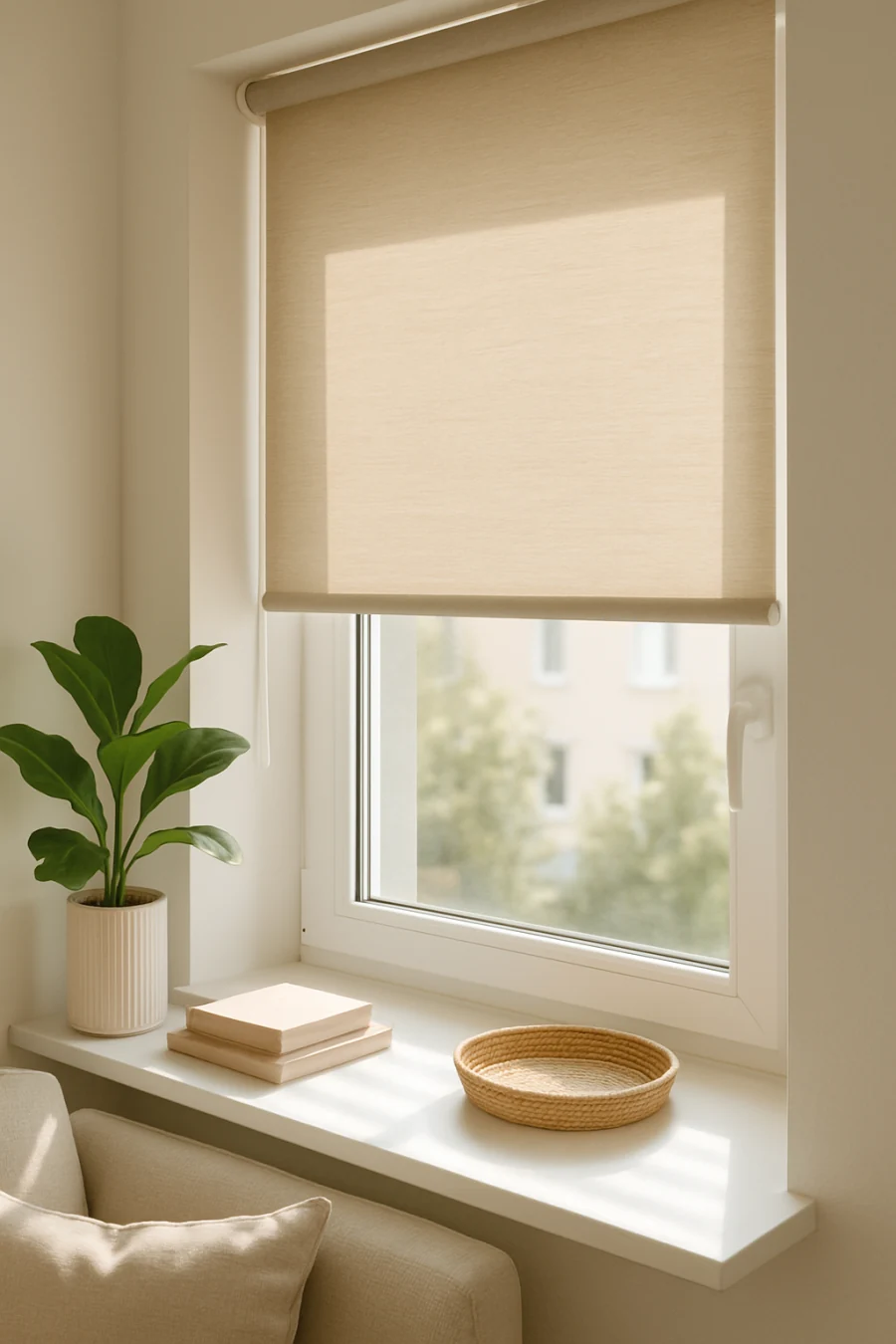


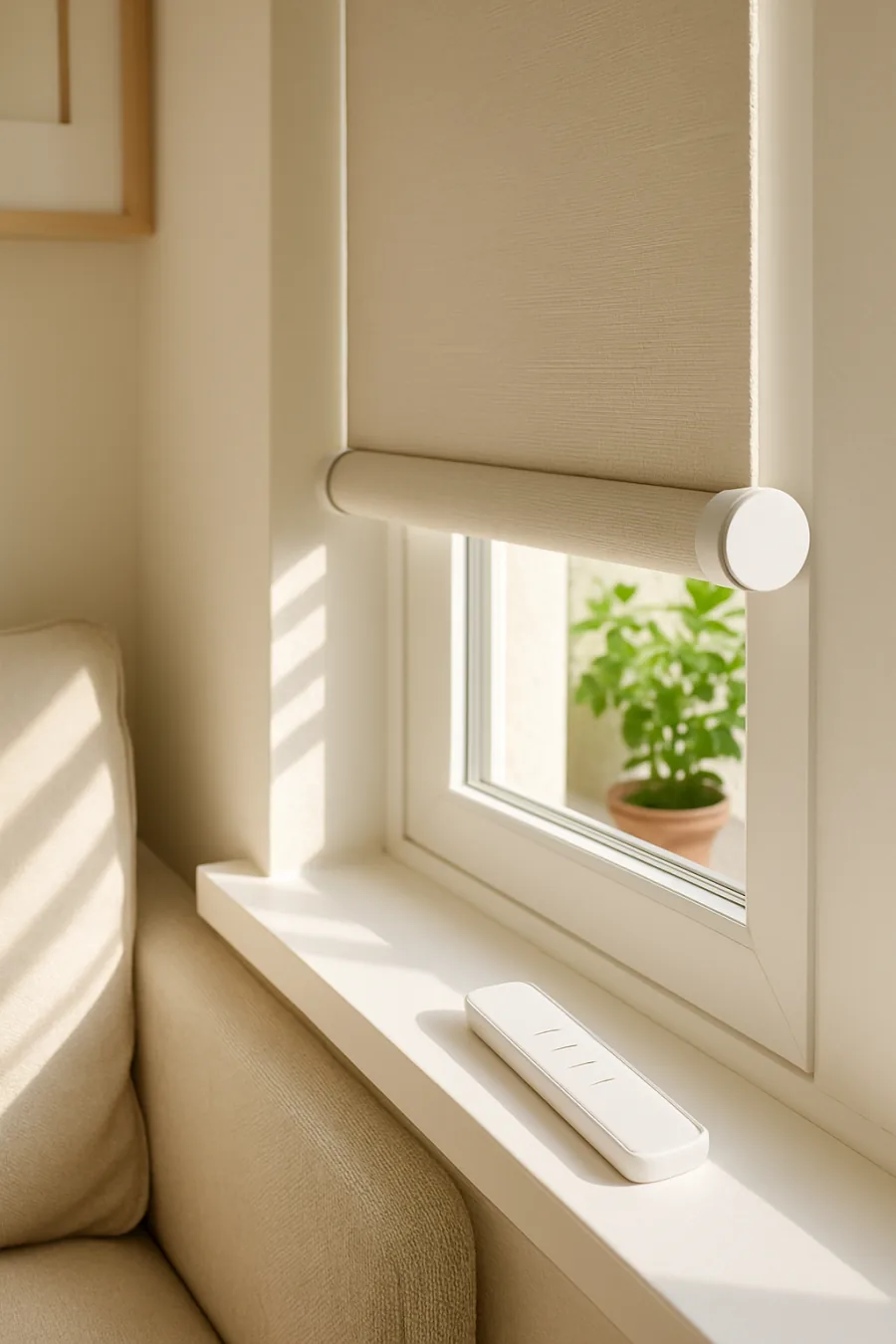











Roller blinds for terraces and verandas in Almaty are a fabric on a tube that is mounted to the canopy or posts, not to the window frame, and covers the area by the house from the low evening sun, mountain wind and prying eyes from the street. We manufacture them to measure in our own workshop: the measurer comes with samples, calculates the cost on site, then the workshop and installation follow. Price — from 14,500 ₸/m².
What an outdoor roller blind is and how it differs from an indoor one
An outdoor roller blind is a fabric on a tube that is mounted to the canopy structure or to the terrace posts, not to the window frame. We make roller blinds for terraces and verandas in Almaty in exactly this design: the product is intended for an open area, not a room, so it covers the terrace or veranda from the low evening sun, from mountain wind and from prying eyes from the street.
For an open area in Almaty, a regular fabric roller blind is suitable more often than it seems. The logic is simple. Film does not hold its shape and gives no privacy. A ZIP system solves more problems than a dacha owner or a café needs. And in between there is the middle ground — roller blinds for a terrace, which we make to measure: fabric, tube, fasteners for your structure.
A ladder of solutions: film, fabric blind, ZIP system
PVC film is a soft window: it closes the opening but does not hold its shape or keep the view. A ZIP system is an all-season structure with a lock on the sides, and it is noticeably more expensive. A fabric roller blind sits between them: the fabric on the tube lowers to the height you need and locks in place. For a veranda under a canopy, that is enough.
Jalusso’s measurer looks at the site and suggests the option that fits the task, not the most expensive one.
How outdoor performance differs from indoor
The difference is in three things: the fabric, the mechanism and the mounting. For outdoors, the fabric is denser and fades more slowly than for an indoor window. The mechanism is protected from dust and splashes. And the fasteners go into the structure — into the canopy, the posts, the pillars — whereas an indoor blind is hung on the frame. The low evening sun means you first need to close the western side of the site, and the wind from the mountains means the edges of the fabric should be secured.
Screen fabric keeps the view from the terrace, but from the street in the evening with the lights on it gives less privacy than a dense fabric. This is a compromise we talk about openly during the measurement.
An outdoor roller blind is mounted not to the window frame but to the canopy structure or the posts, so it is designed for an open site, not for a room.
ZIP system or a regular roller blind: how to tell what your site needs
For an open terrace and a veranda under a canopy, roller blinds for terraces and verandas in Almaty solve the task of evening shade and wind protection with a regular structure — with cable guides or a housing box. A ZIP system is needed where the site is being turned into an all-season room. That is a different task, and there is no point paying for it just for evening shade.
How does a ZIP system differ from a regular roller blind? Its fabric goes into the lock of the side guides and is held in them along the full height. That is why the blind is left outside through the cold season, and the site becomes something like a closed room. Cable guides work differently: a steel cable passes through the bottom bar and is fixed to the decking. The fabric does not flap, but there is more free air around it, and the terrace stays a terrace, not a room.
Wind from the mountains causes the fabric to flap, and the choice depends on that. Cable guides hold the edges of the fabric in the wind; a housing box with guides does the same and at the same time protects the fabric and the tube from dust. And a heavy blind without secured edges should not be installed on a windy side: the fabric will start banging against the posts. We usually advise first assessing how the site is exposed to wind by evening, and only then choosing between a cable and a housing box.
Below is a short table that shows the difference.
Comparison table
| What we cover | How the fabric behaves in the wind | Whether a housing box is needed | What we control it with |
|---|---|---|---|
| Open site | Cable guides hold the edges, the fabric does not flap | Not required, but with a housing box the fabric stays cleaner | Chain, spring or electric motor |
| Veranda under a canopy | The fabric is covered from above, the guides secure the edges | A housing box with guides extends the life of the fabric | Chain or electric motor |
| All-season room | The ZIP system holds the fabric in the lock of the guides | The housing box is part of the structure | Electric motor with remote control |
Cable guides and a housing box with guides hold the edges of the fabric in the wind, so for an open site this is enough if you do not need an all-season room. The choice between a ZIP system and a regular roller blind is the difference between a year-round structure and seasonal protection from sun and wind. The measurer looks at how exposed the site is to wind and suggests the right option on the spot.
Which side of the terrace to cover: orientation, wind from the mountains and time of day
The western side is covered first. Roller blinds for terraces and verandas in Almaty solve exactly this task: in the evening the sun sets low, the rays come almost horizontally and go under the canopy that saved you from the overhead sun during the day. The fabric is lowered when the sun starts blinding those sitting at the table.
The south comes second in terms of heat. In summer the sun stays high there for most of the day, and the canopy takes the main load. But closer to sunset the low evening sun also comes from the southwest — that is when the southern wall of the terrace also calls for fabric. On the east, a blind is needed less often: the morning sun is softer, and the eastern opening is covered only during breakfast, if at all.
A veranda closed on three sides and an open site
A terrace adjoins the house, so one wall is already covered by the house itself. On a veranda closed on three sides, fabric is needed on the open opening, and sometimes on the second side, where the sun sets or where there is a view of the street. Privacy also plays a role here: in the evening, when the lights are on inside, the veranda is visible from the street right through. Dense fabric is hung on that side, not on the side facing the garden.
For an open site where the house does not cover any wall, one blind is not enough. The wind from the mountains comes through the open side in the evening and at night, and fabric without secured edges starts to flap. Cable guides or a housing box with guides are installed on the side the wind blows from, while the side with the garden view is left open during the day.
What we usually advise during the measurement:
- west — cover first;
- southwest — the second opening for a blind;
- the open side with wind — secure the edges of the fabric;
- the side with the view — leave it open until the sun becomes a problem.
The measurer comes with samples and looks at the site on the spot: where the sun sets relative to the house, where the wind blows from in the evening, where the view opens onto. Going by orientation alone is not enough. The canopy matters too, and how the terrace stands relative to neighbouring buildings.
In Almaty the sun sets low in the evening, so the western side is covered first, and the wind from the mountains in the evening and at night requires the edges of the fabric to be secured.
Fabric for terraces and verandas: screen, acrylic, PVC
The fabric for a terrace or veranda is chosen by what the space needs, not by the colour of the sample: screen keeps the view, acrylic awning fabric holds up on an open area, and PVC film closes an opening like a soft window. For terrace roller blinds these are three different things, and they should not be confused.
Screen fabric is a fibreglass cloth with micro-perforation. During the day you can see the garden and the street from the terrace, while from the street it is almost impossible to look inside. In the evening the picture changes: if the light is on under the canopy and it is dark outside, screen works like a shop window. This is where privacy is decided — either you take a denser fabric, or you close the side facing the neighbours and leave the side with the view open. And that is a normal compromise, not a mistake.
Acrylic awning fabric suits open areas. It is denser, with a water-repellent treatment, rolls onto the tube and holds its shape without sagging. Acrylic withstands the swing from daytime heat to night cold — on a veranda under a canopy this is far more noticeable than in a room. For an open terrace in the mountain wind, acrylic is chosen more often than screen precisely because of its density.
PVC film is not a fabric blind. A transparent panel in a frame or with a zip closes the opening completely against wind and rain, but the view through it is distorted, and it heats up in the sun. If you want to turn the space into a second room, look towards a ZIP system or glazing rather than pulling film onto a tube.
How the Almaty climate affects the choice
A sharply continental climate: frost in winter and a big difference between day and night, heat, sun and dust in summer. Fabric for outdoor use is taken denser and slower to fade — not because it will stop lightening, but because it will last longer. The mechanism in the housing box is shielded from dust and splashes, but that is protection, not a guarantee: getting wet and natural fading of the fabric are not covered by the warranty.
Screen keeps the view from the terrace, acrylic awning fabric suits open areas, and PVC film is a soft window, not a fabric blind.
How to attach the blind to the structure: wood, brick, metal
The fastening to the structure is chosen to match the material of the post. For brick, anchors are used; for wood, screws; for metal, special clamps. That is why a metal pergola does not need welding: the clamp wraps around the post and holds the housing box or bracket without welding and without holes in the metal. On a wooden veranda everything is simpler — a screw goes into the beam or the post and holds reliably, as long as the board is not rotten.
Measurement comes before the cost estimate. The measurer inspects the terrace posts and the canopy, determines the material and says which fastening will suit and how the fastening line will sit. He arrives with samples — you can touch the fabric on site instead of choosing from a picture on your phone.
The fastening to the structure depends on exactly where the blind goes. If it is an opening between two posts, the housing box is attached to the posts. If the blind runs under the canopy along the house wall, it is attached to the wall or to the canopy beam. On a flat brick wall an anchor holds confidently. On uneven posts of old brick the fastening line wanders, and the housing box will not sit straight — there we more often suggest cable guide rails, which forgive unevenness.
And what if it is a pergola with thin aluminium posts? The clamp is chosen to match the profile; drilling thin metal is not worth it. Straightness matters more than the looks of the fastening: a skewed housing box will later jam when the fabric is raised.
Step-by-step checklist before installation
- Inspect the posts and the canopy: material, thickness, condition.
- Determine the material of the structure — the fastening depends on it.
- Choose the fastening: anchors for brick, screws for wood, clamps for metal.
- Check that the fastening line is straight — the housing box or bracket will sit along it.
- Agree the plan with the measurer before manufacturing in the workshop.
The structure is drilled for the fastening, and that is normal: the terrace will not have to be redone, the holes go into the posts or the wall. The fastening is chosen to match the material of the structure, so a pergola does not need welding.
Control at height: chain, spring, electric motor
For low openings a chain or spring mechanism is enough — it is simple and reliable. Where it is hard to reach, an electric motor or an electric motor with a remote control is installed: on a high terrace it is awkward to reach for the tube across a table, and a wide terrace roller blind does not yield to the hand at all.
The chain is the familiar option. You pull it, the fabric goes up or down and stays where you stopped it. And it works the same both on a veranda and on an open area. The chain does not like dust: keep it away from the decking, and wipe it down during the season.
The spring mechanism fixes the blind at the required height: pull the bottom rail — the fabric is set. No chain and no wires. On narrow terrace openings, where a chain would get in the way of the passage, the spring saves the day.
An electric motor controls a wide fabric with a remote control. A motor is built into the tube, and how to bring power to it is decided at the measurement. A guest house veranda with two wide openings is just such a case: two blinds on motors, one button at the entrance, and no need to walk around the space.
What to choose by opening height:
- up to arm's reach — chain or spring;
- higher or wider — electric motor;
- several fabrics on one area — a motor for each.
Wide and long fabrics are usually closed with a motor precisely because they cannot be raised by hand. And here the second question matters: one piece or sections.
When the fabric is divided into sections
Long fabrics without guide rails sag, so they are divided into several sections. With guide rails the fabric holds its shape along the whole length, and it does not have to be divided. We do not name the maximum width of a single fabric — it is determined by the measurer on site, not by a table.
For low openings a chain or spring mechanism is enough, while wide and long fabrics are usually closed with an electric motor and remote control.
How much terrace and veranda roller blinds cost
Outdoor roller blinds for a terrace and veranda start from 14,500 ₸/m². This sum includes the outdoor screen or PVC, the housing box and ZIP guide rails; the manufacturing time for this item is 10–14 days. If the area is closed with a motorised fabric, the price starts from 26,900 ₸/m², the motor is already included in this line, and manufacturing takes 12–16 days.
Measurement always comes before the cost estimate: the measurer arrives with samples, measures the openings, looks at the side of the sun and how exposed the area is to wind. Without that, naming a sum is pointless. Installation is carried out after manufacturing in the workshop, not before it.
| Price list item | How it differs | Price from | Lead time |
|---|---|---|---|
| Outdoor roller blinds | basic version: screen or PVC, housing box and ZIP guide rails | 14,500 ₸/m² | 10–14 days |
| Outdoor roller blinds, dense screen fabric | fine perforation, the view is preserved | 16,700 ₸/m² | 10–14 days |
| Outdoor roller blinds, opaque fabric | the area is hidden from prying eyes | 19,600 ₸/m² | 10–14 days |
| Outdoor roller blinds with electric motor | the motor is already in the price of the line | 26,900 ₸/m² | 12–16 days |
| Outdoor roller blinds, opaque fabric with electric motor | opaque fabric plus motor | 36,300 ₸/m² | 12–16 days |
What the total is made up of
The order total is made up of four components: the area of the opening, the fabric, the way the fabric is fixed and the type of control. Plus installation per item. A wide terrace with a motor for each fabric will cost more than a narrow veranda with a chain — and that is normal, their needs are different.
Installation — 4,500 ₸ per unit. For orders from 150,000 ₸ we do it free of charge. We give the timelines straight away: outdoor version — 10–14 days, outdoor with an electric motor — 12–16 days, after which the crew mounts the finished fabrics on the structure.
In my view, the extra cost doesn't start with the motor — it starts with skipping the measurement: without an on-site calculation, people order a system “by eye” and then pay to fix it themselves. Our measurer gives you the exact price right there on your terrace.
Warranty — 3 years on the mechanism and 1 year on installation from the date the acceptance report is signed; getting wet and natural fading of the fabric are not covered.
Measurement, manufacturing and installation: how it works in Almaty and the suburbs
Measurement comes before any price calculation, so everything starts with a WhatsApp message. The measurer arrives with samples, looks at the site, the structure and which way it faces, and gives you the price right there. Within the city, measurement and delivery are free — both for roller blinds on a veranda and for outdoor roller blinds on a terrace.
Here is how the work goes:
- Request via WhatsApp: you describe the site and send photos of the openings.
- The measurer visits with samples and calculates the price on site.
- Manufacturing in our workshop.
- Installation on the finished structure.
- We give 3 years on the mechanism and 1 year on installation; the count starts from the date in the acceptance report.
Installation is carried out after manufacturing in the Jalusso workshop, meaning the blind is brought to the site already finished. Installing one blind costs 4,500 ₸, but for orders from 150,000 ₸ it comes with no extra charge. The manufacturing time for outdoor roller blinds is 10–14 days: the fabric, housing box and guide rails are made for a specific opening, not taken ready-made from stock. If an electric motor is planned for the area, the timeline is different — 12–16 days, and the price of this version starts from 26,900 ₸/m² with the motor already included. It is better to plan the work in advance, before the season, when the evenings on the terrace are still cool and it is not yet obvious that the west side will flood the area with sun.
Suburbs and commercial properties
We travel to the suburbs of Almaty — Kaskelen, Talgar, Issyk, Kapshagay — and the cost of the visit depends on the distance and is quoted before we come out. No surprises on the day of the measurement.
For a hotel or café veranda, that is, for HoReCa properties, the measurer looks at the whole site and counts the number of openings. We once had an order for a hotel veranda in the mountains: 4 openings, acrylic fabric — it handles the swing from daytime heat to night-time cold. The measurer also checked separately how the fixings would sit on the pitched roof.
Kirill comes out — our lead measurer, 9 years working on non-standard structures. He also gives you the exact price, and the order is calculated from it.
Measurement, manufacturing and installation run as one chain with no middlemen: we calculate it ourselves, make it ourselves in the workshop and install the product on the structure ourselves.
Seasonal care, winter and safety near fire
Seasonal care is what separates a fabric that has lasted one warm season from one that works for years. An outdoor roller blind is made for an open site, but winter in Almaty with its frosts and day-to-night temperature swings is not its time. The fabric is raised into the housing box or taken off the roller tube until spring. And it's taken off entirely, not left hanging: that way the fabric and the mechanism get through the cold more easily. In frost, don't lower the blind — ice in the guide rails makes it risky: the edge of the fabric runs along the frozen groove and tears. Wait for the thaw, clear the ice, and only then touch the mechanism.
For the winter, outdoor fabrics are best raised or taken down — that way they last longer. That's the point of seasonal care: it extends the working life of the fabric, not just keeps it looking neat.
Fabric care
After the season, the fabric is washed to remove dust and pollen. Plain water and a soft brush handle the film. Poplar pollen clogs the micro-perforation of a screen more tightly than it looks: wash it off not with a pressure jet, but carefully, from top to bottom. Bird droppings are removed right away — they leave a mark that can't be scrubbed out later. The fabric is dried flat and stretched out.
What seasonal care won't fix is getting wet. The warranty is 3 years on the mechanism and 1 year on installation from the date the acceptance report is signed, and water and natural fading of the fabric are not covered by the warranty. On an open site, the fabric gets wet in slanting rain and lightens in the sun — that's normal behaviour of the material, not a defect.
Fire and insects
If there's a mangal, fireplace or gas heater nearby, the fabric is kept a safe distance from the fire. I can't give you an exact figure — it depends on the installation height, the length of the blind and which side the heat comes from. The measurer looks at the site and suggests a plan: sometimes it's enough to lower the blind only to the table so it doesn't end up in the heat zone.
The blind can be combined with an insect screen — that's a common request on verandas by the water. The screen is fitted to the opening, and the fabric lowers over it.
Seasonal care, winter storage and the right distance from fire together extend the working life of the fabric — that's exactly what we insist on when we hand over a project.
Case studies: how we covered terraces and verandas
The width of the fabric on a terrace is set not by what the customer wants but by the guide rails: a single piece is made exactly as wide as the fixed edge can hold. As soon as the span gets long, fabric without guide rails sags — so it's split into sections, and each section gets its own roller and its own mechanism.
Let me remind you where we start the conversation about any property. If there are no guide rails and the site is windy, the blind starts to flap and bang against the posts in a strong wind. What to do? Install cable guides or a housing box with guide rails: cable guides hold the edges of the fabric in the wind, and a housing box with guide rails protects the fabric and the roller tube from dust. Without this, the fabric on an open side behaves unpredictably, and we say so honestly before the measurement, not after.
A case from practice. A terrace at a country house: brick pillars, and the fixing line along them came out uneven. A housing box wouldn't sit straight, so we used cables instead of guide rails — they hold the edges of the fabric and don't require the supports to be perfectly straight.
For terraces, we most often make roller blinds with fixing to the structure rather than to the window frame. This is exactly that case: the posts and the canopy give support but forgive uneven brickwork, which a housing box does not.
Terrace of a country house
The second point is the nature of the site itself. On a terrace and on a veranda, the fabric is positioned so it doesn't block the walkway and doesn't rub against the facade. We look at where the furniture is, where the walkway is, where the evening sun lands, and only then calculate the sections.
A hotel veranda in the mountains and a terrace with a fireplace
We handle HoReCa properties — hotel verandas, cafés — separately: there are several openings, and each one has its own task. On the hotel veranda in the mountains we chose acrylic awning fabric: it handles the swing from daytime heat to night-time cold. On the wide openings we installed an electric motor, because raising the fabric by hand from outside is inconvenient.
On the terrace with a fireplace, the fabrics were kept a safe distance from the fire. Exactly where that line runs is decided by the measurer on site.
The fabric, guide rails and controls for a terrace and veranda are chosen for the specific site: we don't have one universal set for every property.
FAQ
How does an outdoor roller blind differ from an indoor one in terms of fixing? An outdoor roller blind is fixed to the canopy structure or to the terrace posts, while an indoor one is fixed to the window frame or the sash. That's where the difference in calculation comes from too: the measurer looks at how exposed the site is and what the posts are made of, not just the size of the opening. The fixings are chosen for wood, brick or metal.
What to do in a strong wind if there are no guide rails? You'll have to raise the fabric — without a fixed edge it will flap. Cable guides or a housing box with guide rails are exactly what hold the edges of the fabric in the wind from the mountains, so on an open side they're installed from the start, not after the first gusts.
How do I wash screen fabric and acrylic awning fabric? Screen fabric and acrylic awning fabric are washed after the season — to remove dust, poplar pollen and bird droppings. Getting the fabric wet is not covered by the warranty, and machine washing is not suitable for the blind.
What does the warranty cover? The warranty covers the mechanism and the installation: 3 years on the mechanism and 1 year on the installation from the date the acceptance report is signed. If the case is recognised as a warranty case, we will repair it free of charge and within five working days. Natural fading of the fabric is not covered by the warranty — nor is water.
How does measurement work outside the city? You message us on WhatsApp, and the measurer comes with samples to Kaskelen, Talgar, Issyk or Kapshagay. The measurer tells you the cost of the trip before setting off to you — it is based on mileage. Within the city, measurement and delivery are always free. The measurer also assesses the electric motor on site — whether there is somewhere to run the power supply.
Conclusion
An outdoor roller blind is a separate class of product between PVC film and a ZIP system. It is attached to the canopy structure or to the terrace posts, not to the window frame, so an ordinary roller blind covers the area by the house without all-season rebuilding. We manufacture such blinds to measure: first the measurer looks at the area, then the workshop makes the blind for the specific opening.
First of all, close the western side. In the evening the sun sets low and hits right under the canopy, and the wind from the mountains requires the edges of the blind to be secured. Cable guide rails or a cassette with guide rails hold the edge, and the blind does not flap. The fabric is chosen according to the task of the area: screen keeps the view, acrylic awning fabric works on an open veranda, and PVC film is a soft window, not a fabric blind.
For the money there is one reference point — the price-list item “Outdoor roller blinds”: from 14,500 ₸/m², this price includes the outdoor screen or PVC, the housing box and ZIP guide rails, and the manufacturing time is 10–14 days. If the area needs a motor, we look at the line of outdoor roller blinds with an electric motor: from 26,900 ₸/m², timeline 12–16 days, the motor is already in the price of the line. We charge 4,500 ₸ for installing one unit, but from an order total of 150,000 ₸ we install free of charge.
We keep the mechanism under warranty for 3 years and the installation for 1 year, and we count the term from the signing of the acceptance report. The fabric getting wet and natural fading are not covered by the warranty, and it is more honest to say this before the order, not after. We do not take on running the cable along the beam — how to supply power is decided at the measurement.
There is one practical recommendation: start with a measurement. The measurer comes with samples, looks at the side of the sun, how exposed the area is to wind and the material of the posts, and gives the exact amount on site. Measurement and consultation are always free, within the city measurement and delivery are also free, and we travel outside the city, including Kaskelen, Talgar, Issyk and Kapshagay, and we tell you the cost of the trip before we set off.

