




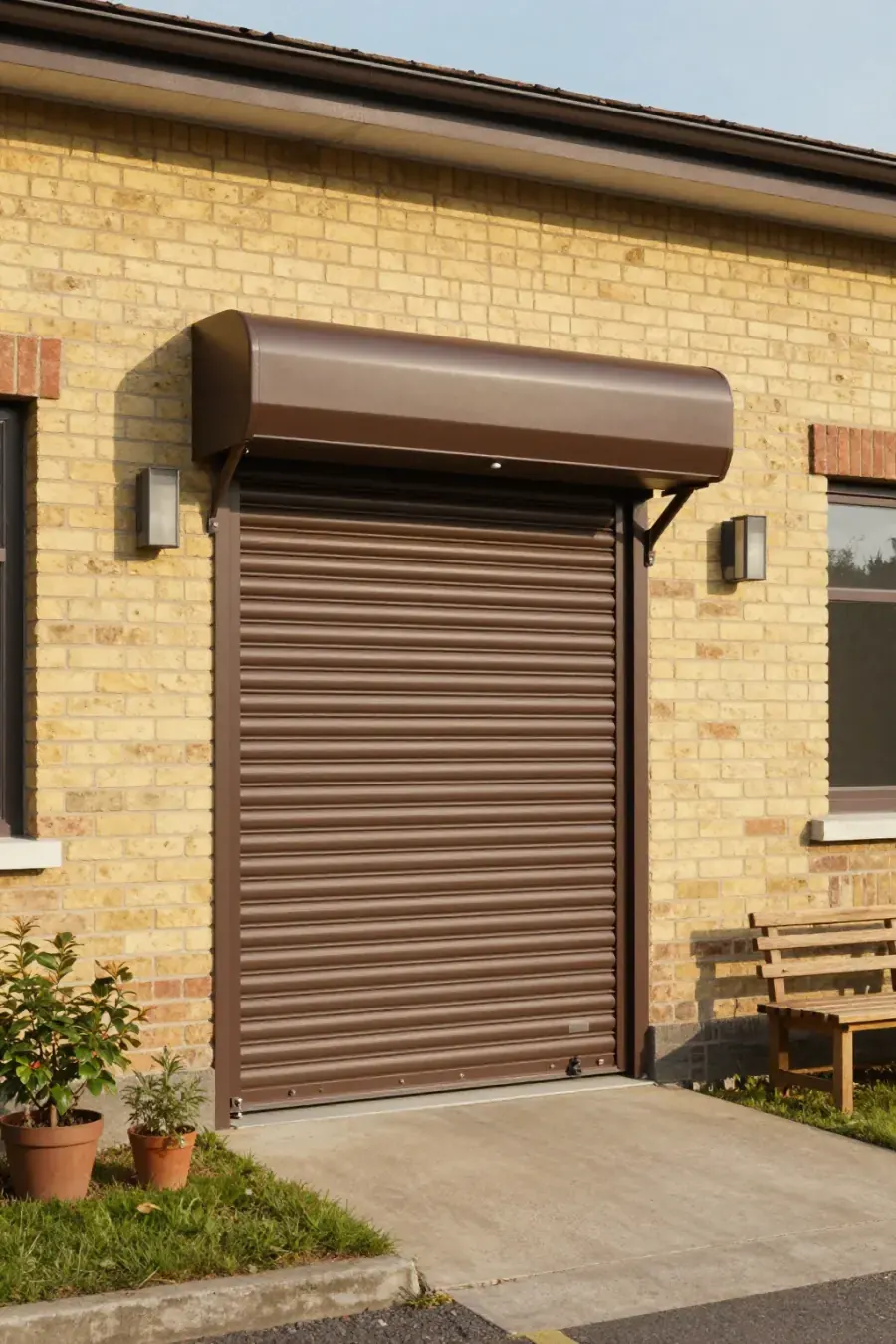

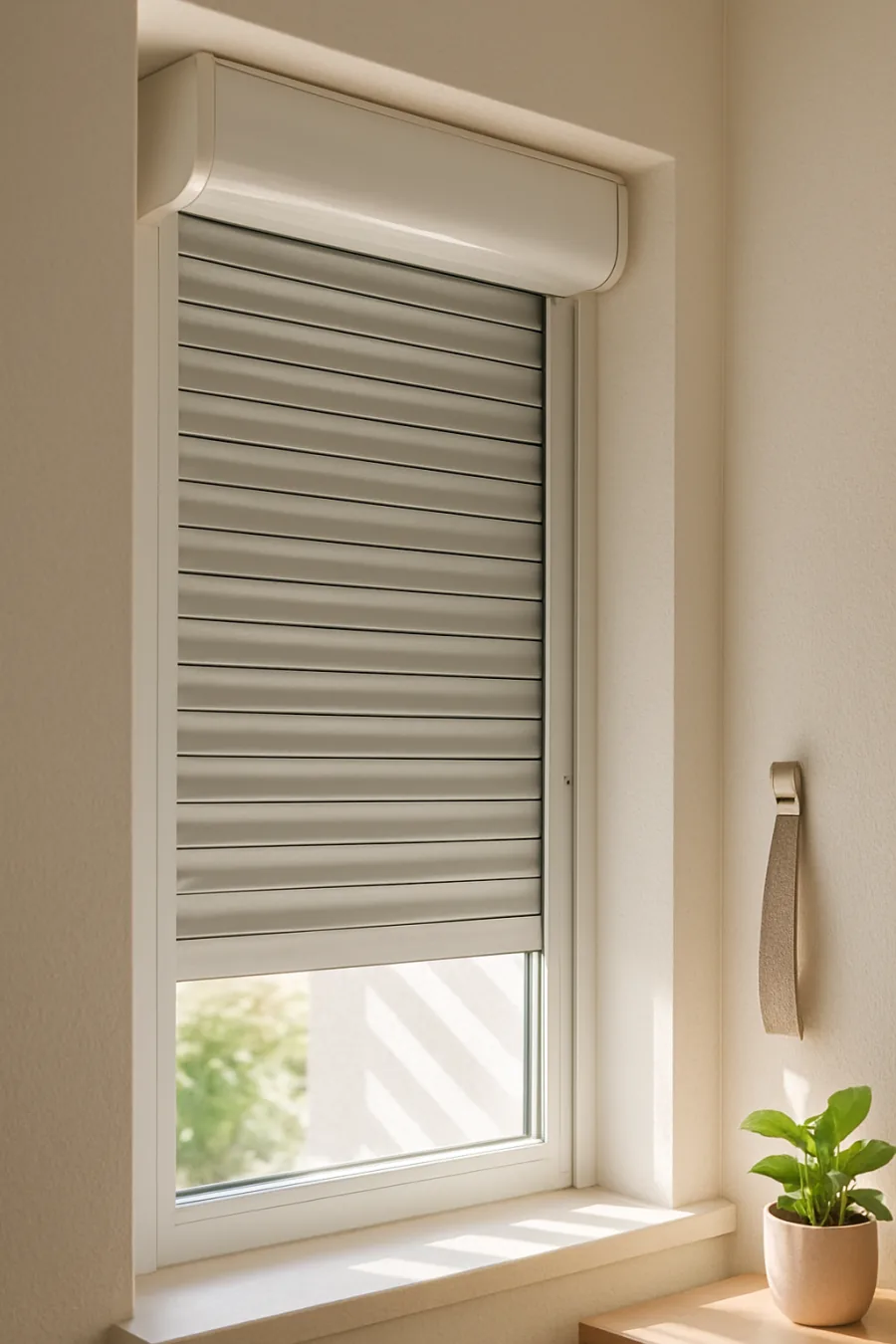


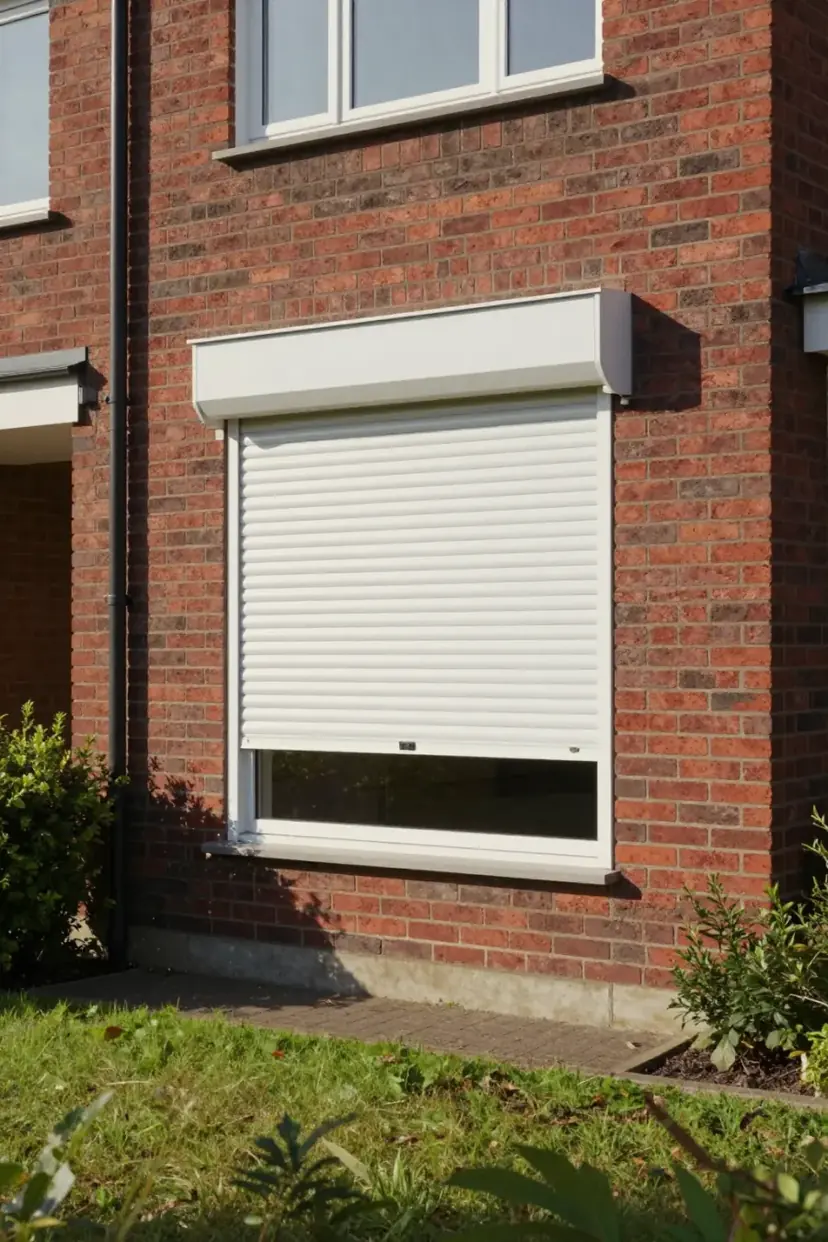


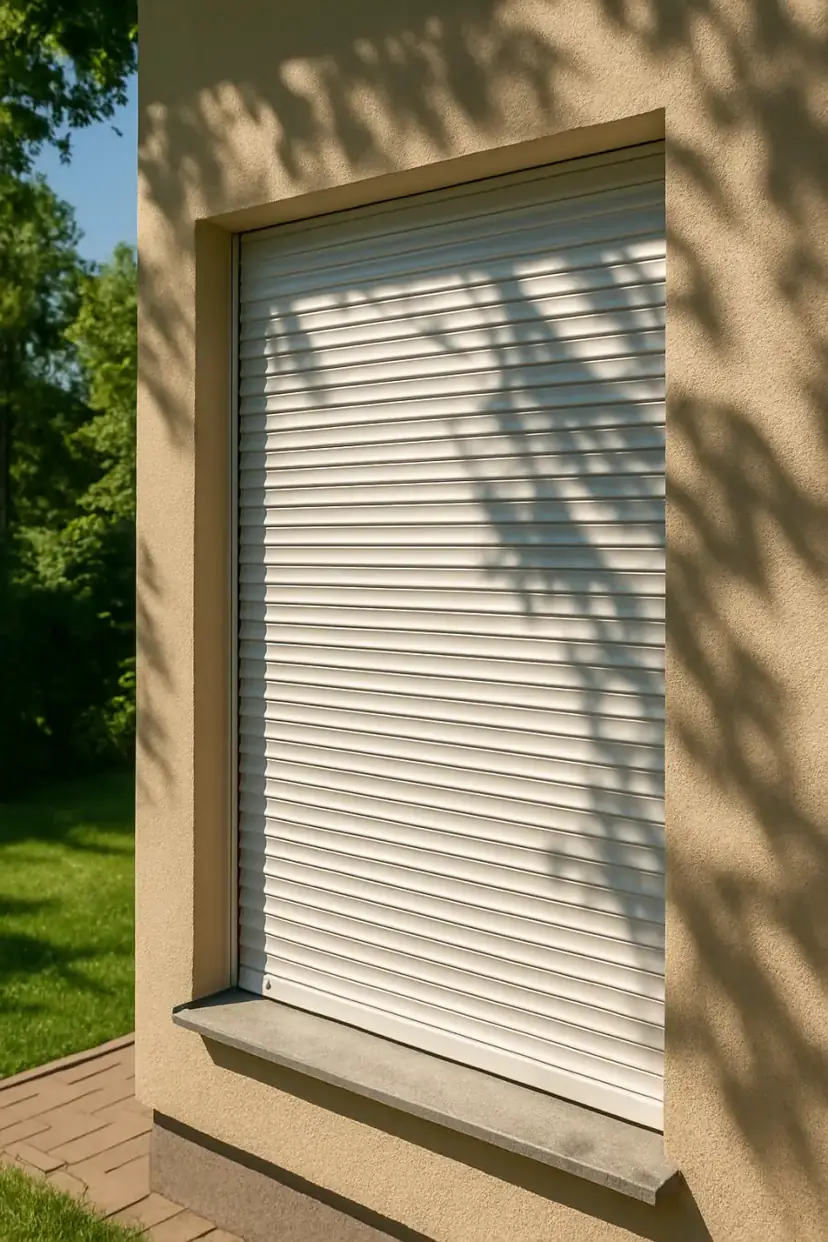


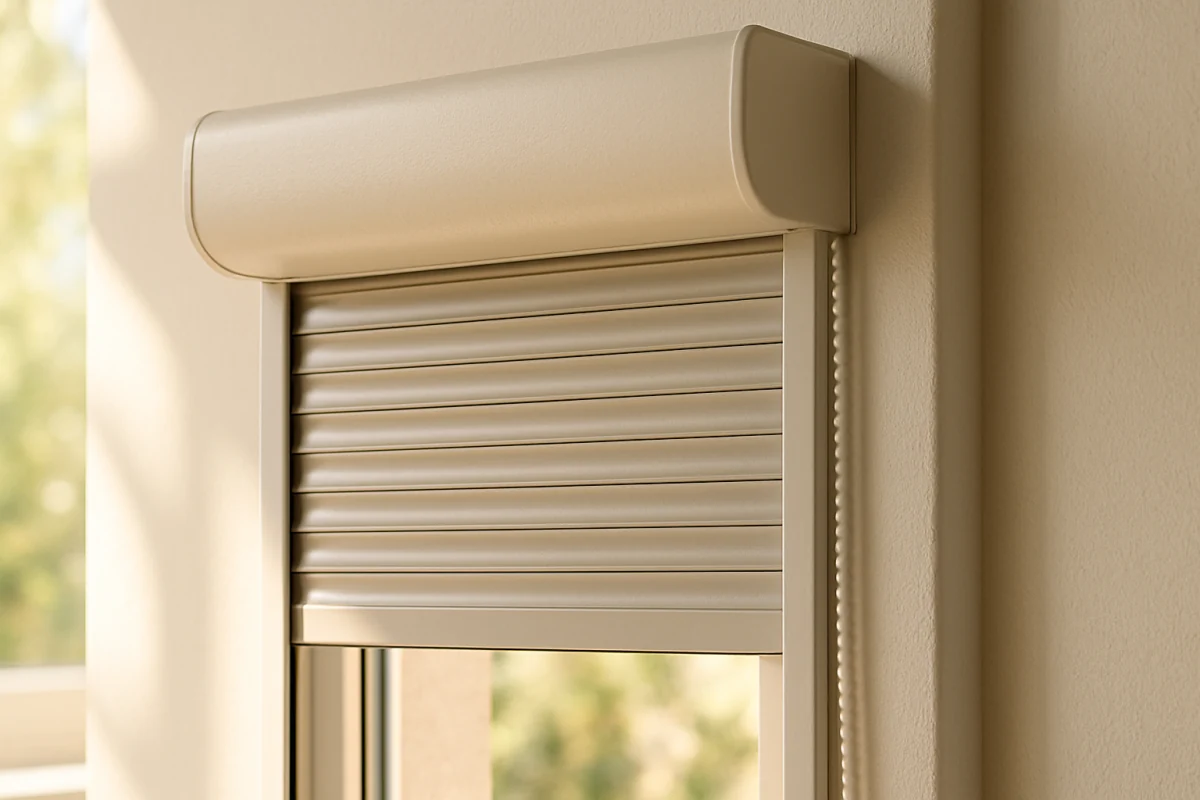











Perforated roller shutters are a roller shutter curtain with through holes made in the slats of the profile: a closed opening stays partly transparent to light and air, while outside glances are held back. We manufacture such roller shutters in Almaty to measurement, from 27,800 ₸/m², lead time 12–16 days.
What perforated roller shutters are and how they differ from a solid curtain
Perforated roller shutters are a roller shutter curtain with through holes made in the slats of the profile. The curtain is closed, yet light and air still pass through the perforation. The holes are made in the profile itself, not applied on top as a decorative overlay, so the closed opening stays partly transparent.
How a perforated blind differs from a solid one
A solid blind covers the opening completely: no light, no air, no view. A perforated one leaves a passage for both. The difference is not an overlay on top of the slat but the profile itself — the roll-formed perforated profile is shaped with ready-made holes, and a pattern of rows runs across the whole blind.
What does this give in practice? A shop window closed for the night does not turn into a solid wall, and a bathroom without a window stops being a dark room. Diffused light gets inside — soft, without a direct sunbeam that blinds and heats. Air moves too: the room is ventilated while the blind is down.
For a shop window this means the goods stay visible during the day, while the blind still holds back outside glances. How much depends on how often and how large the holes are.
- Perforation is through holes in the slats, not an applied decoration.
- Diffused light and air pass through the closed blind.
- The blind holds back outside glances, but does not remove them completely.
- The roll-formed perforated profile is shaped with holes right away, the pattern is set by the profile.
What the hole spacing and diameter set
Hole spacing and diameter are two parameters that determine how much light passes through the blind and how well what is behind it can be seen. The larger the holes and the more often they run, the more light and air and the better the view. The smaller and rarer they are, the more privacy.
There is no direct dependence on a single number: large perforation with wide spacing gives one result, small with frequent spacing another, and the pattern is chosen separately for each site. A shop window needs a view of the goods, a bathroom and wardrobe need air and a little light, a bedroom needs dim light instead of complete darkness. At the measurement we bring profile samples, and the customer looks against the light at how a particular hole pattern behaves.
In my opinion, choosing a pattern from a catalogue picture is pointless — a photo does not show how much light will actually pass through. A sample in your hands settles the question in a minute.
Can you see the shop window through a closed blind during the day and what is visible in the evening
During the day the shop window reads through the closed perforated blind: goods, shelves, price tags by the glass are distinguishable if it is brighter outside than inside. It will not be dark. Diffused light passes through the holes, and the room behind the blind gets enough of it not to turn into a solid box.
Daytime: product visibility and diffused light
When the sun is outside, the eye from the street sees in better than from inside out. A shop window lives by this rule: the sign, display samples, large items behind the glass stay visible, while part of the interior volume recedes into soft shadow. Small details — tags, price labels deep in the sales floor, the faces of sales staff — are no longer discernible. For a shop this is exactly what's needed: the product shows itself, while the working clutter at the till stays in semi-darkness.
The visibility through a shop window also depends on the perforation pattern. Large holes let in more light and give better visibility; small ones make the picture denser. And there's a nuance you only notice on site: a customer from the street perceives the fabric as a light mesh, not as a solid blind.
In the evening: silhouettes and movement
In the evening the picture flips. Lights go on inside, it gets dark outside — and the holes start working in reverse. From the street you can see silhouettes and movement: someone walked past the till, a hand went up, a shadow flickered. Privacy in the evening depends on two things — the lighting inside and the darkness outside. The brighter the lamp behind the fabric and the darker the street, the clearer the picture for whoever is standing opposite.
How to account for this in practice? Work areas — the till, the stockroom, the back room — are best kept off the line of direct view from the street. If the premises are open in the evening, the light near the shop window should be kept dim, and the main lamp moved deeper inside. Perforated roller shutters block outside glances from the street, but they don't cancel the rules of light and shadow.
Roll-formed and extruded perforated profile: what goes where
The choice of profile decides where we can install perforated roller shutters at all. Roll-formed perforated profile suits apartment windows and small openings: it's lighter, the curtain moves more smoothly and quietly, and the housing box takes up less space above the frame. Extruded perforated profile takes the load on shop windows, entrance areas and ground floors without security — where the slat can be pushed, hit or prised open.
The choice always starts from the site and whether it has security. If no one is inside at night and the street is right there, a thin roll-formed profile is not the option we would agree to, and we say so directly at the measurement.
Comparison table
| Profile type | Where we install | What it withstands | What it's controlled by |
|---|---|---|---|
| Roll-formed perforated | Apartment windows, bathrooms and wardrobes, gazebos and terraces, small openings | Weather load, light pressure, frequent raising and lowering | Strap, chain, crank handle, electric motor |
| Extruded perforated | Shop windows, shop doors, entrance areas, ground floors without security, garages | Impact and pressure on the slat, an attempt to prise the blind open and spread the guide rails | Chain, crank handle, electric motor with emergency manual lift |
Does perforation weaken the protection
It does, and it's more honest to say so from the start. The holes reduce protection compared to a solid profile of the same type: a crowbar slides off a solid blind, but on a perforated one there's something to catch onto. What protects better is decided not by the presence of holes as such, but by the type of profile and the framing of the opening.
On an extruded perforated profile, protection is compensated by a deadbolt lock and reinforced guide rails — this is what raises the burglary-resistance class to a level where roller shutters work not as a decorative barrier, but as a real obstacle. A roll-formed profile doesn't allow for such framing, and you shouldn't expect it to have the properties of security roller shutters.
Compared to a roller grille on a window, a perforated curtain is more convenient in everyday use: during the day it rolls up into the housing box instead of staying on the facade, and it doesn't need space under the sash. A grille, on the other hand, doesn't hide away and has to be washed from the outside.
For a ground-floor window in a quiet courtyard, we usually install a roll-formed perforated profile, and for a shop window facing the street — an extruded one with a lock. Roll-formed perforated profile is lighter and quieter and suits apartment windows, while extruded takes the load on shop windows and ground floors without security.
How to choose perforation for your site: shop window, bathroom and wardrobe, bedroom
The hole pattern is chosen for the task of the site: large perforation gives better visibility and ventilation, small — more privacy. Jalusso always asks what matters more on a specific opening, and then suggests a profile with the appropriate hole spacing.
Large perforation is when the holes in the slat are noticeably wider and more frequent. Through it you can clearly see what's happening behind the blind, and air moves more freely. Small is the opposite: the gaps are narrow, the picture behind the blind breaks up into patches, but an outside eye catches almost nothing. The difference is physical, not decorative.
The options by site look like this:
- shop window: large perforation, the product should be readable from the street;
- windowless bathroom and wardrobe: small, you need air and a little light without transparency;
- ground-floor bedroom: small, or skip perforation in favour of a solid profile;
- garage: large, ventilation matters, visibility is secondary;
- gazebo and terrace: large, there light and the view of the plot are worth more than concealment.
Shop and café window
A shop window needs product visibility during the day. Large perforation lets through enough light so the window doesn't turn into a dark spot, and shelves and price labels by the glass stay discernible. In the evening the picture changes: the light inside makes silhouettes visible from outside, so the till and stockroom behind the window are closed off separately. For a café with panoramic glazing, we usually recommend large perforation paired with an electric motor — raising the blind by hand several times a day is inconvenient.
Windowless bathroom and wardrobe
A windowless bathroom needs air exchange and a little light. A perforated blind here works instead of an extractor fan in passive mode: air passes through the holes constantly, not only when the fan is on. We use a moisture-resistant profile — in a room with steam, ordinary treatment holds up worse. In a wardrobe the task is the same: keep things from going musty and don't leave a windowless room in complete darkness.
Ground-floor bedroom
A ground-floor bedroom needs privacy in the evening with the lights on. That's exactly why perforation isn't always chosen here: during the day it helps — air and diffused light, but in the evening, when a lamp is on in the room, silhouettes are readable from the street. If the window faces a courtyard, the solution works. If it faces a street with passers-by, we more often install small perforation or an ordinary solid blind. To be honest: we can't promise that perforation here will be invisible from outside.
Small perforation gives more privacy, large — better visibility and ventilation, and a specific hole pattern is chosen for each site.
Perforated roller shutters and roller grilles: what's the difference
These are two different products, and they shouldn't be confused. Perforated roller shutters are a curtain made of slats with through holes that rolls up into the housing box during the day. A roller grille is a rigid structure that stays outside and doesn't hide in a box. That's where the whole difference in convenience comes from.
Grille roller shutters, sometimes called grille shutters, are assembled from rods or strips with large gaps. Such a grille takes a hit, barely blocks the view and lets air through well. But you can't take it down for the day — it stays on the opening while you work. A perforated curtain behaves differently: in the morning we raise it into the housing box, and the shop window is fully open; in the evening we lower it.
The housing box can be surface-mounted, built-in or concealed. A surface-mounted one is fitted to a finished facade; built-in and concealed ones are set into the opening so that the curtain goes up into the wall or the ceiling. A grille has no housing box at all — that is its main difference from a roller shutter system.
What is more convenient for a ground-floor window? Here the operating mode of the premises decides. If the window must be closed both day and night, a grille is enough. If in the morning you want a full view and a clean facade with no external structures, a perforated blind is installed instead of a grille on the window, because during the day it simply disappears into the housing box.
One caveat. A grille is stronger with the same profile: large gaps do not weaken the strip the way rows of small holes do. Jalusso says this openly so that the choice is a conscious one.
A roller shutter grille and a perforated curtain are different products: the grille does not go into the housing box and stays outside, while the perforated curtain is raised into the housing box during the day.
How much perforated roller shutters cost in Almaty and what the price depends on
The price of perforated roller shutters starts from 27,800 ₸/m², manufacturing time — 12–16 days. This is the base cost of a square metre of curtain made from a perforated aluminium profile. The final amount for the product depends on two things: what controls the curtain and how the housing box is fixed to the opening. Both surcharges are calculated by the measurer on site, with profile samples in hand — so the client sees what they are paying for.
What affects the price
The control type and the installation method are multipliers to the base price per metre, not a fixed surcharge. Here are the coefficients we use.
| Parameter | Option | Coefficient |
|---|---|---|
| Control | mechanical | ×1.0 |
| Control | chain | ×1.06 |
| Control | electric motor | ×1.85 |
| Control | electric motor with remote control | ×2.1 |
| Installation | wall-mounted | ×1.0 |
| Installation | frame-mounted | ×1.05 |
| Installation | no drilling | ×1.1 |
| Installation | cassette system | ×1.28 |
Chain control changes the price of the product only slightly — plus six percent to the base. An electric motor is calculated differently: it includes the motor, the remote control and the emergency manual lift, which is used to raise the blind during a power cut, so the multiplier is almost twice as high. A strap and a crank drive go at the base coefficient for mechanical control.
Installation without drilling and the cassette system cost more than ordinary wall mounting. The reason is simple: on a finished facade we do not cut into the wall or drill the frame — the housing box is surface-mounted or fitted as a cassette. This type of fixing is chosen for panoramic glazing, where you cannot drill into the aluminium profile.
Installation and site visit
Installation costs 4,500 ₸ per product. For orders from 150,000 ₸ we do it free of charge — this is the threshold after which the installation amount does not appear in the quote.
Measurement and delivery within the city are free; the measurer arrives with samples and calculates the cost on site. To the suburbs — Kaskelen, Talgar, Issyk, Kapshagay — we do travel, and the call-out cost depends on the distance and is quoted before the visit, before you confirm anything.
There are no ready-made products in stock: perforated roller shutters are made for a specific opening, so the price is calculated from its area rather than taken from the price list for a ready-made item.
How ordering works: from measurement to installation
We make perforated roller shutters in Almaty to measurement. There are no ready-made products in stock — and this is not a marketing trick, but a consequence of the fact that the opening, the profile and the hole pattern are connected to each other.
Here’s how it works.
- You write to us on WhatsApp. Briefly: the address of the premises, the approximate dimensions of the opening, what kind of premises it is — a shop window, a window, a bathroom.
- The measurer arrives with profile samples. Looking at photos is pointless: the perforation needs to be held up to the opening to see how the street and the interior read through it.
- The measurer determines the profile, the type of perforation and the installation method, and calculates the cost on site.
- The workshop manufactures the product. Time — 12–16 days.
- Installation.
Measurement and delivery within the city are free. To the suburbs — Kaskelen, Talgar, Issyk, Kapshagay — we do travel, and we quote the call-out cost before the visit; it depends on the distance. A call-out outside the city is not included in the free measurement and is not hidden in the price of the product.
We charge 4,500 ₸ for installing one product; if the order total is from 150,000 ₸ — we install at no extra charge. There are options without drilling — frame mounting or a cassette system; they are chosen when the facade or the window cannot be touched.
One nuance that comes up most often during measurement: the client estimates by the opening, and then it turns out that the housing box will be surface-mounted and will extend beyond the window dimensions. That is normal — we calculate the dimensions as they actually are, not from your estimates.
Warranty
The mechanism is covered by a 3-year warranty, installation work — 1 year, counted from the date of the acceptance report. If a case is recognised as a warranty one, we do the work free of charge — within 5 working days. When the warranty period has already expired, we still come — to tighten the mechanism, adjust it, or fit a new chain or cord.
Not covered by the warranty: mechanical damage, reinstallation on your own, exposure to water and fading of the fabric over time.
Measurement ties the profile, the type of perforation and the fixing method into a single product — without it, perforated roller shutters in Almaty are not ordered.
Fixing and control: housing box, guide rails, chain and motor
On a finished facade, perforated roller shutters are fitted with a surface-mounted housing box — without cutting into the wall. This is the main answer for those who have already done their renovation or cladding and do not want to touch the finished work. The housing box sits over the opening, the guide rails run along the sides, and the whole structure is held by fixings that require no chasing. A built-in housing box is concealed in a niche during construction or renovation; a concealed one — behind the soffit or the window reveal: the curtain goes up and is not visible. For installation without drilling we apply a coefficient of 1.1, for the cassette system — 1.28. There is a difference in price, but the facade stays intact.
Panoramic glazing goes well with a perforated blind and an electric motor. Long openings of a café or office on the ground floor are inconvenient to open by hand, so we install a motor with a remote control. During a power cut the blind is raised manually — the emergency lift is included in the electric motor, you do not need to buy it separately.
The control type is chosen by how often the opening is used:
- A strap — the base option, works without electricity.
- A chain — adds a coefficient of 1.06 to the price of the product.
- A crank drive — when the opening is high and you cannot reach the chain.
- An electric motor — coefficient 1.85, with a remote control 2.1.
You can replace a solid blind with a perforated one on an already installed housing box if the profile type and slat width match. Then only the blind is replaced — the housing box, guide rails and fasteners stay in place. We come with profile samples and check on site: this can't be verified from a photo.
On a finished facade the housing box is mounted as an overlay, without opening up the wall; there are options without drilling — onto the frame or as a cassette.
How perforation behaves in the Almaty climate: winter, dust, sun
Winter in Almaty is sharply continental — with frosts and a noticeable temperature difference between day and night, and perforated roller shutters get through it calmly. What freezes is not the profile but the edge of the bottom slat to the guide rail, and the holes actually help here: moisture drains through them instead of standing in the groove between the slat and the guide rail.
Then dust comes into play. In summer there's a lot of it in Almaty, and the question “will the holes get clogged” comes up at almost every measurement. The holes in the slat are not a filter — dust passes straight through them and settles on the glass and windowsill rather than getting stuck in the profile. If the holes are small, some dust does cling to the edges, and it's removed with a regular pressure wash or a soft brush. Snow and ice don't pack into the holes: the perforation is too small for that, and in winter the blind is raised in the morning and lowered in the evening, so ice doesn't build up on it in a layer.
For a perforated blind, the sun is not a problem but the point. Overheating of the glass is reduced because the profile intercepts part of the flow; goods and furniture in a shop window fade more slowly than with no blind at all. We don't do a direct degree-by-degree comparison with a solid profile — there's no reliable figure — but in practice, in summer a room behind perforation feels noticeably easier than behind glass with no shading.
And what about wind and noise
A perforated blind rattles in the wind more than a solid one — the holes let air through, and the slats respond. On guide rails with a tight seal this sound almost disappears. Perforation dampens street noise less than a solid profile: it's for air and light, not for acoustics, and where road noise is critical, we honestly suggest a solid blind or another shading option.
Perforated roller shutters handle the Almaty climate with its frosts, dust and sun without losing their working properties — the holes in the slats don't get clogged with ice and don't stop the curtain from moving in the guide rails.
What to choose: large or small perforation, a blind or a grille
Perforation is rows of holes in the profile itself, not an applied pattern on top of the slat. The pattern is set by the profile, so we don't “draw” a logo or ornament on the blind: the spacing and diameter of the holes change, and with them how much light passes through and how well you can see what's behind the blind.
Small perforation gives more privacy: from the street you can make out silhouettes but not details. Large perforation gives a better view and ventilation. For a facade with a logo this isn't the right tool, I'll say honestly: branding on roller shutters is done differently, and we won't promise patterned perforation for a brand mark.
What we install on different sites:
- Gazebo and terrace. A perforated blind on a roll-formed profile — light and a view stay, and in the evening it screens you from prying eyes.
- Garage and ground floors without security. An extruded perforated profile with a deadbolt lock: there's ventilation, and it takes the load.
- A country house for the season. Perforated roller shutters are installed so the house stays looked after and at the same time ventilated, instead of turning into a sealed box.
- A shop window and door. On a shop window perforation works: the goods are visible during the day. On a door it varies. If the door is glass and the entrance area is visible, a blind is installed on it too, but people walk through a door more often and the till is there, so a smaller pattern is usually chosen here. A doorway with a solid blind also happens — when closing off matters more than showing.
A perforated curtain is installed instead of a roller grille on a window: during the day it rolls up into the housing box, in the evening it closes the opening. And perforated roller shutters keep out prying eyes from the street — exactly as much as the chosen hole pattern allows.
Perforation is rows of holes in the profile, not an applied pattern; the pattern is set by the profile itself.
FAQ
Perforation isn't always burglary protection — it depends on the profile: roll-formed works for sun and privacy, extruded with a deadbolt lock takes the load. That's why the answers to frequent questions start by clarifying which blind we're talking about.
Does perforation weaken the protection
Yes, it weakens it — compared with a solid profile of the same type. Holes are holes. On extruded aluminium this downside is offset by a deadbolt lock and reinforced guide rails, which is why we close shop windows and ground floors without security exactly this way. With a roll-formed profile you shouldn't expect burglary resistance: that's a different task.
How dark it gets in the room
Light transmission depends on the hole pattern, not on whether the blind is closed or not. Small perforation gives more privacy and less light, large perforation gives a better view and noticeably more air. For a windowless bathroom and a walk-in closet, small is enough: what matters there isn't brightness but air movement.
Is perforation enough for ventilation
Ventilation of a room through the curtain does happen, but it's not a supply system. Air passes through the holes, there won't be stagnation — for a pantry, a walk-in closet, a bathroom that's enough. But you shouldn't count on perforated roller shutters replacing the extractor hood in a café kitchen.
Can a solid blind be replaced with a perforated one
Yes, if the housing box and guide rails fit the new profile in size. Then we replace only the curtain, without redoing the fastening. On a finished facade, perforated roller shutters are installed with an overlay housing box — we don't open up the wall. The measurer looks at the housing box on site and says whether the replacement will work or a new set is needed.
Does a perforated blind rattle more than a solid one
In the wind — yes, a little more audible. The holes don't give the blind the rigidity of a solid slat, and it dampens street noise less. If the window faces a noisy street, this is worth keeping in mind in advance.
Conclusion
Perforated roller shutters close an opening so that prying eyes and the sun stay outside, while light and air pass through the holes in the slats. The holes are made in the profile itself, not applied on top — hence how the curtain behaves: during the day a shop window can be made out through it, in the evening with light inside, silhouettes and movement are visible from the street.
The profile is chosen for the site. A roll-formed perforated profile is lighter and quieter; we install it on apartment windows and small openings. An extruded perforated profile takes the load on shop windows, entrance areas and ground floors without security, and with a deadbolt lock the protection is reinforced. Perforation still weakens protection compared with a solid profile of the same type — we keep that in mind when we close a till, a warehouse or a garage.
The hole pattern is chosen for the task. Large perforation gives a better view and ventilation — that's a shop window, a café, a gazebo. Small perforation gives more privacy — that's a windowless bathroom, a walk-in closet, a ground-floor bedroom where evening light inside changes the picture.
Controls and installation change the price of the product: chain, crank handle, electric motor with emergency manual lift, mounting on the wall, on the frame or as a cassette without drilling.
There's one practical recommendation. Before ordering, message us on WhatsApp and call a measurer with samples: look at the profile and the hole pattern in person, hold them up to your opening — and choose based on that. The price of perforated roller shutters starts from 27,800 ₸/m², manufacturing time 12–16 days.
We don't keep ready-made products in stock: every blind is made to measure in Almaty.

