

















We make purple blinds in Almaty to your measurements in our own workshop: the measurer brings shade samples, shows them on your window in your light and calculates the price on the spot. Horizontal — from 4,200 ₸/m², vertical — from 4,600 ₸/m², day-night — from 7,300 ₸/m².
What kind of light purple fabric gives in a room
Purple fabric tints the light passing through it — the room doesn't stay neutral, but it doesn't turn lilac either. How noticeable that shade will be depends on two things: the density of the fabric and the material of the slat. Through purple blinds, light passes diffused, and it's the fabric that sets the colour of the walls, furniture and faces in the room.
Dense fabric lets little light through, so the tinting is weak. Thin fabric works differently: more light passes through it, and the lilac shade lands on the walls noticeably. Fabric diffuses light softly, without stripes — that's its main difference from a slat.
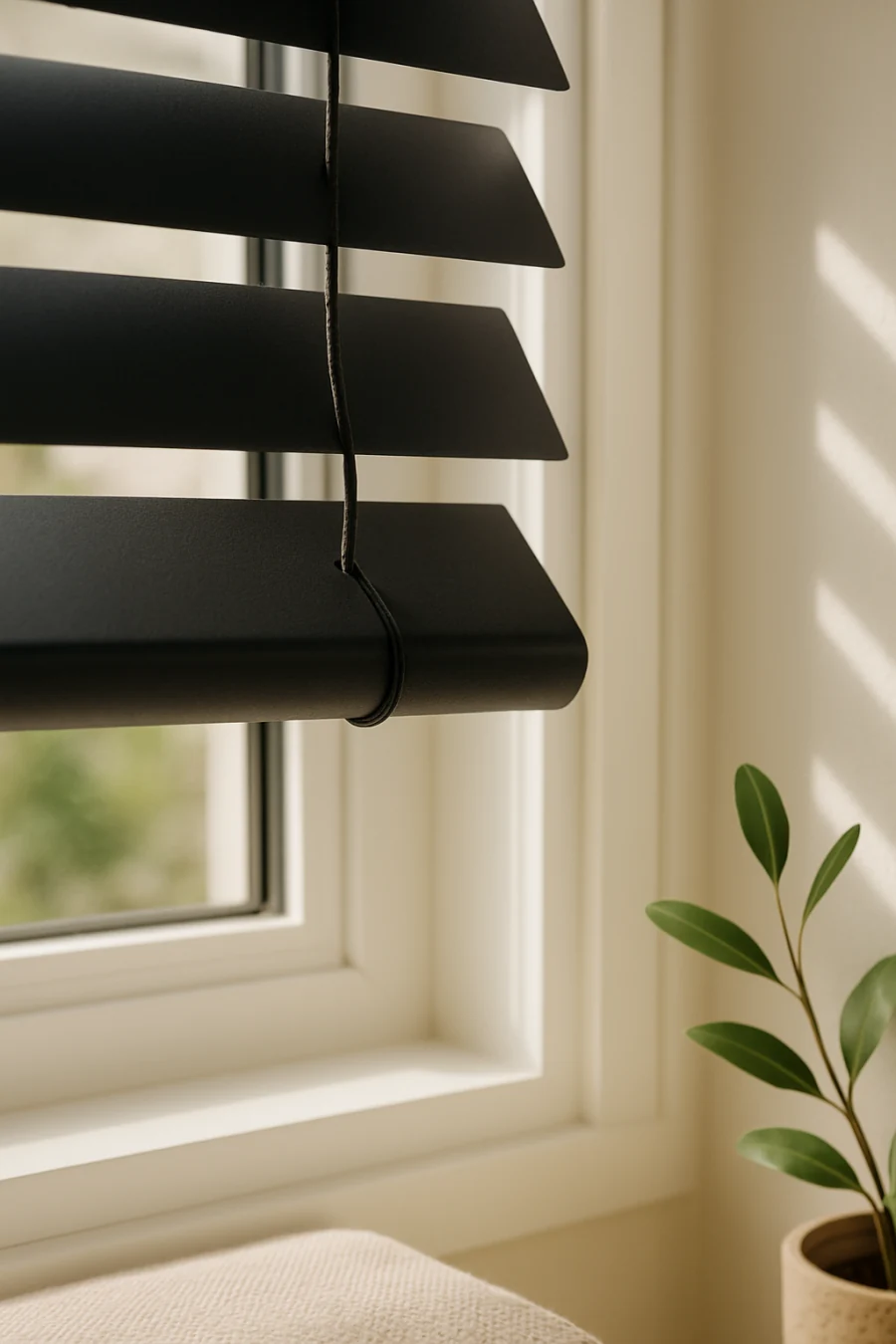
A purple aluminium slat 25 mm behaves differently. When the slat is turned, it blocks light almost completely, and the tinting in the room is weaker than under fabric. When the slat is open, light comes through between the plates in straight stripes. Here, the colour of light in the room depends not so much on how rich the shade is as on the angle of the slat.
Dense fabric vs. thin
The denser the fabric, the less light passes through it and the weaker the tinting. Thin fabric gives a noticeable lilac shade on walls and faces. For a bedroom or a small room where you spend the evening, dense fabric is more predictable: the light stays calm, and the purple reads in the window itself rather than across the whole room.
Slats and light
A turned slat blocks light almost completely, so the tinting in the room is weaker than under fabric. An open slat, on the other hand, lets light through in stripes and makes the colour component more noticeable on the surfaces those stripes fall on. Aluminium holds the shape of the plate, so the angle stays even along the full height of the window.
In practice, the light in a room depends on the density of the fabric and the material of the slat more than on the name of the shade itself.
Lavender, lilac, plum, fuchsia: how not to get lost in the shades
The difference between lavender, lilac and plum comes down to saturation and lightness, not the word on the price tag. The same purple reads differently in different options, so we don't recommend choosing a shade by name. A shade sample decides more than any article. A customer asks for “a soft lilac”, when what she actually needs is lavender — that happens too.
Jalusso divides the shades into three working groups. Within a group they behave similarly; between groups they differ noticeably.
Light group — lavender and lilac
Lavender is the calmest purple. In a small room and in a light interior it works gently and hardly clashes with the furniture. Lilac is a little cooler and more noticeable than lavender: on a white plastic frame it reads more clearly, and on an overcast day it shifts towards grey-lilac. Purple blinds in the light group suit those who are afraid of overdoing the colour: the fabric is noticeable but doesn’t shout. A rich fuchsia on the same window would behave quite differently.
Dark group — plum and aubergine
Plum and aubergine are dense, dark tones. During the day they look almost neutral, and in the evening with the lights on they open up to their full depth. On a narrow window a dark tone can feel gloomy, so we more often use plum and aubergine on vertical slats 89 mm and on dense fabric — on wide openings they read evenly and neatly. A rich purple in a small room is tiring; plum works more calmly precisely because of its depth, not its brightness.
Bright group — fuchsia
Fuchsia is the loudest shade in this palette. On a small window it reads the loudest of all and easily tips into nursery territory. Muted lavender works more calmly than rich fuchsia — that’s the main guideline for a bedroom, a child’s room and a study. We usually suggest fuchsia for a single window, a commercial hall or a niche where the colour is meant as an accent.
The line between lavender, lilac and plum runs along saturation and lightness, not the name, so the shade is chosen by sample, not by the word.
A sample in your hand and the fabric on the window are different colours
The same shade sample reads differently in your hand, against daylight and under warm evening light. In your hand you see the reflected light of the room; at the glass you see the light passing through the material, and those are two different colours. That’s why we never choose purple blinds from a picture or from memory: the measurer brings samples and lays them out right on your window.
In your hand the sample looks denser and darker than it will on the window. Against the light it gets lighter, and cool daylight pulls purple towards blue, while warm evening light, on the contrary, pulls it towards pink. The same piece of fabric can look like lavender during the day and dusty rose in the evening.
What about a white plastic frame? It works like a reflector. Next to it any shade reads cooler and cleaner than next to warm wood or beige wallpaper.
How to look at a sample
- Hold the sample against the glass from inside the room — that way you see what the fabric will look like against the light.
- Step back into the room and look at the whole window, not at the piece in your hand.
- Come back to the sample in the evening, with the lights on in the room: warm bulbs will show whether the shade shifts towards pink.
- Compare the sample with the frame, the wallpaper and the furniture — not one by one, but all in the same field of view.
That’s how you catch the moment when the shade stops appealing to you. A common story: a rich tone chosen from a sample at the table fades at the window — in your hand the colour is brighter than at the glass. You swap it for a lighter one from the same group, and the window no longer looks like a dark patch.
Which light should you go by if the window faces east or west? Go by the time of day when you’re at home most often. If you’re in the room in the evenings with warm light — look at the shade in the evening, not only during the day.
Another thing people don’t notice right away: at the glass itself the colour is always lighter than on the fabric you’ll eventually hang. The sample is small, while the fabric covers the whole window, and the area intensifies the tone.
We don’t show samples by photo and we don’t pick a shade over WhatsApp messages. The measurer comes to the site with samples, you hold them against your glass, and only after that do we fix the shade in the order. That’s exactly why measurement and consultation are free — it’s part of the selection, not a formality.
The same sample reads differently in your hand, against daylight and under warm evening light, so you need to look at it on your own window.
Fabric or slat: which holds purple longer
The same purple on matte aluminium, on PVC and on fabric is three different colours, and the slat holds it longest. We see this at measurements and on site: fabric on the sunny side shifts in tone faster than metal, and replacing a single slat costs incomparably less than re-covering a whole fabric panel.
We always separate the choice of material into two questions. First: how much light should come into the room. Second: how often is this window washed and touched by hand. The density of the fabric determines how much light passes through it, so soft diffused light and total darkness are not shades but different materials in the same category.
| Material | How purple reads | Light in the room | Where it works well | Lead time per price list |
|---|---|---|---|---|
| Aluminium slat 25 mm | evenly, with a slight metallic sheen | in stripes, adjusted by turning | kitchen, balcony, bathroom, study | 3–5 days |
| PVC slat 25 mm | a bit flat, without depth | in stripes, adjusted by turning | child’s room, hallway, rented flat | 3–5 days |
| Fabric, day-night | deep, with a soft tone | smoothly, from open to dense | living room, kitchen, office | 5–7 days |
| Fabric, blackout | dense, with almost no sheen | blocks light completely | bedroom | 5–7 days |
| Vertical slats 89 mm | extends across the full height of the opening | softens the light evenly, no stripes across the room | offices, panoramic glazing | 3–5 days |
Aluminium 25 mm
Matte metal reads the most evenly: the colour settles the same way in light and in shade, with no pink or blue shifts. On aluminium, purple does not darken from moisture — the slat can be wiped right on the window with a soft cloth, no need to take the blind down. If one slat gets bent, it is replaced on its own, without rehanging the whole unit. Manufacturing time — 3–5 days.
PVC 25 mm
On plastic, purple looks a little flatter than on metal — there is less depth to it, but the price is lower too. The slat springs back and does not crease from an accidental touch, so it can safely go where the blind is handled all the time: a child’s room or a hallway. It is washed the same way as aluminium, right on the window. Time — 3–5 days.
Fabric — day-night, screen, blackout
Fabric diffuses light rather than cutting it into stripes — in my view, for a living room that is noticeably nicer than a slat. Day-night adjusts the flow from open to dense, screen keeps privacy during the day without darkness, blackout blocks the light completely. Of these three, only blackout gives full darkness; the others let light through. Fabric fades faster than a slat — worth keeping in mind on a south-facing side.
Vertical slats 89 mm
For a panoramic opening, a horizontal slat looks small, while vertical slats 89 mm hold the geometry of the whole window. The colour reads across the full height, and the blind gathers to one side or covers the opening completely. On wide windows we most often recommend this format — it gives even light across the whole room.
Price-wise the difference is this: horizontal aluminium blinds — from 4,200 ₸/m², vertical fabric blinds — from 4,600 ₸/m², day-night — from 7,300 ₸/m², blackout fabric is priced as fabric. Comparing a material apart from the window makes no sense: for a kitchen and a bedroom, the same budget will buy different options.
An aluminium slat holds its colour in the sun longer than a fabric blind, and the warranty does not cover natural fading of fabric — we say this before the measurement, not after.
South- and west-facing windows in Almaty: how the colour behaves
On a sunny side, purple behaves differently than on a shaded one: a south-facing window and a west-facing window get more direct sun, and a coloured blind fades faster there. This shows most on fabric — an aluminium slat 25 mm holds its colour longer than a fabric blind. And the warranty does not cover natural fading: it is not a defect but a normal reaction of the material to the sun.
Almaty’s climate is sharply continental: hot, sunny summers and cold winters, with frosts and a big temperature swing between day and night. Plus dust, which settles on the blind and makes you wipe it more often. For a window on a sunny side this means one thing: light, heat and dust all work against the colour all year round.
South and west
This is where there is the most direct sun, so the light group of shades — lavender, lilac — and a slat hold up better than the dark group on fabric. Dense blackout on a south-facing window holds up worse than thin lavender precisely because the dark pigment absorbs more solar energy. For south and west we usually recommend horizontal blinds with an aluminium slat 25 mm: the colour reads evenly, the slat is washed right on the window, and it fades more slowly than fabric.
North
There is less light, and the shade reads cooler and calmer. The dark group — plum, aubergine — does not look gloomy on a north-facing window, because there is little direct sun and the room does not turn into a dark spot. A fabric blind on the north side lasts noticeably longer here than on the south.
What fades first? Fabric. An aluminium slat 25 mm holds its colour longer than a fabric blind in the sun. A colour that looks calm on a south-facing window will seem a shade darker on a north-facing one — and vice versa.
On a south-facing side, a coloured blind fades faster than on a north-facing one, and this is worth keeping in mind in advance.
What purple goes with and what it clashes with
Purple goes with grey, white and wood, and clashes with warm yellow and vivid green. That is the main rule, and it saves time on choosing. After that it is a small matter: work out what background you already have.
Neutral background
Grey, white, wood and muted beige are the base on which purple blinds read calmly. Grey in an interior works as a quiet backdrop: it does not clash with the shade or pull it in another direction. White gives more contrast, wood gives warmth, and together with purple they hold the same interior style without overload. Beige will work if it is muted, not yellow in tone.
There is a simple check. Take a sample and hold it against the wall, the wardrobe, the floor — if it does not look like a foreign spot anywhere, you are fine. In my view, this check is more honest than any colour-matching advice.
Clashing and the white frame
Warm yellow and vivid green start to clash next to purple: both pull attention to themselves, and the window gets lost. If the wallpaper already has a pattern, choose a plain slat or fabric without a print — otherwise the colour and the pattern will fight each other.
A white plastic frame is no obstacle. It increases the contrast with purple, and that works in your favour: the blind reads more clearly, the window looks put together. A coloured frame to match purple is not necessary, but a frame in an active warm tone can clash with the blind.
And here is what matters in practice: how it combines with other colours is judged by a sample in your own light, not by a picture. Warm evening light shifts purple towards pink, cool daylight towards blue, and the neighbouring colours on the wall change along with it. Our measurer brings samples and shows how the tone sits with your furniture and wallpaper.
Grey, white and wood are a working pairing for purple; warm yellow and vivid green are the pairing it clashes with.
Rooms: bedroom, child’s room, kitchen, study
Purple blinds for a bedroom will not be gloomy if you fit a dense blind right up against the glazing bead: it blocks the light but does not turn the room black. In a kitchen, though, Jalusso does not recommend fabric near the stove and sink at all. The difference between rooms rests not on the shade but on what the blind is made of.
Bedroom
For a bedroom, the density of the blind matters more than the shade. Thin fabric lets morning light through and tints it, and you wake up earlier than you planned. A dense screen or blackout is fitted right up against the glazing bead — then no strip of light comes through at the edges. The shade is chosen from the light group, lavender or lilac: dark plum reads heavier in a small bedroom. It is not purple that creates gloom, but the lack of light in the room.
Kids' room
You can put purple blinds in a child’s room, but we look not at the colour but at how well the blind tolerates being touched. A child handles the slats, pushes them, catches them with a toy. Aluminium and PVC withstand this: the slat springs back and does not crease. We have seen fabric in a child’s room crumpled more often than we would like. Of the shades, muted ones read more calmly. A motor is also chosen for a child’s room, but we look at the weight and width of the sash separately.
Kitchen
A kitchen means moisture, steam and grease, so aluminium and PVC are what work here. An aluminium slat 25 mm and a PVC slat 25 mm are wiped with a damp cloth right on the window, no need to take the blind down. Grease does not soak into the slat. A fabric blind near the stove and sink soaks up both steam and smells — we do not recommend such orders for a kitchen. If you really want fabric, it goes on the far window, away from the hob.
Study
In a home office, purple blinds solve two problems at once: they remove glare from the monitor and don’t darken the room during the day. Purple day-night blinds work well here. In the closed position, the two-layer fabric gives dense light; in the open position, it lets light through the stripes. With one chain you adjust both layers and hardly touch the slats with your hands. That’s how we installed them in a home office on an east-facing window: the person worked without a desk lamp until noon, and by evening closed the fabric against the sunset.
Day-night in two positions
In the closed position, purple day-night blinds look like an even, dense fabric, and in the open position like alternating stripes that light passes through. The transition between these two states is smooth. That’s exactly why such fabric is often chosen for both the bedroom and the living room.
For the bedroom, the density of the fabric matters more than the shade, and in the kitchen by the stove and sink we don’t recommend fabric — aluminium and PVC hold up there.
How many windows to make purple
The dosage of colour in an apartment determines how purple reads: one coloured window in a room works as an accent, while fabric on every window in a row turns the colour into a background. You don’t have to hang purple blinds everywhere — more often we suggest choosing one room or even one window and leaving the rest neutral.
We have three approaches to dosage.
First: one coloured window per room — usually the one that first catches the eye from the door.
Second: in passage areas, the hallway and the kitchen, where the fabric is touched often, we use a calm tone, and leave the saturated one for a room where you spend less time.
Third: if there are several windows in a room, we make the sashes of one opening purple and leave the neighbouring ones light or neutral. This approach works well on panoramic glazing, where vertical slats 89 mm run in one plane.
And if you get tired of the saturated tone? Then it’s not the whole structure that changes, but its parts. Replacing one slat restores the look of the fabric when a slat is bent or scratched — on aluminium 25 mm it’s replaced one at a time, without rehanging the rest. Completely redoing the fabric in a different shade won’t come out cheaper than choosing a calm lavender right away instead of fuchsia: a muted tone clashes with the interior less, and there’s no reason to change it.
And here’s what I notice from my experience: people worry about colour more than it deserves. Calm lavender doesn’t get boring in two years — but we’ve come back to fuchsia on all the windows of a living room with the question of whether it could be made quieter.
Colour can be dosed: one coloured window in a room reads as an accent, and a damaged slat can be replaced one at a time.
Price and timelines: what the sum is made of
We calculate purple blinds in Almaty by the area of the fabric, not per window as a whole: horizontal — from 4,200 ₸/m², vertical — from 4,600 ₸/m², day-night — from 7,300 ₸/m². The measurer gives the exact sum on site, after measuring the opening and showing shade samples.
The measurer comes with samples free of charge, and delivery within the city is free too. He also calculates the cost in front of you: you won’t have to recalculate it later over the phone.
| Position | Price | Lead time |
|---|---|---|
| Horizontal, aluminium, 25 mm | from 4,200 ₸/m² | 3–5 days |
| Vertical, fabric, slat 89 mm | from 4,600 ₸/m² | 3–5 days |
| Day-night, two-layer fabric | from 7,300 ₸/m² | 5–7 days |
| Electric motor, 220 V or battery | from 7,800 ₸/m² | 7–10 days |
What affects the final price
Four things affect the sum: the type of construction, the slat material, the control and the shape of the window. An aluminium slat 25 mm and a fabric blind cost differently from the start, and a non-standard opening adds work for the workshop.
Installation — 4,500 ₸ per item; for orders from 150,000 ₸ we do it free of charge. We travel to the suburbs; we quote the call-out cost before the visit so there are no surprises.
Control and installation
Control is calculated as a coefficient to the base price: mechanical — ×1, chain — ×1.06. Electric motor — ×1.85, with remote control — ×2.1; this is noticeably more expensive than mechanical, but the fabric moves on its own.
Wall installation — ×1, on the frame — ×1.05, without drilling — ×1.1, cassette system — ×1.28. The coefficients are multiplied by the base price of the item. For timelines we go by the price list: horizontal and vertical — 3–5 days, day-night — 5–7 days, electric motor — 7–10 days.
A fact worth starting from: the price range before measurement is only a range, and the real sum depends on the area, material and control and is quoted on site.
How we work: measurement, workshop, installation
You can see shade samples on your own window before ordering, and it’s free: the measurer comes with samples, holds them against your glass and calculates the cost on site. You don’t need to pay for such a consultation, nor for a call-out within the city.
The process is simple.
- You write on WhatsApp, give the address and the approximate window. We agree on a time.
- The measurer arrives with samples — the same shades from which your fabric is later sewn or dyed.
- On site he shows how purple reads in your light, selects the mounting and quotes the sum.
- The item goes to the workshop: we cut, assemble, fit the mechanism. We don’t keep ready-made stock — everything is made to your size.
- The installation team fits the fabric to the window. Installation costs 4,500 ₸ per item, but if the order sum reaches 150,000 ₸, the team will fix the purple blinds at no extra charge.
At the measurement you can also see what photos can’t tell you: where the window will behave unusually, where a cassette system is needed, and where mounting on the frame is enough.
For a coffee shop, salon or another hall the logic is the same, only the starting point is different — the brand colour. The brand colour sets the shade for a commercial space: you show the sign, menu or logo, and we select the fabric tone so that the window doesn’t fall out of the palette. During the day the hall stays light, in the evening it’s closed off from passers-by. On wide openings, vertical slats 89 mm suit panoramic windows better than a small slat: they hold the geometry and don’t break up the glass. If the glazing is large, at the measurement we calculate the area of each fabric separately and quote the total sum.
And more about timelines: they depend on the price list item, not on the colour. Purple is the same aluminium, the same fabric and the same chain as in any other shade, so there’s no separate marked-up timeline for colour.
We make purple blinds in Almaty in our own workshop to measurement, so measurement and consultation are free, and the measurer quotes the cost on site — before the order, not after.
FAQ
How purple looks from the street in the evening, how difficult the care is and what happens to the density of the fabric — these are the questions we hear most often at the measurement. We answer briefly and to the point.
Can you see from the street in the evening what’s happening in the room?
In the evening, with the fabric closed, you can’t look into the room from the street — from outside the window reads as an even purple rectangle, not as a shop window. But the other options don’t give complete darkness like blackout: light from a chandelier is still noticeable from outside as a soft patch. If you want full opacity, we use dense blackout fabric in the opening — it blocks light completely. On the facade of a high-rise, dense purple fabric from identical windows on different floors looks different: the viewing angle changes from top to bottom, and the same tone on the upper floors looks lighter than below.
What to do if the fabric has collected dust on the slats?
We wipe an aluminium slat 25 mm and a PVC slat 25 mm with a damp cloth and a mild product right on the window; there’s no need to take the fabric down. We clean fabric with a vacuum cleaner on low power with a soft attachment — you can’t machine wash it, the fabric loses its coating and shape, and the colour isn’t the same after washing. Grease in the kitchen doesn’t soak into the slat, but we don’t recommend fabric by the stove and sink at all.
Will purple blinds get darker over time?
The density of the fabric determines not only the light in the room, but also how long the blind keeps its look: does a thin fabric fade more slowly in direct sun than a dense one? No, the opposite — we recommend dense fabric for windows where it matters to darken the room, not for colour fastness. An aluminium slat 25 mm holds its colour in the sun longer than a fabric blind, and that is the main argument for a slat on the sunny side.
Can I order one window first and then order the rest later?
Yes, the measurer comes with samples even for a single window. We make the second blind in the same shade as the first, but we check the fabric batch against the sample: the tone can read slightly differently between batches, and that is only visible when you compare two windows side by side.
Will purple blinds suit a white plastic frame?
A white plastic frame increases the contrast with purple — the colour reads brighter next to it than next to a wooden reveal. Muted shades look calmer in such a frame, saturated ones more noticeable.
In the evening, with the blind closed, no one can see into the room from the street, but full darkness is only given by blackout; the other options do not.
Conclusion
The shade is chosen by the sample on your own window, not by the colour name. Four takeaways worth carrying away from this page are these.
First: light. A purple blind tints the light passing through it, and the density of the fabric or the tilt of the slat decides how noticeable that tinting will be. A thin fabric will give a lilac shade on the walls, a dense one a soft coloured midday. Second: material. Purple blinds in Almaty hold their colour longer on an aluminium slat 25 mm; a fabric blind on a south-facing window fades faster, and the warranty does not cover that. Third: dosage. One coloured window reads as an accent, a blind on every window in a row turns the colour into a background, and a damaged slat can be replaced one at a time. Fourth: mounting and controls are chosen by the sash, not by the catalogue.
What to do in practice? Book a measurement. It is free, the measurer comes with samples, holds them against your glass and calculates the price on the spot — before you order, you see how the shade reads in your light and next to your frame.
We manufacture in our own workshop and install after measurement. So the final decision is made not on a website page, but at your window.

