

















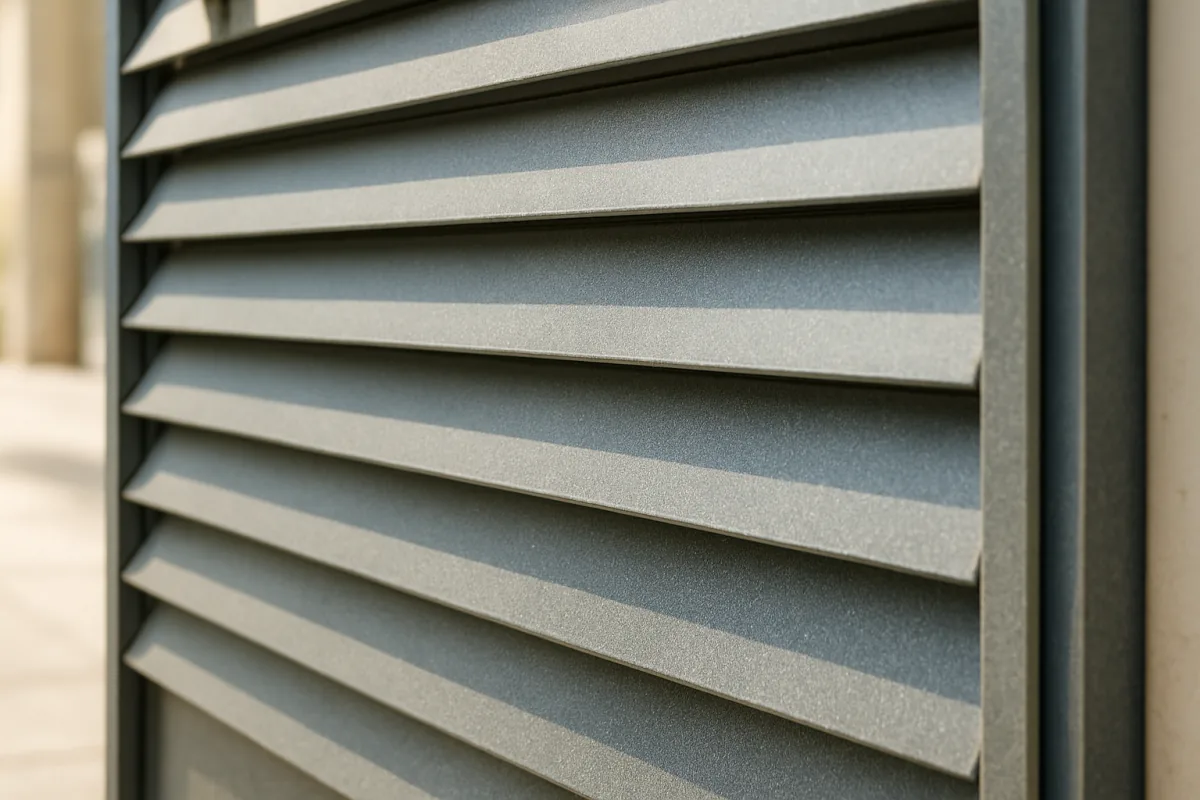











Outdoor, external blinds in Almaty are mounted on the outside in front of the glass: the slats rotate, reflect the sun before the heat reaches the room, and screen the window from prying eyes. We make and install such systems by measurement, with a price guide from 5,200 ₸ per m².
What external blinds are and what they are not
External blinds are a slat system mounted on the outside, in front of the glass. The slats rotate and let light through, so the room stays bright during the day, while the sun is blocked before it reaches the window. We manufacture outdoor, external blinds in Almaty in our own workshop and install them by measurement — we do not keep ready-made products in stock.
The design is simple. An aluminium slat rotates around its axis and gathers into a fabric; it is raised by a roller tube in the housing box. The fabric covers the entire opening — and you cannot be seen from outside, while it stays light inside. Here is the point: external blinds control light, they do not lock the window. That is why they do not give complete darkness during the day, and they do not serve as burglary protection. It is important to understand this before ordering, so you do not later expect from the system something it does not have.
Raffstores, facade, Venetian — one and the same
Raffstores is the professional name for external slatted blinds. Facade and external Venetian blinds are the same product, just in commercial and catalogue language. We call them external because that describes the installation location most accurately.
In Almaty, different things are sometimes sold under the same word: in some places facade blinds means a roller system in a cassette, in others a grille of slats. That is why at the measurement Jalusso first shows a slat sample and only then calculates. The difference in design is visible by hand.
What external blinds are not
Not roller shutters. Roller shutters are a solid fabric without rotating slats, and their task is different: to close the opening. External blinds differ from roller shutters both in design and purpose — they regulate light, they do not replace a wall.
Not an awning. An awning is a fabric canopy over the window, and external blinds differ from an awning in the type of fabric: a rigid aluminium slat versus fabric, which does not rotate and only covers the top of the window.
Not complete darkness in the room. A closed slat lets almost no light through, but roller shutters are more opaque in this sense.
What to choose for a window depends on the task. Need light and privacy during the day — external blinds. Need solid protection of the opening and against burglary — that is roller shutters, a separate category.
| System | Fabric | What it does |
|---|---|---|
| External blinds | Rotating slats | Regulate light, screen from view |
| Roller shutters | Solid fabric blind | Close the opening, protect against burglary |
| Awning | Fabric canopy | Shade the top of the window from outside |
External blinds are a slat system on the outside in front of the glass: the slats rotate and let light through, whereas roller shutters are a solid fabric without rotating slats, and their task is different.
Outside or inside: where the heat is cut off
Outdoor, external blinds in Almaty differ from internal ones in one detail — the place where the solar flow meets the barrier. Internal slats receive the sun after the glass, external ones — before it. The glass has time to heat up and gives heat to the room; an external system intercepts the flow earlier, so in summer the room heats up less. We install such systems precisely for this — to cut off the heat outside, not to fight it inside.
The difference is felt most strongly on the south and west. For example, in an apartment with two south-facing windows Jalusso installers installed external metal blinds, and the owners noted that they started turning on the air conditioner later than with the previous internal ones. The heat is reflected before the glass — and less of it reaches the room.
The window’s orientation decides a lot in general. A west window heats up towards evening, a south one — almost all day, an east one delivers a morning hit to the monitor. External blinds on windows handle all three cases the same way: the fabric outside rotates, and you decide how much light to let in. Sun-protection external blinds do not divide the window into “open” and “closed” — the slat can be set at an angle.
When external protection is worth it
- windows face south or west, and in summer it's hot there even with interior blinds;
- a lot of glazing: a panoramic window, a strip of windows in an office, an enclosed balcony;
- there's a shop or coffee shop window below, where you need both shade and to stay visible;
- there's no room inside for a cassette, or the windowsill is taken.
And when are interior blinds enough? If the window faces north, the glass area is small, and overheating isn't a concern — there's no point installing an exterior system.
Light and privacy during the day
During the day, with the slat tilted, the room is bright, but you can't be seen from the street. That's what daytime privacy is: exterior blinds block the view without turning the room dark. External window blinds cover the opening completely, so there's almost no light leaking around the edges. They don't give complete darkness during the day — for that you need roller shutters, not a slat system.
Exterior blinds take the sunlight before it reaches the glass, so they cut off heat earlier than interior blinds while keeping daylight in the room.
Wind and winter in Almaty: what to actually expect
Street, exterior blinds in Almaty withstand wind and frost exactly as well as the slat, brackets and guide rails are matched to your floor and opening width. Wind load determines this choice: the higher the floor and the wider the window, the stiffer the slat and the more essential the guide rails along the edges of the opening. Jalusso won't promise that the system can withstand anything. An exterior structure has modes that are more honest to mention at the measurement than after installation.
Almaty wind is normal weather, especially in the shoulder seasons. Guide rails hold the blind and keep it from flapping and banging against the wall, so on exposed facades we almost always install them. A cable inside the guide rail secures the slat along its full height — the blind doesn't sway. And heavy banging against the frame at night is exactly what you don't want. Here a slat with a folded edge helps: it's stiffer than a flat one and flaps less. But an exterior system can't be called completely quiet in the wind.
What to do if the wind picks up, the blinds are down, and no one is home? Strong wind means raising the blind in advance — that's the main rule of winter mode. If the window is on a high floor and the control is manual, you won't be able to reach the cord from outside. For such windows, an electric motor is used: raising the slat with a remote control is faster than waiting for the wind to die down. In a south-facing apartment with two windows, we usually suggest a motor precisely because of the wind — not out of laziness, but because of access to the blind.
Winter and wet snow
The first thing to know in advance: frost and thaw cause the slat to freeze to the guide rails. Wet snow packs into the gap, freezes overnight, thaws during the day — and at that moment the blind may not go up. Don't chip off the ice; wait for it to come loose on its own. A closed cassette with guide rails removes part of the risk: it covers the mechanism from snow and dust.
Winter mode is simple: in strong wind and in frost with snow, the blind is raised and left up. This isn't a breakdown or a defect — that's how any exterior slat system behaves.
Warranty on the mechanism is 3 years and 1 year on installation from the date the acceptance certificate is signed. The warranty doesn't cover mechanical damage, reinstallation on your own, exposure to water, or fabric fading over time. Consequences of bad weather — water and ice — aren't covered by the warranty, and we say this before the order, not after. If a case is recognised as a warranty case, we do the work free of charge — within 5 working days at most.
Winter limitations look like this:
- in strong wind, the blind is raised before the wind picks up;
- in frost with snow, the blinds are kept raised;
- don't chip ice off the slat;
- freezing to the guide rails in winter is possible, and it's not a warranty case.
South side and fading
On the south side, a metal slat doesn't fade the way fabric does — and that's its main advantage on sunny windows. Anodising protects aluminium from corrosion and fading: the coating holds its colour, doesn't yellow and doesn't warp from temperature changes. Galvanised steel with powder coating works the same way — powder coating gives a colour to match the facade and protects the metal from rust. That's exactly why we recommend exterior metal blinds for south and west, and not fabric blinds. Exterior window blinds on the south side are installed so the slat keeps its look for years, and metal is unbeatable here. Exterior window blinds with an anodised or coated slat are the most durable choice for a sunny facade.
What we assemble from: slat material, cassette, guide rails
Street, exterior blinds in Almaty are assembled from four components: the slat, the housing box or open roller tube, the guide rails and the brackets. The slat material decides how the system survives sun, rain and frost, while the housing box and guide rails decide how steadily the blind holds in the wind. Let's go through them in order.
The aluminium slat is the main material for exterior blinds. Anodising creates an oxide film on the surface: it doesn't peel, doesn't yellow and holds its colour in the sun, and the aluminium itself doesn't rust. An anodised aluminium slat is lighter than steel, so the load on the brackets is lower — this is noticeable when the opening is large and you have to mount to the window reveal.
Galvanised steel is stiffer than aluminium. It's used for wide openings, shop windows and ground floors, where the blind is long and flaps more. Powder coating gives a colour to match the facade and protects the metal from corrosion. True, a steel blind is heavier — at the measurement we calculate whether the fasteners will hold, and sometimes we advise against steel where aluminium is enough. External window blinds made of steel take a hit and don't bend in the wind.
What to choose — look at the opening and the space:
- Anodised aluminium — ordinary windows in apartments and houses, south and west, panoramic glazing where low weight matters.
- Galvanised steel with powder coating — wide openings, shop and coffee shop windows, ground floor.
- Open roller tube on brackets — when you need access to the mechanism for maintenance.
- Closed cassette with guide rails — when there's room on the facade for a housing box and you want to keep the mechanism away from snow and dust.
Slat profile
By shape, the slat is either flat or with a folded edge, also called a Z-profile. With a folded-edge slat, adjacent strips overlap, and when closed the blind lets almost no light through. A flat slat is simpler, but it flaps a little more in the wind. A C-shaped profile is stiffer than a flat one: the fold works as a stiffening rib. We don't specify the slat width and exact profile in advance — they're chosen based on the opening and wind load at the measurement.
Open roller tube or cassette
The housing box, or cassette, is a closed roller tube with guide rails along the edges of the opening. The guide rails hold the blind in the wind and keep it from swaying side to side, while the housing box itself protects the mechanism from snow and dust. There's also the cable: in a cassette system it presses the slats against the guide rails and adds stiffness on wide openings. It's worth buying street blinds with a cassette if the facade is exposed to wind and snow.
An open roller tube on brackets is mounted to the wall or window reveal without a housing box. This option is chosen when you need access to the mechanism for maintenance and when there's no room on the facade for a cassette. Street window blinds with a cassette look neater on the facade and last longer in outdoor conditions.
The choice between anodised aluminium and galvanised steel is a choice between weight and stiffness, and it's decided by the opening width and the floor.
Control: manual, chain or electric motor
Outdoor external blinds in Almaty are controlled in three ways: manual with a cord, a chain, or an electric motor. The choice isn't about habit, it's about whether you can reach the blind. If the window is at arm's height, manual or chain control is enough. If the outdoor blinds hang high or cover a shopfront entirely, we install a motor.
Manual control works with a cord or chain: you lower the blind and turn the slats by hand. Simple mechanics are predictable, can be repaired on site, and don't depend on electricity. But every morning it's the same movement at every window. And the cord stays on the facade, which not everyone likes.
An electric motor controls raising and turning the slats. A remote control or smartphone replaces the cord and handle on the facade — there's nothing to pull from outside, and the system opens with one button. We install a 220 V motor if a cable can be run to the window. If it can't, we use a battery-powered motor: it's removed for recharging, and there's no need to chase a cable into the wall. External window blinds with a battery work fine where a cable can't reach.
The price difference is noticeable. Manual control is the base configuration, a chain adds a little to it, and an electric motor with remote control costs almost twice as much. We calculate the exact coefficient for your area during the measurement.
- Manual control ×1 — the base option.
- Chain ×1.06 — the same manual control, but with a more convenient pull.
- Electric motor ×1.85 — raising and turning the slats with a remote control.
- Electric with remote ×2.1 — the full set with remote control.
At the measurement we look at the window and tell you straight: if you can reach the cord, you don't need a motor. I don't recommend paying extra for electric control on a kitchen window. A motor is justified where you can't reach the blind by hand, and on facades where it's important to keep the cord out of sight. And on the sunny side, a motor also pays off in everyday convenience: the slats are turned to follow the sun several times a day.
When you can't do without a motor
On a high floor, the window opens outward and the blind hangs above your outstretched arm. Pulling a cord at that height is inconvenient and sometimes dangerous. External window blinds in a top-floor apartment are almost always ordered with a motor — it's a matter of access, not luxury.
Panoramic glazing is the second case. The blind is wider and heavier than usual, it's hard to raise by hand, and the slats have to be turned often. A shop or coffee shop front is also opened with a remote: raise it in the morning, close it in the evening with one movement, without going outside.
A battery-powered motor raises and turns the slats without a cable to the window.
Mounting and installation on the facade
External blinds are held on brackets that we screw into the wall or the reveal — we usually don't drill the window frame for external installation. This way the system sits firmly and the plastic window stays intact. The brackets carry the weight of the roller tube and the blind, so we calculate their number and spacing based on the width of the opening, not by eye.
Installation goes step by step:
- Measuring the opening, checking the reveal and the base for the fasteners.
- Marking for the brackets, taking into account how the blind overlaps the opening.
- Fixing the brackets into the wall or reveal.
- Installing the roller tube, cassette or guide rails.
- Hanging the blind, adjusting the slat travel and turning.
- Checking that the mechanism works and handing over the product.
An insulated facade requires special attention. We drive the fasteners through the insulation layer to the load-bearing base so the system doesn't hang on insulation alone. We make the fixing point neatly, without extra holes — the thermal bridge stays minimal. At the measurement we look at which option suits your facade.
The measurement also determines the final cost of the product. The measurer arrives with samples, calculates on site, and the price range you saw on the website turns into a specific sum.
How ordering works
Measurement and consultation are always free. Installation of one product costs 4,500 ₸, but if the order total is from 150,000 ₸, we install at no extra charge. We take the timelines from the price list: metal blinds — 5–7 days, with an electric motor — 7–10 days. And the timeline counts from signing the measurement, not from the first WhatsApp message.
Insect screen and window opening
An insect screen and external window blinds coexist calmly: the blind hangs outside, the screen sits in the opening, they don't get in each other's way. The sash opens as usual — the system doesn't block its movement. But there are openings where space is tight, and then Jalusso selects the mounting so nothing catches. Such details come up at the measurement, before manufacturing.
The bottom line is simple: we mount external blinds outside on brackets into the wall or reveal, we don't drill the frame, and on an insulated facade we fix them without a thermal bridge.
Apartment in a high-rise, balcony, shopfront
We install external blinds in a high-rise apartment, on a balcony, on a shopfront, and on panoramic glazing. The limitation here isn't the type of window, but access to the facade and who is responsible for the appearance of the wall.
There's a separate nuance with installation on the facade of an apartment building: the management company or the owners' association (KSK) may require approval, because you're changing the look of the building. For our part, we make the system so it doesn't clash with the facade — but the permit, if needed, is arranged by the owner. At the measurement we tell you right away whether you'll have to go to the KSK: sometimes it's enough to notify them, sometimes they ask for a document.
External blinds also work on a glazed balcony. We mount them outside on the glazing or on the reveal, and the blind covers the opening entirely. There's one nuance: the balcony glazing frame is thinner than a wall, so we calculate the fastening separately. And I won't promise the balcony will become dark — these aren't roller shutters, darkening is handled by other systems.
We select the slat colour to match the building's facade — the powder coating and anodising palette has neutral shades for concrete, clinker and light plaster. Anodised aluminium holds its colour in the sun, powder-coated steel gives a close colour match. If the slats are on the south side, lighter shades heat up less: with them the room stays cooler.
A shop or coffee shop front on the ground floor is also our kind of project. During the day the interior is visible from the street, the goods don't fade, and in the evening the blind closes the interior off from passers-by. For shopfronts we use powder-coated steel: it's stiffer than an aluminium slat and doesn't bend in the wind on an open corner.
Flat facing south
A typical situation: two south-facing windows in a high-rise. We install external metal blinds, the timeline from the price list is 5–7 days. The sun is reflected before it reaches the glass, the room is cooler in summer, and the air conditioner is turned on later. As for the price of outdoor window blinds, here's the guideline: we estimate from 5,200 ₸ per m² for metal blinds, and the final figure comes from the measurement.
Shopfront and coffee shop
Shopfront: the goods don't fade, the street is visible during the day, and in the evening the interior is closed off from passers-by. Coffee shop: bright interior during the day, closed off from passers-by in the evening, and the blind doesn't let light through.
Panoramic glazing and a house outside the city
Panoramic glazing is covered by a single external system — a floor-to-ceiling wall goes under one blind outside, and it takes up no space inside. The timeline for the electric motor option is 7–10 days.
Suburbs
We travel to Kaskelen, Talgar, Issyk and Kapshagay. The call-out cost depends on distance and is quoted before the visit; within the city, measurement and delivery are free.
External blinds are a facade solution, so in an apartment building you also need approval from the management company, and for a high floor an electric motor is usually chosen.
How much do external blinds cost in Almaty
Here is a price guide: metal blinds — from 5,200 ₸ per m², blinds with an electric motor — from 7,800 ₸ per m². These are the price list items we use to calculate external systems. The final cost is always calculated after measuring the specific opening.
Why can’t we give one figure right away? There is no separate “external blinds” line in the price list, and that is more honest than drawing a nice price range. An external system is built for the window: the slat width, the roller tube length, the number of brackets and guide rails depend on the opening and the floor. Wind load determines the choice of slat, brackets and guide rails, and therefore the amount of metal in the product. Two windows of the same width on different floors can come to different amounts.
| What we base it on | Guide | Lead time |
|---|---|---|
| Metal blinds, steel | from 5,200 ₸/m² | 5–7 days |
| Motorised blinds | from 7,800 ₸/m² | 7–10 days |
Both items are from our blinds category price list, and both are calculated by the area of the product, not the area of the glass. During the measurement, the measurer measures the opening, calculates the area of the blind with a margin at the edges and gives you the amount on the spot.
What affects the final price
First — the type and width of the slat. Second — the opening method. Third — the size of the opening and the wind load of the floor: the higher and wider the window, the stiffer the profile needs to be. Fourth — the controls.
Our coefficients to the base price are as follows: chain ×1.06, electric motor ×1.85, electric with remote control ×2.1. For installation: on the frame ×1.05, without drilling ×1.1, cassette system ×1.28. So a cassette with guide rails adds noticeably more to the estimate than a chain instead of a cord — and that makes sense, the cassette protects the mechanism from snow and dust.
A simple example with numbers. Let’s take a window with an area of 2 m². Metal blinds with a chain: 5,200 × 2 × 1.06 — about 11,000 ₸ per product. The same blinds with an electric motor and remote control: 5,200 × 2 × 2.1 — already about 21,800 ₸. The only difference is the controls, the blind itself is the same.
Measurement, delivery, installation, warranty
You never pay for measurement and consultation: the specialist brings samples and calculates the price right at your place. Within the city, measurement and delivery are free. Kaskelen, Talgar, Issyk and Kapshagay are also in our service area — we tell you the call-out price in advance, before the specialist sets off.
Installation costs 4,500 ₸ per product. For orders from 150,000 ₸ we install for free. Lead times by price list item: metal blinds 5–7 days, with an electric motor 7–10 days — the count starts from the measurement, not from the call.
The mechanism of outdoor blinds — 3 years of warranty, installation — 1 year, counted from the date the acceptance certificate is signed. When a case is recognised as a warranty case, we carry out the repair free of charge — within 5 working days from the request. If the slats of outdoor blinds are mechanically damaged, the blind got wet, faded from the sun, or you removed and reinstalled the system yourself — the warranty does not cover such cases. When the warranty period has already expired, we still come out — to tighten the fastenings, adjust the mechanism, fit a new cord or chain.
The measurement determines the final cost of the product — before it, any figure remains a guide.
Care and maintenance outside
Maintenance of external blinds comes down to two things: a clean blind and a clean mechanism. The slats are wiped with a damp cloth and a mild product, snow is brushed off with a soft brush, ice is not chipped off — you wait for it to come away on its own. Abrasives and stiff brushes leave scratches on the anodising and powder coating, so only a soft cloth is used.
The care checklist looks like this:
- Dust and city soot are washed off the slat with water and a mild product, without abrasives.
- Snow is removed with a soft brush or brushed off with a gloved hand.
- Ice is not chipped or knocked off — that is a direct path to gouges on the slat and to a broken mechanism.
- We clean the mechanism of dust once a year: this is the most common cause of jamming.
- After winter we check whether the blind runs evenly in the guide rails.
Frost and thaw cause the slat to freeze to the guide rails — we honestly warn you about this at the measurement so that you understand how the system behaves in frost. The warranty on the mechanism is 3 years, on installation — 1 year from the date the acceptance certificate is signed, but it does not cover the consequences of water, so we do not advise anyone to knock ice off the blind. And after the warranty period ends, we still do not leave outdoor blinds unattended: we will come to tighten the fastenings, adjust the mechanism, replace the cord or chain.
High floor
On a high floor, external blinds are washed from outside, and it is not always possible to reach the blind from the window. That is why an electric motor is chosen more often here: the blind is lowered and raised with a remote control or from a smartphone, and for cleaning it is brought to a convenient position without a cord and handle on the facade. We fit the motor at 220 V or on a battery if a cable cannot be run to the window.
Our installers also come out at height — we do not promise work at height with a cherry picker, that is a separate matter. If the window is high and the system has manual controls, cleaning is planned for a day when the blind is lowered and accessible.
We clean the mechanism of dust once a year — this is the most common cause of jamming, and on a high floor this procedure is more important than on the first.
FAQ
How do external blinds differ from roller shutters and an awning? Roller shutters are a solid blind that lowers and closes the opening completely; their slats do not turn because the task is different. External blinds are a slatted system: the slats turn and, when closed, let almost no light through, but they do not give complete darkness in the room and do not protect against break-ins. An awning is a fabric canopy over a window or terrace, with a different type of blind. Fabric holds the sun worse than metal, fades on the south side and flaps more in the wind. Three different products, and they should not be confused: when choosing a system, we first ask what exactly is needed — to cut off the heat, to close a shop window from passers-by, or to protect the window from break-ins. For the latter you need roller shutters, not blinds.
What are raffstores? Raffstores is the professional name for external slatted blinds, the same product that is sold under the words facade or external Venetian blinds. In Almaty, different things are sometimes offered under one word, so at the measurement we look at the construction, not the name.
Will the system interfere with an insect screen? No, if it is fitted properly. External window blinds stand on the outside on brackets into the wall or into the reveal, the screen stays inside the opening and is removed as usual. A conflict is possible only if the brackets are placed too close to the sash — we do not do that at the measurement.
Can they be fitted on a glazed balcony? Yes, if the glazing can withstand the fastenings and the weight of the blind. We install external window blinds on a balcony according to the same scheme: brackets into the wall or into the reveal, guide rails along the edges of the opening. The measurer will tell you what exactly suits your construction — he comes with samples.
What to do in strong wind if no one is at home? The honest answer: nothing can be done remotely if the controls are manual. That is why on exposed floors and on panoramic glazing an electric motor is chosen more often: the blind is raised with a remote control or from a smartphone, without a cord and handle on the facade. We give you the wind load for your floor and opening in advance so that you understand in what weather it is better to keep the system raised.
Do you work in the suburbs of Almaty? Yes, we come out to Kaskelen, Talgar, Issyk and Kapshagay. The call-out cost depends on the distance and is given before the visit; within the city, measurement and delivery are free. Anodising of the slat and powder coating do not depend on distance — the metal has been tested for fading specifically on sunny windows.
Conclusion
External blinds are mounted outside, in front of the glass, and cut off the sun's heat before it reaches the room. This is their main difference from interior systems, and it is what the whole thing is for.
But they do not become roller shutters. External blinds give no protection against break-ins, and they do not give complete darkness in the room either — the slat turns and lets light through. A marquise is a completely different type of fabric, with its own purpose. If you need protection for the opening specifically, we will say so honestly at the measurement and suggest another solution.
Wind and winter require attention. In strong wind the fabric is raised, and in frost the slat can freeze to the guide rails — we do not hide such things and go through them at the measurement so that you understand how the system behaves outside the window.
The price of outdoor and facade window blinds is calculated per square metre: metal blinds — from 5,200 ₸ per m², blinds with an electric motor — from 7,800 ₸ per m². The final amount depends on the opening, the floor, the slat material and the controls, so it is calculated only after measurement. Warranty — 3 years on the mechanism and 1 year on installation from the date of signing the acceptance report; we do not abandon servicing after the warranty either.
What to do next? Write to us on WhatsApp. The measurer will come with slat samples, look at the opening and the window’s orientation, and calculate the cost on site — for your specific window, not for the price range from the article.

