




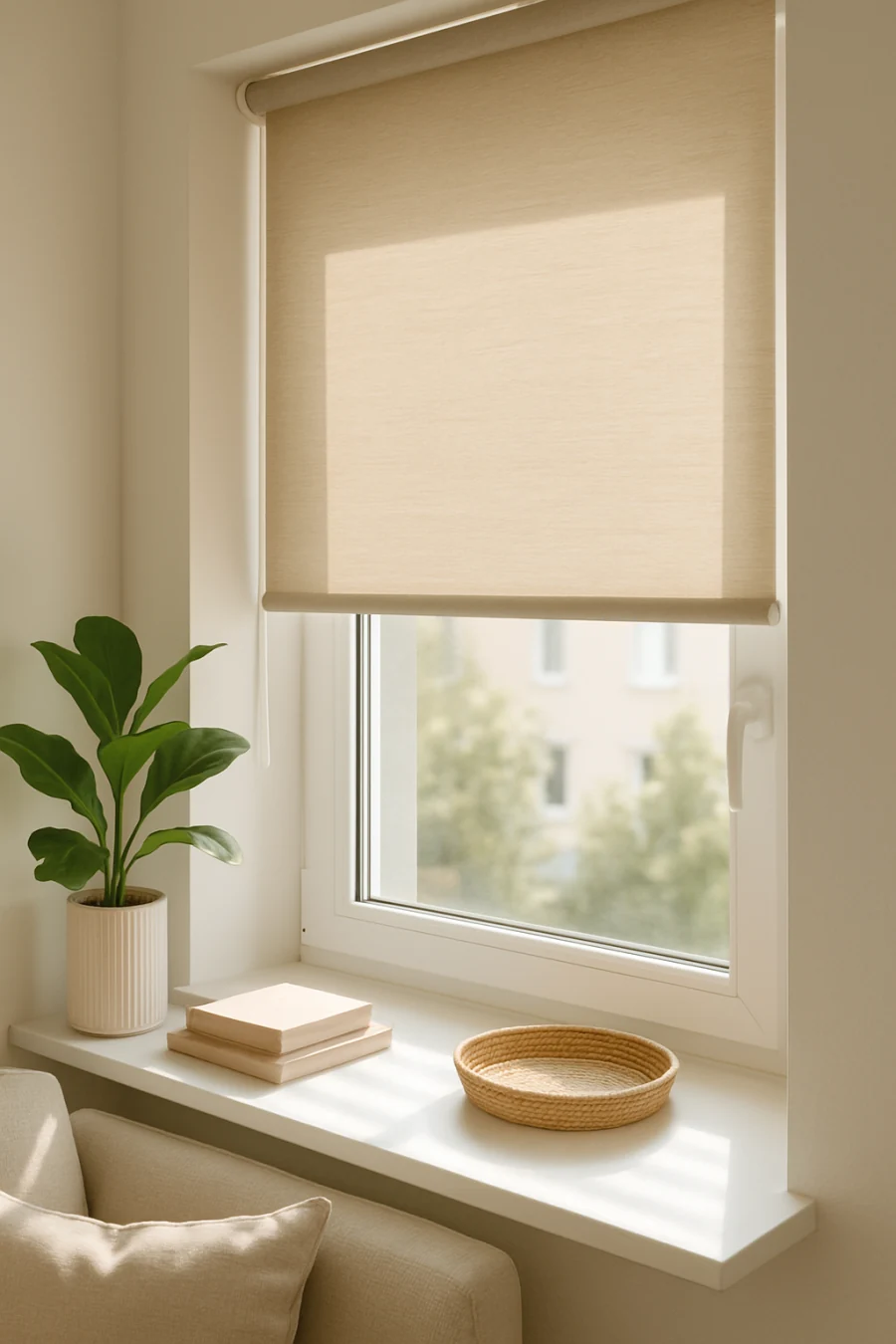


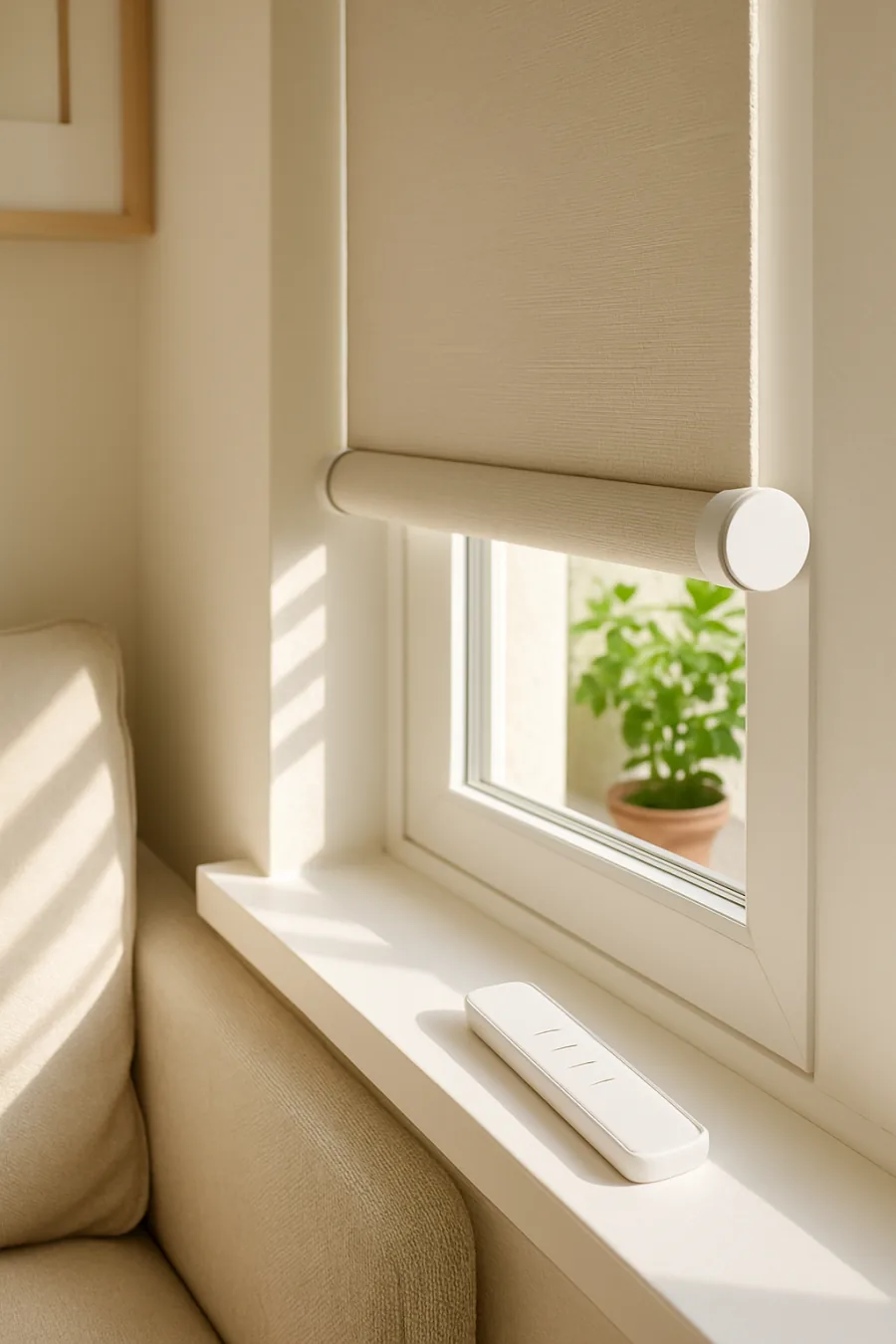


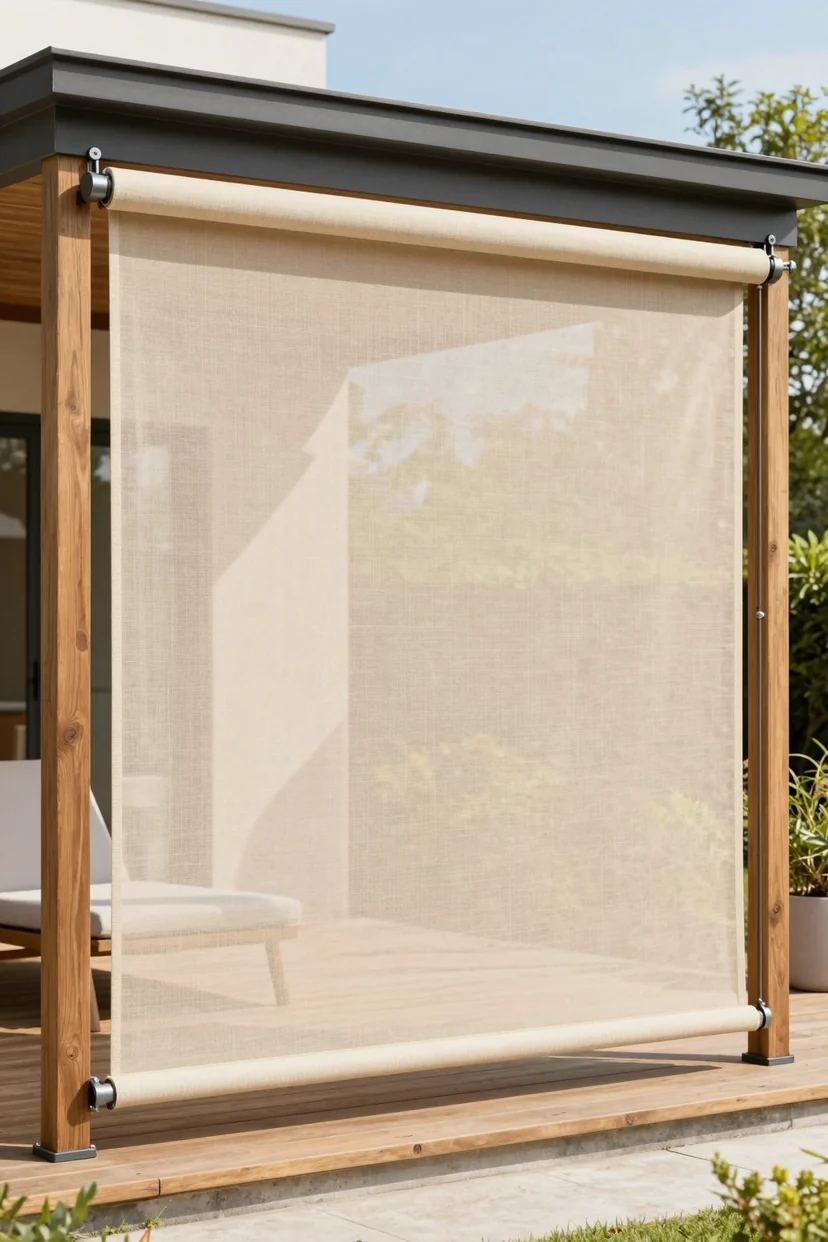











Blue roller blinds in Almaty are made to measure: the fabric rolls up into a compact roll above the window. The same blue looks different on blackout, linen and semi-transparent fabric. Density is chosen for window orientation: south and west — protection from the sun, north — more light. Measurement is free, the measurer brings samples.
How blue behaves on a window
Blue works differently in an interior than on a paper palette. On a window it is always fabric, and its density decides how much daylight gets into the room. Blue roller blinds are chosen not for the shade number, but for how the fabric will behave on a particular window.
A blue roller blind rolls up into a compact roll above the window instead of a rail and curtains. It takes up less space at the sides than any other textile, and this noticeably changes the feel of the windowsill — it stays free.
Shade and density are two different things
The same blue tone reads differently on dense and on semi-transparent fabric. Fabric density sets light transmission: the denser the weave, the less light passes through the fabric. A rich dark blue on blackout looks deeper than the same tone on light semi-transparent fabric, because dense fabric is not lit up from the street.
When blue makes a room darker
A dark rich tone visually narrows the space — this is a matter of colour psychology, not lighting. Light and muted shades work more gently and do not press on the room.
- For the bedroom and kids' room, choose a dense dark blue: it pulls the interior together.
- For the kitchen and living room — semi-transparent fabric and linen, where light is needed.
- In a small room, it is better not to put a dark tone on a wide window across the whole wall.
And here is what is important to remember about care. Dark blue fabric needs dry dust cleaning — dust is more noticeable on it than on light fabric, so the blind is vacuumed more often with a soft brush attachment. Blue on a window is not a colour from a palette, but fabric whose density determines how much light it lets into the room.
What blue fabric does to the light in a room
Blue roller blinds in Almaty change not only the look of the window — they change the light itself. Semi-transparent fabric lets the daylight flow through and tints it cold: the room stays bright, but its colour temperature shifts towards blue. Dense blue fabric does not let daylight through at all, so it casts no shade on the walls.
From there the difference only grows. The same blue tone behaves like two different colours — fabric density decides everything. This is exactly the thing that is hardest to imagine from a catalogue photo.
During the day with a semi-transparent blind down
Lower a semi-transparent blind during the day — and the room will not go dark. Light will pass through the fabric, but it will arrive different.
Walls and faces by the window take on a cold shade. Mahogany furniture or warm beige textiles look unusual in such light: blue mixes into their own tone. The closer to the window, the more noticeable. Deeper in the room the effect weakens — diffused light has time to mix with reflections from the walls and furniture.
The character of the light changes, not its amount. It is for this softness that semi-transparent fabric is chosen for the living room, kitchen and study, where light is needed during the day and a stuffy closed window is not.
In the evening under yellow lamps
In the evening the picture flips. The yellow light of the lamps argues with the blue fabric.
If a warm lamp is on in the room and it is dark outside, the semi-transparent fabric barely takes part in the lighting — the light goes from inside out, not the other way round. The light on the walls stays yellow, the way the lamp gives it, and you will not see any blue. But blinds are not a lamp: in the evening, with the light on, a semi-transparent fabric shows through more than it does during the day, and it does not hide the room from the street. This is worth remembering if the window faces a courtyard. By the way, the shade of the fabric itself reads differently in the evening than in the morning — do not be alarmed if it seems darker.
What does not give off colour
Dense blue fabric and blackout work the other way round during the day. They do not let light through, so they do not give their colour to the room either.
The walls stay their own colour, and the light stays the way the lamps or the gaps along the edges of the fabric give it. No blue on faces. But then there will be no daylight in the room either — that is the price you pay for darkening a bedroom or a child’s room. The trick is simple: if you want colour in the interior but do not want cold light, choose dense blue fabric, not semi-transparent.
Semi-transparent blue fabric tints daylight a cold tone, while dense blue does not let light through and does not give its colour to the room.
Dense and semi-transparent fabric: light and privacy
Privacy with light comes from semi-transparent fabric, privacy with darkening comes from dense fabric. These are two different scenarios, and you choose between them not by the beauty of the shade but by what should happen in the room during the day.
Semi-transparent blue fabric lets daylight through and tints it a cold tone. From the street you can make out silhouettes, but not the details of the interior. This fabric is chosen for the kitchen, living room and study, where it is important to keep the light. Dense blue fabric does not let daylight through at all, so the room stays hidden from prying eyes, but you can no longer call it bright.
Comparison table
| What we compare | Semi-transparent blue fabric | Dense blue fabric and blackout |
|---|---|---|
| Daylight in the room | passes through, is tinted a cold tone | does not pass through |
| Is the room visible from the street during the day | silhouettes are visible, details are not | not visible |
| In the evening with the light on | shows through more than during the day | not visible |
| Colour on the walls | gives a cold shade | does not give |
| What it is chosen for | kitchen, living room, study, where light is needed | bedroom, child’s room, meeting room |
Pay attention to the line about the evening. During the day the sun shines from outside and works like a shutter: the room is hard to make out from the street. In the evening the light is switched on inside, and the semi-transparent fabric starts showing through more than during the day. At that hour it gives no privacy. Is there a way out? Yes — in the evening you raise the semi-transparent blind and close the room with dense curtains, or you choose dense fabric straight away for windows that face the street or a neighbouring building.
This difference does not mean that one fabric is better than the other. In the same home we more often install semi-transparent fabric in the kitchen and dense fabric in the bedroom, and that is normal.
The blackout side
Blue blackout is made as a three-layer fabric. The blue colour faces the room, while the light reflective backing faces the glass. From inside you see a rich blue, from outside the window looks light, not blue. This is what makes blackout hold the darkening: light does not pass through the fabric and does not give blue to the walls.
A strip of light along the edge
With an open roller tube, a narrow strip of light remains along the sides of the fabric — a gap between the fabric and the window reveal. With dense fabric it becomes noticeable precisely because everything else is darkened. This strip is removed by the guide rails of a cassette system: the fabric runs inside them and is pressed to the edges. A cassette system costs more than an open roller tube. If full darkening without light edges is essential to you, this is worth taking into account at the measurement.
The bottom line is simple: semi-transparent fabric gives light and daytime privacy, dense fabric and blue blackout give darkening; in the evening, with the light on, semi-transparent fabric does not hide the room.
One blue on different fabrics
No, the same tone looks different on blackout and on linen. The shade of blue is set not by the picture but by the fabric: the weave of the threads, the density and whether light passes through the fabric. That is why blue roller blinds are chosen not from a catalogue but from a sample held against your own window.
At the measurement a Jalusso specialist lays out four fabrics of the same tone side by side, and the customer almost always chooses a different one from the one they liked on their phone. That is normal — a screen shows colour approximately, while fabric works with real light.
Matte fabric
A fine, even weave without sheen gives the most predictable result. The deep tone lies evenly over the whole surface, without patches or shifting shades. This kind of blue looks good in a bedroom and a study: it does not distract, but keeps the window as an accent.
Linen texture
Linen texture is a rough surface with an uneven weave. Blue on linen texture looks different from blue on blackout: the tone reads deeper, and soft shifting shades appear in the light. The blind works as a detail of the interior, not as a background. For a living room in a calm interior this is my favourite option, though to the touch the fabric is rougher than matte.
Fabric with a weft texture
Fabric with a weft texture resembles denim: the thread runs unevenly, the surface comes alive. Indigo on such fabric looks more expensive than on an even fabric, because the light falls on the relief and gives it volume. It suits those who want colour with character and are not afraid that the blind will become the main accent in the room.
Semi-transparent fabric
The semi-transparent blue fabric tints daylight with a cool tone, and that changes how the shade is perceived. The tone looks lighter and airier precisely because light passes through the fabric. During the day the room stays bright, but with a coolish cast. By the way, in the evening with the lamps on, a semi-transparent blind reads differently than in the daytime — worth keeping in mind before you order.
What to choose
Blue blackout is a dense three-layer fabric, and it gives the darkest, most even tone of the four: light does not pass through the blind, so there is almost no reflected light on the surface. Linen texture and weft-textured fabric win on depth. Semi-transparent fabric wins on lightness.
The shade of blue is set by the fabric: on a matte blind, on linen texture, on weft texture and on a semi-transparent blind, the same tone looks different.
How to choose the density for window orientation in Almaty
The density of blue fabric is chosen by window orientation, not by the catalogue. A south- or west-facing window gets more direct sun, so a dense blind or blackout is used there, while for north and east, light and semi-transparent shades are used. In Almaty the climate is sharply continental: cold winters with frosts and a temperature swing between day and night, and hot, sunny summers with dust. Because of this, the difference between the sunny and shaded sides of a window is felt more strongly than in a mild climate.
South and west
A south-facing window and a west-facing window are the most sun-loaded. A rich dark blue here loses its richness faster than a light one, because dark pigment takes on more ultraviolet. Our warranty does not cover natural fading of the fabric — this is an important point that we talk about openly at the measurement, not in fine print. That is why for sun we recommend dense blinds: dense fabric covers the window more solidly and takes the light on itself.
And does dark blue fabric heat up more on a south window than a light one? Yes, a dark surface heats up more from the sun — that is physics, not a property of a particular collection. But it is the blind itself by the glass that heats up, not the room: a roller blind hangs right against the window, and the heat goes up along the glass, not into the room. If the south window is large and you want to keep the blind down all day, it is more sensible to take blackout — a dense three-layer fabric that does not let light through and heats up less itself.
North and east
A north-facing window and an east-facing window get little direct sun. Here dense fabric works against you: the room is not exactly bursting with light even without a blind, and a dark blind finishes it off. Blue on a north window makes the room gloomier — this is not a matter of taste, but a consequence of there being little light outside and a dark tone letting almost none of it through. In such cases Jalusso suggests a semi-transparent fabric or light-shade blue linen: the blind stays blue, but diffuses daylight softly instead of cutting it.
What to choose for your window
| Orientation | Fabric density | Type of control | What to consider |
|---|---|---|---|
| South, west | Dense fabric or blackout | Chain | Fabric — from 5,400 ₸/m², manufacturing 4–6 days |
| North, east | Semi-transparent fabric or linen | Mechanical | A dark tone makes the room gloomier |
| South, wide window | Blackout | Electric motor | Full blackout — a cassette system costs more than an open roller tube |
| Rented housing | Any, by light | No drilling | Drill-free mounting changes the result |
Checklist by window orientation
- Look at which way your window faces.
- Assess how many hours a day direct sun falls on it.
- If the sun hits for most of the day — take dense fabric or blackout.
- If the window is in shade almost all day — take semi-transparent fabric or linen.
- Compare samples at your own window in your own light: a south side and a north side show the same blue differently.
On a south or west window, a rich dark blue loses its richness faster than a light one, so for sun dense blinds are used, and for north, light and semi-transparent ones.
How to compare a shade by sample
A shade is compared at your own window, not in a catalogue on your phone. We select blue roller blinds in Almaty like this: the measurer brings fabric samples, and they are placed against the frame, wallpaper and furniture in daylight and in the evening. A phone screen lights up the image itself, so the same tone looks brighter and cooler on it than on fabric. Daylight from outside and the yellow light of lamps give two different shades of the same blind — and both will be real.
- See which way the window faces and how much sun falls on it.
- Place the fabric sample against the frame: against a white plastic frame, dark lamination or wood.
- Place the same sample against the wallpaper and furniture — against what stands next to the window.
- Look at the sample in the daytime and again in the evening, when you turn on the light.
- Compare two or three samples with each other, not from memory.
Measurement is free within Almaty, so comparing samples costs nothing. What is more, we can come with samples again — if after the first visit you are torn between two tones. We do this regularly: choosing a colour from memory of a showroom visit makes no sense.
White frame and dark lamination
On a white profile, blue gives contrast; on a dark one it works more calmly. A white plastic frame is a light backing, so a rich tone next to it reads as an accent and the border between the blind and the window is clearly visible. Dark window lamination is dark in itself, and blue fabric on it does not argue but looks like a continuation of the profile. If you want a sharp border — take a rich tone on a white frame. If you do not need a border — a muted one.
One tip from practice: do not choose a shade under evening lighting if you are rarely home during the day. The yellow light of lamps is warm, it dulls the blue, and in the morning the colour will look different. And remember: a shade is chosen at your own window, because the light in the room is part of the colour.
Systems: open roller tube, mini, cassette
In terms of darkening, the open roller tube and the cassette system differ at the edges. With an open roller tube, the fabric hangs freely and a narrow strip of light remains at the sides. The cassette system includes guide rails that remove this strip along the edges of the fabric. Hence the price difference: the cassette system costs more than the open roller tube, because the housing box with guide rails is more complex to manufacture and install. The base price in the price list — from 5,400 ₸/m² — is calculated for an open roller tube in polyester.
The “mini” system is suitable for narrow sashes: a compact roller and narrow guide rails hide by the glass, and the fabric goes into the opening. Furniture next to the window doesn’t get in the way. The mini system is often chosen for balconies and loggias, where every centimetre counts.
An electric motor controls the fabric on wide windows that you can’t reach by hand, and on panoramic glazing. By coefficients, a chain adds 1.06 to the base price, an electric motor — 1.85, electric with remote control — 2.1. On one window the difference between a chain and a remote is noticeable; across several openings it grows proportionally.
Control and mounting
Mounting also changes the total. On the wall — base position. On the frame — 1.05, without drilling — 1.1, cassette system — 1.28. Each option is calculated separately, and the measurer adds them up into one estimate on site.
Two windows in one room
If the fabrics differ in density, the blinds will hold light differently. One window will give a half-tone, the other — darkening, and the difference on the wall is immediately visible. It’s best to decide using samples on both openings at once: you place two fabrics against the frames and see how they behave next to each other.
Jalusso recommends choosing the system for the task, not the other way around: first you decide whether you need the strip of light at the edge, then you look at the price. With an open roller tube the strip always remains, and it has no guide rails — that’s the design, not an option.
Blue in different rooms
A room is chosen not for the colour but for the task: where you need sound sleep — there you need dense fabric, where you need light — translucent fabric. Blue roller blinds for the bedroom and kids’ room are chosen in a dense version and blackout. For the kitchen and living room — translucent fabric and linen, which keep the room bright.
Bedroom. Dense blue fabric gives privacy with darkening — during the day the room is as dark as in the evening. The dark blue tone also brings the interior together around the window, and it’s almost invisible in the sun.
Kids’ room. Here dense blue and blackout solve the issue of daytime naps. And translucent fabric gives privacy with light — the room stays bright, but details can’t be made out from the street.
Study and meeting room. A workspace needs even light without glare on the screen, so translucent fabric or linen is more often chosen. If presentations are shown in the meeting room, blackout is installed.
Kitchen. Talk about blue reducing appetite is about the plate and the tablecloth, not about the fabric on the window. A blue blind in the kitchen changes nothing. For the kitchen, translucent fabric is actually convenient: it softens the sun but doesn’t turn the work area into a dark room.
Blue with wallpaper and furniture. With blue wallpaper the fabric blends in if the tone matches. Then you take a shade two steps darker or lighter than the wall — that way the blind reads separately. Grey-blue and muted tones suit wooden furniture, while rich blue suits grey.
For the bedroom and kids’ room, dense blue and blackout are chosen; for the kitchen and living room — translucent fabric and linen, where light is needed.
Blue with blue wallpaper
So the fabric doesn’t blend with the wall, take a tone two steps darker or lighter.
Blue outside and on the facade
From the facade of a building, a window with blue blackout looks light, not blue. The back of blackout is light, and it faces the glass; the blue colour looks into the room, while the light side of the fabric faces the street.
This is worth considering for those choosing blinds to match the look of the house. The management company or neighbours assess the building facade as a whole, and one window that stands out from the row is immediately noticeable. Blackout behaves modestly in this sense: from the courtyard such a window reads as an ordinary light one. Translucent fabric is another matter. Through it the blue shade is visible from the street, especially when compared with neighbouring windows where neutral fabrics hang. On a lit facade, a translucent blue blind gives a coloured spot and works as a detail of the house’s appearance, not a hidden part of the interior.
In a glass office or a house with panoramic glazing this effect is stronger: there are more fabrics, and they are noticeable from a great distance. What matters more here — the view from inside or how the windows look from outside? We usually ask about this during the measurement, because the answer changes the choice of fabric. If the facade should stay even, blue blackout is chosen: the light back of blackout faces the glass, and from outside the window doesn’t stand out in colour. If a coloured spot on the facade is part of the idea, translucent fabric gives exactly that result.
By the way, in the evening the picture reverses: with the light on in the room, translucent fabric shows through to the outside more than during the day, while blackout still doesn’t show what’s happening inside.
The light back of blackout faces the glass, so from the street a window with blue blackout looks light, while the blue colour of blackout looks into the room.
What about price and lead times
Blue roller blinds in Almaty are calculated by the area of the opening: the base position in the price list is from 5,400 ₸/m² for an open roller tube, and manufacturing takes 4–6 days. This price includes the fabric, roller, mechanism and fasteners. Installation is calculated separately — per item, not per metre. Around the city it costs 4,500 ₸, and for orders from 150,000 ₸ we don’t charge for it. Measurement is free: the measurer comes with samples and calculates the cost on site, so you see the figure before ordering, not after.
What changes the total:
- The area of the opening — the main multiplier, the price is per square metre.
- Fabric group: translucent fabric, matte fabric, linen and blackout cost differently.
- Type of control: mechanical, chain, electric motor or electric with remote control.
- Type of mounting: on the wall, on the frame, without drilling.
- Cassette system: a different design and a different price.
There’s little pleasant in this arithmetic, but it’s honest: a wide window in the living room and a narrow sash in the kitchen in the same shade will give a different total. The cassette system is more expensive than the open roller tube — but it has guide rails.
What the free measurement includes
The measurer comes with fabric samples, places them against the frame, wallpaper and furniture by your window and calculates the cost on site. Within Almaty, measurement and delivery are free. To the suburbs — Kaskelen, Talgar, Issyk, Kapshagay — we do travel, and we quote the travel cost before the visit so it doesn’t come as a surprise. Electric motors and electric with remote control on wide windows are also calculated on site: such things can’t be guessed over the phone.
What changes the total
The area of the opening, the fabric group, the type of control and mounting — these are the four things the price depends on. A chain, an electric motor, electric with remote control, a cassette system with guide rails — each option moves the total in its own direction. Measurement is free within Almaty, and installation is 4,500 ₸ per item, and for orders from 150,000 ₸ we don’t charge for it.
A real example
A typical situation we deal with most often during measurement: a window faces the sunny side, and the customer wants a rich blue colour. During the day a lot of light falls on such a window.
During the measurement the measurer brings fabric samples and lays them out right on the windowsill. A fabric sample is placed against the frame, wallpaper and furniture by the window — first in daylight, then with a lamp on. This is the answer to the question of how to compare a shade when the light in the showroom and at home is different: you need to compare where the fabric will hang, not in a catalogue on a phone screen.
The density is chosen to suit window orientation. On a south-facing window, a thin semi-transparent sample gives soft light, but the richness of the blue reads weaker on it. Blue blackout holds the colour more solidly and does not let light through — for a bedroom on the sunny side, this is a workable option. Semi-transparent fabric remains the choice for the kitchen and living room, where light is needed during the day.
The rule is simple: first window orientation, then the fabric, and only then the shade. The blue you liked on a screen will look different at a window on the sunny side.
FAQ
The answers to the remaining questions rest on three things: fabric density, window orientation, and choosing by sample. Below are the things asked about most often at a measurement.
Which side of the blackout faces the room?
The colour faces the room, while the light-coloured backing of the blackout faces the glass. The dense three-layer fabric with a coating is made this way: you see the blue tone from inside, and the light-reflecting layer works against the glass. From the street, a window with this fabric looks light. About the open roller tube, we remember one thing: a strip of light remains at the sides, and only the guide rails of a cassette system remove it.
How do you care for dark blue fabric?
Dark blue fabric needs dry dusting. Dust and lint are more noticeable on dark fabric than on light, so it is vacuumed more often with a soft brush at low speed. We do not recommend washing the fabrics: washing spoils blackout with a coating, and removable fabrics shrink along the edge after water. A stain on dense fabric is removed with a damp sponge without taking the fabric off the roller tube.
Can blue blinds be installed on two windows of different density?
You can, but they will hold light differently. If one window has blue roller blinds made of semi-transparent fabric and the other has dense blackout, the room will be lit during the day by exactly one window. It is best to coordinate by samples for both openings at once, and to choose the density to suit the orientation of each window: dense for the south, semi-transparent for the north.
Two windows in one room with different fabric density is the most common case when a customer comes back for a second measurement to coordinate the shade again.
Conclusion
Blue on a window is fabric, not a colour from a palette. The density of the fabric decides how much light passes into the room, so the same shade from the catalogue gives a different result: opaque fabric blocks light, semi-transparent lets it through and tints it a cool tone. Hence the difference in how the room looks during the day with the blind down.
The same tone looks different on blue blackout, on linen texture, on fabric with a weft texture, and on semi-transparent fabric. Linen and uneven weft give shimmer and read deeper, matte fabric holds an even tone, and semi-transparent fabric seems lighter and airier because light from outside passes through it. And you cannot choose between them from a picture on your phone.
Semi-transparent fabric gives privacy with light, dense fabric gives privacy with darkening. In the evening with the lights on, semi-transparent fabric does not hide the room: from outside, silhouettes read more strongly than during the day, and this point is worth considering in advance. Full darkening without a strip of light at the edges is only given by a cassette system with guide rails, and it is more expensive than a basic open roller tube.
On a south- or west-facing window, a rich dark blue loses its richness faster than a light one, so dense fabrics are chosen for the sun, and light and semi-transparent ones for the north. The warranty does not cover natural fading, and we will not promise that the blue will not fade.
There is one practical recommendation: book a free measurement so that the measurer brings samples and you can hold them against your frame, wallpaper and furniture in your own light — during the day and in the evening. Within the city of Almaty, measurement and delivery are free.

