
















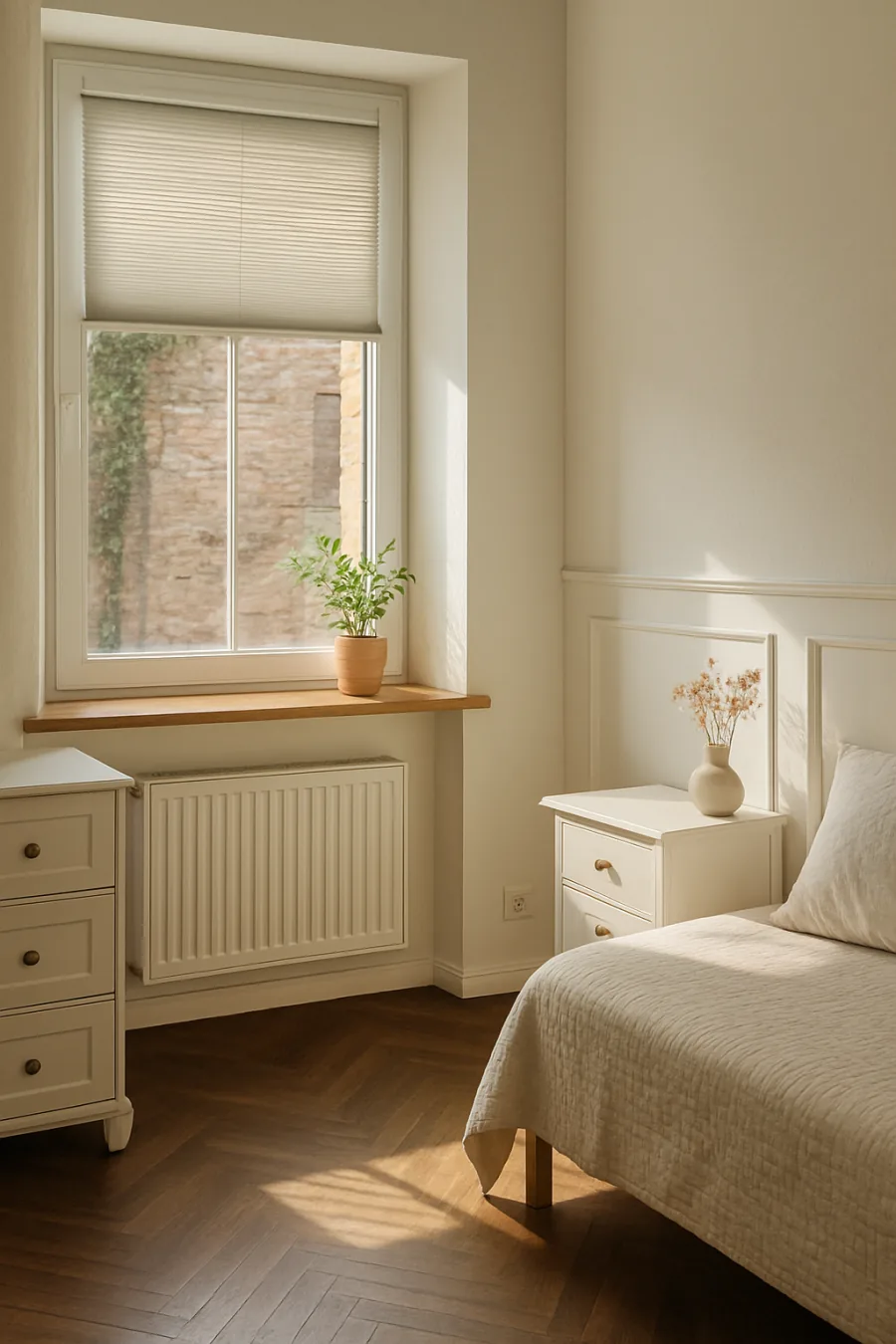


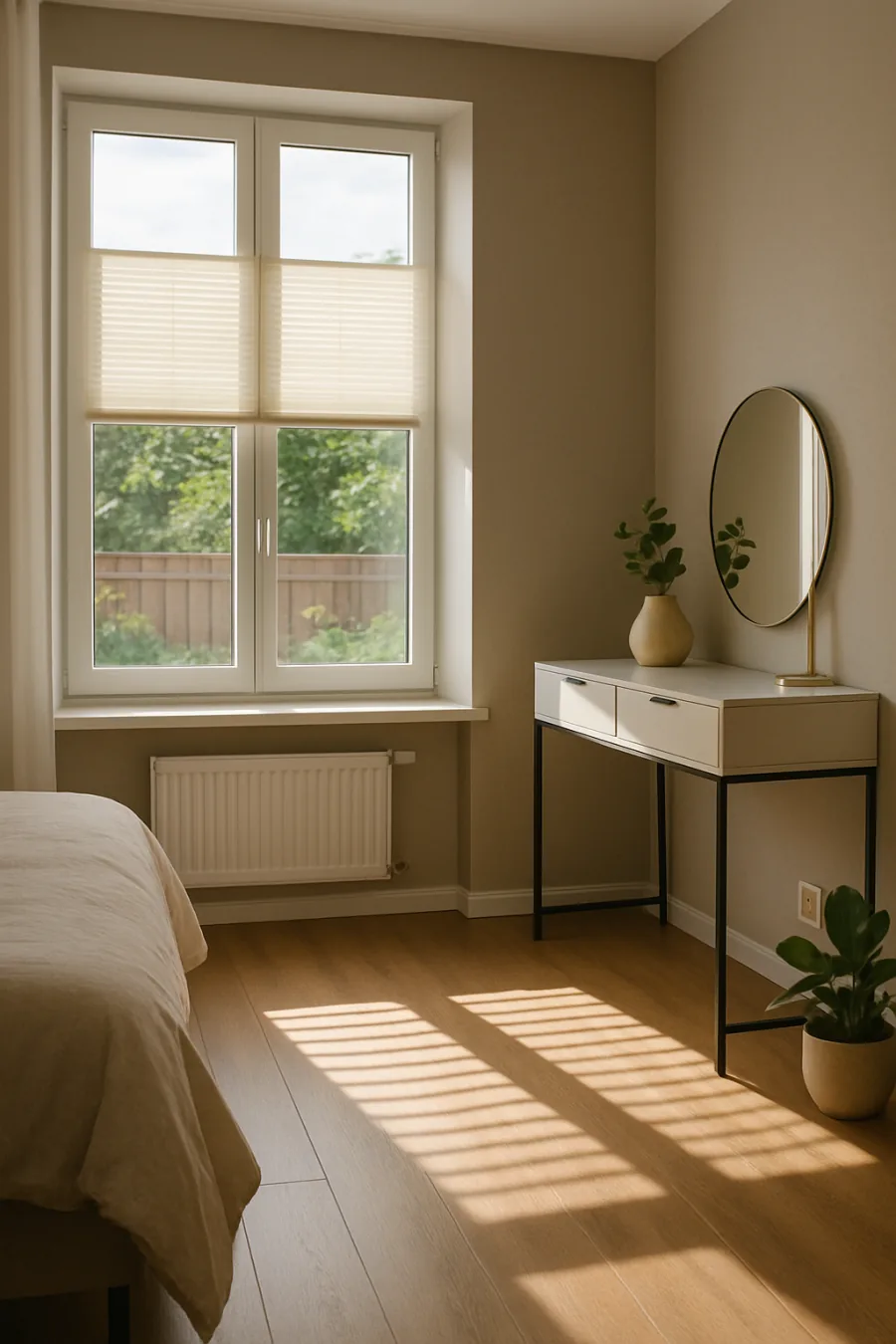











Blinds on adhesive tape in Almaty are attached with double-sided mounting tape directly to the frame of a plastic window, without drilling and without hooking onto the glazing bead. This is how light systems are installed: roller blinds, pleated blinds, aluminium slats on a small window. For south- and west-facing windows we suggest glazing bead mounting.
What adhesive-tape blinds are and how they stay up
Adhesive-tape blinds are attached to the frame of a plastic window with double-sided foam mounting tape. There is no need to drill the profile, and nothing hooks onto the glazing bead. It is the bracket of the product that is glued, not the fabric: one side of the tape goes on the frame, the other on the bracket.
Self-adhesive window blinds work the same way: the tape is on the bracket, and the protective layer is peeled off before sticking. The word “blinds” here covers various products. Tape mounting suits roller blinds, pleated blinds — a fabric concertina — aluminium blinds with a 16 mm slat on a small window, and paper blinds. They are all lightweight, and that is exactly what makes adhesive mounting work.
What are called soft blinds
By soft window blinds, in everyday speech and on marketplaces, people usually mean fabric pleated blinds — a concertina made of polyester or paper. The term is a household one: it refers to ordinary pleated blinds, not a separate type of product. The fabric is lightweight, so soft blinds are suitable for tape mounting.
If a seller writes “soft blinds”, ask what exactly is included — a roller, pleated blinds or a paper concertina. Both the width of the fabric and the control method depend on this.
What the mounting consists of
Double-sided foam mounting tape is made like the tape used to attach car mouldings. The foam layer smooths out unevenness in the profile, and the acrylic base sets within a day and then holds for years.
Mounting tape requires a degreased and dry surface. Plastic wiped with a sleeve holds far worse — on dust and a film of grease the adhesive only sets at the edges.
In the workshop we use 3M double-sided tape. We stick one side to the frame and the other to the bracket of the product; we do not stick it to the glass, where the seam is visible from the street and heats up more.
Adhesive-tape blinds are attached to the frame of a plastic window with double-sided foam mounting tape, without drilling the profile and without hooking onto the glazing bead.
Which blinds can be glued and which cannot
Mounting tape limits both the weight of the fabric and the width of the product — these are the two main conditions. You can glue pleated blinds, roller blinds and aluminium blinds with a 16 mm slat if the window is small. The fabric width is roughly up to one and a half metres. We do not mount wooden blinds, cassette systems or anything with an electric motor on tape.
The tape holds a lightweight fabric. A fabric blind for a window up to one and a half metres wide is exactly the limit; beyond that the adhesive works under tension. Polyester roller blinds, fabric pleated blinds and thin aluminium slats fall within this range. But bulky systems do not. Cassette designs are heavier because of the housing box alone, and the cassette also catches on the frame when the sash is opened. There is no question of such window blinds being glued on tape: they are mounted on brackets only.
An electric motor is not compatible with tape at all. The motor and power supply add weight that the adhesive will not hold; besides, the motor requires rigid fixing of the housing, and tape does not provide such fixing. Wooden slats are out too: heavy and sensitive to humidity — they change shape with temperature swings, and the glued seam works under stress.
And on which windows does the tape hold worse than you would like? On laminated “wood-effect” profiles. If the film fits tightly, it holds fine, but once the lamination starts to peel at the edge, the tape comes off with it. Rough painted metal also does not give the needed contact — the adhesive sits on the bumps and the bonding area drops. And you must never glue onto a dusty, greasy or damp surface: degreasing is essential here, as covered in the installation section.
Table: what the tape will hold and what it will not
| Product | On tape |
|---|---|
| Roller blinds for a window up to about 1.5 m wide | We fit them |
| Pleated blinds, a lightweight fabric concertina | We fit them |
| Aluminium blinds, 16 mm slat, small window | We fit them |
| Wooden blinds | We don't fit them |
| Cassette systems | We don't fit them |
| Wide openings | We don't fit them |
| Any product with an electric motor | We don't fit them |
This table is not a rough guess but the limits beyond which Jalusso does not glue. A customer writes on WhatsApp and asks whether tape will suit their window; most often the answer depends on the width of the sash and the weight of the fabric.
Surfaces where the tape does not hold
Peeling “wood-effect” lamination is the first reason we refuse tape. Next comes rough painted metal: the adhesive does not fill the texture. A dusty, greasy or damp surface holds nothing at all until it is degreased and dried.
On such frames we offer glazing-bead mounting. It touches neither the profile nor the adhesive, and the window manufacturer’s warranty remains valid.
Mounting tape holds lightweight fabric and roller systems for a window up to about one and a half metres wide and aluminium slats on a small window; we do not mount wooden blinds, wide openings, cassette systems or anything with an electric motor on tape.
Why tape does not hold on a south-facing window in summer
It is not all adhesive-tape blinds that fall off, but those hanging on the sunny side. In summer, on a south- or west-facing window, the plastic behind the glass heats up to 50–60 °C. Foam-based adhesive softens at such a temperature. A heavy fabric starts to slide down the frame. Can blinds be mounted with adhesive and do they hold? The answer splits in two: on a north-facing window — yes, for years; on a south-facing one in July — no.
The physics is simple. A south-facing window is in direct sun all day, and it is not the fabric that heats up but the profile itself. This is the key detail: the frame to which the bracket is glued builds up heat. Overheating the plastic softens the adhesive, and the bracket stops holding the weight of the product. The heavier the fabric, the faster it will creep. That is why a roller system with dense fabric on a south-facing window is a risk, while lightweight pleated blinds on the same window may last longer. But we will not guarantee this.
Which windows in Almaty are unsuitable for tape because of the sun? South-facing and west-facing. West-facing because the sun hits it in the afternoon, when the air is already scorching. For such windows we offer glazing-bead mounting. The glazing bead is the strip that holds the glass unit in the frame; the bracket goes behind it and is held mechanically, without adhesive. We do not drill the frame. That means the window manufacturer’s warranty remains valid and not a single hole appears in the profile.
Why the same tape lasts for years on a north-facing window
The only difference is the heating of the frame, not the tape itself. On clean degreased plastic at room temperature, double-sided tape holds for years. A north-facing window does not reach those 50–60 °C, the adhesive does not soften, and the bracket stays in place. That is why the same material works without complaint on one window and creeps on another — and it is not about the brand of tape.
What we offer for the sunny side
Glazing-bead mounting solves the problem without drilling and without adhesive. We do not touch the frame at all, and the window manufacturer’s warranty is preserved. The price is the same as for a product on tape — from 4,700 ₸ per m². For a south- or west-facing window this is our standard option, not a forced substitute.
In summer, on a south- or west-facing window, the plastic behind the glass heats up to 50–60 °C, the adhesive softens, and a heavy fabric creeps — for such windows we offer glazing-bead mounting.
Tape, hook-and-loop, suction cups, glazing bead: how the drill-free methods differ
All four methods have one thing in common: the frame is not drilled, and the window manufacturer's warranty stays valid. The difference is what exactly holds the product and what can be removed without re-gluing the mount.
3M double-sided tape is a mounting tape on a foam base. One side goes onto the degreased profile, the other onto the product's bracket. The acrylic base sets within 24 hours. It holds stronger than silicone pads and easily carries roller blinds, pleated blinds and aluminium slats on a small window.
Magnetic tape is two strips: one on the frame, the second on the bracket. Magnetic tape lets you remove the blind without re-gluing and put it back just as evenly. It is the one people choose when the window is washed often and they don't want to take the blinds off every time. “Blinds with Velcro” and “roller shutters with Velcro” in listings refer to various removable setups: sometimes it's a magnet, sometimes a textile fastener, sometimes glue — before ordering, check what exactly holds the blind.
Silicone pads hold with micro-suction cups. They come off cleanly and are re-stuck after washing. They are also weaker than double-sided tape — fine for a light blind, not for a heavy one. When people say “blinds with suction cups” or “window blinds with suction cups”, they mean silicone pads.
Mounting into the glazing bead doesn't touch the frame either: the bracket goes into the groove between the glass unit and the profile. No glue, no holes — and no heating of the adhesive layer.
Another detail common to all adhesive methods is degreasing the profile. Without it, neither tape, nor magnetic tape, nor micro-suction cups will hold.
Comparison table of the four methods
| Method | How it holds | What comes off without re-gluing | For which window |
|---|---|---|---|
| 3M double-sided tape | Foam-based mounting tape, sets within a day | Nothing, the blind comes off together with the bracket | Any window except on the sunny side |
| Magnetic tape | Two magnetic strips: on the frame and on the bracket | Fabric | A window that is washed often |
| Silicone pads | Micro-suction cups | The blind and the pads | A very light blind, when you don't want glue on the frame |
| Mounting into the glazing bead | Bracket in the groove between the glass unit and the profile | Fabric | A south or west window |
There is no mistake in the tape row: the blind comes off together with the bracket, because the bracket is glued on. This is not an inconvenience, but the price for the most reliable grip of the three adhesive options.
Which method to choose when
A window that is washed often — magnetic tape: take the blind off, wipe, put it back, without touching the bracket. A very light blind and no glue on the frame — silicone pads. Sunny side — glazing bead, in summer it's the only calm option. Everything else — tape.
The difference between tape and glazing bead is not in the price: both options cost from 4,700 ₸ per m². The difference is that tape works on an adhesive layer, while glazing bead does without it and therefore doesn't fear plastic heating up.
Double-sided tape holds stronger than silicone pads, magnetic tape lets you remove the blind without re-gluing, and mounting into the glazing bead touches neither the frame nor glue and suits the sunny side.
How to glue blinds with tape: preparing the frame and installation
Gluing blinds with tape takes four steps: degrease the spot, mark the position, remove the protective layer, press the bracket and wait 24 hours before loading. The order must not be broken — degreasing the profile comes before sticking the bracket, and marking the position is done before removing the protective layer, otherwise you won't be able to take it off and adjust it. 3M double-sided tape sets within 24 hours, and until then it's best not to hang the blind.
Step-by-step instructions
- Wipe the mounting spot free of dust and be sure to degrease it. A regular cloth won't do here: if you wipe with your sleeve, the tape will land on a greasy film and come off.
- Mark the position with a pencil — before you remove the protective layer. A couple of millimetres off is almost invisible by eye, but in fact the bracket ends up crooked.
- Remove the protective layer and press the bracket to the frame with force, not with a jerk.
- Leave it for a full day before putting any load on it. Hang the blind the next day.
What to degrease with? Alcohol or a mild detergent, without abrasives. Solvent and acetone must not be used on PVC: the plastic turns cloudy, and you won't be able to restore its look — that mark will stay on the frame even if you take the blinds off.
In winter and on an unheated loggia
On a cold frame the glue sets worse than in warmth. The mounting spot is warmed with a hairdryer — the frame should be warm to the touch, then the tape will hold properly. On an unheated loggia the tape behaves differently than in a room: the temperature difference between day and night and the cold surface of the profile reduce the grip. This is worth considering when choosing the mount, not after the blind has slid down.
A sash on ventilation
The mount withstands opening if the product is within the permissible weight and width — the very ones the tape actually carries. A heavy blind on a frequently opened sash is a risk: every turn of the sash puts load on the bracket, and the tape won't compensate for the extra weight. If the window is opened several times a day, choose a light system.
Before gluing, the spot must be degreased and the position marked before removing the protective layer; on clean degreased plastic at room temperature the tape holds for years. Preparation matters more than the tape itself.
Removal, glue marks and re-gluing the bracket
Blinds on adhesive tape can be removed in minutes: the bracket is separated from the frame, and the blind comes off together with it. Usually glue is left on the profile afterwards. How to remove it is the question on which windows are most often ruined.
The method is simple: warm water with soap and a soft cloth. The softened adhesive rolls into little balls, which you wipe off with the cloth without pressing hard. If a mark remains, repeat the procedure, but do not scrub the plastic with an abrasive. Solvents and acetone are out of the question — they leave matte spots and cloudiness on PVC, and on a laminated “wood-effect” profile the film itself can come off. Plastic damaged by a solvent cannot be cleaned afterwards.
Moving out is a separate case. When moving, the bracket is removed while holding the blind so it does not bang against the glass and the windowsill. After that the frame stays exactly as it was before installation, apart from the adhesive mark.
Re-sticking: once and right away
If you stuck it on crooked, the bracket can be re-stuck once and right away, in the first minutes after applying. While the acrylic base has not set, the tape comes off together with the bracket and is moved to the marked position. After a day, removing the bracket without leaving adhesive on the frame is no longer possible: you will have to cut the tape off and clean the profile all over again.
Hence the rule we spell out at the measurement: mark the position before peeling off the protective layer, not after. It is cheaper to spend two minutes with a pencil than to scrape tape off the frame later.
A rented apartment and a leased office
For a rented apartment and a leased office, adhesive tape is one of the few ways to hang blinds without consequences for someone else’s window. No holes appear, the glazing bead is left untouched, and the window manufacturer’s warranty stays valid. The frame is not drilled, and the tape mark is removed with warm water and soap.
What is worth clarifying before ordering: the profile type and the side of the building. On a north-facing window the adhesive holds for years without a problem. On a south- or west-facing window, summer heat softens it, and in that case we suggest fixing into the glazing bead at the same price.
After blinds on adhesive tape are removed, adhesive usually remains on the frame; it is cleaned with warm water and soap and a soft cloth; solvents and acetone are not suitable for this — the plastic turns cloudy.
A ready-made kit from a marketplace or a made-to-measure product
A ready-made kit from a marketplace comes in fixed sizes, while a made-to-measure product is built for a specific sash. The difference is obvious right away. When you work out whether it will fit the sash, the question stops being about fabric colour or control type — it becomes about geometry.
A ready-made kit does not account for the actual width of the sash. On a marketplace you choose from what is in stock, while your sash may be a few centimetres wider or narrower than any of the sizes. That leads to two outcomes: either the blind is wider than the opening and rests against the window reveal, or it is narrower and gaps are left at the edges for light to get through. Both feel different on tape. A wide blind is heavier, and you already know how that ends for the fixing. A narrow one looks untidy and does not cover the window.
Why a standard size is not the same as the sash
Sashes differ in width even within one apartment. In a new building with identical windows the spread is smaller, but it is still there. A ready-made kit is either wider or narrower — hence the skew and the extra weight on the tape. We bring samples with us and measure every sash separately, so a made-to-measure product fits the size of that specific sash. A blind width of up to 1.5 m is the upper limit beyond which we do not recommend tape at all, and a marketplace size very easily steps over that limit.
The Jalusso workshop in Almaty cuts the blind to a specific size. A measurer comes to you with samples, you look at the fabric, choose the colour, and he calculates the price on the spot. This is not an extra step — it is what separates a product that will hang for years from one that will have to be taken down.
We stick to the frame, not the glass
The second question is where to stick it. On glass the seam is visible from the street and heats up more. We fix to the frame. 3M double-sided tape behaves differently on glass than on plastic: glass heats up more, the adhesive softens faster, and the installation seam reads from outside as a stripe across the whole window. From inside it is almost invisible, but from the street it shows.
That is why, even within one sash, we mark the position on the profile, not on the glass. Before buying stick-on blinds on a marketplace, do not rely on photos and the size chart alone: every profile has its own frame width, and what fitted at your neighbour’s place may sit crooked at yours.
What it costs and what is included in the price
Blinds on adhesive tape in Almaty cost from 4,700 ₸ per square metre. Fixing into the glazing bead, which we suggest for the sunny side, costs the same. The price is calculated by the area of the blind, not by the size of the whole window: you pay for the fabric or slats that cover the opening.
The base price in the price list is horizontal blinds from 4,200 ₸/m². Drilling-free fixing adds a coefficient of 1.1, after which the amount is rounded up to the nearest hundred — that is how you get 4,700 ₸. The logic is simple: the tape and preparing the frame take extra effort, but they do not turn an inexpensive product into an expensive one. Pleated blinds and aluminium slats on tape are listed as separate lines in the page price list: from 6,200 ₸ and from 5,100 ₸ per m².
Fabric and colour choice moves the price less than it seems. White, beige and grey fabric come with a coefficient of 1.0, dark fabric — 1.04. Standard fabric is also 1.0, sun-protection fabric — 1.15, blackout — 1.35. Control: manual 1.0, chain 1.06. We do not install electric motors on tape, so they are not in the calculation.
What makes up the price
Four things determine the final amount: the area of the blind, the fabric type, the colour and the control type. Area is the main multiplier; the other three work as small adjustments to it. Take a kitchen window with a vent pane: the measurer calculates the square metres, you choose the fabric and a chain instead of manual control, and every surcharge is visible separately in the quote.
Heavy fabrics are a separate story. Blackout is denser than standard, which means it also weighs more. On tape this is already a risk, so for dense fabrics we more often suggest the glazing bead — there the profile carries the weight, not the adhesive. In our experience, chasing blackout on adhesive fixing is not worth it: you get a higher price and less reliability.
What is included in the price
Measurement and consultation are always free. The measurer comes with samples, shows the fabrics and calculates the price on the spot — within the city both measurement and delivery are free. This is not a one-off promotion but our normal way of working: we are the manufacturer, and it matters to us that the product fits the size.
Installation costs 4,500 ₸ per item. For orders from 150,000 ₸ it is free. Drilling-free fixing preserves the window manufacturer’s warranty, and our warranty is 3 years on the mechanism and 1 year on installation from the date the acceptance report is signed.
Where to order blinds on adhesive tape in Almaty
You can order blinds on adhesive tape in Almaty from us: we are a manufacturer with our own workshop, not a middleman working from someone else’s warehouse. There are no ready-made items in stock and there cannot be — every blind is made to measure for a specific sash. That is where the precision comes from: a made-to-measure product fits the size of the window, not “roughly there”. And drilling-free fixing preserves the window manufacturer’s warranty.
Getting started is simple: the client writes to us on WhatsApp. Then a measurer comes with samples, calculates the price on the spot, and only after that does the workshop start the job. No trips to a showroom, no “bring the frame to us”.
How ordering works
The first step is a WhatsApp message: a photo of the window and the approximate width of the sash. The second is a visit from a measurer with samples of fabrics and slats. He looks at the side of the building, the profile type, the condition of the surface for sticking, and gives the price right there on the spot. Then the workshop, then installation.
Within the city, measurement and delivery are free. We do travel to the suburbs — Kaskelen, Talgar, Issyk, Kapshagay — the cost of the visit depends on the distance, and we tell you it before the visit, not after.
Warranty and service
Three years — warranty on the mechanism, one year — on installation work; we count from the moment the acceptance report is signed. If the case is recognised as a warranty case, we will repair it free of charge within 5 working days. And after the warranty we also come: to tighten, adjust, replace a cord or chain. This is not a one-off service “while the paper is valid”.
What the warranty does not cover — mechanical damage, re-installation on your own, water and natural fading of the fabric. To be honest: if the blind was removed and glued back on without us, we will no longer accept a claim about the adhesive seam.
Almaty and suburbs
We are a blinds manufacturer in Almaty with our own workshop, everything is made to measure, there are no ready-made products from stock.
FAQ
Will blinds on adhesive tape fall off in summer? On a south or west window they can: the plastic behind the glass heats up to 50–60 °C, the adhesive softens, and the heavy blind slides down. For the sunny side we offer glazing bead mounting — the frame is not drilled, and the window manufacturer’s warranty is preserved. On a north window the same double-sided mounting tape lasts for years.
How much weight does the tape hold? Mounting tape requires a degreased and dry surface, and for load we rely not on kilograms but on the type of product. Light fabric and roller systems for a window up to about one and a half metres wide, and aluminium slats on a small window, can go on tape. We do not mount wooden, cassette or anything with an electric motor on tape — they need different support.
Is magnetic tape better than adhesive tape in some way? Yes, in one situation: it lets you remove the blind without re-gluing. One strip stays on the frame, the second on the bracket, and the blind goes back in place after you wash the window. If you wash the window often, this is noticeably more convenient. Silicone pads are held by micro-suction cups and come off cleanly, but they are weaker than adhesive tape — they are used for very light blinds.
Will adhesive remain after removing the blinds? Usually yes, a mark remains. It is removed with warm water and soap and a soft cloth. Do not use solvent or acetone — they make the plastic cloudy.
Can the bracket be re-glued if it was glued on crooked? Once and immediately, in the first minutes while the adhesive has not set. After a day it will no longer be possible to remove it without adhesive residue.
Can an electric motor be installed? No, we do not mount it on tape.
Can the blinds be taken along when moving? The blind itself and the brackets — yes, the tape will have to be replaced: it no longer holds the second time. We glue a new strip onto degreased plastic on the new window, and the size of the blind stays the same — it will not fit a window of a different width.
On clean degreased plastic at room temperature the tape holds for years, but on the sunny side in summer the glazing bead replaces it.
Conclusion
Blinds on adhesive tape in Almaty are attached to the frame with double-sided mounting tape — without drilling the profile and without hooking onto the glazing bead.
The tape holds light systems: roller blinds, pleated blinds, aluminium slats on a small window. The blind — up to about one and a half metres wide. Anything heavier and wider we do not mount on tape, and this is not overcaution but a condition under which the mounting works.
On a south or west window in summer the adhesive softens: the plastic behind the glass heats up, and the heavy blind starts to slide down. For the sunny side we have glazing bead mounting — we also do not drill the frame, the window manufacturer’s warranty is preserved, the price is the same.
Preparation matters more than the tape itself. A degreased surface and marking before removing the protective layer — two actions that determine whether the product will hang for years or come off in a week.
The price of a product on tape — from 4,700 ₸ per m², glazing bead mounting costs the same.
The practical recommendation is simple: write to us on WhatsApp. A measurer will come with samples, look at the window, the window’s orientation and the profile — and select the product and mounting for the specific sash. Measurement and consultation are free, and so is the visit within the city. We also travel outside the city — to Kaskelen, Talgar, Issyk and Kapshagay, and we tell you the cost of the visit in advance.

