




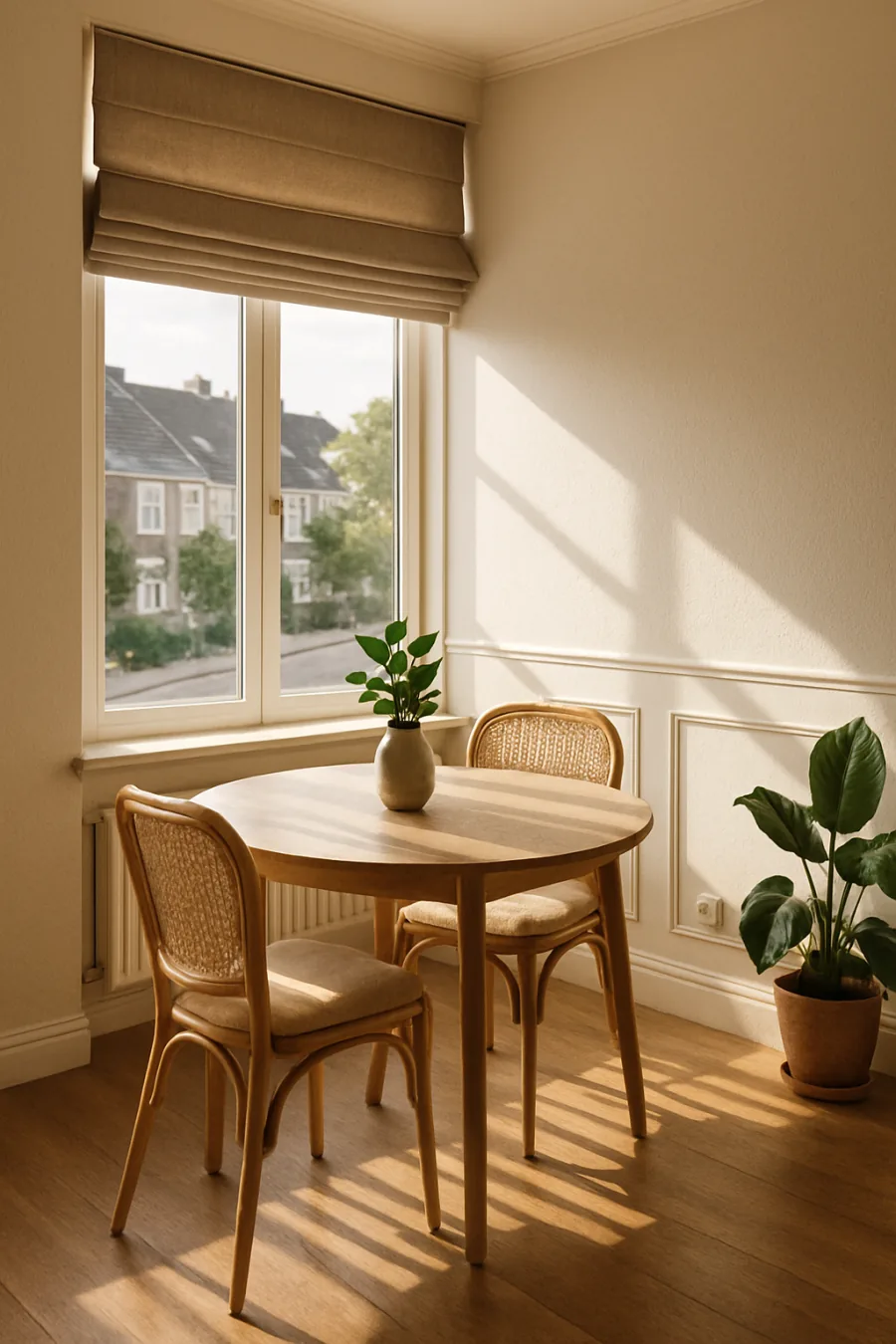
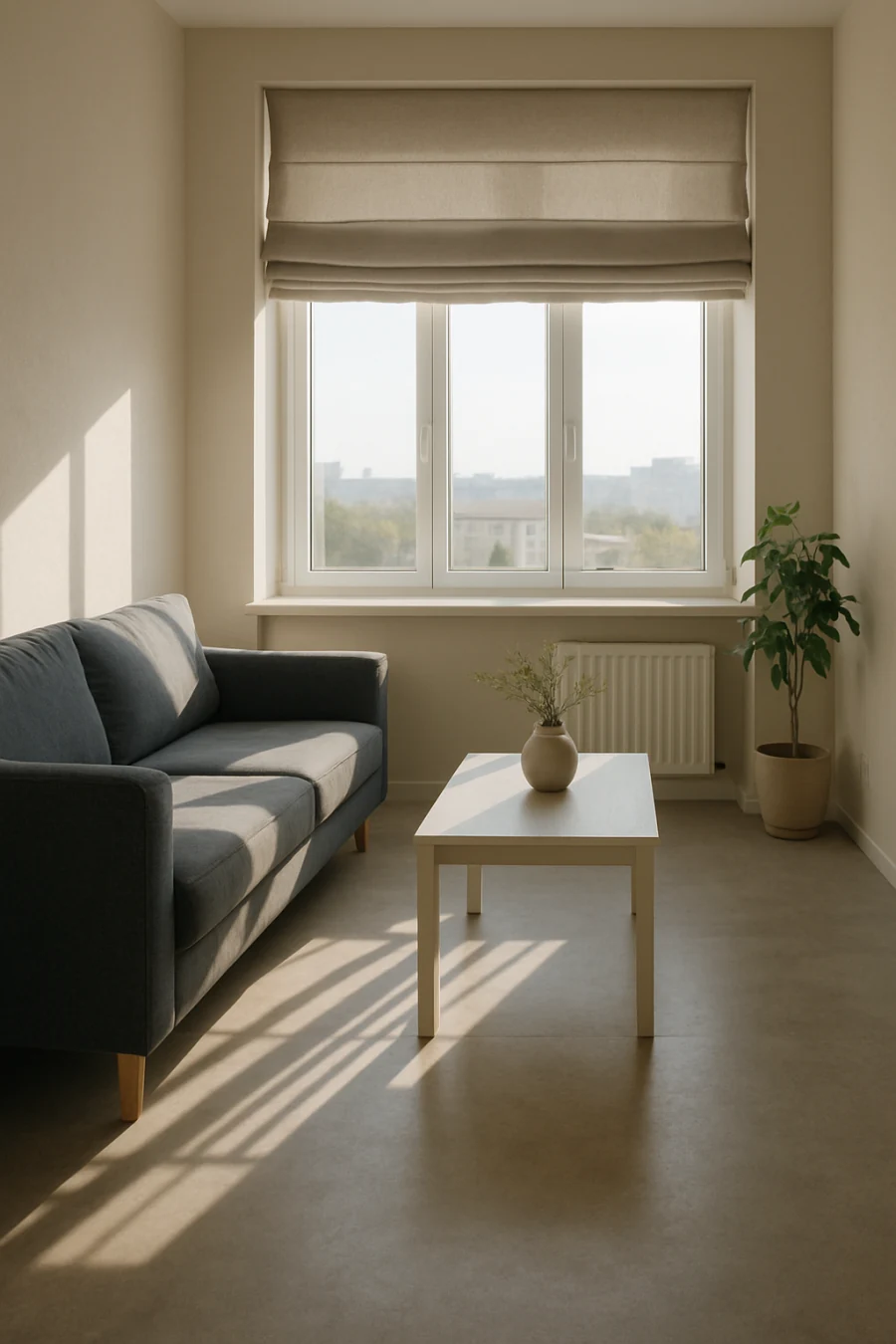
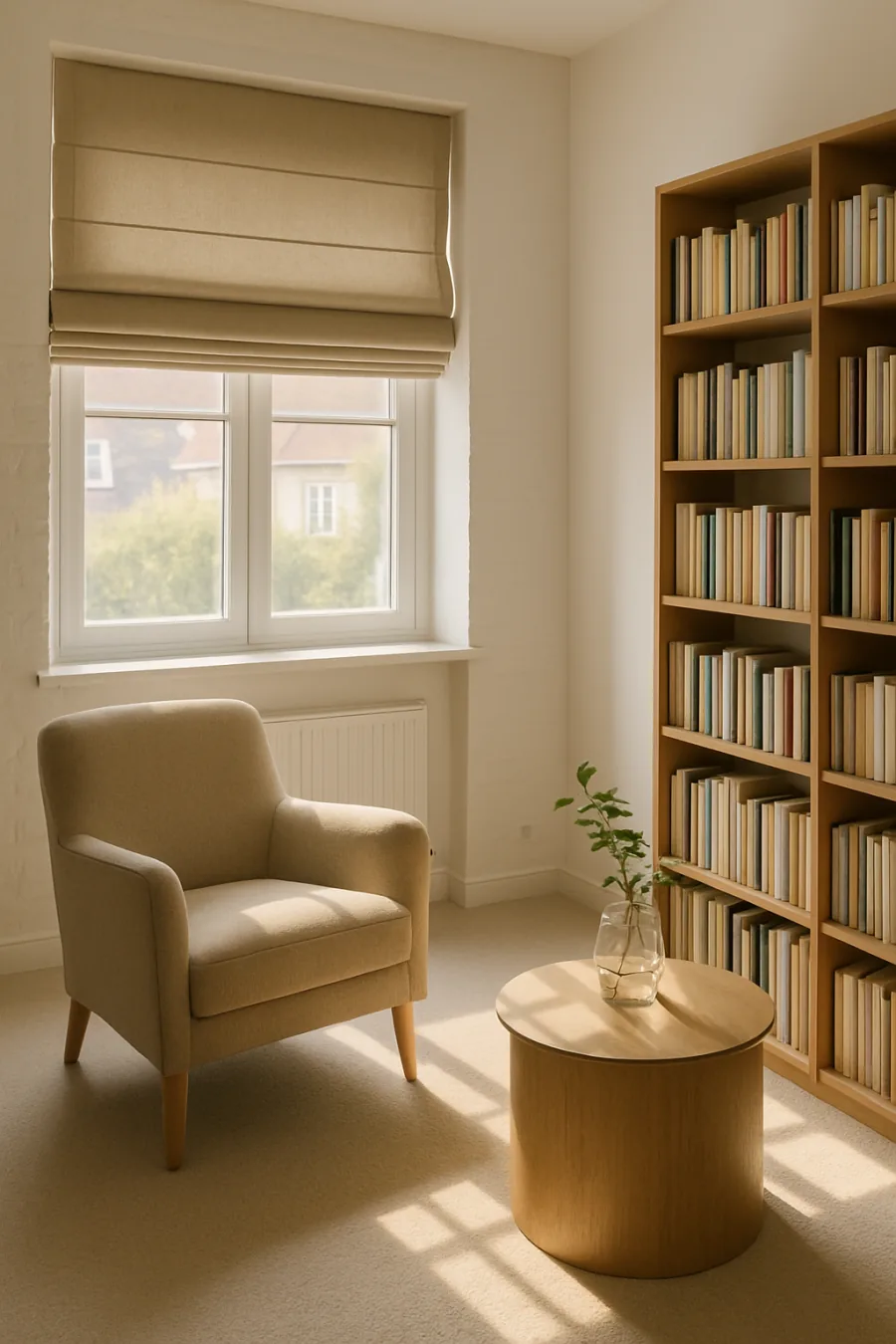











We make blackout Roman blinds in Almaty to measure: dense fabric on a frame doesn’t let light through the blind and gathers in soft folds. But darkness in the room depends not only on the fabric — it comes from proper installation and how the blind sits. Base price — from 8,100 ₸/m², manufacturing time 7–10 days.
Why the fabric blocks light but the bedroom is still bright
Jalusso makes blackout Roman blinds in Almaty like this: a light-blocking blind gathers in soft folds on a rail. Light doesn’t pass through the fabric itself. But if you’ve ever woken up from a strip of light above the rail, you know: dense fabric alone isn’t enough for darkness.
The design is simple. The face fabric sets the colour and texture, and a blackout lining is sewn to its reverse side. That layer is what blocks the light. Rod pockets gather the blind into even folds, and the weight at the bottom keeps the edge from curling — and all of that together is a blackout Roman blind.
How blackout differs from an ordinary Roman blind
An ordinary Roman blind raises the same way — in folds. The only difference is the fabric. Ordinary dense fabric lets light through: during the day the blind glows and the room stays grey rather than dark. With blackout, light doesn’t pass through the blind — that’s the whole difference, not the type of raise or the rail.
Honestly about total darkness
The blind blocks light, but light gaps remain at the sides and at the top above the rail. This isn’t a fabric defect but the geometry of the window: there’s always a gap between the blind and the reveal if the rail is narrower than the opening. Darkening depends on two things together — the light-blocking fabric and the installation that closes those gaps. At the measurement we look at how the blind meets the window and decide whether to extend it beyond the window’s dimensions. By the way, points of light along the fold lines are also a common story: we’ll come back to them when we look at how the blind is made.
With blackout, light enters the bedroom around the fabric, not through it.
How the blind is made: face fabric, blackout lining, rod pockets, weight
Blackout Roman blinds in Almaty block light not through a dense weave of the face fabric but through a separate layer. A blackout lining is sewn to the reverse side of the face fabric — it’s what blocks the light, while the face sets the colour and texture. We assemble the blind from four elements: face fabric, lining, rod pockets and weight. Below we go through each layer in order.
- Face fabric. The visible part of the blind that you choose by colour and texture. On its own it can be light and even semi-transparent — it isn’t what blocks light, the lining is. That’s why the face is chosen to match the interior, not by density.
- Blackout lining. Sewn to the reverse side of the face fabric. On the side facing the window you see a light-reflecting white layer: from the street people look at it, not at the face of the blind. This is one of the two layers, and it differs from three-layer fabric — there the layers are joined in a single blind, while here the lining is sewn to the face.
- Rod pockets. Stitched transverse pockets with rods inserted into them. The rod pockets raise the blind in even folds, so the lining doesn’t pucker or pull away from the face. The fold of the blind lies evenly across its full width.
- Weight. Sewn into a pocket along the bottom edge. The weight keeps the bottom edge of the blind straight: without it the fabric curls at the corners and the blind stops fitting snugly against the opening.
The question “lining or three-layer fabric” is easy to settle. We sew the blackout lining to the face fabric you choose — so the face and colour stay yours, and the reverse side blocks the light. Three-layer fabric is a ready-made fabric where the face, middle and reverse layers are joined at the factory; you can’t match the face to your interior there.
Why glowing points appear along the fold lines
Where the blind is stitched for the rod pockets, the fabric is pierced. If the lining is thin or the seam is stretched, the rod pockets can create glowing points along the fold lines — in those places the blackout shows light through. At the measurement we look at how the stitching lies and choose the lining density to match it, so the folds don’t glow.
A blackout lining is sewn to the back of the face fabric — it is what blocks the light, while the rod pockets gather the blind into even folds, so the lining does not pucker.
Blackout, dimout and three-layer fabric: how they differ on a Roman blind
Dimout darkens a room less than blackout: the fabric dims the light but does not block it completely. Blackout does not let light through the fabric at all — neither through the face nor the back. These are two different materials, and they should not be confused.
Face fabric with a blackout lining is the third option, and it is the most common one in blackout Roman blinds. How does it work? A separate layer — the blackout lining — is sewn to the back of the fabric you choose. It is the lining that blocks the light, while the face sets the colour and texture.
| Blind option | Does light pass through the fabric | How the fold looks | What it is chosen for |
|---|---|---|---|
| Blackout fabric | No | Uniform, dense | Bedroom, attic, home cinema |
| Face fabric + blackout lining | No | Soft, any face | When you need a specific colour or linen |
| Dimout | Partially | Soft, semi-translucent against the light | Living room, study, daytime dimming |
Three-layer fabric is not the same as a blackout lining. In three-layer fabric the light-blocking layer is already woven into the fabric itself, while a lining is a separate piece sewn to the face. Hence the difference in seam thickness and in how the blind falls into a fold.
From the street you see not the face of the blind but the side facing the glass. With a blackout lining this side is more often white — the light-reflecting white layer repels some of the heat and heats up less. A white lining on sunny windows looks neater from the facade: a dark patch in the window does not catch the neighbours’ eye. A black lining looks darker and denser from the street — it is chosen when it matters that the window looks closed.
Can a lining be sewn to any fabric
Not to any. A heavy face fabric together with a lining makes a thick fold, and the mechanism is harder to move — the chain runs tighter and the blind holds its shape worse. At the measurement we look at the fabric in the assembly: how it falls under the rod pockets and whether it puckers along the bottom edge.
Blackout and dimout are different fabrics: blackout blocks the light completely, dimout only dims it, and a blackout lining is sewn to the back of the face fabric but is matched to the density of that fabric.
Where the light strips come from: the edges, the top above the rail, the fold lines
Blackout fabric does not let light through itself, but light still finds its way into the room — around the fabric. It leaks at the sides between the blind and the window reveal, at the top above the rail, and in thin dots along the fold lines. Let us look at each path separately: each has its own cause and its own way of being closed.
- Light gap at the edges. The blind is a couple of centimetres narrower than the opening — and light comes in at the sides.
- Top gap above the rail. A gap remains above the rail, and in the morning a bright strip falls from above.
- Dots along the fold lines. Where the fabric is stitched for the rod pockets, it is pierced, and the blackout can glow in these places.
Side strip
The light gap at the edges is the most common reason a person wakes up before the alarm. A blind fitted exactly to the size of the window leaves a gap of a few centimetres at the sides, and the morning sun hits right through it. What the measurer does: checks how the blind meets the window reveal and decides whether to extend the blind beyond the size of the window. Sometimes it is enough to bring the fabric out onto the wall, sometimes to cover the opening with a margin at the sides. Both schemes are checked on site, because they depend on what is at the reveal: a windowsill, a radiator, a sash opening for ventilation.
Top strip
The top gap above the rail lets a strip of light through from above — it is visible even when the blind is lowered to the windowsill. A cassette rail hides the mechanism behind a cover strip and holds the fabric across its full width, so the top of the blind falls more tightly and almost no gap remains. Light comes through the fold lines less often: the rod pockets can give glowing dots if the lining is thin or the seam is stretched. The measurement shows how the stitching falls for a particular fabric — and this determines how cleanly the room will be darkened.
Darkness in a bedroom depends not on a single layer of fabric but on whether the blind and the installation close all three paths of light — at the sides, at the top and along the fold lines.
Inside-the-opening and overlap-on-the-wall installation: which is darker
Overlap-on-the-wall installation covers the opening with a margin and lets less light through at the sides than inside-the-opening installation. But darker is not always better: the scheme is chosen by the window reveals, by which way the window faces, and by how the sash opens for ventilation.
Inside-the-opening installation reduces the gap at the sides, because the blind sits within the size of the window. There is almost no light at the edges. But this option has a condition: the reveal must be even and deep enough, otherwise the blind rubs against the sash or the windowsill. In winter Almaty is cold and the temperature difference between day and night is large, so condensation builds up at the window, and fabric pressed right against the glass unit gets damp faster. In summer it is hot and dusty — the blind collects dust and is taken down for cleaning more often.
Overlap-on-the-wall installation covers the opening with a margin: the blind is wider than the window and covers the reveals. Light at the sides is almost completely gone. On the other hand, a gap remains above the rail if the rail is not hidden behind a cover strip. Here a cassette rail helps — the mechanism and the fabric are hidden behind a cover strip across the full width, and the top falls more tightly.
What really changes the picture besides the scheme? In my experience, the biggest source of light is not the gap at the sides but the top above the rail — it is often underestimated.
| Installation scheme | Where light remains | What to check during measurement | Mounting coefficient |
|---|---|---|---|
| Inside the opening | A thin strip at the window reveals if the opening is wider than the blind | Evenness of the reveal, its depth, and how the sash moves | On the wall ×1 |
| Overlapping onto the wall | Clearance above the rail | Whether there is room for a mounting plate above the window | On the wall ×1 |
| Mounting on the frame | At the edges of the frame and where it meets the sash | How the blind clears the glazing bead and the handle | ×1.05 |
| No-drill mounting | At the points where it presses against the frame | Whether the pressing force is enough for the weight of the blind | ×1.1 |
| Cassette system | Almost none — the top is covered by the mounting plate | The depth of the reveal for the cassette | ×1.28 |
Here is how the Almaty climate affects the choice: temperature swings and dust mean the blind must sit flush and not rub against the sash — otherwise the fabric quickly loses its look.
Inside-mount installation reduces the gap at the sides, while overlapping onto the wall covers the opening with a margin — which scheme is darker depends on which way the window faces and what is in the way at the reveal.
What the measurer checks on site and how to test the fabric yourself
The measurement reveals how the blind meets the opening and determines the mounting method — these two things decide whether a strip of light will remain at the edges. Roman blackout blinds cannot be chosen “by eye” from a catalogue: the same fabric gives different light leakage in different openings. That is why Jalusso comes with samples and looks at the window on site.
What the measurer does, step by step:
- Inspects the opening and the reveals. Whether the reveal is even, whether there is a recess where the blind will sit.
- Holds a fabric sample up to the light. This is how darkening is checked right at the measurement — no tables or percentages.
- Folds the sample into a pleat. Checks how the fabric holds its shape and whether the lining bulges.
- Checks whether the blind interferes with opening the sash. If the blind is down, ventilation should still work.
- Selects the mounting: on the wall, on the frame, no drilling, or a cassette rail.
Frame mounting is convenient when the reveal is narrow and the blind has no room to unfold. No-drill mounting is chosen where the profile cannot be touched. A cassette rail covers the mechanism with a plate and holds the fabric across the full width — the top sits tighter and less light escapes above the rail.
Ventilation with the blind down is a separate check, not a minor detail. If the blind covers the sash, you will not be able to open it for micro-ventilation. At the measurement we see how the window opens and either move the blind aside or choose a mounting that does not interfere with the frame’s movement.
Heavy curtains are not our case: with the sample in hand you can see how the blind will fold. Kirill, our lead measurer, usually spends about twenty minutes on such an inspection, and that is enough to tell whether a gap will remain. The measurer comes with samples, checks how the blind meets the opening and determines the mounting method — this decides whether a strip of light will remain at the edges.
How much a Roman blackout blind costs: base price, coefficients, installation
The base price of a Roman blind is from 8,100 ₸/m², and blackout fabric goes at this same base. We do not have a separate surcharge specifically for blackout. The total is made up of two multipliers: the control coefficient and the mounting coefficient.
Frame mounting gives a coefficient of 1.05, no-drill — 1.1, cassette system — 1.28. Wall mounting has no surcharge. Control changes the amount more: manual — ×1, chain lift — ×1.06, electric motor — ×1.85, electric with remote — ×2.1.
As an example, let us take a blind with an area of 3 m² on a chain lift with a cassette rail — the scheme we most often install in a bedroom. We calculate like this: 8,100 multiplied by 3, then by 1.06 and by 1.28. The measurer calculates the exact amount on site based on your dimensions and chosen fabric — the area of a specific opening and the density of the lining can only be seen during measurement.
We charge 4,500 ₸ for installing one item, but if the order total reaches 150,000 ₸, we install it free of charge. Manufacturing time for Roman blinds is 7–10 days. You can only buy Roman blackout blinds from us by measurement: there are no ready-made items in stock, each blind is sewn for a specific opening.
We give 3 years on the mechanism and 1 year on installation work; the count starts from the day the acceptance certificate is signed. If the case is recognised as a warranty case, the work is done free of charge — we allow up to 5 working days for it. When the warranty period has already expired, a technician visit is still possible: we will tighten the mechanism, adjust it, and fit a new cord or chain. Mechanical damage, self-reinstallation, water and natural fading of the fabric are not covered by the warranty.
Coefficient table
| Parameter | Option | Coefficient |
|---|---|---|
| Control | Mechanical | ×1 |
| Control | Chain | ×1.06 |
| Control | Electric motor | ×1.85 |
| Control | Electric + remote control | ×2.1 |
| Mounting | Wall-mounted | ×1 |
| Mounting | Frame-mounted | ×1.05 |
| Mounting | No drilling | ×1.1 |
| Mounting | Cassette system | ×1.28 |
The price per square metre is multiplied by the control coefficient and the mounting coefficient — there is nothing else in the formula.
Roman or roller blackout blind: what to choose for the bedroom
For the bedroom you choose between two different mechanisms: a roller blind rolls the fabric into a roll, Roman blackout blinds gather it into soft folds. The fabric in both can be light-blocking; the difference is how the blind leaves the window.
The fold of the blind is the main difference. A roller blind hangs as a flat sheet and rolls up into a tight cylinder. A Roman blind folds into pleats, and these remain visible when the blind is raised. The stack of folds above the window takes up more space than a roll — that is the price of the fabric look. In a bedroom where the window goes from the floor or almost from the floor, the stack of folds goes up to the ceiling and is not noticeable. On an ordinary window it is visible, and this is worth considering at the measurement, not after installation.
The weight of the blind depends on the size of the fabric, the density of the face fabric and the blackout lining. The wider the window, the heavier the blind and the more important it is how the mechanism moves under it. At the measurement we check this on a specific blind: the measurer brings samples and sees how the fabric behaves when folded, not from a catalogue.
For the bedroom, a chain lift is chosen more often. A chain lift gives a smooth movement of the blind — pull the chain at the side and the blind stops at the height you need. The chain runs along the reveal and does not interfere with opening the sash.
And yes, blackout can be motorised. An electric motor removes the need to reach for the blind by hand: it raises with a remote control or a button. People choose it for tall and sloped windows that are otherwise out of reach. A coefficient of 1.85 applies to the base price for an electric motor, and 2.1 if a remote control is added to it.
The mechanism of a Roman blind is more complex than that of a roller blind: the folds have to lie evenly, and on a narrow window this is more noticeable than on a wide one. We make blinds to measure, so we select both the fabric and the mounting for each window.
A raised Roman blind leaves a stack of folds above the window rather than a roll — and for a bedroom this is more often a plus than a minus.
Which rooms blackout is chosen for: bedroom, kids’ room, home cinema, attic
Blackout Roman blinds are chosen for the bedroom and kids’ room more often than for other rooms, and also for a home cinema, where darkness is needed during the day. For a north-facing window such a blind is not essential — a dense fabric is enough there.
- A bedroom needs darkness in the early morning. In summer in Almaty the sun rises early, and a fabric with a blackout lining removes this light entirely: it does not pass through the fabric. For a bedroom, installation with the smallest possible gap at the sides is usually chosen, because a morning strip of light along the edge wakes you just as well as an open window.
- A kids’ room needs safe operation without hanging cords. We do not offer a chain in a kids’ room: a child can reach it themselves. Here we install a lift that cannot be reached, or a motorised rail with a remote control.
- A home cinema needs darkness during the day too. The screen is visible when light does not fall on the fabric from the side — so during the measurement we look at the window reveals and the junction, not just the fabric.
- An attic and sloped window needs non-standard mounting. A straight rail will not fit on a sloped reveal, and such openings are handled by our lead measurer Kirill — he has nine years of experience with arched, triangular and roof windows.
- A north-facing window needs less. There is no direct sun there, and a dense face fabric without lining is enough for daytime sleep. There is no point paying for blackout on the north side.
Will it be stuffy in summer? The fabric does not let light through, but it does not block the air. Ventilation depends on how the sash opens with the blind lowered, and we check this during the measurement. A dense blind traps some of the dust that blows in from the street in the heat, but it does not seal the room.
Blackout is most often chosen for the bedroom and kids’ room, and also for a home cinema, where darkness is needed during the day; for a north-facing window it is not essential, a dense fabric is enough there.
Operation and care: chain, electric motor, washing, fading
A fabric with rods, lining and a weight bar cannot be washed like a bedsheet. Blackout Roman blinds are not a piece of fabric but an assembled product: the rod pockets are stitched along the full height, a weight bar is sewn in at the bottom, and a lining runs on the back. Any machine wash pulls such a construction in different directions — the seams under the rod pockets stretch, the weight bar skews, and the fabric then hangs crooked.
We explain blind care like this: the mechanism and frame are wiped with a dry cloth, dust is removed from the fabric with a soft brush or a vacuum cleaner on low power, and deep cleaning is done by a dry cleaner. The cord and chain should not be pulled with jerks — a chain lift gives the fabric a smooth movement, and a sharp movement only harms the mechanism here. Want to remove the cord from the equation altogether? An electric motor removes the need to reach for the blind by hand: it raises with a remote control or a button, and the fabric moves at the same speed every time. And for tall and sloped windows this is not a luxury but the only convenient option.
Fabric fading is the second question that is asked almost always. Fabric may lose colour over time on the side facing the window, and this is a natural process, not a manufacturing defect. The warranty does not cover it: 3 years apply to the mechanism, 1 year to the installation from the date the acceptance certificate is signed. If you want to prolong the look of the fabric, choose light tones for south-facing windows — they lose colour more slowly. This is advice from experience, not a promise that the sun will not touch the fabric at all.
Briefly about what is worth remembering before ordering:
- Mechanism and frame — a dry cloth, no moisture.
- Fabric — a soft brush or dry cleaning, not machine washing.
- The cord and chain are moved smoothly, without jerks.
The most important thing about care is not the list of actions itself, but the fact that a blackout Roman blind is made for your opening and cannot be washed like ordinary textiles: a construction with rod pockets, lining and a weight bar is designed for dry dusting and careful handling.
How ordering works in Almaty and the suburbs
You cannot buy blackout Roman blinds in Almaty in ready-made sizes from us: we are a manufacturer with our own workshop, and every product is made to measure. There are no ready-made products in stock — first the measurer takes the dimensions of the opening, then the workshop cuts the fabric to these dimensions, and only then does the team come to install.
Here’s how it works.
- You message us on WhatsApp.
- A measurer comes with fabric samples and calculates the cost on the spot, based on your dimensions.
- The workshop makes the fabric — we make Roman blinds in 7–10 days.
- Installation within the city, then signing of the acceptance certificate.
Measurement and consultation are always free. Within Almaty, measurement and delivery are free too. To the suburbs — Kaskelen, Talgar, Issyk, Kapshagay — we do travel, and the cost of the visit depends on the distance and is quoted before the visit, so that you can decide with your eyes open.
Installation costs 4,500 ₸ per product, and for orders from 150,000 ₸ we do not charge for it. The warranty covers the mechanism and installation: 3 years for the mechanism, 1 year for installation from the date the acceptance certificate is signed. If a case is recognised as a warranty case, we carry out the remedial work free of charge and finish within 5 working days. After the warranty we also come — to tighten, adjust, replace the cord or chain. Mechanical damage, reinstallation on your own, water and natural fabric fading are not covered.
The measurement determines the mounting method, and the warranty covers both the mechanism and the installation — these two points decide how the whole order will go.
FAQ
Questions during measurement repeat from one site to another — about the weight of the fabric, the space above the window and what is visible from the street. We answer briefly.
How much the fabric weighs and whether it is easy to raise with the chain
The weight of the blind depends on the size of the fabric, the density of the face fabric and the lining. We do not quote a separate figure in kilograms — the fabric weighs exactly as much as the specific fabric on the specific opening gives. A chain lift gives the fabric a smooth movement, and the mechanism for this fabric is checked during the measurement: if the movement is tight, we select a different fabric or a different control.
How much space a raised blind takes up above the window
A raised Roman blind leaves a stack of folds above the window. It is the more compact the smaller the height of the fabric and the thinner the fabric with the lining. A heavy face fabric in the stack gives a bulkier pack — this is visible when you hold the fabric up to the light and gather it into a fold.
Is the lining visible from the street
The blackout lining is sewn to the back of the face fabric, so it is the lining that is visible from the street, not the face of the blind. The white side faces the window, and from outside the window looks light rather than dark. The colour of the lining is chosen during the measurement: white or black — both face the glass, the difference is in how they look from inside the room.
Is a chain lift suitable for a kids’ room
For a kids’ room we recommend mounting without hanging cords, so that a child cannot reach them on their own. We do not offer a chain in a kids’ room — this option is chosen for tall windows and adult rooms.
Can the sash be opened for ventilation when the blind is down?
Yes, if the fabric does not block the movement of the sash. Ventilation with the blind down depends on how the window opens and which mounting method is chosen; we check this on site. If the fabric gets in the way of the sash, we select a different mounting or a different position of the fabric.
The questions most often asked during measurement are about the weight of the fabric, the space above the window, the type of backing on the street side and ventilation.
What to remember
Blackout Roman blinds in Almaty solve one problem — keeping out the light early in the morning and during the day — but they solve it with two things at once: a light-blocking fabric and installation that closes the gaps. If you take installation out of the equation, the fabric alone will not give you darkness.
Blackout fabric does not let light through. This is its main property, and the whole construction rests on it: the face fabric, the blackout backing on the reverse, the rod pockets, the weight in the bottom pocket.
Light gets into the room around the fabric. At the sides between the fabric and the window reveal, at the top above the rail, and sometimes in dots along the fold lines where the fabric is stitched for the rod pockets. Three places, three different solutions.
Inside-mount installation and overlap installation on the wall give different light leakage at the edges — the scheme is chosen during measurement, looking at the specific window reveal and at which way the window faces.
The price is made up of a base and coefficients. Blackout goes at the base price of Roman blinds from 8,100 ₸/m², there is no separate surcharge for it; the total depends on the control — chain, electric motor — and on the mounting: on the wall, on the frame, without drilling, cassette system.
Manufacturing time is 7–10 days. We give 3 years of warranty on the mechanism of blackout Roman blinds and 1 year on installation, counted from the day the acceptance report is signed.
There is one practical recommendation: start with a free measurement. The measurer will come with samples, check how the fabric meets the window opening and calculate the cost on site based on your dimensions — before you have ordered anything.

