


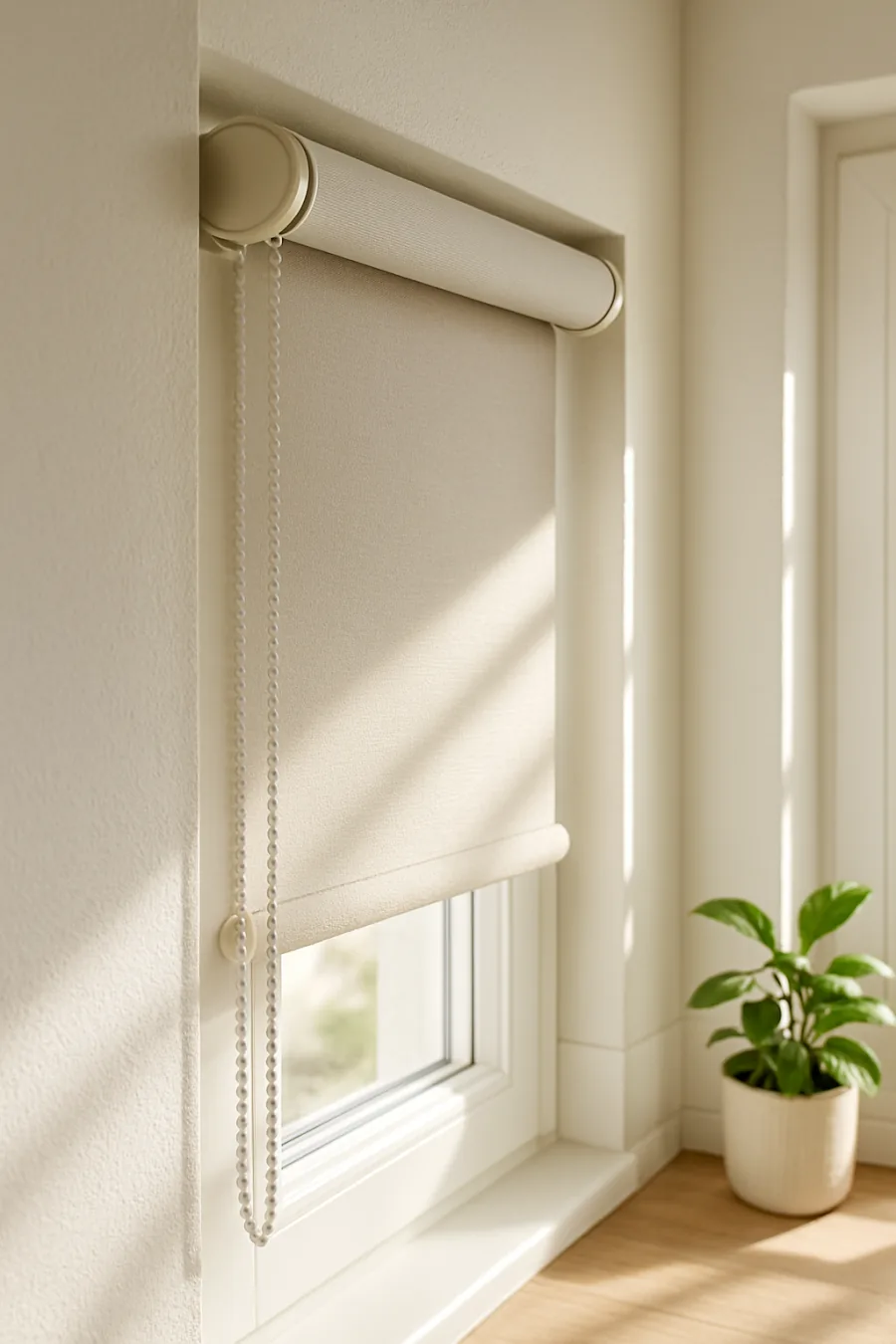


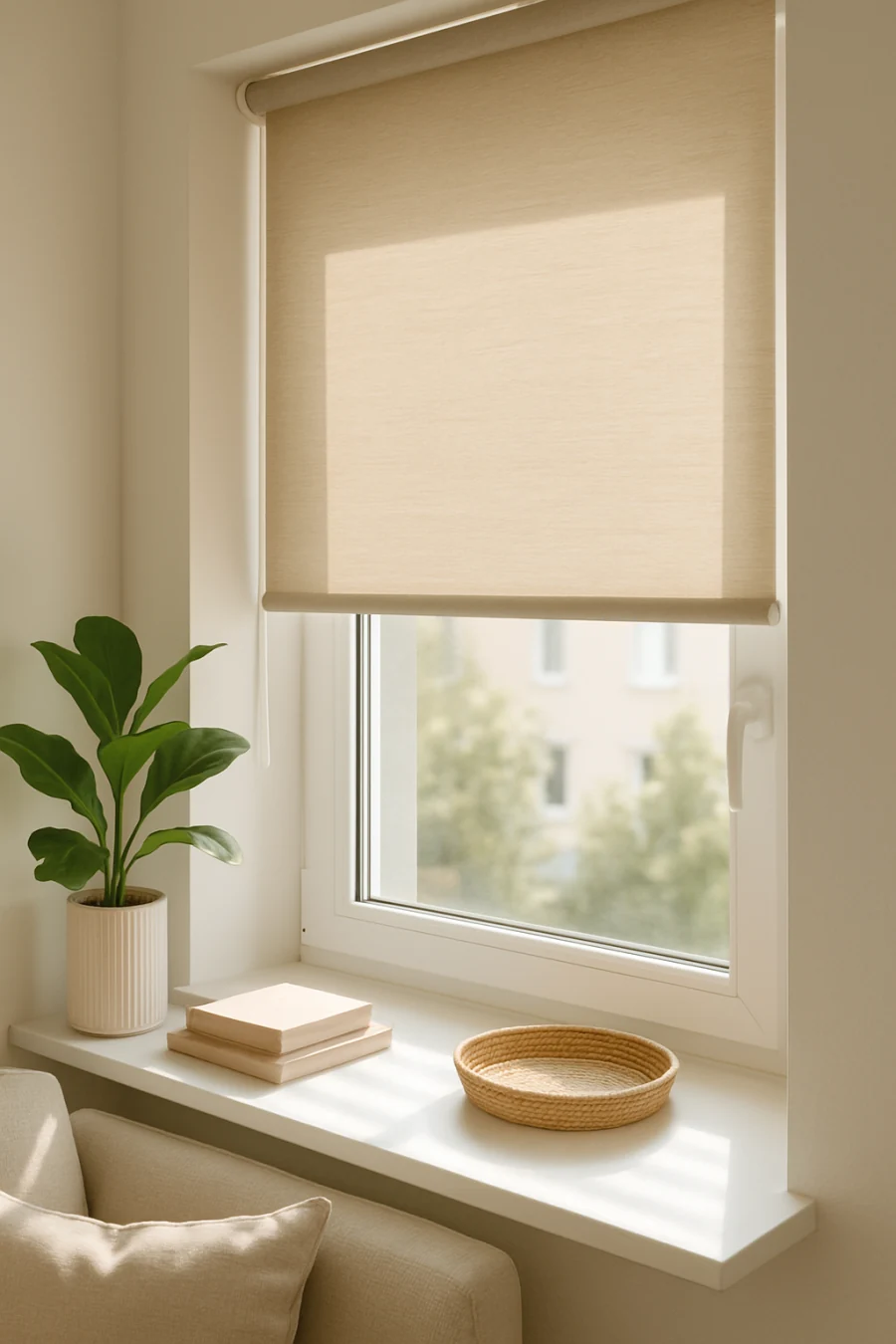


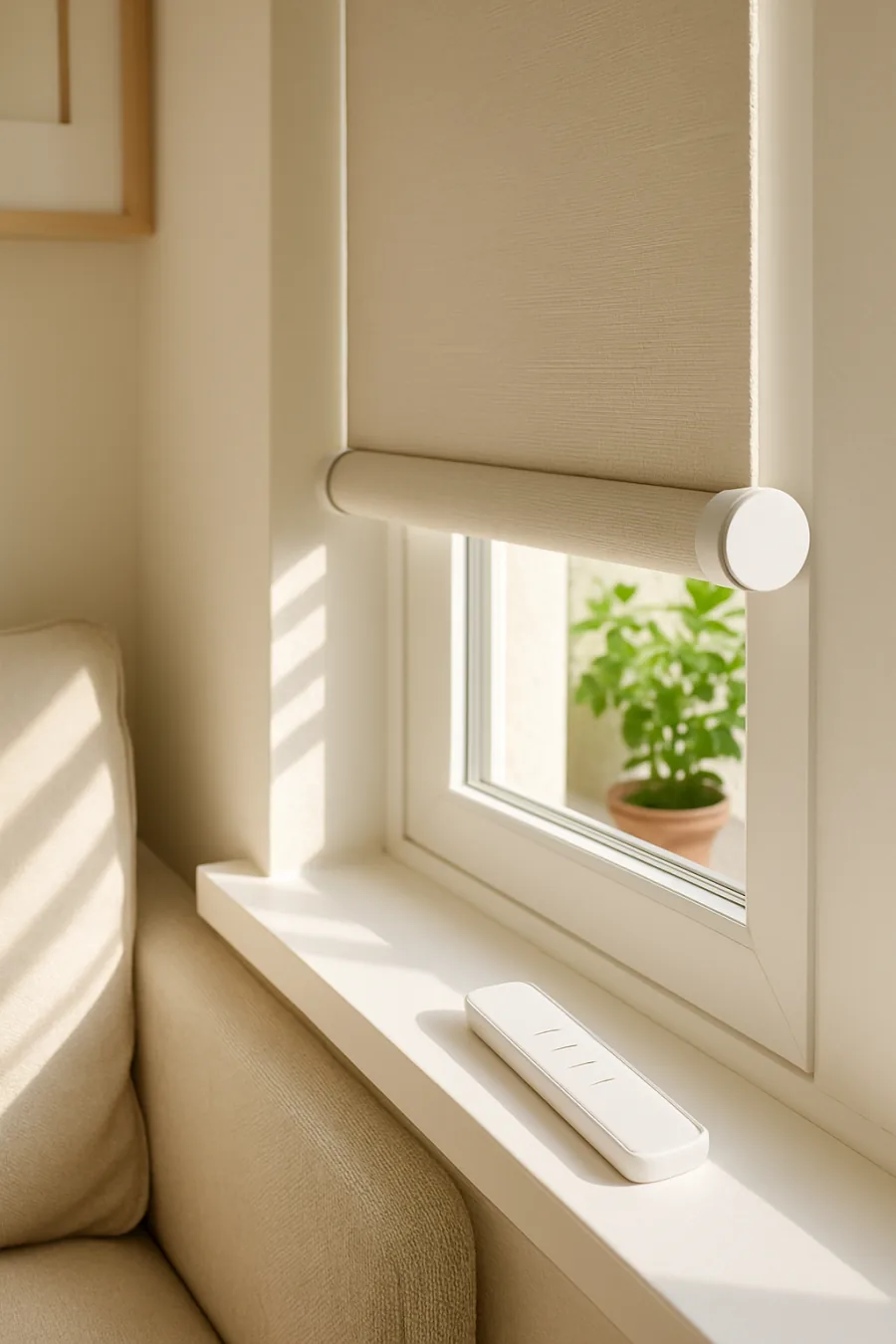




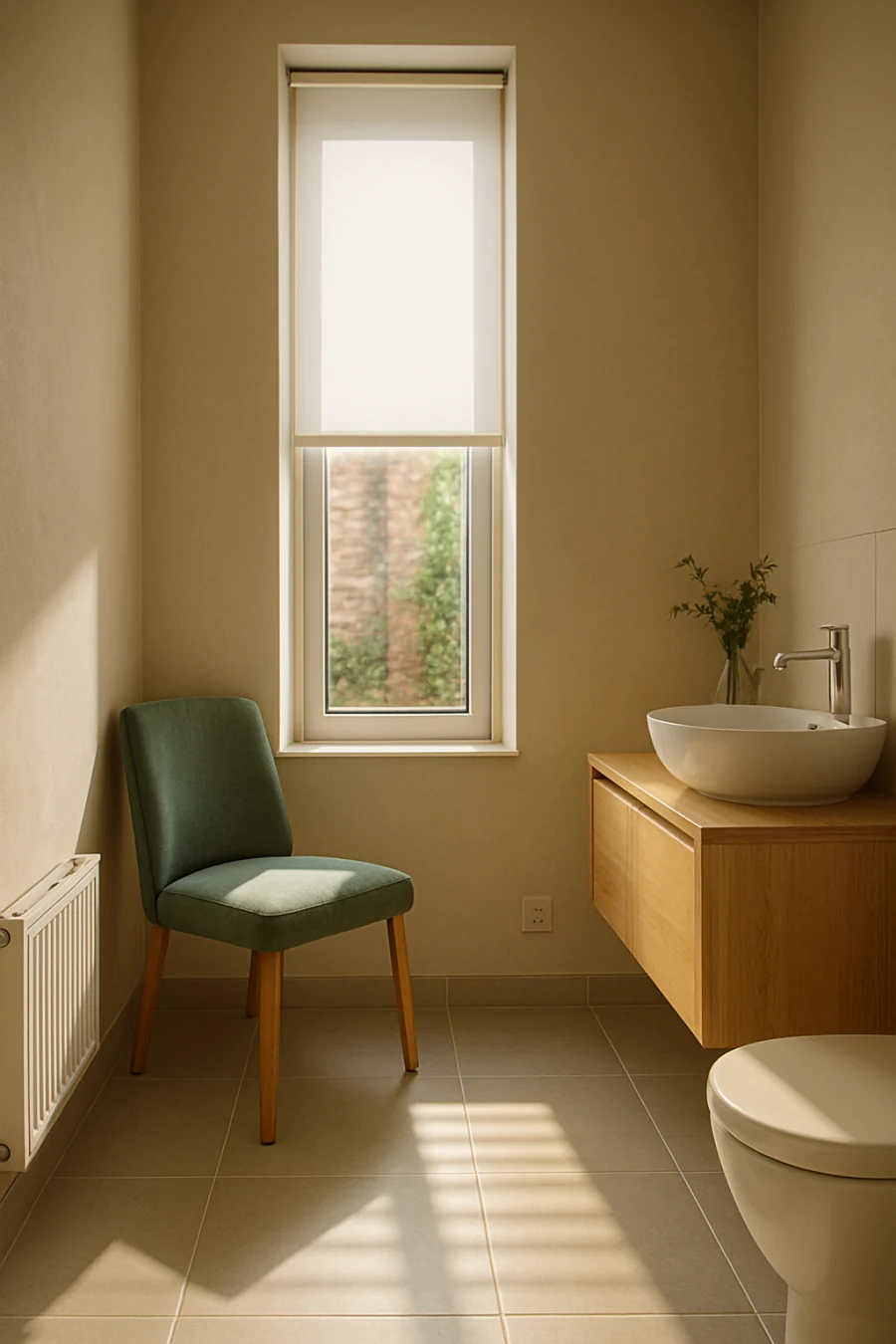











We make roller blinds for bathrooms in Almaty to measure from moisture-resistant fabric: PVC or fibreglass fabric, with an anodised profile and fixings for your surface. Measurement and delivery within the city are free, manufacturing takes 4–6 days, the price is from 5,400 ₸/m², installation is 4,500 ₸ per item.
Why sheer in a bathroom gets damp and yellow, while roller fabric does not
Sheer in a bathroom gets damp because it absorbs moisture and holds it in the fibre: between showers the fabric does not have time to dry out, and deposits from hard water settle on it. Roller blinds for bathrooms in Almaty behave differently: the fabric hangs by the glass as a compact roll and does not reach towards the water like a curtain.
Steam and splashes in a wet room call for a fabric chosen for constant humidity, not an ordinary decorative textile. A roller blind on a bathroom window needs a moisture-resistant fabric: PVC fabric, fibreglass fabric or polyester with a dirt- and water-repellent coating. It is the material that decides whether the blind survives steam without odour and yellowing.
What happens to ordinary fabric in a wet room
Moisture settles on the fibre, and fabric in a bathroom simply has no time to dry out: shower after shower, and the fibre stays damp. Add deposits from hard water. Hence the yellowing and the smell, which no washing will remove afterwards.
We have seen such windows during measurements: the owner took the sheer down every couple of months, washed it, and a week later it smelled damp again. The fabric is not to blame here, it is the conditions in the room. A bathroom needs a material that does not take on moisture at all.
Why a roller blind hangs differently
The fabric is rolled up by the glass and does not hang down towards the water like a curtain. The space beneath it is dry, and splashes do not reach the tube.
And yes, an ordinary roller blind will do for a bathroom, if its fabric is designed for moisture. Which material to choose for steam and splashes, we look at next.
Sheer absorbs moisture and holds it in the fibre, while fabric on a tube hangs by the glass as a compact roll and does not reach towards the water.
Which fabric suits a bathroom with steam and splashes
For splashes and steam we use PVC fabric or fibreglass fabric. Coated polyester is the basic item in the price list, and the price is calculated from it, but in a room where the shower runs it loses to the first two.
PVC fabric
PVC fabric is a smooth material with no pile, and deposits from hard water are wiped off it with a damp sponge instead of soaking into the structure. PVC fabric does not absorb moisture or odours, which is why it is most often chosen for a bathroom with constant splashes. It hangs by the glass as a compact roll and does not reach towards the water like a curtain. Wipe it down after a shower every few days, and that is all.
Fibreglass fabric
Fibreglass fabric holds its shape thanks to a fine mesh under the coating, which is visible if you look at the cut edge. Fibreglass fabric does not stretch from steam: the fibre does not swell, so the fabric does not ripple or sag between the tubes after a year of use. Mould does not grow on such fabric as long as moisture is not left on it for long. It suits those who want a blind that looks like new for years.
Coated polyester
Coated polyester is an ordinary woven base treated with a compound. The dirt-repellent coating lets you wipe off deposits with a damp sponge: water and dirt do not penetrate the fibre, they stay on top. The water-repellent coating works on the same principle, but its life runs out: over time the fabric starts to absorb. What happens without the coating? The fibre will take on moisture, the deposits will stay in the structure, and mould will appear in that spot. For a guest bathroom used once a day, polyester is enough. For a shower used by two people morning and evening, it is not.
What the anodised profile changes
The anodised profile is the bottom bar and end cap made of anodised aluminium. It does not rust or oxidise from steam. Choose it if you want the bottom of the blind not to spoil from moisture: an ordinary painted profile in a bathroom will eventually show spots of corrosion, while an anodised one will not.
A single roller blind in the bathroom stays close to the glass and doesn't attract splashes — but which fabric to use in it is decided by the humidity level, not by colour.
Table: comparison of fabric for a bathroom
| Material | With moisture | Care | When to choose |
|---|---|---|---|
| PVC fabric | Doesn't absorb moisture or odours | Damp sponge, film wipes off the surface | Bathroom with splashes, shower next to the window |
| Fibreglass fabric | Moisture-resistant, doesn't stretch from steam | Damp sponge, fabric comes off the tube | You want a blind that holds its shape for a long time |
| Coated polyester | The treatment repels water, but its life is limited | Damp sponge without abrasive | Guest bathroom, moderate humidity |
| Anodised profile | Doesn't rust or oxidise from steam | Wiped together with the fabric | Room with heavy steam |
The base price is from 5,400 ₸/m² for polyester on an open roller tube. We don't have separate prices for PVC fabric, fibreglass and anodised profile: the measurer brings samples, shows the materials in hand and calculates the total for your window.
How PVC fabric differs from fibreglass and treated polyester
The difference between the three materials is in what holds the fabric together and how it behaves with moisture. PVC fabric is smooth and dense to the touch, doesn't absorb moisture or odours, because water stays on the surface. Fibreglass fabric is built differently: a fine mesh is visible under the coating, and it keeps the material from stretching from steam. Treated polyester works in a third way: polyester itself absorbs moisture moderately, while the dirt- and water-repellent treatment repels splashes and keeps film from soaking into the fibre.
The table below helps you choose a material for the humidity level in the room.
| Material | Behaviour in a wet room | Care in the bathroom | When to choose |
|---|---|---|---|
| PVC fabric | Doesn't absorb water, it stays on the surface | Film is removed with a damp sponge | Constant splashes, shower next to the window |
| Fibreglass fabric | Doesn't stretch from steam, holds its shape | Film is removed with a damp sponge | You want the fabric to hold its shape |
| Coated polyester | Holds up thanks to the treatment | Stains are removed with a damp sponge | Moderate humidity level |
| Day-night system | The stripes collect film | Harder to clean than a smooth surface | You need to change the shading, humidity is moderate |
Terminology: fabric and textile
Roller blinds in the bathroom are often described with one word — fabric — and that's why people get confused about their properties. But PVC is not a fabric: it's a blind. When comparing what absorbs odours and what doesn't, the difference is fundamental — PVC has no fibres inside that could hold moisture and odour. Polyester and fibreglass do have fibres, and the question comes down to how well the treatment or coating covers them. On a PVC surface, film from hard water holds weakly, while on a textured fabric it clings more readily. That's exactly why a smooth blind is more practical in a wet room.
The manufacturing time for all these items is the same — 4–6 days, and the price is calculated from the base item in the price list: roller blinds made of polyester on an open roller tube — from 5,400 ₸/m².
About day-night blinds in the bathroom
The day-night system is a two-layer fabric of alternating opaque and sheer stripes that shift and adjust the degree of shading. It blocks light well, but it's not chosen for constant splashes: the stripes collect film, and cleaning them is harder than a flat surface. If you want to change the shading without replacing the blind, and the humidity level in the bathroom is moderate, it's a workable option — but not as the main solution for a room with a shower.
Jalusso usually shows at the measurement how each material behaves after wiping — on the sample you can see where a mark remains and where it doesn't. Mould and film develop where moisture is retained in the structure, so in a bathroom the material is chosen by humidity level, not by appearance.
How to mount a roller blind on tile or glass without drilling
A drill-free mount is applied to a degreased, dry surface and leaves no holes in tile or glass. That way a roller blind in the toilet stays on a hook-and-loop strip, suction cups or a glazing-bead clamp — no holes in the tile or the glass partition. We always ask during the measurement which surface must not be drilled, and we select the mount for it.
Will the adhesive tape hold if the bathroom is always steamy? The tape alone won’t — surface preparation is what holds it. Tile and glass must be dry at the moment of installation: sticking it right after a shower is the most common mistake we see. On a degreased, dried surface the mount holds up fine in a damp environment.
A mini system on the sash takes up minimum space by the glass. A frame mount and a sash mount solve a different problem: the blind runs right up against the glass and doesn’t get in the way of the handle. And on a narrow opening the mini system keeps the windowsill free — in a tight bathroom that’s noticeable.
Step by step: drill-free installation
- Wash and degrease the surface.
- Let it dry — don’t stick it right after a shower.
- Press the mount into place along the markings.
- Wait before hanging the blind.
- Check how the chain runs.
The order is simple, but the fourth point is the one most often skipped — and the blind pulls the mount sideways while the tape hasn’t set yet.
If the tape starts to come off
The mount can be tightened or the tape replaced. We don’t promise forever: the installation warranty is 1 year from the date the acceptance report is signed, and after the warranty we still come to tighten and adjust. In my view, that’s more honest than talking about “lasts for years”.
A blind right above the bathtub
If splashes reach the blind, choose PVC fabric or fibreglass fabric. And don’t leave the blind wet on the roller tube: after a shower it’s better to raise the blind so steam and splashes don’t collect in the folds of the roll.
A drill-free mount leaves no holes in tile or glass — that’s its main advantage in a bathroom where you can’t drill into the tile or the glass partition.
Can you see a silhouette through a roller blind in the evening with the light on
Yes, in the evening a light-filtering fabric shows a silhouette if the light is on inside. During the day it’s the opposite: a light-coloured fabric hides the room from prying eyes, and from the street you can’t make out what’s happening behind the glass. The rule is simple — light travels to where it’s darker. In the evening it travels from inside out, and the blind works like a screen.
Why this happens
A light-filtering fabric lets some light through the fibre, and that’s enough for a person’s outline to show from outside. Coated fabrics and light shades behave like net curtains, only denser. A dense roller removes that difference: the less light passes through the blind, the weaker the silhouette. At the measurement we always ask which way the window faces — the choice of density depends on it.
What to choose for a ground floor
For a ground-floor window and a floor-to-ceiling window, choose a dense PVC fabric or fibreglass fabric. A floor-to-ceiling window needs a blind over the full height without joins, otherwise there will be a strip at eye level through which everything is visible in the evening. An anodised profile doesn’t affect privacy here, but it protects the bottom of the blind in a wet room. A dense blind is a little heavier than a light one, but at night it doesn’t turn the bathroom into a shop window.
A bathroom window on the ground floor or between the bathroom and the kitchen should be covered with an opaque material: a light-filtering fabric shows a silhouette in the evening with the light on, while a dense PVC or fibreglass blind keeps privacy around the clock.
The price of a roller blind for a bathroom: what the sum is made up of
The total is made up of four things: the area of the opening, the blind material, the control type and the mounting method. The base is from 5,400 ₸/m² for coated polyester on an open roller tube. Installation of the product is a separate line: 4,500 ₸ per unit, and for orders from 150,000 ₸ we don’t charge for it. Measurement at the window is free, and it’s exactly what gives the two figures you can’t calculate without: the area of the opening and the type of mount.
What the total is made up of
The area is the width of the opening multiplied by the height; that figure goes into the calculation at the price per square metre. Then control comes in. Mechanical control has a coefficient of ×1, a chain with a stopper — ×1.06, an electric motor — ×1.85, electric with a remote control — ×2.1. So a chain costs more than mechanical control, but the gap between them is small — not the same as switching to an electric motor.
The mount has its own multiplier: wall ×1, frame ×1.05, drill-free ×1.1, cassette system ×1.28. Side guide rails aren’t a separate line in the price list — we count them together with the system.
A small toilet window
Here the picture isn’t obvious. If the opening is half a square metre, the blind comes out at half the base price, while installation stays at 4,500 ₸ per unit: on a mini system it doesn’t go down. In my view, narrow windows are exactly where you can see that you need to count not the blind but the whole sum. A moisture-resistant fabric and a cassette raise the total fastest: a cassette system adds ×1.28 to installation, but covers the blind with a housing box.
Example calculation
Let’s take a window with an area of 1 m². Polyester on an open roller tube, mechanical control, wall installation: 5,400 ₸ for the blind plus 4,500 ₸ for installation — 9,900 ₸. The same blind with a chain and a drill-free mount: blind 5,400 × 1.06, installation 4,500 × 1.1. The window is the same, but the sum is different.
For orders from 150,000 ₸ we install for free. The threshold is the same for any bathroom window, and it’s reached through area, material and system, not through the number of sashes. The measurer calculates the exact cost on site — he sees the opening, the surface and how the sash opens.
Cassette system or open blind: what to choose for a bathroom
For a bathroom with constant steam we more often recommend a cassette system: the blind goes under the housing box, and splashes don’t reach it. If the window is small and ventilation is regular, an open blind on a roller tube is enough — it’s easier to care for and cheaper. The difference isn’t in the fabric, but in how tightly the system covers the roll.
When people choose a cassette
A cassette system is a housing box in which the blind is wound onto a roller tube and closed on all sides. Side guide rails keep the blind from sagging: in a bathroom they stop it flapping from draughts and protect the edges from splashes. The frame mount is fitted at the edges of the sash, while the roller tube stays inside the housing box. This design is chosen when the room is constantly steamy and you want to keep the blind away from water. Guide rails are worth choosing if the window is often opened for ventilation: the blind doesn’t swing and doesn’t catch on the handle.
In the calculator a cassette system has a coefficient of ×1.28 for installation. There’s little to like about that figure, but it’s exactly what answers the question of whether the room is ready for the roll to be covered by a housing box.
When an open system is enough
An open roller tube is the same roller blind for a bathroom without a housing box: the blind hangs in view, with an anodised bar at the bottom. You won’t have to wipe the housing box, because there is no housing box. If the window is small, the sash opens regularly and steam leaves through the ventilation, an open blind copes no worse than a cassette. We install it both in guest bathrooms and in bathrooms with a window onto the kitchen — where humidity doesn’t last all day.
A cassette system covers the blind with a housing box in high humidity, while an open blind is simpler and cheaper.
Frame mount, sash mount or above the opening: what tilts together with the window
With a sash, only the roller blind for the toilet that is mounted directly on the sash tilts out with it. The fabric on the frame and the blind above the opening stay in place during ventilation — the sash moves out from under them.
That is where the difference in mounting comes from. Frame mounting fixes the cassette to the fixed part of the window: the sash opens and tilts out, while the blind stays where it was. Sash mounting is attached to the moving part — and then the fabric moves with it.
Casement window
For a casement window, a mini system on the sash is used. The fabric moves with it and does not get in the way of opening. During the measurement we check how the sash opens with the handle in mind — sometimes the handle hits the cassette, and then we change the mounting option.
Blind on the frame and above the opening
Frame mounting keeps the blind in place when the sash tilts out. A chain with a stopper lets you leave the blind at the height you need — raise the fabric to the required level, and the sash opens freely without catching anything. If the window is fixed, ventilation goes through the vent, and the blind simply covers the glass.
Condensation behind a lowered blind
Condensation on the glass builds up when the fabric covers it tightly and someone has just taken a shower in the room. A couple of solutions. First: after a shower, raise the blind — the fabric will dry out and the glass will air out. Second: leave a small gap between the fabric and the glass so air can move.
We once had an order for a corner bathroom: two blinds on an anodised profile, frame mounting, casement sashes. The client was worried they would have to take the fabric down every time before ventilating. They did not: a chain with a stopper raises the blind in a couple of seconds, and the sash tilts out under it.
The mounting option is determined not by design but by how your window opens — and that is the first thing our measurer looks at on site.
How to care for the fabric in a bathroom and what to remove limescale with
Caring for roller blinds in a bathroom comes down to one rule: after a shower, raise the fabric so it dries out. Limescale from hard water is removed from the smooth surface with a damp sponge — no powders or stiff brushes. Before that, lower the blind all the way so you can reach the bottom rail.
Everyday care
Humid air by itself is not harmful to the fabric. It is more dangerous to leave it wet on the roller tube: water stagnates there, and over time mould and limescale build up in the folds.
- After a shower, raise the blind — this way the fabric dries out and the glass airs out.
- Do not leave the roller blind closed while the steam has not cleared from the room.
- Once a week, wipe the fabric with a dry or slightly damp cloth.
Ventilation works here alongside cleaning: the sash is opened, the fabric stays in place, and the room dries faster. If the window is fixed, air changes through the vent — that is enough too, as long as you do not leave the blind wet.
Washing the fabric
When it comes to washing, everything depends on the material. Smooth PVC fabric and fibreglass fabric are wiped with a damp sponge: the coating does not absorb water, so limescale stays on the surface and wipes off without effort. Dirt- and water-repellent treatment works the same way — it lets you remove limescale with a damp sponge without affecting the structure of the fabric.
The question of whether to take the fabric off the roller tube is decided by the specific fabric. Some fabrics are removed for washing, while others are not taken off the roller tube — this is determined on the sample, and the measurer shows the difference on site. We do not recommend machine washing: the mechanism is not covered by warranty after that.
For the bottom rail and the plug made of anodised aluminium, the same wiping is enough — the profile is unaffected by water and does not oxidise from steam.
Limescale from hard water stays on any surface if the fabric dries wet for a long time — regular wiping removes it before it sets into the coating.
A narrow toilet window, a window between the bathroom and the kitchen, a floor-to-ceiling window
A non-standard opening does not require a ready-made product from a store: for every window, the fabric is made precisely to measure, so both a narrow guest bathroom window and a floor-to-ceiling window are covered without seams. Measuring the window determines the area of the opening and the type of mounting — how the blind sits against the glass depends on these two things.
Narrow guest bathroom window
For a small toilet window, we use a mini system on the sash. It takes up minimal space by the glass, the fabric runs exactly along the opening, and the windowsill and reveals stay free. In a narrow bathroom, this is noticeably more convenient than a rail with a curtain: you do not have to reach over the toilet to lower the fabric. The mini system has a short control — the chain hangs on the side of the sash, not in the middle of the wall. What is more, such a blind can also be installed on the fixed part of the window if the sash does not open.
Window between the bathroom and the kitchen in an old building
A window between the bathroom and the kitchen in an old building is an opening that can only be assessed during measurement: it matters which side the sash opens on and which way the room faces. In such buildings, the window is often narrow and low, and around it there is old tile that you hate to drill into. The measurer looks at the surface, checks how the handle moves and suggests a mounting for it. If the window faces the kitchen, the density of the fabric is chosen so that light from the bathroom does not disturb the kitchen in the evening.
Floor-to-ceiling window in a private house
A floor-to-ceiling window requires fabric over the full height without seams — here the roller blind is made as a single piece, so the line comes out continuous. On the ground floor, dense PVC fabric or fibreglass fabric is used: during the day it hides the room from prying eyes, and in the evening it does not show silhouettes. For a tall opening, we recommend a chain with a stopper — the fabric stops at the height you need, and you do not have to pull it all the way.
A pipe box is a separate task
If there is a plumbing box with pipes and meters behind the toilet, that is a different job: it is covered with a cassette blind, and we do not offer that service on this page. We cover toilet windows here; for a box, please ask separately.
For every non-standard opening, the fabric is made precisely to measure, so a narrow toilet window and a floor-to-ceiling window are covered without seams.
Roller blind or other solutions for a bathroom
In a small wet room, a roller blind is more compact than horizontal and vertical blinds and roller shutters. Horizontal blinds collect dust and limescale on the slats — and in a bathroom you have to wipe them constantly, not once a season. Vertical blinds take up space by the glass: their slats hang right in front of the sash and get in the way of opening it.
Roller shutters are a fixed structure for the whole opening. In an apartment bathroom, this solution is rare: bulky, expensive, and steam still settles under the housing box anyway.
A roller blind on a bathroom window requires only one thing — a moisture-resistant fabric. Beyond that, it is a question of convenience, not of construction.
Horizontal and vertical blinds
The general rule is simple: the fewer open surfaces in the room, the less limescale. Horizontal blinds have many surfaces — every slat. Humid air settles on them in a thin layer, and over time the slats begin to dull.
Vertical blinds behave differently: less dust, but the strips cover the sash and block access to the handle. For a bathroom window, this is inconvenient if the window is opened regularly.
Roller shutters
Roller shutters are fitted over the whole opening — that's a major job, not a window solution. They're used in a bathroom when you need to close off the entire window from prying eyes outside and don't mind the space taken up by the housing box. In an apartment, this option is rarely chosen.
Electric motor in the bathroom
An electric motor is available in the calculator, but for a bathroom window we don't recommend it. In a damp room, extra electrics mean extra points where something can fail. Manual control and a chain with a lock are simpler and behave more predictably in a wet environment.
The day-night system adjusts the level of dimming without replacing the blind — but for constant splashes we don't use it, as we mentioned above.
Fabric decoration
Photo printing on the fabric is an option for those who want roller blinds in the bathroom to blend in with the tiles. The design is applied to the fabric during manufacturing, based on the measurement.
The bottom line is simple: horizontal blinds collect dust on the slats, vertical blinds take up space by the glass, and roller shutters are a fixed structure; a roller blind is more compact in a small room.
When you need a measurer and how ordering works in Almaty
You can order roller blinds for a bathroom in Almaty right from WhatsApp — the measurer arrives with samples and calculates the cost on site. Measurement and consultation are always free with us, this is not a one-time promotion or a condition of a large order.
How ordering works
Four steps, and the first one is not payment, but a conversation.
- You write to Jalusso on WhatsApp and describe the window: where it is, how the sash opens, what the surface around it is like.
- The measurer arrives with samples. Measuring the window determines the area of the opening and the type of mounting — both the fabric and the mechanism depend on these two things.
- The workshop manufactures the product to your dimensions: we don't have ready-made items in stock, we are a manufacturer and make everything for a specific window.
- We schedule the installation for a day that suits you. Installation is charged per item — 4,500 ₸.
It's also during the measurement that we decide which fabric suits you. Bring the samples to the window — that way it's easier to see how the fabric will behave in your light.
Timelines and warranty
Manufacturing roller blinds takes 4–6 days. We keep the mechanism of the roller system under warranty for 3 years, and the installation work for 1 year, counted from the day the acceptance certificate is signed. If a case is recognized as a warranty case, it will take no more than 5 working days to resolve — and you won't have to pay for it. The warranty does not cover mechanical damage, reinstallation on your own, water, and natural fading of the fabric — this is especially important to remember in a bathroom, where moisture is nearby every day. Once the warranty period has expired, you can still call us — we'll come, tighten the mounts, adjust the fabric, and install a new cord or chain.
Trips to the suburbs
For a private house in the suburbs — Kaskelen, Talgar, Issyk, Kapshagay — we travel out, the cost of the visit depends on the distance and is quoted before the visit. Within the city, measurement and delivery are free.
Measurement and consultation are always free, and manufacturing roller blinds takes 4–6 days, so the bathroom window gets covered before you even have time to get used to it.
FAQ
Yes, for a bathroom with splashes, a roller blind made of PVC fabric or fiberglass fabric is suitable. These materials don't absorb moisture: splashes settle on the surface and run off, while the film stays on top and can be wiped off. Sheer behaves differently in such a room — moisture goes into the fiber, and the fabric becomes damp.
There is one rule, though. Don't leave the fabric wet on the roller tube: after a shower, raise the blind so it dries. And tell the measurer that the window is in the bathroom — they will select the material for this mode.
Which fabric doesn't absorb odors? PVC fabric is smooth, without pile, so odors don't linger on it. Fiberglass fabric also behaves well: under the coating it has a fine mesh that doesn't absorb moisture. Polyester with impregnation is the base option, and it works, but the material is selected by sample during the measurement.
Can a blind be installed on a small toilet window? Yes. For a narrow opening, a mini system on the sash is used: it takes up minimal space by the glass, the fabric runs exactly along the opening, and the windowsill and reveals remain free.
How to mount on tiles and glass? Use drill-free mounting — adhesive strips, suction cups, or a clamp on the glazing bead. Degrease the surface, let it dry, and only then press the mount along the markings. Don't stick it right after a shower.
Does the blind interfere with ventilation? A blind on the frame or above the opening stays in place when the sash is tilted — the fabric doesn't get in the way. Only a blind attached directly to the sash tilts with it, which is why we use a mini system for a tilt-and-turn window.
How much does it cost and how long is the wait? Manufacturing — 4–6 days. The warranty on the mechanism and installation does not cover getting wet and the consequences of moisture — this is important for a bathroom.
The exact cost is calculated by the measurer on site based on your window.
Conclusion
For a wet room we recommend two materials: PVC fabric and fiberglass fabric. Polyester with impregnation remains the base option in the price list — the price of 5,400 ₸/m² on an open roller tube is calculated from it, and for a bathroom with moderate humidity it is sufficient.
Mounting is selected based on the surface, not by habit. For tiles and glass, a drill-free option is used; for a plastic window — on the frame or on the sash. And this is where people most often get confused: only the blind attached directly to the sash tilts with it. A product on the frame or above the opening stays in place, while the sash moves under it.
Another point that people remember only after installation. In the evening with the light on, light-transmitting fabric shows a silhouette — like sheer, only denser. For a first-floor window and a floor-to-ceiling window, we use dense PVC or fiberglass fabric. In my opinion, this point is worth discussing during the measurement, rather than finding out by trial and error.
The bottom line on money is simple. The area of the opening is multiplied by the price per m², then the control option and installation are added: 4,500 ₸ per item, and for orders from 150,000 ₸ installation is free. Manufacturing takes 4–6 days, we don't have ready-made items in stock — everything is made to measure in our own workshop.
Before ordering, write to us on WhatsApp and describe the window: where it is, how the sash opens, what the surface around it is like. The measurer will arrive with samples, show how the fabric behaves after wiping, and calculate the cost on site. Measurement and delivery within Almaty are free; for the suburbs — Kaskelen, Talgar, Issyk, Kapshagay — we travel out, and we quote the cost of the visit before the visit. We make roller blinds for bathrooms in Almaty for a specific window, so a non-standard opening is not a reason to look for a ready-made product.

