




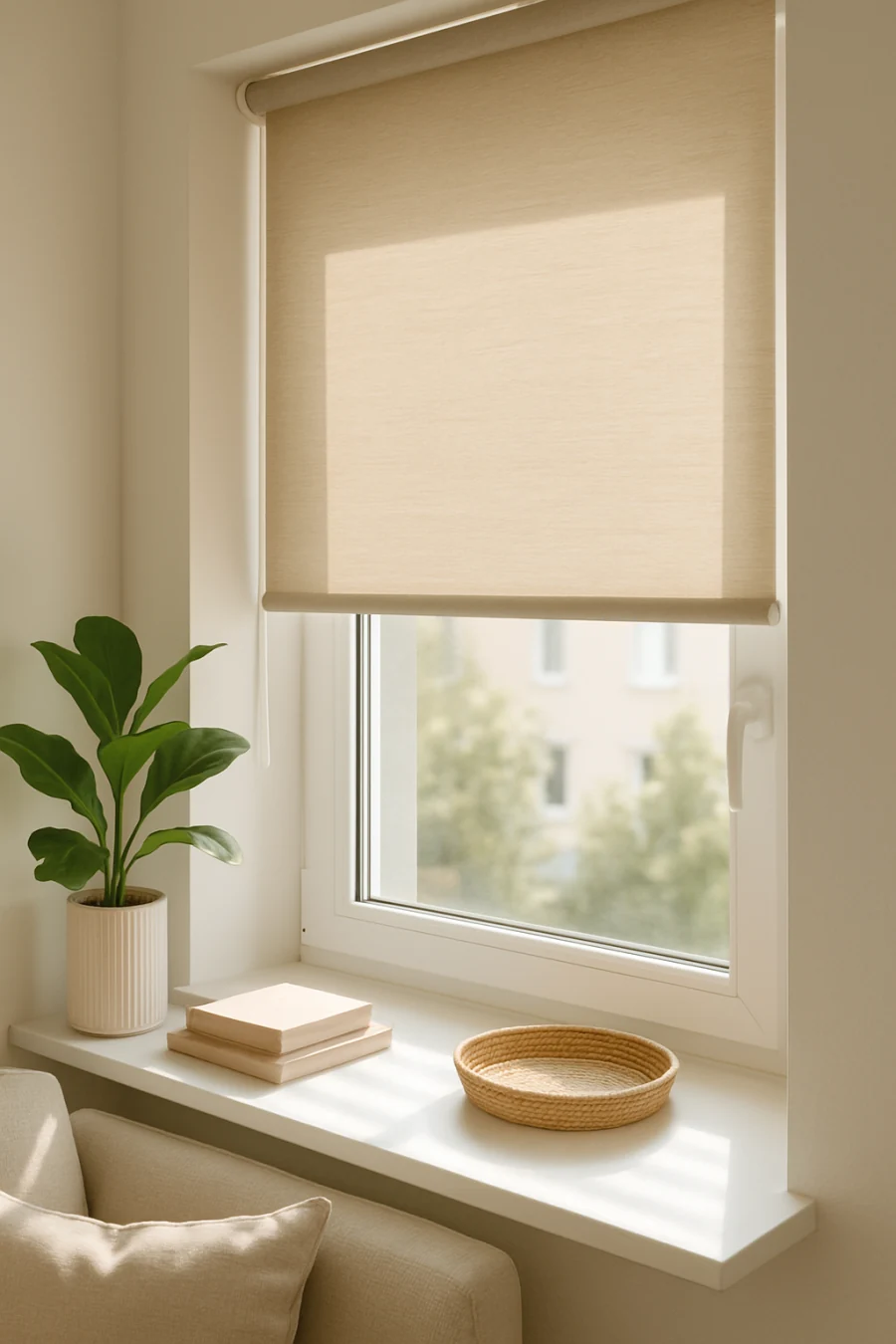


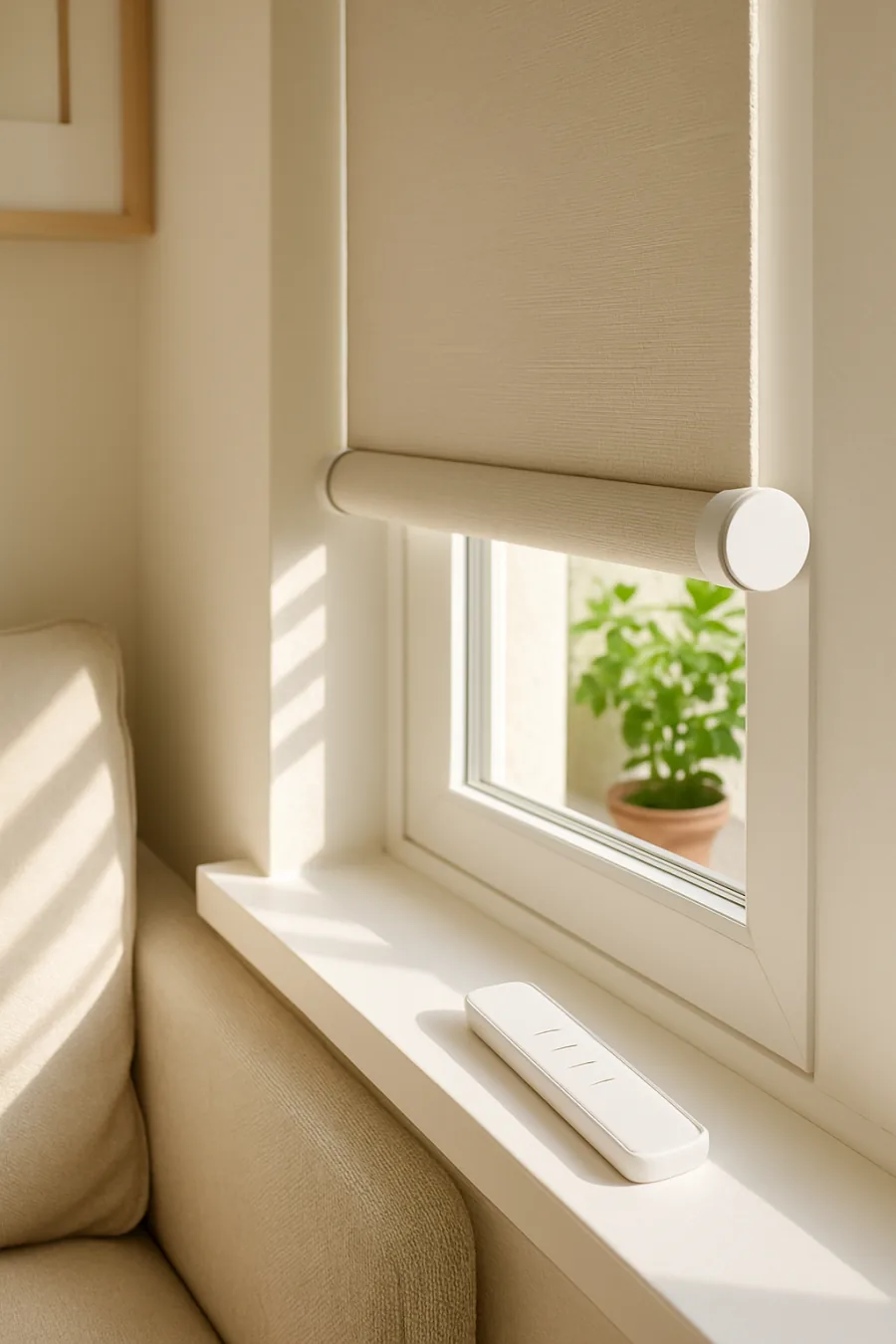


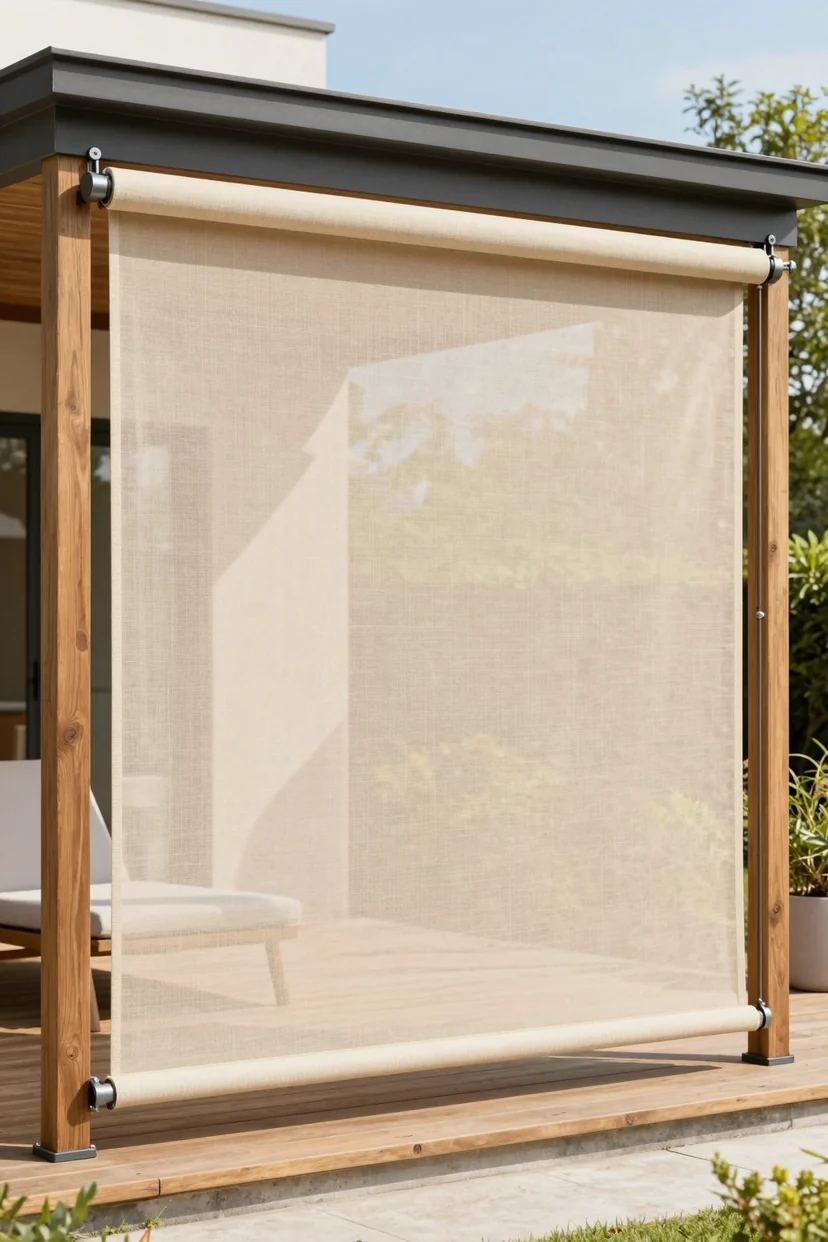











Perforated roller blinds in Almaty are screen fabric with even, fine holes: light comes through diffused, without glare, the view of the street stays, and during the day the room is hidden from prying eyes. The density is chosen by openness percentage — 1%, 3% or 5%. We make them to measure, from 5,400 ₸/m².
What perforated roller blinds are and what exactly we make
Perforated roller blinds are roller blinds whose fabric is made of screen material: it lets light through not as a solid stream but through many even, fine holes. Hence the name — perforation.
Perforated roller blinds are simple in design. The screen fabric winds onto a roller tube, the roller tube is fixed to the window, and the mechanism raises and lowers the fabric. Screen diffuses sunlight through even holes, so the room is bright but without harsh rays. This light doesn't cause glare on furniture, a desk or a screen.
What “perforation” means in this product
Perforation means holes distributed across the entire surface of the fabric, not a pattern or a design. Light passes through them, not a separate image. The holes are small and identical, so the fabric looks even and calm — no stars, no city silhouettes on it.
How we work
We are a manufacturer with our own workshop in Almaty, so we don’t keep finished products in stock — every perforated roller blind is made to measure. The client writes on WhatsApp, a measurer arrives with screen fabric samples, then the workshop and installation follow. On the samples you can see how screen of different densities behaves at a specific window, and that’s more honest than any description.
Perforation as we make it means even small holes in screen fabric, not a cut-out pattern; everything is made to measure, there are no finished products in stock.
How a perforated blind differs from “Night City”
“Night City” is a dense blackout fabric in which laser cutting carves a decorative pattern: silhouettes of buildings, stars, tree crowns. The perforated roller blinds we’re talking about here work differently — it’s screen, where the holes are distributed evenly across the entire surface of the fabric and form no pattern. The difference isn’t in the shade or the price, but in the very logic of the product: one option composes a picture out of light, the other simply softens the light itself.
Laser-cut patterns work like a stencil. During the day, while it’s brighter outside than in the room, the cut-out contours start glowing on the floor, walls and furniture — the very effect people buy “Night City” for. It’s beautiful if that’s what you intended. But the room stops being a backdrop: the pattern lies on top of the room, and you no longer choose whether to look at it or not. With blackout, the fabric is opaque and blocks the view of the street completely — that’s what blackout is for.
Screen behaves in exactly the opposite way. The holes are small and identical, so sunlight passes through them diffused, without harsh glare, and no pattern is projected anywhere. The view of the street is preserved: through 5% screen you see clearly, through 3% screen it’s softer, through 1% you get silhouettes and the general layout. We only make blinds like this. For us, perforation means precisely even holes, not laser cutting and not designer patterns.
| Feature | “Night City” | Screen |
|---|---|---|
| What the fabric is | Dense blackout | Screen fabric on the tube |
| How the holes are made | Laser cutting carves a pattern | Even holes across the entire surface |
| What happens during the day | The pattern glows on the walls and floor | Light is diffused, no pattern |
| What about the view of the street | The street isn’t visible | The view is preserved, clarity depends on the percentage |
| Do we make it | We don’t make it | We make it to measure |
If what you need is a pattern on the wall, that’s not our work, and at the measurement we’ll tell you so directly rather than offer you something “similar”. But soft light with the view from the window preserved — that’s exactly what screen is about, and here it’s worth understanding what different openness percentages give you.
Screen 1%, 3% and 5%: what you’ll see from your room
The openness percentage is the share of open area in the fabric of perforated roller blinds. The lower the percentage, the denser the fabric, the less light it lets through and the less is visible in both directions — both from the street into the room and from the room onto the street. It’s the openness percentage that determines the density of the fabric and its light transmission, not the colour or the thickness of the tube.
Screen marked 1% is the densest of the three groups. The holes here are microscopic: diffused light passes through, but the view of the street stays minimal, silhouettes instead of a picture. During the day the room is protected from prying eyes. In the evening, when we turn on the lights, that protection is no longer enough — you need a second layer or a dense fabric. As a standalone blind for the bedroom, 1% screen doesn’t work: it doesn’t darken the room.
Screen 3% is the middle of the range. A light-grey fabric with small cells gives soft diffused light and a slight view of the street: the outlines of the courtyard and cars are distinguishable, the details aren’t. During the day the room is hidden from prying eyes, but in the evening with the lights on you can see what’s happening inside through it — here too you need dense curtains. The anti-glare effect in this group is noticeable on screens and glossy countertops.
Screen 5% lets through more light and gives a clear view of the street — the reader’s question “why can you see better through 5% than through 1%” is easily answered: the open area of the fabric is larger, so more rays reach the eye directly. This group has a downside: during the day the room is visible from outside. For the bedroom, 5% screen is only used together with a dense fabric, but for the living room and terrace it works well.
The colour of the fabric changes how density is perceived. Dark screen of the same group looks denser than light: graphite fabric reflects less and seems more opaque, even though its open area is the same. At the measurement we let you look at both options against the light — the difference is immediately visible, and with a sample it’s more honest than any description.
The openness percentage is the share of open area in the fabric: the lower it is, the denser the fabric, the less light and the less is visible in both directions.
Screen 1%
Dense fabric with minimal view. During the day the room is protected from prying eyes, in the evening you need extra protection. Not as a blind for sleeping.
Screen 3%
Soft diffused light and a slight view of the street. During the day it hides the room, in the evening with the lights on you need dense curtains.
Screen 5%
More light and a clear view of the street. During the day the room is visible from outside, so for the bedroom — only together with a dense fabric.
Fabric colour
Dark screen of the same group looks denser than light.
Which openness percentage to choose: a south-facing window, a north-facing one, and the room’s purpose
The openness percentage is chosen in two steps: first you look at which way the window faces, then you refine it by the room’s purpose. For a south-facing window in Almaty you take denser screen, for a north-facing one — more open. And you go not by the colour of the fabric, but by the purpose: colour is secondary, it only slightly changes the perception of density.
A south-facing window requires denser screen, because the sun sits in the room almost all day, and in summer dust is added to it. Dense fabric removes the harsh contrast: the anti-glare effect on the desk and screen holds even at noon. A north-facing window gets almost no light. There, on the contrary, the more openness the easier it is for the room — otherwise it stays in semi-darkness even during the day.
The easiest way is to choose from the table, then check the decision on a sample.
| Window and purpose | Openness percentage | What you get in the room |
|---|---|---|
| South, heat and dust | 1% | Soft diffused light, anti-glare effect, minimal view of the street |
| North, lack of light | 5% | More daylight and a clear view of the street |
| Home office with a monitor | 3% | The screen isn’t washed out, the yard outside stays visible |
| Living room | 3% or 5% | Even light and an open panorama, if the window doesn’t face south |
| Kitchen | 5% | Bright at the work surface, the fabric doesn’t block the view of the yard |
A couple of notes. For a home office with a monitor, 3% is good because it gives an even background behind you and doesn’t darken the room until dusk: you can see the yard from your desk, and the screen doesn’t catch glare. The kitchen lives on light, so 5% makes more sense there — but if the window faces south, a 5% screen will be see-through from outside during the day, and that’s worth keeping in mind in advance.
If you’re torn between two groups, go with the more open one. You can always darken a room with a dense screen, but you can’t bring light back through a fabric that’s already made. A 5% screen gives a clear view of the street and more light, and that’s the reserve you’ll miss later with 1%.
The choice comes from the room’s purpose and the window’s orientation, not from colour: darkening is solved with a second layer of fabric, not by switching to a denser screen group.
What screen fabric is made of and why it matters at the window
Screen fabric is based on fibreglass with a PVC coating. The fibreglass gives the screen fabric its shape retention: the blind doesn’t stretch under its own weight, doesn’t sag between fixings and stays flat on the tube. The PVC coating works as a protective shell — it’s what takes on dust, UV and temperature swings, not the fibre itself.
Why does this matter at the window? Because perforated roller blinds hang in the most aggressive spot in the flat. There the fabric sits in the sun all day, and in the evening it’s much colder by the glass than in the room. Fabric that stretches or warps under this regime stops winding evenly onto the tube — and the blind starts to jam. In Almaty you can add dust and hot summer sun: over a season the fabric gets a lot of UV. Fibreglass with a PVC coating handles this regime noticeably better than ordinary fabric. And yes, a screen feels different from how it looks: to the touch it’s a dense, slightly rough material, not a thin film.
A separate question is whether dark fabric fades on a sunny side. The honest answer: fabric fading is possible, and it isn’t covered by warranty — not by us, not by any manufacturer, because it’s a natural process under UV, not a manufacturing defect. A dark screen loses colour depth more noticeably than a light one, so on a south-facing window the difference between fabrics will show up sooner. At the measurement we show samples that have already been working at windows — the difference is visible without explanation.
The warranty on perforated roller blinds covers the mechanics: 3 years on the mechanism and 1 year on installation from the date the acceptance report is signed. Fading isn’t on that list.
Screen fabric is based on fibreglass with a PVC coating: the fabric holds its shape and doesn’t stretch, while fabric fading remains a natural process that isn’t covered by warranty.
How to choose the percentage at the measurement: step by step
Window measurement and consultation are free, and you choose the fabric density not from a catalogue but from a live sample. The measurer arrives with samples of 1%, 3% and 5% screen fabric, holds them up to your glass — and you look at the yard, the walls of the building opposite, the mountains through the very fabric that will later go on the window. The price is calculated on the spot, not sent later.
Here’s how it works.
- We look at the opening and the sashes. Window measurement is needed to work out where the fixings will go. If the blind should move with the sash when you open the window for ventilation, installation on the frame solves this without drilling into the wall. When a clean window line matters more, installation on the wall above the opening is chosen.
- We hold the samples up to the glass. Through 1% the yard reads as silhouettes, through 3% you can see more, through 5% the picture is almost as if there were no blind. That’s how the decision comes together: hold the sample, step back a couple of paces and see what matters more to you — the view or the density.
- We confirm the chain side. The chain mechanism raises the fabric smoothly and holds it at any height, but which side the chain goes on depends on where the furniture sits by the window and which hand you find it comfortable to pull with. That’s what the measurement determines — you can’t guess it by eye.
- We check the cassette system. Yes, perforated fabric can be fitted in a cassette: the fabric and tube are hidden in a profile matched to the window colour. But the cassette takes up space on the sash, and on a narrow profile this sometimes gets in the way of ventilation — we look at the specific window.
- We discuss the suburbs. Within the city, measurement and delivery are free. We travel to Kaskelen, Talgar, Issyk and Kapshagay, and we tell you the call-out cost before we come.
We don’t keep ready-made products in stock — everything is made for your window. At the measurement you see the difference between fabric groups right away, instead of trying to imagine it from a description.
How much a perforated blind costs and what changes the price
Roller blinds — from 5,400 ₸/m². This price per square metre covers the fabric, roller tube, control mechanism and fittings, and the final total depends on the size of the opening, the fabric group and the type of control. Measurement is free: our measurer calculates the cost on site, for your window, not an average. If you have decided to buy perforated roller blinds, these four items add up to the final amount.
The price per square metre is the base that everything else is multiplied from. The larger the opening, the more fabric and the higher the total; denser screen groups cost more than open ones. Fixings and the tube are already inside the base — they don’t appear as a separate line.
Control is the first thing that changes the total.
| Control | Coefficient |
|---|---|
| Mechanical | ×1 |
| Chain | ×1.06 |
| Electric motor | ×1.85 |
| Electric + remote control | ×2.1 |
A chain mechanism adds a little to the base, and in most flats we fit exactly that: the fabric locks at any height, and adjusting the light is convenient. An electric motor replaces manual chain control and noticeably raises the price — it’s chosen for tall windows and for places where you can’t get to the window.
Installation is calculated separately: 4,500 ₸ per item, free for orders from 150,000 ₸.
| Installation | Coefficient |
|---|---|
| Wall-mounted | ×1 |
| Frame-mounted | ×1.05 |
| No drilling | ×1.1 |
| Cassette system | ×1.28 |
Wall installation is the basic option. Frame installation lets you open the sash without touching the wall and costs a little more. A cassette system hides the fabric and tube in a housing box, so it comes with the highest coefficient.
A separate note on manufacturing time: 4–6 days from the measurement and fabric approval. We don’t keep ready-made products in stock — we’re a manufacturer in Almaty and make everything for your windows, so “same day from stock” isn’t something we do. Measurement and delivery within the city are free.
The measurement determines which side the chain goes on and the mounting method, and the final amount is calculated from these. Manufacturing time — 4–6 days.
Evening: what’s visible from outside with the lights on and how to solve it
Evening privacy depends not on the density of the screen but on where the light is brighter. While it’s brighter outside than in the room, only silhouettes are visible through the holes — you can’t make out the interior. As soon as you turn on the ceiling light, the balance changes: the room becomes brighter than the yard, and perforated roller blinds start working the other way. From the street, everything happening inside is visible.
Perforated roller blinds don’t darken a room — that’s how the fabric itself is made. A 1% screen covers more of the fabric area than a 3% or 5% screen, and during the day it’s the most closed group. In the evening there’s almost no difference between the groups: the holes stay holes at any density. The view of the street, which is the whole point of the blind, works during the day. At night it turns into a channel for watching from outside in. Have you noticed how in the evening you can see a lit window from the street? With perforation the effect is the same, just broken up into dots.
Evening privacy needs a second layer or a dense fabric on the same window. There are several options:
- Dense fabric on a neighbouring system: next to the screen, a second roller blind is installed in a closed cassette with blackout and lowered for the evening.
- Day-night (zebra): a striped fabric with alternating dense and transparent stripes, which you use to close the gap in the evening.
- Dense classic-cut curtains over the screen — the same second layer, just on a rail.
Dense fabric complements the screen on one window rather than replacing it: during the day the fabric is raised and the view stays, in the evening the second one is lowered. For example, in a living room with two windows we install a 3% screen for the day and a blackout in a cassette for the evening — during the measurement the measurer shows how both fabrics behave with the lights on.
During the day, while it is brighter outside than in the room, only silhouettes are visible through the holes; in the evening with the lights on the picture changes, and full privacy needs a second layer.
Caring for perforated fabric: dry dusting instead of washing
Caring for perforated fabric comes down to dry dusting: dust is removed with a soft vacuum brush on low power, and the holes do not get clogged. The fabric cannot be washed, and it does not need to be taken down either.
Why this is so is clear from the design. The screen fabric is wound onto the tube together with the mechanism, and water will reach not only the fabric but also the unit responsible for lifting. After washing, the fabric loses its shape, and the mechanism starts working in jerks. We have seen such cases: people took the fabric down, soaked it, dried it on the balcony — and brought it to us for reassembly. The warranty on the mechanism is 3 years from the date of signing the acceptance report, but self-reinstallation and water are not covered by the warranty.
The rules are simple.
- Dust is removed every few weeks with a soft vacuum brush on the lowest power — without pressing, from top to bottom.
- Noticeable dirt is removed with a damp cloth without detergents and wiped dry immediately.
- Abrasives, solvents and stiff sponges are not used: they leave marks on the fabric.
- The fabric is not unscrewed from the tube and not soaked whole.
Now about the dust, of which there is plenty in Almaty. The perforation holes do not get clogged: they go through the fabric, and the airflow during ventilation blows fine dust out of them. Our measurer Kirill took apart such a blind after several years of use — the cells remained open, only the surface was clogged, and it is cleaned with a brush.
The noise of the fabric in the wind is a matter of mounting, not of the fabric. If the blind is installed on the frame or in a cassette, the fabric is taut and does not flap. An open roller tube on guide rails also holds it steady. When ventilating a sash, however, the bottom of the fabric sometimes catches the windowsill — this is solved by the length that the measurer allows for in advance.
You can vacuum with a soft brush, but you cannot wash or take down the fabric.
Open roller tube, closed cassette, chain and electric motor
An open roller tube and a closed cassette solve the same task differently: an open roller tube leaves the fabric in view and presses it against the glass, a closed cassette hides both the fabric and the tube inside the profile. For narrow openings and kitchens, an open roller tube is more often chosen — it takes up less space at the sash. A closed cassette is chosen where a clean window line matters: from outside only the profile in the frame colour is visible, not the wound fabric.
A cassette system is the same closed cassette, only with guide rails on the sides. In a cassette system the fabric does not swing when the sash is open, because it runs inside the profile. The price is higher: in the calculator a cassette system comes with a coefficient of 1.28 for installation, while wall mounting is 1, frame mounting is 1.05, and no-drill mounting is 1.1.
The control is chosen by window height and habit. A chain mechanism fixes the fabric at any height — this is convenient when the blind is raised often and a little at a time. An electric motor replaces manual chain control: for a high window that you cannot reach by hand, it is the only way to avoid a stepladder. In the calculator an electric motor comes with a coefficient of 1.85, electric with remote control — 2.1, mechanical control and chain — 1 and 1.06.
The chain side is chosen during the measurement, not when ordering from a catalogue. The measurer looks at which side is more convenient to approach the window from, where the furniture stands and how the sash opens — this determines whether the chain hangs on the right or on the left.
About an office with a monitor: a screen and day-night solve different tasks. Day-night (zebra) is a roller blind made of alternating dense and transparent stripes, convenient for changing the light in steps. A screen keeps the light diffused at all times and prevents glare on the screen, so it is better suited for a workstation with a monitor. In a meeting room with three sashes we installed a 3% screen — on video calls faces did not fall into shadow, and the background behind them was not overexposed.
An open roller tube presses the fabric against the glass and suits narrow openings and kitchens, a closed cassette hides the tube and fabric in a profile in the window colour, and the chain side is chosen during the measurement.
Screen and Almaty: sun, dust, mountain view
Perforated roller blinds in Almaty handle two local loads: hot sun and dust. A 5% screen still keeps the mountain view — the fabric does not turn into a solid curtain, the view of the street remains. The climate here is sharply continental: summer is sunny and dusty, winter is cold, with a temperature difference between day and night. The window works in both modes.
In summer on the south side the screen takes the main load. Fabric with even holes diffuses the rays: a desk by the window does not overheat, and there is no glare on the monitor screen. A south-facing window requires a denser screen — for the south we more often install 1% or 3%. The north makes up for the lack of light: there 3% or 5% is more appropriate, otherwise the room will be dim all day. In the north a dense screen simply eats up the already scanty light.
The mountain view is a separate reason why people even look towards a screen. Through 5% fabric the ridge can be made out, the snow on the peaks is visible, the outlines do not blur. Through 1% you distinguish the general silhouette, but the details are lost here — that is the price of density. Whether it is worth it depends on what matters more to you in the room: the picture outside the window or soft light and minimum glare.
Dust in Almaty settles on the fabric unevenly: more at the edges and on the bottom bar. Once a season we go over the fabric with a soft vacuum brush on low power, and the holes stay open. Water and detergents do harm here: the tube and mechanism are damaged by moisture, the fabric loses its shape — so dry dusting only.
During the measurement we show samples on your window and in your light: the density that looks good in the showroom may read differently in a room with a mountain view.
The sharply continental climate of Almaty and the window orientation determine the choice of density more than the colour of the fabric: for the south 1% or 3% is chosen, for the north — 3% or 5%, and a 5% screen preserves the mountain view.
FAQ
Here are the questions most often asked before ordering: about the openness percentage, measurement, price per square metre and warranty. Short answers — without repeating what has already been covered above.
How does a dense screen differ from a light one by feel on a sample?
The openness percentage is a characteristic of the fabric, not of the colour. A 1% screen is denser than a 5% screen, but by feel the difference is almost imperceptible: your fingers feel the structure of the fabric, not the share of holes. The right way is to hold the sample against the glass and look at the light: through dense fabric the street is seen as soft silhouettes, through an open one the details are distinguishable. During the measurement a Jalusso specialist lays the samples side by side, and the difference becomes obvious in a minute.
What happens if you get the percentage wrong?
A mistake doesn't break the window, but it changes how the room feels: too dense a screen makes the room dim, too open leaves you on view during the day. The openness percentage affects light and your view of the street, not how the mechanism works. That's why we don't recommend choosing from a catalogue: look at three fabrics at your own window at your own time of day.
Can a screen be fitted in a cassette system?
Yes. A cassette system hides the fabric and the tube in a housing box, and a screen fits it just like any other fabric. In the calculator this is taken into account by a coefficient of 1.28 on the base price. People choose this option when they want a clean window line with no exposed tube.
What's included in the price per square metre?
Roller blinds — from 5,400 ₸/m². This price includes the fabric, the tube, the control mechanism and the fasteners. The final amount depends on the window area, the perforated fabric group and the control type — chain, motor, or motor with remote control. Installation is charged separately — 4,500 ₸ per item, free on orders from 150,000 ₸. Manufacturing time — 4–6 days from the measurement and fabric approval.
Which side is chosen for the chain?
The side of the chain and the mounting method are determined by the window measurement: the measurer looks at how the sash opens, where the windowsill runs and what's nearby. The chain shouldn't end up in the area where you constantly reach for the window. Chain control adds a coefficient of 1.06 to the base price.
What happens after the warranty?
The mechanism has a 3-year warranty, installation work — 1 year; the count starts from the day the acceptance certificate is signed. If the case is recognised as a warranty case, we do the work free of charge — this takes up to 5 working days. Once the warranty period has expired, you can still call us — we'll tighten the fabric, adjust the mechanism, fit a new cord or chain. The warranty doesn't cover mechanical damage, re-installation by hand, exposure to water, or natural fading of the fabric.
Perforated roller blinds last a long time precisely because the mechanism can be adjusted rather than replaced entirely.
The bottom line
Perforated roller blinds in Almaty are a screen: a fabric with even, small holes, not a blackout with a cut-out pattern. Everything else we've talked about above follows from that fact. The openness percentage determines the density of the fabric and how much light it lets through: one gives the densest fabric and the least view, three — soft diffused light and a light view of the street, five — more light and a clear picture outside. It's easy to remember, but harder to choose for your own room.
The second takeaway: density is chosen by the room's purpose and the orientation of the window, not by the colour of the fabric. A south-facing side calls for a denser screen, a north-facing one — a more open screen. A dark fabric in the same group looks denser than a light one, and choices are often built on this property, though it only changes perception, not the percentage itself.
The third takeaway concerns the evening. During the day, while it's brighter outside than in the room, you see silhouettes through the holes, not the interior. In the evening with the lights on the picture flips, and a screen won't save you here: evening privacy is planned with a second layer — a dense fabric, a blackout on a neighbouring system, or day-night blinds. It's more honest to say this at the measurement than to promise full privacy from a single fabric.
The fourth takeaway is about the design. An open roller tube presses the fabric against the glass and suits narrow openings and kitchens, a closed housing box hides the tube in a profile matching the window colour, the side of the chain is chosen at the measurement, and for a tall window it's worth looking at an electric motor. Five in the percentage group and a cassette system are two different solutions, and they shouldn't be confused.
There's one practical recommendation. Book a free measurement and look at screen samples at your own window at different times of day — in the morning and towards evening, with the lights on. The density that seems right from the catalogue often turns out to be the wrong one at a real window.

