




















Blackout roller blinds in Almaty are made from multilayer fabric: light does not pass through the fabric, but it still gets into the room through the gaps — at the sides, above the tube, under the bottom bar. So darkness depends not only on the fabric but also on the design: open roller tube, guide rails, cassette housing box. We make such blinds to measure.
How blackout fabric is made and why it blocks light
We assemble Blackout roller blinds in Almaty from multilayer fabric, and the key part is the light-blocking core, not the density of the weave. Light does not pass through the fabric. Ordinary roller fabric works differently: it darkens the room through a tight weave of threads and lets a little light through in bright sun. The difference comes down to one thing — whether there is a black layer inside.
Layers of the fabric
In three-layer fabric, we show the client three layers on a cut sample. The face weave looks into the room. The dense black core acts as a light-blocking coating and holds back the light. The white backing faces the glass. The layers on the cut are clear without explanation — that is why our measurer always carries fabric offcuts. The front side can be anything: jacquard with a woven texture, a pattern, photo printing. Light transmission does not change with the design.
Dimout is not blackout, and the two should not be confused. Dimout darkens partially: it softens the difference between day and night but does not remove it. At bright midday, a room with dimout stays light, while with blackout it is dark.
Why “does not pass through the fabric” does not mean “the room is dark”
Blackout roller blinds do not let light through the fabric — this is a property of the fabric, and it is constant. But look at such a blind on an open roller tube: there will still be a strip of light at the edges. Light gets in there not through the fabric but through the gaps — between the fabric and the window reveal, above the tube and under the bottom bar. It turns out that a blackout roller blind and blackout roller blinds solve only half the problem: the fabric blocks the light, but the edges of the window do not.
| Fabric | What it does with light | Where it fits |
|---|---|---|
| Blackout (three-layer) | Does not let light through the fabric | Bedroom, kids' room, home cinema |
| Dimout | Darkens partially | Living room, kitchen, study |
| Standard thick roller blind | Darkens, lets a little light through | Rooms where you don't need darkness |
Below we'll look at the four paths of light separately — at the sides, above the roller tube and under the weight bar.
Blackout fabric doesn't let light through the blind itself; how dark the room gets depends entirely on whether the gaps at the sides, above the roller tube and under the bottom bar are closed.
Where light comes from in a room if the fabric is opaque
A strip of light in a room doesn't come through the fabric — it comes from the gaps at the sides, above the roller tube and under the bottom bar. Blackout roller blinds in Almaty cover a window with light-blocking fabric, but the fabric itself is only half the job. Light reaches a bedroom or a home cinema around it, and how tightly these four places are covered decides whether you'll wake up to a bright line on your pillow or not.
Gaps at the sides, or side light leaks, are the most noticeable reason blackout roller blinds don't give the darkness you expect. The blind hangs a few millimetres away from the window reveal, and sunlight passes through this gap as a thin bright line along the full height of the window. The greater the distance between the edge of the fabric and the wall, the wider the strip. In the morning this line hits you right in the face — familiar to anyone who sleeps with their head towards the window.
The gap above the roller tube is the second path. The tube with the fabric wound onto it is fixed above the glass, and on top, between it and the reveal, an open section remains through which light reaches the upper part of the wall. On an open roller tube this gap is not covered by anything.
The strip of light under the bottom bar is the third path, and it's the one people remember least often. The heavy bottom bar rests on the windowsill, but if a gap remains under it, light comes through along the bottom of the window and lights up the floor. The weight bar is sewn into the bottom pocket of the blind precisely so that the edge drops evenly and fits snugly against the windowsill, without waves or gaps.
The fourth path is the mechanism itself: on an open roller tube the fabric winds onto the tube, and a small section above and to the side of it stays open. This is not an installation defect but a feature of the design.
What does this mean in practice? During the day, a room with an open roller tube will be noticeably darkened, but not completely dark: narrow bright strips will remain at the sides and on top. If you work night shifts or watch a projector, these strips are enough to be a nuisance.
How do you get rid of side light leaks and the gap above the roller tube? The gaps at the sides are closed with guide rails, and the section above the roller tube with a cassette housing; together they form a cassette system. There's also a simpler way: hang the blind on the sash with an overlap so the fabric covers the edge of the window. In my view, for a rented flat this is often enough — building a cassette for a single sash makes little sense. But guide rails need a groove in the sash, and our measurer checks the profile before we name an option.
A strip of light in a room appears because of the gaps at the sides, above the roller tube and under the bottom bar, so how dark a room gets depends not on the fabric but on how tightly these four places are closed.
Open roller tube, guide rails and cassette: how to choose the design
Full blackout comes not from the fabric itself but from the design: guide rails close the side gaps, a cassette housing removes the gap above the roller tube. If you need the room to be truly dark, a light-blocking blind alone is not enough — what matters is what covers the gaps around it.
Jalusso makes three designs. The difference between them is only in how many gaps remain around the blind.
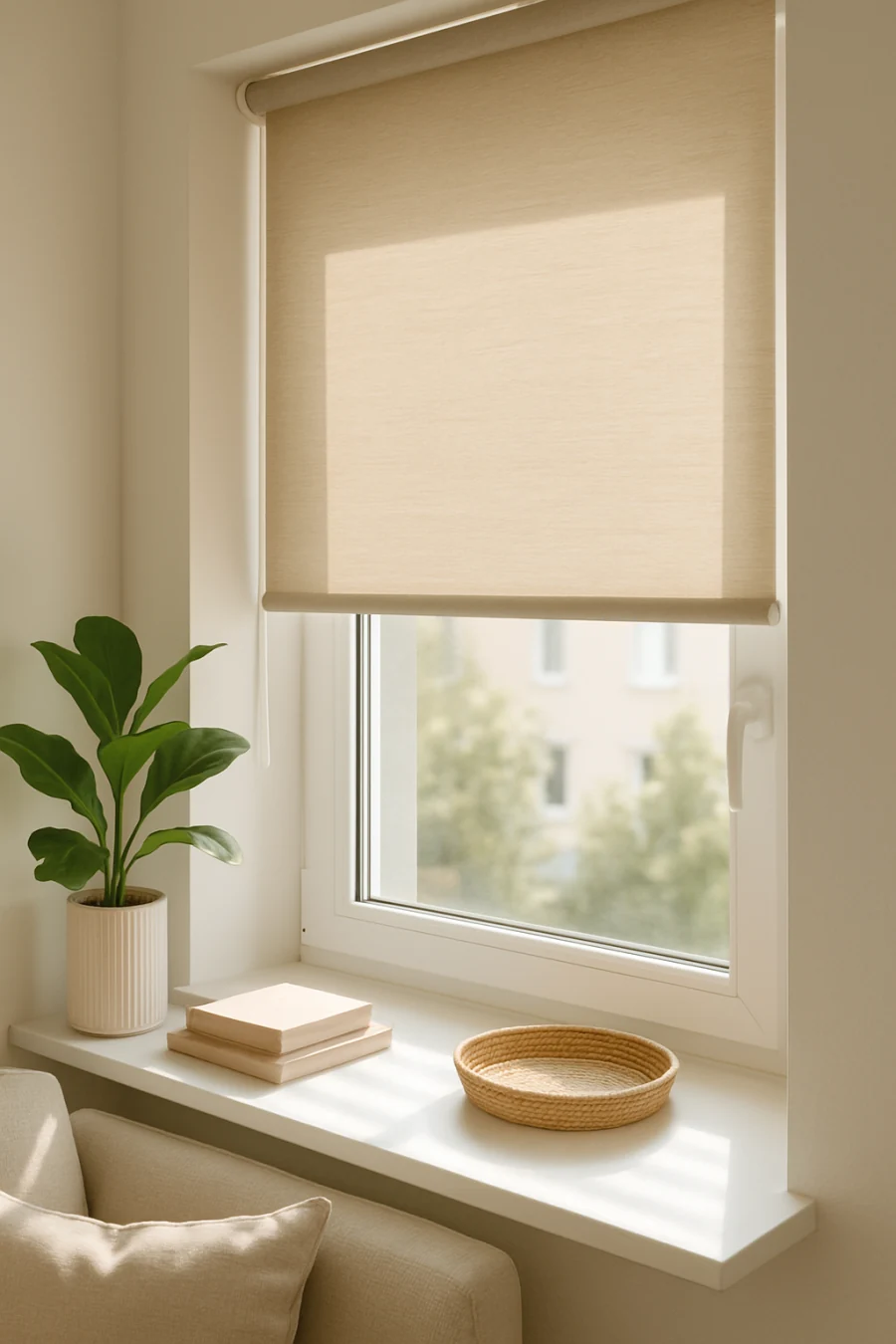
- Open roller tube. The mechanism and the wound fabric are visible, and a metal weight bar is inserted into the bottom pocket, which keeps the blind taut and stops it from curling. A narrow gap remains at the sides and above the roller tube. This option is chosen for living rooms, kitchens and offices — where full darkness is not needed.
- Guide rails without a housing. Narrow plastic strips run along the sides of the blind and slot into a groove in the sash. The guide rails close the side gaps between the blind and the reveal — the very strip of light along the frame disappears. The gap above the roller tube, however, remains.
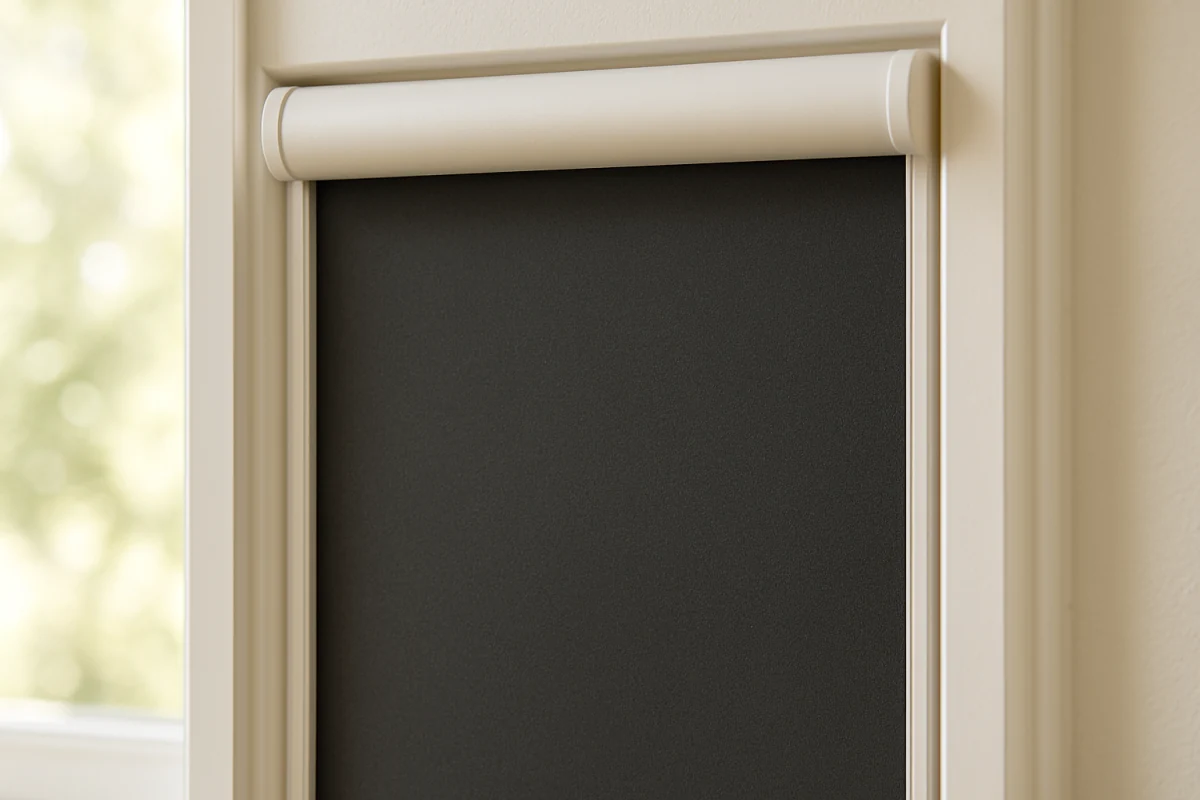
- Cassette system. The cassette housing closes the gap above the roller tube and protects the fabric from dust, and guide rails run inside the housing. The cassette system combines the housing and the guide rails and closes the gaps on all sides except the bottom edge. But the gap above the roller tube and the gaps at the sides are different places, so we price the housing and the guide rails as two separate elements, not as one part.
Which is cheaper? The open roller tube is the base item in the price list, from 5,400 ₸/m². A cassette costs more: in the calculator it comes with a coefficient of ×1.28 to the price of the product, and that's without the guide rails. If the task is simply to keep the sun out of a room used during the day, an open roller tube is enough. For a bedroom, a child's room or a home cinema, the difference in price pays off by the fact that light doesn't wake you in the morning.
One blind per window or a separate one for each sash? On a sash that opens, the blind gets in the way of the sash, so we more often install separate blinds: one for the fixed part, another for the opening one. On sliding and tilt-and-turn windows, the measurer checks how the blind will pass the handle and suggests an option for the specific profile. Blackout roller blinds with guide rails are installed the same way on plastic and wooden windows — the only difference is the fasteners.
A blind with guide rails can be fitted to a standard roller system; a housing requires a cassette design, because the roller tube has to be hidden in something. How dark a room gets depends on how many gaps are closed, not on how dense the fabric is.
White backing or silver: what to choose for the side of the building
For south- and west-facing windows we more often recommend fabric with a silver reflective backing. The silver backing faces the glass and reflects the sun's heat: the blind not only blocks light but also heats the room less in hot weather. A three-layer blackout has a white backing, and that's a different material — it darkens but doesn't reflect heat.
What is thermo blackout, layer by layer? It's a version of blackout fabric that has a silver-grey layer on the back instead of a white coating. The reflective layer only works in this specific version, not in every blackout fabric — and such a blind must be hung strictly with the reflective side facing the glass. Turn it the other way and the layer will heat the fabric instead of protecting you from the sun. The difference matters, and you can see it on a sample at the measurement if you look at the cut edge.
A white backing gives a light appearance from the street: from the courtyard the window looks like a white blind, not a dark screen. For ground floors and homes where windows face a neighbouring courtyard or the street, this is often the deciding factor — a homeowner doesn't want the façade to look dark. The front side can be anything: dark jacquard, textured weave, a pattern. The colour of the front side doesn't affect blackout — light doesn't pass through the core, not through the paint.
Keep the climate of Almaty in mind: hot, sunny summers and cold winters with frosts and a day-to-night temperature swing. On south- and west-facing windows, the window turns into a heater during the day. And here's a subtlety worth stating plainly: if heat matters more to you than the view from the street, choose the silver backing; if the window faces the street and you don't want a dark façade, choose the white backing.
Dark fabric in the sun is subject to natural fading, and this process happens the same way with both backings, because the sun hits the front side. Fading is not covered by the warranty.
Below is a comparison across three parameters.
| Parameter | White backing | Silver backing layer |
|---|---|---|
| Heat reflection | No | Yes, the layer faces the glass |
| View from the street | Light-coloured fabric | Silver-grey fabric |
| Mounting side | Any | Only with the layer facing the glass |
We always show how the white backing looks from the street on a sample during the measurement, because it is hard to judge this from a photo. We install thermal blackout roller blinds on south- and west-facing windows; reflective roller blinds are the same material under a different name.
The reflective layer is only present in a separate fabric version and faces the glass; the three-layer blackout has a white backing, and we do not promise heat reflection from any blackout.
Blackout roller blinds for plastic windows: mounting options
Blackout roller blinds for plastic windows can be mounted in four ways: on the frame, on the wall, inside the opening, and without drilling. The choice depends on how closely the fabric should sit to the window and whether the profile or wall can be drilled. For a permanent window in a bedroom we usually recommend the frame or a cassette, and for rented housing — a no-drill mount.
Frame mounting reduces the gap between the fabric and the window. The brackets are fixed directly to the profile, the tube sits flush against the glazing bead, and there is minimal space left at the sides for light to leak through. This option is chosen when the sash opens inwards and the fabric must not get in its way. Wall mounting makes the blind overlap: the fabric hangs over the window reveal and windowsill, covering the window with a margin. The gap between the fabric and the glass is larger, but we do not touch the reveal — this is convenient where the profile has already been finished or you do not want to drill it.
Inside-the-opening mounting hides the tube inside the window recess: the blind is almost invisible from the side, and the fabric hangs in the plane of the reveal. No-drill mounting is held by clamps or an adhesive base and leaves no marks — it is chosen for rented housing and for windows that cannot be drilled under the terms of the lease. In a new building with fresh finishing we also often start with it, and only later does the client decide whether to switch to frame mounting.
Two questions come up at almost every measurement. The first is about summer. On a south-facing window the glass under a dense blind heats up, and that is normal physics: the fabric does not let light through, and the heat stays by the glass. If the window faces south or west, we suggest a fabric with a silver reflective backing layer — it faces the glass and takes some of the heat away from the room. The second is about winter. A dense blind reduces air movement along the glass, so in severe frost condensation may appear on the frame. It is dealt with by airing and by not lowering the fabric right up against the glazing bead at night.
Travel area: Almaty is our main city. We travel to the suburbs — Kaskelen, Talgar, Issyk, Kapshagay; the cost of the visit depends on the distance and is quoted before the visit.
Frame mounting reduces the gap between the fabric and the window, wall mounting makes the blind overlap, and no-drill mounting leaves no marks and suits rented housing — it is precisely how closely the fabric sits to the window that determines whether light gets into the room at the edges.
How to check the fabric at the measurement and how we calculate the price
Roller blinds — from 5,400 ₸/m² on an open roller tube, manufacturing time 4–6 days. You can check the fabric right at the measurement: the measurer arrives with samples, and you look at the fabric against a flashlight rather than taking our word for it. Measurement and consultation are free, and so are the visit and delivery within the city.
What to look at on the sample
Point a flashlight from the back and see whether light passes through the fabric. The flashlight check at the measurement shows whether the fabric lets light through or not — it is more honest than any description. Then look at the backing: the three-layer blackout has a white one, while the silver reflective layer is only present in a separate fabric version. It is worth examining the cut edge separately — it shows the face weave, the black core and the backing coating that make up the multi-layer fabric. Put the sample against the window and step aside: in side light you can see how the fabric behaves in your interior, not in the showroom.
And if you decide to order blackout roller blinds for a project — we calculate not from a picture, but from your opening.
What the total is made up of
The price per m² depends on the area of the opening, the type of fabric, the control and the mounting. Area is the basis: the wider and taller the window, the more fabric goes into the product. The type of fabric affects the price because textured blackout and the version with a reflective layer cost differently.
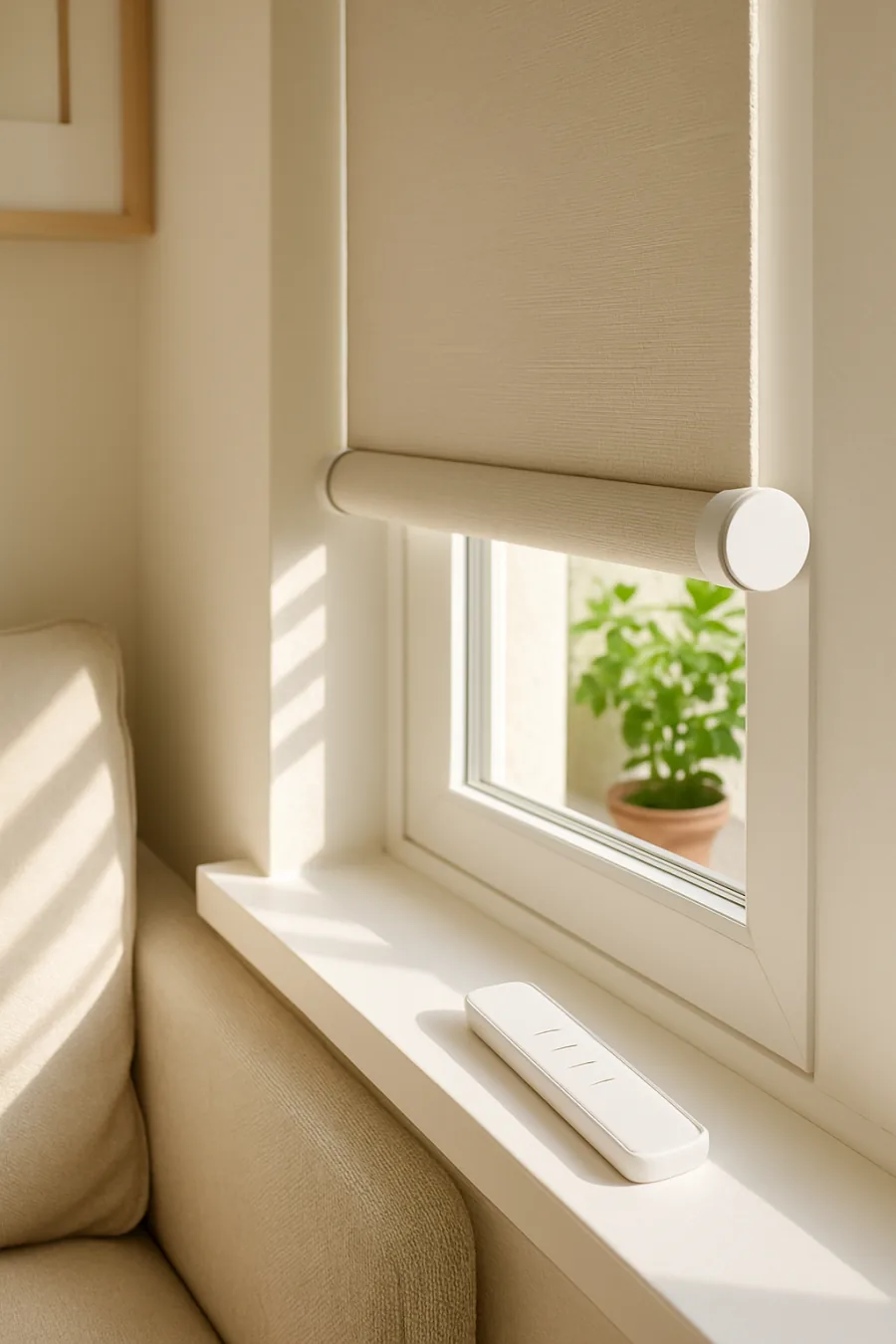
Chain control affects the cost of the product by a factor of ×1.06 to the base mechanism. An electric motor increases the price by the calculator factor — ×1.85, and electric with a remote control ×2.1. Mounting is also calculated by a factor: frame ×1.05, no-drill ×1.1, cassette system ×1.28, wall ×1. Installation of one product costs 4,500 ₸, but if the order total reaches 150,000 ₸, we install at no extra charge.
We are a manufacturer with our own workshop in Almaty: there are no ready-made products in stock, every blind is made to measure. Whether you want to buy blackout roller blinds or choose a blackout with an electric motor — the measurer quotes the exact amount on site, based on your windows.
A warranty applies to the finished product: 3 years on the mechanism and 1 year on the installation from the date the acceptance certificate is signed.
Care for multi-layer fabric and replacing the fabric
Multi-layer fabric requires dry care without machine washing. The layers are bonded to each other, and the drum with the spin cycle separates them: the coating peels away from the core, the fabric ripples and stops blocking light. That is why Jalusso does not recommend a washing machine on any setting — even “delicate”.
What to do about dust and stains:
- Dry dust is removed with a soft brush or a vacuum cleaner with an upholstery attachment — at minimum power, without pressing on the fabric.
- Stains are removed with a damp sponge without rubbing: blot rather than rub, otherwise a light shiny mark will remain.
- We do not use stain removers, chlorine or stiff brushes — they eat away the backing coating.
- If the fabric has lost its look, we replace only the fabric. The tube, mechanism and brackets stay in place, and the replacement costs less than a new blind.
Dark fabric in the sun is subject to natural fading: over time the face side pales, and this happens on its own, without anyone's mistake. Such fading is not covered by the warranty — nor are mechanical damage, re-installation on your own and water. Our warranty is 3 years on the mechanism and 1 year on the installation, and after it ends we still come: to tighten, adjust, replace the cord or chain. Separately about a child's room: the coating has no smell, the fabric does not stick to the hands and does not dirty the windowsill — otherwise we would not offer it for a room where a child spends half the day. Moreover, for a child's room people more often choose a light or reflective option: dark fabric is simply not needed there.
Dry dust is removed with a soft brush or a vacuum cleaner with an upholstery attachment, machine washing is not recommended, and natural fading of the fabric is not covered by the warranty.
Case studies: bedroom, home cinema, south-facing window
For a home cinema we usually install a cassette system with guide rails rather than day-night blackout. The reason is simple: a projector needs darkness throughout the room, while day-night lets in diffused light and works as a compromise between darkening and lighting. If the screen is watched in the evening, an open roller tube is enough. But during the day the picture on it fades from side light leaks, and then the housing box with guide rails solves the problem.
Bedroom: sheer curtain, drape and one fabric
With blackout roller blinds you don't need a sheer curtain during the day — and here's why. Blackout replaces the drape, but not the sheer: during the day the fabric is either closed or raised, and it doesn't give diffused light. So in daylight the window looks either tightly closed or fully open. In my view, that's an honest trade-off worth knowing about before the measurement. If you need soft light during the day, we suggest installing a day-night system alongside: one for darkening, the other for light.
One fabric or one per sash
One blind per window is cheaper and simpler to operate, but per-sash mounting is used when the sashes open separately. Then each blackout roller blind is made to its own width, and an open sash doesn't pull its neighbour along. A single blackout roller blind across both sashes is chosen for a fixed window where nothing opens. At the measurement you can see whether the fabric interferes with the handle and hinges, and the measurer names the suitable option.
What else people order for a kids' room and living room
For a children’s room, blackout roller blinds with a print are ordered most often: the light-blocking properties are preserved with photo printing, and the room stays dark. For a living room with a south-facing window, people take the same fabric but with a reflective backing. “Blackout roletes” are the same blackout roller blinds, just a name that came from another catalogue, so at the measurement we show samples and don’t argue about words.
Blackout replaces the drape, but not the sheer: during the day the fabric is either closed or raised, and it doesn't give diffused light.
FAQ
Does the colour of the front side affect darkening? No. A dark fabric and a light fabric from the same collection darken equally: it's not the dye that blocks light, but the multi-layer fabric with a black core. Colour decides something else — how the blind looks in the interior and how visible it is from the street. There's a subtlety here: light fabrics also have a light backing, and in the evening, when the light is on in the room, a soft glow is visible from outside. Dark fabrics show less of this effect. We show both options on samples so you can look at them under your own lighting, not from a photo in a catalogue.
How dark will the room be? The fabric doesn't let light through the blind, but light transmission is only part of the picture. Light enters the room through the gaps: at the sides, above the roller tube, under the bottom bar. If you need maximum darkness, choose a cassette system: it combines the housing and the guide rails, and there are almost no gaps left. On an open roller tube there will be a strip of light at the edges.
How do you check the fabric before ordering? The flashlight test at the measurement takes half a minute. You hold the sample against the window and shine a flashlight from the back — if you see dots on the front side, the fabric lets light through. We always let you do this yourself, rather than just showing the sample against the light.
What about the warranty? We give 3 years on the mechanism and 1 year on installation work; the count starts from the day the acceptance certificate is signed. If the case is recognised as a warranty one, we do the work at no charge within 5 working days. But it doesn't cover mechanical damage, re-installation on your own, water, or natural fading of the fabric. Even after the warranty period has expired, we come out to you — to tighten the mechanism, adjust the movement, replace the cord or chain.
Do you need a sheer curtain if we're installing blackout roller blinds? Yes, and this is the most common question about combining with a sheer. Blackout roller blinds replace the drape, but not the sheer: during the day the fabric is either closed or raised, and it doesn't give diffused light. If you need soft light during the day without prying eyes, the sheer is kept and the blind is hung right against the frame. Blackout roller blinds in this case don't interfere with the sheer — they run along the frame, while the sheer hangs on a rail in front of the window.
The short summary of all the answers is one thing: light-blocking fabric doesn't let light through the blind, and the darkness in the room is a matter of execution and installation.
Conclusion
Blackout roller blinds in Almaty solve one task — removing light from the room — but they solve it on two levels. The first level is the fabric: a multi-layer blind with a light-blocking core doesn't let light through itself, and this is checked with a flashlight at the measurement in a couple of seconds. The second level is the execution. Light enters the room not through the fabric, but through the gaps: at the sides of the blind, above the roller tube and under the bottom bar.
Here are five conclusions that sum up everything we do on this order.
The fabric doesn't let light through the blind, but that's not the same as darkness in the room. Installation makes the difference.
Gaps at the edges, above the roller tube and under the bottom bar are four paths for light, and each is closed by its own element. An open roller tube leaves side light leaks, guide rails remove them.
The cassette housing and guide rails are two separate elements that come together in a cassette system: the housing covers the roller tube from above, the guide rails press the fabric to the frame at the sides.
The silver reflective backing is a separate fabric option, not a property of any blackout. A three-layer blind has a white backing, and we don't promise heat reflection from it.
The price depends on the area of the opening, the type of fabric, the control and the mounting. Roller blinds — from 5,400 ₸/m² on an open roller tube, manufacturing time 4–6 days; chain, electric motor, cassette system and drilling-free installation are calculated as coefficients, and installation costs 4,500 ₸ per item and is free for orders from 150,000 ₸.
What to do next? Book a free measurement. The measurer arrives with samples, you check the fabric with a flashlight, look at the cut and the backing, choose the execution for your window — and get an exact quote on the spot. Warranty — 3 years on the mechanism and 1 year on installation.

