
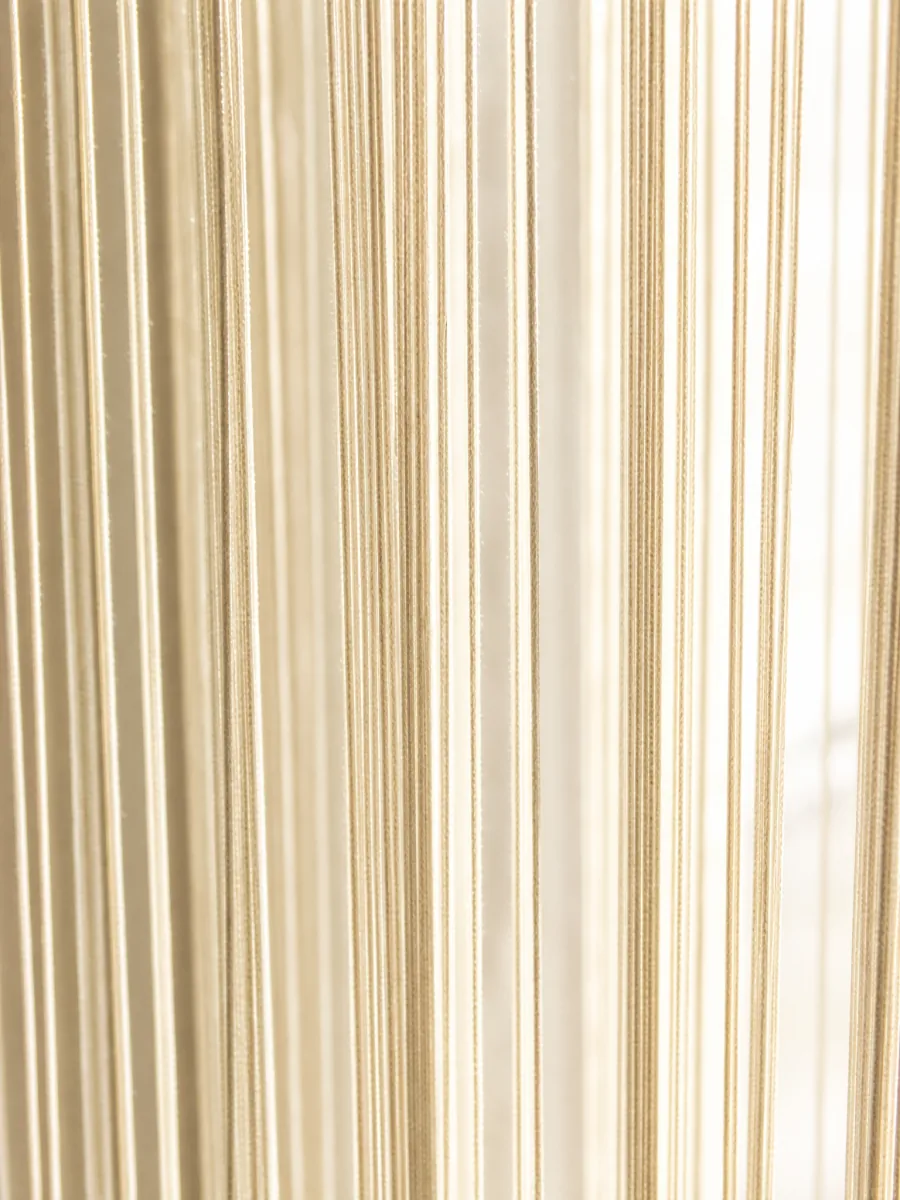




















String curtains, also known as kiseya or thread curtains, are a panel of freely hanging threads on a rail. People buy them not for light protection, but to divide a space without a door and bring a window to life. We make such curtains in Almaty to measure: the panel is made for your opening, not adjusted from a ready-made one.
What string curtains are and why they are confused with blinds
String curtains are a panel of freely hanging threads fixed to a rail. There are no slats, no turning and no sliding. That is exactly why calling them blinds is wrong, even though the words sit side by side in search and on marketplaces.
A thread panel works differently from any blind system. It doesn't turn at an angle to the light and doesn't slide to the side. The top of the panel is held on the rail, the bottom hangs freely and sways slightly with the movement of air. The job of such a curtain is not to cut off light, but to give light shade and divide a space.
Kiseya, thread curtains, noodle curtains
The same product in Almaty goes by three names: kiseya, thread curtains, noodle curtains. There is no difference between them — they are not different models, but different words for one panel. Jalusso calls it string curtains, because in most orders the threads are made of cord, not thin fabric.
The confusion starts at the moment of purchase. A person sees a photo of hanging threads on a product card and decides there is nothing to order — a ready-made one will do. Then it turns out the ready-made panel doesn't match the opening in width.
Why “Breeze” is not string curtains
“Breeze” rope blinds are vertical slats made of threads about 89 mm wide, joined by a chain. They have a bottom weight, the slats turn around their axis and slide to the edge of the window. Both are operated by a cord and a chain.
String curtains have none of this. A thread panel doesn't turn, doesn't slide and has no shared weight — each thread hangs on its own. Slats made of threads and “strings” are terms from the world of vertical systems and don't apply to string curtains. The difference is obvious at once: blinds are operated, curtains simply hang.
| Feature | String curtains (kiseya) | “Breeze” rope blinds |
|---|---|---|
| Base | freely hanging threads | slats made of threads about 89 mm |
| Control | no | cord and chain |
| Slat tilt | no | yes |
| Sliding to the edge | no | yes |
| Bottom rail | threads without a weight | a weight at the bottom of the slats |
The comparison answers the beginner's main question: if you need to slide and turn the slats, that's vertical blinds, not a string curtain. A string curtain is a panel of freely hanging threads on a rail, with no slats, no turning and no sliding, so calling it rope blinds is wrong.
Do the threads protect from sun and heat?
No, a string curtain barely protects from sun and heat. Light passes freely between the threads, so the panel dims the light and softens direct rays, but it does not darken the room. It does not take away the heat either: the thread does not reflect heat and does not work as a screen. This is a decorative solution, and it is worth choosing for the look, not for the shade.
The light protection of a string curtain depends not on the density of the weave, but on how much light remains between the threads. Even a dense thread leaves gaps. Polyester behaves predictably in this sense: it does not fade as quickly as natural fibre, but it does not solve the darkening task itself.
The limits of use look like this:
- A room where the sun comes in at a right angle all day — a string curtain will not save it from overheating.
- A bedroom where you need darkness for sleep — only a dense roller blind or another system with an opaque fabric gives light protection.
- A living room or studio where it matters to separate zones and soften the light — this is exactly where a string curtain works.
- A window on the south side — the risk of the thread fading is real, so the thread material matters more than its density.
Why product cards say “blackout”
The name on a ready-made product card does not mean there is a darkening fabric inside. Threads have no solid cloth — they are semi-transparent by nature. So the word “blackout” in a card description says nothing about the real light protection.
How to get both the look and light protection
A string curtain gives the look, a roller blind gives the darkening. On one window they work as a pair: the string curtain hangs closer to the glass and sways in a draught, the roller blind comes down over it when you need to block out light and heat. For a sunny side we more often suggest exactly this combination, not a string curtain alone.
Light passes between the threads, so a string curtain dims the light and softens direct rays, but it does not darken the room and does not save from heat.
Zoning: an opening without a door, a studio, a salon
For zoning an opening without a door, a string curtain is used more often than for a window. A doorway, an arch and an internal partition are places where a panel of threads works for its direct purpose: it separates two zones while staying permeable. No door is needed here, and a solid partition would take away light and air.
We make such panels to measure, not adjust ready-made ones. The client writes on WhatsApp, a measurer comes with thread samples, measures the opening and calculates the cost on site. Then comes the workshop and installation. Measurement comes before both the cost calculation and the manufacturing: without it you can neither calculate the footage nor choose the density for a specific place. Within the city, measurement and delivery are free.
Where does a string curtain give the most? Let's go through the scenarios.
- A studio where the sleeping area is separated from the main room. No partition is built, the panel is hung on a rail to the ceiling.
- The opening between the kitchen and the living room. The passage stays open, but the two zones are visually separated.
- A salon, café or shop with a shop window. Here there are several openings, and an even look of the panel along its whole length matters more.
In a beauty salon with three openings, it matters more that the panel does not fall apart from the constant movement of people, so a thread denser than usual is appropriate there. In a residential opening such density is usually not needed.
A studio and a sleeping place
Separating the sleeping zone from the main room without building a partition is the most common task in studios. Here the string curtain hangs from the ceiling and divides the room into two parts, while the light from the window passes through the threads.
Opening between the kitchen and the living room
Keeping the passage open but visually separating two zones — that is how the panel works in the opening between the kitchen and the living room. One thing matters: the threads should not hang right next to the stove and the sink, where splashes and grease settle on them.
A salon, café, shop with a shop window
Several openings in one room — here density and an even look of the panel matter more. The more openings there are, the more noticeable the difference between panels of different density, and the more carefully the thread needs to be chosen for each.
Where and in which city
We manufacture and install string curtains in Almaty — from measurement to installation.
Vertical rope blinds and a string curtain are different products, and for zoning we use a string curtain. On doorways, arches and internal partitions it is hung more often than on windows, because its task is to divide the space, not to block the light.
A ready-made panel 300×280 or made to fit the opening
A ready-made product 300×280 is a panel of fixed width and height, sold on marketplaces. It can only be trimmed in height: the threads are shortened with scissors, they do not fray and do not unravel. But the width of a ready-made product cannot be changed. If the opening does not match those three metres, the panel either hangs as a narrow strip or gathers in a fold at the edge, and it cannot cover the opening completely.
On marketplaces the names are mixed up, and someone who wants to buy rope blinds often gets exactly such a ready-made string curtain. We make string curtains to measure: the panel is immediately assembled to the required width and the required thread density. Density is not a small thing here. For an opening in a passage area you need a thicker and stiffer thread that holds its shape and catches less; for a window you can take a sparse one — it gives light shade and hardly blocks the light. In a ready-made product the density is set by the manufacturer, and it cannot be adjusted to the task.
| Parameter | A ready-made panel 300×280 | Made to fit the opening |
|---|---|---|
| Width | fixed | to the width of the opening |
| Height | trimmed with scissors on site | to the height of the opening |
| Thread density | set by the manufacturer | chosen to fit the space |
| Mounting | “rod pocket” mounting on a rail | “rod pocket” mounting on a rail |
| Measurement | not needed | free, with samples |
What can and cannot be fixed on site
The height of the threads can be shortened — with scissors, to the length you need, and you can really do it yourself after installation. The width of the fabric — no. If the finished product is wider than the opening, there is nowhere to put the extra threads: cutting them off at the edge means breaking the even spacing of the threads across the whole width.
How the measurement works
The client writes to us on WhatsApp. The measurer comes with thread samples and calculates the price on site, based on the actual dimensions of the opening. Within the city, measurement and delivery are free. We also serve Kaskelen, Talgar, Issyk and Kapshagay: a measurer will come to you, and we will tell you the call-out price in advance — it is calculated by distance.
A ready-made fabric can be trimmed in height, but not in width, so it has to be fitted to the opening with whatever is at hand, while a made-to-measure fabric is immediately made to the right width and density.
Do the threads tangle: a passage, a cat, a child
Yes, the threads tangle — but not on their own, for two reasons: if the fabric is constantly pushed apart by hand, and if a cat lives nearby.
In this sense, rope blinds behave like any fabric made of freely hanging threads: while the string curtain hangs still, it keeps a neat look, but as soon as you start walking through it in the opening every day, the threads catch on each other and gather into clumps. Pushing the string curtain apart by hand is the most common cause of tangling that we see during measurements. A cat adds a second cause: playing with threads is natural for it, and restoring an even fabric afterwards is hard. Children are the third cause, and the most serious one, and we cover it separately below.
What reduces tangling, by situation:
- A passage between rooms: the thicker and stiffer the thread, the better it holds its shape and the less it catches on its neighbours.
- Frequent movement through the opening: a high thread density helps — the fabric is stiffer and less willing to gather into clumps.
- A cat near the fabric: we do not leave a short fabric that reaches the floor; we trim the bottom so that the animal cannot reach the threads.
- A child’s room: loose threads without fixing are not suitable here, and we cover this scenario separately.
A passage area
A thicker and stiffer thread holds its shape and catches less. In a passage where the string curtain is pushed apart every day, we recommend not the lightest thread but a dense one: it is stiffer, the threads are less willing to gather together, and the fabric keeps a neat look longer. If the passage is wide and people walk through it constantly, a string curtain there is a compromise: it gives the look, but it requires attention.
What to offer for a child’s room
For a child’s room we do not recommend a string curtain. Loose threads get pulled, hung on and tangled in — this is not about aesthetics, but about safety. For a child’s room, a roller system with a fixed bottom bar and no loose cords is safer: the fabric goes up in one movement, and a child cannot get tangled in the threads or pull them towards themselves.
The threads tangle if they are constantly pushed apart by hand and if a cat is nearby, while in a child’s room loose threads get pulled, hung on and tangled in.
Thread material: cotton, jute, linen, synthetic
The thread material decides where the fabric can go at all. Jalusso works with four options: cotton cord, jute, linen and synthetic polyester cord. Cotton, jute and linen are solutions for indoor spaces, while for a veranda all year round only synthetic works: it withstands outdoor conditions and humidity. This is the first thing to tell the measurer — not the colour and not the density, but the place where the fabric will hang.
How do the materials differ in behaviour? Cotton cord shrinks when washed, so we clean it with a dry brush. Jute and linen hold their shape better than cotton and do not sag. Synthetic cord is afraid of neither humidity nor the outdoors. The difference shows not on the first day, but after the first wet cleaning or the first season outdoors.
Cotton
Cotton cord is a soft matte thread; it falls in waves and softens the light. A cotton fabric looks calm, without shine, and works well in a bedroom or living room where you need soft shade. Since cotton shrinks when washed, we base its care on a dry brush: we remove dust without water and without soaking. If you want to wash the fabric in a machine, cotton is not the best choice for that — here it is more honest to look at polyester right away.
Jute and linen
Jute and linen give an uneven thread with a handmade look. The fibre is coarser than cotton, so the fabric holds its shape and does not sag — the threads hang more evenly and gather less into a loose mass. Such a texture asks for a place where it can be seen: a loggia, a veranda, a window area in a country house. But natural fibre stays natural: moisture and the outdoors all year round do not suit it, and on an open veranda in winter jute will behave worse than synthetic.
Synthetic
Synthetic cord is a polyester thread. It does not fade, does not stretch from humidity and withstands outdoor conditions, so for a veranda all year round we offer only it. On a south-facing window, where the sun stays long in summer, polyester is also calmer than cotton: the colour holds, the fabric does not shrink, and washing does not change the length of the threads.
Of all the threads, polyester handles machine washing most calmly, so we only talk about washing with a note about the material. Natural fading of the fabric is not covered by the warranty — on the sunny side, the thread material matters more than its density.
An example from practice: for the veranda of a country house we quoted four openings, and there the choice of material was not about looks but about what would survive the winter and humidity — we settled on polyester.
The thread material determines where the fabric will last long: cotton, jute and linen — for a room, polyester — for a veranda, a loggia and the sunny side.
Density, lurex, beads and bugles
Thread density and decor are two different levers. Density changes how the fabric holds the opening and how much light passes through it; lurex, beads and bugles change first of all the look and the weight of the product. A doorway needs a thicker and stiffer thread: the more threads per metre, the denser the curtain and the less it catches on clothes and hands. On a window, a sparse string curtain is usually enough — it is meant as light shade, not as a curtain.
Lurex is a shiny thread woven into the fabric: in the light it gives point-like sparks, while in a room without direct sun it looks almost like an ordinary thread. Beads and bugles are strung decorative inserts; they are heavier than the thread, so the fabric falls more evenly and sways less from draughts.
Thanks to the weight of the beads and bugles, the fabric flies apart less — that is its noticeable plus, to be honest. The minus is different: such inserts collect dust more readily than a smooth thread and require more careful handling when washing.
Thread density affects the look of the fabric and the price, but raises it moderately. Lurex and bugles raise the price more than density — because of the decorative inserts in the fabric.
How the types of thread differ:
| Thread type | What it consists of | What it changes in the fabric |
|---|---|---|
| Simple thread | smooth polyester thread | light shade, the most affordable price position |
| Dense thread | more threads per metre | the fabric is more compact and catches less in the passage |
| With lurex | shiny thread in the fabric | point sparks in the light |
| With beads and bugles | decorative inserts | the fabric is heavier, sways less, but collects dust more readily |
Prices for each line are in the price list on the page — we don't repeat them in the text because the total depends on the height of the fabric. If you need the look of the fabric rather than light protection, decorative inserts give more than density.
How to hang string curtains: rail, wall, ceiling, paired with a roller blind
String curtains are hung on a rail — to the wall or to the ceiling, in the opening or with an overlap beyond its edges. The fabric is hung on the rail through a rod-pocket attachment: the threads are gathered at the top and threaded into the rail's channel. No drilling of the fabric itself is required — only the spot for the rail is drilled.
Then the order is:
- The client writes to us on WhatsApp and describes the opening or window.
- A measurer arrives with thread samples and calculates the cost on site. The consultation and the measurer's visit cost nothing, and delivery within Almaty is also free.
- The workshop makes the fabric of the required width, density and height.
- Installation of each structure is 4,500 ₸, and for orders from 150,000 ₸ installation is free.
Where to mount the rail — to the ceiling or to the wall — depends on whether there is space above the opening for a ceiling rail and where you want the fabric to go. If the opening is high and the ceiling is far away, we mount the rail to the wall above the opening. If you need to cover the space from floor to ceiling, the rail goes on the ceiling.
“Breeze” rope blinds are installed differently: they have slats made of threads, turning and sliding with a cord and chain, and they are controlled not by “pulling apart by hand” but by pulling the cord. String curtains are not controlled this way — they are simply pulled apart by hand.
How much to overlap beyond the edges of the opening
The overlap beyond the edges of the opening is needed so the fabric covers the opening completely rather than hanging as a narrow strip. If the string curtain hangs exactly at the boundaries of the opening, gaps remain on the sides and the zoning stops working. Our measurer will advise on site how many centimetres to overlap on each side for a specific opening — this depends on the thickness of the walls and on what the fabric rests against.
Double-row rail with sheer
On a window, string curtains are most often hung together with a roller blind: the string curtain provides the look, the roller blind provides light protection. If sheer is to hang next to the string curtain, a double-row rail is used and the fabrics are separated by rows. The string curtain goes on the front row, the sheer on the back row, and they don't interfere with each other when sliding.
During installation it's important that the string curtain doesn't rub against the sheer: the threads are thin and catch. A double-row rail removes this problem — each row works separately.
String curtains are hung on a rail to the wall or ceiling, in the opening or with an overlap beyond the edges, and on a window they are complemented by a roller blind.
Care: washing, untangling, cleaning without taking down, trimming to height
Caring for string curtains comes down to four actions: washing, untangling, dry dusting without taking down, and trimming to height. None of them requires a workshop — everything is done on site, with your own hands.
Preparation and washing
The main rule for washing string curtains: tie the fabric first, then wet it. The fabric is tied into a bundle in several places — this way the threads don't scatter and don't catch on each other. Then it's placed in a laundry bag, a delicate cycle is set, and the spin is turned off. It's dried hanging: the threads stretch under their own weight, and no ironing is needed. The bag is not an over-precaution. Without it, the threads in the drum wrap around neighbouring items and pull out in loops.
A note on material
We only talk about machine washing with a caveat about the thread material. Cotton cord shrinks when washed, so we clean cotton with a dry brush rather than soaking it. Jute and linen are natural fibres, and the care routine for them is best discussed at the measurement. Synthetics wash freely and don't stretch from moisture. If the fabric has beads and bugles, the routine is the same — delicate, in a bag, no spin, only the bag is taken denser so the decor doesn't hit the drum. Do the threads tangle after such washing? With the bundle tied — no.
Untangling and cleaning without taking down
The threads can be untangled without taking the fabric off the rail. Start from the bottom, from the ends of the threads: undo knot by knot, from the edge to the centre, rather than pulling the whole clump at once. String curtains do collect dust — that's the price for an open fabric made of many threads. Dry dusting without taking down is done with a vacuum cleaner with a soft brush on minimum power or an ordinary clothes brush directly on the hanging fabric. The frequency depends on the place. Near a radiator and in the kitchen away from the stove, dust settles faster, in the bedroom — slower.
Cut to height
Trimming to height is done with scissors, and this can be done yourself after installation. The threads don't fray or unravel: the whole row is cut at once along a taut thread or a ruler so the bottom comes out even. Shortening the fabric is easier than lengthening it — so centimetres are cut off gradually.
The threads of string curtains are held in the fabric by the weave, not by a selvedge: the cut edge needs no finishing and doesn't unravel.
Almaty's climate: dust, sun, draughts, radiator
Almaty's sharply continental climate places four demands on the threads at once: summer dust, a sunny side, winter draughts from the opening and warm air from the radiator. The fabric withstands all four, but behaves differently in each case — and some of the adjustments are made at the measurement stage.
In summer the threads collect dust. This is the price of the open structure: string curtains have no solid fabric, so dust settles on each thread individually rather than on the fabric as a whole. Wiping every thread is pointless — it's easier to go over it with a vacuum cleaner and a soft brush, or take the fabric down and wash it according to the thread material. December and January in Almaty are cold, with a noticeable difference between day and night, and the night frost makes itself felt in the opening.
A south-facing window
On a south-facing window the threads fade — most of all those in direct line with the sun. Thread density doesn't help here: more threads per metre gives a denser look to the fabric, but doesn't protect the thread from UV. The material is what matters. Synthetic cord — polyester thread — doesn't fade and doesn't stretch from humidity, so that's what we use on the sunny side. Cotton loses colour faster in the south.
Draughts and the radiator
Draughts and warm air from the radiator make the threads sway and rise — this is not a defect, but a property of the open fabric. In a doorway, where air moves constantly, the threads will always move. Near a radiator, the rising air picks up the lower part of the fabric and twists it slightly. What a heavier thread changes: it holds the line straighter and catches less, so for a passageway we recommend not the thinnest thread.
Out-of-town visits
Kaskelen, Talgar, Issyk, Kapshagay — our measurer comes there with samples and calculates the cost on site. The cost of the visit depends on the distance and is quoted before the visit, so there are no surprises afterwards. Within the city, measurement and delivery are free.
String curtains are a decorative solution, and they handle the climate exactly as well as the thread material and installation location are chosen correctly.
What the price is made up of and how the order works
String curtains in Almaty start from 5,800 ₸/m². The final price is affected by thread density, thread type and fabric height. Decorative inserts raise the price much more than density does. This is perhaps the main thing to understand before the measurement: customers often assume they're paying extra for density, when in fact the difference in price comes from lurex, beads and bugles.
What affects the cost
Thread density changes the look of the fabric and the price, but moderately. More threads per metre — the fabric looks more gathered and lets less light through, and behaves more steadily in a passageway.
Thread type is the second lever. A simple polyester thread, a dense thread, a thread with lurex, a thread with beads and bugles: each next option is more expensive than the previous one, and decorative inserts give the most noticeable jump.
Fabric height is the third. The longer the threads, the more material goes into the product.
You can break down your opening by these three parameters using the calculator on the page or at the measurement — the measurer comes with samples and calculates the cost on site.
Order stages
- You write to us on WhatsApp and tell us the task: an opening, a window or a shop window.
- The measurer comes with thread samples and calculates the cost on site. Consultation and measurement cost nothing, as does the visit with delivery within the city.
- The workshop makes the fabric to your dimensions.
- We install it. Installation costs 4,500 ₸ per item, but if the order total is from 150,000 ₸ — we install at no extra charge.
We also travel outside Almaty: Kaskelen, Talgar, Issyk, Kapshagay. We quote the visit price in advance; it's calculated by mileage.
What string curtains don't have is a lifting mechanism, cord or chain — the fabric simply hangs on the rail. That's why warranty cases for string curtains concern installation, not mechanics.
Warranty
Installation carries a 1-year warranty from the date the acceptance certificate is signed. If a case is recognised as a warranty case, the work is done free of charge within 5 working days.
Not covered by the warranty: mechanical damage, reinstallation by your own efforts, contact with water and fading of the fabric over time.
If you're unsure which thread type to choose for your budget, tell the measurer where the fabric will hang: they'll select the density and material for the location. The price of string curtains is made up of thread density, thread type and fabric height, and decor raises it more noticeably than density.
FAQ
Brief answers to the questions we get most often. Full explanations are in the sections above.
How are string curtains different from rope blinds? String curtains are a fabric of freely hanging threads on a rail. In “Breeze” rope blinds, the threads are gathered into slats about 89 mm wide, the slats are joined by a chain and controlled by a cord and chain — they can be tilted and moved sideways. String curtains have no slats, no tilt and no sideways movement: it just hangs. And yes, these are two different products, although the names are constantly confused.
Do string curtains protect from the sun? Hardly at all. Light passes between the threads: the fabric dims the light and softens direct rays, but it doesn't darken the room or save you from the heat. On a window they are usually paired with a roller blind — then the string curtains provide the look, and the roller system handles light protection.
Do the threads get tangled? They do if the fabric is constantly pushed apart by hand and if there's a cat nearby. In a passageway, a thicker and stiffer thread helps: it holds its shape and catches less.
Can it be machine washed? Yes, but according to the material: the fabric is tied in a bundle in several places, washed in a bag on a delicate cycle and dried hanging. Cotton cord shrinks when washed — we clean it with a dry brush.
How do you shorten the threads? Cut them with scissors to the required length. The threads don't fray or unravel, so you can adjust them yourself after installation.
Are string curtains safe in a child's room? We don't recommend it. Children pull on the loose threads, hang on them and get tangled in them. For a child's room, a roller system with a fixed bottom bar and no loose cords is safer.
Can the fabric or slats on old vertical blinds be replaced? This doesn't apply to string curtains, and here's why: string curtains are not vertical blinds. They have no slats or fabric strips that could be replaced — only threads on a rail. Slat replacement concerns vertical blinds, and this repair doesn't apply to a thread fabric. If you need a repair specifically for a vertical system — that's a separate conversation about its slats.
Will a ready-made fabric 300×280 fit my opening? A ready-made product 300×280 can't be adjusted to the width of the opening — the width can't be corrected on site. The fabric can be trimmed in height with scissors, but if the opening is narrower or wider than 300 cm, you'll be left with either a gap or extra overlap. That's why we make the fabric to measure: the right width and density straight away.
String curtains are not vertical blinds, so slat and fabric strip replacement doesn't apply to them.
Conclusion
The main takeaway from this article: string curtains are a solution for zoning and light shade, not for light protection. Light passes between the threads, so they don't darken the room or save you from the heat. If you need darkness, pair it with a roller blind on the window: the string curtains provide the look, the roller blind provides light protection.
The second takeaway is about names. String curtains have no slats, no tilt and no sideways movement, so calling them rope blinds is incorrect: “Breeze” is a separate system with slats about 89 mm wide and cord and chain control. And it's not a ready-made product 300×280 from a marketplace: a ready-made fabric has a fixed width that can't be corrected on site, while in height the threads can be trimmed freely with scissors — they don't fray or unravel.
The third takeaway — the thread material is chosen for the place, not for the look. For a veranda all year round, only synthetic cord works: it does not fade and does not stretch from humidity. Cotton cord, jute and linen are solutions for indoor spaces, and cotton shrinks when washed, so we clean it with a dry brush.
The fourth takeaway — about how the threads behave. In a passage area the curtain gets tangled if it is constantly pushed apart by hand, and especially if there is a cat nearby; there a thicker and stiffer thread helps. In a child's room, loose threads get pulled, hung on and tangled in — for a child's room we recommend a roller system with a fixed bottom bar and no loose cords.
The fifth takeaway — price. The final cost is affected by thread density, thread type and the height of the curtain, while lurex, beads and bugles raise the price noticeably more than density does.
There is one practical recommendation: before ordering, tell the measurer the task — an opening, a window or a shop window. The density and material of the thread are chosen for the place, and this is clear right away at the measurement. We make string curtains in Almaty to the size of the opening: the measurer comes with samples and calculates the cost on site.

