




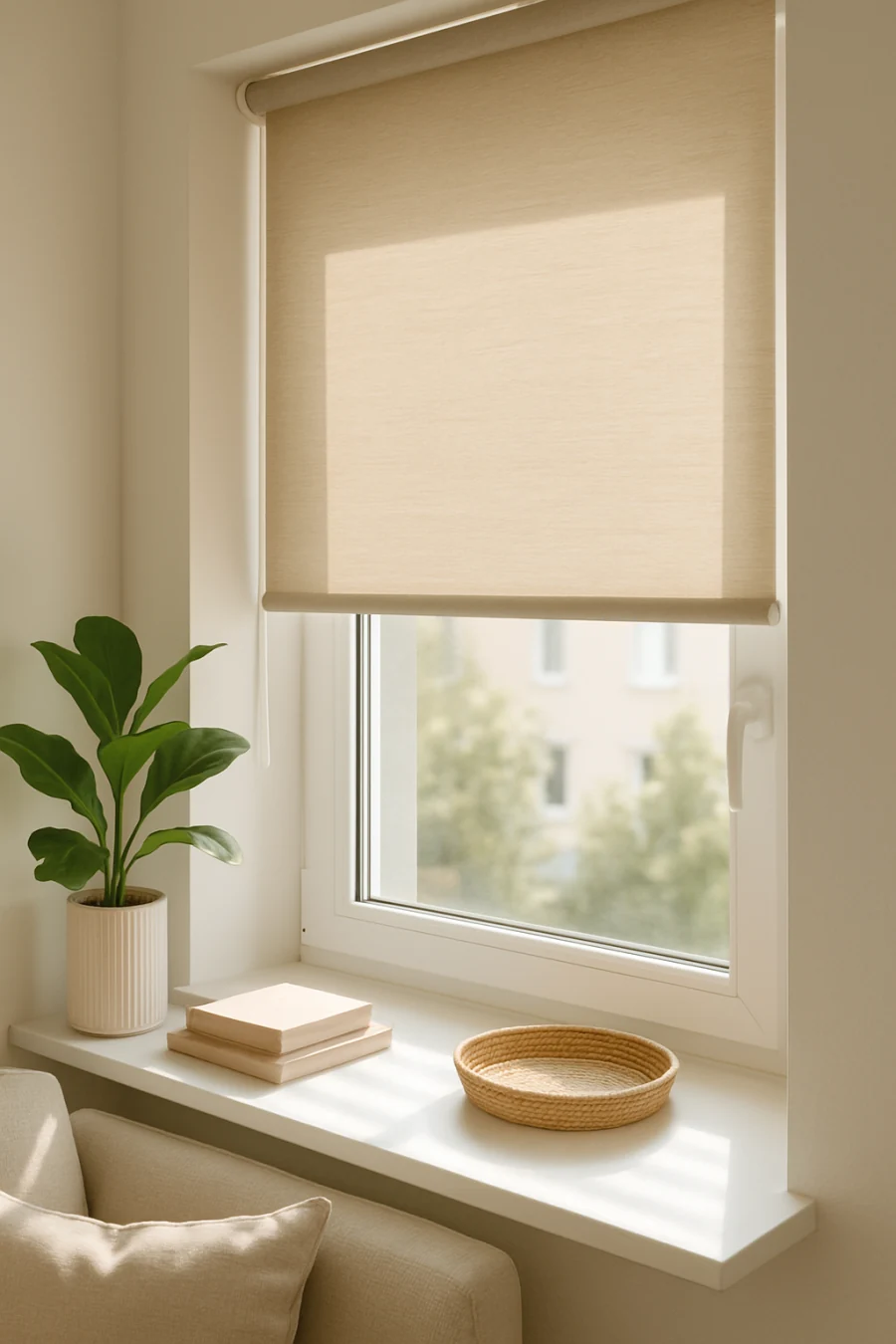


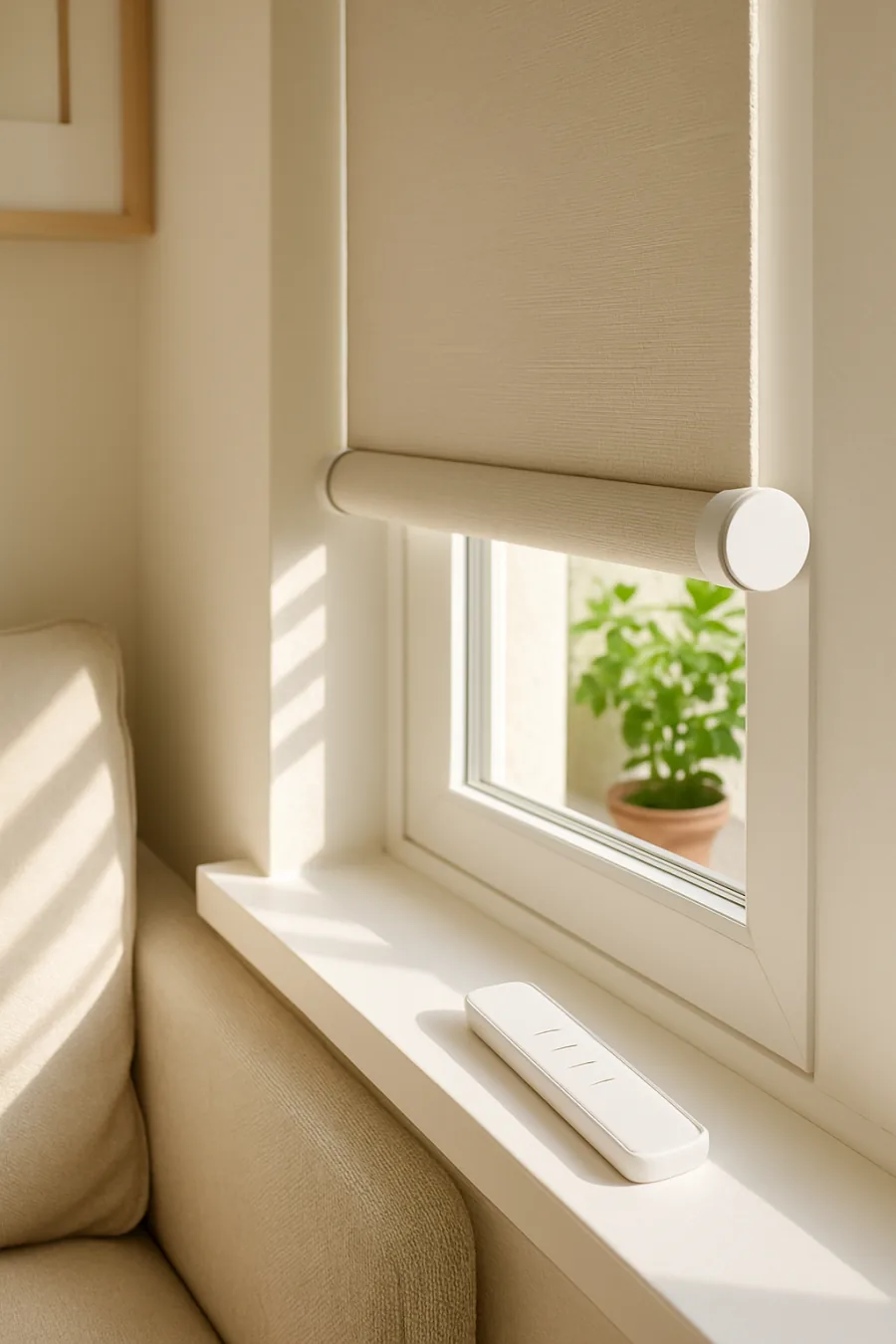


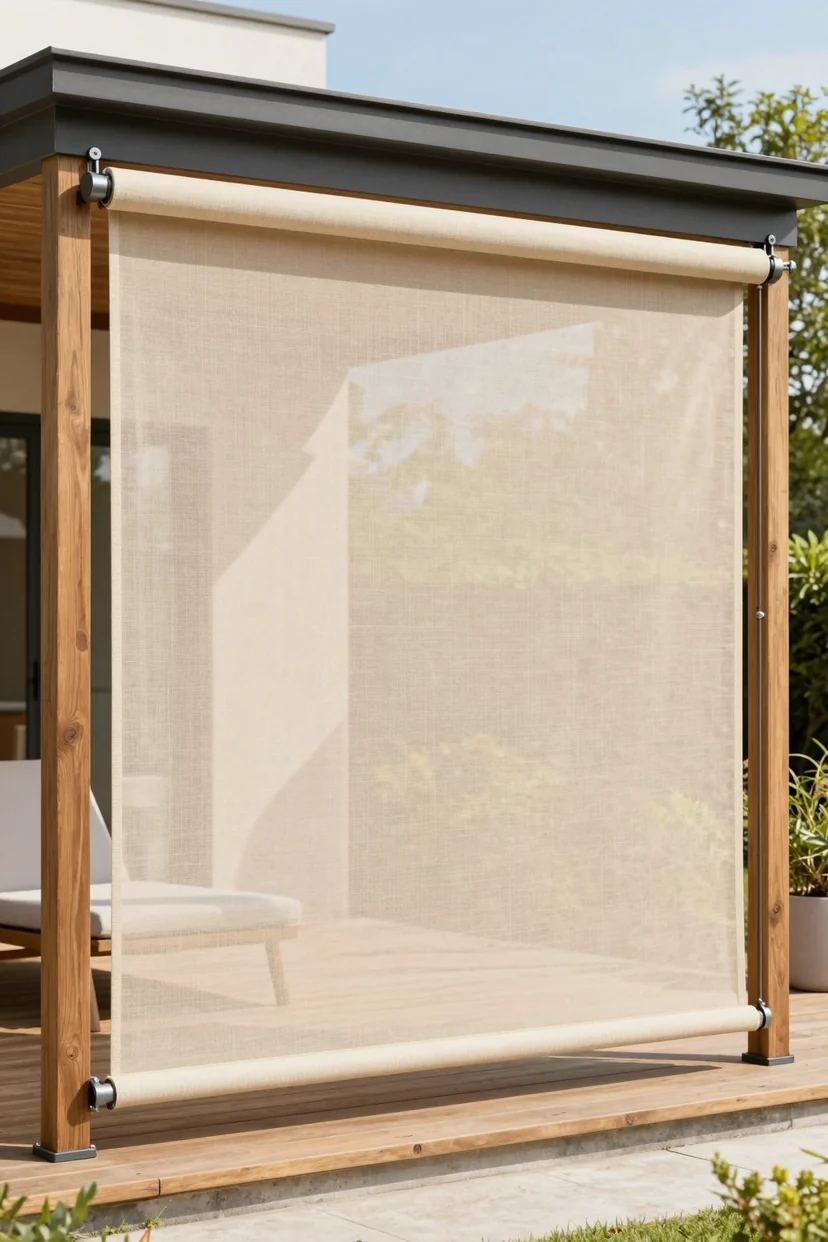











We make office roller blinds in Almaty to measure: one fabric per window, screen 1, 3 or 5% against glare on monitors, mounting without drilling for rented frames. Price — from 5,400 ₸/m², manufacturing 4–6 days, installation 4,500 ₸ per item, from 150,000 ₸ free. Measurement in the city is free.
Why an office is counted not by the blind but by the whole facade
Office roller blinds in Almaty are fitted to each window, not stretched as a single fabric across the whole facade. So an order here is counted by the row of openings: as many windows, as many fabrics, and they all have to look like one set. In an open-plan office this is especially noticeable. One window covered “however it turned out” immediately stands out as a mismatch against the rest.
The measurement determines three things that make the facade look even: the number of fabrics, the bottom height and the side of the chain. A small thing at first glance. But if the chain is on the right on one window and on the left on the next, the row no longer reads as a row. And the fabric colour and the facade will diverge at the first attempt to order more — not by colour, but by the shade of the same fabric from different batches.
How an office order differs from an apartment one
In an apartment there are usually one or two windows, and each lives its own life: a different room, a different height, different fabrics. In an office it is a row of identical openings one after another. One bottom height for all windows matters because it is visible both from inside and from the street: an even line of fabrics reads as order, while a mismatch at the bottom reads as an unfinished renovation. The colour matches within one batch of fabric, and that is a separate item in the order.
What the measurer records for the whole office
- The number of fabrics — for each opening, separately for each sash or one fabric for a wide window.
- The bottom height — one for all windows in the row, so that the line of fabrics matches.
- The side of the chain — the same on all windows, according to the desk layout.
- One batch of fabric — so that the colour does not differ between windows.
An office order is counted not by one window but by the whole row of openings: the measurer records the number of fabrics, the bottom height and the side of the chain for all windows at once.
Which fabric removes glare on the monitor: screen and its density
Screen removes glare on the monitor. Office roller blinds made of screen let light through but scatter it — the monitor stays readable and the sun does not dazzle. That is why screen is used in offices and open-plan spaces where people work at computers all day.
What the percentage on screen means
The percentage on screen is the share of light that the fabric lets through directly. The lower the percentage, the more light passes through and the less it is scattered. Screen 1% lets almost no direct rays through — the screen does not reflect even in bright sun. Screen 5% lets more light through and keeps the room brighter, but it also dampens the glare on the monitor less. The antistatic treatment removes static — less dust settles on the fabric, and the manager does not have to wipe the fabrics every week.
Table: screen density for the office task
| Office task | Screen density |
|---|---|
| Open-plan office, many monitors | 1% or 3% |
| Office with a drafting table | 5% |
| Meeting room for a projector | a separate dense fabric |
Screen is mounted on an open roller tube — this is the simplest and most common scheme. The fabric is wound onto the roller tube without a cassette and side profiles, and the chain comes out at the side. From inside, a fine mesh structure is visible — the city can be seen through it, while from outside the window looks even. And on the facade it is important that all fabrics are of the same density: then the windows read the same.
Screen density is chosen according to window orientation and the load on the screens. For a west window, where the sun stands low and hits the monitors at a sharp angle, sometimes even 1% is not enough — then a dense layer is added to the screen. For a north window with soft light, 5% is enough. The measurer comes with samples and shows the fabric in your light — that way you can see how the fabric behaves on your window specifically.
Let us take a typical situation: an office with a drafting table by a south window. The engineer marks up a drawing in even light, and harsh shadows from the sun get in the way. Screen 5% works here: it lets enough light through for work but dampens hard rays. In an open-plan office with rows of monitors, 1% or 3% is more often chosen — there it is more important to remove glare than to keep brightness. Density is the first thing discussed at the measurement, even before the area of the opening is calculated.
Screen lets light through but scatters it, so the monitor stays readable and the sun does not dazzle; density is chosen according to window orientation and the load on the screens.
Screen or dim-out: what to install on the south and west side
On the south and west side, dim-out with heat protection is added to the screen. Screen dampens glare on the monitor, but in summer the glass itself under direct sun gets very hot, and the fabric does not shield from it. Dim-out is denser: it holds both the light and the heat coming from the sunny side.
Almaty has a sharply continental climate. Summers are hot, sunny and dusty, while winters are cold, with frosts and a noticeable temperature difference between day and night. That is why fabric for office windows is chosen not for one season but for two at once.
How window orientation changes the choice
For windows on the north side, screen is enough. The sun comes in softly and briefly, monitors reflect glare from scattered light rather than from a direct ray. Screen 1% or 3% is installed — the room stays bright and the screens are readable.
On the south and west side the load is different. During the day the glass takes a direct stream, and by evening in the west the sun hits low and at a sharp angle — right at the level of the workplace. This is where dim-out comes to the rescue.
There is also a third fabric option. Blackout does not let light through at all, but for an office it is used narrowly — in a meeting room where the room needs to be fully darkened before showing slides. There is no point in keeping blackout on all windows of an open-plan office: workplaces would stay dark, and the lights would have to be switched on during the day.
| Side of windows | What we install | Why |
|---|---|---|
| North | Screen 1% or 3% | Scattered light, no direct ray |
| South and west | Screen plus dim-out | Glare during the day and heat build-up in the glass |
| Meeting room | Blackout on a separate blind | We darken the room before showing slides |
| Cassette system on the window by the desk | Coefficient ×1.28 to the base | Dust does not settle on the fabric or the tube |
Our advice is this: north — screen, south and west — screen plus dim-out, meeting room — blackout on a separate blind. Office roller blinds are chosen for the side of the building they face, not for the colour of the walls. During the measurement Kirill holds both fabrics against your glass in your light — and the decision is made on the spot, not from a picture.
So the south and west sides are not covered by a screen alone, but together with dim-out they protect the office from both glare and heat.
Rented office: how to hang blinds without drilling into the frame
Office roller blinds can be installed with no holes in the frame at all — for a rented space this is the main option. A no-drill fixing holds on the sash itself or on the window reveal and leaves no marks. It does not suit every window, though.
The difference is simple. A no-drill fixing keeps the frames of a rented office intact: when you move out, you take the blinds down and hand the space back in the same condition you received it. A frame fixing is more reliable in a permanent place, but it is chosen so that it does not get in the way of the opening sash — otherwise the window will no longer open for ventilation. A wall fixing is used when the opening is wide and the frame simply cannot take the weight of the tube with the fabric.
Three fixing methods and when each is used
- No drilling — rentals, a temporary office, a space you plan to move out of. The frame stays intact.
- On the frame — a permanent office, normal sash opening, a neat look from the street.
- On the wall — wide and tall openings, panoramic glazing, double-height spaces where there is nothing to fix to the frame.
In our calculator, wall installation has a coefficient of ×1, no-drill — ×1.1, frame — ×1.05. The price difference is small, and the choice is made by the window, not by the money.
What happens when you move out of the office
Moving out is the most common question from tenants, and the answer is short. The blinds come off the fixing, no marks are left on the frame, and the mechanism remains under warranty — 3 years on the mechanism and 1 year on installation from the date the acceptance report is signed.
There is one detail worth mentioning at the measurement: some fixings are designed for a specific profile, so when moving to another office new brackets are sometimes needed. The fabric, tube and mechanism move with you.
We usually advise tenants to tell the measurer right away that the space is rented. Then they will choose a fixing for a rental, not for long-term use.
What it costs to cover an office with 10–20 windows
We calculate by the area of the openings. The base is from 5,400 ₸/m² for the “Polyester, open roller tube” option, manufacturing 4–6 days. Installation of one unit costs 4,500 ₸; if the order total reaches 150,000 ₸ or more, installation is free. On an order of 10–20 windows this total is almost always reached, so installation effectively drops off the invoice.
The price per m² is not the price “per window”. It is multiplied by the area of each opening, and only then are the calculator coefficients applied to the total. An office with ten windows on the sunny side will use more fabric than a single-window room — simply because there are more blinds. Office and study blinds can only be bought by measurement: Jalusso does not keep ready-made items in stock, every blind is cut for a specific opening.
What the total is made up of
The total is made up of four things: the area of the opening, the fabric group, the type of control, and the fixing. The measurer takes the area with a tape measure for each window separately. The fabric group determines which material goes into the cut.
The type of control and the fixing are calculated as coefficients to the base:
- Chain — ×1.06
- Electric motor — ×1.85
- Electric with remote — ×2.1
- Installation on the frame — ×1.05
- Without drilling — ×1.1
- Cassette system — ×1.28
Mechanical control has no surcharge, ×1. And the coefficients are multiplied, not added: a cassette system together with an electric motor will give a noticeably different total than each option on its own.
Example calculation per price list
Let us take a window of 2 m² — a typical opening in an open-plan office. At the base rate that is 2 × 5,400 = 10,800 ₸. We add a chain: 10,800 × 1.06 = 11,448 ₸ per blind. A no-drill fixing adds another ×1.1 — that comes to 12,592.8 ₸. Multiply by ten such windows and we get 125,928 ₸: the order does not reach the free installation threshold, so 4,500 ₸ per unit will be added to the total. With fifteen windows the invoice will already be over 150,000 ₸ — and we do not charge for installation.
This is the logic of the invoice, not a ready-made quote. The measurer gives the exact price on the spot — after seeing the openings, the sashes and the chosen fabric. Manufacturing time depends on the area of the opening and the type of control: the workshop takes longer to make a large motorised blind than a standard one with a chain. The warranty on the mechanism and installation — 3 years on the mechanism and 1 year on installation — applies regardless of how many windows are in the order.
The base price is from 5,400 ₸/m², manufacturing 4–6 days, installation 4,500 ₸ per unit and free from 150,000 ₸.
One fabric, one bottom height, one chain side: how an office looks even
An even office look rests on three things: one fabric, one bottom height, one chain side. The colour is chosen for the side the facade is most often seen from. From the street you see the line, not the shade: if the blinds are lowered to different heights, the facade looks like a random set of pieces, even when the fabric is the same. Inside the rule is different — it matters that the city can be seen through the fabric, not a solid grey wall. Office roller blinds are installed so that the outline of the street stays outside the window and there is no glare on the desks.
One batch of fabric ensures the same colour on all windows. This is not a small thing: different batches can differ by half a shade, and on a long facade this is noticeable. An order in two batches requires fabric from one batch — the windows of the first stage and the second are made from one roll. That is what Jalusso does when an office is covered in stages.
What we fix for the whole office:
- one batch of fabric for all windows;
- the chain side — the same along the whole row;
- the bottom height of the blind;
- the side the facade is viewed from.
Why the bottom height matters more than the colour
An even bottom on all windows reads from the street as order, and it is easier to achieve than it seems: the measurer sets one height for the whole row. The colour matches within one batch without any extra effort. But a bottom that has drifted apart is visible at once — one blind reaches the windowsill, the next hangs a hand’s width higher. On a long facade this is the first thing a passer-by notices.
Office and open space in one fabric
A manager’s office and an open space can be covered with the same fabric but in different densities. For an open space, where people sit behind monitors all day, they choose a screen of 1% or 3% — more light, no glare. In an office with a drafting table, they use 5% to remove harsh shadows. The fabric is the same, the pattern is the same, but the density is different — you feel it inside, while from the outside the facade stays uniform. During the measurement, we lay out samples in your light and show how each percentage behaves.
If the office is covered in two stages, the fabric is still taken from the same batch — otherwise the second stage may arrive in a different shade.
Control: chain at the desk, shared roller tube, remote control for high windows
One chain controls several blinds at once if they are assembled on a shared roller tube with couplings, while one blind is raised and lowered by a chain at the desk. A shared roller tube with couplings connects several blinds on one chain: three windows in a row open with one movement of the hand. A chain on each window separately is when an employee decides for themselves how much light to leave at their workplace.
Here is how we usually arrange controls across an office:
- A chain on each blind — for workplaces along the windows: a person adjusts the light without getting up.
- A shared roller tube with couplings — for a long row of identical openings: one chain for the whole row.
- An electric motor — for windows above human height: the motor raises the blind itself.
- Motor with remote control — for an atrium and double-height space where you can’t reach even with a long chain.
Who is responsible for the blinds in the office? Usually it’s the administrator or office manager. We advise agreeing in the team right away: one chain per window — one pair of hands, otherwise everyone pulls it and the mechanism quickly loosens. In my opinion, this rule saves more than any repair done after the fact.
What to choose for the workplace
At the desk, a chain is convenient — an employee adjusts the light at their workplace without getting up from the chair. A spring mechanism is used for small windows where you don’t want extra parts. For an office where the window opens for ventilation, the chain is routed so it doesn’t interfere with the sash.
High windows and panoramic glazing
A high window — double-height or atrium — can’t be covered with a chain: a long chain brought down to hand level doesn’t always help. For such openings we install an electric motor. It controls windows above human height, and paired with a remote control it opens the whole row at once.
We divide panoramic glazing into several blinds butted together — then each one rises separately or all together. Roller blinds also cover an office in an atrium if the blinds are made to the size of the opening, not in pieces.
A shared roller tube with couplings connects several blinds on one chain, and an electric motor controls windows above human height.
Meeting room: a separate blind for the projector and video calls
A meeting room needs a separate blind for the projector and screen. That way the room is darkened before slides are shown, while the blinds in the rest of the office stay raised. Roller blinds are installed in an office so that each room has its own mode.
In an ordinary office, a screen works the other way: it lets light through and diffuses it so it’s comfortable to work behind a monitor. In a meeting room the task is different. Here it’s important to remove the light hitting the screen on the wall, otherwise the presentation isn’t visible. That’s why the density is higher than in an open space, and before a presentation the blind is lowered completely.
What helps in a meeting room:
- blackout — a dense fabric that covers the window before a presentation;
- motor with remote control — darkening at the push of a button, without going to the window;
- a separate blind for each sash or one wall-mounted blind for a wide opening.
Blackout isn’t installed on all windows in an office — only in the meeting room. In other rooms it would make the room dark and force you to burn lights all day.
Why the density in a meeting room is different
The screen on the wall shouldn’t glare. But full darkness isn’t needed either: people need to see each other and their notes. A dense blind removes the light hitting the screen, while some light still remains in the room — enough not to turn on the ceiling lights.
Fabric with treatment for rooms with fire safety requirements
Flame-retardant fabric is needed for rooms with fire safety requirements. It’s a dense fabric with a treatment that doesn’t support combustion. It’s installed in meeting rooms and corridors where such requirements apply to finishes. The documents for the fabric are clarified during the measurement: the measurer looks at the room and says what will work.
Before a video call, the blind in the meeting room is lowered, while the light in the room stays on — so the screen on the wall doesn’t glare and the participants are visible.
Installation around the company’s schedule: work doesn’t stop
Installation around the company’s schedule doesn’t stop the office workday. The time is agreed in advance, and the crew moves through the space instead of chasing all employees around the floor. We install office roller blinds in Almaty during the hours you name yourself.
First, a short answer to the main question: yes, blinds can be installed without sending people out of their offices. Installing one unit takes a little time, so we go through the windows one by one — first the open space, then the offices, then the meeting room. An employee gets up from their desk for a couple of minutes, and work continues. And the whole office isn’t closed during this: blinds are hung zone by zone, not all at once across the floor.
The order of work, step by step
- You write to us on WhatsApp and describe the office: how many windows, which rooms, what’s in the way on the frames.
- The measurer comes with samples, shows the fabric in your light and calculates the cost on the spot — free within the city.
- The workshop makes the blinds in 4–6 days, for the “Polyester, open roller tube” option.
- Installation follows the agreed schedule: you choose the day and hours, morning or end of the workday.
Measurement and installation are tied together: the measurer records the chain side, the bottom height and the mounting method, and from that data the crew knows where to bring their tools.
How to agree on a time
Installation is scheduled around the company's routine, and rooms are closed one at a time. The meeting room can be closed over lunch, offices in the afternoon. The office never has to shut down for a whole day — and that's the main reason tenants with every hour accounted for come to us.
Installation around the company's routine doesn't stop the office workday: the time is agreed in advance, and the work moves room by room.
What gets in the way at the window: the sash, a convector, an air conditioner, dust
A blind on the frame must not get in the way of an opening sash — that's the first thing the measurer checks. If the fabric blocks the sash's swing, the bracket is moved higher or swapped for a version with an offset: then the window opens for ventilation and the fabric stays put. The second point is dust. Roller blinds on an open roller tube collect it on the fabric and on the roller tube itself, and in an open-plan office by the road noticeably more dust settles. Here's what we do about it:
- Cassette system. The fabric and roller are covered by a housing box, and the chain comes out at the bottom. Dust doesn't settle on the fabric, and the mechanism is protected from accidental contact — chosen for offices with desks packed close to the windows. In the quote this is the cassette system coefficient ×1.28.
- Guide rails on the sides. The fabric slides in side profiles and doesn't pull away from the glass. The edges don't flap in a draught — the option for walk-through areas and offices where sashes are opened often.
- Weight bar in the hem. The bottom edge is sewn into a bar that holds the fabric straight and keeps it from curling. On wide windows and panoramic glazing, without it the fabric skews.
On south and west sides, a dim-out with heat protection is added to the screen: summers in Almaty are hot and sunny, and the fabric by the glass heats up more than it seems from inside the office.
Sash open for ventilation
An opening sash and a blind on the frame coexist if the bracket sits with the right clearance. The measurer looks at where the sash swings when it opens and picks the option: sometimes it's enough to shift the fabric away from the hinge, sometimes to move the bracket forward. A mistake here is expensive: the fabric catches the sash, tears along the edge, and that's mechanical damage, not a warranty case.
Convector and air conditioner
An under-window convector and an air conditioner set the lower limit of the fabric. If the fabric blocks the airflow, warm air from the convector hits it in winter, and in summer the air-conditioner stream pulls the fabric and rocks the bottom edge. The measurer picks the mounting option on site: in one office a shortened fabric is enough, in another the blind is mounted on the wall with an offset from the windowsill.
The cassette system protects the fabric and roller from dust, the guide rails hold the fabric against the glass in a draught, and the weight bar keeps the bottom edge straight on a wide window.
How measurement and installation work in Almaty and the suburbs
Measurement and consultation are always free. You message us on WhatsApp, agree on a time, and the measurer comes to the office with fabric samples. Within the city, measurement and delivery are free, so the final amount won't grow because of the trip.
What happens during the measurement
The measurer goes around all the office windows and counts not one fabric but the whole row of openings. The measurement determines the number of fabrics, the height of the bottom edge and the side of the chain — for the whole office at once, so that in the morning employees don't wonder why the neighbour's blind is pulled on the right and yours on the left. He also looks at how the sash opens, where the air conditioner is and which way the window faces.
The measurer shows the fabric in your light. A screen on the north side and on the south side looks different — you can see that at the measurement, and you don't have to guess from a photo in the catalogue.
The measurer suggests drill-free mounting where the premises are rented: the frame stays intact, and the blind works from the same roller and the same chain. He calculates the cost on site — based on the area of the opening and the type of control.
Almaty suburbs
We travel to Kaskelen, Talgar, Issyk and Kapshagay. The call-out cost depends on the distance, and we tell you it before the visit — you know in advance what the visit will cost. Installation in the suburbs is no different from the city: same scheduling around the company's routine, same room-by-room approach, so work doesn't stop.
How long to wait for the measurer at the office is a matter of scheduling, and it's agreed in the chat. If you have several offices, the visit is planned so that all the windows are seen in one trip and the crew doesn't have to come twice.
One visit from the measurer covers the whole office at once: the number of fabrics, the height of the bottom edge, the side of the chain and the cost for all the windows.
Care and warranty: what to do after installation
Caring for office roller blinds comes down to two things: removing dust from the fabric and tightening the mechanism. No taking the roller tube apart, no machine washing. Once a year we come and do it ourselves — even if the warranty has already expired.
How to clean without stopping work
The office won't stop because the blinds are being wiped. Dry dust is removed with a vacuum cleaner and a soft brush attachment — right on the lowered fabric, during the workday. Fabric with a coating is wiped with a damp cloth. The antistatic coating on the screen and dense fabrics collects less dust, so offices by the road are cleaned less often. What you must not do: take the fabric off, wash it or take the roller tube apart.
On the sunny side dust settles more visibly, and there we advise going over it with the vacuum a little more often.
What the warranty covers
For office roller blinds, the warranty period on the mechanism is 3 years, and on installation work 1 year, both counted from the day the acceptance report was signed. If a warranty case occurs, we do the work at no charge within 5 working days. Not covered by the warranty: water, natural fading of the fabric, mechanical damage and cases where the client moved the product themselves.
In a rented office it's a common story: on moving out, the blinds are taken down, transported and installed in the new place by the tenants themselves. The mechanism can go out of adjustment because of this — such a case isn't covered by the warranty, but we come even after the warranty: to tighten, adjust, replace the cord or chain.
The warranty covers the mechanism and installation, while fabric care is up to you.
FAQ
Two questions come up most often, and both are settled at the measurement, not in a chat.
Roller blinds or blinds for the office
Office roller blinds are a fabric by the glass that rolls onto a roller tube: no rail, no drapes, no strips between slats. Blinds are a different format, where light is adjusted by turning the slats. For an office task, roller blinds are chosen more often: one fabric covers the whole window, and there are no horizontal shelves for dust to settle on.
And what about glare? For workstations behind a monitor, a screen is chosen — it lets light through but diffuses it, so the screen stays readable.
One fabric for three sashes or several
For a window with three sashes, the measurer counts the number of fabrics on site. There's no ready answer from the catalogue here — the measurement determines the number of fabrics, the height of the bottom edge and the side of the chain for all the office windows at once. The width of the opening decides whether one wide fabric can hold even tension, and ease of use suggests whether it's better to split the opening. If the sashes open for ventilation, the fabrics are spaced so they don't get in the way.
We make office roller blinds in Almaty to measure in our own workshop: the measurer comes with samples, shows the fabric in your light and gives the price on site.
Conclusion
Office roller blinds in Almaty are calculated for a row of windows at once, not for a single window. One fabric, one height of the bottom edge, one side of the chain — three things that make the facade read evenly both inside and from the street. Different fabrics on neighbouring windows are visible to the naked eye: one batch matches in colour, the next one no longer does. That's why we make orders in two stages from the same batch.
A screen of 1, 3 or 5% removes glare on monitors. The density is chosen for the side of the building and the load on the screens: in an open-plan office with a dozen monitors, 1% or 3% is enough, while an office with a drafting table needs 5%. On the south and west sides, a dim-out with heat protection is added to the screen — summers in Almaty are hot and sunny, and in winter there can be sharp temperature swings between day and night.
In a rented office we install mounts without drilling: the frames stay intact, the blinds can be taken down when you move out, and no marks are left behind. The warranty on the mechanism still applies.
The base price is from 5,400 ₸/m² for the “Polyester, open roller tube” option, manufacturing takes 4–6 days, installation is 4,500 ₸ per item, and from 150,000 ₸ installation is free. After that the total depends on the size of the opening, the fabric group, the type of control and the mounting: chain — coefficient ×1.06, electric motor — ×1.85, electric with remote control — ×2.1, frame mounting — ×1.05, no drilling — ×1.1, cassette system — ×1.28. The exact amount is quoted by the measurer on site.
The practical advice is simple: message us on WhatsApp and arrange a free measurement with samples — the measurer will come to your office, show you the fabric in your own light and calculate the cost for all the windows at once. The consultation and measurement cost nothing in any case, and within the city limits the measurer’s visit and delivery are also free. That way you get one figure for the whole office instead of seven different ones pieced together from messages.

