




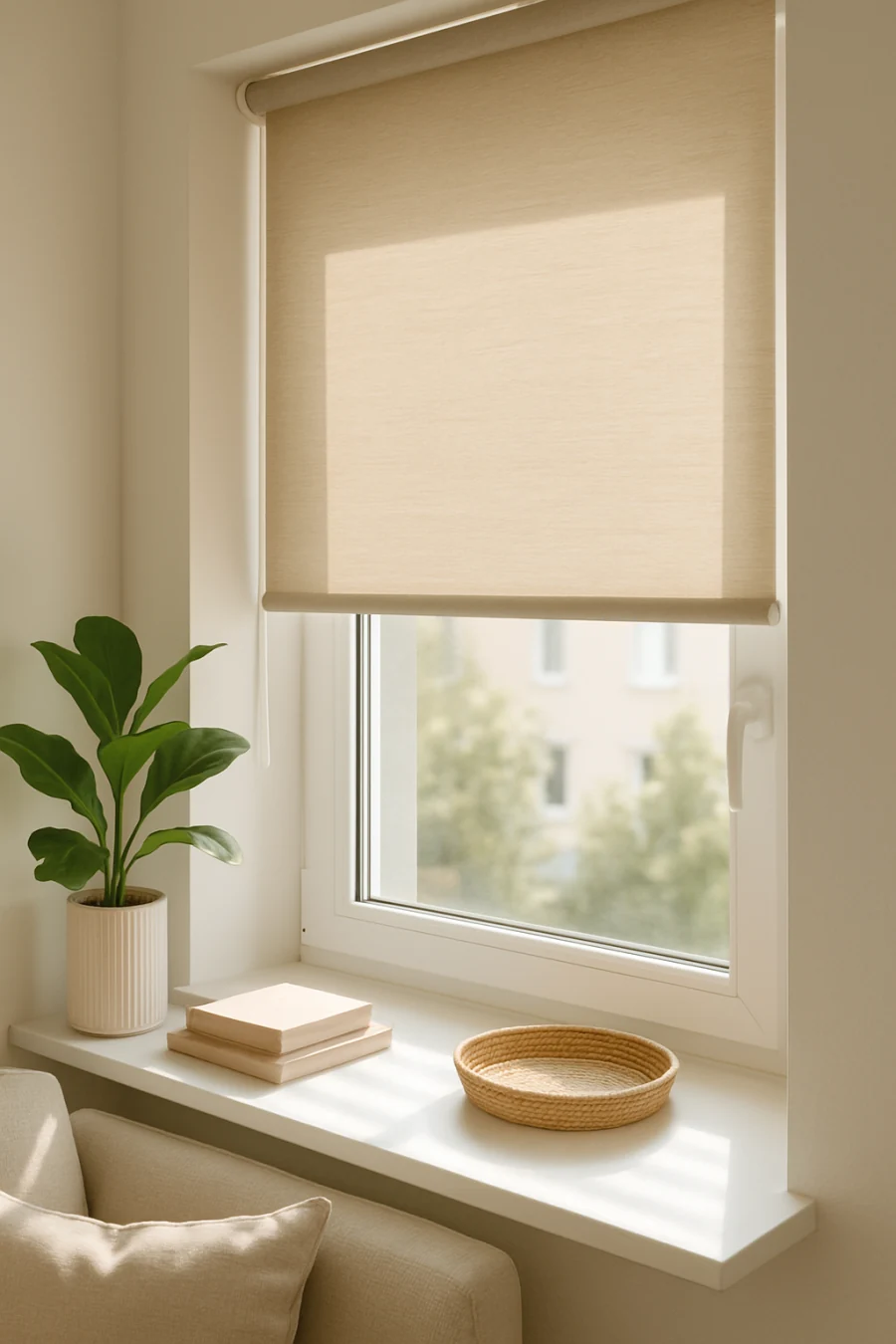


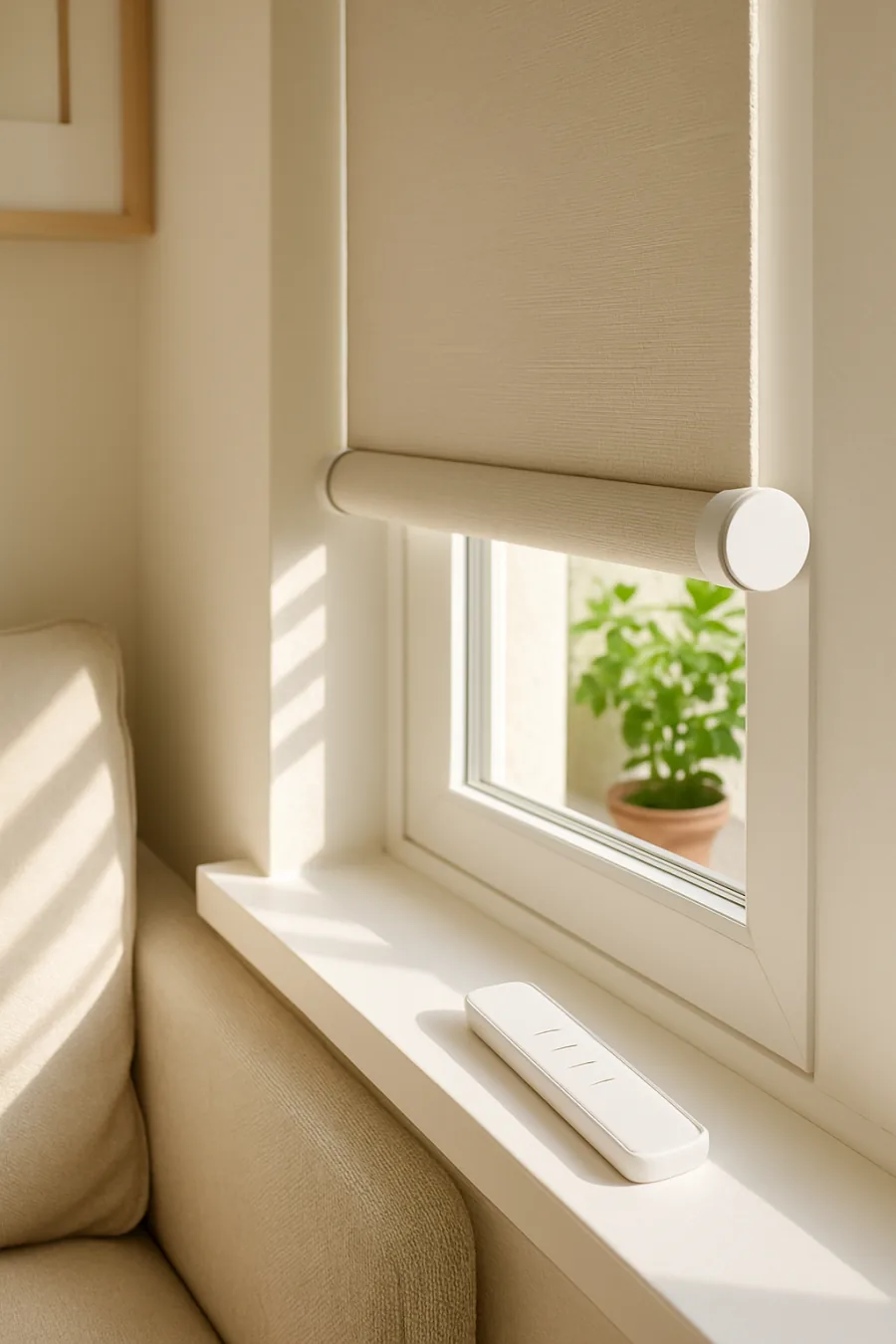




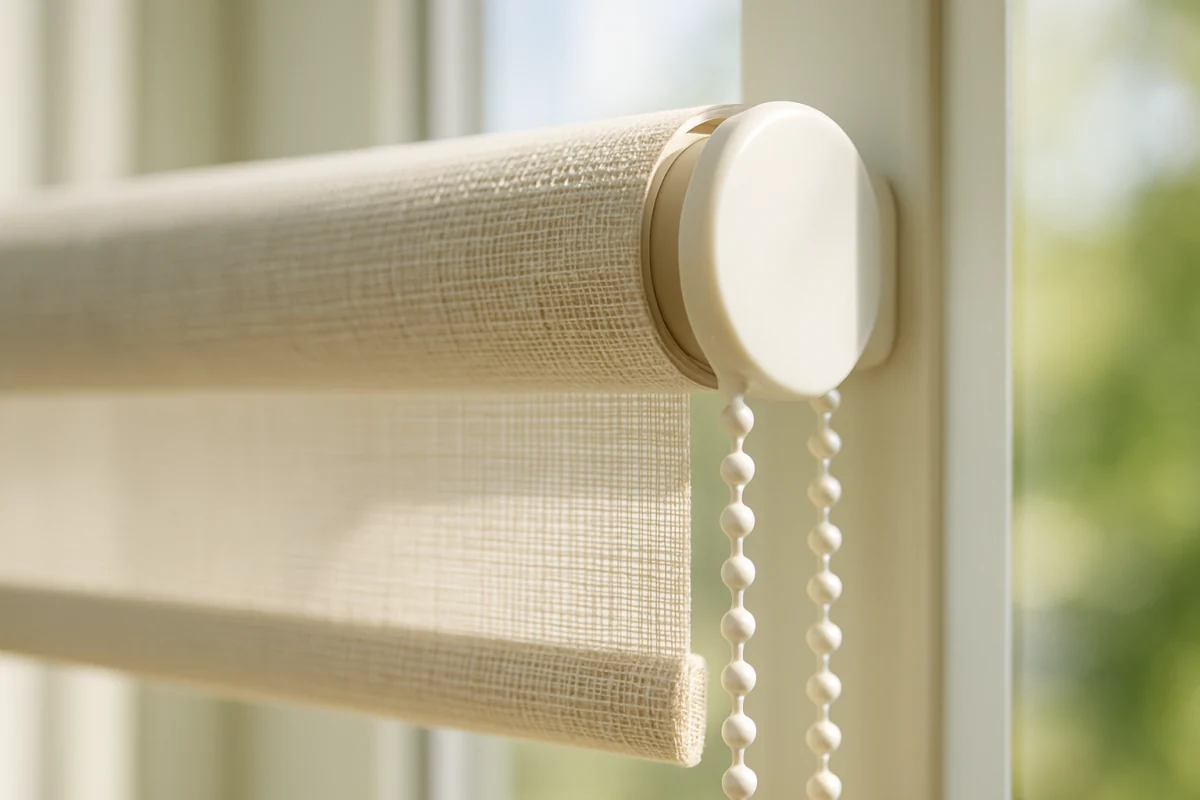










Transparent roller blinds in Almaty are light-transmitting fabric on a tube: sheer, semi-transparent linen or mesh. During the day the fabric diffuses light and keeps the view, but it is never fully transparent. In the evening with the lights on, the room shows through, so you need a second layer for the night. We make them to measure, from 5,400 ₸/m².
What a transparent roller blind means and how it differs from a semi-transparent one
Transparent roller blinds in Almaty are light-transmitting fabric on a tube, not a fully transparent panel. A transparent roller blind lets light through and keeps the view from the window, but it does not make the glass invisible. Semi-transparent fabric diffuses direct sunlight: light enters the room softly, without harsh patches on the floor or glare on the countertop.
The difference between a transparent and a semi-transparent roller blind is a matter of degree, not of the nature of the material. Sheer lets through more light and barely changes the view outside. Semi-transparent linen or mesh diffuses more. And here is an important detail: the more the fabric diffuses, the harder it is to make out the room from the street. We often hear “I want a transparent one, but so that I can’t be seen” — and that is exactly about this scale, not about two different products.
Why there is no fully transparent fabric
Any fabric on a roll diffuses something — otherwise it is not fabric but film. Cotton fibre, polyester, mesh threads: all of this catches light and breaks it into many rays. We do not have absolute transparency in any version, and you will not find it in the price list either. We always suggest choosing not “transparency in general” but how strongly the fabric should soften the light.
What a light shade of fabric gives you
White and light fabric changes the colour of light in the room the least. Light passes through it almost without a shift in shade, so furniture and walls look as usual. A dark shade works differently — it makes the light cooler, and the room seems gloomier on a cloudy day. At the measurement with samples this is visible in a couple of minutes, as soon as you hold the fabric against the glass.
What to choose is clear from two things at once: how much light should stay in the room and how tightly the fabric should close it off from the street.
| Fabric | Light in the room | View outside | The room from the street during the day |
|---|---|---|---|
| Sheer | Soft, almost without loss | Trees and silhouettes are visible | Blurred, details are not readable |
| Semi-transparent linen | Even, with texture | Harder to make out than through sheer | Shadows are more noticeable than through sheer |
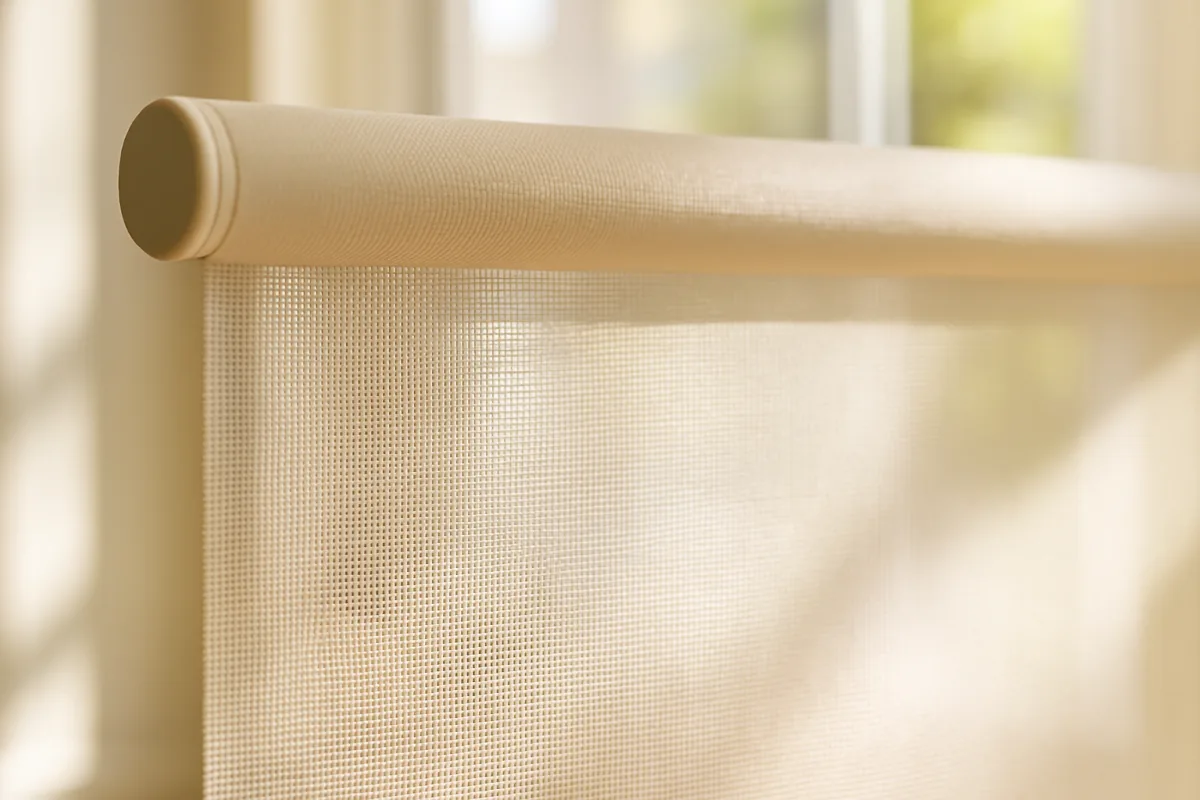
| Fine mesh | Light, slightly muted | The view stays | The room looks blurred |
| Small cell | Even diffusion without glare | The view is weaker than through mesh | Barely readable |
By a transparent roller blind we mean a light-transmitting fabric on a roller tube, not a fully transparent fabric.
Can the room be seen from the street: what changes during the day and in the evening
During the day, semi-transparent roller blinds hide the room from the street, but in the evening, with the lights on, the fabric becomes see-through. This is not a fabric defect but physics: it all comes down to the difference in brightness between the street and the room. While it is brighter outside than inside, the eye from the street sees a blurry patch in the window. As soon as a lamp is switched on in the room, the picture flips — and that is where one blind is no longer enough.
What can be seen during the day
From inside, the view stays: sheer hides the room from the street during the day, but the outlines of trees and the building opposite can still be made out through it. Light diffusion works one way — direct sun turns into a soft glow rather than a blinding stream. A person outside sees a luminous surface, not a table, a sofa and the people behind them.
What matters: daytime privacy depends on the density of the fabric. The finer the weave, the more blurred the picture from the street. On the ground floor by a sidewalk, it is better not to leave a window with mesh without a second fabric even during the day — passers-by stand right up close and look from below at a convenient angle.
What happens in the evening
Evening lighting makes the fabric see-through. A chandelier or floor lamp switched on turns the fabric into a screen: from the street you can see both the furniture and what you are doing in the room. Sheer loses here first — it is thinner, linen reads as denser thanks to its texture, but even that does not save you.
A second layer solves this honestly and simply. Two systems are installed on one opening: a transparent one for the day and a dense blind or blackout for the night. We have few busy windows, and most often the second blind is needed specifically in the bedroom and living room on the first or second floor, where neighbouring buildings stand opposite. A kitchen on an upper floor usually manages with one fabric.
The bottom line on visibility is this: the second layer closes the window for the night, while the transparent blind stays for the day.
A transparent roller blind instead of a curtain: what changes at the window
Yes, you can replace a curtain — and more changes than people usually think. Transparent roller blinds remove two things from the window at once: the curtain panel and the curtain rail. A roller blind is mounted on the wall, in the frame or in the opening with a short bracket, and the fabric winds onto a roller tube and stays in the upper part of the opening instead of hanging down to the floor.
What goes away along with the curtain
The rail goes away. Along with it — the wall that was drilled for it, and the curtain that had to be taken down for washing, ironed and hung back on hooks. The habit of folds goes away too: the fabric on the roller tube rolls into a tight roll, so it does not collect dust along its whole height and does not catch on the windowsill. Caring for the fabric becomes dry and quick — a dry cloth or a vacuum cleaner with a soft brush, without taking it down and without a washing machine.
And this is most noticeable in small rooms. In the kitchen, a curtain by the countertop is a separate headache: it hangs over the sink, absorbs odours and grease. We install transparent roller blinds as a short fabric right on the sash, and the work area stays clean.
What stays the same
Light in the room and the view from the window. A thin mesh or soft sheer diffuses the direct stream just like a curtain, and sometimes more evenly — the fabric is taut and does not create random clumps and gaps between folds. Mounting in the opening leaves the windowsill free, and what a curtain usually pushed out comes back to it: flowers, appliances, a cup set down.
One point about the sash: if the window opens inwards, the gap between the fabric and the handle matters. We check this during the measurement, then drill — nobody wants to redo the holes.
When replacing a curtain, the curtain rail is removed, the wall is freed up, and the fabric on the roller tube does not gather folds and does not hang over the windowsill.
How to choose the transparency on a sample at your own window
Choosing transparency from a picture on a website is pointless. Semi-transparent roller blinds are tested at your own window and in your own light: the measurer brings fabric samples, and the decision is made based on them, not on a number from a catalogue. The same piece of fabric looks different on a south-facing windowsill and on a north-facing one — and that is normal, because we always look at it against the light. As a rule, ten minutes at the window is enough for a person to see the difference between sheer and mesh for themselves.
The process is simple.
- You message Jalusso on WhatsApp and give the approximate dimensions of the opening.
- The measurer arrives with samples and lays them out at your window.
- You look at each piece against the light — into the room and out to the street.
- You choose a fabric group, and the dimensions and mounting are confirmed right there.
- We calculate the price on the spot and give you the manufacturing time.
A sample shows how the fabric behaves in your own light — something neither a photograph nor a description can give. Another argument for a measurement: at the window you immediately see how the fabric will sit relative to the sash handle.
Why a transparency number decides nothing
Different manufacturers calculate light transmission percentages differently, so they cannot be compared with each other. At your window, the picture depends on the orientation of the opening and the time of day: one thing in the morning, another by midday. In my view, this is the most overrated indicator in selection — a number on paper says nothing about how the room will read from the street.
Organza and sheer in a roller system
Organza is stiffer and more transparent, sheer is softer and diffuses light more softly. For a roller system, something else matters more: how the fabric rolls onto the roller tube. A stiff material holds its shape, a soft one rolls more evenly. Semi-transparent linen stands apart in this row — it has a texture with uneven knots, and from the street the fabric reads as denser than sheer or thin mesh.
Transparency is tested at your own window and in your own light: the measurer brings fabric samples, and the decision is made based on them, not on a number from a website.
The price of a transparent roller blind: what the amount is made up of
The most cost-effective way to buy transparent roller blinds is at the base price position: polyester on an open roller tube — from 5,400 ₸/m². But the final amount for one window is never equal to this figure multiplied by the area. The fabric group, control type and installation method are added to the base, so two windows that look identical can cost differently.
What adds up to the final amount
The area of the opening is the first thing the measurer calculates: the price is per square metre of fabric, so a wide window in the living room and a narrow sash in the kitchen cost differently. The second value is the base fabric group: from 5,400 ₸/m² is polyester on an open roller tube, while sheer, semi-transparent linen or mesh are calculated differently, and the measurer quotes the difference for the specific fabric.
The third is the control mechanism. Mechanical control comes with a coefficient of ×1, chain — ×1.06, electric motor — ×1.85, and electric with remote control — ×2.1. The chain controls the position of the fabric manually, while the electric motor automates raising the fabric — you pay separately for convenience. The fourth value is installation: on the wall — ×1, on the frame — ×1.05, without drilling — ×1.1, cassette system — ×1.28. The cassette system is more expensive than an open roller tube because the fabric retracts into a closed housing box.
Example calculation per price list
Let’s take a typical two-sash window in the kitchen — the very one where a sheer used to hang by the countertop. We’ll conditionally take the area of such an opening as two square metres: the base of 5,400 ₸ is multiplied by the area, then the control coefficient and installation coefficient are added. With a chain and frame mounting you get a mild surcharge, with an electric motor and cassette system — noticeably more. Want to save — go for an open roller tube, want a neat housing box — pay for the cassette.
The measurer quotes the exact amount on site: they see the opening, the window profile and how the fabric will sit next to the handle. Installation is a separate line — 4,500 ₸ per item. For orders from 150,000 ₸ installation is free, and for an apartment with several windows this threshold is reached on its own. And if you’re calculating one two-sash window instead of a sheer — that’s one price position plus installation; we don’t include the spring mechanism and separate prices for sheer, linen or mesh in the calculation.
Polyester roller blinds on an open roller tube cost from 5,400 ₸/m², manufacturing time in the workshop — 4–6 days.
Sheer, linen, mesh and fine weave: how each fabric behaves
The difference between fabrics is only visible when you look through them at the street. We give the client samples and ask them to hold them against their own glass: the same sheer reads differently on the sunny side and in the shade. Below — how transparent roller blinds behave in the four versions we make.
| Fabric | What is visible from the street | Character of light | Where it fits |
|---|---|---|---|
| Sheer | Blurred silhouettes, details are not readable | Soft diffusion, light haze | Living room, bedroom in combination with a dense layer |
| Semi-transparent linen | The room is less readable than through sheer | Warm light with texture | Rooms where you want cosiness and less visibility |
| Fine mesh | The room looks blurred | The view is preserved, the light hardly changes | Daytime areas, offices |
| Small cell | An even veil without silhouettes | Even diffusion without glare on screens | Offices, living rooms with electronics |
Sheer softly diffuses light, the fabric winds onto the roller tube and does not gather in folds. Semi-transparent linen has a texture with uneven knots — the surface is not smooth, and because of this the room is less readable from the street. Thin mesh leaves the view blurred: you see the courtyard and trees, while a gaze from outside meets the fine weave. Fine weave removes glare on screens — this is noticeable if the monitor is at an angle to the window.
A table in the kitchen by the window and a café shopfront
A transparent blind is suitable for the kitchen by the stove, but with a caveat: by the countertop the light shouldn’t be harsh on the eyes, so here sheer or fine weave is more often chosen, not thin mesh. The fabric is installed short, on the sash — we don’t recommend a long one by the stove, it will collect soot. Moreover, the upper part of the opening can be left open, and then the extractor hood works as usual.
For a café shopfront the logic is the opposite. Guests by the window shouldn’t be blinded, while the hall should remain visible from the street — so a passer-by sees the seating and comes in. Here thin mesh or sheer works: the light is softened, while the silhouettes of people and furniture remain. In a coffee shop with a 2.6 m window we installed fine weave — the owner wanted visitors at the tables by the glass not to squint from the sun in the middle of the day.
Sheer softly diffuses light, linen gives texture and reads denser, mesh leaves the view blurred, and fine weave gives even diffusion without glare on screens.
Open roller tube and in-reveal mounting: what is visible from outside and what happens to the windowsill
On an open roller tube you can see the neat winding of the fabric. This is not a defect or unfinished work — that’s how a system without a housing box is designed, and transparent roller blinds in Almaty look exactly like this in the interior: the fabric lies on the roller tube in even turns, and the sides remain open. From inside the room the winding is hardly noticeable, from the street it also reads as a neat roll of fabric, not as a technical detail.
In-reveal mounting works differently from installation on the wall or frame. The blind is placed inside the window reveal, the fabric goes right up to the glass. With this method the windowsill remains free — you can put back flowers, books, anything, and nothing gets in the way. In-reveal mounting doesn’t touch the frame, no extra holes appear in the profile. The downside — the reveal must be level enough for the roller tube to sit without skewing.
What to consider in advance:
- The open roller tube is visible both from inside and from the street: there is no housing box here to hide the winding.
- In-reveal mounting leaves the windowsill free and doesn’t touch the frame, but requires level reveals.
- On the wall and on the frame the fabric goes further from the glass, but the roller tube can be partially hidden behind the reveal.
- There is also a no-drilling option for the frame, but it requires a suitable window profile.
How the fabric gets along with the sash
The main question when mounting on the sash is whether the fabric will hit the handle when opening. If the roller tube is too close to the hardware, the sash simply won’t open fully, and the fabric will have to be pulled with force. The Jalusso measurer checks this during the measurement: they look at where the handle is, which way the sash opens and how much space remains by the reveal. Based on this data, the chain control side and roller offset are chosen. Sometimes it’s enough to shift the system by a couple of centimetres.
Loggia and panoramic glazing
On a loggia and balcony the fabric is installed just like on a regular window — there are simply more openings and they are wider. With panoramic glazing there is one question: where the roller tube runs. If there are several glazing sections, it’s decided in advance — one long blind for the whole width or a separate fabric for each section. A long roller is harder to maintain, but from outside the picture is cleaner. We usually advise splitting a wide opening into parts: it’s easier to open the sashes one by one.
In the end, the choice between an open roller tube and in-reveal mounting is a choice between a visible neat winding of fabric and a free windowsill with an untouched frame; we calculate both options based on the measurement.
Transparent and dense blind on one window: how it looks and how to replace two systems
During the day, semi-transparent roller blinds let in light and keep the view, but in the evening with the lights on they become see-through — so a second layer is fitted on the same opening. A dense blind or a blackout blind closes the window at night, while the transparent roller blind has already replaced the sheer curtain and the rail. You can combine it with curtains, but more often we suggest two roller systems: they don't compete for space at the window.
How does this look in practice? The upper roller holds a semi-transparent fabric, and below it or beside it on its own roller is a dense one. From outside you see two neat rolls; from inside each is raised by its own chain, and the room doesn't get heavy fabric folds that have to be taken down before washing. Curtains on a rail next to the roller tube are kept if they're part of the interior, but then the rail comes back, and with it the sheer curtain.
Two systems on one opening
You can fit two roller blinds on one opening: a semi-transparent one for the day and a dense or blackout one for the night. Each is operated by its own chain, so during the day you can lower just the light fabric, and in the evening add the dense one to it. That means privacy is solved without giving up light.
The distance between the rollers is calculated at the measurement: it depends on the depth of the window reveal and on whether the upper roller stops the sash from opening. We once had an order for a hotel room with two floor-to-ceiling windows — there the transparent fabric worked during the day, and a blackout blind served as the second layer at night. In such cases installation is charged per item: 4,500 ₸ for each, but with an order from 150,000 ₸ installation is free.
Day-night instead of two blinds
A single day-night system is one fabric with alternating dense and light stripes that slide relative to each other. During the day light passes through the light stripes; in the evening the stripes are shifted and the opening is closed more tightly. One fabric is enough when the window doesn't face a busy side and the room doesn't have to be dark to the last crack at night.
But day-night doesn't give the full darkness of a blackout. For a bedroom where you need a night with no light at all, we still recommend two systems: a semi-transparent one for the day and a dense one for the evening. The choice is made at the measurement, with both options laid out.
Two systems are possible on one opening: a semi-transparent one for the day and a dense or blackout one for the night, and the alternative to them is a single day-night system.
Interior fabric and outdoor blind: why they are different products
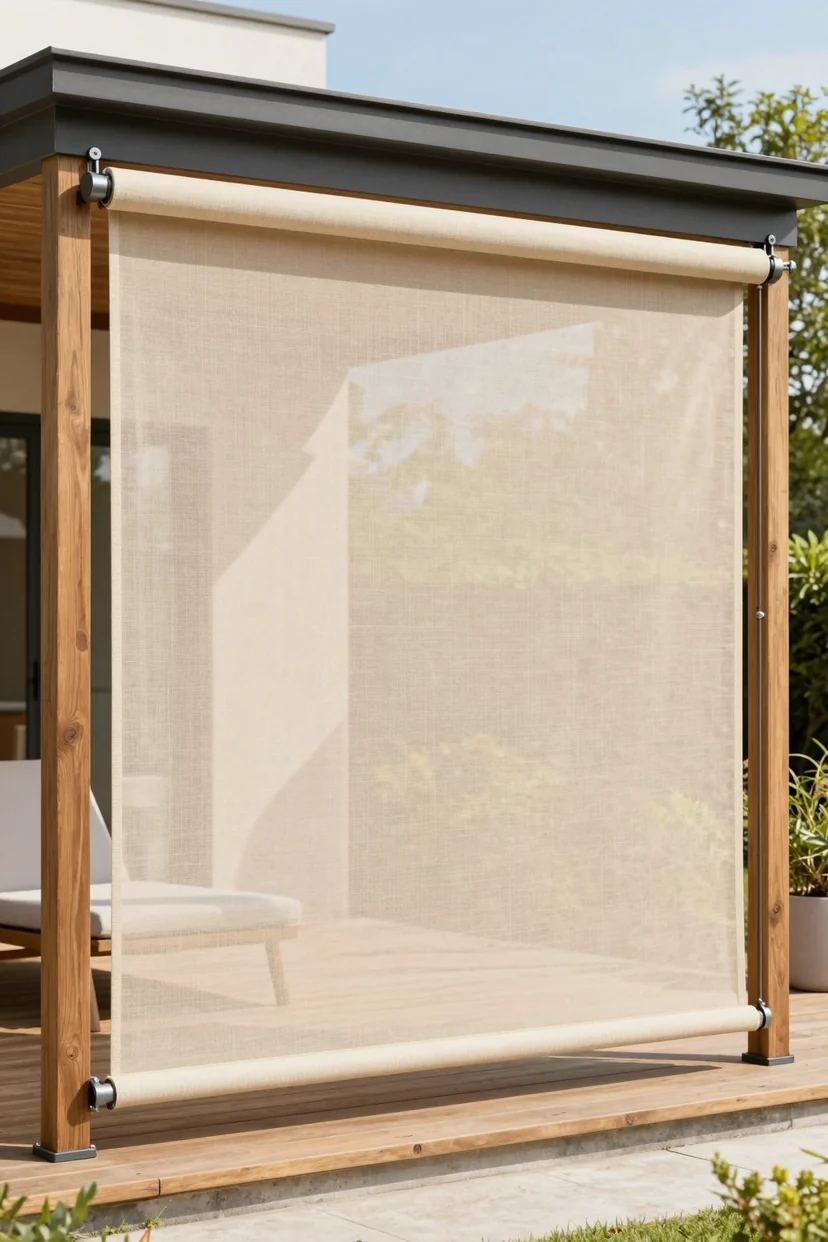
Transparent roller blinds in Almaty for outdoor use and interior semi-transparent fabric are two different products with different construction. An outdoor system is assembled from PVC film or dense outdoor fabric, held by ZIP guide rails at the edges. Our workshop makes interior roller blinds: light-transmitting fabric on a roller tube with a chain for a room, an office or a shop window from the inside.
How they differ in essence:
- PVC film belongs to outdoor systems, not interior ones: it doesn't let air through and holds the wind, but it isn't used as fabric for a room.
- A ZIP system is fixed with guide rails at the edges — the fabric slides in them and doesn't flap. An interior roller blind has no guide rails: the fabric simply rolls onto the roller tube.
- Outdoor fabric differs from interior fabric in composition: it is given moisture-resistant and UV-resistant properties. Semi-transparent fabric for a window doesn't have such properties.
Why a terrace needs a different product
An outdoor product withstands wind and precipitation precisely thanks to the film and the guide rails. Interior semi-transparent fabric isn't designed for that — it needs neither guide rails nor moisture-resistant treatment. If you need to protect a terrace or a summer area from rain and wind, that's a job for an outdoor system, not a roller blind on a roller tube.
Rain through an open window
The fabric got wet — don't rub it and don't try to dry it with a hairdryer. Let the fabric dry naturally: sheer, linen and mesh regain their shape after drying. If a mark remains after it gets wet or the fabric has gone wavy, message us on WhatsApp — we'll take a look on site.
We make interior roller blinds, and we don't make outdoor PVC systems or ZIP constructions: they're not in our price list, and the warranty doesn't cover water.
Caring for semi-transparent fabric without washing
The fabric is cleaned with a vacuum cleaner with a soft brush on low power or with a dry cloth — you can't machine-wash it, because the roller tube and the mechanism don't come off. That's the main thing to know about caring for the fabric.
Dust and soot settle on the fabric gradually. In Almaty the summer is hot and dusty, windows face either a courtyard or a street with a stream of cars, and the fabric absorbs this suspended matter just like a windowsill. But there's no need to panic: dust settles on the surface, not into the fibre, so it's enough to go over the fabric once a month. We mention this at the measurement so that a person doesn't later look for a way to wash the whole blind.
The process is as follows:
- Lower the fabric fully so that the whole area is accessible.
- Go over it with a vacuum cleaner with a soft brush on low power — without pressing.
- Where the brush is awkward, remove the dust with a dry cloth.
- Don't rub, don't wet and don't remove the roller tube.
Semi-transparent fabric must not be wrung out, soaked or hung back wet: the roller tube, the chain and the mechanism stay in place, and the fabric is wound on them.
What to do about a stain
A stain is treated carefully on the spot: mild soap and water, without rubbing. If the mark doesn't come out, it's better to call us — replacing or re-assembling the unit will cost less than a ruined fabric, and we service the mechanism even after the warranty.
South side and fading
On the south side the fabric fades naturally over time — a light one changes shade gradually, almost imperceptibly to the eye, and the warranty doesn't cover this. Transparent roller blinds made of sheer or mesh on a sunny window last exactly as long as the pigment holds out. We don't observe yellowing as a separate defect: the shade shifts towards a warmer, not a dirty, tone. If the window faces south and the original colour of the fabric matters to you for a long time, tell us at the measurement — we'll pick a fabric for that side.
Measurement in Almaty and the suburbs: how fabric selection works
In Almaty transparent roller blinds are made to measure, not taken ready-made, because the opening, the sash and the handle are different for every window. Measurement and consultation are always free with us: the measurer comes with fabric samples and calculates the cost on the spot, for your windows. There are no ready-made products in stock — the workshop cuts the fabric to a specific size.
How it works in practice:
- You message us on WhatsApp, give the address and a convenient time.
- The measurer comes with samples and looks at the window: the sashes, the reveal, the profile, where the roller tube will go.
- You look at sheer, semi-transparent linen, thin mesh or a small weave right in your own light.
- The measurer calculates the area, the control and the installation, and gives the sum on the spot.
- The workshop makes the fabric in 4–6 days, then installation.
- We give a 3-year warranty on the mechanism and a 1-year warranty on installation from the date the acceptance certificate is signed.
Within the city, measurement and delivery are free. To the suburbs — Kaskelen, Talgar, Issyk, Kapshagay — we do travel; the cost of the visit depends on the distance and is quoted before the visit, so there are no surprises. Our lead measurer Kirill has been working with non-standard windows for nine years: arched, triangular, attic — and on such openings the solution is found on site, not from a catalogue.
Sunny side and dust
In summer, Almaty is hot, sunny and dusty. Semi-transparent fabric diffuses direct sunlight: behind the blind, furniture and appliances heat up less, and protection against fading works because the light falls on surfaces more softly. Dust and soot settle on the fabric gradually, and going over it with a dry brush once a month is enough. For the south and west sides, people choose a denser fabric — linen or a fine mesh; for the north, a sheer is enough.
How an order goes from measurement to installation
Then everything follows the chain: measurement with samples, calculation on site, manufacturing in the workshop in 4–6 days, installation. We charge 4,500 ₸ for installing each item, and if the order total is from 150,000 ₸, we install free of charge. This is exactly how to buy transparent roller blinds — made to your own sizes, not as a ready-made roll from a shop. Measurement and consultation are free: the measurer arrives with samples and calculates the cost on site; within the city, measurement and delivery are free, and we travel to the suburbs, with the cost of the visit quoted before the visit.
FAQ
A transparent roller blind lets light through and keeps the view — that is what sets it apart from an ordinary fabric curtain. Ordinary fabric is denser and noticeably darkens the opening during the day. Transparent roller blinds are chosen where you need light without harsh glare. From the street during the day, you can’t make out the details of the room, but in the evening the picture changes — more on that below.
How is a transparent roller blind different from an ordinary fabric one?
Semi-transparent fabric diffuses the rays rather than cutting them off. The room stays bright, the silhouettes of trees outside the window are visible, and there is no direct sun on the countertop or screen. An ordinary fabric curtain can’t do that: it darkens. If what you need is light, choose a sheer, semi-transparent linen or mesh.
Can it be installed without drilling into the frame?
Yes. We do reveal mounting and installation without drilling — the frame stays intact and the windowsill stays clear. This option suits rented apartments and windows where you don’t want to drill into the profile. At the measurement, we look at the profile and the handle: the blind must sit level and not press against the sash. The measurer names the right method on site.
Will this blind work in a kitchen?
Yes, especially if the window is by the countertop. Diffused light doesn’t strain the eyes, and the work areas aren’t visible from the street. A net curtain by the stove, on the other hand, can’t hang there — it gets taken down or it gets in the way. In the kitchen, people more often choose a short blind for the sash made of mesh or sheer: such fabrics hardly pick up odours and dust.
What if you need privacy in the evening?
Add a second layer. In the evening, when the light is on in the room, the semi-transparent blind shows through, and it’s more honest to admit this limitation in advance. A second layer — a dense curtain or a blackout — closes the window for the night and stays out of the way during the day. You can install two systems on one opening: the measurer will show how they work together and what happens with the controls.
How long do you wait for the product after measurement?
Roller blinds take 4–6 days from the moment of measurement. During this time, the workshop cuts the fabric to your sizes and assembles the mechanism, then the installer arrives. Installation costs 4,500 ₸ per item, free for orders from 150,000 ₸. Manufacturing follows the price list — from 5,400 ₸/m²; the measurer calculates the exact amount on site.
The most frequent questions are about the difference between fabrics, installation without drilling and evening privacy: the first two are answered by a sample at the measurement, and the third by a second layer.
What to remember
A transparent roller blind is a light-transmitting fabric on a roller tube, not a fully transparent blind. Any sheer, semi-transparent linen or mesh diffuses something, and the difference between them is a matter of degree, not of absolute transparency.
During the day, the semi-transparent blind hides the room from the street. In the evening, when the light is on in the room, the blind shows through — and that’s where a second layer makes all the difference. Without it, there will be no privacy after sunset.
Transparency is chosen on a sample at your own window, not by a number from a website. Why? Because the same fabric behaves differently on different windows: the light from the street, the orientation of the opening and the time of day change the picture beyond recognition. The measurer brings samples — and the decision is made based on them.
Price — from 5,400 ₸/m², manufacturing time 4–6 days, installation 4,500 ₸ per item. For orders from 150,000 ₸, installation is free.
Interior fabric and an outdoor blind are different products. Outdoor systems are made from PVC film or outdoor fabric in ZIP guide rails, and our warranty does not cover them. A terrace or a summer café needs a different product, not this blind.
Our practical recommendation is simple: book a free measurement with samples. The measurer will look at the opening, the sash and the handle, lay out sheer, linen and mesh in front of you — and you’ll settle the question of the second layer on site, not by trial and error.
In Almaty, we make such blinds for your windows: measurement, workshop, installation. We give a 3-year warranty on the mechanism and 1 year on installation, counted from the moment the acceptance certificate is signed.

